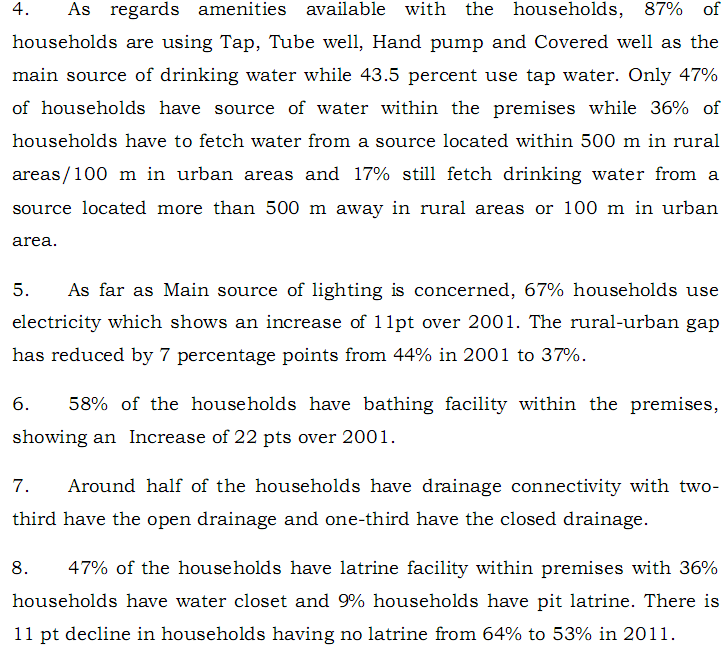
A list of Deprivation indicators culled from the Census 2011 Household amenities & asset Data [Take note of the yawning gap b/w rural & urban households):
Households that use Firewood, Crop Residue, Coal/Charcoal, Cow Dung for cooking:
67.2% of total households (86.6% of Rural Households[R], 26.3% of Urban Households[U])
No water closet latrine within Premises: 63.6% (80.6% of R, 27.4% of U)
No Tap Water: 56.5% (69.2% of R, 29.4% of U)
No TV: 52.8% (66.6% of R, 23.3% of U)
No drainage: 48.9% (63.2% of R, 18.2% of U)
Bathroom is just an enclosure without roof or have No Bathroom at all: 58% (74.7% of R, 22.5% U)
No Telephone: 36.8% (66.6% of R, 23.3% of U)
Electricity not main source of lighting: 32.8% (44.7% of R, 7.3% of U)
House not in Good condition: 46.8% (54% of R, 31.5% of U)
Other General observations (via Census Website):
Here is some good news from the 2011 census in contrast to the dismal picture above: Total fertility rate continues to fall in India (~2.4 in 2011) . It has been below replacement in urban India for a decade now (~1.9). The urban population by 2011 figures is 31.16 % of total or about 377 million people which is a 3.37 percentage point increase from 2001. The rural TFR is 2.7.
http://data.gov.in/visualization-gallery#119
ha! True. Thanks Bajrang bali for small small mercies- can't even feed, house and cloth the existing numbers; any more are beyond our capacity.
BTW Apart from rural-urban divide on TFR, regionally divide is equally interesting. Overall TFR (2.4),is above replacement level (given India's high mortality rates, shouldn't it be slightly above 2.1 instead of 1.9?) primarily due to very high TFR of just two of the most populous (and poorest) states – UP(3.3) and Bihar (3.5). Entire South (Maharashtra included), North-West (except Haryana), West Bengal are already at or below replacement levels.
But there has been fast declines in TFR in the BIMARU states. So one expects, India should achieve TFR of 2.1 in 2-3 decades (if not earlier).
http://en.wikipedia.org/wiki/Indian_states_ranking_by_fertility_rate
PS: Thanks for correcting the rural-urban population share, I had mistakenly used 2001 data when rural share was 72% (and urban 28%),