Network of Death (yes, but….)

….“No god condones this terror. No
grievance justifies these actions. There can be no reasoning, no
negotiation, with this brand of evil….The only language understood by
killers like this is the language of force…..So the United States of
America will work with a broad coalition to dismantle this network of
death”….

….
As the USA declares total war in the Middle East (again) there are no Christians (or neo-cons) hell bent on a crusade, instead it is just the Central Command engaged in a “lawn mowing” operation against deviant Shias (led by Bashar al Assad) and Sunnis (led by Abu Bakr al-Baghdadi).

A few (genuine, if non-original) critiques. The #1 coalition “ally” of the USA – the Saudis – behead just as many people as the Caliphate does. They were the prime movers behind 9/11. They keep spreading Salafist poison around the globe, to the extent that some Japanese (!!!) have now joined the islamist brigades. Why not get rid of the head of the snake- the House of Saud?
………
Speaking of allies, is it not possible for Viceroy Richard G Olson (full title: Ambassador of the United States to Pakistan) to ask the revolutionary brothers-in-arms to stop playing games and let their long suffering countrymen move on with their lives? Hundreds have been killed by floods, millions are internally displaced, manufacturing has been paralyzed (lack of electricity).  When is enough, actually, you know, enough?

Finally, many wise people are claiming (and we agree) that Obama is fighting this war to boost his popularity and keep the US Senate out of Republican hands. Already the polls are registering a boost. And that is fair enough..as a limited objective (the soldiers will be back home by Christmas).

However in the long term it appears that there are only two proper options: remain all-in or steadily pull-out. Either the Central Command is dismantled (the USA has enough oil on-shore) OR the entire Middle East North Africa is colonized (to protect minorities of all stripes including Shias and Sunnis). If the USA persists with the familiar bombs and carrots strategy, then it will surely be transformed into an ineffective master-villain despised by all (see Afghanistan, Libya).
…………………..

This is how a Nobel Peace Prize laureate goes to war. He
smiles warmly at the members of the U.N. General Assembly. He mentions
his grandmother’s village in Kenya and notes that “Islam teaches peace.”
He admits his country’s own flaws, praises “the path of diplomacy and
peace,” and asserts that lasting gains cannot be “won at the barrel of a
gun.”


Also, he wades a good 19 minutes into his 40-minute speech (the official time limit is 15 minutes) before getting to the nub of the matter: “The terrorist group known as ISIL must be degraded and ultimately destroyed.”
….
“In
the most horrific crimes imaginable, innocent human beings have been
beheaded, with videos of the atrocity distributed to shock the
conscience of the world,” he says. “No god condones this terror. No
grievance justifies these actions. There can be no reasoning, no
negotiation, with this brand of evil. The only language understood by
killers like this is the language of force. So the United States of
America will work with a broad coalition to dismantle this network of
death.”

….
Network of Death! A linguistic heir to George W. Bush’s
Axis of Evil, perchance? “Those who have joined ISIL should leave the
battlefield while they can,” the peacemaker threatens.

….
This
is a different Obama from the one who spoke in Cairo five years ago,
urging a new era in relations between America and the Muslim world.
Though similar themes appeared in both addresses, the 2014 Obama was
more demanding of the Muslim world — and less apologetic about America’s
role — as he lectured Muslim leaders to make a serious fight against
extremists.


In the 2009 speech, Obama invoked the “Holy Koran”
five times and asserted that “any world order that elevates one nation
or group of people over another will inevitably fail.” He spoke out
against the U.S. use of torture and said he would close the Guantanamo
Bay prison. (He didn’t.) He spoke of the “intolerable” situation faced
by Palestinians and called for a stop to Israeli settlements. 


“The enduring faith of over a billion people is so much bigger than
the narrow hatred of a few,” the new president said. “Islam is not part
of the problem in combating violent extremism — it is an important part
of promoting peace.”

….
On Wednesday, the second-term president went
relatively easy on Israel, instead telling Arab countries to stop using
the conflict “as an excuse to distract people from problems at home.”

….
Obama
was stern in his instructions for the Muslims: “It is time for the
world, especially in Muslim communities, to explicitly, forcefully and
consistently reject the ideology of organizations like al-Qaeda and
ISIL,” also known as the Islamic State. 

….
He went on at some length about
the intolerance of clerics who preach hate and the “hypocrisy” of those
who fund terrorism.
And he instructed Arab
nations to “acknowledge the destruction wrought by proxy wars and terror
campaigns between Sunni and Shia across the Middle East.”

….
“In
this century, we have faced a more lethal and ideological brand of
terrorists who have perverted one of the world’s great religions,” he
said. “With access to technology that allows small groups to do great
harm, they have embraced a nightmarish vision that would divide the
world into adherents and infidels, killing as many innocent civilians as
possible, employing the most brutal methods.”

…..

Link: washingtonpost.com/barack-obama-makes-the-case-for-war

….

regards
Indians vs Cowboys (Madison Square Garden)

….a human
rights group has obtained summons…
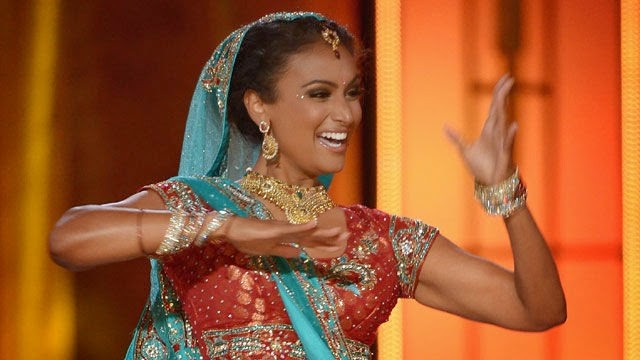
from the US Federal Court for the Southern District of New York….open letter addressed to Miss America 2014 Nina Davuluri… one of the emcees in
Madison Square Gardens…..“Modi is a lifelong member of the RSS….Hindu nationalist
organization that has praised Hitler…disheartening to know that you will be speaking”…

 …
A summons from the US Federal Court for the Southern District of New York…that sure rings a bell. The US Attorney for the Southern District is Preet Bharara, the cowboy lawyer who
(allegedly) ordered a top-to-bottom cavity search on Devyani
Khobragade
. What is the chance that he and his marshals will NOT attempt to arrest
the “Hitler loving” Modi??  

Then again, if Hitler-praise counts as a global standard thought crime (GSTC), Madhav Sadashiv “Guruji” Golwalkar of the RSS has nothing on Haj Mohammed Effendi Amin el-Husseini, the Grand Mufti of Jerusalem. The latter was not just a Fuhrer fan, he actually collaborated with the Third Reich (another collaborator/admirer was “Netaji” Subhas Chandra Bose, grand-uncle of Prof Sugata Bose of Harvard and a hero to millions of secular Bengalis).
…..
The Mufti’s people, the Palestinian nationalists and their brothers in the Ummah, in the internationalist Left and in the nationalist Right, recently marched in Germany while chanting “Hamas, Hamas…Jews to the gas.” This is most remarkable: a rainbow coalition expressing robust admiration for the Final Solution in its very place of origin. Hitler would be justly proud.

Now as it happens, the Hindu Nationalists also have their own “Hitler” list…Yamīn-ud-Dawla Abul-Qāsim Mahmūd ibn Sebüktegīn (Mahmud of Ghazni), Mu’izz al-Din Muhammad (of Ghor), and many others…..who continue to receive undiluted admiration amongst the Ummah (and in school textbooks) for their unyielding endeavors in infidel crushing. This is the fundamental pillar of the two nation theory: our Ghazis are their villains. Are some Hitlers then superior to other Hitlers? 
 …….
Taking a step back now to the good old days when Indian monks used to travel to the USA to preach the message of goodwill to all. The story of Narendra-I aka Narendra Nath Dutta aka Swami Vivekananda who visited the United States in 1892 as representative of the Hindus is relatively well known.

What is not as well known is the story of Virchand Raghavji Gandhi who represented Jainism in the Parliament of Religions in Chicago in 1893 (his statue is displayed in the Chicago Jain temple).
….

[ref. Wiki] Jain monk Acharya Vijayanandsuri, also known as Acharya Atmaram, had initially been invited to represent Jainism
at the Parliament,
but as Jain monks do not travel overseas, could not
attend. He recommended Gandhi to go in his stead and serve as the
emissary for the religion. 

.
Atmaram and his disciple Vallabhsuri trained Gandhi for six months.  At the Parliament he said: 
“It is an astonishing fact that
foreigners have been constantly attacking India and in the face of all
this aggression the soul of India has stood vital and watchful.
Her
conduct and religion are safe and the whole world looks at India with a
steady gaze.” 

….

With adequate qualifications one may still say of India today that “her conduct and religion are safe.” The Jains are of course at the top of the social, economic and political ladder: Amitbhai Anilchandra Shah is the first Jain President of the Bharatiya Janata Party (BJP), he famously won the “man of the match” award (by Modi) in the campaign to crush a 50 year old dynasty. Another high-flying Jain (and a bosom friend of Modi) is Gautam Adani.
….
A sharp 152% jump in his
wealth saw Adani Group chairman Gautam Adani break into the list of 10
richest Indians even as Mukesh Ambani retained the pole position,
according to a latest report….Adani blazed into the top league
riding on the runaway share prices of his companies in recent past,
pegging his wealth at Rs 44,000 crore,
said Hurun Report, published by a
China-based luxury publishing and events group, tracking the uber rich.

……

It is also the case that with the advent of the second republic in May 2014, the world “looks at India with a steady gaze” (and so presumably does Preet Bharara). In light of this our best wishes (meant sincerely) to Narendra-II as he prepares to make his entry on to the world stage. It is on rare occasions that the Madison Square Garden is sold out…..certainly not for (brown) leaders.

Truth be told, this is a coming out party for the Hindu-Americans spear-headed by the majority Gujarati-American community. And as a wise american once said with great eloquence: “elections have consequences” and “I won” ….this is true in India as well. 

If you do not like the results (and we do not), then you still have a choice to fight for your rights (and for the votes of the people). But merely  invoking Hitler will not stop Hindus from electing Hindu nationalists. Indeed what all this drama-bazi does is to permit Hindutva-vadis to wear the victim mask while doing nothing for the actual victims.

It is clear (from the track record of the past ten years) that Modi cannot be defeated using law-fare. The Islamists have also tried guerilla war-fare with limited success– simply more victims have been created. The only way is to defeat the Hindutva-vadis through elections. That should not be too difficult- the BJP got only 31% of the national vote share (the NDA alliance as a whole got 40%). 

All that needs to be done is for a “secular alliance” to ensure that the balance 60% is not wasted through ego clashes. Indeed such a grand alliance (Congress + Nitish Kumar + Lalu Yadav) recently crushed the BJP in the Bihar by-polls. It will be hard work to achieve such unanimity on an all-India basis (not to mention, how to rule, once elected, with a sense of purpose). But this will be the only way.   
 
….
It is a rock ‘n’ roller’s dream to “sell out The Garden,” but for a
foreign politician to pack New York City’s most famous sports and
entertainment arena is another thing entirely.


Prime Minister Narendra Modi, on his first trip to New York as leader
of the world’s most populous democracy, will draw perhaps the largest
crowd ever by a foreign leader on U.S. soil when he takes the stage on
Sunday in Madison Square Garden
before a crowd forecast to total more
than 18,000 people.


Thousands more are expected to pack New York’s Times Square to watch
his address in Hindi on big screens as well as smaller viewing parties
around the country and on TV in India.


The Indian diaspora hopes this visit by a leader who was until
recently barred from the United States will signify India’s importance
not only on these shores but in the wider world too.

The event is being emceed by prominent members of the Indian American
community, Nina Davuluri, who has just relinquished her crown as Miss
America 2014, and TV journalist Hari Sreenivasan.


“Indian citizens and diaspora over the world are hopeful that this
(Modi) administration will cut bureaucracy and focus on people,” said
Dr. Dinesh Patel, chief of arthroscopic surgery at Massachusetts General
Hospital in Boston, who arrived in the United States more than 50 years
ago.


Patel, who says he was given an award for work in education by Modi, a
fellow Gujarati, added: “People are passionate to see the new leader.
Another Narendra is coming to this country to let the USA know what
India is about.”


The first Narendra was Swami Vivekananda, a 19th-century philosopher
and monk who propagated the Hindu faith in the United States. Modi often
cites a speech by Vivekananda, born Narendra Nath Datta, to the
Parliament of Religions in Chicago in 1893, as a source of inspiration.


“Let us remember the words of Swami Vivekananda and dedicate
ourselves to furthering the cause of unity, brotherhood and world
peace,” Modi wrote Sept. 11 to his 6.5 million followers on Twitter.
India’s economy, the third largest in Asia, has struggled to recover
from sub-par growth, shackled by layers of bureaucracy anathema to the
diaspora. Modi’s general election triumph in May was driven in large
part by his entrepreneurial mantra.


On the eve of his U.S. visit, tensions remain between the Washington and New Delhi over trade and spying. The 64-year-old former chief minister of Gujarat was denied a U.S.
visa in 2005 over sectarian rioting that killed more than 1,000 people,
mainly Muslims, three years before. Modi, who denies wrongdoing, has
been exonerated by a Supreme Court probe.


..
Washington was late to warm to Modi. Its ambassador to India only met
him in February, when opinion polls already put his nationalists on
course for a big election win.


India’s U.S. diaspora is a highly educated population of nearly 3.2
million, making up about 1 percent of the U.S. population, according to
latest U.S. Census Bureau data.


….
As a group, they are more likely to be hooked to the internet than
their fellow Americans, far more likely to have a college or
professional degree and twice as well off with an average household
income of more than $100,000.


“Indians are generally very ambitious and entrepreneurs,” said Mike
Narula, the founder, president and chief executive officer of Long
Island, New York-based Reliance Communications, a distributor of mobile
telecom devices and accessories.


Narula, who came to the United States 17 years ago, first working in
the garment industry, now has his own company with more than, 200
employees. He’s part of the host committee for Modi’s visit to
Washington, where the prime minister will meet with President Barack
Obama on Monday and Tuesday.
“We attempted to do business in India. I hope Modi will look into
streamlining issues such as VAT, the role of FDI (foreign direct
investment) and find a way for American businesses to not have to go
through 19 red tape bureaucracies,” he said.


While Indian Americans are well represented in America’s professional
class, they are less visible in the military. Some 0.1 percent serve in
the armed forces compared to 0.4 percent of Americans as a whole.
“The diaspora does very well on entrepreneurship, but not as much on
the physical sacrifices. It is not just enough to be a citizen and
taxpayer,” said Raj Bhandari, a 48 year old Mumbai-born banker from New
Jersey. “As a larger community I would like it to be more engaged on the
front lines.”

………………..

A day
before Prime Minister Narendra Modi’s landmark visit to the US, a human
rights group has obtained summons against him for his alleged role in
the 2002 Gujarat riots as state chief minister. New York based American Justice Centre (AJC) obtained the summons
from the US Federal Court for the Southern District of New York in a
suit filed with two survivors of what it called the “horrific and
organized violence of Gujarat 2002.”

Filed under the Alien Tort Claims Act (ATCA) and the Torture
Victim Protection Act (TVPA), the 28-page complaint charges Modi with
“committing crimes against humanity, extra-judicial killings, torture
and inflicting mental and physical trauma on the victims, mostly from
the Muslim community.”


AJC said it is providing legal support and advice to the
survivors in their effort to hold “Modi accountable for his complicity
in the violence.


“The survivors are suing Modi for the loss of lives and trauma in
their families, and caused emotional, financial and psychological
devastation in their lives.
“The Tort Case against Prime Minister Modi is an unequivocal
message to human rights abusers everywhere,” said John Bradley, an AJC
director.


“Time and place and the trappings of power will not be an impediment to justice.” The Alien Tort Claims Act, also known as Alien Tort Statute
(ATS), is a US federal law first adopted in 1789 that gives the federal
courts jurisdiction to hear lawsuits filed by US residents
for acts
committed in violation of international law outside the US, AJC said.

…..

Link (1): in.reuters.com

Link (2): hindustantimes.com/us-rights-group-gets-court-summons-against-modi

regards

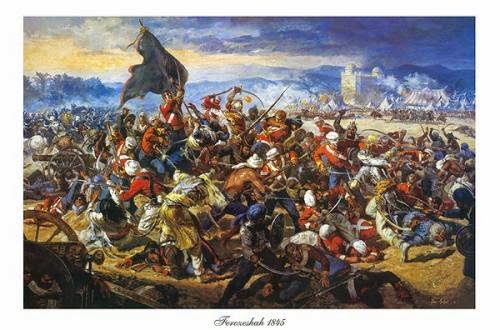
Great Wars: Panipat (1761) – Ferozeshah (1845)

“Volleys
of musketry were delivered by us at close quarters, and were returned just as
steadily by the enemy…..In all the previous actions….one or two volleys were as much as the Sirkar’s (the British
state’s) enemies could stand….these Sikhs gave volley for volley, and never
gave way until nearly decimated “
…. 

 …
As yet another war gets kicked-off in the Middle East, it may be time to reflect on what is gained (and lost) through endless war-mongering. Indians have in particular, suffered from centuries of war imposed upon them both by desi elites and foreign invaders. It also needs to be stressed that without the help of the British Indian army, there would have been no sure path to victory for the allies in 1918 or in 1945.

The post-independence wars have been not been on such a grand scale as Panipat and Ferozepur Ferozeshah (thanks to Athar Saeed for the correction). On the other hand, it is now possible to envisage complete annihilation of the sub-continent, so we are not sure if this counts as progress.
…..
Late afternoon on January 14,
1761, Maratha generals and soldiers fleeing the battlefield at Panipat took
with them an indelible memory of Ibrahim Khan Gardi’s artillery and musketeers
wreaking havoc on the enemy “like a knife slicing through butter”.
Despite their thinning ranks, the French-trained Telangi infantry, who called
themselves Gardis in the honour of their illustrious commander, fought like
true professionals. 

Though predominantly Muslim, they stayed loyal to the
Brahmin Peshwa and fought a Muslim coalition, ignoring blandishments and
threats till the very end.
If all Maratha generals had stuck to the original
plan drawn up by Ibrahim Khan-that of forming a hollow infantry square and
forcing a passage to Delhi by destroying the Afghan right flank-the result of
the Third Battle of Panipat could have been different.
…..

But despite the defeat, Panipat made it clear to the Indians that subsequent
battles in the subcontinent will be won by the boom of artillery and rattle of
musketry. 

According to Dr Uday S Kulkarni’s exhaustive account of the battle
titled ‘Solstice At Panipat: 14 January 1761’, Maratha generals like Scindia,
Holkar and Gaekwad, who were staunch critics of Maratha commander-in-chief
Sadashivrao Bhau’s touching faith in Ibrahim Khan Gardi and his European style
of fighting, would change their minds and increasingly repose faith in
European-styled drilled infantry and artillery. 
In fact, they would also
abandon their traditional strength of guerrilla warfare or ganimi kava, a
process that started right from the Panipat battlefield. But the Marathas
weren’t alone in this: soon, most Indian rulers were racing one another to
modernise their armies. This phase also saw a gradual departure from the
mediaeval practice of assigning more weightage to cavalry than any other combat
arm.

But it was Nawab Shuja ud-Daulah
of Avadh who was among the first to utilise lessons learnt at Panipat.
He had
allied himself with Ahmed Shah Abdali, but neither he nor his forces took any
active part in the battle. In 1764, his moderately Europeanised army led by
westerners-including Walter Reinhardt Sombre or ‘Samru sahib’,
the husband of
Begum Samru-gave a tough time to the English at Buxar, the first battle fought
by the English for territorial control in India. 
Shuja’s army also had Rohillas
and Afghan cavalry, who were mostly veterans of Panipat. His artillery directed
devastating fire on the British. But the British held out with the wily Hector
Munro in command and some disciplined musketry by the infantry, the backbone of
which was formed by over 5,000 sepoys. Shuja’s forces, with all their bravery,
had no answer for the Anglo-Indian bayonet charge.

Despite the defeat, Shuja continued to modernise his army, raising 18
European-styled infantry battalions by the 1770s. But he would never get the
chance to measure swords with the English again as Avadh became a vassal state
of the English after Buxar.

Indian history books today, while recognising Buxar as a watershed moment in
our national history, skip another important point: that it was at Buxar that
the identity of the Indian sepoy as a match-winner for the British was
established (though four years earlier at Plassey, Robert Clive was disappointed
with Indian officers and made it a rule that Indian troops will only be
officered by Europeans-a condition that stuck on until the end of First World
War). 

And it was at Buxar that the foundation of the Indian Army of today was
laid. From that point on, the sepoy would be the backbone of English armies
conquering different Indian states one by one. The English would gradually
develop a blind faith in the Indian sepoy: a phase that would last until 1857
and continue again towards the end of the 19th century.

For the Marathas, it was Mahadji Scindia who broke new ground in
Europeanisation of his army. Scindia employed a brilliant French mercenary,
Benoit de Boigne, to raise a brigade that could dress, march and fight as a
European army.
A former officer in the French, Russian and Honourable East
India Company’s armies, de Boigne taught Scindia’s men the British musket drill
and everything else that he knew on the condition that he wouldn’t be made to
fight the English with whom he had cordial relations. 

Mahadji’s meteoric rise
as the dominant power in the north of India hinged on the shoulders of this
able Frenchman. Mahadji’s new, formidable army came to be known as
‘Fauj-i-Hind’ or ‘Army of Hindustan’. By 1790, it had 37,000 soldiers trained
in the European fashion, and 330 pieces of artillery. 


But after Mahadji’s death
in 1794, his less capable grandnephew and successor Daulat Rao Scindia would
fritter away the gains of his predecessor. He would wage fratricidal wars with
other Maratha chieftains and lose both territory and reputation fighting the
British. His army stopped attracting talent, both due to his own apathy and
some shameless nepotism practised by his French general, Perron. But they would
still give Arthur Wellesley, the future Duke of Wellington, his “toughest
battle” at Assaye.

Elsewhere in the south, Nawab Hyder Ali was raising a formidable army. Hyder
was impressed with the British and wanted their military assistance to
modernise his army. The British were reluctant, which led Hyder to seek help
from the French.
With French help, Hyder modernised his infantry and artillery,
but unlike other Indian powers of the day that ignored cavalry, Hyder’s focus
was always on his cavalry and he used it with great skill, always leading it
from the front. 

In fact, the Mysore cavalry, with its dash and daring, had
built for itself a fearsome reputation among its rivals. In the 1770s, Hyder
Ali had 20,000 cavalry, 20 battalions of infantry and an unknown quantity of
guns. Even the English grudgingly admitted Mysore cavalry’s superiority, though
they referred to its actions as that of a swarm of locusts on crops.

Hyder Ali and Tipu Sultan also abandoned the common Indian practice of engaging
militias raised by provincial governors in war time and went for a fully
centralised recruiting and training system. A very rudimentary form of
regimental system was also followed. But by Tipu Sultan’s time, Mysore
artillery had attained a high degree of finesse. 


Tipu introduced a rocket
artillery corps organised in kushoons. Tipu’s guns were also known for their
longer range and accuracy. It’s not known how many artillery pieces he had; but
at the fall of Srirangapatnam and Tipu’s death in 1799, the British found 421
gun carriages, 176 12 pounders and 4,12,000 iron round shots ranging from four
to 42 pounds inside the fort.

A few years after Tipu Sultan’s
collapse, the process of the end of the Maratha Empire began as well. The
Peshwa signed the Treaty of Bassein with the English in 1802, agreeing to
station a 6,000-strong British force in his territory. The Poona Horse (now 17
Horse, Indian Army) was thus born.

After the Third Anglo-Maratha War ended in 1818, the Maratha Empire ceased to
exist and the Peshwa’s army was disbanded. Many former soldiers of the Peshwa found
service in the Bombay Army of the HEIC. They were placed in the Poona Horse,
Bombay Sappers and Miners and Maratha Light Infantry. Among the first to join
these regiments were the Gardis.

Up north, with the decline of the Scindia’s power and due to irregularities in
pay, many of Scindia’s well-trained troops left him and sought greener pastures
to the west. They soon found a new employer who was willing to pay them more,
both respect and money. He was Maharaja Ranjit Singh, the lion of Punjab.

Ranjit Singh wanted to modernise his army. The visionary ruler knew a clash
with the British was inevitable at some point in the future and he wanted to be
fully prepared for that. He employed Europeans of different nationalities to
train his troops. Ranjit Singh organised his infantry on French lines, cavalry
on British as well as traditional lines, and artillery on European lines. 


The
English were so alarmed by this tremendous expansion of force that they ordered
the arrest of any Frenchman trying to cross the Sutlej.

Despite the build-up, the clash that Ranjit Singh foresaw didn’t happen in his
lifetime but after his death and when the Sikh state was in considerable decay.

Just before the First Anglo-Sikh War, the Sikh army had grown bigger than the
state could support. According to UK-based military historian Amarpal Singh’s
book, ‘The First Anglo-Sikh War’, in 1839, the Lahore state had an army
consisting just under 47,000 regular infantry,16,000 regular and irregular
cavalry, and 500 pieces of artillery. The artillery was mostly manned by Muslim
gunners.

But after Ranjit Singh’s death,
there was a period of anarchy that saw too many court intrigues and rapid
decline in leadership of the army. The army, though, continued to expand (over
80,000 in 1845) and went out of control. It functioned through village
panchayats that were subservient to none. The soldiers were paid twice the sum
that a sepoy in HEIC’s army received every month. The soldiers also resorted to
loot and plunder whenever they wanted.

Amarpal Singh argues that the Lahore state engineered a situation whereby the
growing influence of this republican Sikh army could be curbed-by crossing the
Sutlej and inviting an English attack in 1845.

All through the war, the Sikh commanders abandoned the field, leaving their men
to fend for themselves, at early stages of battles. At Ferozeshah, for
instance, the Sikhs had clearly dominated the battlefield with their artillery
completely destroying the British artillery, and infantry returning fire with
amazing rapidity. 

Sitaram, a sepoy in the British army, as quoted by Singh in
his book, pretty much summed up the ground reality when he wrote: “Volleys
of musketry were delivered by us at close quarters, and were returned just as
steadily by the enemy. In all the previous actions in which I had taken part
one or two volleys at short range were as much as the Sirkar’s (the British
state’s) enemies could stand; but these Sikhs gave volley for volley, and never
gave way until nearly decimated…”

Yet, instead of moving forward and decimating the enemy, the commander, Lal
Singh, ordered a general retreat, much to the chagrin of his own troops.
The
Sikhs abandoned all their guns and equipment and left.

…..

Link: timesofindia.indiatimes.com/Evolution-of-Indian-military-From-Panipat

regards

Dads and daughters

…“I asked my daughter to brush her teeth…no success….reminded her…not so long ago that she would have responded…..She came back….with a list that she had compiled…important events that I had missed due to work commitments”….
….
True story. We recently attended a meeting filled with distinguished (old) people, when one guy suddenly points to another sitting across the table: we are batch-mates from such and such elite institution. When lunch was announced shortly and we were able to mingle the opportunity was not missed to raise an inconvenient point: you guys claim you are batch-mates, yet one has pure silver hair while the other has jet-black. What gives?

The explanation was thought provoking: in each case it was the daughter who insisted that (a) silver hair looks cool, and (b) hair dye is a must in order to preserve that youthful look from decades back.

While greeting a family with a boy-child (as they say) we usually congratulate them by saying that the little angel looks rather calm and peaceful. Most times (99/100) we get a knowing smile and a wink, their harassed faces tell the tale very well. With new dads running around with the girl-child in the park (and the mother safely out of hearing range) we try out a different message (and a different tone): Apurba (we say), you may be able to (barely) escape punishment by not paying enough attention to your wife, but beware, never say no to your daughter (and never forget her birthday). She will remember it decades later (when she chooses your nursing home). Surprisingly enough, not one man disagreed.
………

….
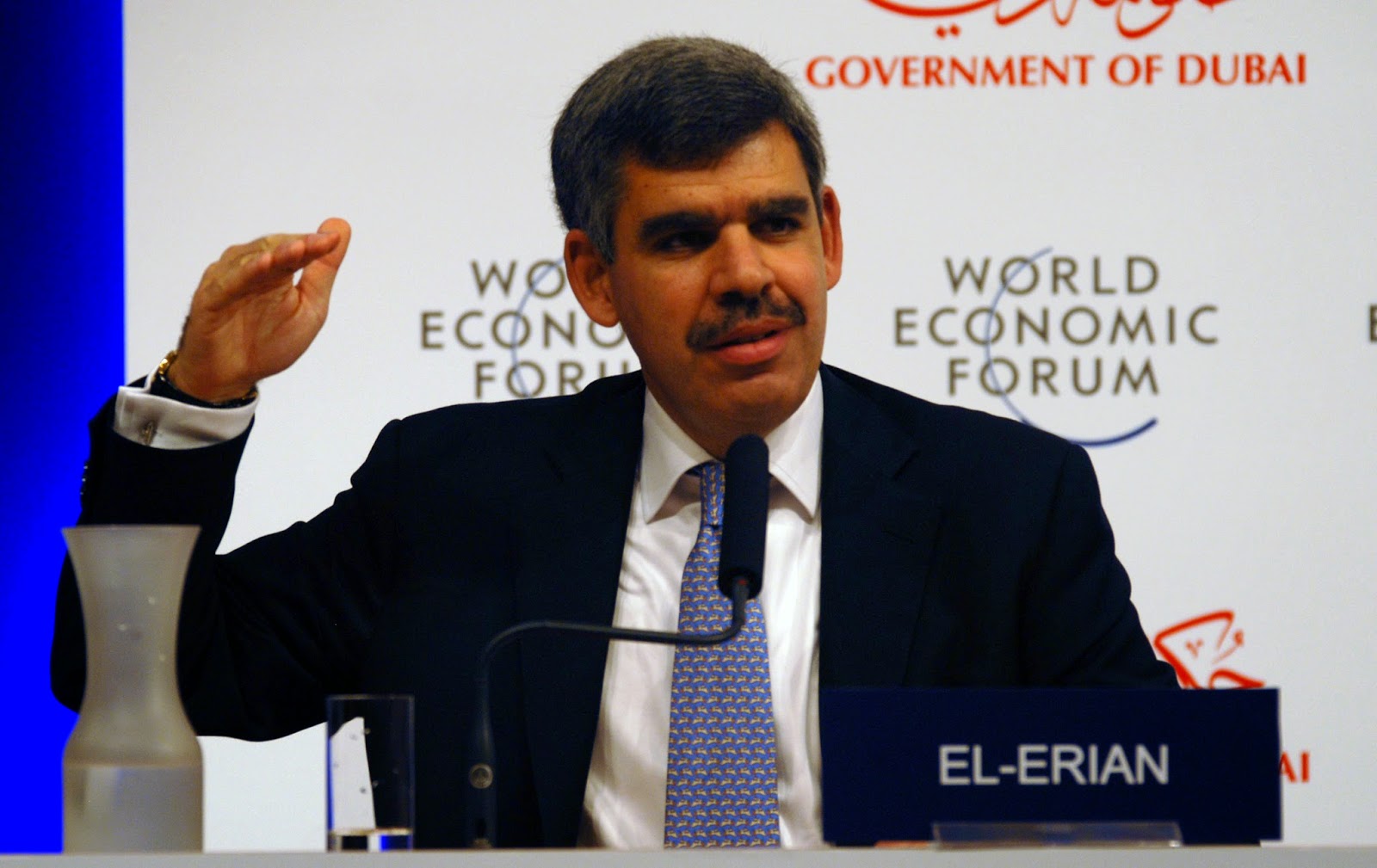
And now we have proof…even those evil bastards…those big shot financiers are softies…when it comes to their daughters. Heartiest congratulations to Mohamed El-Erian…he is undoubtedly the father of the month. What does it profit a man to gain the whole world and forfeit his flesh and blood? May all dads (new and old) learn from this (and not wait till they are in their 50s) and become better men….who make the world a better place to live in. Bravo!!!
………

When the Oxbridge-educated economist stepped down last year as the
chief executive of the PIMCO investment fund, one of the largest on the
planet, rumour was rife that he had fallen out with its founder Bill
Gross.

But Mr El-Erian yesterday revealed one main reason for
leaving his high-pressured post was a 

mundane conversation with his then
10-year-old daughter about brushing her teeth
which led to her writing
him a note listing the 22 important events in her life he had missed due
to work.


In a moment of domestic truth which will sending a
shiver down the spines of working parents the world over,
the document
presented to the financier included missing the child’s first day at
school, her first football match and a Halloween parade.

Mr
El-Erian, whose earnings at PIMCO reportedly reached as much as $100m a
year, said the incident showed him instantly that he had allowed his
relationship with his daughter to suffer at the expense of his
globetrotting job.

In an interview with Worth magazine, he said:
“About a year ago, I asked my daughter several times to do something –
brush her teeth I think it was – with no success. I reminded her that it
was not so long ago that she would have immediately responded.

“She
asked me to wait a minute, went to her room and came back with a piece
of paper. It was a list that she had compiled of her important events
and activities that I had missed due to work commitments. Talk about a
wake-up call.”

He continued: “I felt awful and got defensive: I had a good excuse
for each missed event! Travel, important meetings, an urgent phone call,
sudden to-dos. But it dawned on me that I was missing an infinitely
more important point.

“As much as I could rationalise it… my
work-life balance had gotten way out of whack, and the imbalance was
hurting my very special relationship with my daughter. I was not making
nearly enough time for her.”

The 56-year-old investment guru, who
regularly features in lists of the world’s most powerful or influential
financiers, last year swapped his role at PIMCO’s California
headquarters for a “portfolio of part-time jobs”, including a role as
chief advisor to the fund’s German parent, Allianz.

Mr El-Erian
said he realised the trope of departing executives and politicians that
they wanted to spend more time with their families was a cliche but
added he had realised his time was better spent being a good father than
a good investor.

In a separate interview with Reuters, he
declined to comment on his relationship with 70-year-old Mr Gross,
saying only that the so-called “Bond King” was “brilliant”.

In the
meantime, Mr El-Erian said he was enjoying his time with his daughter,
preparing her breakfast, driving her to and from school as well as
planning a holiday together.

He said: “I’m the first to recognise
that I am incredibly fortunate to be able to structure my life in this
way. Unfortunately, not everyone has this luxury. But, hopefully, as
companies give more attention to the importance of work-life balance,
more and more people will be in a better position to act holistically on
what’s important to them.”

…..

Link: independent.co.uk/us-financier-quits-2trn-investment-fund-after-his-daughter-writes-list-showing-22-life-landmarks

regards 

Aur tumhare paas kya hai?

……

It is not just a popular put-down in India……one close family member was hit with a variation of this (by a member of the academic tenure-track progress committee in the USA as part of a seemingly casual conversation)…..so, what has been your contribution so far?….what do you do all day??..…within a few months he was asked to leave…..thankfully he was fore-warned (and fore-armed with a tenured position, no less)……
…..

China:
Aaj mere paas yuan hai, bangla hai, range-rover hai, naukar hai, trillion dollar account
hai….aur tumhare paas kya hai?
(China: Today I have everything….what do you have?) 

India:
Mere paas Mars hai!! (India: I have
my Mars!!) 

….
Yes, victories are never permanent (nor that meaningful in the grand scheme of things) but it is important to remember how exactly China lost out to dirty, poor, big talking but good for nothing India……the mighty Yinghuo-1 was piggy-backing on a Russian rocket which mis-fired (and the Japanese ship ran out of fuel!!!)…

…..
Link (1): en.wikipedia.org/wiki/Deewaar

Link (2):  bbc.com/news/world-asia-india
….

regards

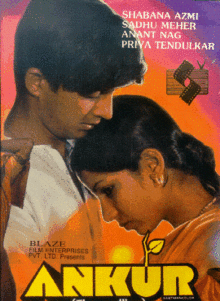
A seedling (ankur) is 40 years

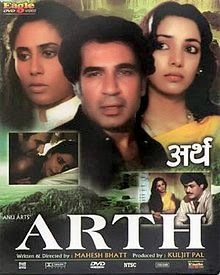
…the major turning points in your life? Ankur….the parallel cinema movement. Arth…the women’s rights movement…….hunger strike with Anand Patwardhan…built
tenements for 50,000 slum dwellers at Chandivli
…...could not have a child….I was heartbroken….Zoya and Farhan…their mother was generous
in letting us have access to them…..And I got
the man!
…..

….

 …
When it comes to the best (hindi) film actors (women) there will be many deserving candidates. Going by (Filmfare) awards won (and nominated) it would be Jaya Bhaduri (Bachhan), Nutan Samarth (Behl) and Kajol Mukherjee (Devgan). We have a soft spot for Smita Patil (Babbar) and we feel that but for her untimely death she would have been the best. Then there is Comrade Sayyida Shabana Azmi, who first starred with Ankur (The Seedling), a Shyam Benegal film in 1974. We wish Shabana didi (apu) all the best as the years go by.
……..


Only one cloudy lining in an otherwise brilliant blue sky (and we think Azmi recognizes this herself- see interview below). There are (we believe) a few red lines in life. You are not a (human) man if you rape. You are not a child anymore when you pick up a gun and torture others (yes, we know that indoctrination is to blame). 

Likewise do not call yourself a feminist if you steal another woman’s husband and continue to brag about it three decades on (yes, we know that the man is equally responsible). If feminism has a creed it should be: sisters first do no harm (to another sister).
….
She has five National Awards, more than 120 films and has been a UN Goodwill
Ambassador status. As a vocal and articulate champion of communal
harmony and economic equality, she has honored her father, Kaifi Azmi’s
political legacy.

He inherited his literary talent from his father, Jan Nissar Akhtar and
his uncles, but it was  his scripting partnership with Salim Khan
that
created waves at the box office and made him a star. The wit and
sensitivity of his poems have carved him an important niche in the
nation’s literary annals. Married to one of Bollywood’s biggest
actresses, a star scriptwriter in his own right, he remains an intensely
private person.

Shabana Azmi reveals the hidden side of her husband and soulmate: Javed Akhtar.

Firstpost: You are articulate, expressive about what
you believe in, while he is quieter, more involved in his own world. Are
you opposites in terms of temperament?

Shabana Azmi: On the contrary, I cannot think of anyone who is closer to me, and more similar than Javed. He is my soulmate.

What makes your relationship so perfect?
Look at the similarities in our backgrounds. In discovering Javed I
rediscovered my father. Both are from UP, both poets, film lyricists,
writers. Both love politics… In fact if you consider the fact that one
seeks the perfect match of backgrounds for an arranged marriage, then
this could well have been the perfect arranged marriage.

But it wasn’t arranged…
He was already married by the time I realised how well suited we were.

When did that happen?
He had been coming home for a very long time, like other poets he would
come to read his poems to my father, seek his opinion. But I was very
busy with my work, and never really engaged with him.

Then in the ‘80s, I sat in on conversations my father had with him on
poetry, on politics, and I realised he was very different from his
image.

How did you become close?
He saw Sparsh, he really liked the movie. He told Sai (Paranjpe,
director) that he really liked the film. There was a little party at
Sai’s and he was invited too. We met there. He spoke of the film in such
detail that I was amazed. That was the start of serious complex
conversations.

But the fact remained that he was a married man…
Yes, we realised that. We stayed away from each other for as long as was
possible. My mother was against it completely. When I told my father, I
asked him, “Is he wrong for me?” And he said, “He is not wrong, but the
circumstances are wrong.”

When I asked him, “What if I change the circumstances,?” he said, “Then it should be okay.”

It could not have been easy.
Nobody can understand the anguish, the heartbreak… There were children involved.
For 2 to 3 years, we suffered the trauma. And then one day, we decided
to break up. It was too traumatic for the children if we went on. We
told each other, “We will break up after one last meeting.” We met for that last meeting and we talked and talked… not love talk
alone, but about everything, politics, poetry. We got so busy talking ,
we forgot to break up.

What was especially endearing?
The fact that he is so much like my father. For any ordinary man, my
father is a tough act to follow, especially knowing how much I
hero-worshipped my father.

Did you never dream of children of your own?
Of course we did, I did. For medical reasons, I could not have a child.
It hurt a lot, and I was heartbroken for a while.
Then I told myself,
“One can’t have everything in life.”

Also Zoya and Farhan were very young then, and their mother was generous
in letting us have access to them. So I had children around. And I got
the man! I cannot imagine being married to anyone else.


…..

You complete 64. How do you look back on you amazing life so far?
With gratitude for being at the right place at the right time. I feel
blessed that my parents gave me values that I cherish. I’m singularly
lucky to have worked with directors who dared me to take risks and be
different and I am thankful to the Indian film industry. I will also
remain indebted to all those people who sensitised me to using art as an
instrument for social change.

What are your earliest memories of your birthday as a child?
My mother was superstitious about celebrating our birthdays because she
lost her firstborn a week before his first birthday, for which she had
made grand preparations. So childhood memories are mostly distributing
two sweets each to my classmates and the thrill of wearing beautiful
clothes to school instead of the boring uniform.

What drove you to choose acting as a profession?
It was predestined in a way. My mother, Shaukat Kaifi, who is a very
respected theatre artist, was working with Prithvi Theatres and used to
strap me on her back as a four-month old child and carry me to work
because we couldn’t afford a maid. When I was about three years old, I
started accompanying her on her tours [during school vacations]. I would
go to sleep backstage, with the smell of greasepaint all around me.
 

At St Xavier’s College (Mumbai), together with Farooq Sheikh, who was
two years my senior, we formed Hindi Natya Manch and went on to win
awards in every category through our college term. After completing my
graduation, I joined The Film and Television Institute of India in Pune
and passed with the gold medal for Best student in Acting. I am a firm
believer in training and at FTII, Prof Roshan Taneja, our acting
teacher, was wonderful. At the FTII, I was exposed to a lot of European
and Japanese cinema that shaped my aesthetics and directed the choices I
made in my career.

How did you make the niche that you have for yourself as an actor in a formula-driven industry?
I have an unconventional face for a Hindi film heroine. I remember BR
Chopra suggesting that I should do only vamps roles and Tarachand
Barjatya saying that I look “lower class” and so should restrict myself
to playing a maid etc. It’s another matter that later both of them cast
me in roles that were far removed from the moulds they had suggested! I
am amazed at the success I got in mainstream Hindi cinema and often
think those films (like Fakira, Parvarish, Amar Akbar Anthony etc) were
successful in spite of me, not because of me.

But I’d also played some very substantial roles in parallel cinema that
won me critical acclaim and several national awards, so I developed a
status that was equivalent to the most successful stars of those times
because I was not competing on their home ground. Had I done that, I’m
sure I would have been on the bottom rung of the ladder, but parallel
cinema gave me and Smita (Patil) and Naseer (Naseeruddin Shah) and Om
(Puri) a unique position. I will always feel indebted to the various
directors and writers who cast me in strong meaningful roles.
 

I didn’t plan my career. I was just guided by my aesthetics and the
sensibilities I had acquired because of my parents and the FTII.

Would you say success in show business is, as they say, “luck by chance”?
I attribute my success to being at the right place at the right time in
large measure. But I also do not take my work for granted and continue
to get butterflies in my stomach before embarking on a new film or a new
play.I’ve imbibed a lot from my mother about how to prepare for a part.
Days before [a new shoot], I start dressing up like a witch, a slum
dweller, a mafia don, depending on what I’m playing and move around the
house trying to inhabit the part.

Filmmaking is a collaborative effort. Actors get the maximum acclaim
because they face the camera. The truth, however, is that an actor is
successful because a whole team of technicians behind the scenes are
working to camouflage the weaknesses and enhance the strengths of the
actor. The film set is a training ground for relationships – you
negotiate your way through different people, from your co-star to the
light boy and the junior artists. It’s up to you whether you isolate
yourself and choose the ivory tower or you learn from all those you work
with. It’s so easy for a celebrity to be liked – a kind word, a genuine
smile and you spread good cheer.

Looking back, which do you feel were the major turning points in your life?
Ankur, because it ushered in the parallel cinema movement. Arth, because
it started my involvement with the women’s rights movement. Madame
Sousatzka with Shirley MacLaine; that led to my working in 10 films in
the West. My five-day hunger strike along with Anand Patwardhan for the
slumdwellers of Cuffe Parade. Today, we at Nivara Hakk have built
tenements for 50,000 slum dwellers at Chandivli as a result of a
tripartite agreement with the government of Maharashtra, a private
builder and us. My nomination to the Rajya Sabha by the President of
India has also been a great learning experience. I was a very active
member.

The single-most influential film of your life?
Mahesh Bhatt’s Arth remains a milestone. I continue to meet women who
say that it was a transformative experience for them and gave them
tremendous strength.

You’ve also done a lot of humanitarian work. You work with the
NGOs Nivara Hakk, run Mijwan Welfare society and have spoken to the UN
on various issues.
 

I’ve gone to the UN, been a signatory to a worldwide Human Rights
document about accepted measures during war times along with Kofi Annan
and Aga Khan; spoken at the Hague international court of justice on the
population question… issues that I was learning as I went along the
way.

If you could change one thing, what would it be?
An end to our patriarchal society’s mindset that values boys over girls.

……

Link (1): firstpost.com

Link (2): www.firstpost.com

….

regards

India-Southern Research Organization (ISRO)

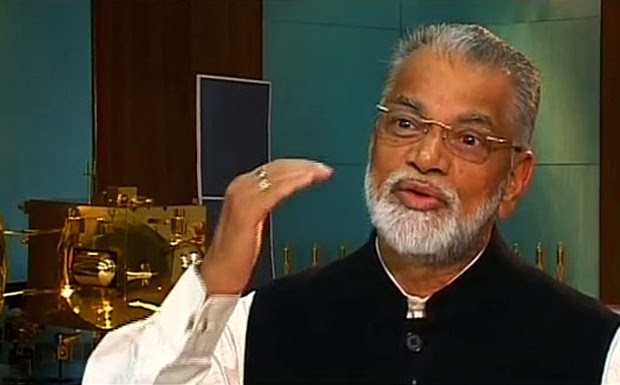
1. K Radhakrishnan: chairman of ISRO and
secretary, Department of Space.…2. M Annadurai: program director Mars
Orbiter Mission.….3. S Ramakrishnan: director, Vikram Sarabhai Space
Centre and member Launch Authorisation Board.….4. SK Shivakumar: director, ISRO Satellite Centre….5. V Adimurthy: mission concept designer, Mars Orbiter Mission.…6. P Kunhikrishnan: mission director for the
launcher….7. Chandradathan: director of the
Liquid Propulsion Systems Centre.…8. AS Kiran Kumar: director, Satellite Application Centre.…9. MYS Prasad: director, Satish Dhawan
Space Centre…10. S Arunan: project director, Mangalyaan.….B Jayakumar….MS Pannirselvam….V Kesava Raju…..V Koteswara Rao

….

 …
Wise people (liberals) tell us that it is a sin to be parochial. We have no doubt that they mean well. The (bong) poet has said that under this (brown) skin, both Hindus and Muslims have the same red blood flowing in their veins (arteries). Personally speaking, we would be delighted to live in a world beyond parochialism but this is not what we have right now.

Our policy is to tread the middle ground (as we see it). We celebrate identities but we do not approve of divisiveness. If that sounds weird, we are curious about your background but that is just because we do not know you. We have nothing to say about self-affixed labelings. If Barrack Obama counts his missing African dad to claim African-Americanship (while discounting the pale-ness of the maternal grand-parents who nurtured him) then we accept that at face value.

As long as people respect the fundamental truths (but many do not) that (1) we all came from a village in East Africa (yes we know, hyperbole) and that the (2) culture in which you are raised will be a huge influence on you and that (3) discriminating against individuals solely based on their background (say caste or sect) is illogical and immoral, we can argue (non-violently) about everything else.

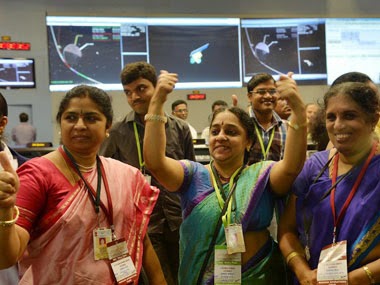
That is a very long prelude to get to the topic at hand: we salute the South Indians who made the Mars Orbital Mission (MOM) a success. Before people get angry and accuse us of parochialism please see discussion above. There are countless groups in India which are subject to ridicule, derision, and even hate (women as a whole are probably the largest group to be so victimized) but it is the “South Indian” alone which causes maximum confusion. How does one go about defining an authentic South Indian?
…..
This not-so-original thought came to us during discussions with a “big man” woman. She is from Goa but she was having a go at South Indians. Thing is, for most of India, Goa would count as south!!! Perhaps as a (Gaud Saraswat) Brahmin she truly believes that GSBs originated on the banks of the Saraswati river in Punjab (see above for East Africa reference). But then most of the stereotyping about South Indians was pointed against southern Brahmins who have dominated the academies and bureaucracies in the North (after having been kicked out from the South).

Perhaps a true South Indian is a Catholic fisherman from Kanya Kumari (the southern-most tip of mainland India) whose forefathers threw out a commemorative tablet glorifying the Hindu revivalist Swami Vivekananda into the ocean (Vivekananda Rock to them is St Xavier’s Rock). 

Or she may be a follower of the Kalaignar (artist) Muthuvel Karunanidhi, who rejected his own (Sanskrit-origin) name Dakshina-murthy, who was associated with breaking idols of Ganesha (such activities are termed communal only when Hindutva-vadis inflict it on others) and who publicly declared Hindus to be thieves.

The award for the most authentic South Indian (as the one most vehemently opposed to Hindu-Hindi hegemony) must surely go to the highest Brahmin (and tallest mass leader) of them all. This is what Eknath Ranade, the Rashtriya Swayamseval Sangh (RSS) volunteer and the driving force behind the Vivekananda Rock Memorial would have to say about the Man:
…..
He succeeded in persuading almost every State
government to make a contribution towards the construction….even Nagaland and Arunachal Pradesh…..”Leaders of
every political party became
willing partners of the Vivekananda Rock Memorial. The only
Chief Minister who sent me back empty handed was the then Kerala Chief Minister
Comrade EMS Namboodiripad. I can say this much about my abortive
interview with him. It was like conversing with a sphinx. It was monologue
all the way on my part. Only an empty stare from the other side!”.

…….

This is the South India which has stood up against North India and the North Indian Party. But then this is also the South India where ISRO supremo K Radhakrishnan (also from Kerala) openly prays in (Hindu) temples so that the Mars Orbiter Mission is a success. These South Indians who presumably came up with the Sanskrit origin name of Mangal-Yaan. Then there is the inconvenient fact that a socialist, anti-superstition (read: Hindu practices) party that is loud and proud about its (non-Hindu) 5000 year old culture (or is it 50,000?) is being led by a super-caste, dictator-for-life who has added an extra “a” to her name due to advice from jyotishis (astrologers).

Perhaps all of this adds up to the well known “pragmatic” nature of South Indians (as opposed to the allegedly violent, uncompromising Northies). But then we have the example of Lord Hanumana who is loved, respected…and even feared all over India, in idol as well as in living form. Without the violent, uncompromising (South Indian) Hanumana – as the Ramayana makes it clear –  there would be no victory of good over evil. He is also the only known being who can fly around with his tail on fire. What better analogy for the Mars rocket do we have anyway?
……

1. K Radhakrishnan: He is the chairman of ISRO and
secretary, department of space. The 65-year-old avionic engineer
graduated in engineering from Kerala University in 1970. Radhakrishnan
also has an MBA degree from IIM-Bangalore and he also got a doctorate
from IIT-Kharagpur. Besides being a top space scientist, Radhakrishnan
is an enthusiast of Kerala’s classical art form Kathakali and a keen
music lover. He received a Padma Bhushan in 2014.

2. M Annadurai: He is the programme director of Mars
Orbiter Mission. Mylswamy Annadurai joined Isro in 1982 and was the
project director for Chandrayaan I, Chandrayaan II, ASTROSTAT, Aditya -I
and the Mars Obiter Mission. Annadurai and his works are mentioned in
the 10th standard Science Text Book of Tamil Nadu. Born in Kodhawady
near Pollachi in Coimbatore district of Tamil Nadu, Annadurai has been
leading many Remote Sensing and Science missions at
ISRO.

3. S Ramakrishnan: Director of Vikram Sarabhai Space
Centre and Member Launch Authorisation Board. A senior ISRO scientist
has more than four decades of experience in rocketry in the Indian space
programme. Joined
ISRO in the August of 1972 , Ramakrishnan played a
key role in the development of PSLV which carried the Mangalyaan into
the space. He had said, “From here to go to Mars we are going to use
only a fraction of what we did in getting to the (Earth) orbit.” The
challenge for him was the launch of the rocket. He said the launch
window was only five minutes. Ramakrishnan is a mechanical engineer from
the College of Engineering, Guindy, Chennai. He received his M.Tech in
Aerospace from IIT-Madras with the first rank.

4. SK Shivakumar: Director of ISRO Satellite Centre,
Shivakumar joined ISRO in 1976. He was part of the team that developed
the telemetry system for Chandrayaan-I, India’s first lunar exploration
mission.  He also developed satellite technology and implemented
satellite systems for scientific, technological and application
missions. He said, “Our baby is up in the space. It was almost like a
caesarean.”

5. V Adimurthy: Born in Andhra Pradesh and educated at
IIT-Kanpur, Adimurthy joined
ISRO in 1973 and was the Mission Concept
Designer of Mars Orbiter Mission. He was also awarded the Padma Shri in
2012.

6. P Kunhikrishnan: He is the Mission Director for the
launcher. From the Vikram Sarabhai Space Centre in Thiruvananthapuram,
Kunhikrishnan has seven successful PSLV launches under his belt since
2009. He was appointed the mission director for the ninth time. He was
responsible for seeing the rocket completes its mission successfully and
that the satellite is correctly injected in the designated orbit. The
challenge for him was that the orbital characteristic of the Mars
Mission is different from regular PSLV missions.

7. Chandradathan: Took over as the Director of the
Liquid Propulsion Systems Centre in 2013. He joined ISRO in 1972.
Initially, he worked for the SLV-3 project during its design phase and
later was involved in the development of solid propellant formulations
for SLV-3. Over three decades, Chandradathan made contribution to the
realisation of solid motors for sounding rockets, SLV-3, ASLV and PSLV.

8. AS Kiran Kumar: Joined ISRO in 1975, Kumar is the
Director of Satellite Application Centre. He was responsible for
designing and building three of the orbiter payloads – the Mars Colour
Camera, Methane Sensor and Thermal Infrared Imaging Spectrometer. The
challenge before him was miniaturising the components as the satellite
does not provide much space.

9. MYS Prasad: He is the director of Satish Dhawan
Space Centre and chairman of the Launch Authorisation Board. From 1975
to 1994, he worked in the launch vehicle development programmes of ISRO.
He was part of the project Ttam of SLV-3, the first indigenously
developed launch vehicle of India. As the launch was during northeast
monsoon season the challenge was to enhance weather forecasting
capability to 10 days and simultaneously carrying out preparatory work
for Mars Mission while dismantling the GSLV rocket after the mission was
aborted earlier this year.

10. S Arunan: He is the project director of Mangalyaan.
Arunan was responsible for leading a team to build the spacecraft. The
challenge for him was to build a new communication system, which would
largely be autonomous so that it could take decision and ‘wake up’ the
orbiter engine after 300 days.

11. B Jayakumar: The associate project director of PSLV
project,  Jayakumar was responsible for the rocket systems, testing
till the final lift-off.

12. MS Pannirselvam: The chief general manager of range
operation director at Sriharikota Rocket port, Pannirselvam was
responsible for maintaining launch schedules without any slippages.

13. V Kesava Raju: He is the mission director of Mangalyaan. Raju and his team will track the journey of the MOM in the outer space.

14. V Koteswara Rao: He is the ISRO scientific secretary. 

…..

Link (1): firstpost.com

Link (2): ivarta.com

….

regards

Random Thoughts

It is the season to be busy at work, so I am unable to write a coherent post but these scattered thoughts were itching to get out:

1. Pakistani anchor Talat has written an interesting piece in Urdu in which the conceit is to start with a long section that sounds like one of Tahir ul Qadri or Imran Khan’s speeches and then reveal that it is the Urdu translation of one of Goebbel’s speeches.
These days anyone has the right to speak in Germany — the Jew, the Frenchman, the Englishman, the League of Nations, the conscience of the world, and the Devil knows who else. Everyone but the German worker. He has to shut up and work. Every four years he elects a new set of torturers, and everything stays the same. That is unjust and treasonous. We need tolerate it no longer. We have the right to demand that only Germans who build this state may speak, those whose fate is bound to the fate of their fatherland.


Therefore we demand the destruction of the system of exploitation! Up with the German worker’s state!


Germany for the Germans!

This is actually very apt. TUQ is consciously and IK is unconsciously (lacking the smarts to understand such things and easily manipulated by clever men) using this exact line in Pakistan. Co-opting the vocabulary of “revolution”, “overthrow of elites” etc created by the Left, the fascist wing of the Paknationalist movement is preparing the ground for an overthrow of democracy and the implementation of a long-held dream: the Chakwal solution. May Allah protect us all.

2. The delegitimization of the 2013 elections continues apace, aided by several media houses (especially the pro-army ARY group, long known for its close links with the hard-paknationalist faction and the intelligence agencies) and feckless mainstream politicians who had made rigging allegations as per the usual Pakistani routine and who now find themselves unable to point out that this election was actually fairer than most Pakistani elections and even if there had been NO irregularities whatsoever, PTI could not conceivably have won (a cursory looks the winning margins and candidates will confirm this fact).
This of course does not mean the election was completely fair. There were many irregularities, (though maybe less than those seen in the last election), with the worst cases in KPK (ANP and PPP unable to campaign thanks to the Taliban lending a hand), interior Sindh (intimidation by local bigwigs) and Karachi (the worst case of all, led by MQM gangsterism)…none of which are a focus of Imran Khan’s protest.
So, the election, whose outcome would not have been very different even if most irregularities were avoided, has been delegitimized. The point is to overthrow the system, not to fix it. 
This is not rocket science, but it does need to be said again and again.

3. A somewhat parochial point, in that it is a peculiar obsession of mine based on my own history and the background I come from….I recognize that it may not be as important as it looms in my life…..but anyway, here goes: someday Allah may call the Pakistani Left to account for the fact that their main historical role seems to have been to prepare the narrative tropes that are now being used by every right wing force in Pakistan (not just the military-sponsored adventurers, but also the religious parties and even the Taliban);  not only has the Left provided the vocabulary (and ALL of the poetry) of “revolution” and “jab taj uchaley jaen gay” (when the crowns are knocked off heads), they have also undermined the intellectual foundations of the (already weak) elite faction that could have stood up for liberal democracy in Pakistan.The middle classes are obviously not all in favor of liberal democracy. They are also a breeding ground for “national-socialism” and religious fundamentalist groups, but the fraction of them that could be expected to argue for liberal democracy is further weakened in Pakistan by the penetration of Marxist-Leninist tropes among people who do not otherwise consider themselves part of the revolutionary Left.  This (mostly superficial and shallow) adoption of left-wing narratives and cliches does not imply that most of these people have stopped having servants and maids (god forbid) or have any deep interest in preserving our ancient way of life in the face of evil modernity (quite the contrary, most are looking for “progress and prosperity”, just like good middle class people in other third world countries); but to a surprising extent, in Pakistan their narratives about the wold are derived (usually without any detailed knowledge of the source) from relatively small Marxist-Leninist parties and their intellectual fellow travelers. What I am saying is that this superficial and frequently muddled idle talk does seem to have a real effect on the way many educated people see the world and what patterns they impose on it. One of those patterns is a distrust of liberal democracy and a vague yearning for revolution. This leaves their representatives (and many journalists for example fall in this category) seriously handicapped when confronted with clever demagogues condemning liberal democracy and demanding revolution. (I must stress that i am not talking here about the relatively tiny band of deeply committed Marxists and/or Luddites, both groups having serious issues in my opinion, but both having some semi-rational basis for THEIR mistrust of liberal democracy and modern capitalism). Its a convoluted point, and I apologize for not being clearer. But something like this does seem to be going on…and it is handicapping the liberal democrats in the debates that are going on today in Pakistan…

PS: I promised @umairjav that I would rewrite this…Now I dont think I will rewrite this point, just try to clarify it a bit: It is NOT about people who actually worked for Left wing causes or understood (to varying extents) the finer points of Marxist theology. THOSE people are NOT in PTI (for the most part). They can be found in the PPP, the ANP, various Sindhi and Baloch nationalist organizations and so on, but rarely in the PTI. I am aware of that. My dig is not meant to imply that Leftists have themselves become PTI activists (most PTI activists were probably born after the first death of Marxism-Leninism in 1991). No, my thought process went something like this: 

  • The “Left” (especially in Punjab) has very little direct impact on current Pakistani political shenanigans. The first part of the dig is a dig at the surprising irrelevance of the Left.
  • But thanks to the prominence of the old Left in various cultural spheres and the extraordinary popularity of Leftist talking points (not the same thing as saying “domination of leftist parties or their economic policies”) in postcolonial educated people (again, think of it this way: even right wing politicians in our countries absorbed many disembodied memes that had originally been birthed in Marxist or Bolshevik circles as part of a greater whole of “imperialism the last stage of capitalism” type analysis), even these kids have absorbed notions of revolution, revolutionary change and the overthrow of the elites. 
  • Its possible I am overstating the role of the Left in creating these memes. I dont think so at this point (i.e. I dont think I am overstating it), but I am open to this possibility 🙂
  • I have either clarified or dug myself deeper into the hole…or both. Got to run…

4. And last but not the least, congratulations India (and particularly the Indian Space Research Organization) on achieving a historic first: a Mars mission that has worked at first attempt. An amazing accomplishment, especially consdiering that they spent less on this mission than Hollywood spends on an average blockbuster movie production. Well done..

Unfortunately (or perhaps fortunately), in Pakistan you cannot see the above videos because youtube is still banned in Pakistan. Allah works in mysterious ways…

The happy martyrs

….Hamas initially denied any link to the June attack….Last month, the group acknowledged responsibility.…..”Hamas praises the role martyrs Abu Aysha and Kawasme played in
chasing down Israeli settlers…their assassination
will not weaken the resistance”….

….
The two Hamas lads…so happy to have helped ignite another war, even more happy that 2000 of their own (including small children) have been killed by the enemy (it all comes down to who wins the propaganda war), and now happiest ever in death (to be celebrated as martyrs for all time).

It is an article of faith amongst the (western) Left that an alliance with Islamists will bring down the enemy (and in the long run this prediction may indeed come to be true). We are told that compromise is a dirty word (and the enemy believes in this creed as well). The muslim lands must be liberated at all costs.

Meanwhile back in the real world, Israel is building up alliances with Egypt and Saudi Arabia (and when Kurdistan becomes an independent nation there will be one more all-weather friend). Hamas has been kicked out of Qatar and given shelter in Turkey. The flames in the Central Middle East is visible from space. North Africa is terribly troubled (except for Morocco and Tunisia). Afghanistan is likely to sink deep into mud starting next year. Pakistan is in a precarious position with everyone interested in gaining power (but none so keen on ruling).

It is not that we should ignore the crimes of Israel (and for that matter India) as belonging to some lesser category. But we are not able to discern any constructive message that will make the people in the Middle East North Africa even a tiny bit hopeful (perhaps we are biased and being blinded by hatred). At this rate the world will simply learn to ignore MENA, except for periodic bouts of “lawn mowing” by the Israeli Defense Forces. Fighting thousand year wars with infidels will not bring any peace and over time even the oil fueled prosperity will look like a mirage.
……
Israeli troops shot dead two Palestinians in the West Bank city of
Hebron on Tuesday and the military said they were members of Hamas
responsible for the killing of three Israeli youths in June, an attack
that led to the Gaza war.


….
Marwan Kawasme and Amar Abu Aysha, both in their 30s, were shot dead
during a gun battle after Israeli troops surrounded a house in the city
before dawn, the army and residents said. Israel had been hunting the
men for three months.


Kawasme and Abu Aysha were suspected of carrying out the kidnapping
and killing of the three teenage seminary students, who were abducted
while hitchhiking at night near a Jewish settlement in the West Bank on
June 12.


The military said army and police forces were trying to arrest the two suspects when a firefight erupted. “We opened fire, they returned fire and they were killed in the
exchange,” Israeli military spokesman Lieutenant-Colonel Peter Lerner
said.


The governor of Hebron, Kamel Hmeid, confirmed on Palestinian radio that the two were dead.

“It’s clear now the two martyrs, al-Kawasme and Abu Aysha, were
assassinated this morning during a military operation in the Hebron
University area. We condemn this crime, this assassination, as
deliberate and premeditated murder,” he said.


Kawasme and Abu Aysha were affiliated with Hamas, which initially denied any link to the June attack. Last month, however, the group acknowledged responsibility, although
its leadership said it had no advance knowledge that the men were
planning to abduct the students.


“Hamas praises the role martyrs Abu Aysha and Kawasme played in
chasing down Israeli settlers and we stress that their assassination
will not weaken the resistance,” Hamas spokesman Sami Abu Zuhri said in
Gaza.


Israeli Prime Minister Benjamin Netanyahu praised the operation. “We
will continue to strike terrorism everywhere,” he said at the start of a
cabinet meeting in Jerusalem. “This morning the long arm of Israeli
justice caught them.”


Israeli forces have conducted widespread sweeps across the West Bank
in the past three months, rounding up hundreds of suspected Hamas
members in house-to-house raids in the hunt for the suspects behind the
attack.


The abduction and killing of Eyal Yifrach, 19, and Gilad Shaer and
Naftali Fraenkel, both 16, caused alarm throughout Israel and set off a
cycle of violence, including the killing of Palestinian Mohammed Abu
Khudair, 16, by three Israelis who have been arrested and charged.


Khudair’s killing led to clashes between Palestinian youths and
Israeli police in East Jerusalem, while the round-up of Hamas suspects
across the West Bank provoked rocket fire at Israel from militants in
Gaza, leading to the war.


Gaza medical officials say 2,100 Palestinians, most of them
civilians, were killed in the 50-day conflict, while 67 Israeli soldiers
and six civilians in Israel were also killed.


Efforts to forge a lasting peace agreement following the war are set to resume in Cairo on Tuesday.

….

Link: reuters.com

….

regards

Pakistani makes the largest political bet in history –

It seems us Pakis are instinctively Unionist (which makes sense – God save the Queen).

Describing himself as a committed unionist of Pakistani-German heritage, he said he had been partly motivated to gamble that much money – the largest political bet in British history and believed to be one of the largest worldwide – because it was good publicity for the pro-UK campaign.
But he added: “The first thing I should say is: don’t try this at home. Perhaps I have a bit of a unique background given what I do given I have been involved in markets and as my daughters tell me, I’m a bit of a data geek and information nerd.”
Nicknamed “Peter” by Vine after he insisted on remaining anonymous, he said he had studied more than 80 polls on the academic referendum website whatscotlandthinks.org, overseen by the Strathclyde University polling expert Professor John Curtice.
http://www.theguardian.com/politics/2014/sep/22/city-trader-bet-900000-scotland-no-vote-scottish-referendum
Brown Pundits