Author: Brown Pundits Archive
Bangladesh forgives Jamaat
…..
….
This, in our opinion, is a good (but not fair) ruling. Bangladesh urgently needs a working compromise between people who swear by Partition-I (freedom from Bengali Hindu oppression) and those who are loyal to Partition-II (freedom from Punjabi Muslim oppression). People (Bengali Muslims) need to forgive and forget the past, else more people are dead and broken in the present (total death count from last year’s riots was in excess of 100).
…
…
What about the (Bengali Hindu) minorities? To our infinite regret we have to agree here with Professor Sharmila Bose (Oxford University). These people are so irrational that they are still clinging on to their bhitey-mati (home and land). However time is not on their side- legal and extra-legal means have been used to grab an estimated 2 million acres as of date (45% of all Hindu owned land). As Professor Abul Barkat (Dhaka University) observes “when it comes to land there is no secularism.”
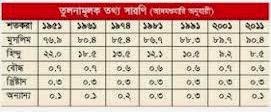
The recorded change in Hindu-Bangladeshi population: 22% (1951), 18.5% (1961), 13.5% (1974), 12.1% (1981), 10.5% (1991), 9.2% (2001) and 8.5% (2011), see below for more details and links. We have faith in history as a (persistent) teacher, the Hindus will eventually get the message and clear out.
……
……over 9 lakh Bangladeshi Hindus have vanished from the country during the past decade. This has been reported officially by the Bangladesh Statistical Bureau (BSB) and the National Population Research and Training Institute (NPRTI).
Currently, Hindus account for 8.5 per cent of the total population of the country. However, in the 2001 census, the Hindu population of Bangladesh was 9.2 per cent. The Muslim population was 89.7 per cent in 2001, but increased to 90.4 per cent.
The two census reports identified 15 districts in the country where the Hindu population has decreased alarmingly. The institutions were quoted by the speakers as having claimed that the âmissing population have not shifted anywhere in the countryâ…..
…
Professor Abul Barkat of Dhaka University’s Department of Economics, in
his survey on the status of Hindus since independence, found that the
Vested Property Act was the single largest cause of migration of Hindus
from Bangladesh. The law, which allowed the government to possess
property abandoned by those who fled during Partition, soon
metamorphosed into something abused by both citizens and the state.
The study found that 2.01 million acres, comprising 45 per cent of the
land owned by Hindus, was lost due to this Act. Though there were
attempts to amend the law, little has changed. Sustained campaigning on
the issue led to the Awami League government passing the Vested Property
Return Act 2001.
But this law to return appropriated land is caught in
bureaucratic and legal tangles. “When it comes to land, there is no
secularism. All parties have been involved in land grabbing and no one
is keen on implementing this law,” Hossain said.
…..
While fingers will point many different ways in order to diffuse (or deny) the blame for the ongoing ethnic cleansing, we prefer to characterize this process as a tribute to the two nation theory. At least the Hindus have an escape route north, west and east, across the border, do spare a thought about the Urdu speaking “Bihari” Muslim minorities rotting away in Dhaka slums, neither the Islamic Republic of Pakistan nor the secular republic with Islam as state religion Bangladesh have time or space for them.
An important side-effect of TNT may be observed in the recent by-polls in India (held after the Lok Sabha elections in May). In most cases the BJP lost miserably all across India – Bihar, Uttar Pradlesh, Uttarkhand, Rajasthan and Karnataka. Even in Gujarat BJP has under-performed. But there is a bright spot: victories in Basirhat Dakshin in West Bengal and Silchar in south Asom. Both are regions bordering Bangladesh and the rise of the BJP shows that the migrant Hindus have abandoned the “secular” formulations (Trinamool Congress and the Communists) and voted in favor of the Hindu-Hindi party. In its own way (and in not a good way) this is a sign for the times to come.
….
Bangladesh’s
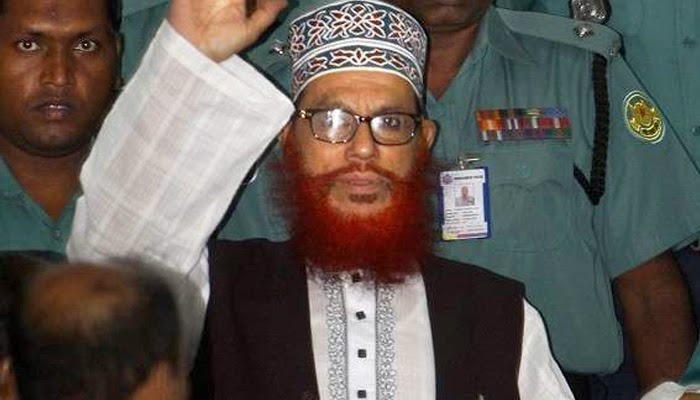
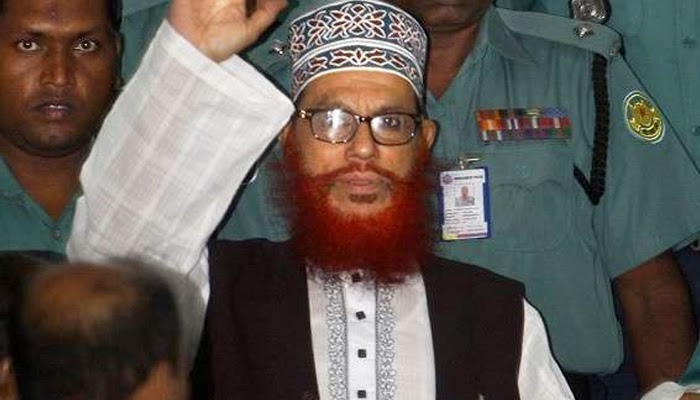
Supreme Court on Wednesday commuted the death sentence of Delwar
Hossain Sayedee, a top Islamist preacher whose sentencing last year
triggered the deadliest political violence in the country’s history, ,
to life term.
In a surprise ruling, the court said Sayedee
should spend “the rest of his natural life” in jail, attorney general
Mahbubey Alam said. “We had expected that the court would uphold his death sentence,” Alam told reporters.
Lawyers for Sayedee said they were not satisfied with the court’s
ruling on the 74-year-old, who was convicted last year on eight counts
including murder, rape and persecution of the country’s minority Hindu
community. “He should have been acquitted of all charges as the
case was tainted by a number controversies,” Khandaker Mahbub Hossain
told reporters.
Last February’s judgement by a war crimes court
triggered weeks of bloody protests left more than 100 people dead and
plunged the impoverished nation into a major crisis.
Security
was tightened nationwide ahead of Wednesday’s ruling, with thousands of
police, the elite security force, Rapid Action Battalion, and the
paramilitary border guards being deployed in major cities and towns.
Sayedee, vice-president of the Jamaat-e-Islami party, was one the
country’s most popular Islamic preachers with millions of followers. In his heyday he would draw hundreds of thousands to his preaching sessions, and CDs of his speeches were top sellers.
He has said the original judgement was influenced by “atheists” and pro-government protesters who wanted to see him executed.
…
Link (1): timesofindia.indiatimes.com/Bangladesh-court-commutes-top-Islamists-death-sentence
Link (3): timesofindia.indiatimes.com/Door-out-of-Dhaka
Link (4): facebook.com/after-pakistan-bangladesh-will-be-almost-hindu-less-nation-soon
…
regards
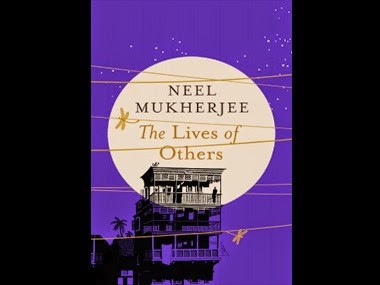
The lives of peasants
focus of an animal filled with itself and itself only…..pushes him
against the mud wall and drives the curve of the blade with all the
force in his combusting being…This time the blood, a thin, lukewarm jet, hits him full on his
face…
…
Earlier it was feudalism. Now it is globalization. Even the so-called elites have very little control over their lives. If you are looking for a profession where you will never run out of clients (and money) try being a psychiatrist. The ones we know have one mile long queues in front of their office- clients suffering from unbearable stress of having great expectations (from ourselves, from our near and dear ones) in an uncertain and unforgiving world.
……
….
None of the above excuses the utterly horrific conditions in which peasants continue to lead their lives. If we enjoy living in a liberal democracy (however flawed) and not suffer from armed revolutions the elites will need to share. Every man, woman and child must be guaranteed dignity of life (and labor). To take just one example, all communities (and local governments) should learn from the example set forward by the Sikhs and adopt a no beggar policy.
The days of dividing and misruling are mostly behind us, as the BJP has discovered in the recently held by-poll(s) shocker – losing 9-2 to Samajwadi Party in Uttar Pradesh and 3-0 in Uttarakhand and 3-1 in Rajasthan to a Congress party which is supposedly dead and buried. We live in hope for a better tomorrow, but there will be many a (non-fictional) Nitai Das who need help now and are unable to wait.
…..
A third of the way through the half-mile walk from the landlord’s house
to his hut, Nitai Das’s feet begin to sway. Or maybe it is the head-spin
again. He sits down on the lifeless field he has to cross before he can
reach his hut. There isn’t a thread of shade anywhere.
…
The May sun is
an unforgiving fire; it burns his blood dry. It also burns away any
lingering grain of hope that the monsoons will arrive in time to end
this third year of drought. The earth around him is beginning to fissure
and crack. His eyelids are heavy. He closes them for a while, then, as
sleep begins to take him, he pitches forward from his sitting position
and jolts awake. Absently, he fingers his great enemy, the soil, not
soil any more, but compacted dust. Even its memory of water has been
erased for ever, as if it has never been.
He has begged all morning outside the landlord’s house for one cup of
rice. His three children haven’t eaten for five days. Their last meal
had been a handful of hay stolen from the landlord’s cowshed and boiled
in the cloudy yellow water from the well. Even the well is running dry.
…
For the past three years they have been eating once every five or six or
seven days. The last few times he had gone to beg had yielded nothing,
except abuse and forcible ejection from the grounds of the landlord’s
house.
…
In the beginning, when he had first started to beg for food, they
shut and bolted all the doors and windows against him while he sat
outside the house, for hours and hours, day rolling into evening into
night, until they discovered his resilience and changed that tactic.
Today they had set their guards on him. One of them had brought his
stick down on Nitai’s back, his shoulders, his legs, while the other one
had joked, âWhere are you going to hit this dog? He is nothing but
bones, we don’t even have to hit him. Blow on him and he’ll fall back.’
Oddly, Nitai doesn’t feel any pain from this morning’s beating. He knows
what he has to do. A black billow makes his head spin again and he
shuts his eyes to the punishment of white light.
All he needs to do is walk the remaining distance, about 2,000 hands. In
a few moments, he is all right. Some kind of jittery energy makes a
sudden appearance inside him and he gets up and starts walking. Within
seconds the panting begins, but he carries on. A dry heave interrupts
him for a bit. Then he continues.
His wife is sitting outside their hut, waiting for him to return with
something, anything, to eat. She can hardly hold her head up. Even
before he starts taking shape from a dot on the horizon to the form of
her husband, she knows he is returning empty-handed. The children have
stopped looking up now when he comes back from the fields. They have
stopped crying with hunger, too.
The youngest, three years old, is a tiny, barely moving bundle, her eyes
huge and slow. The middle one is a skeleton sheathed in loose, polished
black skin. The eldest boy, with distended belly, has become so
listless that even his shadow seems dwindled and slow. Their bones have
eaten up what little flesh they had on their thighs and buttocks.
..
On the
rare occasions when they cry, no tears emerge; their bodies are
reluctant to part with anything they can retain and consume. He can see
nothing in their eyes. In the past there was hunger in them, hunger and
hope and end of hope and pain, and perhaps even a puzzled resentment, a
kind of muted accusation, but now there is nothing, a slow,
beyond-the-end nothing.
The landlord has explained to him what lies in store for his children if
he does not pay off the interest on his first loan. Nitai has brought
them into this world of misery, of endless, endless misery. Who can
escape what’s written on his forehead from birth? He knows what to do
now.
He picks up the short-handled sickle, takes his wife by her bony wrist
and brings her out in the open. With his practised farmer’s hand, he
arcs the sickle and brings it down and across her neck. He notices the
fleck of spit in the two corners of her mouth, her eyes huge with
terror. The head isn’t quite severed, perhaps he didn’t strike with
enough force, so it hangs by the still-uncut fibres of skin and muscle
and arteries as she collapses with a thud. Some of the spurt of blood
has hit his face and his ribcage, which is about to push out from its
dark, sweaty cover. His right hand is sticky with blood.
The boy comes out at the sound. Nitai is quick, he has the energy and
focus of an animal filled with itself and itself only. Before the sight
in front of the boy can tighten into meaning, his father pushes him
against the mud wall and drives the curve of the blade with all the
force in his combusting being across his neck, decapitating him in one
blow. This time the blood, a thin, lukewarm jet, hits him full on his
face. His hand is so slippery with blood that he drops the sickle.
Inside the tiny hut, his daughter is sitting on the floor, shaking,
trying to drag herself into a corner where she can disappear. Perhaps
she has smelled the metallic blood, or taken fright at the animal moan
issuing out of her father, a sound not possible of humans.
…
Nitai
instinctively rubs his right hand, his working hand, against his
bunched-up lungi and grabs hold of his daughter’s throat with both his
hands, and squeezes and squeezes and squeezes until her protruding eyes
almost leave the stubborn ties of their sockets and her tongue lolls out
and her thrashing legs still. He crawls on the floor to the corner
where their last child is crying her weak, runty mewl and, with
trembling hands, covers her mouth and nose, pushing his hands down,
keeping them pressed, until there is nothing.
Nitai Das knows what to do. He lifts the jerrycan of Folidol left over
from three seasons ago and drinks, his mouth to the lip of the plastic
canister, until he can drink no more. His insides burn numb and he
thrashes and writhes like a speared earthworm, thrashes and writhes, a
pink foam emerging from his mouth, until he too is returned from the
nothing in his life to nothing.
….
Link: http://www.firstpost.com/printpage.php?idno=1714685&sr_no=0
…..
regards
Pakistan: Weimar Republic of Asia?
More than 3 years ago I wrote a piece asking whether Pakistan is a failed state or the Weimar Republic? At that time, i was still an optimist and thought it was probably neither. But I did say at the end: (the original article is at the end of this post, to see it with hyperlinks go to http://www.3quarksdaily.com/3quarksdaily/2011/03/pakistan-failed-state-or-weimar-republic-omar-ali.html#sthash.0aDDDW0f.dpuf ).
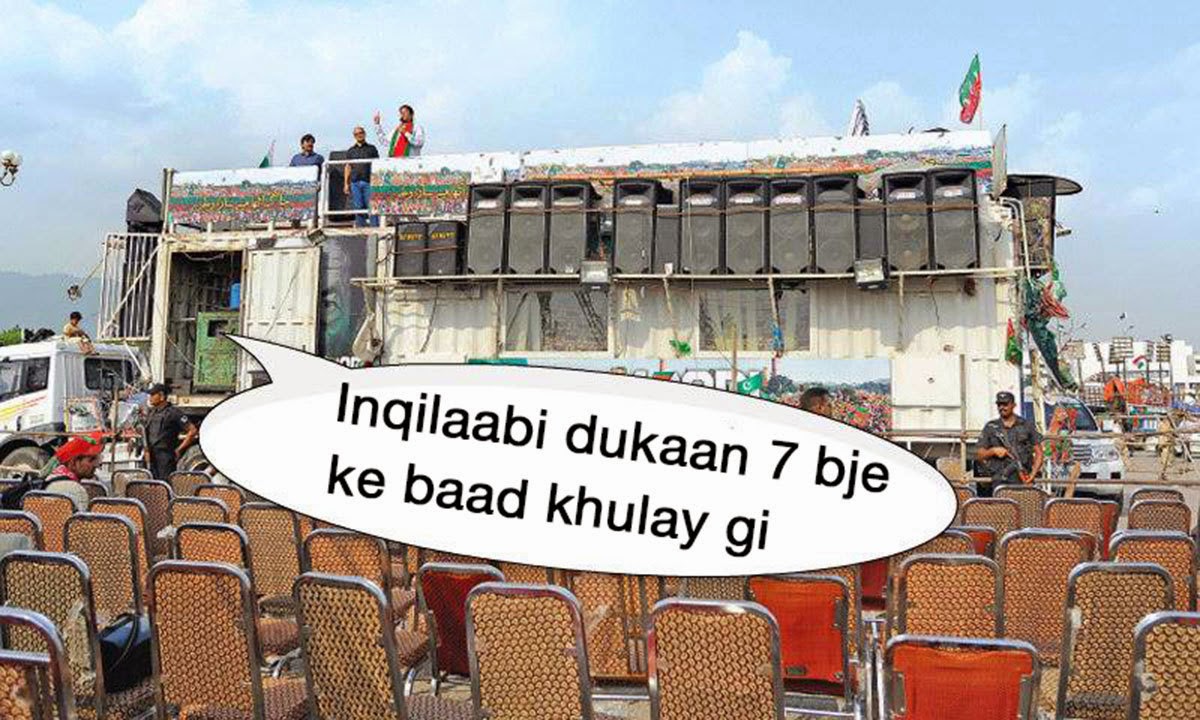
So much for the optimistic version. Since this is a post about Pakistan, it cannot end without some pessimism. The most dangerous element in Pakistan today is not the Islamist fanatics. It is the rise of China. Not because the rise of China threatens Pakistan or because Chinese hyper-capitalism or cheap Chinese products threaten our industry or our social peace or any such thing, but because it may inflate the egos of the military high command to the point that they lose contact with reality and try a high jump for which we are not yet ready (and may never be ready). Itâs not that the high jump will get anywhere, but that the attempt may lead us into more trouble than we can handle. Jf 17 thunder
I say this because GHQ, for all its pragmatic pretensions, has been known to overestimate their skill and underestimate their opponents. If China was not truly a rising power, and if Pakistan did not have some real assets and advantages, we might have been safer in the long run. But since there is an element of truth in the paknationalists notions about China and the changing global balance of power, they may lose their balance. All I am saying is GHQ is prone to flying off on a self-generated hot air pocket even when the situation does not encourage such optimism. When the situation actually has some positive aspects, there may be no restraining them. But, I remain an optimist. I think our own weaknesses may protect us from the fate of a much stronger and more capable country (Germany in 1940).
This year, things have taken a turn for the worse. According to a report (written months ago, so not cooked up after the event), a plan was hatched in London to depose Nawaz Sharif and bring in a new government under the supervision of the army. Who knows what the real details of the plot are (it may be that the army chief, for example, was not involved, but only some generals and retired adventurers put the script together) but it hit a snag on 14th August when Imran Khan failed to deliver his promised 100,000 motorcyclists to the “Azadi March”. But not to be deterred by poor crowds, he has kept up the show and the civilian institutions of the state have failed to establish their writ in spite of court orders and blatant violations of the law by Imran Khan and Qadri (including a raid on a police station by Imran Khan himself, to free PTI workers being held there). Whether this failure is due to incompetence, collusion or fear of the army (likely all three), the insistent drumbeat of speeches (and their 24-7 amplification by most news channels) in Islamabad continues and the central government looks weak and ineffectual in spite of the support of most established political parties. This is not necessarily considered a negative in Pakistan, where the government, the police, the courts and the political parties are all corrupt to varying degrees and all have their hand in robbing and insulting the citizenry on a daily basis. In fact, some leftists (and not just leftists) who are not necessarily fans of Imran Khan or Qadri cannot help but be delighted by the scenes of policemen getting beaten up and “high authorities” looking like fools.
But unfortunately (or fortunately, if you happen to think that the demise of Pakistan is in fact a desirable outcome and the sooner the better) this humiliation is not being meted out to bring about more democracy or a Bolshevik revolution (itself a most undesirable event as far as I am concerned, but i am sure many friends disagree with that) but to bring in a new cycle of military rule (this time using the “Bangladesh model” of technocrat govt to mask the “military” part) and Paknationalist cleansing. This is an old dream. Since Pakistan does not seem to conform to the dreams of “true Pakistani nationalists” (too much “disorder”, too many dirty politicians, too much “provincialism”, too little discipline and too few white rings on trees) there is a recurring desire to try and clean the place up (the “Chakwal solution”). Shoot the corrupt politicians. Bring in “clean people”. Break up existing provinces with their linguistic and cultural identities and replace them with “more efficient smaller provinces” and “pure Pakistani culture”. Get rid of “Indian culture”. etc etc….of course there isnt just ONE dream. In actual practice, the dreamers have many different dreams. Some want an end to “fake democracy”. Others want an end to democracy, period (“no political parties in Islam”). Some want Swedish Social Democracy but with more Islam and fewer naked women. Some want organic farming (with “extra people” being exported elsewhere perhaps, so that some sort of Vandana Shiva paradise can be re-established with a pre-1960 population level) while others want modern progressive agriculture (Jahangir Tareen). Some want to cut off the hands of thieves (with future troublemakers, but not the current lot, having their hands and feet cut off on opposite sides, as per Quranic recommendations) while others just want more handouts. But the dreams converge on the desire to destroy the current “system” and replace it with a better one. Oh well, I guess the phrase I am looking for is “useful idiots” and lets leave it at that..
But thats not what triggered this post. What triggered this post is the notion that all this is itself a symptom of that good old social phenomenon “things fall apart”. It used to be the case that a general would just poke the president in the ribs and send him on his way (Sikander Mirza, literally poked in the ribs to encourage him to leave) and the political class and civil service would (overwhelmingly) fall in line and take orders. That was in “old Pakistan”. That fell apart in 1971, but new Pakistan retained the institutional characteristics and ideological peculiarities of old Pakistan (in fact, they became more concentrated once the inconvenient Bengalis exited Jinnah’s dream palace). General Zia conducted his coup without any fuss. Sure, he then had to hang Bhutto and flog tens of thousands to keep the show on the road, but at least the civil service remained fully loyal (Roedad Khan rising to become secretary general of the interior before retiring and writing about dreams going sour and now joining Imran Khan!). Generals Aslam Beg and Waheed KakaR did their thing via President GIK but by 1999 things were messier. At least one general went along with an attempted pre-emptive strike on the army by the prime minister before the old ways prevailed. But even that was smooth sailing compared to this farce. Now the army chief may not even be the main conspirator! Retired generals and (perhaps, if even half the rumors are true) some soon to be retired ones are trying one thing, the chief is trying another. The good old bureaucracy has long since splintered into various camps. The police is looking shaky. Old reliables of the deep state are present on all sides of the “revolution” and cannot seem to agree on one deep state script. The corrupt politicians are proving surprisingly resistant to “positive change”. Journalists are in opposing camps. Media houses are openly fighitng each other. Even the main actors (Imran Khan and Qadri) dont seem to be on the same page. And to top it all, Punjab has one set of priorities and all the other provinces seem to have very different ones, not just amongst the people (where it was always thus perhaps) but even among the leaders of those provinces. Even the Taliban are not united any more. Is this a good sign or a bad sign?
In the short term, it must count as a bad sign. Whatever your politics (and if you are reading this in English on the internet, your politics are likely to be either paknationalist or leftist…or both; cognitive dissonance is not just a river in Egypt) the country as a functioning state needs certain institutions to function at bare minimum levels. Last year there was even hope that in Pakistan those institutions may be strengthening and may now include a superior judiciary, an election commission and a parliament, but thanks to Imran Khan and his “youthful” supporters, all that has been delegitimized very thoroughly. Still, that is India-level dreaming, forget about that. What about having a police force and a civil adminstration? what if you no longer have those either? that has not happened yet, but both are being battered as we speak. No big deal you say. They are corrupt, incompetent and useless anyway…mostly true, but then, they are all we have. What happens when they are gone? Some army officers and their cousins (which covers most of the Punjabi middle class) are probably going “you forget the army”, but no, I didnt forget them. The army is the pride of Pakistan. Still disciplined, united, well armed, etc etc. But there has NEVER been a martial law in which they actually ran things at the local level. The country has always run (and never run too well, but it is what it is) using the civilian instittutions of the British Raj. Ideally, the aim would have been to remodel them over time into improved versions suitable for an independent democratic country, but what with ideological confusion and martial laws, that never really happened. So OK, they are pretty bad by now, even compared to British Raj standards. But they are all there is. Lose them and its over, Even if root and branch replacement is someone’s aim, no replacement actually exists, so the question is academic.
Are we heading for that point? Please give your opinion in the comments.
My own feeling: we are headed that way and if this goes on, it could become irreversible. I am an incorrigible optimist, so I dont think its too late yet. If MNS survives AND actually learns some lessons and rules a little better (less reliance on police and gangsters, more inclusive and responsive government) AND his victory pushes intelligence agencies a little on the back foot, then institutions may come out a little stronger and more secure. But that seems increasingly unlikely (perhaps it always was, I dont know). If he does not survive this and we are to host the Bangladesh model, then things will look better for a few months (at most), then decay much faster than before as the emperor is seen to have no clothes. That will then lead to Paknationalists “doubling down”, with the possibility that the full Chakwal solution may finally be attempted. Provinces will be broken up, political parties will be decapitated. “Bad journalists” and intellectuals will be arrested or exiled. The ideological vacuum will be filled with Paknatinalism, which is just too shallow and confused a construct on which to base a successful state. Chaos and/or war with India will follow as the cart follows the horse.
Too pessimistic? What do you think?
The old article from 2012 follows.
PAKISTAN: FAILED STATE OR WEIMAR REPUBLIC?
by Omar Ali
I recently wrote an article with this title that was triggered by a comment from a friend in Pakistan. He wrote that Pakistan felt to him like the Weimar Republic: An anarchic and poorly managed democracy with some real freedoms and an explosion of artistic creativity, but also with a dangerous fascist ideology attracting more and more adherents as people tire of economic hardship and social disorder and yearn for a savior. While the Weimar comparison was new to me, the âfailed stateâ tag is now commonplace and many commentators have described Pakistan as either a failed state or a failing state. So which is it? Is Pakistan the Weimar republic of the day or is it a failed state? For my initial answer, you can read the article in the News, but when that article was circulated among friends, it triggered some feedback that the blog format allows me to use as a hook for some further discussion and clarification.
Some friends disagreed with my contention that Weimar Germany was too different to be a useful comparison. Germany and Pakistan may indeed be apples and (very underdeveloped) oranges, but the point of the analogy was that the current artistic and creative ferment in Pakistan is not sustainable and just as the Weimar Republic fell to fascism (not to state collapse), Pakistanâs current anarchic spring is a prelude to fascism.
Itâs a fair point, but I think the crucial difference between Pakistan and Weimar Germany that I should have highlighted is the decentralized and broken up nature of the polity, with so many competing power centers that it is very hard to imagine a relatively modern fascist takeover (which, I assume, is the danger we are being warned against).
To make this point clearer, letâs look at the power that is supposed to be the agency of incipient fascism in Pakistan; Liberals who fear a fascist takeover almost universally regard the military high command as the center of this fascist network. They may regard the Jamat e Islami, with its long history of organizing thuggish student and labor wings, its close alliance with the jihadist faction of the army, and its systematic (islamicized) fascist ideology, as the ideological center of such a takeover. But they expect the army and its intelligence agencies to be the actual executors of Pakistani fascism. Thus, they point towards army apologists like Ahmed Qureshi and Zaid Hamid as propagandists who are preparing the ground for this supposed takeover.
But a closer look reveals a vast gulf between anarchic and incompetent reality and slickly presented âpaknationalistâ propaganda. The armyâs âIslamist-fascistâ wing has been pushed back by 10 years of American vetting of the high command that makes it hard to imagine a successful Islamist version of fascism. Of course, some leftists accept that, but believe that the threat was never from âIslamo-fascismâ, but from good old fashioned fascism in the German and Italian mode, led by army officers in Western uniforms, not by the beards and their gangs. But that leads to two other problems; one is ideological, i.e. what will be the ideology of this fascist takeover? In Germany and Italy it was German and Italian nationalism, but Pakistani nationalism minus Islam is still too incoherent to be useful for this purpose (which is why the small sliver of educated westernized paknationalists who flock around army websites are so ineffectual and confused). But the critical missing component is not ideology (which can be created from very thin gruel if needed), the critical missing component is capacity; the army cannot even control its own agents in the tribal areas and South Punjab. It could not fix the electrical grid after running the system unchallenged by civilians for almost ten years. Its ministers and trouble-shooters ran a semi-functional Pakistan Railways into the ground during a similar period of direct military control. Even during martial law, they are forced to make deals with corrupt and useless politicians to keep other corrupt and useless politicians at bay. This, in short, is the gang that cannot shoot straight. They may be more capable in some areas than their detractors imagine (witness the efficient handling of the Raymond Davis families by the ISI or their ability to make nuclear bombs or advanced aircraft) but they really cannot make the trains run on time even if they do take over again. Their strong points are limited to a few areas (very good at milking their foreign patrons, for example) but their weak points are far too many and are getting worse. The threat is less serious than imagined.
A lot of feedback comes from the opposite extreme: the people who are convinced that Pakistan is on an unstoppable slide to disaster. To these people, the army is less capable than I indicated. Since they believe that all other institutions have already become junk, the army is the last wall standing between the current disorder and total state collapse, and the army is not immune to decay. Since the army has been ruling the country in one form or the other for decades, it has become politicized and discipline, morale and professional competence are deteriorating. Add to that the fact that the army is now fighting a civil war against the very elements it created and lionized for years and is doing so without any ideological framework beyond conspiracy theories about Hinjews and CIA agents. This situation is not sustainable and the army itself will crash and burn at some point, with horrific consequences. Meanwhile, the country is splitting further on ethnic and sectarian lines and is always one step away from economic chaos. No one, not the army, not the mainstream political parties, not the intelligentsia, has a coherent framework in which they can disengage from Islamist millenarian dreams and rebuild the country as a more normal country âdevelopingâ country.
Again, some of the points are fair points, but I think the doom and gloom may be exaggerated. First of all, it is very hard to break up a modern post-colonial state. Itâs been done, but it is not easy and it is not the default setting. The modern world system is heavily invested in the integrity of nation states and while some states do fail in spite of that, this international consensus makes it difficult to get agreement on any rearrangement of borders. In most cases, distant powers as well as surrounding neighbors find it more convenient to find ways to compromise within existing borders. Even a spectacular failure, like the collapse of the Soviet empire, actually ends up validating already existing borders rather than creating entirely new ones. The supranational structure of the Soviet Union collapsed, but its component nations remained almost entirely within their existing borders. In this sense, Pakistan does not have 4 separate ethnically and culturally distinct units joined by weak supra-national bonds. Even an extremely unhappy component like Baluchistan is not uniformly Baloch. In fact, Balochis are probably no more than half the population of that province. Sindh contains large and very powerful Mohajir enclaves that do not easily make common cause with rural Sindh. More Pakhtoons live in Karachi than in the Pakhtoonkhwa capital of Peshawar. Economic and cultural links (especially the electronic media) unite more than they divide. If nothing else, cricket unites the nation. In addition, the reach of modern schooling and brainwashing is not to be underestimated. Even in far flung areas, many young people have grown up in a world where Pakistani nationalism is the default setting.
Economically, the country is always in dire straits, but agribusiness and textiles are powerful sectors with real potential. More advanced sectors can easily take off if law and order improves a little and irrational barriers with India are lowered a little bit. The nation state is not as weak as it sometimes appears to be.
So much for the optimistic version. Since this is a post about Pakistan, it cannot end without some pessimism. The most dangerous element in Pakistan today is not the Islamist fanatics. It is the rise of China. Not because the rise of China threatens Pakistan or because Chinese hyper-capitalism or cheap Chinese products threaten our industry or our social peace or any such thing, but because it may inflate the egos of the military high command to the point that they lose contact with reality and try a high jump for which we are not yet ready (and may never be ready). Itâs not that the high jump will get anywhere, but that the attempt may lead us into more trouble than we can handle.
I say this because GHQ, for all its pragmatic pretensions, has been known to overestimate their skill and underestimate their opponents. If China was not truly a rising power, and if Pakistan did not have some real assets and advantages, we might have been safer in the long run. But since there is an element of truth in the paknationalists notions about China and the changing global balance of power, they may lose their balance. All I am saying is GHQ is prone to flying off on a self-generated hot air pocket even when the situation does not encourage such optimism. When the situation actually has some positive aspects, there may be no restraining them. But, I remain an optimist. I think our own weaknesses may protect us from the fate of a much stronger and more capable country (Germany in 1940).
– See more at: http://www.3quarksdaily.com/3quarksdaily/2011/03/pakistan-failed-state-or-weimar-republic-omar-ali.html#sthash.0aDDDW0f.dpuf
“Malik sahab, sorry…go back”
suffered….It is your fault, sir” …..“Malik sahab, you are not a minister any more….And even if you are, we don’t care…Anymore”….
..
A most refreshing bit of news out of Pakistan. The golden rule is that the planes must wait, the traffic must halt, the queues must give way for the elite class in South Asia. This is especially true if the man (it is usually a man) has taken a public vow to serve the public. Cheers are due when the suffering commoners take a stand against their high-handed overlords. It will be even better if this causes people to introspect. Bravo!!!
…
……
Angry passengers on board a PIA flight stopped former interior minister
Rehman Malik and a Hindu lawmaker of the ruling PML-N from boarding the
plane, accusing them of causing over two hours of delay.
..
The Islamabad-bound Pakistan International Airlines flight PK-370 from
Karachi was delayed by two and a half hours yesterday as it kept
waiting for the arrival of Pakistan People’s Party (PPP) senator Malik
and National Assembly member Dr Ramesh Kumar Wakwani.
When they finally came, the passengers stopped them from boarding the aircraft.
According to a video clip repeatedly shown by the local media,
passengers were shouting at Malik who was filmed going back hurriedly
when confronted by the passengers.
…
“Malik sahab, sorry. You should go back. You should apologise to these
passengers. You should be ashamed of yourself…250 passengers have
suffered because of you. It is your fault, sir,” a passenger was heard
saying in the clip.
…
“Malik sahab, you are not a minister any more. And even if you are, we don’t care…Anymore,” he said.
…
The clip, which has gone viral online, showed passengers booing and ridiculing the lawmakers as the crew also joined them.
Kumar was not shown in the video but Dawn reported that he was also not allowed to board the plane.
PIA spokesperson Mashood Tajwar speaking to Dawn denied the flight was
delayed because of Malik and said that shift manager Nadeem Abro and
terminal manager Shehzad Khan have been suspended due to the delayed
take-off of PK-370.
…
“PIA does not promote VIP culture…But this flight was delayed an hour and 30 minutes due to a technical reason,” Tajwar said.
After the initial delay which was due to technical reasons, the plane
was delayed for a further 15 to 20 minutes and they have been suspended
for this delay, he claimed.
…
“The delay had been conveyed to passengers via SMS. Some passengers who
had given the contact details of their travel agent may not have been
conveyed the message by their agents,” Tajwar said. He said the plane
took off at 8:55 pm last night.
….
“The flight was not delayed because of Rehman Malik. We are looking into
what actually happened but after the delay, the flight departed when
it was meant to,” he added.
…
Meanwhile, Malik today denied on Twitter he was responsible for the
delay while Wakwani told PTI he only reached the airport after informed
by PIA staff when the flight was going to take off.
“I had confirmed before leaving for the airport if the flight was on
time and when it was delayed, I adjusted my plans accordingly,” Wakwani
said.
….
Link: http://www.outlookindia.com/news/printitem.aspx?860135
….
regards
Made (for India) in Pakistan
have been popular there…..does that mean we have to
modify our content to suit their tastes?….If only the answer was a simple
binary choice…..One cannot peel away all the layers of history within a
single article….money is as real today as
it was in 1947…..
…
Adi Abdurab (head screenwriter for the TV series Burka Avenger) has raised an important question which has implications on cross-border cultural exchanges (and the impact thereof).
…
……
[ref. Wiki] Burka Avenger is a multi-award winning Pakistani animated television series created and directed by famous Pakistani rock star and social activist, Aaron Haroon Rashid. The show features Jiya, an “inspirational teacher” whose alter ego is a burka-wearing superheroine. Jiya uses “Takht Kabaddi”, a special martial art
that incorporates books and pens, to fight crime. The Urdu language series first aired on 28 July 2013.
…….
Our feeling is that Adi Sahib is unduly worried about Pakistani culture losing its way and getting merged with India, though we agree that Pakistanis have the right to be paranoid.
The PTV serials which are making waves in India are doing so because of fascination with a conservative culture and old-fashioned Punjabi, which appeals to an older generation in North India (and may also appeal to youngsters looking for something different). As such these productions already meet the “something different to digest instead of the same drudgery” standard that Adi claims to be aspiring for.
….
That said some cross-border no-no-s do exist. Pakistani movies that depict a thumping victory over evil Indians on (or off) the battlefield will not work in India (and vice versa). As to the critique that an excess of rona-dhona is necessary to melt Indian hearts, we are not convinced. There have been a number of Indian movies of late starring Vidya Balan which are not tear-jerkers (Bobby Jasoos, Kahani) and which have been fairly successful.
How about a Hindu boy – Muslim girl romance (or the other way around)? That formula has been made to work in India of the past, though we are not so sure about today (see Love Jihad). Perhaps this is what Adi means by the “peeling away layers of history” – the fading history of Hindus and Muslims living side by side in imperfect harmony.
We may be wrong but the impression we get about Pakistan today is that any show that highlights minority-majority community bonding (for example, Shia boy – Sunni girl) will not be popular. If true, this points to the nature of the threat(s) facing Pakistan (and the cultural scene): the enemy inside is way more formidable than the one across the border.
There are also places where Adi contradicts himself: if we accept that 10% of India (market wise) will be more sizable than Pakistan (his words), then it is not just a secondary market (his words again) anymore. Indeed this is exactly the logic which enthuses the cited producer and (as we see it) it is a cause for alarm for Adi.
Also his analogy of Turkey vs. Pakistan with Pakistan vs. India is not credible – the cultural distance between Pakistan and India is less than that which exists between Pakistan and Turkey. Then again this IS the root cause of paranoia. In a few decades Pakistanis will stop worrying about Indian cultural imperialism (while embracing Arabic cultural imperialism).
Finally, back to the Burka Avenger. As we understand it, this serial has been appreciated internationally. It is a smart way to undermine the patriarchy that permeates all of South Asia. Adi Sahib should just continue the good work and make movies/shows about strong women (who of course will not cry even under the most trying circumstances). We are sure that such a product will be a success in Pakistan, India and beyond. Best of luck!!!
…..
prevailing notion was that we need to make something that sells well in
India. The producers were willing to go to any lengths to ensure that
outcome; from hiring Indian actors to outsourcing key production tasks.
This got me thinking:
Bollywood already makes their own
blockbusters, so why would they patronise what would, at best, be our
tribute to them? We already have such talented individuals in our own
country; why outsource?
Waar is the most lucrative movie in Pakistani history and not a Bollywood blockbuster. Why not try to replicate that success instead?
To
be clear, this is about introspection, not hate. It’s about learning,
and to that end, I ask you: should Pakistan be making entertainment
primarily for Indian audiences?
Our content is slowly becoming India-centric with each passing
iteration, simply because we are gaining traction there.
..
Zindagi Gulzar Hai was picked up
for regular telecast. Our actors work there frequently, our musicians
have been popular there for decades now. So, does that mean we have to
modify our content to suit their seasoned tastes? Should we not be
giving them something different to digest instead of the same drudgery
they can just source locally?
If only the answer was a simple
binary choice. One cannot peel away all the layers of history within a
single article, so I won’t even try. However, money is as real today as
it was in 1947, so let us look at it from a strictly business
perspective.
India has a population of just over 1.25 billion.
For such a massive audience, even 10 per cent penetration generates more
business than the Pakistani average. It makes perfect sense to market
(even pander) to that region.
For the same outcome, we should put
serious efforts in making our content more commonly available in China,
even a tiny portion of those accumulated eyes on our product will be
more than what Game of Thrones does on a good day.
The
cardinal rule of business is that you donât turn away a paying
customer. If any country wants our content, it should be sold happily â
there canât be any limitations there.
However, they remain a
secondary market. Our primary market is Pakistan. If we prioritise the
secondary market, our content will lose traction in the primary market. To simplify, we cannot hope to sell a product in any international market if it fails to succeed locally.
But
what’s happening is that producers and writers are creating bipolar
content: content that has shifted focus to generic situations that
translate well across the border featuring the likes of atypical
relationships and oh so much crying; trumping content pertinent to
Pakistanis on a personal level.
To put it into perspective, imagine the immensely popular Turkish dramas turning into something akin to Humsafar and Bulbulay. That
is very unlikely because these shows are designed to generate business
in Turkey. Whatever business they do here is a bonus. India might be a
huge market, but it is still just that â a bonus.
In recent times,
everyone from Nusrat Fateh Ali Khan, Adnan Sami Khan, Junoon and Ali
Zafar built their personal brands first. They did not start out by
creating music specifically for India. They created original content
that made such a huge impact it was felt over the border.
With regards to cinema, our films are rapidly anchoring themselves to what are rather disjointedly named as âitem songsâ.
In
the meeting with the aforementioned producer, there was talk of hiring
an international studio for CG work, even though there are studios in
Pakistan which had successfully worked for illustrious projects like Spiderman 3, Tomb Raider, Discovery Channel, Audi Ad campaigns to quote a few examples.
Oneâs
identity should be a matter of pride, especially when catering to the
whims of Pakistani audiences has proven profitable in the past. Content
creators should not water at the mouth so voraciously at the prospect of
taking it across the border that they end up trampling our own
audiences to get there.
We have spent a lifetime cultivating our own identity, and fickle as it’s often made out to be, it does exist. When
we refuse to take ownership of it, others impose their presumptions. If
we work harder at pleasing the world over ourselves, we risk losing
both. And that would be really bad for business.
…..
Link: dawn.com/should-pakistani-entertainment-cater-to-india
…..
regards
TCS bats for (Saudi) women
In Saudi Arabia the goal is to help women (who are presently unable to step out of the house without a male relative) to be trained in “communications, presentation skills,
corporate etiquette, global culture and MS Excel skills” and encourage them to join the brave new world of back-office workers who may not be male and who are not relatives (but presumably still virtual and kosher).
…..
Indian IT bellwether TCS Sunday opened the first
all-women back office centre in Riyadh, Saudi Arabia, in partnership
with GE and Saudi Aramco. The 3,200-square metre business process centre will offer jobs for
3,000 Saudi women for customers like oil major Saudi Aramco and the
US-based General Electric (GE) in the desert kingdom over the next three
years.
…
“The back office, which is supported by the Saudi government’s human
resources development fund programme, strengthens job creation and
economic diversification,” the global software major said in a statement
here. The centre will provide specialised finance and accounting, human
resources, materials supply and office services to improve operational
efficiency.
….
“Skills, talent and technology converge at the centre, marking a new
era for the IT and business process services industry in the kingdom,”
Tata Consulting Services (TCS) CEO and managing director N.
Chandrasekaran said on the occasion.
…
Saudi Minister of Commerce and Industry Tawfiq bin Fawzan Al Rabiah,
Saudi Arabian general investment authority deputy governor Prince Saud
bin Khalid, Saudi Aramco chief executive Khalid Al Falih and GE
vice-chairman John Rice were present at the centre’s inaugural event.
…
“The centre brings significant value to our economy and helps address
the challenge of creating jobs for talented and skilled Saudi female
graduates, establishes a diverse workforce and boosts our
competitiveness,” Al Falih said.
…
With TCS’s domain expertise in providing shared services the world
over, including its customers in the kingdom, the centre will focus on
its core competencies. “We thank our partners Saudi Aramco and GE and look forward to their
support to scale up operations at the centre,” Chandrasekaran noted.
Both partners have hired 100 women each and transferred their back office services to the centre. “The centre is a proof of our commitment to support the kingdom in
human capital development and job creation for its women,” Rice said.
In the first phase, about 300 women employees were given intensive
training in various disciplines. Of them, 90 percent are fresh graduates
and the remaining have two-to-four years of experience in back office
operations. They were chosen from King Saud University, Princess Noura University
and Imam University from 1,200 candidates interviewed for the jobs.
“The recruits were trained in communications, presentation skills,
corporate etiquette, global culture and MS Excel skills to ensure
highest levels of service efficiency,” the statement added.
….
Link: https://in.finance.yahoo.com/news/tcs-opens-women-back-office-141218895.html
…..
regards
The “rockstar” Gandhi
sari and a shawl the color of rust….âWe would
have no hunger in the world if the seed was in the hands of the farmers….They want to take that awayâ…..Shiva argues that the prevailing model of industrial
agriculture….places an
unacceptable burden on the Earthâs resources….Shiva has contempt for farmers who plant monocultures….âThey are ruining the planet…..They are
destroying this beautiful worldâ….
….
The list of power ladies from India who carry high name recognition in the West (and the rest) reads as follows: (1) Arundhati Roy, (2) Vandana Shiva, (3) Sonia Gandhi, and (4) Mother Teresa. For people keeping score we have (3) christians and (1) brahmin, also (2) are naturalized citizens.
How about the others? Indira Gandhi is probably fading from memory, even as Mayawati rises as a Dalit icon (she will need to capture the Red Fort for true greatness). We are guessing that not too many westerners know about Indra Nooyi and other corporate bosses.
Indian music and dance do not have (yet) a female Ravi Shankar, even though his first wife Annapurna Devi (born Roshanara Khan, daughter of Alauddin Khan) was more talented and stopped performing because of the unhappiness expressed by her husband. The Shankar progeny Geetali Norah Jones Shankar and Anoushka Shankar would (at most) be recognized as Americans with Indian influences.
Bollywood is a non-starter as well, westerners would barely know a Freida Pinto from a Priyanka Chopra. There was a time when we thought that Kareena Kapoor and/or Aishwariya Rai will break through into Hollywood but what is really needed is a James Bond lady, and there are none that fit the bill right now.
In sports there is (sad to say) no female Sachin Tendulkar (not even a PT Usha) equivalent. Indians barely rate on the sports scene anyway so this is not much of a surprise.
So….what then about Vandana Shiva? VS is a Gandhian (self-declared) in her relentless
opposition to modernity. She is a nuclear physicist (self-declared) who
hates fertilizers (and Monsanto). Gandhi Mark-I was nominated multiple times
for Nobel Peace prize, we hope that Gandhi Mark-II will get her reward at an early date (she is certainly as deserving, if no more, than Obama and the European Union).
Why do people, especially left-liberals in the West (who have benefited the most from the bounties of modernity) love her so much for her love of traditional ways?
…..
Like Gandhi, whom she reveres, Shiva questions
many of the goals of contemporary civilization. Last year, Prince
Charles, who keeps a bust of Shiva on display at Highgrove, his family
house, visited her at the Navdanya farm, in Dehradun, about a hundred
and fifty miles north of New Delhi.
Charles, perhaps the worldâs
best-known critic of modern life, has for years denounced transgenic
crops. âThis kind of genetic modification takes mankind into realms that
belong to God and God alone,â he wrote in the nineteen-nineties, when
Monsanto tried to sell its genetically engineered seeds in Europe……..Shiva, too, invokes religion in her assault on agricultural
biotechnology. âG.M.O. stands for âGod, Move Over,â we are the creators
now,â she said in a speech earlier this year.
…
As we see it, Westerners are genuinely alarmed about the degradation of the environment (and inflation of food prices) if/when billions of third world peasants demand a “western” lifestyle (quadruple delight of chicken, beef, pork, and fish). They would not mind if a few Indian agents can persuade Indians that blind following of the West is immoral. If you are a super-caste woman preaching the virtues of Indian (vegetarian, organic) civilization then more power to you.
…..
PRESIDENT George W Bush angered Indians in May 2008 when he said that
India, where the “middle class is larger than our entire populationâ
the demand for better food had caused â[world] price to go up.”
…
Almost the same day in May, EU Commissioner for agriculture
Mariann Fischer Boel told the European Policy Centre: âThose who see
biofuels as the driving force behind recent food price increases have
overlooked not just one elephant standing right in front of them, but
two. The first elephant is the huge increase in demand from emerging
countries like China and India. These countries are eating more meat…
So a dietary shift towards meat in countries with populations of over 1
billion people each has an enormous impact on commodity markets,â noted
the Danish commissioner.
…….
Under any other circumstance a person like Vandana Shiva would be denounced as Hindu supremacist and a Luddite (the original Gandhi
was very much denounced as such). But these are tough times and the rule-book has changed. Today if you preach against
consumerism by lesser, third-world, people, you are sure to be loved as a
rockstar…a beautiful moon without a single blemish.
……………….
Early this spring, the Indian environmentalist
Vandana Shiva led an unusual pilgrimage across southern Europe.
Beginning in Greece, with the international Pan-Hellenic Exchange of
Local Seed Varieties Festival, which celebrated the virtues of
traditional agriculture, Shiva and an entourage of followers crossed the
Adriatic and travelled by bus up the boot of Italy, to Florence, where
she spoke at the Seed, Food and Earth Democracy Festival.
At each stop, Shiva delivered a message that she has honed for nearly
three decades: by engineering, patenting, and transforming seeds into
costly packets of intellectual property, multinational corporations such
as Monsanto, with considerable assistance from the World Bank, the
World Trade Organization, the United States government, and even
philanthropies like the Bill and Melinda Gates Foundation, are
attempting to impose âfood totalitarianismâ on the world.
…
She describes
the fight against agricultural biotechnology as a global war against a
few giant seed companies on behalf of the billions of farmers who depend
on what they themselves grow to survive. Shiva contends that nothing
less than the future of humanity rides on the outcome.
…
âThere
are two trends,â she told the crowd that had gathered in Piazza
Santissima Annunziata, in Florence, for the seed fair. âOne: a trend of
diversity, democracy, freedom, joy, cultureâpeople celebrating their
lives.â She paused to let silence fill the square. âAnd the other:
monocultures, deadness. Everyone depressed. Everyone on Prozac. More and
more young people unemployed. We donât want that world of death.â
The
audience, a mixture of people attending the festival and tourists on
their way to the Duomo, stood transfixed. Shiva, dressed in a burgundy
sari and a shawl the color of rust, was a formidable sight. âWe would
have no hunger in the world if the seed was in the hands of the farmers
and gardeners and the land was in the hands of the farmers,â she said.
âThey want to take that away.â
…
Shiva, along with a growing army
of supporters, argues that the prevailing model of industrial
agriculture, heavily reliant on chemical fertilizers, pesticides, fossil
fuels, and a seemingly limitless supply of cheap water, places an
unacceptable burden on the Earthâs resources. She promotes, as most
knowledgeable farmers do, more diversity in crops, greater care for the
soil, and more support for people who work the land every day. Shiva has
particular contempt for farmers who plant monoculturesâvast fields of a
single crop. âThey are ruining the planet,â she told me. âThey are
destroying this beautiful world.â
…
The
global food supply is indeed in danger. Feeding the expanding
population without further harming the Earth presents one of the
greatest challenges of our time, perhaps of all time. By the end of the
century, the world may well have to accommodate ten billion
inhabitantsâroughly the equivalent of adding two new Indias.
….
Sustaining
that many people will require farmers to grow more food in the next
seventy-five years than has been produced in all of human history. For
most of the past ten thousand years, feeding more people simply meant
farming more land. That option no longer exists; nearly every arable
patch of ground has been cultivated, and irrigation for agriculture
already consumes seventy per cent of the Earthâs freshwater.
…
The
nutritional demands of the developing worldâs rapidly growing middle
classâmore protein from pork, beef, chicken, and eggsâwill add to the
pressure; so will the ecological impact of climate change, particularly
in India and other countries where farmers depend on monsoons. Many
scientists are convinced that we can hope to meet those demands only
with help from the advanced tools of plant genetics. Shiva disagrees;
she looks upon any seed bred in a laboratory as an abomination.
…
The
fight has not been easy. Few technologies, not the car, the phone, or
even the computer, have been adopted as rapidly and as widely as the
products of agricultural biotechnology. Between 1996, when genetically
engineered crops were first planted, and last year, the area they cover
has increased a hundredfoldâfrom 1.7 million
hectares to a hundred and seventy million. Nearly half of the worldâs
soybeans and a third of its corn are products of biotechnology. Cotton
that has been engineered to repel the devastating bollworm dominates the
Indian market, as it does almost everywhere it has been introduced.
….
Those
statistics have not deterred Shiva. At the age of sixty-one, she is
constantly in motion: this year, she has travelled not only across
Europe but throughout South Asia, Africa, and Canada, and twice to the
United States. In the past quarter century, she has turned out nearly a
book a year, including âThe Violence of the Green Revolution,â
âMonocultures of the Mind,â âStolen Harvest,â and âWater Wars.â In each,
she has argued that modern agricultural practices have done little but
plunder the Earth.
Nowhere is Shiva embraced more fully than in the West, where, as Bill
Moyers recently noted, she has become a ârock star in the worldwide
battle against genetically modified seeds.â She has been called the
Gandhi of grain and compared to Mother Teresa. If she personally
accepted all the awards, degrees, and honors offered to her, she would
have time for little else.
…
In 1993, Shiva received the Right Livelihood
Award, often called the alternative Nobel Prize, for her activism on
behalf of ecology and women. Time, the Guardian, Forbes, and Asia Week
have all placed her on lists of the worldâs most important activists.
Shiva, who holds a Ph.D. in philosophy from the University of Western
Ontario, has received honorary doctorates from universities in Paris,
Oslo, and Toronto, among others.
…
In 2010, she was awarded the Sydney
Peace Prize for her commitment to social justice and her tireless
efforts on behalf of the poor. Earlier this year, Beloit College, in
Wisconsin, honored Shiva with its Weissberg Chair in International
Studies, calling her âa one-woman movement for peace, sustainability,
and social justice.â
…
âFor
me, the idea of owning intellectual-property rights for seeds is a bad,
pathetic attempt at seed dictatorship,â Shiva told the audience in
Florence. âOur commitment is to make sure that dictatorship never
flourishes.â
…
While she spoke, I stood among the volunteers who were
selling heirloom vegetable seeds and handing out information about
organic farming. Most were Italian college students in for the day from
Bologna or Rome, and few could take their eyes off her. I asked a
twenty-year-old student named Victoria if she had been aware of Shivaâs
work. âFor years,â she said. Then, acknowledging Shivaâs undeniable
charisma, she added, âI was just in a room with her. I have followed her
all my life, but you canât be prepared for her physical presence.â She
hesitated and glanced at the platform where Shiva was speaking. âIsnât
she just magic?â
At least sixty million Indians have starved to death
in the past four centuries. In 1943 alone, during the final years of
the British Raj, more than two million people died in the Bengal Famine.
âBy the time we became free of colonial rule, the country was sucked
dry,â Suman Sahai told me recently. Sahai, a geneticist and a prominent
environmental activist, is the founder of the Delhi-based Gene Campaign,
a farmersâ-rights organization. âThe British destroyed the agricultural
system and made no investments. They wanted food to feed their Army and
food to sell overseas. They cared about nothing else.â
…
Independence, in
1947, brought euphoria but also desperation. Tons of grain were
imported each year from the United States; without it, famine would have
been inevitable.
…
To become independent in more than name, India
also needed to become self-reliant. The Green Revolutionâa series of
agricultural innovations producing improved varieties of wheat that
could respond better to irrigation and benefit from fertilizerâprovided
that opportunity. In 1966, India imported eleven million tons of grain.
Today, it produces more than two hundred million tons, much of it for
export. Between 1950 and the end of the twentieth century, the worldâs
grain production rose from seven hundred million tons to 1.9 billion,
all on nearly the same amount of land.
….
âWithout the nitrogen
fertilizer to grow crops used to feed our recent ancestors so they could
reproduce, many of us probably wouldnât be here today,â Raoul Adamchack
told me. âIt would have been a different planet, smaller, poorer, and
far more agrarian.â Adamchack runs an organic farm in Northern
California, and has served as the president of California Certified
Organic Farmers. His wife, Pamela Ronald, is a professor of plant
genetics at the University of California at Davis, and their book
âTomorrowâs Tableâ was among the first to demonstrate the ways in which
advanced technologies can combine with traditional farming to help feed
the world.
….
There
is another perspective on the Green Revolution. Shiva believes that it
destroyed Indiaâs traditional way of life. âUntil the 1960s, India was
successfully pursuing an agricultural development policy based on
strengthening the ecological base of agriculture and the self-reliance
of peasants,â she writes in âThe Violence of the Green Revolution.â
..
She
told me that, by shifting the focus of farming from variety to
productivity, the Green Revolution actually was responsible for killing
Indian farmers. Few people accept that analysis, though, and more than
one study has concluded that if India had stuck to its traditional
farming methods millions would have starved.
…
The Green Revolution
relied heavily on fertilizers and pesticides, but in the
nineteen-sixties little thought was given to the environmental
consequences. Runoff polluted many rivers and lakes, and some of Indiaâs
best farmland was destroyed. âAt first, the Green Revolution was
wonderful,â Sahai told me. âBut, without a lot of water, it could not be
sustained, and it should have ended long before it did.â
…
To feed
ten billion people, most of whom will live in the developing world, we
will need what the Indian agricultural pioneer M. S. Swaminathan has
called âan evergreen revolution,â one that combines the most advanced
science with a clear focus on sustaining the environment. Until
recently, these have seemed like separate goals.
…
For thousands of years,
people have crossed sexually compatible plants and then chosen among
their offspring for what seemed like desirable characteristics (sturdy
roots, for example, or resistance to disease).
….
Genetic engineering takes the process one step further. By
inserting genes from one species into another, plant breeders today can
select traits with even greater specificity. Bt cotton, for instance,
contains genes from a bacterium, Bacillus thuringiensis, that
is found naturally in the soil. The bacterium produces a toxin that
targets cotton bollworm, a pest that infests millions of acres each
year. Twenty-five per cent of the worldâs insecticides have typically
been used on cotton, and many of them are carcinogenic. By engineering
part of the bacteriumâs DNA into a cotton seed, scientists made it
possible for the cotton boll to produce its own insecticide. Soon after
the pest bites the plant, it dies.
…
Shiva and other opponents of agricultural biotechnology argue that the
higher cost of patented seeds, produced by giant corporations, prevents
poor farmers from sowing them in their fields. And they worry that
pollen from genetically engineered crops will drift into the wild,
altering plant ecosystems forever. Many people, however, raise an even
more fundamental objection: crossing varieties and growing them in
fields is one thing, but using a gene gun to fire a bacterium into seeds
seems like a violation of the rules of life.
Vandana Shiva was born in Dehradun, in the foothills
of the Himalayas. A Brahmin, she was raised in prosperity. Her father
was a forestry official for the Indian government; her mother worked as a
school inspector in Lahore, and, after Partition, when the city became
part of Pakistan, she returned to India. In the nineteen-seventies,
Shiva joined a womenâs movement that was determined to prevent outside
logging companies from cutting down forests in the highlands of northern
India. Their tactic was simple and, ultimately, successful: they would
form a circle and hug the trees. Shiva was, literally, one of the early
tree huggers.
….
The first time we spoke, in New York, she explained
why she became an environmental activist. âI was busy with quantum
theory for my doctoral work, so I had no idea what was going on with the
Green Revolution,â she said. Shiva had studied physics as an
undergraduate. We were sitting in a small café near the United Nations,
where she was about to attend an agricultural forum. She had just
stepped off the plane from New Delhi, but she gathered energy as she
told her story. âIn the late eighties, I went to a conference on
biotechnology, on the future of food,â she said. âThere were no
genetically modified organisms then. These people were talking about
having to do genetic engineering in order to take patents.
…
âThey
said the most amazing things,â she went on. âThey said Europe and the
U.S. are too small a market. We have to have a global market, and that
is why we need an intellectual-property-rights law.â That meeting set
her on a new trajectory. âI realized they want to patent life, and life
is not an invention,â she said. âThey want to release G.M.O.s without
testing, and they want to impose this order worldwide. I decided on the
flight back I didnât want that world.â She returned to India and started
Navdanya, which in Hindi means ânine seeds.â According to its mandate,
the organization was created to âprotect the diversity and integrity of
living resources, especially native seed, and to promote organic farming
and fair trade.â Under Shivaâs leadership, Navdanya rapidly evolved
into a national movement.
….
In
contrast to most agricultural ecologists, Shiva remains committed to
the idea that organic farming can feed the world. Owing almost wholly to
the efforts of Shiva and other activists, India has not approved a
single genetically modified food crop for human consumption.
..
Only four
African nationsâSouth Africa, Burkina Faso, Egypt, and Sudanâpermit the
commercial use of products that contain G.M.O.s. Europe remains the
epicenter of anti-G.M.O. advocacy, but recent polls show that the vast
majority of Americans, ever more focused on the connection between
food, farming, and their health, favor mandatory labeling for products
that are made with genetically modified ingredients. Most say they would
use such labels to avoid eating those foods.
…
For her part, Shiva
insists that the only acceptable path is to return to the principles and
practices of an earlier era. âFertilizer should never have been allowed
in agriculture,â she said in a 2011 speech. âI think itâs time to ban
it. Itâs a weapon of mass destruction. Its use is like war, because it
came from war.â
…
Like Gandhi, whom she reveres, Shiva questions
many of the goals of contemporary civilization. Last year, Prince
Charles, who keeps a bust of Shiva on display at Highgrove, his family
house, visited her at the Navdanya farm, in Dehradun, about a hundred
and fifty miles north of New Delhi. Charles, perhaps the worldâs
best-known critic of modern life, has for years denounced transgenic
crops. âThis kind of genetic modification takes mankind into realms that
belong to God and God alone,â he wrote in the nineteen-nineties, when
Monsanto tried to sell its genetically engineered seeds in Europe.
…
Shiva, too, invokes religion in her assault on agricultural
biotechnology. âG.M.O. stands for âGod, Move Over,â we are the creators
now,â she said in a speech earlier this year. Navdanya does not report
its contributions publicly, but, according to a recent Indian government
report, foreign N.G.O.s have contributed significantly in the past
decade to help the campaign against adoption of G.M.O.s in India. In
June, the government banned most such contributions. Shiva, who was
named in the report, called it âan attack on civil society,â and biased
in favor of foreign corporations.
…
Shiva maintains a savvy
presence in social media, and her tweets, intense and dramatic,
circulate rapidly among tens of thousands of followers across the globe.
They also allow her to police the movement and ostracize defectors.
….
The
British environmentalist Mark Lynas, for example, stood strongly
against the use of biotechnology in agriculture for more than a decade.
But last year, after careful study of the scientific data on which his
assumptions were based, he reversed his position. In a speech to the
annual Oxford Farming Conference, he described as âgreen urban mythsâ
his former view that genetically modified crops increase reliance on
chemicals, pose dangers to the environment, and threaten human health.
âFor the record, here and up front, I apologize for having spent several
years ripping up G.M. crops,â he said. âI am also sorry that
I . . . assisted in demonizing an important technological option which
can be used to benefit the environment.â Lynas now regards the
assumption that the world could be fed solely with organic food as
âsimplistic nonsense.â
….
With
that speech, and the publicity that accompanied it, Lynas became the
Benedict Arnold of the anti-G.M.O. movement. âIf you want to get your
name splattered all over the Web, thereâs nothing like recanting your
once strongly held beliefs,â Jason Mark, the editor of Earth Island Journal, wrote.
Perhaps nobody was more incensed by Lynasâs conversion than Shiva,
who expressed her anger on Twitter: â#MarkLynas saying farmers shd be
free to grow #GMOs which can contaminate #organic farms is like saying
#rapists shd have freedom to rape.â The message caused immediate
outrage. âShame on you for comparing GMOs to rape,â Karl Haro von Mogel,
who runs Biology Fortified, a Web site devoted to plant genetics,
responded, also in a tweet. âThat is a despicable argument that devalues
women, men, and children.â Shiva tweeted back at once. âWe need to move
from a patriarchal, anthropocentric worldview to one based on
#EarthDemocracy,â she wrote.
….
Shiva has a flair for incendiary
analogies. Recently, she compared what she calls âseed slavery,â
inflicted upon the world by the forces of globalization, to human
slavery. âWhen starting to fight for seed freedom, itâs because I saw a
parallel,â she said at a food conference in the Netherlands. âThat time,
it was blacks who were captured in Africa and taken to work on the
cotton and sugarcane fields of America. Today, it is all of life being
enslaved. All of life. All species.â
….
Shiva cannot tolerate any
group that endorses the use of genetic engineering in agriculture, no
matter what else the organization does, or how qualified its support.
When I mentioned that Monsanto, in addition to making genetically
engineered seeds, has also become one of the worldâs largest producers
of conventionally bred seeds, she laughed. âThatâs just public
relations,â she said.
….
She has a similarly low regard for the Bill and
Melinda Gates Foundation, which has taken strong positions in support of
biotechnology. Not long ago, Shiva wrote that the billions of dollars
the foundation has invested in agricultural research and assistance
poses âthe greatest threat to farmers in the developing world.â She
dismisses the American scientific organizations responsible for
regulating genetically modified products, including the Food and Drug
Administration, the Environmental Protection Agency, and the United
States Department of Agriculture, as little more than tools of the
international seed conglomerates.
….
At times, Shivaâs absolutism
about G.M.O.s can lead her in strange directions. In 1999, ten thousand
people were killed and millions were left homeless when a cyclone hit
Indiaâs eastern coastal state of Orissa. When the U.S. government
dispatched grain and soy to help feed the desperate victims, Shiva held a
news conference in New Delhi and said that the donation was proof that
âthe United States has been using the Orissa victims as guinea pigsâ for
genetically engineered products. She also wrote to the international
relief agency Oxfam to say that she hoped it wasnât planning to send
genetically modified foods to feed the starving survivors. When neither
the U.S. nor Oxfam altered its plans, she condemned the Indian
government for accepting the provisions.
On March 29th, in Winnipeg, Shiva began a speech to a
local food-rights group by revealing alarming new information about the
impact of agricultural biotechnology on human health. âThe Centers for
Disease Control and Prevention has said that in two years the figure of
autism has jumped from one in eighty-eight to one in sixty-eight,â she
said, referring to an article in USA Today. âThen they go on to
say obviously this is a trend showing that somethingâs wrong, and that
whether something in the environment could be causing the uptick remains
the million-dollar question.
….
âThat questionâs been answered,â
Shiva continued. She mentioned glyphosate, the Monsanto herbicide that
is commonly used with modified crops. âIf you look at the graph of the
growth of G.M.O.s, the growth of application of glyphosate and autism,
itâs literally a one-to-one correspondence. And you could make that
graph for kidney failure, you could make that graph for diabetes, you
could make that graph even for Alzheimerâs.â
…..
Hundreds of millions
of people, in twenty-eight countries, eat transgenic products every
day, and if any of Shivaâs assertions were true the implications would
be catastrophic. But no relationship between glyphosate and the diseases
that Shiva mentioned has been discovered. Her claims were based on a
single research paper, released last year, in a journal called Entropy,
which charges scientists to publish their findings. The paper contains
no new research. Shiva had committed a common, but dangerous, fallacy:
confusing a correlation with causation. (It turns out, for example, that
the growth in sales of organic produce in the past decade matches the
rise of autism, almost exactly. For that matter, so does the rise in
sales of high-definition televisions, as well as the number of Americans
who commute to work every day by bicycle.)
…..
Shiva refers to her
scientific credentials in almost every appearance, yet she often
dispenses with the conventions of scientific inquiry. She is usually
described in interviews and on television as a nuclear physicist, a
quantum physicist, or a world-renowned physicist. Most of her book
jackets include the following biographical note: âBefore becoming an
activist, Vandana Shiva was one of Indiaâs leading physicists.â When I
asked if she had ever worked as a physicist, she suggested that I search
for the answer on Google. I found nothing, and she doesnât list any
such position in her biography.
….
Shiva
argues that because many varieties of corn, soybeans, and canola have
been engineered to resist glyphosate, there has been an increase in the
use of herbicides. That is certainly true, and in high enough amounts
glyphosate, like other herbicides, is toxic. Moreover, whenever farmers
rely too heavily on one chemical, whether it occurs naturally or is made
in a factory, weeds develop resistance. In some regions, that has
already happened with glyphosateâand the results can be disastrous.
….
But
farmers face the problem whether or not they plant genetically modified
crops. Scores of weed species have become resistant to the herbicide
atrazine, for example, even though no crops have been modified to
tolerate it. In fact, glyphosate has become the most popular herbicide
in the world, largely because itâs not nearly so toxic as those which it
generally replaces. The E.P.A. has labelled water unsafe to drink if it
contains three parts per billion of atrazine; the comparable limit for
glyphosate is seven hundred parts per billion. By this measure,
glyphosate is two hundred and thirty times less toxic than atrazine.
For years, people have been afraid that eating genetically modified
foods would make them sick, and Shivaâs speeches are filled with
terrifying anecdotes that play to that fear. But since 1996, when the
crops were first planted, humans have consumed trillions of servings of
foods that contain genetically engineered ingredients, and have draped
themselves in thousands of tons of clothing made from genetically
engineered cotton, yet there has not been a single documented case of
any person becoming ill as a result.
….
That is one reason that the
National Academy of Sciences, the American Association for the
Advancement of Science, the World Health Organization, the U.K.âs Royal
Society, the French Academy of Sciences, the European Commission, and
dozens of other scientific organizations have all concluded that foods
derived from genetically modified crops are as safe to eat as any other
food.
….
âIt is absolutely remarkable to me how Vandana Shiva is
able to get away with saying whatever people want to hear,â Gordon
Conway told me recently. Conway is the former president of the
Rockefeller Foundation and a professor at Londonâs Imperial College. His
book âOne Billion Hungry: Can We Feed the World?â has become an
essential text for those who study poverty, agriculture, and
development.
….
âShiva is lionized, particularly in the West,
because she presents the romantic view of the farm,â Conway said. âTruth
be damned. People in the rich world love to dabble in a past they were
lucky enough to avoidâyou know, a couple of chickens running around with
the children in the back yard. But farming is bloody tough, as anyone
who does it knows. It is like those people who romanticize villages in
the developing world. Nobody who ever lived in one would do that.â
I arrived in Maharashtra in late spring, after most
of the seasonâs cotton had been picked. I drove east from Aurangabad on
rutted roadways, where the contradictions of modern India are always on
display: bright-green pyramids of sweet limes, along with wooden
trinkets, jewelry salesmen, cell-phone stands, and elaborately decorated
water-delivery trucks. Behind the stands were giant, newly constructed
houses, all safely tucked away in gated communities. Regional power
companies in that part of the country pay two rupees (about three cents)
a kilogram for discarded cotton stalks, and, as I drove past, the
fields were full of women pulling them out of the ground.
…..
Although
India bans genetically modified food crops, Bt cotton, modified to
resist the bollworm, is planted widely. Since the nineteen-nineties,
Shiva has focussed the worldâs attention on Maharashtra by referring to
the region as Indiaâs âsuicide belt,â and saying that Monsantoâs
introduction of genetically modified cotton there has caused a
âgenocide.â
….
There is no place where the battle over the value, safety,
ecological impact, and economic implications of genetically engineered
products has been fought more fiercely. Shiva says that two hundred and
eighty-four thousand Indian farmers have killed themselves because they
cannot afford to plant Bt cotton. Earlier this year, she said, âFarmers
are dying because Monsanto is making profitsâby owning life that it
never created but it pretends to create. That is why we need to reclaim
the seed. That is why we need to get rid of the G.M.O.s. That is why we
need to stop the patenting of life.â
….
Shiva contends that modified seeds were created
almost exclusively to serve large industrial farms, and there is some
truth to that. But Bt cotton has been planted by millions of people in
the developing world, many of whom maintain lots not much larger than
the back yard of a house in the American suburbs.
…
In India, more than
seven million farmers, occupying twenty-six million acres, have adopted
the technology. Thatâs nearly ninety per cent of all Indian cotton
fields. At first, the new seeds were extremely expensive. Counterfeiters
flooded the market with fakes and sold them, as well as fake
glyphosate, at reduced prices. The crops failed, and many people
suffered. Shiva said last year that Bt-cotton-seed costs had risen by
eight thousand per cent in India since 2002.
…..
In
fact, the prices of modified seeds, which are regulated by the
government, have fallen steadily. While they remain higher than those of
conventional seeds, in most cases the modified seeds provide greater
benefits. According to the International Food Policy Research Institute,
Bt farmers spend at least fifteen per cent more on crops, but their
pesticide costs are fifty per cent lower. Since the seed was introduced,
yields have increased by more than a hundred and fifty per cent. Only
China grows and sells more cotton.
….
Shiva also says that
Monsantoâs patents prevent poor people from saving seeds. That is not
the case in India. The Farmersâ Rights Act of 2001 guarantees every
person the right to âsave, use, sow, resow, exchange, share, or sellâ
his seeds. Most farmers, though, even those with tiny fields, choose to
buy newly bred seeds each year, whether genetically engineered or not,
because they insure better yields and bigger profits.
….
I visited
about a dozen farmers in Dhoksal, a village with a Hindu temple, a few
seed shops, and little else. Dhoksal is about three hundred miles
northeast of Mumbai, but it seems to belong to another century. Itâs
dusty and tired, and by noon the temperature had passed a hundred
degrees. The majority of local farmers travel to the market by bullock
cart. Some walk, and a few drive. A week earlier, a local agricultural
inspector told me, he had seen a cotton farmer on an elephant and waved
to him. The man did not respond, however, because he was too busy
talking on his cell phone.
…….
In the West, the debate over the value of Bt cotton focusses on two
closely related issues: the financial implications of planting the
seeds, and whether the costs have driven farmers to suicide. The first
thing that the cotton farmers I visited wanted to discuss, though, was
their improved health and that of their families. Before Bt genes were
inserted into cotton, they would typically spray their crops with
powerful chemicals dozens of times each season. Now they spray once a
month. Bt is not toxic to humans or to other mammals. Organic farmers,
who have strict rules against using synthetic fertilizers or chemicals,
have used a spray version of the toxin on their crops for years.
….
Everyone
had a story to tell about insecticide poisoning. âBefore Bt cotton came
in, we used the other seeds,â Rameshwar Mamdev told me when I stopped
by his six-acre farm, not far from the main dirt road that leads to the
village. He plants corn in addition to cotton. âMy wife would spray,â he
said. âShe would get sick. We would all get sick.â
….
According to a
recent study by the Flemish Institute for Biotechnology, there has been a
sevenfold reduction in the use of pesticide since the introduction of
Bt cotton; the number of cases of pesticide poisoning has fallen by
nearly ninety per cent. Similar reductions have occurred in China. The
growers, particularly women, by reducing their exposure to insecticide,
not only have lowered their risk of serious illness but also are able to
spend more time with their children.
….
âWhy
do rich people tell us to plant crops that will ruin our farms?â
Narhari Pawar asked. Pawar is forty-seven, with skin the color of burnt
molasses and the texture of a well-worn saddle. âBt cotton is the only
positive part of farming,â he said. âIt has changed our lives. Without
it, we would have no crops. Nothing.â
….
Genetically engineered
plants are not without risk. One concern is that their pollen will drift
into the surrounding environment. Pollen does spread, but that doesnât
happen so easily; producing new seeds requires a sexually compatible
plant. Farmers can reduce the risk of contamination by staggering
planting schedules, which insures that different kinds of plants
pollinate at different times.
….
There is a bigger problem: pests
can develop resistance to the toxins in engineered crops. The bollworm
isnât Bt cottonâs only enemy; the plant has many other pests as well. In
the U.S., Bt-cotton farmers are required to use a ârefugeâ strategy:
they surround their Bt crops with a moat of plants that do not make Bt
toxins. This forces pests that develop resistance to Bt cotton to mate
with pests that have not. In most cases, they will produce offspring
that are still susceptible.
….
Natural selection breeds resistance; such
tactics only delay the process. But this is true everywhere in nature,
not just on farms. Treatments for infectious diseases such as
tuberculosis and H.I.V. rely on a cocktail of drugs because the
infection would quickly grow resistant to a single medication.
Nevertheless, none of the farmers I spoke with in Dhoksal planted a
refuge. When I asked why, they had no idea what I was talking about.
Responsible newspapers and reputable writers, often
echoing Shivaâs rhetoric, have written about the âsuicide-seedâ
connection as if it were an established fact. In 2011, an American
filmmaker, Micha Peled, released âBitter Seeds,â which argues that
Monsanto and its seeds have been responsible for the suicides of
thousands of farmers. The film received warm recommendations from food
activists in the U.S. âFilms like this can change the world,â the
celebrity chef Alice Waters said when she saw it. ….
As the journalist
Keith Kloor pointed out earlier this year, in the journal Issues in Science and Technology,
the farmer-suicide story even found its way into the scientific
community. Last October, at a public discussion devoted to food
security, the Stanford biologist Paul Ehrlich stated that Monsanto had
âkilled most of those farmers in India.â Ehrlich also famously
predicted, in the nineteen-sixties, that famine would strike India and
that, within a decade, âhundreds of millions of people will starve to
death.â Not only was he wrong but, between 1965 and 1972, Indiaâs wheat
production doubled.
….
The World Health Organization has estimated that a hundred and seventy
thousand Indians commit suicide each yearânearly five hundred a day.
Although many Indian farmers kill themselves, their suicide rate
has not risen in a decade, according to a study by Ian Plewis, of the
University of Manchester. In fact, the suicide rate among Indian farmers
is lower than for other Indians and is comparable to that among French
farmers. Plewis found that âthe pattern of changes in suicide rates over
the last fifteen years is consistent with a beneficial effect of Bt
cotton for India as a whole, albeit perhaps not in every cotton-growing
state.â
….
Most farmers I met in Maharashtra seemed to know at least
one person who had killed himself, however, and they all agreed on the
reasons: there is almost no affordable credit, no social security, and
no meaningful crop-insurance program. The only commercial farmers in the
United States without crop insurance are those who have a philosophical
objection to government support. In India, if you fail you are on your
own. Farmers all need credit, but banks will rarely lend to them. âWe
want to send our children to school,â Pawar told me. âWe want to live
better. We want to buy equipment. But when the crop fails we cannot
pay.â
….
In most cases, there is no choice but to turn to money lenders,
and, in villages like Dhoksal, they are often the same people who sell
seeds. The annual interest rate on loans can rise to forty per cent,
which few farmers anywhere could hope to pay.
….
âI am at serious
odds with my colleagues who argue that these suicides are about Bt
cotton,â Suman Sahai told me when I spoke to her in Delhi. Sahai is not
ideologically opposed to the use of genetically engineered crops, but
she believes that the Indian government regulates them poorly.
Nonetheless, she says that the Bt-suicide talk is exaggerated. âIf you
revoked the permit to plant Bt cotton tomorrow, would that stop suicides
on farms?â she said. âIt wouldnât make much difference. Studies have
shown that unbearable credit and a lack of financial support for
agriculture is the killer. Itâs hardly a secret.â
It would be presumptuous to generalize about the complex financial
realities of Indiaâs two hundred and sixty million farmers after having
met a dozen of them. But I neither saw nor heard anything that supported
Vandana Shivaâs theory that Bt cotton has caused an âepidemicâ of
suicides.
….
âWhen you call somebody a fraud, that suggests the person
knows she is lying,â Mark Lynas told me on the phone recently. âI donât
think Vandana Shiva necessarily knows that. But she is blinded by her
ideology and her political beliefs. That is why she is so effective and
so dangerous.â Lynas currently advises the Bangladeshi government on
trials it is conducting of Bt brinjal (eggplant), a crop that, despite several peer-reviewed approvals, was rejected by the environmental minister in India.
…
Brinjal
is the first G.M. food crop in South Asia. Shiva wrote recently that
the Bangladeshi project not only will fail but will kill the farmers who
participate. âShe
is very canny about how she uses her power,â Lynas said. âBut on a
fundamental level she is a demagogue who opposes the universal values of
the Enlightenment.â
The
all-encompassing obsession with Monsanto has made rational discussion
of the risks and benefits of genetically modified products difficult.
Many academic scientists who donât work for Monsanto or any other large
corporation are struggling to develop crops that have added nutrients
and others that will tolerate drought, floods, or salty soilâall traits
needed desperately by the worldâs poorest farmers.
…
Golden Riceâenriched
with vitamin Aâis the best-known example. More than a hundred and ninety
million children under the age of five suffer from vitamin-A
deficiency. Every year, as many as half a million will go blind. Rice
plants produce beta carotene, the precursor to vitamin A, in the leaves
but not in the grain. To make Golden Rice, scientists insert genes in
the edible part of the plant, too.
…
Golden Rice would never offer
more than a partial solution to micronutrient deficiency, and the
intellectual-property rights have long been controlled by the nonprofit
International Rice Research Institute, which makes the rights available
to researchers at no cost. Still, after more than a decade of
opposition, the rice is prohibited everywhere. Two economists, one from
Berkeley and the other from Munich, recently examined the impact of that
ban. In their study âThe Economic Power of the Golden Rice Opposition,â
they calculated that the absence of Golden Rice in the past decade has
caused the loss of at least 1,424,680 life years in India alone.
(Earlier this year, vandals destroyed some of the worldâs first test
plots, in the Philippines.)
….
The need for more resilient crops
has never been so great. âIn Africa, the pests and diseases of
agriculture are as devastating as human diseases,â Gordon Conway, who is
on the board of the African Agricultural Technology Foundation, told
me. He added that the impact of diseases like the fungus black sigatoka,
the parasitic weed striga, and the newly identified syndrome maize
lethal necrosisâall of which attack Africaâs most important cropsâare
âin many instances every bit as deadly as H.I.V. and TB.â For years, in
Tanzania, a disease called brown-streak virus has attacked cassava, a
critical source of carbohydrates in the region. Researchers have
developed a virus-resistant version of the starchy root vegetable, which
is now being tested in field trials. But, again, the opposition, led in
part by Shiva, who visited this summer, has been strong.
….
Maize
is the most commonly grown staple crop in Africa, but it is highly
susceptible to drought. Researchers are working on a strain that resists
both striga and the African endemic maize-streak virus; there have also
been promising advances with insect-resistant cowpea and nutritionally
enriched sorghum. Other scientists are working on plants that greatly
reduce the need for nitrogen fertilizers, and several that produce
healthful omega-3 fatty acids. None of the products have so far managed
to overcome regulatory opposition.
….
While
I was in India, I visited Deepak Pental, the former vice-chancellor of
the University of Delhi. Pental, an elegant, soft-spoken man, is a
professor of genetics and also one of the countryâs most distinguished
scientists. âWe made a mistake in hyper-propagandizing G.M. products,
saying it was a technology that would sort out every problem,â he began.
âThe hype has hurt us.â Pental, who received his doctorate from
Rutgers, has devoted much of his career to research on Brassica juncea, mustard seed. Mustard and canola, Brassica napus, share a common parent.
Mustard is grown on six million hectares in India. There are parts of
the country where farmers raise few other crops. âWe have developed a
line of mustard oil with a composition that is even better than olive
oil,â he said. âIt has a lot of omega-3 in it, and that is essential for
a vegetarian foodâânot a minor consideration in a country with half a
billion people who eat no meat.
…
The pungency that most people associate
with mustard has been bred out of the oil, which is also low in
saturated fats. âIt is a beautiful, robust system,â he said, adding that
there have been several successful trials of the mustard seed. âAll our
work was funded by the public. Nobody will see any profits; that was
never our intention. It is a safe, nutritious, and important crop.â It
also grows well in dry soil. Yet it was made in a laboratory, and, two
decades later, the seed remains on the shelf.
….
Nearly twenty per
cent of the worldâs population lives in India. But the country has only
five per cent of the planetâs potable water. âEvery time we export one
kilogram of basmati rice, we export five thousand kilograms of water,â
Pental said. âThis is a suicidal path. We have no nutritional
priorities. We are exporting millions of tons of soy meal to Asia. The
Japanese feed it to cows. The nutritive value of what a cow is eating in
Japan is more than what a human being eats in India. This has to stop.â
…
Pental
struggled to keep the disappointment out of his voice. âWhite rice is
the most ridiculous food that human beings can cultivate,â he said. âIt
is just a bunch of starch, and we are filling our bellies with it.â He
shrugged. âBut itâs natural,â he said, placing ironic emphasis on the
final word. âSo it passes the Luddite test.â
…..
Link (1): www.newyorker.com/magazine/2014/08/25/seeds-of-doubt
Link (2): http://www.asianconversations.com/IndiaNonVeg.php
….
regards

Education is our birth-right
the practice…..a Class V textbook of the State Board has a chapter on child
marriage where her and another girl’s names feature……..âSuch stories encourage adolescents to protest against child marriageâ …..Asadur Rahaman, UNICEF in West Bengal….
…
India is a land of the disadvantaged with a few creamy layers enjoying the fruits of a globalized economy. There are many ways to alter the status quo: Arundhati Roy favors armed revolution (because non-violence as preached by Gandhi – a humbug in her words – is a non-starter). This may still happen if Indians at the bottom of the ladder are left to rot with no helping hand from the fortunate class.
……
…
The first step towards emancipation begins with the freedom to vote and to speak (and India is an imperfect example of these principles as applied to the real world). Gradually there would be an increase in awareness of rights (and responsibilities) as citizens, of which the right to education must rank first along with roti, kapda and makaan. A few, new Bhimrao Ramji Ambedkars will need to come forward to arise and awake their communities (because other communities/castes will not care if they are left behind).
We sincerely hope that Rekha and her fellow sisters will take the non-violent revolution forward. We need many more voices in support of education (and against child marriage). Parents must be convinced to raise daughters as equal to sons. We want all the fundamentalists (of all colors and stripes) to back off. As women progress, we are sure that they will lead the country forward to a better place.
……
What is common among Malala Yousafzai, Anne Frank, Hellen Keller and 16-year-old Rekha Kalindi from Purulia in West Bengal?
10 years old. Her resistance led to other girls in the area following in
her footsteps. She, along with two other girls from the district, was
conferred the National Bravery Award by then President Pratibha
Devisingh Patil in 2010.
âRekha’s story fits very well in this theme (the bookâs theme), as she
resisted a very common but not so great practice in her area, when she
was about 10 years old and has with her act inspired other girls to do
the same. It shows that very young children, even very young girls in a
patriarchal society, have the power to make a difference,â she said in
an email response.
Rekha said she was very happy that the story about her is being
published in other countries. Since the time she and other girls from
Purulia had resisted child marriage, many girls came forward to oppose
the practice, she said, adding that poverty and lack of education are
still resulting in such marriages.
out that a Class V textbook of the State Board has a chapter on child
marriage where her and another girl’s names feature.
their voice against child marriage,â Asadur Rahaman, chief of field
office UNICEF in West Bengal, said. Pointing out that child marriage and
trafficking of girls continue to be a concern in States like West
Bengal, Mr. Rahaman said that a scheme like Kanyasree providing
scholarship to school-going girls is a significant initiative.
…….
Link: thehindu.com/kolkata/bengal-girl-joins-malala-in-dutch-book
….
regards
David Cawthorne Haines
has spent a decade of his life serving under the Royal Air Force…..âYour evil alliance with America continues to strike the
Muslims of Iraq …..playing the role of the obedient
lapdog will only drag you into another bloody
and unwinnable warâ….At the end of the latest video, another hostage â apparently British â is paraded……
….
The Maida Vale killer strikes again. David Haines has been reportedly beheaded. DCH was a British (Scottish) aid worker who was (we presume) trying to help out the miserable people of Syria, his family must be wondering why they agreed to this labor of love in the first place.
……
……
A number of critical questions will be asked (and re-asked): What was David Haines…who has a military background…really doing in Syria? Should Britain and the USA consider paying ransom to terrorists? What will happen to the Brits and Americans still being held hostage (yes, we know)?
Leaving aside emotions for the moment, we were a bit curious about the New York Times reporter who presently heads the Caliphate bureau. Our first thought was that Rukmini Callimachi is an American offspring of a Brown (girl) and White (boy). Not even close. She is from Romania (see below) and has a fantastic back-story, grandparents who were in love with India (hence the first name), parents who left Communist Romania for Switzerland, ancestral family tied to the Greek super-castes of the Ottoman Empire – the Hellenic Phanariots. Rukmini has been nominated for a Pulitzer Prize for journalism and is also known as a poet.
Syria and Iraq were of course part of the same Ottoman empire and it can be argued that the original Caliphate was more tolerant of minorities such as Callimachis than the new one is of Yazidis. However even a brief look at the rise and fall of the Phanariots will reveal the hollowness of such arguments. It was only a handful of Greek Orthodox families (Wiki lists about 50 names including Ypsilanti) that rose to prominence and even then they were frequently executed on account of “treachery.” Here is how the first Phanariot millionaire Michael Kantakouzenos lived (and died) in the 16th century.
……
Michael preferred to live at Anchialos, a city almost exclusively inhabited by Greeks, where he had built a magnificent palace that cost 20,000 ducats and was said to rival the Sultan’s own. Nevertheless, his extravagance aroused the envy and enmity not only of
his fellow Greeks, but of the Turks as well, and when the influence of
his patron, Sokollu Mehmed, began to decline, his enemies struck: in
July 1576 he was arrested and his property confiscated, but he managed
to save his life and secure his release through the intervention of
Sokollu Mehmed. Kantakouzenos was able to re-acquire his fortune, but he
was again accused of plotting against the Sultan, and on 3 March 1578,
he was hanged from the gateway of his palace in Anchialos.
…….
Ultimately, the Phanariots led the Greek mutiny in 1812 and were banished from the Ottoman court because their loyalty was suspect. This is a bit similar to how Sikh regiments have been downgraded following the Khalistan movement.
David Haines was not a millionaire, he was a mere aid worker. His error was to live amongst people (and help them) who did not much care if he lived or died, because they deemed him to be barely human. This is an age-old problem (see: two nation theory) and it is a terrifying one.
…………………..
Islamic State in Iraq and Syria released a video on Saturday that
showed the beheading of a British citizen, David Cawthorne Haines, an
aid worker.
â were killed by the group in back-to-back-executions in the past
month, according to the footage and a transcript released by SITE
Intelligence, which tracks the terrorist group.
the moments before his death, Mr. Haines, 44, as the two other
journalists did before him, reads a script in which he blames his
countryâs leaders for his killing. Addressing Prime Minister David
Cameron of Britain, he says: âI would like to declare that I hold you,
David Cameron, entirely responsible for my execution. You entered
voluntarily into a coalition with the United States against the Islamic
State.â He added: âUnfortunately, it is we the British public that in
the end will pay the price for our Parliamentâs selfish decisions.â
killing of Mr. Haines, a father of two from Perth, Scotland, was a
clear message to Britain, a key ally of the United States as it tries to
build an international coalition to target the militant group, which
has made major advances across Syria and northern Iraq in recent months.
also put pressure on the government of Mr. Cameron, a member of a core
coalition of nations announced as NATO leaders met in Wales this month
and sought to devise a strategy to address the growing threat from the
Islamic State in Iraq and Syria, or ISIS, including plans to strengthen
allies on the ground in Iraq and Syria and conduct airstrikes against
the militants.
a major expansion of the military campaign against ISIS, including
airstrikes against the group in Syria. The beheadings of Mr. James
Foley, on Aug. 19, and Mr. Sotloff, on Sept. 2, followed the start of a
campaign of airstrikes against ISIS positions in Iraq.
group is currently holding two more British nationals, as well as two
other American aid workers.
to to disclose their names, after ISIS warned that the hostages would
be killed if relatives made their identities public.
and the United States are among the only nations in the world that have
held to a hard-line, no-concessions policy when dealing with
kidnappings by terror groups. Until earlier this year, ISIS was holding
close to two dozen foreigners in the same jail where Mr. Haines was
imprisoned on the outskirts of the Syrian town of Raqqa.
Haines, who has a military background, was kidnapped 19 months ago in
northern Syria and was held alongside an Italian co-worker, Federico
Motka. Both men worked for ACTED, a French aid group, and had traveled
to Syria to try to help during the countryâs civil war. Their fates
diverged based on their countryâs individual policies: Mr. Motka was
released in May, one of 15 Europeans who were liberated from the same
ISIS-run jail for a ransom, according to a person who was held alongside
them and who could not be named because of the sensitivity of the
matter.
this month, Mr. Cameron ruled out paying a ransom for Mr. Haines. âItâs
a desperately difficult situation,â he told Sky News. âWe donât pay
ransoms to terrorists when they kidnap our citizens,â he said, adding:
âFrom the intelligence and other information I have seen, there is no
doubt this money helps to fuel the crisis that we see in Iraq and
Syria.â
……
Rukmini Callimachi was among the Finalists for the Pulitzer Prize for International Reporting “for her in-depth investigation of the exploitation of impoverished children in West and Central Africa.” Working
at first as a freelancer, she made her mark in international journalism
writing articles for “Time” Magazine, “Daily Heraldâ Chicago and now
for Associated Press.
Rukmini left Romania during the communist
regime with her mother, father and grandmother, for Switzerland and then
the United States where she got a degree in English. Her first name
shows her grandparents’ love of Indian culture, while her family name
goes back centuries deep into the Romanian history. She is a direct
descendant of one of the oldest Romanian families (Moldavian Phanariotes).
…..
[ref. wiki] Phanariots were members of those prominent Greek families residing in Phanar the chief Greek quarter of Constantinople, where the Ecumenical Patriarchate is situated, who came to traditionally occupy four positions of major importance in the Ottoman Empire: Grand Dragoman, Grand Dragoman of the Fleet, Hospodar of Moldavia, and Hospodar of Wallachia.
Phanariotes emerged as a class of moneyed Greek merchants (they commonly claimed noble Byzantine descent) in the latter half of the 16th century, and went on to exercise great influence in the administration in the Ottoman Empire’s Balkan domains in the 18th century. They tended to build their houses in the Phanar quarter in order to be close to the court of the Patriarch, who under the Ottoman millet system was recognized as both the spiritual and secular head (millet-bashi) of all the Orthodox subjects of the Empire (except those Orthodox under the
spiritual care of the Patriarchs of Antioch, Jerusalem, Alexandria,
Ohrid and PeÄ), thus they came to dominate the administration of the Patriarchate frequently intervening in the selection of hierarchs, including the Ecumenical Patriarch of Constantinople.
…………..
Link (1): nytimes.com/islamic-state-says-it-has-executed-david-cawthorne-haines
Link (2): roxanapascariu.blogspot.in/2009/04/rukmini-callimachi
Link (3): theguardian.com/isis-video-david-haines-beheading
……….
regards