 On Twitter there was a thread which posited what “might have been” if the Mongols had forthrightly smashed the Delhi Sultanate and added India, at least its north, to their vareigated domains. After the death of Genghis Khan, the Mongol Empire split into four broad political-geographical zones.
– to the north and west, was the Golden Horde. These Mongols and their Turkic subjects battered Europe held suzerainty over the principalities which succeeded Kievan Rus and bickered and battled with the Il-Khanate to their south.
– The IlKhanate centered around modern-day Iran, and for much of its early period controlled the Levant, much of Anatolia, and Mesopotamia.
– The Chagatai Khanate, which occupied Central Asia, to the west and east of the Altai and Tien Shan (roughly, Transoxiana and modern Xinjiang)
– The Yuan, which encompassed China and Mongolia
Genghis Khan’s conquests occurred in the early 1200s. By the 1300s all of the three “western” domains took up Islam as the primary religion of the Mongol elite. The Yuan in the east remained non-Muslim, mixing patronage of Tibetan Buddhism with the Mongols’ customary shamanist Tengrism. When they were expelled from China they retreated to Mongolia and the descendants of the Yuan ruled Mongolia until their integration into the Manchu Empire in the 17th-century.
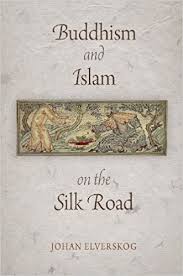
One thing that is illuminated in Buddhism and Islam on the Silk Road is that the eastern Mongols flirted with adopting Islam before they finally shifted to Tibetan Buddhism in the 16th-century. Some of their leaders took Muslim names and seem to have adopted the trappings of Islam, before falling away.
Though the transition of the western Mongols toward Islam differed across the three Khanates. The IlKhanate ruled over mostly Muslims. The fact that for several generations Muslims were ruled by Tengrists, Buddhists, and Christians (Persian Christianity had a foothold in Mongol in the 12th-century) was always a tension. Ultimately, the IlKhan conversion to Islam was not of major consequence because the IlKhanate collapsed earlier than the other domains.
The Golden Horde adopted Islam in large part because that was the religion of the Turks who comprised the majority of the nomads in the confederation. But, in the early period, the Golden Horde was hegemonic over many Christian regions, and the majority of its subjects may have been nominally Christian. And yet the Mongol elite was naturally assimilated into the Turkic elite, not the Christian princes (though they did intermarry with the Christian nobility, and some Lithuanian and Russian noble lineages have Mongol ancestry from the Golden Horde).
The Chagatai Khanate’s adoption of Islam in the 14th-century was ironic, because Chagatai, one of the sons of Genghis Khan, was a fierce Mongol traditionalist who personally detested Islam. As with the Golden Horde, the Islamicization of the Chagatai lineage seems to have been a function of the reality that the non-Muslim Mongols swam in a sea of Turkic Muslim subjects.
Which brings us to India. Most readers of this post will know that the Mongols had various military encounters with the nascent Delhi Sultanate, but ultimately India never truly became a part of their empire. But what if it had?
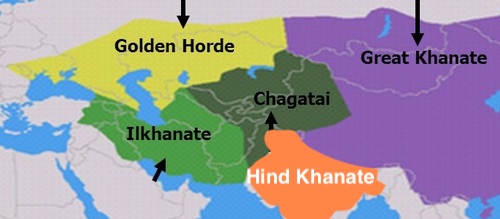
The person who initially posted this counterfactual fantasized about the destruction of Islam in India because the Mongols were against Islam. This is objectively not so. In the 13th-century, the Mongols were religiously peripatetic and latitudinarian. The only “higher religion” that they were initially familiar with was the Persian Christianity of their Kerait and Naiman neighbors. Most of Genghis Khan’s sons married Christian women from these tribes.
Though Genghis Khan himself took to developing a special relationship with a Daoist adept, repeatedly the early Mongols seemed to exhibit a strong affinity toward Tibetan Buddhism, prefiguring the Mongol mass conversion of the 16th-century. Buddhist lamas were presences in both the Golden Horde and the IlKhanate, and Persia in the 13th-century saw a renaissance of Buddhist temple building.
My initial thought about the counterfactual is that the Mongols would surely have become Muslim, as they did in the Golden Horde, because of the large number of Turkic Muslims present in India. The analogy here is with the Golden Horde. In the Golden Horde Mongols and Turks shared the same mode of production, as pure pastoralists and rent-seekers. Mongols who lived a sedentary lifestyle may have eventually simply been absorbed into the Russians.
But then I began thinking: what about the Yuan dynasty example? Here Mongols used Muslims as an intermediary caste with the local population, and never became Muslims themselves. Additionally, while the Han Chinese did not have a military caste (the military profession had a low status in China at the time), obviously India’s Rajputs were a local group of non-Muslims with whom the Mongols might identify. Many of the Mongols were already nominally Buddhist, and so concepts such as Dharma might be familiar to them.
So let’s imagine a fork where Mongols arrive as non-Muslims, and somehow establish a synthesis with Hindus and eventually assimilate as a Hindu caste. This is not totally crazy. In 1228 the Tai Ahom arrived in Assam. They were already partially Buddhist, though eventually, they became Hindus.
Of course, many Hindus want to know: would this be the end of Islam in the subcontinent? I don’t think so for two reasons.
First, the Mongols were generally religiously tolerant. This often held even after their initial conversion to Islam, which was often quite nominal and practical. It seems unlikely they’d wage a religious vendetta against Islam as such. The Turks and Afghans who arrived in the earlier decades would probably simply go into service with the Mongol Khanate. Eventually, they’d be the core of a religious minority in a post-Mongol but Hindu dispensation. This is what happened in China, where many of the Chinese Muslims clearly descend from Central Asians and Turks who arrived with the Yuan.
Second, there may simply be structural reasons why Muslim Turks would move into India no matter what at some point. India was rich. The Turks and Afghans were not. Additionally, as pastoralists and nomads with ready access to horses, the Central Asians had structural advantages against local polities, who could not mobilize the whole of local economies. I suspect, to be honest that the Mongols would only arrest and delay a process that was inevitable.

 As I have noted before, Adam K. Webb’s Beyond the Global Culture War highlights attempts by early 20th century Asian traditionalists to coordinate. Some of the same characters appear in Mark Sedgwick’s Against the Modern World: Traditionalism and the Secret Intellectual History of the Twentieth Century. For all the influence of Fabian socialism on Nehru and the early leaders of India, nothing on the scale of what happened in China to the traditional society occurred in India.