The Failure of Pakistani Alliances & The Instability of the Middle East

After all the pointless flame wars on this website I wanted to tackle some less divisive topics, therefore I have decided to create a short post discussing the failure of alliance structures in the Middle East (including Pakistan going by the World Bank definition). The alliances we will actually look at being the METO/CENTO/Baghdad Pact, SEATO, and the two recent pacts between Saudi Arabia, and Pakistan with Turkey being the most recent entrant.

(P.S. XTM can you add an Active Author Category for me.)
Continue reading The Failure of Pakistani Alliances & The Instability of the Middle East

Geography is Power

The goal of this post will be to act as a counter to XTM’s post about geography not being power. It will rely on realism as a doctrine of international relations to de-cypher the significance geography has had on the Indian Subcontinent and how it has affected the trajectories of the nations within it.

Geography initially reared its head in discussions of strategy during the times of Mackinder and Mahan in the early 1900s. Where Mackinder so boldly stated that “Who rules East Europe commands the Heartland; who rules the Heartland commands the World-Island; who rules the World-Island commands the world.”. However, these words were written in colonial era Britain as a device to fear monger about the Russians as they were the perfect counter to their strategy of controlling the world with sea power through internal lines of transportation through Cold Siberia. With that cold logic Russia which had been the ally of British through the two world wars became a target. Continue reading Geography is Power

Indus Water Treaty: What lies in the future?

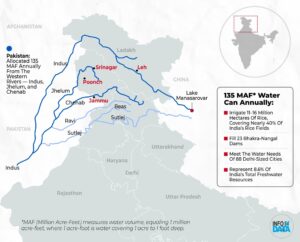
Indus Waters Treaty was signed in 19 Sept 1960 between India and Pakistan under mediation provided by the World Bank. As a political compromise between Pakistan and India seemed improbable the US and UK decided to pressure both into signing onto a technical treaty which could outline the claims and limits of both nations on the flow of the water. Over the years it was touted at the most successful and unequal water sharing agreement where the upper riparian nation only made claim to a minor portion of the river’s waters.

The Indus basin was categorized into two groups of rivers. With the Eastern Rivers (Beas, Ravi, and Sutlej) being controlled by India and the Western Rivers (Indus, Chenab and Jhelum) being controlled by Pakistan.

Many still blame Nehru for this treaty in India for only allowing India to control less than 20% of the Indus’ waters, while many in Pakistan still decry the unequal nature of the treaty in directly awarding a set of rivers to India as that may eventually cause droughts in the parts of Pakistan which are mainly fed by the Eastern rivers. However, the main calls for renegotiations of the treaty have originated in India which at this point has put it into ‘abeyance’. In this post we will go through the main areas of dispute in the treaty and what the possible solutions for the current impasse may be.

Continue reading Indus Water Treaty: What lies in the future?

Review: Pakistan: Courting the Abyss by Tilak Devasher, a 10 year retrospective

Hey folks, this will be my first article on Brown Pundits. Hope you guys enjoy it! Any recommendations regarding future topics, books, or just critique on the article itself will be greatly appreciated!

Tilak Devasher is a former Special Secretary, Cabinet Secretariat Government of India. He is now known as a prolifically researcher on Pakistan in India. 10 years ago he began his scholarly journey with Pakistan: Courting the Abyss. As I was going through the book I wished there was a 10 year retrospective on his work which would help us determine how well his work has held with time. So, I’ve decided to undertake that task myself.

Continue reading Review: Pakistan: Courting the Abyss by Tilak Devasher, a 10 year retrospective

Brown Pundits