

Hey folks, this will be my first article on Brown Pundits. Hope you guys enjoy it! Any recommendations regarding future topics, books, or just critique on the article itself will be greatly appreciated!
Tilak Devasher is a former Special Secretary, Cabinet Secretariat Government of India. He is now known as a prolifically researcher on Pakistan in India. 10 years ago he began his scholarly journey with Pakistan: Courting the Abyss. As I was going through the book I wished there was a 10 year retrospective on his work which would help us determine how well his work has held with time. So, I’ve decided to undertake that task myself.
I will largely stray away from the sections involving historiography as that is not where my expertise lies. I will instead look to compare the numbers provided in the literature in order to determine the accuracy of the trajectories being prescribed in the book. Therefore, I will not be looking into the Ideology of Pakistan (Nazaria-i-Pakistan), The Muslim League or the Pakistan Movement. Due to this reason I will also not be commenting the origins of the Balochistan insurgency, or other provincial issues based on history.
The Army
The most stark feature of the army is the overrepresentation of Punjabis in the rank of its officers while its underrepresentation in the ranks of its troops. Along with the rising radicalism seen within not just the troops but among the officers as well. It would be unthinkable for the army chief of the nation to have prided himself on memorizing the quran just a few decades ago.
Shuja Nawaz notes a decline in the percentage of representation of soldiers from Punjab, between 1990 and 2005, from 63.86 per cent to 43.33 per cent, but that of the officers rising from 66.46 to 66.93 per cent. Within Punjab there was a shift to the more populous and emerging urban centres of central and even southern Punjab. These bigger cities and towns were also the traditional strongholds of the growing Islamist parties and conservatism, associated with the petit bourgeoisie. [1]
The Rise of Radicalism
An aspect of Pakistani radicalism on display is the differences between the Shia, and the Sunni (Deobandi). There has been spate of attacks on Shias by Sunnis in Pakistan most recent of which can be considered the bombing of a Mosque in Islamabad which killed at least 30 people an injured more than 169. These sentiments seem to be encouraged by a plurality of Muslims who believe that Shia are non-Muslims.
Ominously, a 2012 Pew Global Survey showed that 41 per cent of the respondents in Pakistan believed that Shias were non-Muslim. As sectarianism takes deeper roots, the question of what is true Islam has taken on greater salience. Since Shias are seen as diverging from mainstream (Sunni) Islam, their killing seems to attract less sympathy, adding to the impunity of the killers.
Madrasas
Madrasas pose several challenges. First, according to Interior Minister Chaudhry Nisar Ali Khan, ‘90 per cent of madrasas had no connection to terrorism, based on intelligence reports received’.[3] On another occasion he was at pains to point out that his government was not painting all seminaries with the same brush; he said that ‘around 10 per cent of madaris were involved in terror activities’.[4] This would imply that 10 per cent of the madrasas, where anywhere between 150,000 and 300,000 students study (estimates vary hugely about the total number of students studying in madrasas) could be potential terrorists. Even if 1 per cent of them were to become suicide bombers, there could well be around 3,000 potential suicide bombers waiting to blow themselves up. Even if they do not blow themselves up, the limited education they have received would make them dysfunctional members of society, prone to being incited to violence.
Madrasas are a direct consequence of a state lacking capacity to educate all its youth. Because of which many will flock to madrasas which are unqualified, often unregistered and incapable of handling a modern curriculum. The reality also is that due to radical madrasas going out of their way to avoid any kind of registration we have no idea how many madrasas are operating in Pakistan. According to estimates from a decade ago there are at least 35,000 Madrasas in total operating in Pakistan with around 26000 being registered serving around 2-3 million children.
In 2014, according to the interior ministry, there were at least 22,052 registered madrasas in Pakistan, but there was no record of the unregistered ones. According to a July 2015 report titled ‘The Madrassa Conundrum — The state of religious education in Pakistan’, the number of madrasas in Pakistan had crossed 35,000.[5]
However, the only contestation to the awfulness of the Madrasa system is that vast majority of violent terrorists come out of the public schooling system with little to no exposure to the Madrasa system. However, that would ignore the fact that less than 10% of Pakistan’s children are enrolled in Madrasas. Meaning there is a 4 times overrepresentation of Madrasa graduates in terrorism according to Christine Fair.
Christine Fair, for example, noted that while madrasas proved to be a hotbed for disseminating ideology, they were not a major source of militant recruitment. Of the 141 cases studied by her, less than a quarter, thirty-three of 141 ever attended theological schools. Of those thirty-three madrasa products, twenty-seven attended a madrasa for four or fewer years, and most also attended public schools. In contrast, the remaining eighty-two were well educated by Pakistani standards, at least a matriculate.6 Another survey of ten major jihadi groups revealed that of the over 15,000 people from Punjab who died in Afghanistan and Kashmir only 40 per cent had actually studied in madrasas.
Terrorism
Pakistan would do well to refer to the 2008 study of the Rand Corporation of 648 terrorist groups existing between 1968 and 2006. The study found that military operations resulted in the elimination of terrorist groups only in seven cases whereas 40 per cent of the groups were crushed through police and intelligence work and 43 per cent renounced militancy by joining political parties. Military force has rarely been the primary reason for the end of terrorist groups. While it acknowledged the importance of hard force, especially against large and well-organized groups, it also stressed a range of policy instruments including policing and intelligence networks.7 This element is largely absent in Pakistan.
The rise of Terrorism in Pakistan has been its most apparent feature in the recent past. The book correctly identifies the TTP as being a large issue in terrorism in the KPK. However, the book could’ve never expected the quantum of increases now visible across Pakistan because of the rise of the Taliban in Afghanistan. Regardless the end to terrorism doesn’t seem to be in the cards in short-term as there has been no acknowledgement of the detriments of using non-state actors as state policy in Pakistan.
However, stopping the use of such elements as instruments of state policy will only be the start. It will have to be followed up by dismantling the infrastructure of jihad – the madrasa network, the training camps – and provision of jobs, after a period of re-educating the madrasa graduates and changing the mindset in government schools. This would mean massive investment in industry and agriculture to create jobs and in education to provide modern education. Pakistan would have to build a counter-narrative to join the battle against the Islamic hardliners and present a viable alternative. Unfortunately, Pakistan has yet to acknowledge, let alone deal with, the ideology of hatred and militancy that has been cultivated as state policy for over four decades. Given that for decades the Pakistan has viewed jihadis as an instrument of state policy against India, it will be extremely difficult to change that policy in the immediate future, or even medium term. With terrorism continuing to fester internally, Pakistan’s slide on the slippery road towards the abyss will hasten in the years to come.
WEEP Analysis
Water:
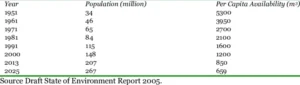
The availability of water is changing due to climate change, change in rainfall pattern, melting of glaciers, etc., as borne out by the trends of water availability. A statistical comparison of surface water availability between the last thirty and ten years points towards declining water flows. While average flows for the years 1978 to 2008 equal 140 MAF, the same for 1998–2008 is 128.52 MAF. In years without super floods (four out of five years), average flows have declined from 135.6 MAF during 1978–2008 to 123 MAF during 1998–2008. The highest river inflow in the last three decades was 172.10 MAF in 1977–78; the highest inflow since 1998 has been 152.69 MAF in 2006–07.8
The book doesn’t go into any details regarding the Indus Waters Treaty which has now been put into abeyance. I tend to agree with it on that fact, IWT remains only a minor issue for Pakistan. The real problem lies on the rapidly rising population which will inevitably mean water scarcity for most of its citizenry. My views on the IWT and the water situation in Pakistan is that it will be another drain on the foreign exchange reserves of the nation as imported grain, and produce will work to substitute the lack of water in the nation by importing it through goods which Pakistan will no longer be able to be self-sufficient on in the future. These ideas are better detailed in a substack article on virtual water.
However, this will inevitably mean a shift away from crops like sugarcane, rice, and a shift towards cash crops which demand a greater value in the international market which can be used to subsidize the inevitable grain imports. It would unironically mean Pakistan having to move away from a halal diet to a satvik diet for the sake of maintaining their foreign exchange reserves.
The UN’s Food and Agriculture Organization (FAO) measures the pressure on national water resources by calculating water withdrawal as a percentage of total renewable water resources (TRWR). Stresses are considered high if the TRWR value is above 25 per cent. Pakistan’s water pressure amounts to a staggering 74 per cent. This pressure is exorbitant even compared with neighbouring high-pressured countries, including India at 34 per cent and Afghanistan at 31 per cent.[9]
Education:
In absolute terms, half of the country’s out-of-school children – about 52 per cent – live in Punjab, 25 per cent in Sindh, 10 per cent in KPK, 7 per cent in Balochistan, and six per cent in other parts. In terms of proportion, Balochistan and Sindh are home to the highest proportion of out-of-school children. As many as 66 per cent of children in Balochistan and 51 per cent in Sindh are out of school, followed by Punjab and KPK with 47 per cent and 34 per cent out-of-school children respectively. Speaking in Quetta recently, the adviser to the Balochistan chief minister Sardar Raza Barrech said that 1.6 million children were out of school in the province, two-thirds of whom were girls.10
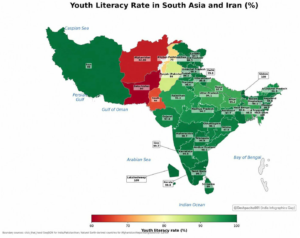
The Education situation in Pakistan is so grim that outside of Afghanistan and Sub-Saharan Africa it has no competition in youth literacy numbers. When the next generations of India, Bangladesh and Nepal will have almost 95% literacy rates, Pakistani Punjab doesn’t even reach 90%. Meaning even regional backwaters like Sylhet in Bangladesh are more literate than Pakistan’s most literate province.
Economy:
There are many grim statistics regarding Pakistan however, I want to remind everyone that even fundamentalist militaristic juntas in other parts of the world have better track records of economic management than Pakistan. The issues Pakistan faces are uniquely awful in that regard. In an already lengthy review if I could bring your attention to a specific set of paragraphs it would be the impact that being a security state has brought to Pakistan and the horrid future that holds for it if it remains determined on the trajectory towards becoming a ‘hard state’.
During its first three decades, Pakistan was a ‘development state’, wherein the state agenda pursued by all governments – civilian and military – was economic development. This period was marked by large-scale asset creation (dams, irrigation systems, highways, power plants, industrial complexes, factories, etc.). The ‘security state’ replaced the ‘development state’ in 1977 as a result of which economic development ceased to be the primary agenda of the state. The period was marked by a failure to invest in additional capital formation as well as lack of replacement investment in economic assets created earlier. Brief attempts to revive the ‘development state’ it in 1990s proved futile.11
This is proved statistically by the fact that during the 1970s, the real rate of growth of development expenditure was 21 per cent per annum and the rate of growth of defence expenditure was 2 per cent. During the 1980s, the rate of growth of development expenditure crashed sevenfold to 3 per cent and the rate of growth of defence expenditure escalated almost fivefold to 9 per cent. As a percentage of GDP, development expenditure has been falling from 9 per cent in the 1970s to 7.3 per cent in the 1980s to 4.7 per cent in the 1990s and to 3.5 per cent in the first decade of the millennium. Currently it is 3.2 per cent.
Population:
During the period, 1971–2015, around 8.77 million Pakistanis proceeded abroad for employment through the Bureau of Emigration. The main concentration of overseas Pakistanis was in the Middle East (49 per cent), Europe (28.2 per cent) and the United States of America (16 per cent). Manpower export continues to show an upward trend from 0.622 million in 2013 to 0.752 million in 2014 and 0.946 million in 2015. However, around half of the migrant workers are illiterate and unskilled workers and only 1.76 per cent workers are doing white-collar jobs. Among the skilled workers, drivers are in the highest number, followed by masons, carpenters and tailors.12
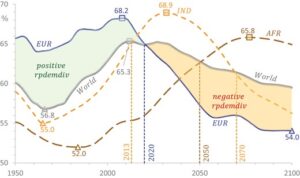
Many Pakistanis seem to talk about the ‘extinction-level birth rates’ of many Indian states in this forum. However, they fundamentally misunderstand the nature of the demographic dividend. The demographic dividend only arises as a result of decline in birth rates which allows for the population to be able to afford higher impact consumption goods like a better car, air conditioning, etc which simulate the local economy. Pakistan hasn’t even gotten started with its demographic dividend as its birth rates remain sky high meaning most of its population will be unable to afford the rates of consumption necessary to stimulate the economy. It is likely that Pakistan won’t enter its demographic dividend until 2050 alongside most of Africa. India itself has only entered the demographic dividend after 2013.13
The other problem with an unrealized demographic dividend is that an unproductive population would pose huge pressures on resources like food, water and energy. A country that was near to being self-sufficient in food in the early 1980s has a food security issue today largely due to increased population. As noted earlier, agriculture accounts for about 20 per cent of Pakistan’s GDP and employs 60 per cent of its labour while 70 per cent of export revenue stems from agriculture. A decline in water availability would impact on food production at a time when the population is increasing, creating multiple crises. And the availability of water is declining and is below the 1,000 m3 /year per capita benchmark.
Conclusion:
Pakistan: Courting the Abyss remains a great read to gain some amount of background on the various elements of the multi-crisis Pakistan finds itself in. Most of the issues detailed in the book have either exacerbated or maintain their significance. The only issue with the book is that it is rather lengthy and goes into excessive detail regarding each topic which may be too much for many casual readers. Even I had to plumb through the depths of many articles to fairly evaluate this book according to present sources.
TL;DR If you wish to understand the basic history, ideology, economy, water management, education, foreign policy, and future of Pakistan in a single book then this is the book for you.
P.S. Thanks for reading the article. If you’ve had the chance to read all my commentary on this book please recommend me some other books on similar topics. I would welcome any opposing perspectives on the matter.
Sources:
[1] Shuja Nawaz, Crossed Swords: Pakistan, Its Army, and the Wars Within, Karachi: OUP, 2008, pp. 570–71.
[2] Pervez Hoodbhoy, ‘Healing our sectarian divide’, Dawn, 21 February 2015.
[3] Nisar Ali, ‘Sympathisers, Supporters of Terrorists Live Among Us’, Dawn, 21 December 2014.
[4] ‘Madressah project: From reform to a registration drive’, Dawn, 29 December 2015.
[5] ‘Report says over 35,000 madrassas operating in Pakistan’, Pakistan Today, 31 July 2015.
[6] Cited in Hasan Mansoor, ‘Report on state of madressahs in Pakistan launched’, Dawn, 31 July 2015.
[7] Cited in Umar Cheema, ‘Not military but police-agencies cooperation needed to fix terrorists’, The News, 10 January 2015.
[8] Kaiser Bengali, ‘Water Management under Constraints: The Need for a Paradigm Shift’, in Michael Kugelman and Robert M. Hathaway (eds), op. cit., p. 48.
[9] FAO, AQUASTAT database, 2013, cited in Daanish Mustafa, Majed Akhter, and Natalie Nasrallah (eds), op. cit, p. 6.
[10] ‘Education crisis’, editorial, , 19 December 2015.
[11] Kaiser Bengali, ‘Proposed Agenda for Sustained Economic Revival’, Karachi: Social Policy and Development Centre, September 2013.
[12] Economic Survey 2015–16. Ministry of Finance, Government of Pakistan.
[13]Steven Brakman & Tristan Kohl & Charles van Marrewijk, 2024. “Demography and Income in the 21st Century: A Long-Run Perspective,” CESifo Working Paper Series 11108, CESifo.
Great article. Congrats on the first post. Hope to see more from you.
While Punjab has a high TFR, it is still lower than the other states.
This is causing an ethnic change. You can see it in the cricket team too which has got a lot more Pathan representation.
The team that lost the 1999 final had 8 Punjabis, 1 Mohajir, 2 Pathans.
The team that lost the 2022 final had 5 Punjabis, 6 Pathans.
In a similar vein, these were Aakar Patel’s 10 predictions about Pakistan back in 2012. Eerie how correct he was.
https://tribune.com.pk/story/460283/ten-predictions-about-pakistan
Stark, scary statistics.
For me, what jumps out is the utter lack of accountability for Pakistan’s so-called ‘security’ state. Education, Irrigation infrastructure – simple basics like food, water, electricity, energy, education – Just utterly dismal performance but zero accountability for the jernails. Meanwhile 100% of the army top brass – not just the senior jernails and ‘Corp Commanders’ – all have minted international fortunes.
There was a sentence in an article in the Financial Times during the Kayani years that I still remember – Would the average Pakistani enlisted soldier stay loyal if they realized that their senior officers were US Dollar millionaires, while the entire country including the foot soldiers were struggling to make ends meet? I am not a betting man, but am pretty sure its a safe bet that this statement about PakMil senior ranks being USD millionaires would be true today as well. Its a Ponzi Mafia Organization that rewards its own, regardless of how bad the Pakistani nation’s finances are.
I’ve had umpteen number of educated Pakistanis insist at me with sincerity, that their ‘army is the only institution that actually works and can be trusted’. Never mind that the same army has been hollowing out the nation across all measurable metrics over the last few decades. When the obvious word Kleptocracy is used, injury is feigned.
I don’t doubt the loyalty of a Pakistani Soldier because doing so is bad strategic discipline. For the most part the Pakistani Soldier is loyal to their platoon, their regiment, and their nation. They might not be the richest among their nation but they still get a rather plush pension. If they ended up being promoted to a Cpt or Lt by the end of their service they will end up with a small parcel of land. Many will be more than willing to kill for those opportunities in a country like Pakistan.
oh I am under no illusions about the loyalty of Pak soldiers – as we see on BP comments, wrapping oneself in the flag and fanatical tribal loyalty is addictive even when the incentives aren’t there. My reference to that article was more about the nature of corruption and wealth in the senior Pak brass.
Do write some posts occasionally.
yes Authorial Autonomy means one can curate and control their threads as they like it..
Nationalism in south asia seems to be a means for the educated snd priveleged to justify their own complicity and lack of concern or care towards less than ideal or even a sorry state of affairs.
The people who you met probably were still not as badly affected and would be using the sorry state of many others to console themselves, just probably lacked the guts to admit the same.
Also add a “Read More” element because otherwise it fills the home page.
Om apologies – the survey results are out and we have made them sticky for now.. However we will up-post this after the survey results.
> Madrasas are a direct consequence of a state lacking capacity to educate all its youth
This is complete and utter nonsense by Tilak. Perhaps he forgot to take a good look at his own country? Education is available equally to all children but I hardly ever see Gurukuls, Convents or Gurudwaras exclusively teaching religion to Children. At the same time Madarasas are getting more common as median income goes up in India.
Hindus don’t understand Islam too well. And until they do, all attempts at studying Pakistan will stay lacklustre. This is also the reason why Pakistan has objectively won all wars with India, with an exception of 1971, despite whatever claims are made by Indian establishment.
Pakistan has won its wars?
All except 1971.
Naah.
Siachen/Kargil were clear losses. Siachen led to loss of territory and Kargil failed to meet its objectives (the purpose of a war).
Even 65 was a loss, even if they spin it as “Defense Day” considering the purpose was to capture Kashmir which they failed at.
48 can be considered to be a “tie” (even though India got more of the territory). But then again India is happy with what it got, Pakistan isn’t.
Good topic to write on ..
Later. I’ll do a Sooryavanshi piece first.
> Kargil failed to meet its objectives (the purpose of a war)
This is exactly why the Hindu worldview kept Indian state at losing side for over a Millenia.
The objective of Pakistan is absolute annihilation of Indian civilization. Just because it hasn’t occurred yet, doesn’t mean they’ve lost.
> 48 can be considered to be a “tie”
How is it a tie if India hasn’t been able to get access to erstwhile kingdom of Kashmir despite the King signing the instrument of accession? Pakistan, not only holds part of the land even today but they even sold some to China!
> Even 65 was a loss
Pakistan attacked India, and Indian Prime Minister agreed on ceasefire with no reparations, demilitarisation or punitive measures on Pakis! When has it occurred in history where winning side didn’t impose conditions on losing side?
> Siachen/Kargil were clear losses
Come out of your delusions, otherwise another Talikota is waiting to happen.
Even 65 was a loss, even if they spin it as “Defense Day” considering the purpose was to capture Kashmir which they failed at.
65 was a war of mutual incompetence on both sides. India can be said to have “won” only so far as Pakistan failed to achieve any of its objectives when it started Operation Gibraltar. Basically the same as US getting defeated in Afg, Iran etc. Defense Day is obviously a face saver for domestic consumption.
48 can be considered to be a “tie” (even though India got more of the territory). But then again India is happy with what it got, Pakistan isn’t.
I don’t fully agree. I don’t think even Nehru was unhappy with losing nearly half of Kashmir proper. For obvious reasons, he felt quite strongly about Kashmir personally. Loss of GB was a well planned and executed British machination to ensure there is no possibility of a land connection between USSR and India. Roy Butcher actively misled Nehru in to thinking any counter attacks to recover lost territory were a bad idea and Nehru (being the woolly headed idealist he was) foolishly took the matter to the UN. I can point you to some good literature on this if you are interested.
I do agree that, today, no Indian govt would say no to a lasting agreement where the LoC is recognized as the international border but it would be a compromise to move on because we stand to gain more by closing this chapter (unlike the Pakistani establishment).
we should have posts on these soon. it’s been a fairly quiet June for BP what with the survery and all
Education isn’t equally available to every Pakistani child. Even Bangladesh has invested a larger portion of its budget into Education. That is the main reason many flock to Madrasas. Even the current number of Madrasas are insufficient to address the number of children who are currently left with no education.
In India most upwardly mobile Muslims will send their children to English medium school, even convent schools. No Muslim parent sends their child to a Madrasa if they have the choice of sending them for English education.
Most Madrasas remain draconian in their syllabuses, they are unable to impart a scientific education on to their pupils. Although its not saying much considering even the public schools remains regressive on topics like Evolution.
These are good points though Madrassas probably complement formal education as well..
> Perhaps he forgot to take a good look at his own country? Education is available equally to all children but I hardly ever see Gurukuls, Convents or Gurudwaras exclusively teaching religion to Children
Re-read this again. I was writing about India.
> most upwardly mobile Muslims
These are just elites amongst Muslims. No different compared to their Pakistani counterparts. You think Pakistani elites on this website send their children to a Madrasa? But the fact remains that a large part of Muslim population in the subcontinent will never be sufficiently rich and hence the impact of Madrasa education on this segment will only increase with time, whether it be India or Pakistan.
Welcome to BP.
Since you asked for book recommendations on this topic: Have you read Christophe Jaffrelot’s The Pakistan Paradox: Instability and Resilience?
https://blogs.lse.ac.uk/southasia/2016/04/13/book-review-the-pakistan-paradox-instability-and-resilience-by-christophe-jaffrelot/
The thing India needs to think about is where will these people go if things go south so to say.
People talk about bangaldesh causing a refugee crisis but we should put more focus on our western neighbours. Bangladesh will still have water and can produce food for its population and itself is reaching less than replacement level fertility. Pakistan on the other hand..
I think we are years if not decades away from such a refugee crisis. Given the Pakistani elite’s willingness to …rentier the state, the probability that Pakistani continues its ‘teetering on the brink without quite falling into the abyss’ state for the foreseeable future.
The one thing that can really change the dynamics is a dramatic fall from power of the CCP, which as of now, almost all will agree, is….quite unlikely.
Time for Afghanistan to repay the favour.
India needs a sensor defined and algorithmically enforced border with Pakistan. IYKYK.
Walls and fences are useless against population displacement.