
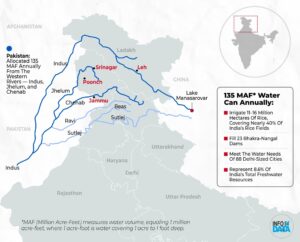
Indus Waters Treaty was signed in 19 Sept 1960 between India and Pakistan under mediation provided by the World Bank. As a political compromise between Pakistan and India seemed improbable the US and UK decided to pressure both into signing onto a technical treaty which could outline the claims and limits of both nations on the flow of the water. Over the years it was touted at the most successful and unequal water sharing agreement where the upper riparian nation only made claim to a minor portion of the river’s waters.
The Indus basin was categorized into two groups of rivers. With the Eastern Rivers (Beas, Ravi, and Sutlej) being controlled by India and the Western Rivers (Indus, Chenab and Jhelum) being controlled by Pakistan.
Many still blame Nehru for this treaty in India for only allowing India to control less than 20% of the Indus’ waters, while many in Pakistan still decry the unequal nature of the treaty in directly awarding a set of rivers to India as that may eventually cause droughts in the parts of Pakistan which are mainly fed by the Eastern rivers. However, the main calls for renegotiations of the treaty have originated in India which at this point has put it into ‘abeyance’. In this post we will go through the main areas of dispute in the treaty and what the possible solutions for the current impasse may be.
Points of Dispute
Hierarchy of Dispute Resolution
One of the major points of contention between India and Pakistan in the Indus Waters Treaty is which method of dispute resolution should be utilized. India opines that a neutral expert is best equipped to provide a judgement on any dispute as the treaty was created as a technical document divvying up the river system. As the technological leaps which have occurred since the signing of the treaty are such that only a technical expert could decipher which portions of a dam project are adhering to the spirit of the treaty and which are not. Pakistan opines that the court of arbitration remains the best method for the settlement of any dispute as it ensures both parties adhere to the limitations set on dam construction and that water use in the upper riparian are limited to irrigation, power production and no excessive storage occurs at any dam project.
India claims that the entire treaty has been used by Pakistan as a tool to delay and alter any project on the Indus. To the point that even the Eastern Rivers which India has had complete claims over remains underutilized. This had gotten to a point in 2016 where over a dam project both the neutral expert and the court of arbitrations were consulted with both providing contradicting verdicts.
Distribution of Water
The Indus Waters Treaty remains the most unequal treaty in terms of water distribution. The main claim on the Indian side has been that due to a change in population on their side of the border their requirements for water have risen but the treaty remains largely in the past. The water flowing through the Indus River Systems has only declined as times goes on. Therefore, a new bargain needs to be struck to make the treaty viable for the future for either sides.
Pakistan affirms that population has risen more significantly across their side of the border, therefore their claims over the waters are more important now. Furthermore, they claim that giving over the entire claim over the Eastern Rivers to India was a massive failure of their predecessors. Pakistan therefore also asks claims over a portion of the Eastern Rivers to ensure that there isn’t any drought caused on their side due to a complete redirection of the Eastern Rivers as stated in certain claims by Indian politicians.
Colonial Nature of the Treaty
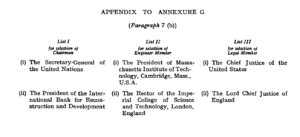
Perhaps the least commented on portion of this treaty is its inherently colonial nature. The treaty was negotiated in the good offices of the World Bank an American Institution, it was clearly an objective of the USA and UK’s governments to ensure the viability of their client states in Pakistan. Even today the governments of the US and UK are deeply involved in the selection Engineer Members, and Legal Members which are involved in the dispute resolution portion of the treaty. It would future proof the treaty further if these positions were devolved to the main participants of the treaty.
Through Indian eyes this treaty is almost written by a colonial master on unequal terms. Now, that India is no longer in a state of Ship-to-mouth existence it needs to shed these clearly colonial features of the treaty. Pakistan might find this portion of the treaty not as excusable due to the fact that the member states with these influence have often been close allies of theirs through formal treaties such as (SEATO, CENTO or the Baghdad Pact) and both the powers sent aircraft carriers (HMS Eagle and USS Enterprise) to intimidate India in 1971.
Possible Future Scenarios
At this point the chances of an Amended treaty are going to require deft negotiations from the Pakistani side as many projects on the Western Rivers in Indian territory have already begun to spring up. Therefore, the chances for a “Permanent Abeyance” or “Total Disregard” remain most likely.
Indus Waters Treaty Amended
This is an ideal scenario in which all that track-2 level diplomacy leads to fruitful results. Where the treaty is examined by both sides and amended to ensure that the points of conflicts that led to its abeyance are sufficiently allayed such that they won’t lead to any future suspension or abeyance.
In this scenario the water distribution either changes nominally (giving both sides minor claims to waters from both set of rivers while maintain a similar distribution of water) or remains the same. However, the main dispute is resolved which is the hierarchy of dispute resolution. In a scenario where Pakistan has the upper hand it would ensure the court of arbitration is the highest, in the case where India holds all the cards as the upper riparian it will be the neutral expert.
If the amendments are ambitious it could even tackle the colonial nature of the treaty excising any influence of former colonial powers from the treaty. Making it not just future proof but even more closely aligned to the Indian policy affirmed in the Shimla Agreement.
Permanent Abeyance
The Indian government finds this scenario particularly enticing. As it isn’t directly suspending the treaty while side stepping all its cumbersome dispute resolution mechanism. It can easily ignore any rulings from International Courts as they have little to no jurisdiction over the country. It allows the state to have a good level of ambiguity in decision-making which many bureaucrats appreciate. It leaves a card up their sleeve which they can use to entice Pakistan during a future crisis.
On the Pakistani side this is a dreaded option as it removes any influence they might’ve had over the construction on the Indian side. Projects which previously might’ve been delayed and altered for decades will be suddenly out of their influence. But the most devastating will be the lack of data sharing which would affect the planning of crop seasons. This uncertainty could’ve been reduced to a degree if a larger number of dams were to be constructed on the Indus however as a “hard” state Pakistan rarely has any resources to spare for non-military projects of this magnitude.
Total Disregard
The most extreme of all options would be a total disregard for the treaty. Instead of acting like the treaty is only in abeyance which means the claims over the Rivers remain static in principle. Meaning India has limited influence over the Western Rivers. In this scenario a large build up of projects begins on both the set of Rivers. A number of river connection, dams, and reservoir projects spring up to capture water from the Indus. Large tunnels of 30-40kms are built up to join river water of the Indus towards Uttarakhand and Rajasthan through canals ensuring that more than 20% of the waters from the Indus River System never reach across the border.
Any construction of dams or reservoirs on the Western Rivers would tilt the world towards this scenario. As once the construction is complete no incumbent government will ever have any incentive to adhere to the old treaty ever again. Meaning once a project is constructed it will become a permanent fixture, Once a river is redirected to a canal it cannot be turned off, because anyone who turns it off will commit political suicide.
Projects like the Chenab-Beas link tunnel are inching up towards this reality. Where Pakistan’s claims over the Western Rivers are diluted through rather small and insignificant projects over long periods of time. In its current state the link tunnel doesn’t even transport 1 MAF of water from the Chenab to the Beas, however, it demonstrates a principle that Pakistan holds no influence over Indian construction on its claimed river waters.
Conclusion
Every day that passes without any open negotiation between the governments of India and Pakistan on the issue of the Indus Waters Treaty is a day where we move closer towards the scenario of “Total Disregard”. Personally, I wouldn’t want this issue to get to a point where Indian leaders jockey to claim larger and larger portions of Pakistan’s waters for the sake of their local constituencies and jingoistic sentiments. The effect this treaty’s abeyance has over Pakistan isn’t as large as most would assume due to a short-to-medium term effects on the Indus’ waters however in the long term it might reduce millions into poverty due to the rising cost of water.
I’d love to know your thoughts on this! What real talking points do you think we can pull from this issue? Also, let me know if there’s a blind spot I completely missed that needs to be addressed.
What are the things that have already been “done”?
No sharing of hydrological data, desilting etc I know about.
Has construction actually accelerated? Also was the Pakistani inspection of these constructions ever a thing and have they been stopped?
The main project that I’ve outlined here that most directly violates the treaty would be the Chenab-Beas link tunnel. If the treaty were to be amended a restoration of hydrological data wouldn’t be as difficult and desilting could occur with prior notice. None of these issue are as large as the link tunnel itself because it contests Pakistani claims over the waters themselves in principle.
What about the dams/Wullar barrage?
The main issue India had was Pakistanis wasting time and delaying these projects.
That could be easily solved with a resolution of the hierarchy of dispute resolution. The main reason the Indian side got fed up with the treaty was the world bank started both the court of arbitration and neutral expert investigation on the same project and they both gave contradicting verdicts. An infinite stalling tactic wouldn’t be possible for Pakistan with the treaty if the neutral expert had the clear final word on the disputes.
The main disputes that people tend to highlight on the IWT are the Kishanganga and Ratle Hydroelectric Projects because they were directly on the Western Rivers which Pakistan has claims over. So they couldn’t have any large reservoirs or water storage capabilities and had to be primarily built for electricity production.
I think despite all the bluster Pakistan will come to the table at a certain point and accept a re-negotiated agreement with more concessions to India. Further they wait, further the concessions.
India doesn’t really need to do anything. They are happy with the current status quo and can keep on building infrastructure.
Nice, balanced article.
What realistic options does Pakistan have to get India back on the review table? It’s no longer feasible to negotiate. As BB mentioned, the current status quo works in India’s favour.
The only option that they have is to stop the terror infrastructure and forget the Indian side of Kashmir.
Of course, this might a big step for them but then again India needs to be given something for them to shift from the status quo (and not just regarding the IWT). Otherwise India can just maintain it indefinitely.
This is not even me speaking from an Indian bias but basic game theory.
Maybe at some future point the Pakistanis concede when it is far more costlier to make peace and concentrate completely on their western front (where their troubles don’t look like they will subside soon).
Can’t agree more. It is basic game theory at play.
The main issue is once a project is built it can’t be turned off. The more time they take to come to the negotiating table the more they will have to concede. If water is redirected or stored from the Indus in large quantities through canals, dams, reservoirs, etc then Pakistan will have no recourse in the future. My fear is that they don’t realize this and take too long to negotiate. Once that happens just day-to-day life in Pakistan becomes a lot harder.
Also the longer they wait, the more the power gap increases hence even less concessions outside of the built infrastructure.
Pakistan’s issues basically stem from them thinking they are a “peer” of India and hence taking decisions with that mindset.
This entire comment discussion overlooks a major variable while running self-congratulatory loops on ‘game theory’.
The leadership in Pakistan simply do not have incentives aligned with what you guys believe or expect.
The IWT dispute, like all the others between India and Pakistan is not a bilateral dispute but a tri-lateral one.
The parties involved are the citizens and nation-state of India and Pakistan, along with an executive leadership in Pakistan that has its own separate set of incentives, distinct from what is in Pakistani interest.
Once you factor this simple and obvious fact into the issue, the conduct of the Pakistani side starts making a lot more sense. The Pakistani leadership is not directly damaged when the consequences of abeyance/disregard start impacting Pakistan. In fact, their internal position within Pakistan and ability to sustain its power and kleptocratic loot, get strengthened. They can simply continue to blame India, make threatening noises and indulge in war hysteria – all of these are meaningless, mostly empty threats – that in fact, weaken the position of the Pakistani state on the issue.
If ‘day-to-day’ life in Pakistan gets harder, the Pak leadership is throwing itself yet another party – on one hand they get one more hot-button issue to whip up sentiments and continue larping as well-meaning ‘defenders of Pakistan’, and on the other, their argument in front of IMF and other funding sources get strengthened as well. Look at the aftermath of the earthquake and flooding that Pakistan suffered from over the recent years, and see how the government of Pakistan responded to those.
Declan Walsh is a pullitzer prize winning journalist and author, and one of his interviews he talked about how a senior Pakistani politician took him and some UN officials on a tour to the poverty-stricken, underdeveloped interiors of Sindh and Punjab, hectoring the ‘firangis’ on how Pakistan needs massive injection of aid. The politician had no response when the UN rep asked him about what the Pakistani government had done over the last few decades when he can clearly see the opulence and comfort enjoyed by the leadership in Pakistan’s capitol.
Neutrals and Indians would wonder why Pakistan continues its terrorism shenanigans with India, this kabuki reflexive hostility at the UN and elsewhere, when its citizens would draw immediate and immense benefit from rapprochement with its massive, fast-growing Eastern Neighbor.
And the answer is simple and constant – because the current status quo may be costly to the Pakistani, but its immensely profitable to its leadership.
TL;DR – don’t expect any sort of rational ‘game theory’ driven outcome from the IWT dispute.
Excellent comment! We often don’t realize that incentive misalignment is the heart of many a chronic problems in the world.
This is a very high signal comment, even if we don’t entirely agree with it.
erm, maybe elaborate on what you disagree with and why?
You make it sound its like some sort of massive cliff or disconnect when it is a very integrated society
I am not implying ‘disintegrated’ or ‘disconnected’ anywhere. Elite capture is a fact of life in all societies, including the US, UK, India, AND Pakistan. Just that I’m asserting that its more pronounced in Pakistan, and the policy choices and outcomes are more explicitly disconnected. And there is a mountain of evidence available to back up my assertion. I don’t need to rehash it.
Not everything has to be interpreted through Kabir’s imposed lens of ‘anti-Pakistan’. This is the tragedy of his constant tarring and hostility. Even a cogent reasonably objective argument is over-read as some sort of jaundiced take. And frankly its a bit annoying – especially when I have been around long enough, provided repeated explicit clarifications of my perspective.
You posting cherry-picked statistics on India is a ‘ceasefire violation’.
You don’t get to censor my comments while deleting mine. In fact, you replying to my comment which barely mentions you in passing, is arguably more of a ‘ceasefire violation’ than my original comment. Stop replying to me and harassing me. My online ‘safety’ is being threatened. 😀
post declaration of said ‘ceasefire’ you went to the extent of writing an entire post about me, one of the rare occasions where your contributions to BP wasn’t a recycled piece, or an anti-India diatribe.
You trying to weaponize this coddling/ceasefire into a cudgel to push your own skewed views while denying others the right to question or challenge them is a……..common sense violation.
Get well soon.
There is no need to refer to K at every instance ..
“Game theory” doesn’t mean that Pakistan will accede to India’s wishes.
It simply means that if India doesn’t get what it wants it will maintain the status quo (and not just regarding the IWT) and Pakistan can’t really change it, even the military.
Of course like you said, the military can maintain hostility permanently and enjoy the fruits while their citizens suffer.
But again, that is a them issue, nothing to do with us.
But that’s the thing. The military can’t maintain this hostile status quo permanently. Cities like Karachi are in a deep water deficit since a decade ago. If these issues start cropping up in Punjab of all places we can expect seditious elements to gain footholds across the country. Pakistan’s water availability is already at around 600 cubic meters per capita according to certain projections, below 500 is considered to be severely water scarce. Egypt is at around 500 cubic meters per capita and it can no longer afford to even grow its own grain for its population and has to focus on cash crops so it can gain enough foreign currency to keep its citizens supplied. If population keeps rising at the same rate as it is now we will be seeing Malthusian-esque famines in a decade.
Like I said, that’s on them.
They can try to maintain “parity” with a giant which is opening up the gap every year while the civilian population suffers or they accept the “hegemony” and attain a level of prosperity (like say Bangladesh).
That is up to them.
North Korea already exists as a model so if the military can maintain power while the population suffer, then who are we to say otherwise?
Ultimately up to the people of Pakistan to decide their future for themselves.
Your point is that current status quo is bad for the Pakistani public. RNJ’s point is that it does not matter what happens to the Pakistani public as long as the military is in power.
My point is that it does not really matter to India either way as Pakistan cannot change the status quo. All the demands for “talks/cooperation etc” are from one side.
No, its most definitely an ‘us’ issue. Pahalgam, 26/11 and badly verbalized attacks in international forums like the UN by bumbling Pak diplomats etc.
Op Sindoor was a non-trivial escalation in delivering direct pain and consequences to PakMil and its assets. And India will continue having to invest and allocate disproportionate attention – cash, kind and kin, to ‘manage’ the Pak Mil’s machinations.
This is why every discussion of Ind-Pak issue needs to explicitly address the tripartite nature of it. Else Indians can keep the blinders on their eyes and keep taking meaningless victory laps over how the gap between India-Pak citizenry is widening. That shyte is less relevant because its ultimately the capabilities, intent of the ‘third’ party that is more relevant.
This is useless and has no effect. We have our own wordcellers in international forums.
Terrorism is definitely an issue but then again it is not the 90s anymore. India has both better fast bowlers and better Dhurandhars.
Its not just the gap between the citizenry that is widening. As India’s military tech becomes more indigenous the gap will multiply even more exponentially.
And who knows, in the distant future we can prop up Afghanistan like China does Pakistan.
Good comment. The Pakmil’s idea of what is ‘rational’ is different from what one might expect it to be, and this has been the cause of much misery in the subcontinent.
Speaking of Declan Walsh, I’d urge everyone to read his book ‘The Nine Lives of Pakistan’ (epub) which is based on his experiences in the country from 2004-2013, when the ISI abruptly kicked him out of the country. Its a fascinating portrait of the country. Dhurandhar fans will appreciate that he has a chapter on SP Chaudhary Aslam, whom he interviewed several times before the latter’s death.
I keep meaning to read Anatole Lieven’s Pakistan: A Hard Country. Will get to it someday.
Logically speaking what you say makes perfect sense and any serious nation will do exactly the same thing. BUT, you underestimate the suicidal empathy of our Left intelligentsia, the dumbassery of our babus and the short sightedness of our netas. We can very much still mess this up. The Indian state apparatus is not very different from the one that committed all those strategic blunders under Nehru.
It has changed a lot though. And is changing further.
Maybe not as hardline as it can be but not the old days either.
Good writeup! However I think this is incomplete without also discussing China’s proposed dam on the Yarlung Tsangpo(Brahmaputra) and its possible implications, and India’s response to it.
It would be good to contrast both the situations.
great comment to an excellent article..
India is planning to build “reverse dams” to control flooding in downwater areas IF China plans to weaponize it.
Dibang is already under construction and Upper Siang is planned.
Of course, the Brahmaputra is majorly rain-fed but contingencies are always good.
These are more feasible and viable solutions to upstream water infrastructure than threatening to blow them up with missiles which is just hot air for domestic consumption.
Yarlung Tsangpo is a separate topic in itself. Chinese construction is not bound by any treaty nor are they bound to even release any data regarding their water storage. Any actions the Chinese commit to on the Yarlung Tsangpo will be due to reasoning independent of the Indus Waters Treaty.
More in the sort of what can be done by a downstream country.
The treaty is not really enforceable and Pakistan is not going to bomb upstream structures despite all the hot air.
They will either have to build infrastructure downstream (with maybe the help of the Chinese) which means they have to give up something for the funds and/or act on India’s red line of terror.
Can Pakistan also build reverse dams to insulate itself? Can China also restrict water to India using its new dams?
Pakistan needs to build a lot of overdue water management infrastructure. But all of that costs money. Which will interrupt the grift and loot, as well as the PakMil toys acquisition to ‘difaaa’ against India. They simply don’t have it.
So the short-term response will be to try and raise the whinging to cacophonous levels – threaten “nukuleeear vaaar” “water is life” etc etc
The sensible thing to do would be to initiate dialogue with India, and get the IWT back from ‘abeyance’. But this would require a settlement with India that will at least have some public aspects. Who amongst the Pak Elite is ready to sign Simla 2.0 and then be hanged later for their efforts? Not Bilawal. And certainly not Muneer.
Was Zulfiqar hanged on account of Siml?
I’m happy to defer to Pakistani explanations of why he was overthrown by Zia and then subsequently hanged.