We need to have a honest discussion about censorship on BP. We have a contributing author who demands and exercises the right to “ban” other contributing authors from commenting on ‘his’ threads. This, while continuing to spout distinctly one-eyed perspectives and cherry-picked regurgitated content.
Do we want BP to be a space with ‘dueling’ threads, or actual discourse? If Indians and Pakistanis can’t even manage a written conversation on a blog post via comments, without arbitrary petty ‘bans’ justified in the name of “I simply don’t like you” – this is the sort of thing that ends up having a disproportionate impact on the nature of what this space is.
Tag: Indo-Pak Relations

The Forty-Day War: Pakistan Saved the World?
[A note before we begin: We held back out of respect for Iran Zamin and the weight of what was unfolding. Pakistan has now acted where others would not, and the moment deserves acknowledgement.
This should have been India’s role. No other power sits closer to both Tehran and Washington. No other civilisational bridge existed with the credibility to hold both sides. That fatal trip, PM Modi’s visit to Tel Aviv, poisoned those waters permanently. It did not merely signal a foreign policy choice. It signalled comfort with regime change in a neighbouring civilisation. The opportunity cost is historic and will not be recovered.
What Pakistan has achieved is without precedent in its modern history. The Muslim Prussian Republic, forged in argument, held together by will, perpetually doubted, walked into the gap the subcontinent’s greater power vacated and stopped a war. The world owes a debt to Quaid-e-Azam and Allama Iqbal’s creation that it will not rush to acknowledge. That is how it goes. But we are noting it here, now, while the moment is live.]
History named the last one. It was called the Twelve-Day War. Clean. Surgical. A rehearsal. This one will be called the Forty-Day War. It began on 28 February 2026 with a decapitation strike that shattered Iran’s command structure in a single night and a brutal attack on a girl’s school. It paused on 8 April, when a Pakistani Prime Minister’s tweet achieved what five weeks of bombardment, ultimatums, and a pope’s intervention could not.
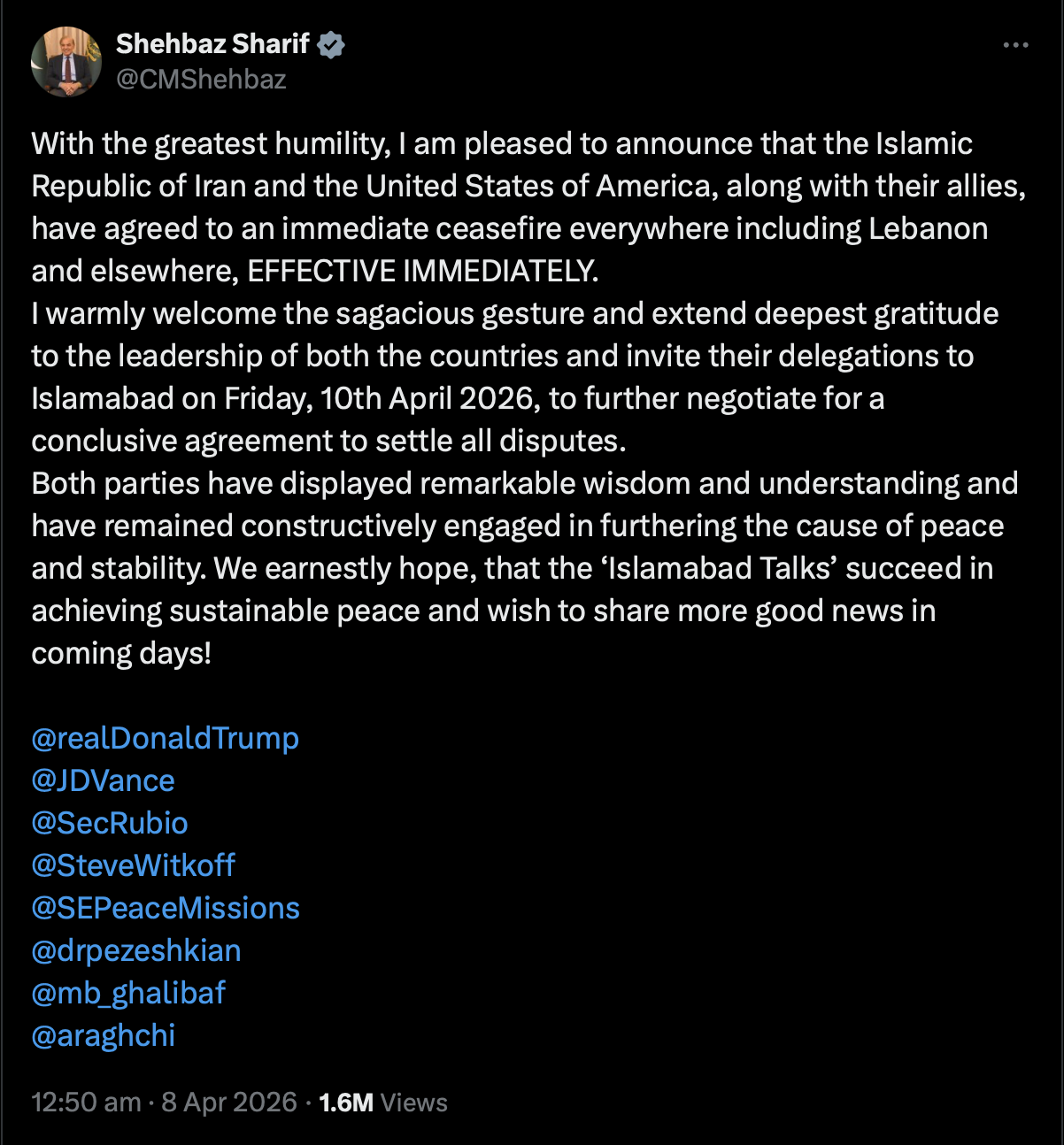
Pakistan forced the pause the world could not secure.
This is not sentiment. It is structural. Islamabad was the only room both sides could enter. Pakistan maintained working diplomatic channels with Tehran throughout the war. It shared enough institutional credibility with Gulf capitals to be trusted as a mediator. It was sufficiently operationally relevant to Washington; Field Marshal Munir’s name appeared, unremarkably, in Trump’s own ceasefire announcement, to be taken seriously rather than patronised. No other state sat at that intersection. Egypt tried. Turkey tried. Neither had all three legs of the stool.
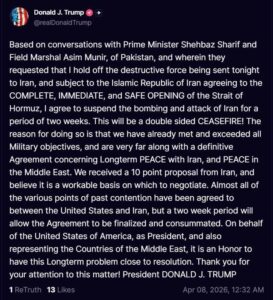
Over forty days, escalation outran control. Oil surged past $110 a barrel and briefly touched $117. Insurance markets seized. Traffic through the Strait of Hormuz reduced to a trickle. American signalling moved from coercive to apocalyptic, “a whole civilization will die tonight.” Iranian signalling hardened even as its leadership structure absorbed shock. Each side retained the capacity to raise costs further. Neither had a clean exit.
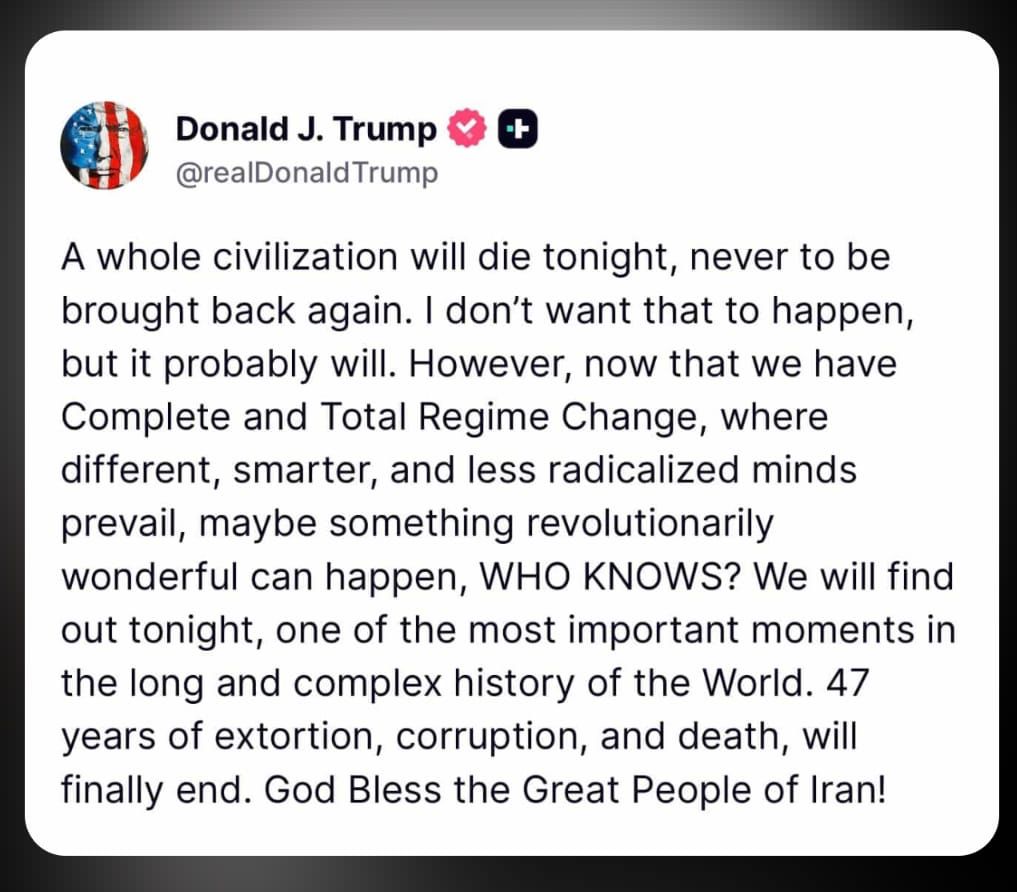
Pakistan supplied one.
The mechanics of the pause reveal everything. Tehran accepted a two-week window in which maritime traffic would resume under its coordination. Read that precisely. Coordination, not surrender. The Strait remains, in Iranian framing, an instrument of state power. That is not the language of defeat; though states rarely speak the language of defeat in real time, regardless of battlefield reality. What matters is what the text actually says. Iran controls the reopening. Iran does not yield it.
Washington will declare victory. The machinery is already running. Continue reading The Forty-Day War: Pakistan Saved the World?

Open Thread
Formerly Brown asked me to post this:
1. Six Ukrainians and one US citizen have been arrested by india while crossing over from Myanmar. Apparently they were helping to create trouble in Myanmar, an eventually trying for a Christian state there. Sheikh hasina had sounded about US interests in such a venture.
2. Tamilnadu elections might be closer than expected. Side show: seeman’s Tamil party is attracting Brahmins!! who are opposed to Dravidians.
3. LDF might pop UDF once again in Kerala. Ironically both fronts are accusing each other of being B team of BJP, who have 1 seat currently!!!
4. Indian lokasabha is to add 215 more seats reserved exclusively for women by the 2029 polls. Modi has changed india for ever.

Is Hormuz, Israel’s Suez but Pakistan’s Second Act?
Start with the uncomfortable question nobody in Washington wants to ask directly: how is this not a defeat for Israel?
Trump reposted Shehbaz Sharif’s offer to host US-Iran peace talks, and Bannon’s WarRoom picked it up within the hour. That’s the tell. When Pakistan’s diplomatic positioning lands on the most watched MAGA platform in America, amplified by the President himself, the “Second Act” isn’t a thesis anymore. It’s the news.
In 1956, Britain and France attacked Egypt alongside Israel. Militarily, they won. The Egyptian army collapsed. The canal was taken. Then Washington intervened, sterling cracked, and within weeks they withdrew — humiliated, permanently diminished, never again operating as independent great powers in the Middle East. They won the battle and lost the century. (As an aside, PM Modi made his allegiances clear from the very start of this conflict; the bombing was reportedly postponed for his visit to Washington. India, like Britain and France in 1956, has picked its side. The question is whether it has picked the winning one.)
That is the template. Now run the present war through it. Israel spent two years engineering this confrontation. Then, at the exact moment diplomacy began to work, the bombs fell. Oman’s Foreign Minister Badr bin Hamad Al Busaidi, a cautious, establishment figure from a cautious, establishment country, said it plainly: nuclear negotiations were making progress, Iran had agreed to no enriched uranium stockpiling and full IAEA verification, peace was within reach. Talks were due to resume on 2 March.
The strikes began on 28 February.
That is not coincidence. That is a choice: war over settlement. Now look at the structure that follows. Iran has not won militarily. Its air force is degraded. Its infrastructure is hit. Its Supreme Leader is dead, replaced by his son; a harder man, not a softer one, which is itself a signal about how decapitation strategies tend to end. But Iran has achieved the one thing that matters strategically: leverage over the Strait of Hormuz. Analysts are already describing any exit that leaves Iran as the effective gatekeeper of the Strait as a colossal strategic failure for the United States. That is the centre of gravity. The US can bomb, seize assets, escalate. But it cannot reopen the Strait on its own terms if Iran is willing to absorb damage and impose cost. Geography is doing the work. Patience is doing the rest.
Now watch Washington move.
A $200 billion supplemental request is already in play. Oil prices are moving. Trump has begun the political separation, “I might have forced their hand”, while his own Secretary of State had already said Israel led the way. That asymmetry matters. Trump wants a deal he can sell to American families at the petrol pump. Israel wants Iran broken. Those are incompatible war aims, and they are visibly diverging: Trump rebuked Israel over the South Pars gasfield strike; Israel assassinated Ali Larijani, seen by some as a key potential negotiating figure, just as back-channel possibilities were opening.
The same negotiations torpedoed in February are now the only viable exit. Trump says Iran wants a deal. Iran denies it. Neither side is behaving like a defeated power. This is not surrender. This is endurance; and endurance, historically, beats air supremacy.
That is Suez. It does not require retreat under fire. It requires something subtler: the moment when the patron begins calculating its costs independently from the client, and reaches a different conclusion. When that happens, the war ends regardless of battlefield position. Britain and France didn’t lose in 1956 because they ran out of soldiers. They lost because Washington ran out of patience.
The American public will eventually ask whose war this was. That question is already forming. And it is precisely here, in the gap opened by Washington’s growing ambivalence and Israel’s strategic overreach, that the second story begins.
While the US and Israel have been consumed by a war that is proving harder to exit than to enter, one country has quietly stepped into the resulting vacuum. Not China. Not Russia. Not Turkey, though Ankara is watching closely.
Pakistan.
Continue reading Is Hormuz, Israel’s Suez but Pakistan’s Second Act?
The Façade of a rules‑based international order

Politics is deeply ideological—but does ideology really matter in geopolitics at all?
A few modern (if that’s a fair word) Islamic countries—Turkey, Azerbaijan, and Pakistan—have adopted an increasingly anti‑India position. For Pakistan, this stance is ideological; for Turkey and Azerbaijan, it is clearly pragmatic. Meanwhile, India has become friendlier with the Taliban, Iran (the current war notwithstanding), and the Gulf states.
Similarly, India’s closeness to Israel is not ideological—though cheerleaders on social media often present it that way. It is strategic and does not depend on Jews being tolerant of Hinduism. I have zero insight into how Israelis view Hinduism (nor do I, as a resident of India who never intends to visit Israel, particularly care). But that should not matter, because Israel is one of the very few all‑weather geopolitical partners India has.
India needs weapons and technology, and it gets them from Israel—so Israel is important to India. India needs oil and gets it from Iran and Russia—so they are important to India.
These statements may sound childish or crude, but they capture how geopolitics actually works. It does not run on ideology or cultural history. Much of the cultural narrative that intellectuals and pop‑culture try to weave around geopolitics is post‑hoc justification meant for an idealistic public. Even dictatorships engage in such storytelling—not just democracies. There are exceptions, of course. For instance, when the Nupur Sharma controversy broke, it triggered a small geopolitical crisis for India.
Nation‑states are both products of culture and creators of culture. Cultural and political anxieties were the prime movers of the Pakistan movement. But the lived realities of Pakistan, India, and even Bangladesh as nation‑states have produced their own cultural trajectories and divergences.
So should an Indian cheer for the bombing of a friendly totalitarian theocracy at the hands of its friend which is a selective liberal democracy {only for the chosen people) ?
No—not only because Iran is a friend of India, but because emerging economies that are democracies need at least the façade of a rules‑based international order to function. Donald Trump doesn’t seem to like the façade but diplomacy of varying shades still ought to be relevant in politics for years to come.
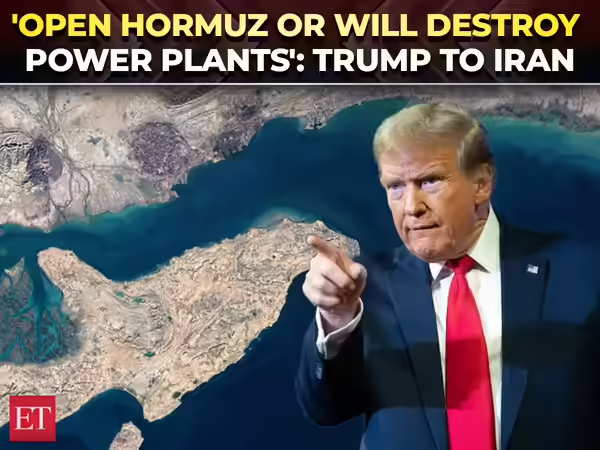
The Hormuz Ultimatum: Wealth Doesn’t Win Wars
Wealth Doesn’t Win Wars
A contact in New York mentioned, almost in passing, that the shelves at their local (premium) supermarket were beginning to empty. Not bare, but noticeably thin, the way they go before a blizzard. People panic-buying quietly, without announcement. At LaGuardia, long queues that the local press has barely covered. The official newsflow says nothing. But the supermarket shelves don’t lie.
This is how the consequences of a war 6,000 miles away arrive in the richest city in the world; not with sirens, but with gaps on the grocery shelves and unexplained airport delays that nobody in authority seems in a hurry to explain. The information lag is itself a story. There is roughly a week between what is happening and what is being reported. Don’t believe one’s lying eyes.
BB’s thesis is that military power is ultimately a function of GDP. It is a reasonable working assumption. It is also, we would argue, dangerously wrong in the specific conditions we are now watching play out in real time.
The United States and Israel are the two wealthiest, most technologically sophisticated military powers to have ever jointly prosecuted a war. Their adversary is a sanctioned, inflation-wracked theocracy that has been massacring its own citizens and losing proxy after proxy for two years. And yet here we are, Day 23 of Operation Epic Fury, with Trump issuing a 48-hour ultimatum to obliterate Iran’s power plants unless the Strait of Hormuz is fully reopened, Iran responding that any such strike will be met with attacks on U.S. and Israeli energy and infrastructure assets, Brent crude at $112 a barrel and Goldman Sachs projecting elevated prices through 2027, and the administration having exhausted every economic lever it possesses. The richer side is losing the economic war. The question is whether they know it yet.
Iraq, Afghanistan, and the Sociology of Surrender
The pattern is not new. We have watched it twice in living memory, in the same geography, and both times the lesson was the same. Continue reading The Hormuz Ultimatum: Wealth Doesn’t Win Wars
Indian RW cheering for Iran
I am adding this post after procrastinating putting it up for days.
Most Indian RWers and even Centrists and LWers are directly or subtly on side of Iran vs Israel/US. One just has to visit timeline of Hindutvavadi influencers like JSai Deepak, Abhijit Iyer, Kushal Mehra.
Even the Right leaning or Centrist media people like Shiv Aroor, Palki Sharma, Arnab are actively cheerleading Iran. Indian government has thus far avoided taking a position pro Iran, but its obvious where Indian interests lie.
Despite Military ties with Israel and India seen as generally pro Israel – the criticism of Israel and Bibi is very common now in Indian SM.
Funny none of the posters here have noticed this !
Pakistan must not treat Afghanistan like Gaza
[A note to readers: BB’s open thread is taking a short break while he recalibrates to high-signal posting]
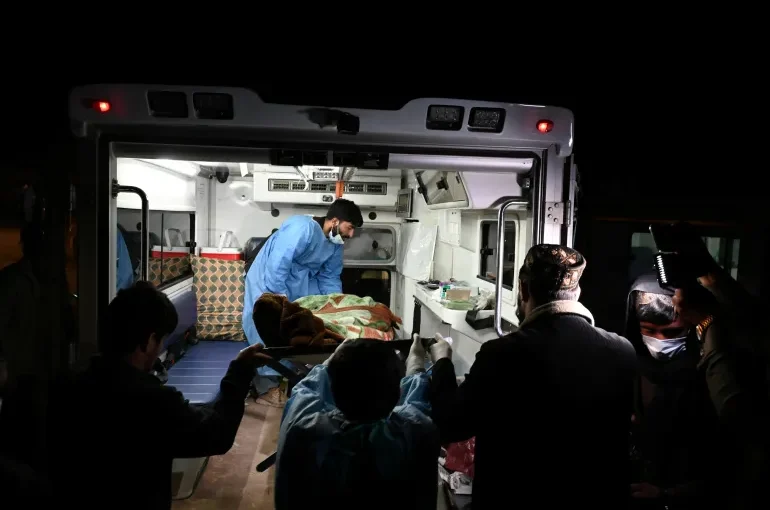
Pakistan Strikes a Hospital in Kabul.
Late on Monday night, the 28th night of Ramadan, a missile struck the Omid (“Hope”) Addiction Treatment Hospital in Kabul. It is a 2,000-bed facility built in a former NATO camp, housing thousands of young Afghans receiving treatment for drug dependency. Witnesses said they heard three explosions just as patients were completing evening prayers. Two bombs struck patient rooms directly. “The whole place caught fire. It was like doomsday,” one survivor told Reuters. Al Jazeera
Taliban authorities say 408 were killed and 265 injured; figures that remain unverified by any independent party, though the physical destruction of the hospital and the ongoing rescue operation are not in dispute. Rescuers were still pulling bodies from rubble by flashlight through the night. The UN human rights expert for Afghanistan, Richard Bennett, said he was “dismayed” and urged all parties to “respect international law, including the protection of civilians and civilian objects such as hospitals.” ABC News
Pakistan insists its strikes “precisely targeted military installations and terrorist support infrastructure” in Kabul and Nangarhar, with targeting “carefully undertaken to ensure no collateral damage.” CP24
One witness at the scene noted military units were positioned around the hospital perimeter; which may explain the targeting logic, if not excuse it. No secondary explosions consistent with an arms depot were filmed.

The pattern matters as much as the incident.
Continue reading Pakistan must not treat Afghanistan like Gaza
The Strait That Broke the World
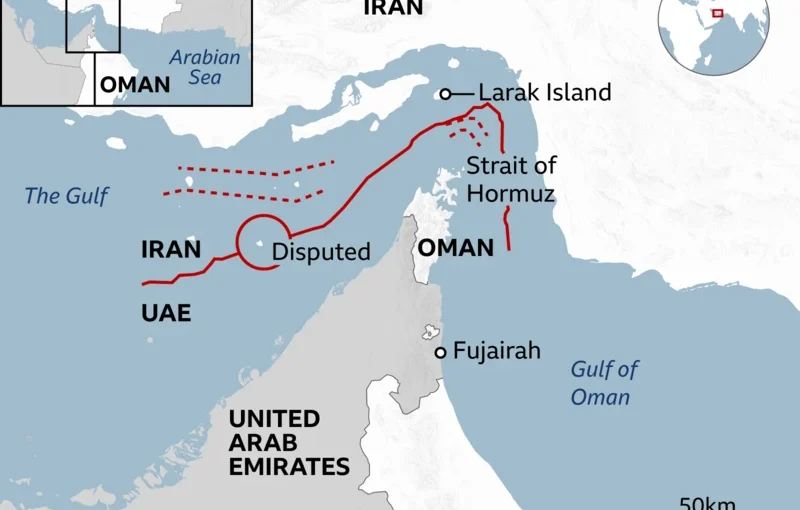
On February 28, 2026, the United States and Israel struck Iran.
They hit fuel depots, missile sites, command infrastructure. Within seventy-two hours, the Strait of Hormuz, twenty-one nautical miles at its narrowest, carrying twenty percent of the world’s oil, closed. It has not reopened. Everything that follows from that sentence is not speculation. It is arithmetic.
The Price
Oil was at sixty-five dollars a barrel when the bombs fell. Within days it touched one hundred and twenty. Analysts at Kpler said publicly that if Hormuz stayed shut through March, one hundred and fifty was not a ceiling. Barclays agreed. The IEA called the disruption the largest in the history of the global oil market, twice the scale of the 1956 Suez Crisis. People heard those numbers and thought: petrol prices. School run. Heating bills. They were thinking too small.
The Cascade
Oil is not just fuel. It is the circulatory fluid of the entire industrial world. When it doubles overnight, everything that moves, everything that is made, everything that is insured, financed, or shipped reprices simultaneously.
Marine insurance becomes unwritable. Trade credit freezes. Every CFO at every company in every sector looks at their cost assumptions, built at seventy dollar oil, and cancels the next quarter’s capex in the same morning meeting. That coordinated freeze is not a symptom of recession. It is the recession, arriving before a single GDP figure confirms it.
The banks come next. Energy loans, airline debt, shipping company bonds, all underwritten at sixty to eighty dollar oil. At one hundred and twenty sustained, covenant breaches begin quietly. Not crashes. Tightening. The marginal credit that keeps service businesses alive stops flowing.
Then the Gulf sovereign wealth funds. ADIA. PIF. QIA. Mubadala. Two to three trillion dollars in global assets, equities, real estate, private equity, deployed as patient capital into Western markets for fifteen years. They are nominally richer at one hundred and twenty dollar oil. But their export infrastructure is disrupted, their domestic spending obligations spike immediately, and their liquidity needs arrive precisely when their asset values are falling.
The moment even one major fund moves from net buyer to net seller, it removes the price support it has been providing silently for years. Other funds follow. The risk premium they have been suppressing across global asset classes reasserts overnight.
This is not the 2008 financial crisis. That was a fire in the financial system’s wiring. This is the fuel supply to the engine failing. Different category. Larger consequences.
Pray for Peace- Join in