The Democrats won control of both houses of Congress on 3 November. CBS News called the House for them at about 10:15 pm Eastern and the Senate at about 11:35 pm (CBS). Some races were still uncalled on Wednesday morning, including the Senate seats in Alaska and Mississippi. The new Congress takes office in January.
The Iran question
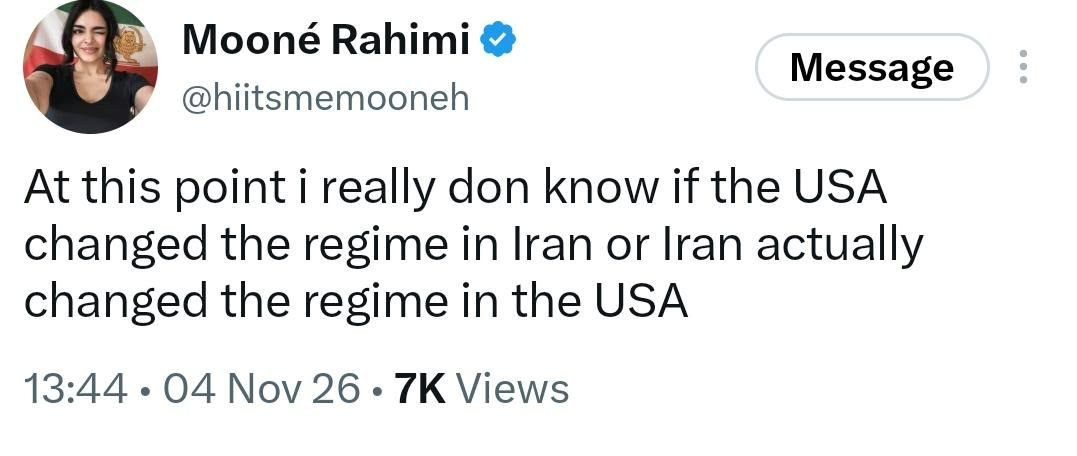
Mooné Rahimi put it this way on X on 4 November:
This war began with US and Israeli strikes on Iran on 28 February 2026. It has not ended; talks were held in Qatar on 31 October and 1 November (Al Jazeera).
| Preliminary exit polls and prices | Figure |
|---|---|
| Voters who said the Iran war was a crucial or major factor in their vote (CNN) | 74% |
| Voters concerned about gas prices (CNN) | 87% |
| Trump’s approval among voters surveyed (CBS) | 38% |
| US average, regular gasoline, 28 Feb 2026 (AAA) | $2.98 a gallon |
| US average, regular gasoline, 3 Nov 2026 (AAA) | $4.15 a gallon |
A strategic victory for Iran
Trump’s reply on Truth Social was that he was not on the ballot, and that if he had been, Republicans would have won.
Did Trump’s war with Iran help cost Republicans Congress? I think it did, and this is what Tehran was counting on: that the cost of the war would reach American voters, and that they would punish the government for it. They have. That is not support for Iran. It is support for a quick end to the war and a return to normal gas prices. But it looks like a strategic victory for Iran.
Seats that changed
Democrats won seven Senate seats that Republicans held:
| State | Winner | Defeated |
|---|---|---|
| Maine | Troy Jackson | Susan Collins |
| Texas | James Talarico | Ken Paxton |
| Ohio | Sherrod Brown | Jon Husted |
| Kansas | Adam Hamilton | Roger Marshall |
| Iowa | Josh Turek | Ashley Hinson |
| North Carolina | Roy Cooper | Michael Whatley |
| South Carolina | Annie Andrews | Darline Graham |
Darline Graham is Lindsey Graham’s sister. Governor Henry McMaster appointed her to the seat on 13 July 2026, after Lindsey Graham’s death.
Talarico is the first Democrat to win a Texas US Senate race since 1988 (AP).
El-Sayed and Sky News
In Michigan, Abdul El-Sayed held the open seat for the Democrats, beating Mike Rogers. He becomes the first Muslim elected to the Senate (AP).
On Election Day, outside a polling site, he asked the Sky News correspondent James Matthews whether he was registered to vote in Michigan. Matthews said he was not. “Then why would I care to have a conversation with you?” El-Sayed replied (The Hill).
The desi ballot
| Candidate | Race | Result |
|---|---|---|
| Vivek Ramaswamy (R) | Governor of Ohio | Lost to Amy Acton |
| Pia Dandiya (D) | House, Florida 22nd | Won, first term |
| Suhas Subramanyam (D) | House, Virginia 10th | Re-elected |
| Ro Khanna (D) | House, California 17th | Re-elected, over Ritesh Tandon (R) |
| Pramila Jayapal (D) | House, Washington 7th | Re-elected |
| Ami Bera (D) | House, California 3rd | Re-elected, eighth term |
| Amish Shah (D) | House, Arizona 1st | Leading, not yet called |
| Aruna Miller (D) | Lieutenant Governor, Maryland | Re-elected with Wes Moore |
| Saritha Komatireddy (R) | Attorney General, New York | Lost to Letitia James |
| Nithya Raman | Mayor of Los Angeles | Too close to call against Karen Bass |
The five Indian-American House winners listed are all Democrats. Two familiar names were already out before November: Shri Thanedar lost his Democratic primary in August, and Raja Krishnamoorthi lost the Illinois Senate primary to Juliana Stratton.
Muslim voters and Pakistani Americans
In Britain, Pakistanis stand for both South Asian and Muslim politics. In the US they stand for neither. Every South Asian winner for Congress listed above is Indian American. The first Muslim senator, El-Sayed, is the son of Egyptian immigrants.
Pakistani Americans appear at state level. Saud Anwar (Connecticut Senate) and Salman Bhojani (Texas House) lead their races, as does the Bangladeshi American Md Masudur Rahman (Connecticut Senate). Nabeela Syed won Illinois Senate District 26.
More on Brown Pundits
Earlier: Inside Pakistan’s High-Stakes Gamble on Trump.
The current Open Thread is Open thread: Musk the sociopath?
What prevents trump from bombing Iran again?
it’s pretty clear there is little to no support for the Iran war among US voters
There was little support from the US voter for a 20 year occupation of Afghanistan. It takes a lot more than that to pull back from a conflict for the US.
Afghanistan didn’t cause pain at the pump..
Did the erratic tarrif changes have any effect on the market?
I think the republicans will rebel against it, they cannot survive another loss for Israel. Trump can get impeached if he overreaches.
Ballot box democracy works the way it is intended.
Realistically post-Iran war regardless of what happens the US will be strategically convergent with Israelis even further. They might act distant on the official channels and at the political level but the reality is the interests are aligned even more severely at this point. The war might escalate further or it might become a low intensity simmering conflict but it isn’t going to go away.
My answer was in the narrow context of what stops Trump from bombing.
It is political suicide here. He can count down days to impeachment from the first attacks.
Broader Israel-US collusion is too embedded to dis-entangle. The Dems are friends of Israel too.
Let’s not kid ourselves, historically the US has found rather creative ways to escalate conflicts while looking like the victim. Trump admin has been found to be lacking creativity and has preferred to instead lie bold facedly or to not try to justify their actions at all. All it would take to create a bipartisan consensus of bombing Iran would be a tug at the heartstrings using an incident involving American troops or equipment. Such incidents were fabricated by the US in the past as well to escalate conflicts like the Gulf of Tonkin Incident.
Nothing. He will only have to share whatever intel he has with some people at least now who dont believe him.
The US is technically still not at war with Iran yet here we are.
“US Vice President JD Vance says Iran war is ‘the reason we lost’ midterms”
https://www.dawn.com/news/2042118/us-vice-president-jd-vance-says-iran-war-is-the-reason-we-lost-midterms
he is pivoting towards the Presidency for sure
This guy is trying too hard.
If Trump is going to have a tough time, no amount of money from Thiel can help JD Vance win the next election.
Meanwhile in India….
https://www.indiatoday.in/opinion/story/us-midterm-election-results-trump-no-lesson-for-narendra-modi-indian-voters-premature-joculation-3032149-2026-11-04
#####
The pattern is old. Every time a strongman somewhere stumbles, we break into bhangra. Brazil, France, Serbia, Bangladesh, Israel, now America. The tune never changes: lesson for Modi. Melodious. Hummable. Imported. Those leaders came and went. Modi has not lost an election he contested since his first, in 2002. Not that he can’t or won’t. His party can’t win some prized states in spite of repeated claims of a rise. The born leader, meanwhile, waits to inherit all these imported lessons, presumably with interest. This is one outsourcing contract India doesn’t sign up for.
Real voters here still decide on jobs, prices, freebies, caste arithmetic and whether the local candidate looks after the drain in their lane. Hate for Modi or for Rahul Gandhi does not decide their fortunes. Policy does.
#####
My take: Rahul’s congress is at 20% vote share and modi’s is at 40%.
For Rahul to have any chance, 10% of modi votes have to switch, which at this point looks difficult….
Haha, funnily enough, I wrote something very similar. The global news channel coverage of American elections is bad enough, but the Indian ones go overboard.
The total amount of people who dont vote for the nda is 56% of which 19% vote for congress and more broadly 41.48% to 43.8% who voted for the NDA.
People who voted for neither is approximately 14.8%. The actual number one needs to get to the INDIA alliance is closer to 2%( which is still difficult but not impossible). The real increase in voteshare can be made by joining up with parties outside of both alliances.
All this to say is that the difference between both parties in terms of vote share is not that big nor is the gaps unbridgeable.
Man there are so many things wrong with this analysis that it isn’t even worth poking holes in it because it is more holes than substance. The reality is the INDI block is too dependent on parties with one foot out of the door. In a case where the block actually does end up competing with the NDA, the NDA will end up poaching its members by providing them better terms as it did with Nitish and Naidu. Alliance vote shares don’t matter as much and the vote share of the party at the center of the alliance matters more towards its cohesion. We have to remember that even Mamata Banerjee was a former BJP alliance member.
So basically my main point that there is a sufficient number of people who dont vote for the BJP and who can be brought into the alliance is correct? Because that is what I was trying to get at.
As long as you show yourself to be best placed to listen to their demands that they dont believe the BJP will be able to do, you have ample avenues to increase your vote share and horse trading does not make this mass of voters go away, it just delays the defeat till the next elections.
Anyways the election is 2.5 years away, a lot can change. My only point is that the INDI alliance bridged tue gap once and there is enough votes out there to bridge it even further without even getting into the voters of the NDA.
You make several laughable assumptions in your argument. Firstly, that the INDI block is in any way coherent. Secondly, that vote percentages will transfer perfectly across party lines. Thirdly, the voters who vote for the opposition are non-BJP voters instead of voters for a specific regional party or Congress. All of these mistakes combines to make it a completely vacuous argument.
You make several assumptions yourself.
First that present day infighting will continue indefinitely and the fact that one party that clearly is a threat to them wont bring them together and when thia does vote percentage will transfer seamlessly.
Second that the non bjp voters, wont eventually come together themselves when the above happens.
Your fundamental assumption is that the numerous factions of the opposition can never come together because.. well it is just another instance of your opinion being treated as fact. The numbers are there and at little by little the social conditions for these numbers to come together are also coming place.
AAP and DMK refuse to even attend the INDI block meetings at this point. TVK is in an alliance of convenience with the Congress. The only parties that seem to want to keep the INDI block together are the election losers of the alliance like TMC. The reason everyone assumes that they’ll never come together is because they’ve historically fallen apart. Do you even remember the days when Nitish Kumar was supposed to be the convener for the alliance and then he left to re-ally with the BJP or when Chandrababu Naidu shifted away from the alliance to join hands with the BJP. The AAP is at the forefront of the anti-Pappu campaign at this point to oppose the Congress in Punjab. The alliance is fractious and denying that simply shows your own biases.
Indian politics is full of surprises and one should not close their mind to the possibilities.
Both of us agree that the numbers are there, it is whether the opposition parties can mend their differences and work together.
Almost all parties are united in ‘vote chori’ whatever the merits of this whole issue and if anything the fact that so many parties in the opposition have lost their states and have to gain back their political relevance as soon as possible is why them coming together becomes more likely not less.
Even the AAP if it finds itself out of power will be behaving very differently. Anyways being anti congress does not mean it will be pro BJP.
All I am trying to say is that putting your ego down and working together is difficult but not impossible and most parties in the INDI alliance are in a position where they have everything to lose by not working to bring the BJP down a peg
Nothing about needing to be specially biased towards them, just having baseline trust in their desire for survival.
Some would say praying for miracles isn’t a valid electoral strategy. But let’s see what happens perhaps the left will surprise us this time because 126 losses aren’t enough to prove a pattern here.
It is not praying for miracles becauee there is nothing miraculous about people who want power who cant obtain it on their own coming together.
And patterns change in politics all the time.
6th grade arithmetic cope. Reminds me of this long mathematical argument a teenager had once made on a cricket forum after India lost the 2003 WC cricket final. Crux was that India ‘could have chased 360’ if they didn’t get all out after 8 wickets had fallen. Because Ashish Nehra could have hit 5 sixes.
Logic doesn’t matter, its the emotion.
The fact is thst the majority of people in India dont vote for the party you ‘reluctantly’ vote for.
There is nothing to suggest that these people and the parties they vote for, cant overcome their difference and come together in governance.
That is the real cope here, that people wont responde to the tendency to delegetimize all dissent and opposition to their needs and demands, with coming together as one.
It is good for you, that the party you reluctantly vote for, at least is aware of this possibility and eventually after much pointless attempts at suppression takes the correct steps to prevent broad consolidation. Maybe try to be less emotional in your judgement?
I am just going to interject here and say that I think both of you are kinda missing the forest by focusing on the trees here. I feel like a lot of the arguments being made kinda miss the strong structural elements that shape both Congress and the BJP. Congress is organized in a horizontally, while the BJP are organized in a vertical manner in terms of their structures. Congress is basically a battle royale party, a massive tent party, where the winner takes all kinda of model.
Fundamentally, the party is open to basically everyone from any social or ideological background, and said people can simply leave the party when it suits them. This creates a more equal structure where everyone holds equal billing with one another, but also produces a deeply competitive environment where everyone constantly undermines one another to rise in rank. Basically, it’s easy to enter or leave, but never easy to rise in rank. Kinda the reason why dynastic politics works exceptionally well in the party is that they have direct connections to pre-existing figures in the party; it’s easier to establish supporters within the organization by utilizing the prestige associated with the family name.
Another crucial element here is that this openness often results in a political model that favors practical politics over ideological politics. The Congress generally speaking are very good to horse trading or forming complex political alliances, but the lack a clear vision for the country or even a functional end goal for their party. Mostly due to two main facts: a) appealing to a diverse set of people generally requires you to dilute your ideology, often completely forsaking it as the number of people groups increases over time. b) the Congress originally started as a fundamental left-of-center political party that favored more socialist or dem soc economic practices that fell out of popularity in the post-90s period. They haven’t really found a new vision to replace the older one that followed since their inception. Over time, they shifted away from a clear ideology to more practical political tactics to maintain power during the coalition era of the 2000’s.
Nonetheless, this focus on practical politics over ideology has helped the party ensure its survival long after what should have been its expiration date. Practical politics often sacrifices effective execution of policy for flexibility, which is quite useful in building alliances and keeping your faction relevant in a changing political environment. A lot of Congress’s extensive weaknesses, often from disputes, fragmentation, decentralization, coalition politics, and other such things, have, in some essence, kept it alive for much longer than it should have.
On the other hand, the BJP/RSS/Communists/Marxists/Naxals and others like them are organized in the near-inverse manner: vertically. Usually, anyone who wants to join can’t simply become a part of their organization without agreeing with their ideological positions, and leaving these entities is often difficult. However, this need for ideological purity that sacrifices practical politics and flexibility often results in a hierarchy and more organization in the party. There is a clear leader to follow, who has a clear vision or aim (“Revolution,” “Hindu Rashtra”). Many of these groups have very grassroots organizations that are able to appeal to the ordinary electorate much more effectively.
However, two problems naturally persist. a) This model emphasizes structure at the expense of flexibility and often centers quite deeply around specific key leaders. If your leader wants to make a dumb decision, then you have to follow through even if it is objectively bad. Internal dissent is often suppressed and often builds up over time until it eventually blows up in your face at some point. Congress members argue more than the communists or the BJP, but that because their model allows for dissent to be expressed, it is a feature, not a flaw, per se in this specific instance.
Also, a hot take: I think that the BJP-like entities produce good party followers, but mediocre to bad politicians, while Congress has garbage followers as well as workers, but mediocre to good politicians. I should clarify I don’t mean good leaders or ethical politicians, rather just people who are good at deploying political strategies and working to retain power. Outside of the top brass, most of the middle-to-lower-end politicians in the BJP and Communist parties are not really politicians since they seem to be quite dependent on the grassroots networks and their party name to coast through a lot of elections.
Congress, on the other hand, is basically a battle royale, where everyone from your enemies to even your family is out to steal your position, influence, and money. So, the ones that survive all of this tend to be quite good at sucking up to people, changing your words, and knowing when to grab opportunities that come before them. The BJP and Communists just don’t have the same cutthroat system that makes such politicians, but they definitely have a better organizational structure that makes mobilization a lot easier, and people aren’t out to backstab you all the time (at least not to the extent as it is in Congress).
b) The general populace must actually think that your ideology has some merit or is worth considering to put their support behind. This is, in some essence, a double-edged blade. Popular support for a given ideology and policy positions can result in more than average turnout among the population. At the same time, if people become disillusioned with this belief system because it failed to materialize any meaningful results, then they will abandon everything in one go. It basically happened to the communists, who initially won great support among many people due to their support for land reforms and socioeconomic reforms, resulting in many electoral victories. After the 90s, their economic model was deeply delegitimized by the masses, and they lost their status as a major political party across many states. Oftentimes, many of these well-structured organizations are kinda reformed as well once they are set in their ways, especially if their leadership turns rotten, since internal dissent is needed for reform, and that is usually hard.
All of this kinda can be seen in the last election itself. The Congress was able to muster a lot of its coalition partners together in what everyone assumed was going to be a loss. At the same time, there was clearly a lot of dissent both internally (I remember hearing about the dispute between Yogi and Modi/Amit since they were seen as showing favoritism to Gujaratis over Upites) and at the grassroots level. Yet none of the BJP leaders seem to have paid attention, and honestly seemed to have believed that they would come out more successful than last time.
Another thing I should point out here is the fact that the BJP, to a degree, understands how the Congress works to a degree. The biggest blowback for the Congress in recent times comes from the gradual death of regional parties, which would have formed a key part of their coalitions. The BJP has brought in many regional groups and gradually absorbed their entire leadership as well as workers. This clipped the Congress’s wings in many places and left it as a sitting duck in many places. At the same time, it has made a lot of the regional parties that survived very suspicious of the BJP and more willing to work with the Congress.
Fundamentally, I don’t think Congress will ever truly overcome the BJP, and the BJP won’t be able to truly kill Congress. The decline of the BJP will happen in a gradual manner over time as different sections of society become disillusioned with Hindutva (like they did with Communism) due to oversaturation or changing sociopolitical realities, but they won’t fully switch over to Congress. The dissent will gradually build up over time until it pops in one go, like it did during the last election. At some time (probably when Modi retires, dies, or loses popularity), the BJP will fragment and new political parties will form (like with Congress), or they will decline in electoral share and produce a political vacuum that will be filled by newer parties that will emerge.
In all honesty, I don’t see both parties doing well in the long run, though. Congress survived much longer than it traditionally did, but there is a question to ask about how fair it is in a post-Modi electoral reality that has been significantly changed. In the past, many of Congress’s electoral allies had come from political factions that originated from their party or had close pre-existing connections. However, New political factions in the future are probably going to be more different, as they are more interlinked with BJP-like politics and have cross-party connections with Congress.
On the BJP, they have been overly reliant on Modi for quite a while, and I am not really sure how they’re going to manage any of the internal schisms that are going to emerge. In addition, a lot of their Hindutva ideas have become oversaturated in the socio-political matrix to the extent that another conservative party could simply co-opt those ideas and use them more effectively. At a certain point, their policy positions and ideological talking points can evolve beyond what the party followed, as it did with the communists.
In simple terms, the BJP will decline over time, but Congress can’t fill its shoes, and it’s going to create a political vacuum with a lot of uncertainties. Of course, this is my opinion, and reality may go in a different direction.
I am not talking about anyone being replaced because that is fundamentally impossible.
Both the BJP and congress have at least 20% of the population at the very least who will never shift away and vote for someone else. No one is shifting to anyone else unless these parties cease to exist.
What this whole discussion was about is whether the congress can get enough votes to dislodge the BJP. The answer in my opinion is yes, there are. And even if this is divided amongst many parties, the fact that many of these parties have lost power and need to get back into office as soon possible makes any possible infighting a little less likely. There is nothing too miraculous about this.
I dont have much confidence in them lasting long in office but that is a separate discussion.
My only hope is that irrespective of who comes to power the kind of supplication and obeisance shown to politicians and bureaucrats ceases. That is what will bring real political change not which party wins or loses.
I think you are underestimating how much of the population can shift between the two parties. In the last three election cycles, the BJP has only (11% of Lok Sabha seats) 63 seats (7 from UP) that consistently vote for it, while the Congress has only retained a total of (2% of Lok Sabha seats) 12 seats (6 seats coming from Kerala) in the Lok Sabha. Regional factions held all the other seats, or they were split among different political parties. This raises a question: how much of the electorate has any loyalty to a political party? Rather, they seem to have no qualms about switching parties when it suits them. I don’t think either party has a large base of loyal supporters, as it would seem on the surface.
I would go so far as to say that I don’t think there is a deep deference to politicians among the masses, as it would seem on the surface. Rather, the polarized nature of the environment makes it hard to have any conversation without it degrading into a shitshow, even though internally they might have different opinions. Fundamentally, the electorate doesn’t care who the leader is, as long as these groups don’t try to interfere with the pre-existing practices of the populations and deliver socio-economic benefits. The appearance of strength and obedience doesn’t always mean actual obedience or deference.
Furthermore, I want to say that the BJP will decline over time, but I don’t think Congress will ever dislodge them either. The BJP has a greater risk of internally fragmenting and the base gradually abandoning it, eventually producing a political void. The problem here would be the fact that Congress won’t be able to fill in that void completely, and the BJP won’t be able to regain its dominant position either. This could create a more fragmented environment without a clear leading party and mutiple coalitions forming around both the declining BJP and Congress.
It produces a situation where the BJP remains a major political player, but lacks the capacity to fully assert control. This is a recipe for political deadlocks, where the Congress tries to pass a bill, and the BJP blocks it. Neither party has the upper hand, and both will engage in complex political attacks against each other. This might worsen religious and caste relations as the BJP instigates communal conflicts to shift the electorate in its direction. Also, both groups will probably play around with caste politics until it opens rifts between different groups. This will probably result in a period of politics that involves excessive switching between Congress and BJP, which, in an ideal world, would produce healthy competition, but realistically both parties try to undermine tactics that leave everyone worse off while causing both parties to decline.
The main issue will be this political vacuum that most certainly will form since politics has been centred around Modi and the BJP for around 15 years at this point, so their decline will create a gap. The issue is going to be about how and who fills that gap; it doesn’t have to be Congress necessarily. A lot of the coalition that Congress has been part of has been wiped out by the BJP and is less likely to be able to meaningfully return to politics. None of which includes the issues relating to future generations of these parties. Both Modi and Rahul Gandhi are both becoming older with time, which presents larger issues about successors that will replace them and become future generation of the party.
Elections in India are not the only measure of a party’s influence. For various reasons your vote share wont directly mirror the seats you win.
However, having a dedicated group of people who financially support you, attend your protests, do paid and unpaid labour in the form of politicsl firefighting or campaigning, are instrumental to a political party being relevant.
I am speaking in the above terms, as this mass of people who believe in you are much better indicator of a party’s longevity than the seats it wins.
I agree that neither party will dislodge each other and the situation is changing, as older batch of politicians and leaders pass on. Cant comment too much on what the landscape will look like after they do because trying to predict the future is messy business.
But one thing I am certain of, at both the lowest points in this century at least 20% of the population voted for both the congress and bjp directly, this is the bedrock on which the survival of these parties will be built, as long as leaders are sensitive to the needs and desires of these people of course.
##the Congress originally started as a fundamental left-of-center political party that favored more socialist or dem soc economic practices that fell out of popularity in the post-90s period.###
*****
No, it was a centerist party. In independent india, for North india it had a coalition of Brahmins, dalits and muslims,with Brahmins ruling. All their earlier chief ministers were Brahmins .
The so called left turn happened with Indira Gandhi after she split the party in 1969. Nehru was nominally left, with emphasis on planning.
The powerful obcs resented the above arrangement and coalesced around charan singh in guise of socialism.
Gradually the Congress Jati coalition unravelled and they are still searching for the magic formula.
BJP in its efforts to enlarge the envelope has taken all sections in their tent and has effectively become an obc party.
It’s loyal base is smarting under this arrangement and may vote for a general category friendly party, as and when it emerges.
I think you are mixing social conservatism with economic conservatism here. Almost all the political parties in India, irrespective of economic positioning, have been socially conservative in one way or another. In economic terms, Congress has always favored centralized planning in the early days and favored more active government involvement in the economy via things like Welfare, increased health care and education spending, etc. Compare that with the BJP and other right-leaning factions that have generally favored fewer regulations, less government involvement, reduced welfare expenditure, and other more economically conservative policies. Most of the more active government intervention policies practiced by the BJP are done out of practical necessity rather than economic ideological desire.
Fundamentally, Congress in the pre-90s has attempted to imitate a lot of the economic policies closely associated with other left-leaning governments like the Soviets. The Congress of the pre-90s could be seen as a centrist party, but that is a somewhat relative category since Communist and Socialist groups closely tied to more far-left economics were the dominant faction in those days. Congress is a centrist in the context of the pre-liberalization period, but broadly, they would be more on the left side of the economic spectrum from a broader perspective. Really, the Congress gradually became more to the right in the economic sense over time, especially after the 90’s, but at the price of having a clear economic vision.
In terms of caste, I don’t really think there is resentment in the way you are talking about here. Many of the OBC castes often had their own caste-adjacent parties, like the SNDP groups for Ezhavas. Above all else, most OBC groups (like Yadavs, Vokkaligas, Ezhavas, Jats, etc.) are too big a group for most parties to ignore in order to ensure electoral success. In a broader sense, the main appeal that Congress and other left-leaning parties always had for these groups mainly stemmed from their economic policies. Communists and other left-leaning groups favored things like land reforms that explicitly benefited the lower caste groups. Furthermore, the Congress has always favored more extensive welfare policies that helped uplift a significant portion of OBCs who were economically depressed.
Over time, these groups saw a gradual improvement in their socioeconomic conditions, which naturally shifted their economic interests towards other financial and social interests that the BJP was able to provide. Even then, not all OBCs followed the same pathway. Ezhavas of Kerala still strongly align themselves with left-leaning groups, while Yadavs/Vokkaligas are generally split more evenly between different parties.
The biggest aspect here that I think you have missed is the social impact that economic liberalization policies of the 90s had on society. Before this period, there was much stronger class and caste (in the varna/OBC/SC sense) consciousness that propped up a lot of the left-leaning factions. Many of the communists’ early rise in popularity originated in their active fight against landlords and push for land reforms, which was universally well liked by all Jati in the lower varna background. However, this changed over time as land reforms became a thing; feudal land practices faded with the introduction of more capitalist practices after the 90s.
This gradually resulted in the decline of caste and class consciousness. The lower caste split along Jati lines as some endogenous groups saw improvements in their economic positions, while others didn’t improve as much. As each socioeconomic difference formed along Jati lines, the more economically forward jatis turned to groups other than Communists, Socialists, and Congress.
Even your argument about the BJP being an OBC party kinda of is flawed. The BJP needs Brahmanical groups and their intelligentsia to hold, develop their ideological values, and socially validate their religious nationalism. The Modi-era BJP has tried to balance the interests of the different groups with each other using religious rhetoric and economic policies. They placed Brahmins in high posts in their government and gave financial/insitutional as well as broader economic support to the lower castes, and reduced taxation alongside general deregulation policies that actively benefit mercantile groups that control the economy.
Of course, trying to appease every caste group is nearly impossible, and inevitably their contradictory/oppositional socio-economic needs will result in conflict. Religious nationalism was fundamentally the basic glue that held these groups together as part of a shared Hindu community. However, the Indian political pendulum has always swung between religious consolidation and caste consolidation, which inevitably means that religious consolidation fades with time as caste conflict arises and consolidation under caste identity happens.
You can see that in recent times. There was a conflict in Madhya Pradesh, where the Brahmin community felt upset after the BJP tried to appeal to the OBC community by picking a minister from their community over a Brahmin minister. Fundamentally, the BJP needs to appeal to every group, but has been facing difficulties in recent times in making the conflicting caste interests align. I don’t think they have even decided as to whether they even want to be seen as an OBC or Brahminical or merchant-oriented party.
Makes sense..
###Speaking about the impact of the midterm results on US foreign policy and India-US ties, Tharoor said Trump would retain considerable freedom in determining the country’s foreign policy.
“Fundamentally, Trump remains pretty much a free bird on foreign policy, so India, I think, will just have to continue negotiating with the Donald Trump we know,” Tharoor told News18.
Tharoor added that the midterm results could, paradoxically, leave Trump with greater freedom to pursue his foreign policy agenda..
Read More:
https://www.moneycontrol.com/news/india/trump-remains-a-free-bird-shashi-tharoor-on-why-us-midterm-results-may-not-change-foreign-policy-14070918.html
There are reports coming out of an incident of shooting on protestors in Rawlakot, PoJK. At least 11 dead and more injured. Its been 150 days since internet was suspended.
There is also reported use of mortars against protestors.
https://x.com/sneheshphilip/status/2118293019116064994
Muslim on muslim violence and repression is to be brushed under the rug as acceptable or non-existent. Infidels are the focus.
https://www.facebook.com/share/v/19jb8Qm4yV/
Analysing Vivek ramaswamy,…
Brahmins, literacy, patriarchy, misogeny,(?), and all in between…
Can Americans understand this?
https://theprint.in/opinion/sharp-edge/narendra-modi-donald-trump-us-midterm-elections-india/3091435/
this is the high priest of india’s liberals, vir sanghi in print, bringing them back to firm ground…
### Narendra Modi isn’t Donald Trump. India’s electoral math makes it harder to humble BJP
Things are easier for BJP, with or without Gyanesh Kumar, than they are for Donald Trump. It’s the numerical factor alone that suggests Narendra Modi could beat anti-incumbency.###
%%% And there are the personality differences. Trump is a slightly deranged figure lost in his own chaotic megalomania and baffling narcissism. Modi is shrewd, calculating and thinks of long-term strategy. He sometimes appears to have lost his touch as protests against his rule have grown, but even on his worst day he is smarter than Trump on his best day. %%%
It really is such a self deluding editorial. Especially the bit about electoral math.
Rep -> Dems had a 15-20% shift in vote share.
That sort of vote share shift in India away from the NDA towards UPA would completely invert their current positions.
The electoral math in the US and India is no different, they are both FPTP systems.
By design in FPTP 2 camps always form, it matters little that they are separate parties or not. Nevertheless the slightly more multivariate nature provides boundless speculation and verbose gratifications.
Vir Sanghvi is right that it’s the economy that provided the shift. Liberals will read it as a reversion to their world view.
The larger problem India & Indians have with America remains unsolved. This is something that is not covered well I feel.
https://indosaurus.substack.com/p/mid-term-jubilee?r=1mp4jc
Nice article. Now,
1. How will the democrats accommodate the concerns of these converted republican (essentially white) voters? or will they come back home when a ” Christian ” Vance is on the ticket.
2. As I read elsewhere, a Muslim liberal can (will ) lean on his religion and culture and yet be accepted, while , a Hindu liberal needs to shit on Hindu practices /Hinduism to be accepted as a liberal. Eg. The new Iyer mayor of LA, ever present Ro Khanna (although a new catholic), Ms. Jayapal and…..
Below is a cut and paste from a comment on line. How many of you agree?
#####
The problem U.S. facing regarding Jensen Huang is there are hundreds of thousands of Chinese women married to Americans. From big names like oracle CEO Larry Ellison to small your 70 years old nobody potatoes with a 30 random Chinese wife.
Unless you arrest them all U.S. is pretty much screwed lol. They lost it long time ago 😂
I’d argue that isn’t even the root of the actual issue. The reality is everyone working in AI has encountered the “clearly a Chinese spy” type at parties and social gatherings. They’re women and men completely out of the league of any actual AI/tech person who hang out and try to make contacts within tech itself. The reality is trying to control that is a lost cause because many Chinese women go out of their way to do the same things as the spies so its really difficult to differentiate between a social climber and a spy.
And the poor wife gets only 77 billion this week, instead of 81 billion as of last week.