
I’ll expand on this but enjoy the beautiful song in the meantime.
Tag: Indo-Pak Relations
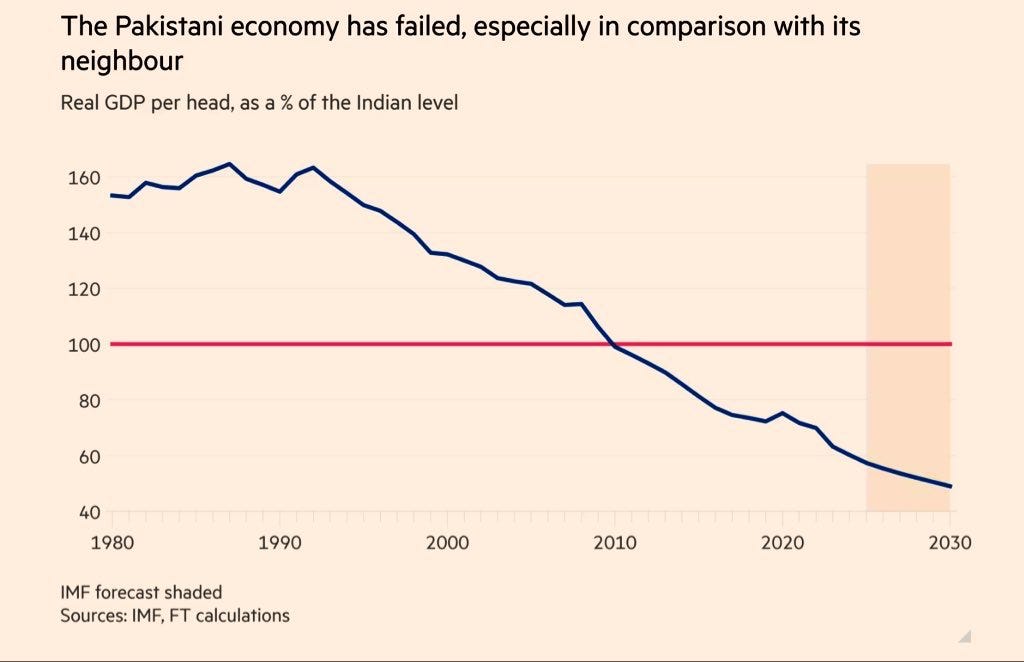
India vs. Pakistan in one graph
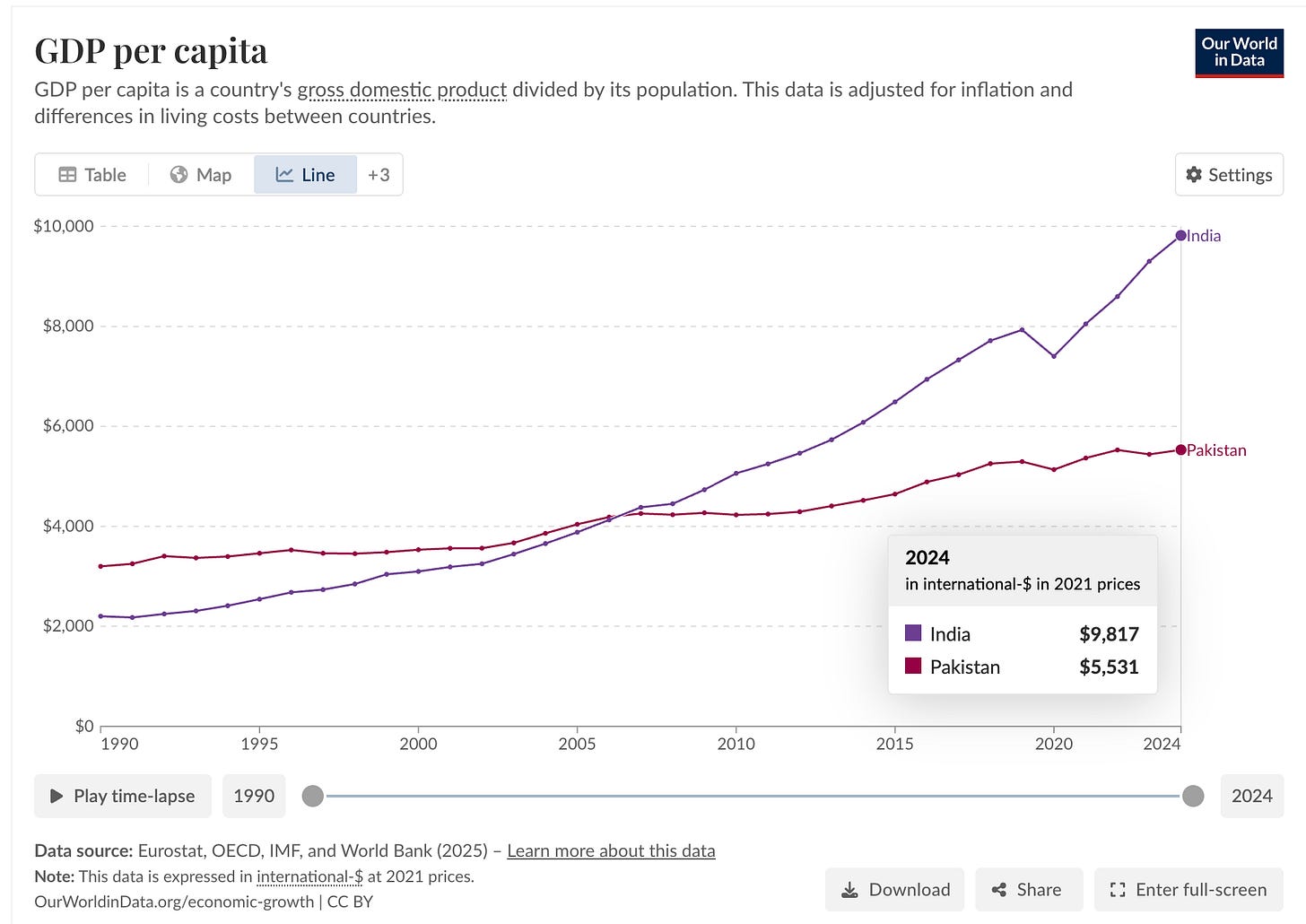
However, total GDP isn’t the right comparison. More populous economies will usually produce more output. GDP per capita is the correct metric to consider. Until 2009, India was poorer than Pakistan on a per capita basis. India truly became richer than Pakistan after 2009 and since then it hasn’t looked back. If trends continue for a decade, India will be more than twice as rich as Pakistan soon.
Pakistan’s GDP is about $400 billion while India’s is around $4 trillion. Since the ratio of their economies has stayed roughly constant for decades, their nominal growth rates should be similar from the 1960s onwards.
So why has India pulled ahead in GDP per capita? The reason is simple. Pakistan’s high fertility has driven population growth faster than India’s. In 1952 Pakistan had about one-tenth of India’s population; by 2025 it had grown to nearly one-seventh.
The other explanation why Pakistan finds it easier to maintain the status quo is that it is located in a geopolitically sweet spot. It can extract geopolitical rents from the US. It’s location close to Afghanistan is strategically important and the US has used many Pakistani airbase.
Thanks 0M for the article.
Regency, Not Rupture in Pakistan (Open Thread)
(h/t Archer, who called for this thread in the comments on “Erm”.
Also as fair warning to the Commentariat, Flame Threads will be put down and any violator will have fines ranging from mass comment deletion to revocation of Author Rights. Say what you like but tread carefully in how you say it since I did want to write on White Intellectuals hogging the “South Asian” space after Indosaurus’s excellent piece on the Great Gandhi but this just tumbled out)
Pakistan’s Interior Minister, Mohsin Naqvi, told an Islamabad seminar last week that the country’s 80-year-old governance system has “collapsed” and that Pakistan needs new provinces. A day later the DG ISPR called on the parties to consider an “administrative reset.” This week Naqvi assured the press that Shehbaz Sharif will serve his full five years; while standing by every word about the destroyed system, and reprising, for good measure, his claim to the biggest scam in Pakistan’s history: judges, bureaucrats, politicians and bankers, all implicated, an inventory that conspicuously omits one institution. The scam has an address, One Constitution Avenue, a two-decade property saga Naqvi has been prosecuting in public since May; the individuals remain nameless, naturally.
Naqvi is a Husayni Sayyid, the surname is the pedigree, claimed descent from the Tenth Imam, which makes us cousins by caste, and at present the unluckiest good Shia boy in the Islamic Republic: sent out to fly the Deep State’s kite and left to absorb the fire alone.
The PPP demands his resignation; Khawaja Asif suggests he reset his own ministry first; Raza Rabbani reminds everyone that the disease is constitutional violation, not cartography.
A Coup is surplus to requirements
Continue reading Regency, Not Rupture in Pakistan (Open Thread)
Dharms are Natural Democrats
On what Britain bequeathed, and what Delhi chose
- What did Britain actually leave in 1947, institutions or a franchise?
- Whose precedent was universal suffrage in 1950?
- Why did the wardrobe never decolonise?
- Are all South Asians natural democrats?
The Colonial Bequest
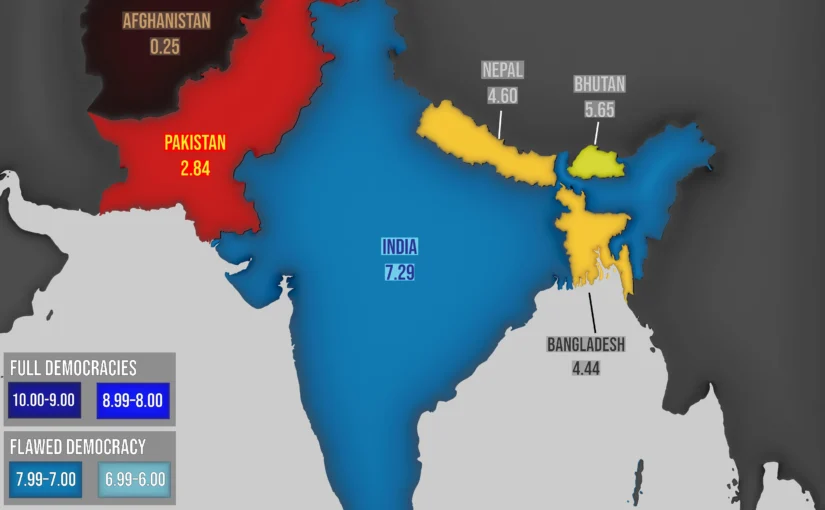
The parliamentary system across India, Pakistan and Bangladesh is Westminster’s. The founders, Gandhi, Nehru, Jinnah, were British-trained lawyers. Liberal democracy arrived in the West through revolutions and arrived in South Asia from the top down. Before the British, the subcontinent was ruled by monarchies, and the political parties are still run by royal houses in all but name, the Bhuttos, the Sharifs, the Gandhis. South Asians, on this account, are not natural democrats.
The chamber, the party system, the common law, the drafting language, the Inns of Court on the founders’ CVs are Albion’s gift. The Indian precedents, Chandragupta and Akbar are kings at scale, and pointing at them concedes the monarchy claim rather than rebutting it. The answer sits in the smaller polities.
The Dharmic republics

The Writ of the Pakistani State into P.A.K
Rawalakot vs. Jantar Mantar
- Has any other South Asian government fired the anti-national frame at a major protest movement?
- What matters, constitutionalism or state resolve?
- Can a state be “hard” outwards without treating domestic opposition as an external enemy?
Is this the same as Delhi?
Last night, the Azad Jammu and Kashmir Police issued a statement about clashes at Rawalakot. It said that armed groups of the proscribed Joint Awami Action Committee had tried to force their way into the city, that appeals to disperse were rejected, that fire was opened on law enforcement officials, and that two officers were injured. The phrase used was challenging the state writ.
Five weeks earlier, on 23 June, Dharmendra Pradhan described the Cockroach Janta Party as a B team of disruptive elements and told India Today that tukde-tukde forces were at Jantar Mantar.
The two governments reached for the same instrument. Both took a movement making material demands and attempted to relocate it outside the nation, where its demands would no longer require an answer. This is the standard subcontinental response to a protest that cannot be conceded to.
The difference is what happened next. The JAAC is now banned. Pradhan resigned on 25 July.
Why is the Pakistani case different?
Indus Water Treaty: What lies in the future?
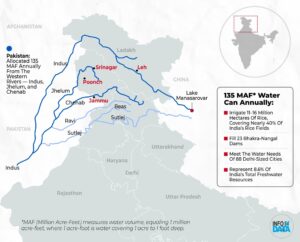
Indus Waters Treaty was signed in 19 Sept 1960 between India and Pakistan under mediation provided by the World Bank. As a political compromise between Pakistan and India seemed improbable the US and UK decided to pressure both into signing onto a technical treaty which could outline the claims and limits of both nations on the flow of the water. Over the years it was touted at the most successful and unequal water sharing agreement where the upper riparian nation only made claim to a minor portion of the river’s waters.
The Indus basin was categorized into two groups of rivers. With the Eastern Rivers (Beas, Ravi, and Sutlej) being controlled by India and the Western Rivers (Indus, Chenab and Jhelum) being controlled by Pakistan.
Many still blame Nehru for this treaty in India for only allowing India to control less than 20% of the Indus’ waters, while many in Pakistan still decry the unequal nature of the treaty in directly awarding a set of rivers to India as that may eventually cause droughts in the parts of Pakistan which are mainly fed by the Eastern rivers. However, the main calls for renegotiations of the treaty have originated in India which at this point has put it into ‘abeyance’. In this post we will go through the main areas of dispute in the treaty and what the possible solutions for the current impasse may be.
Continue reading Indus Water Treaty: What lies in the future?

The Pandits who read Brown Pundits
In May, Brown Pundits drew around sixty-one thousand visits, roughly two thousand a day and up about a third on the month. Thirty of those readers answered our survey, and while they agree on almost nothing, they are held together anyway by what they find interesting.
They are, on the same evidence, almost entirely male, forward-caste nearly to a person, and tilted in their politics.
The survey can only make sense against the size of our readership. In May, Brown Pundits drew about sixty-one thousand visits, close to two thousand a day, up roughly a third on April. Nearly half of that traffic came direct, readers typing the address or returning by habit rather than arriving from a search or a feed, and the average visit ran about a minute and a half across a little over two pages. The largest national audiences were in Canada, India and the United States.
| Brown Pundits, May 2026 | |
|---|---|
| Visits | ~61,000, up about a third on April |
| Per day | ~2,000 |
| Direct traffic | 49% |
| Average visit | ~1m 27s, 2.2 pages |
| Largest audiences | Canada, India, United States |
Against those sixty thousand, thirty people answered our survey before we closed the form. This is the devoted few who filled in a form asking their caste and their politics, not a census of the many who pass through.
The comments show who shouts; the survey shows who is here.
| Of the thirty who answered | |
|---|---|
| Men | 25+ |
| Aged 30 to 49 | 18 |
| Hold a Master’s or doctorate | 21 |
| Reading from outside South Asia | 17 |
| Hindu (five observant) | 18 |
| Muslim | 4 |
The one thing everyone wants
Review: Pakistan: Courting the Abyss by Tilak Devasher, a 10 year retrospective

Hey folks, this will be my first article on Brown Pundits. Hope you guys enjoy it! Any recommendations regarding future topics, books, or just critique on the article itself will be greatly appreciated!
Tilak Devasher is a former Special Secretary, Cabinet Secretariat Government of India. He is now known as a prolifically researcher on Pakistan in India. 10 years ago he began his scholarly journey with Pakistan: Courting the Abyss. As I was going through the book I wished there was a 10 year retrospective on his work which would help us determine how well his work has held with time. So, I’ve decided to undertake that task myself.
Continue reading Review: Pakistan: Courting the Abyss by Tilak Devasher, a 10 year retrospective
India’s Wealth will not turn Pakistan into East Germany
Our 2026 reader survey is open until 7 June – anonymous, roughly five minutes. Please take a moment.
The Comment thread is afire with the usual (and senseless) India-Pakistan arguments (essentially which of the two is poorer). Q waves the whole question away by pointing at the figure, unimpressed by “an average Indian producing only $2,800 in GDP every year,” and asks what the point even is. There is a point, two in fact.
First: per capita and scale measure different things. Per capita describes the life of a citizen. Scale describes the weight of a state. A single integrated market of 1.4 billion people generates agglomeration, economies of scale, and a pull on capital and talent that no small rich economy can match (India’s ascent in the world of cricket is an extremely interesting meditation). That is why India passed Japan in 2025 to become the world’s fourth-largest economy, why it is the fastest-growing major one, and why it is on course to take third from Germany by around 2028. The market no exporter can ignore, the trade terms a four-trillion-dollar base can lean on, the air defence and roads it can fund: that is concrete power, and it is not nothing. Much of the gain is siphoned by a clutch of oligarchic houses, but the dynamism is real.
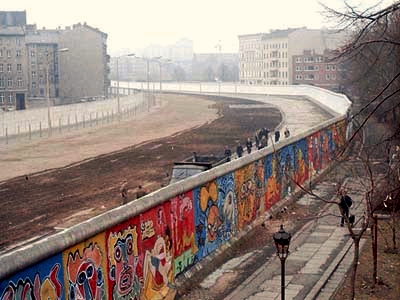
Second: however that same wealth does not buy what BB imagines it buys. India outweighs Pakistan in GDP by something close to eleven to one. It has still not turned Pakistan into its East Germany, a dependent satellite drawn quietly into its orbit and, in time, absorbed. Pakistan remains sovereign, armed, and unbought. Pakistanis are not running across the Punjabi wall to their ethnic kin.
In May 2025, after Pahalgam, the larger economy did not dictate terms: Operation Sindoor ended not in surrender but in a ceasefire announced, awkwardly, from Washington, with both capitals claiming the win.
Look West. Iran is a fraction of the wealth of the United States and Israel, yet it has absorbed the most advanced air forces on earth, kept its regime, and kept the knowledge to rebuild what was struck. The guns fell silent at a ceasefire, not a capitulation. Wealth buys reach. It does not buy outcomes.
BB treats the GDP gap as a deed of ownership over Kashmir, and assumes Kashmiris will swallow their pride for a higher income per head, that prosperity purchases consent. It misreads the Islamicate moral economy entirely. In that ledger ‘Izzat and Deen, dignity and faith, are not line items to be outbid. The Hyderabadi Harvard PhD still sings the song of his lost people.
Peoples who set independence above comfort have done so across the whole anti-colonial century, and no balance sheet has ever talked them out of it. Money may buy luxury but not loyalty.
What price will any Indian or Pakistani nationalist accept for their love and loyalty to their homeland?
Open Thread: BP Survey
Our 2026 reader survey is open until 7 June – anonymous, roughly five minutes. Please take a moment.
Update – from the thread: More reading reccys. Furqan flagged Dr Naazir Mahmood’s The assassination that changed India, along with his own book review on Duniya Digital and a related op-ed, Stupidity or strategy, on the political economy of the subcontinent’s borrowed democratic forms. Kabir marked the passing of playback singer Suman Kalyanpur with two recordings: an unreleased Pakeeza song, introduced by Meena Kumari, and a Rafi duet. And from our own pages, the latest BRAHM newsletter: The Sky Above São Paulo.
Update, 1 June 2026 – links from the thread: The Peshawar Review has a new issue out, including Professor Harbans Mukhia’s reminiscences of Kirori Mal College (College Days) and Shan-e-Ahmed reading an Urdu transcreation of T. S. Eliot’s “The Love Song of J. Alfred Prufrock” (Prufrock in Pakistan). On the Tata Sons listing question, Agni flagged a cluster of commentary: the Indian Express “to list or not to list” column, The New Indian Express on the boardroom fight, Soonawala on why an IPO may not appeal to investors, and Business Standard on the 12 June board meeting. Survey responses are at 18 and counting; please add yours if you haven’t.
Editor’s note, 1 June: This Survey thread will sit on the front page through the week, until Sunday the 7th June, while we are travelling Eastbound, so we have made it an Open Thread. What strikes us, watching the comment threads, is that for all the constant bickering, BP is a community, and a recognisably Desi one.
It has the hue of a Hindu joint family (to be of the Indian subcontinent is, almost by definition, to have Hindu ancestors; “Hindu” is simply what the Persians called the people beyond the Indus) that has built a wall down the middle of the house and still cannot get over each other. The wall is real. So is the fact that nobody moves out.
Original Post: Every few years BP runs a reader survey. Razib began the tradition in 2019, and the responses then told us things the comments alone never could.
Seven years on, with a substantially different commentariat, we are running the 2026 edition. The prompt to revive it came from Kabir, whose recent post on what BP is and is not raised exactly the kind of question a survey can help answer, and we are grateful for it.
Nineteen questions, anonymous, roughly five minutes. The core spine is demographic in Razib’s tradition: age, sex, country, mother tongue, ethnic background, religion, caste, education, political ideology, and views on Hindu and Pakistani nationalism. A few behavioural questions follow on how often you visit, how long you have been reading, how you first found BP, and which topics you would like to see more of, with optional fields at the end for handle, newsletter signup, and anything else you would like the editors to know.
Please take the time to fill in this survey. Thank you for your engagement.