The Pakistani Voice That Isn’t in the Room

BB made a very sharp observation, and we want to put it on the record as a note rather than a finished argument, because it deserves more elaboration than we can give it today.

Who carries the Green Passport

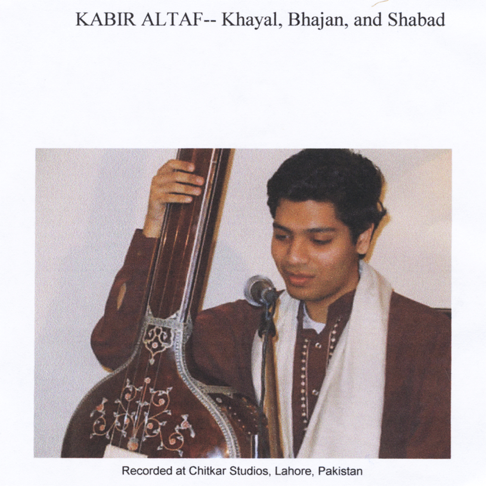
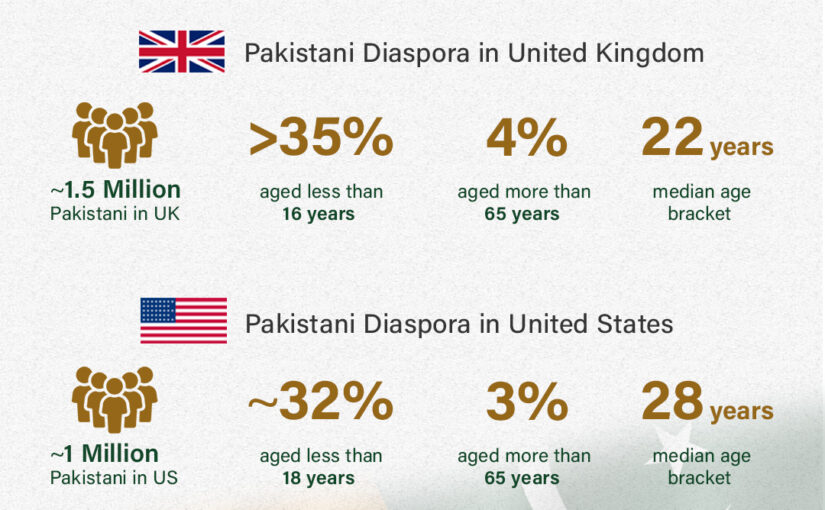
Look at who carries the Pakistani case at BP. Kabir holds a foreign passport. Q and EK write from the diaspora. Every voice that argues the Pakistani perspective here argues it from somewhere else. Not one of them speaks from inside the country: resident, middle or upper-middle class, holding a green passport with everything the green passport actually costs at the visa counter, at the airport, in what can and cannot be said at home. India, by contrast, is argued for in large part by Indians who live in India (BB is one such example). So the table is lopsided in a particular way. One side is represented by people inside the country it speaks for; the other, almost entirely by people outside it.

No photo description available.
The Great Cleft

Diasporas are powerful but deadly

Continue reading The Pakistani Voice That Isn’t in the Room

Bin Qasim’s Thousand-Year Wound

There is one fault line under everything that happens here, and it is old. Pakistan stands, whether it wishes to or not, as the proxy for the Muslims of the subcontinent, and India as the proxy for its non-Muslims. This is not a quarrel of the last election or the last war. It is a wound more than a thousand years old, set running when Muhammad bin Qasim landed in Sindh in 711, and it has been arguing with itself in the subcontinental subconscious ever since. Every thread on this site is a small, late episode of that argument.

There is a scene in The Devil Wears Prada, the cerulean one, where a colour chosen by Miranda Priestly (Meryl Streep) at the summit of fashion is followed down the seasons, runway to department store to clearance bin, until Andy (Anne Hathaway), who fishes it out is sure her choice owed nothing to any of it.

Anne Hathaway referencing the ICONIC cerulean sweater scene for her first  day filming The Devil Wears Prada 2 💙 Andy is back! , #AnneHathaway  #TheDevilWearsPrada #TheDevilWearsPrada2 #AndySachs ...

The subcontinent’s argument works the same way. Bin Qasim’s landing in 711 was a decision taken at the top of history, and it has filtered down through thirteen centuries of conquest, doctrine and memory into a comment thread, where two strangers swapping insults are certain the quarrel is about this week. It is not. It was chosen for them a thousand years ago, and they are wearing it without knowing the name of the colour.

What is new is that the argument is going quiet, and quiet is worse than loud. The subcontinent is partitioning itself a second time, in the mind. Indians increasingly talk only to Indians, Pakistanis only to Pakistanis, each inside a feed built to agree with them. The 1947 line cut the map; the algorithm is cutting the conversation. Against that, the value of Brown Pundits is simple and almost embarrassing to state. It is one of the few open places left where the two sides still argue with each other in public and mean it. That is worth defending even when the argument is ugly, because the alternative is not a calmer argument. It is no argument, and two rooms that never open the door.

Is BP sui generis on the Internet?

Continue reading Bin Qasim’s Thousand-Year Wound

Open thread

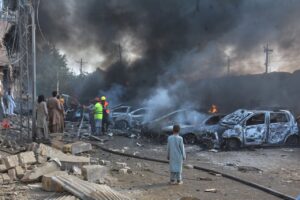
On early Sunday morning, May 24, 2026 — Just a few days before the festival of Eid al-Adha — on a quiet morning in Quetta’s Chaman Pathak neighborhood.  An explosive-laden vehicle ripped through a shuttle service carrying passengers, from the Quetta Cantt station –  killing at least 24 and 70+ wounded, mostly military personnel, laborers and families, that were headed to the Peshawar-bound Jaffar Express. These were ordinary Pakistanis looking forward to getting back to their hometowns for the Eid holidays. The Balochistan Liberation Army has claimed responsibility for the attacks. This tragedy comes just around the first anniversary of the Khuzdar school bus bombing  — killing 8 civilians, injuring dozens, most of the fatalities being school girls. This attack was also connected to separatist militants in the province. Celebrated by journalists, talking heads and govt officials across the eastern border along with their social media commentariat – blinded by nationalism.

Jaffar express sounds familiar as that train was also attacked a little over a year ago, March of 2025, early in the holy month of Ramadan. That attack orchestrated by the BLA, killed over 60. It seems like attacking Pakistan around the holidays is the M.O of these militant groups and their handlers.

There is grief across Pakistan as terrorism has gone up, patience is wearing thin among the general public with the states inaction against these adversaries of the nation. The Dhurandars are running up their kill streak, maiming innocent Pakistanis across the country, trying to instill fear, chaos and division. There is palpable frustration among the citizenry due to government incompetence and lenience towards ethno-fascism and a failure to protect its citizens from this regional proxy war. Will the Dhurandars be brought to justice for the mass murder of innocent civilians or will the Dhurandar-ing continue with more violence, terrorism and bloodshed across Arz-e-Pak to no avail.

Here’s to another somber Eid and world peace.

Nehru Lost India, Not Jinnah

We write this from the chair of those who have just declined, again, to partition their own blog. The exercise concentrates the mind. Brown Pundits has a Saffroniate. It has a Crescentiate. It has an awkward intermediate seat between Viceroy and Prime Minister. We have chosen, repeatedly, to hold the centre.

We have observed that Nehru did not.

1. The Men.

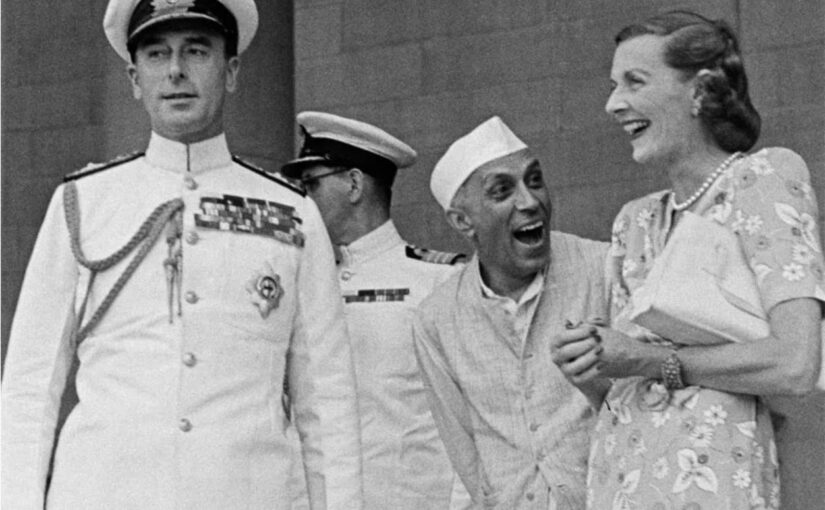
Jinnah was self-made. He was technically brilliant. He was legalistic to the point of pedantry, which is the only kind of legalism that ever wins a constitutional argument. Nehru rode on his father’s coattails, on Gandhi’s affection, on the Mountbattens’ hospitality.

The asymmetry was decisive. One man knew the document. The other man trusted the room.

2. The Cabinet Mission Plan.

The Cabinet Mission Plan of 1946 already confederated India. Grouping A, Grouping B, Grouping C. The Centre held defence, foreign affairs, communications. Everything else devolved. This was workable. The League accepted it provisionally as the best available route to parity. Nehru wobbled, then in his July Bombay press conference reserved the Congress right to revise the groupings once seated in power. The League withdrew within weeks. The edifice collapsed.

The question the Saffroniate refuses to ask is the simple one. Why was it harder to confederate on linguistic lines than on religious lines? The States Reorganisation that the Republic executed in 1956 was already latent in 1946. Madras Presidency was a Tamil, Telugu, Malayalam, Kannada tinderbox. Bengal was Bengal. The Indus was the Indus. The Hindi belt was the Hindi belt.

Four groupings could have been negotiated. Continue reading Nehru Lost India, Not Jinnah

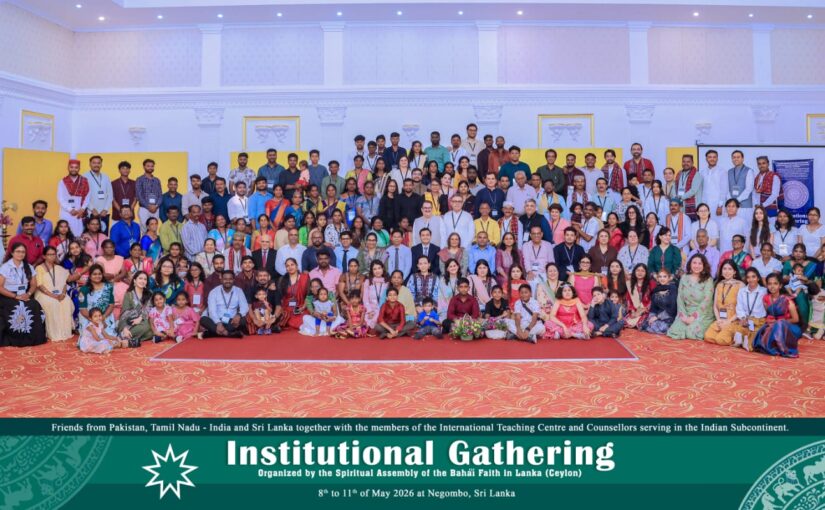
At Negombo, the Indian subcontinent meets where it still can

The photograph above was taken on the 11th of May in Negombo, on the western coast of Sri Lanka. The caption records the occasion plainly: friends from Pakistan, from Tamil Nadu, and from Sri Lanka, gathered with members of the International Teaching Centre and the Counsellors serving in the Indian subcontinent, at an Institutional Gathering convened by the Spiritual Assembly of the Bahá’ís of Lanka.

We want to say something about what this image makes possible, and where.

Indians & Pakistanis cannot meet any longer

The hard fact first. There is no longer any practical way for an ordinary Indian and an ordinary Pakistani to sit in the same room inside either of their own countries. Visa regimes have hardened to the point of farce. The land border is sealed in spirit if not in law. What remains are the smaller states of the subcontinent and the wider diaspora. Of the smaller states, Sri Lanka is the one that handles the meeting most gracefully: visa-on-arrival to both passports, no overland complication, no political theatre, and a civic culture that does not ask either side to perform a position.

Which brings us to the older question, whether Sri Lanka belongs to our civilisational space at all. Some friends north of the Palk Strait still treat the island as adjacent rather than constitutive. We think this is wrong, and the reasons are not sentimental.

Sri Lanka is Dharmic? Continue reading At Negombo, the Indian subcontinent meets where it still can

India and Pakistan Are Playing Chicken; simply to hurt themselves

Two comments are worth picking up on, and one claim worth interrogating.

N disagrees that contact ameliorates ties. EK suggests the only Islamicate voices the Indian RW respects are those who have “debased their own civilizational integrity.” We do not know who he is shadow-tweeting. It could be us, the Founders of this blog, who are Islamicate by heritage and recognisably friendly to Hindu right-wing readings. Either way, the framing is off. And then there is Q, on the thread as we write, claiming Pakistanis “will eventually take over the Islamicate world.

The cost of distance

The dominant idea of the last decade is that less contact means more security. Fewer visas. Less trade. No cricket. No artistic exchange. Reduced diplomatic warmth. This is sold as realism. It is, in large part, self-harm.

Distance does not produce clarity. It produces mythology. When people stop meeting one another, they begin imagining one another. The imagined neighbour is always simpler, darker, and easier to hate than the real one.

He is also, as Dhurandhar showed, sexier. Hatred and desire run on the same current. The more villainous the Pakistani on screen, the more the Indian audience leans in.

Civility is built by proximity. Not sainthood. Habituation. When people share space, study, trade, marriage, and culture, the room for fantasy narrows. One can still dislike the other side. But one dislikes actual people, not cartoons.

N’s response to this is that contact theory is “akin to blaming a victim for not engaging with the perpetrator.” That feels like the Israeli security story applied to the Indian Sub-continent. It assumes Pakistanis are a permanent terror-source requiring permanent counter-violence.

Pakistan obliges the narrative by behaving badly enough often enough to keep it alive. India obliges the frame by treating every bad actor as the median Pakistani. Both governments are now invested in the loop.

Pakistanis no longer defend hybrid Islamicate culture Continue reading India and Pakistan Are Playing Chicken; simply to hurt themselves

Kabir, the Anchor of the Crescent

Dissent Must Have a Home

The parent post set out why the house speaks in the plural and why pruning widens the room. This post sets out the harder discipline. A plural voice that cannot bind itself is not a voice. It is a whip. And a forum that cannot bind its Founders is not a forum. It is their salon.

The Crescent anchor.

When Brown Pundits was revived, two commentators returned before anyone else. Kabir was one of them. sbarrkum was the other. That mattered more than any traffic number. A forum lives by the return of people willing to argue in public, under their own names or their settled masks, on a schedule that does not flinch.

Kabir matters for a second reason. The Centre gathers quietly and often overlaps with the Saffron bench in instinct or historical frame. The Crescent bloc on this site is essentially held together by Kabir. Remove him and the others do not regroup under a new flag. They drift.

Without Kabir, Brown Pundits will become a site where Muslims are written about more than they are written by.

Continue reading Kabir, the Anchor of the Crescent

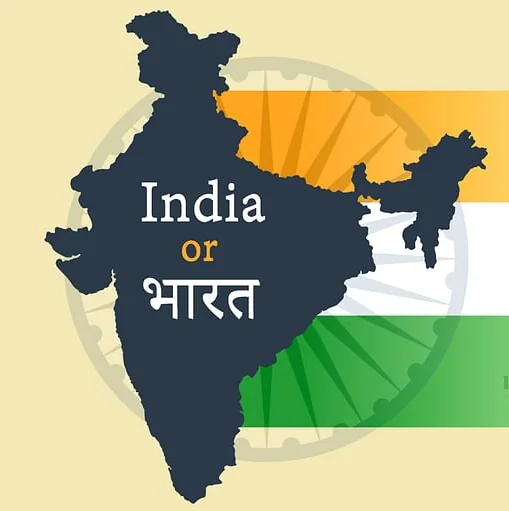
India That Is Bharat: The Exceptional Uniqueness and the Dual Identity

This is a Brown Pundits Precedent Post.


We have been asked, repeatedly and in good faith, why Brown Pundits appears to handle criticism of India with more care than it handles criticism of Pakistan. The charge is that we hold a double standard. It deserves a direct answer.

The answer is that we do hold a distinction, and we are not embarrassed by it, but it is not the distinction the charge assumes.

The Distinction

Pakistan is roughly seventy-nine years old as a sovereign state. India as a sovereign state is roughly seventy-nine years old as well. As nation-states under international law, as signatories to the United Nations, as entities with currencies and armies and foreign ministries, the two are pari passu. We treat them that way and we will continue to treat them that way. On every question that applies to nation-states as nation-states, the two sit at the same table and get the same scrutiny.

But India is not only a nation-state. India is also a civilisation, and the civilisation is not seventy-nine years old. The civilisation is, give or take the archaeological argument one prefers to have, somewhere around five thousand years old. It stretches from the Indus Valley through the Dravidian-Aryan synthesis, through the Vedic period, through the great classical flowering, through the medieval syntheses, through the colonial rupture, and into the present. One can argue the exact nature of the continuity. One cannot plausibly argue that the continuity is not there. It is there in the same way it is there for China. It is there in the same way it is there for Egypt. It is there.

This is not a claim about superiority. It is a claim about category. Pakistan is a sovereign state. India is a sovereign state and a civilisation. The two facts do not cancel. They coexist.

The Civilisational Peer Group Is Short

How short is short. At the level of a nation-state that is co-terminus with a multi-millennial civilisation, the peer group is essentially India and China. Two entries. Iran and Egypt have the civilisational depth but have been transformed by the Greco-Arab conquest, in an unalterable fashion. Greece has the civilisational depth but the modern Greek state is a nineteenth-century construction with limited political continuity to the ancient polis; the Ottoman interlude was equally determinative. Israel is a unique case and we will come to it.

That leaves India and China. Two countries on the planet where the nation-state is also the civilisation, where the sovereign political entity today is a recognisable continuation of the same cultural-linguistic-religious matrix that produced its earliest texts, and where the ordinary citizen, with some education, can read something written two or three thousand years ago in a language that is still a living vehicle of the culture.

That is not a small claim. It is also not a nationalist claim. It is simply a descriptive one.

The Indian Exception Continue reading India That Is Bharat: The Exceptional Uniqueness and the Dual Identity

The Ukrainian Interlude is over

The Iranian One has just started

Nobody seems to be interested in Pakistan’s diplomatic resurrection. What does it mean that a country written off as failed just a year ago is now the hinge of a regional peace settlement and averting World War Three on the double. This is the actual story of 2026 and it is not on our comment boards.

Pakistan: From Failed State to Diplomatic Champion

A year ago, before Operation Sindor, Pakistan was being written off in every serious strategic publication in the English language. The IMF was reluctant. Every mainstream Indian and Western analyst agreed. Pakistan was finished as a regional actor of any significance.

Today Pakistan is mediating, leading, the Iran crisis. The Hormuz situation, which could have escalated into a catastrophic closure of the world’s most important oil chokepoint, is moving toward resolution largely because Pakistan has positioned itself as the only party credible with Tehran, Riyadh, and Washington simultaneously.

The war that looked civilisational is now looking more like a pivot point. Pakistan is not a failed state. India is not uniquely ascendant under PM Modi. The question of whether the BJP holds power post-Modi is now a live one, not a theoretical one. Iran is not isolated. Israel is not unbreakable. The realignment is happening now, in real time, and almost nobody seems to be writing about it.

Iran Stood Up Continue reading The Ukrainian Interlude is over

Open Thread; The Archive, The Lynching, and Humanity First

Open Thread — The Archive, The Lynching, and Humanity First

A note: we are currently backtagging the entire BP archive — all 3,987 posts. The comment boards may show cross-linked notifications as the system processes older threads. We will update when complete.

Gaurav Lele’s post today asks serious questions about asymmetric condemnation. It is worth reading carefully.

But one comment in the thread deserves to be elevated. Calvin wrote:

https://article-14.com/post/even-after-their-son-was-lynched-the-khan-family-did-not-leave-the-hindu-village-3-months-later-they-fled-694f49ba99322The fact is that the people caught in TCS case will be tried and spend years in jail. That is where the fundamental difference in response comes from, we know when the perpetrators are muslim not only them but even their family will suffer, this is not guaranteed when the muslim may be the victim.

Calvin is right. And the story he linked proves it.

Continue reading Open Thread; The Archive, The Lynching, and Humanity First

Brown Pundits