
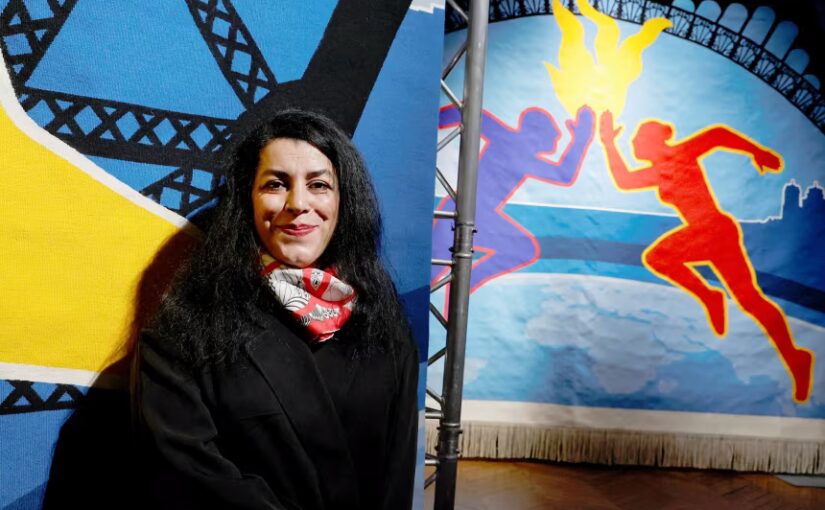
Marjane Satrapi, French-Iranian artist and the author of ‘Persepolis’, dies at 56

Rest in Peace Marjane Satrapi – As an aside, our 2026 reader survey is open until 7 June – anonymous, roughly five minutes. Please take a moment.


Thanks to Agni for bringing this to our attention.  I remember reading Persepolis years ago and it definitely does provide a different perspective on the Iranian Revolution. 

From CNN:

French-Iranian artist and activist Marjane Satrapi, whose graphic novel “Persepolis” brought home the struggle of the Iranian people to millions around the world, has died. She was 56.

A statement from the Élysée Palace announcing her death Thursday lauded Satrapi’s work, saying her work “captivated a global audience.”

“Her passing marks the loss of a leading figure in French culture and an artist deeply committed to freedom, whose work carried a universal message and earned her immense international acclaim,” the Élysée said.

And:

Satrapi’s work spanned numerous graphic novels – which she preferred to call “comic books” and films. In 2019, she directed “Radioactive,” a British biographical drama film starring Rosamund Pike as Marie Curie.

But she was also an outspoken critic of Iran’s ruling establishment and a prominent supporter of the “Woman, Life, Freedom” movement that emerged after the death of 22-year-old Mahsa Amini in police custody in 2022.

Iranian women human rights group, the Narges Foundation described Satrapi as “a fearless advocate for feminism, women’s rights” and as someone who “champion(ed) the struggles and resilience of Iranian women.”

Why is Pakistani Culture obsessed with Policing Female Virginity?

We were at our favourite Persian restaurant. A young woman two tables away, not Persian herself, was telling her Persian father about her female friend in continental Europe.

The friend was Pakistani-origin. She had started dating a Latino man. The Pakistani friend’s mother, somehow, had a dream. In the dream, her daughter had lost her virginity.

The dream was the trigger.

The mother went into a spiral. The father, it was said, lost his job. The mother had a nervous breakdown. A trip back to the Muslim homeland was arranged. The daughter refused to board until she saw the return flight in her hand. Only then did she get on the plane. When she returned to the Muslim country, they told her she wasn’t going back to Europe.

We lost the rest of the story, and, over the rest of the meal, we thought about Sana Cheema.


What Sana Cheema Saw

Sana Cheema was a twenty-six-year-old Italian-Pakistani who had lived in Brescia since 2002. She wanted to marry a second-generation Italian-Pakistani man of her own choosing. Her father took her back to Gujrat, in Punjab, under the pretext of a visit.

She was strangled the day before her return flight to Italy. Her neck was broken. Her hyoid bone dislocated. Her father, her brother, and her uncle were charged. They had buried her quickly, without autopsy, and told relatives she had died of natural causes. The body had to be exhumed on a magistrate’s order after Italian media forced the case into daylight.


Qandeel Baloch, in the Same Line Continue reading Why is Pakistani Culture obsessed with Policing Female Virginity?

Brown Pundits