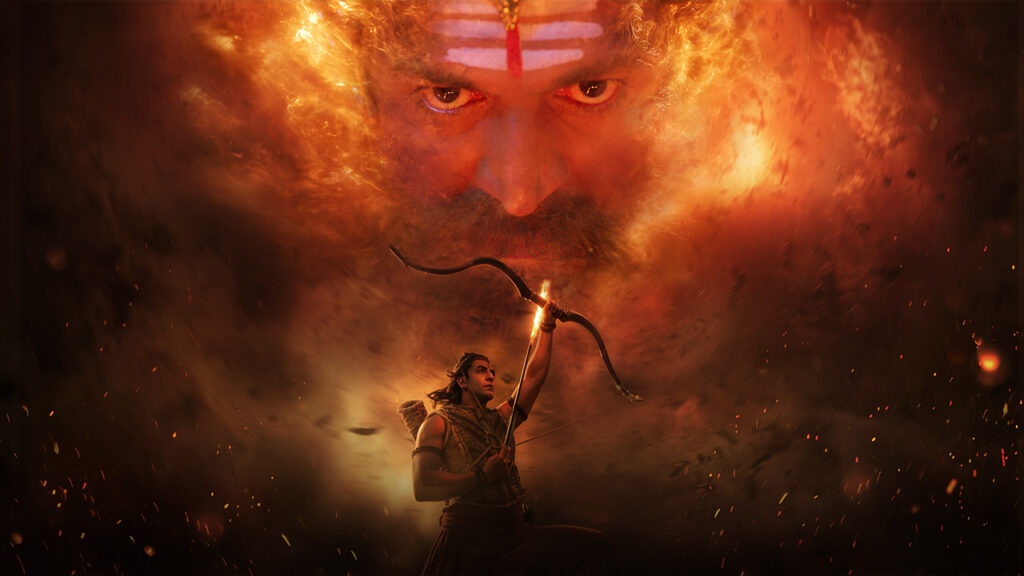
I watched Ramayana: Part 1 on Diwali night. Nitesh Tiwari’s film, with Ranbir Kapoor as Ram, Yash as Ravan and Sai Pallavi as Sita, grossed ₹1,033 crore worldwide in its first eight days by Sacnilk’s count, the third-fastest Indian film past ₹1,000 crore. That is a huge opening. Whether it pays back a reported ₹4,000 crore for the two-film project is not yet known.
Ravan gets the best role
The best roles go to the complex characters, and in the Ramayan the most complex character is Ravan. The epic turns on the gulf between Ram and Ravan. Ram is the ideal king, and an ideal is hard to act. Ravan is a learned king who won his boons from Brahma through penance, and he still abducts another man’s wife. The distance between what he knows and what he does is where the drama is. Yash takes that role; Gulf News’s reviewer says he steals the show.
The Marvelification of Hindu mythology
Anupama Chopra called it the Marvelification of Hindu mythology. The film is made for Indian audiences first, with the scale of a Hollywood franchise: two parts, a Diwali release, and a score by Hans Zimmer and A. R. Rahman. (I wrote earlier about Zimmer and the Ramayana.) What struck me most was the detail. I learned a great deal about the Ramayan itself. The epics carry a depth of character, lineage and consequence that franchise universes have to invent.
Gods you can cast
Watching it, I was reflecting on monotheism, where the story centres on a man who comes into the world and reveals a book, and divine qualities are imbued in that one individual. In Hinduism, the deities have very human characteristics. They love, rage, grieve and make mistakes. That makes them relatable, and it makes them easy to put on screen.
I think this gives Hinduism far more room to make epics like this than Islam has. In Islam, and in Islamicate derived traditions, the Divinely inspired Personage is not depicted, out of respect. Sacred stories can still be filmed under that rule, but the central figure stays off screen. In the Ramayan, the god is the lead role.
India’s soft power
This is Indian soft power at work. The dialogue is mostly Hindi, so Hindi-Urdu audiences in India and Pakistan can follow it, and I expect many Pakistanis to watch it. There is also a great deal of Sanskrit. The film is Indian without apology. Pakistanis have claimed the story before: a Karachi theatre group staged it as “our Ramayana too” (Ramayan in Karachi?).
India is not the wealthiest country in the world, yet it has a film industry that resisted the Western onslaught. Hollywood dominates cinema in most countries; India is one of the few large markets where its own films still win. To me that speaks to the power and integrity of the Hindu cultural tradition, which has kept adapting through a millennium of colonisation.
The film also belongs to its moment. This is Modi’s India: a new Hindu wave, supercharged by South Asian capitalism, the India of the Ambanis.
It also feeds a theory I wrote about when the teaser came out. A Kashmiri nationalist once put it to me that Ranbir and Ranveer, Hindu heroes and children of the Indus, are being promoted to take the blockbusters away from the Khans (Ranbir as Lord Ram: The Indus Paradox). Ranbir as Ram, with a ₹1,000 crore opening, is the case that theory points to.
The problem is pacing
The film is enjoyable and emotionally absorbing, and I am glad I watched it. It is tightly edited, but the pacing does not serve the story. There were two better options. One was a series of 10 to 30 episodes, taking each part of the epic in detail. The other, if it had to be cinema, was to be far more judicious: even across two or three parts, decide which episodes carry the story and let the rest go. Part 2 is now reported for Diwali 2028.
I think this will be one of the first movies to do proper AI face replacement to translate dialogues instead of simply dubbing. So it will be released in different languages depending on the nation it is released in, so Thailand gets a Thai language release with a dub that matches the lip movements of the characters. So this movie won’t be restricted strictly to the normal bollywood markets.
that’s pretty amazing – I suspect it will be huge in Thailand.
Thanks now I understand the strategy; virtually ALL of Asia will flock to see this.
yeah I was pulled into watching this a few days ago. It …didn’t suck. Which isn’t exactly high praise, but its a non-trivial low bar to clear.
Biggest weakness for me was the music, which for an ‘Indian’ film should almost always be a +. Both on the songs, and the background music. Music got better at the end, but ….compared to say, LoTR, which the movie makers clearly were aspirationally thinking of, the background music lacked emotional punch. Which once again, for an Indian movie, is…a surprise. I think its either the ‘committee’ thing that didn’t work, and maybe Rahman is…not as good as he once was.
yes very good point; i forgot to add to the review.
very strong LoTR themes (the orcs = demons etc).
also Ranbir, as Lord Ram, gives very strong Elfin vibes?