Ancient Ancestral South Indians (AASI)
-
South India funds India?
X.T.M comments on a chart suggesting the southern states and the old Punjab subsidise the rest of India, links the south’s position to Partition’s contest over rich regions, and compares…
-
New DNA research paper sheds light on proto-Dravidian and Indus Valley Civilization genetics.
A self-described non-specialist reads a new European Journal of Human Genetics paper on the Koraga, which proposes a distinct ‘Proto-Dravidian’ ancestry from around 2400 BCE, and asks what it implies…
-
First AASI mtDNA genomes from Sri Lanka (2500 and 5500 BC)
Razib Khan quotes a paper reporting the first mitochondrial genomes from Mesolithic hunter-gatherers in Sri Lanka, haplogroups M18a and M35a, both South Asian-derived, adding only that it is odd this…
-
The Todas are more like IVC people than anyone else
Razib Khan notes from the Genomes Asian 1000K supplements that the Toda sit closest to Indus Valley samples on the PCA, resembling them in having some but not much AASI…
-
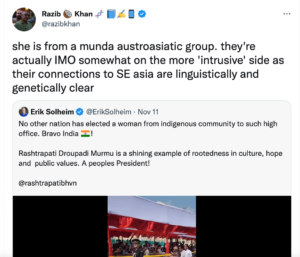
Adivasis are not really more indigenous than most other Indians; they are marginalized
Razib Khan argues that Adivasis are no more indigenous than most other Indians, since populations mixed between about 4000 BC and AD 1, and that what sets them apart is…
-
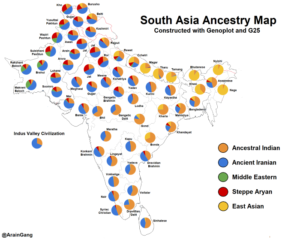
Global 25 is good, but a minor issue
Razib Khan challenges a Global 25 map of South Asian ancestry, arguing that it wrongly gives Andamanese-related ancestry to northeastern groups such as the Khasi, whom his f3 tests show…
-
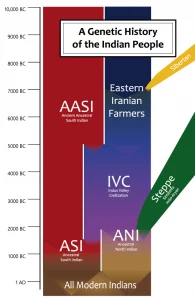
Against blood quantum as a measure of indigeneity
Razib Khan sets out the three ancestry streams behind modern South Asians (Steppe Indo-Aryan, Ancient Ancestral South Indian and an Iranian-farmer-related component) and argues that blood quantum is a poor…
-
Stark Truth About Aryans: a story of India (part 1)
Razib Khan posts the opening of his paid Substack essay Stark Truth About Aryans, which sets out how recent genetic research explains South Asia’s diversity and asks what findings of…
-
The Aryan Integration Theory (AIT)
Razib Khan drops the label ‘Aryan Invasion Theory’, arguing from ancient DNA that Indo-Aryans interposed themselves into a fallen landscape rather than conquering a coherent civilisation, with steppe admixture dated…
-
The Jat Gene!
Razib Khan plots Jat samples on PCA and admixture charts, finding them at the ANI end of the cline and distinct from Pashtuns and especially Baloch, who show more West…