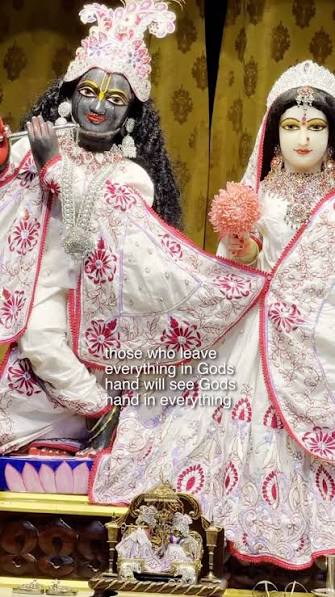
We were at a beautiful midnight Janmashtami celebration last night. The words that came to me were magical and timeliness.
Nothing in that room was untouched. Popular Hinduism has spent eight centuries trading with Islam, and vice versa. What was interesting was that at midnight, following baby Krishna’s birth (which was beautifully staged), the Mandir decided to have a birthday cake with the kids cutting it and singing happy birthday. It was a clever nod to modernity and a way to keep these young British Asian (Sindhi) kids tied in to their culture.
Can Dharma fight back?
NDG wrote that Dharma is in recession across Asia because its values cannot cope with the zero-sum ideology of the Abrahamic faiths. Dharma is “an operating system that hasn’t figured out there is a virus“. In his telling, Korean megachurches are eating Fiji, while their missionaries are converting the poor of Nepal, Sikkim and the North East, and Singapore is ever closer to a Christian plurality.
However it feels that the real catalyst in Asia is modernity, not Christianity, and that the young of Singapore and Seoul are leaving churches faster than any missionary can fill them. Indo mentioned that conversion is easy. Every life has a night of anguish, and the missionary is there that night with tea and a tithe. However conversion is never just an individual context but a societal one.
Who makes a society
Headcount alone does not make a society. Money, power, fame and taste make it, and all four sit with a small number of people drawn from the same few strata. The elite is whoever controls the school, the language of advancement, the marriage market and the standard of taste, because those four are how a society reproduces itself in the next generation. In India that band has always been narrow.
Partitioning the Elites
Partition was, at the top, a partition of elites. Punjab was a mass exchange, and its wound belongs to everyone. But Pakistan’s state culture was written by a migrating class: the Urdu-speaking salariat of the United Provinces and Bihar, who owned no land in the new country and gave it Urdu and an ideology instead, until the Punjabi-dominated army and civil service took the state off them, a takeover complete by 1958. The elite that stayed made India, and the country still runs on the tastes of that class, its English, its institutions, its newspapers, its idea of what an educated person looks like.
The Normans
As mentioned in the discussion on Aryan genetics, the Normans ruled England in French for three centuries; the peasants kept English and took the vocabulary. A preprint this April sequenced 78 people from a Surrey churchyard in use from the ninth century to the thirteenth and found no genetic break across 1066: the elite was replaced, the population was not, and the culture changed anyway. The Turks ruled Delhi in Persian for longer; Hindustani absorbed the words and kept its own grammar. The Mongols, who ran the largest land empire ever assembled, ended up praying to the gods of the people they conquered: Allah in Persia, the Buddha of Tibet in Mongolia. The direction of cultural flow is set by whoever holds the standard of what is beautiful and correct, and a warlord on a horse is not that person.
Taste is the hardest currency
Aesthetics track class. What an elite finds beautiful becomes what the society finds beautiful, and beauty is where religion lives day to day: the music, the dress at a wedding, the food at a funeral, the calendar. A convert does not step out of any of it. An Indian baptised on Sunday still eats with his cousins on Diwali, still marries inside his jati more often than not. The conversion is real to him. It is invisible to the society, because the milieu did not convert with him.
Conversion en masse
Conversion changes a society in one of two ways. Either the milieu converts as a block, which is mass conversion and is nowadays rare, or the missionary is the person who builds the elite. Spain did the second in the Philippines. It ran the islands through the friars for three centuries, and the friar’s school was where the native elite was remade. Tagalog survived and Spanish did not, but Catholicism became the society because it had first become the society’s elite. The same mechanism explains the three Indian states where Christianity became the majority, Nagaland, Mizoram and Meghalaya, hill societies where the mission school was the first school and so produced the first modern elite.
Kerala
Kerala is the other case, and it is the domestication case: the Syrian Christians of Malabar were a landed and trading elite of the coast for a thousand years before any Portuguese missionary arrived, and they hold a niche inside Kerala’s caste order rather than standing outside it. Where an elite already stood, the missionary knocked for two centuries and the door stayed shut.
The Census
India’s Christians were 2.3 percent of the population at the 2011 census, and the share has never left the twos in any census since 1951. Seven decades of missionary work, and the line is flat.
Nagaland
Historically masses can convert first and manufacture their own elite later. A movement that converts a district, breeds, builds its own schools and marries its own graduates will produce an elite within a century. That is the Naga story in miniature. But it needs prestige institutions at scale, not baptisms, and India has shown no takeoff anywhere outside the hills. That line has held for seventy years
Sri Lanka
Sri Lanka points the other way, to Dharmification. The Portuguese, Dutch and British made a Christian coastal elite, and Christians were 10 percent of the island in 1891. The 2024 census has them at 6.9 percent. What happened in between was an elite changing its badge. S.W.R.D. Bandaranaike was born into an Anglican family, converted to Buddhism, and rode Sinhala Buddhist nationalism to the premiership in 1956. When the prime minister’s own conversion runs towards the majority religion, the missionaries’ century is over. Empire made a Christian elite; the revival replaced it, and the numbers followed the elite down.
Korea
Christianity grew there because it attached itself to the elite project of the twentieth century: the mission school, the hospital, the Hangul Bible, and above all resistance to Japan. It was the modernising creed of a nationalist elite. Everywhere Christianity has grown fast, it has ridden an elite project or built one.
And now? The 2025 Hankook Research survey has 51 percent of South Koreans with no religion, 20 percent Protestant, 11 percent Catholic and 16 percent Buddhist, and those shares have barely moved since 2018. Among 18 to 29 year olds, 72 percent have no religion. Half of Korean Catholics are over 60. The fertility rate hit 0.72 in 2023, the lowest in the world, and stands at 0.80 after two years of small rebound; in Seoul it is 0.63. The Korean missionary in Sikkim is in danger of ageing out.
58 percent of South Korean Christians say they feel close to Confucianism. Korean society infiltrated the church and rendered it Asiatic.
One of my favourite words comes from Korean, nunchi, the art of “reading a room”. Religions must read their societies, or they wither.
The diaspora shows the same law from the other side. Korean Americans are 59 percent Christian against 32 percent in Korea, because Christians were the ones who emigrated to a Christian country. Their American-born children are split, 47 percent Christian to 45 percent unaffiliated. One generation inside the American milieu and the American pattern takes over. North of the DMZ the same people, under a different elite, are atheist by decree. Same blood and the same language, and three religious settlements, each set by the elite that ruled it.
What is religion
Religion is not a fixed thing that a society holds or loses. Religion is a dynamic force. It may be divinely inspired but it is subject to human forces at the same time, and every organisation that wants to survive its century has to fit the mould of that century. Popular Hinduism did that with Sufi Islam, and subsequently Christianity. Korean Christianity is dancing and duelling with Confucianism as we speak.
The virus is modernity, and it is in the missionaries’ bloodstream too. Seven in ten young Koreans have no religion, and the capital that exports the megachurches has a fertility rate of 0.63. A creed that is losing the under-30s at home will not keep anyone’s soul abroad.
The soul of a country is kept by its elite, and India’s elite is not converting. It is doing what it has always done, setting the standard of taste that everyone else, converts included, has to live inside. I went to a devotional and had an eggless cake slice, and halwa, with the whole room singing out Happy Birthday to Lord Krishna’s name. The prevailing musical traditions were shaped as much by Sultanate and Mughal courts as any temple. It felt timeless because the adaptation was complete. That is the soul of Dharma, and it has nunchi.
Excellent article XTM. I have an anecdotal Japanese addendum here.
Shortly after the 1945 Japanese surrender MacArthur (or people riding his coattails) tried to convert Japan.
They brought in an American tutor (Elizabeth Gray Vining) for Akihito and the Empress started taking choir lessons.
Unfortunately the Korean war broke out and the General was called into service on the peninsula. Whereby the officials from the Imperial ministry quickly boxed the lady out and she returned to the US shortly after.
Wonderful article and explains many things in the comversion in other thread very well.
There are reports of Iranian expatriates converting to Christianity, may be for citizenship.(?)
Also there are reports of conversions inside Iran. Not sure as to why?
Lots of people change their religion for an easier immigration process, under religious discrimintion
Christianity appeals to some iranians, but not as much as agnosticism, zoroastrianism, humanism, and other secular ideologies.
Christianity has done well with a post-Islamic Iranian population.. but of course I suspect the Bahá’í Faith would appeal a lot more ..
The only survey I have is the Gaa’man survey where apparently 1% of Irans population is christian, aside from historically christian populations that is.
If the islamic republic ever ends, Bahai and zoroastrianism will definitely see a lot of popularity among the religiously curious people. Same with hinduism and buddhism as well.
Again that’s a pathway to “whiteness.” They don’t tend to marry other Iranians..
An interesting clip on Black Iranians:
https://www.instagram.com/p/Dc6ROenNOIK/
I think people are forgetting the most lasting conversion a person can go through. From Religion to Atheism, Once a person is disillusioned with organized religion that they make the jump to Atheism they rarely tend to look back. Most conversion in modern societies that do take place is from Religion to Atheism.
I don’t think people become atheists through intellectual inquiry. It’s ordinarily that modernity is also very distracting ..
Also religion fails to adapt to the modern day.
Some definitely are becoming atheist as a result of intellectual inquiry.
Most are becoming nones, an amorphous terms that means that their religious belief or lack thereof does not fall into standard categories.
At the risk of sounding like a Marxist (Eww), I believe that its more driven by the material conditions of the modern environment. People are no longer dependent on the largess of organized religion for a variety of communal services. Furthermore, the Pope is easy to revere as a distant figure, but when the guy is implicated in actively hiding some rather disgusting acts of his own bishops and cardinals which most people can read in their day to day news coverage, it becomes rather tough to defend organized religion. Similar analogues apply for most religions. In a hyperconnected world the religious figures cannot maintain a mysterious image anymore and have their dirty laundry out in the public. It ends up making Atheism a likely position for most individuals who are capable of reading.
##convert does not step out of any of it. An Indian baptised on Sunday still eats with his cousins on Diwali, still marries inside his jati more often than not. ##
This appears OK with older Catholics (probably upper caste converts ) and some nadars.
But the new converts to evangelical sects, are having a real problem. Families are split. The second generation if they marry outside the fold, such families are ostracised. Esther Iyer has said so.
The issue became so bad that in places like chitradurga in karnataka, a congress minister (anjaneya)belonging to scheduled caste brought the anti conversion bill, which was withdraw by the leadership after intervention from “high command “.
Eventually bjp passed it, and congress which had promised it’s reversal has had no energy to do so.
I see everyday two sisters (both flower sellers), one of whom has become a christian, not sporting a bindi, no Mangala Sutra, no flowers, no earrings etc, the other sister is a normal Hindu woman with all signs of a married woman.
When we enquired, the “Hindu”woman blamed their uncle for converting her sister.
Further,
A few of the landed gentry like vokkaligas in cauvery basin, lingayats of north and central karnataka, reddys, naidus, rajus of Telugu communities of andhra and Tamilnadu, also some chettiars of TN, got converted by the white missionaries in the British period. Probably, this was mainly to achieve progress and prestige. (it is doubtful if any brown man could have converted these powerful communities. )
Now, all these communities have enormous political power because of their historical power base and numbers.
Now they are seeing that, being Christian as bit of a downgrade and don’t mind their daughters marrying out.
Since they control positions of power In the church, they seem to be satisfied at present. But the “lower strata” Christians are becoming vocal and demanding church positions, not sure as to how long this dominance will hold on.
Travelling for work so don’t yet have the time for a proper response and a proper response is required for this article who’s premise is based on half-truths and misinformation (potentially disinformation even) from the other thread.
?
Forewarning: This is just my opinion; it can be wrong and flawed.
The reason why Christianity was successful in some regions and not others in India was due to four main reasons, which exist solely here and do not apply to regions outside of South Asia. Firstly, the biggest advantage that Christianity enjoyed over the other major religions in the land most stemmed from the fact that the early church had stronger connections to the West and, by extension, enjoyed access to modern amenities. Many Christian groups built some of the best schools and hospitals due to their access to funding, as well as the poor socioeconomic condition of the country. Combined these elemnts with the general structure of Christian organizations, which lacked overt, direct forms of casteism, instead suffered mostly indirect, systemic caste discrimination.
During the 60s-80s period of extensive caste conflicts that emerged as a result of Indian society transitioning from a heavily feudal to a market economy, many lower caste populations threatened to convert and did convert in many situations to force the upper castes to improve their life circumstances. Christianity probably saw some of the highest rates of conversion during this time period. However, most of these advantages faded after the 90’s as the introduction of a fully capitalistic economic system led to two main effects. The first change came with the expansion of corporations, who build better and equally (if not more) advanced hospitals, schools, etc. This reduced the socioeconomic advantage the church enjoyed for the longest time and brought active competitors that could change them on the economic front.
The second change mostly stems from how caste politics had significantly shifted. New reformers like Narayana Guru started caste reformation movements that reduced direct forms of discrimination. Around the same time, the general caste consciousness that had formed previously gradually fragmented as the lower castes split along internal Jati lines, since some lower castes became more economically better off than other lower caste groups. Christianity lost the ability to allow people to escape direct forms of caste discrimination since most forms of casteism gradually transformed into systemic discrimination, which the church (like almost all other South Asian institutions) suffered from. Furthermore, many lower caste Hindu groups came into conflict with lower caste Christian groups since they believed it didn’t make sense why Christian lower caste people should receive reservations and other benefits since they come from a more egalitarian religion and enjoy said benefits. This further divided lower caste groups and even paved the way for Hindu nationalism among them.
The second major factor of Christianity’s success stems from the fact that it often converted people outside of mainstream society. A significant portion of Christians in India are usually tribal populations, who often live in the Northeast regions. This place exsisted outside of mainstream society, lacking both caste and organized religion. Additionally, these regions suffered from insurgencies, and they generally didn’t want to convert to any mainstream religion associated with the Indian state, i.e., Hinduism and Islam. Christianity remained more closely associated with Western society and was less connected to the Indian state; in addition to being an organized religion, unlike the traditionally tribal religions that didn’t have an organized structure. Furthermore, many tribal leaders wanted to bring more tribal unity and thought that sharing a common religion could help reduce tensions between different tribal groups, which, in hindsight, was particularly successful.
However, today there aren’t any more tribal communities left that remain uncontacted, and the few that remain are often being courted by Hindu groups like the RSS as well, so there is more competition. The more mainstream tribes are better integrated into Hindu, Islamic, or other religions, and they become even less receptive to Christianity as the RSS and Hindutva grew over time, while crystallizing religious identity and establishing stronger religious boundaries. These tribals tend to show more opposition to Christianity as well, since it requires a shift in their traditional practices.
The third major reason for the success of Christianity, especially the American evangelical groups, stemmed from the cult business in India. A sizeable portion of Indians just love to fall into stupid cults all the time. Many of the historical religious sects that dominate this land tended to have started as a kind of cult, with a charismatic leader claiming to be the avatar of Vishnu, the Mahdi, or a tantric yogi or lama. In recent times, you have Osho, Sadhguru (who plagiarized Osho), Ram-Rahim, etc. However, some of these groups feel out of favor with the ruling elite or have committed severe crimes, which has resulted in them being jailed, as seen with Ram-Rahim. Their removal from the social environment resulted in a social vacuum, which new-age Christian preachers and their weird Christian cults came to fill over time, hence their gaining popularity. They were most successful before 2014 and enjoyed some sway afterward. However, things have changed a lot in the last decade. A lot of the imprisoned figures, like Ram-Rahim, have been released from prison, and they will try to start up their cults again. Even then, if you wanted to make a cult; would make one around, say, Hinduism or Islam (the religions that make up around 80% & 14%) or Christianity (which makes up 2-3%).
My fourth reason is probably going to be a controversial take. To make things even more of a mess, the RSS has grown over the years and has started developing its grassroots networks. An entity that simultaneously has begrudging respect for their organization and brings a sense of horror for what they believe. In a horrifying display of their power, the RSS not only successfully imitated the strategies used by the above groups, but they even further developed them to make it into things that words can’t describe. They developed a cult of personality around Modi in a manner quite similar to the ones that developed around people like Ram-Rahmim and, ironically enough, it kinda eclipsed some of these groups, including the Christian ones. The evangelicals try to convert people into their group, while the RSS tries as best they can to drag people into their group. The pastors build a church, then the RSS will build a temple. RSS really does go head-to-head with these groups, often coming out on top since they just have more influence. Institutional religion often pales in contrast to cults and the biggest cult of them all: ethnoreligious nationalism (Hindutva, Christian nationalism, Islamism, and what have you).
If I had to make a prediction, Christianity will probably remain stagnant in the coming decades. The knock-on effect of the BJP’s rise was the gradual distancing of religious conversion from the national consciousness and the often ostracizing of converts in general, not just Christian converts, but all converts in every religion. Furthermore, the gradual weakening of Christianity in the West, which hasn’t stopped despite recent claims of revival, and the development of new laws about foreign funding have changed how things work these days. Christian groups that are more well-established in Kerala, Goa, and the North East will be able to transition well into this new reality since they have deeper roots or stronger influences in these regions. Christian communities in other regions probably won’t be able to meaningfully manage this ever-shifting environment since they are neither deeply rooted nor able to maintain the socioeconomic advantage as groups like the RSS rise.
Another issue would be the fact that most Christians outside of those historic or majority regions are fundamentally urban people (like most religious minorities), which basically means they end up with lower fertility rates due to urban economic pressures. At the same time, other religions (especially Hindus) tend to have a higher rural population with a greater fertility rate than urban counterparts, including urban Christians. None of which gets into the issue that urban populations do become less religious and often post-Christian, sometimes even without having become Christian. Urban populations tend to be more educated, making them more critical of all religious institutions and more socially liberal (i.e., accepting queer people, pro-abortion). Modernization kinda runs counter to the most Christian value systems, which I am not really sure would be particularly appealing to progressive populations. They kinda become westernized in the post-Christian way that is happening in the West. At the same time, the rural regions aren’t open to the religion as the RSS grassroots networks grow; in addition, rural populations are more conservative and less willing to change their traditional practices.
Christianity is stuck between a rock and a hard place. Conversion has become taboo, fertility has declined with urbanization, and international networks are shifting. Hindu nationalism has crystallized religious identity and become antagonistic over time. At the same time, Christianity is relevant at the state level in the Northeast and far South. However, these states are politically marginal (Kerala and Goa), or they are politically unstable (Northeast), which makes it irrelevant on a national level. In all honesty, Christianity is never going to be the dominant religion like it once was during the colonial period. Unlike the muslims with a large population, Jain/Zorastrians with their wealth, and the Sikhs (a community smaller than Christians) who can punch above their station, Christians don’t even come close to these groups.
In all frankness, Christianity in India is fundamentally a marginal religion that (dare I say) is kinda irrelevant in the nation. Christian priests claim they have a lot of conversions and numbers just to stay relevant. Indian Christians are Indians who happened to be Christian and are as fragmented as most indian communities go. Hell, the Christian community I come from literally could not even agree on whether they should face or face the people when praying in the middle of Mass. The greatest number of converts that the religion had after 200 years of British colonisation was 3%, which, honestly, was mostly due to circumstances that, let’s be frank, will never come again.
To put it simply: Christians are fundamentally irrelevant and are useful as a boogeyman, but I don’t see this community ever truly working together, much less realigning the religious landscape.
1) One another fact is that , when facing an aggressive Muslim situation, the Indian Christian gets closer to the Hindu.
The situation in keralam (against IUML domination of UDF ) and in northeast (against Bangladeshi infiltration ), is worth watching.
2) the missionary effect of RSS and it’s affiliates is really telling. They seem to provide a sense of belonging cutting across the caste divide, especially amongst obcs.
Firstly, the dynamics of Kerala do not work in that manner at all, since the main conflict between Muslim-Christians are predominantly Class-Caste issues rather than communal ones, since neither group actually lives near the other. Kerala can be divided into three pieces: Malabar, which was ruled by the Zamorin of Kozhikode; Thiruvithamkoor, ruled by the royal family of Travancore; and the kingdom of Kochi that sits in between. Traditionally, all trade in Kerala was managed by three main groups: The Malabari Muslim Mappilas, the Yudah (Jewish) Mappilas, and the Nazrani (Christian) Mappilas, while the Nair and other Hindus controlled the political institutions. The Muslims controlled the ports of Malabar, the Jews controlled the ports of Kochi, and the Christians controlled the ports of Travancore. These three basically filled the role that baniyas, Khatris, and other Vaishyas filled in North India.
During the Raj, Travancore remained a princely state, while Malabar was directly ruled by the British. This caused Malabar to fall behind Travancore in the post-Independence period. The economic rise of Travancore resulted in increased economic prosperity of the Christian community, as they were the main traders in Travancore. Over time, the Christians expanded their influence north into Kochi (where the jews already migrated to Israel) and Malabar. However, the economic conditions of Travancore stagnated in the last 2 decades, while Malabar saw an expansion in recent years, which saw the growth of the Muslim community’s economic influence. The Muslims are now expanding their economic footprint southwards this time around and coming into direct conflict with the Christian traders in the region. Hence why you have rising tensions between the communities that occasionally result in violence, despite both groups living in different places from each other.
The Hindu groups (especially the Ezhavas and Nairs) in this equation basically control the political power and form major vote banks. Christians generally tend to work with these communities since, fundamentally, the main interest is in maintaining economic dominance rather than political dominance at this point. This is why the dominant sections of Christians align with the neo-liberal-leaning Congress and generally don’t like the state-centred LDF groups. Of course, there is a caste division, with the lower-caste Christians (like their Hindu and Muslim counterparts) aligning more strongly with the LDF a lot more often.
Muslims are similar as well since they want to dominate the economic sphere; however, in recent years their larger size basically meant that they wanted to expand into the political sphere as well and came into conflict with traditional Hindu groups like Ezhavas. However, I don’t see this conflict developing into anything big since muslims are a complete minority in Travancore, so the league will never be able to gain significant seats on their own; hence, they require the support of the Congress and LDF. Additionally, they will forever work with the communists rather than the Congress since the Congress’s main supporters are among the Travancore Hindu communities and the Christian groups. The LDF communists are more politically centred around the Malabar region and would redirect resources to the region, often away from Travancore. Muslims naturally benefit from this arrangement over the Congress, who are fundamentally a Nair-Nazrani party and doesn’t want to lose either groups.
Fundamentally, everything is a stalemate between all three groups. Muslim expansion in influence causes the other two communities to gang up together, and vice versa for other cases. The thing that will break this camel’s back isn’t demographics or communalism; rather, it will be the issue of migration. Kerala is below the fertility rate of 2, and the population pyramid will start to shift soon, which means the government needs to attract newer migrants to the region to compensate. This will create a lot of racial, linguistic, and communal conflicts, as every group will try to bring in migrants that benefit them; all the while, racial tensions will boil up between the preexisting groups and the new migrants as economic issues become more prevalent.
Secondly, I disagree with the argument that the RSS can cut across castes. If they had such an ability, they would have been in power in India rather than the socialists and left-leaning groups. From how I see things, the equation is in reverse. The land reforms of the pre-90s period that broke the hold of the large landlords and the economic liberalization of the 90s resulted in the gradual weakening of caste as the old feudal system completely fell apart. The RSS and the BJP, when I was growing up in the early 2000’s was always seen as the “upper-caste” party by many people.
The weakening of the traditional system resulted in converting caste into a systemic issue rather than a direct issue faced in daily life. This weakening of caste resulted in people losing the communities that were created by caste, and people started to gradually turn to religious communities to fill in that social gap. The changing caste dynamics forced the RSS to adapt to the newer reality of the times, and they started to shift their internal structure over time. The old Left, on the other hand, failed to understand the underlying changes and still relied on older paradigms that were long gone.
I mean, this is the reason why the main base of the BJP is centred around the urban lower- to middle-class, since urbanization generally weakened caste identity. Caste, for better or worse, historically prevented religious alignment since it cut across different religions and allowed for consolidation under a common caste banner. Its gradual weakening resulted in religious communities that were bound together by caste breaking apart or becoming distant, as there was no common identity (except in the South, where a strong ethnolinguistic identity formed). The RSS saw these trends and clearly adapted to these changes.
were all three Mapillahs? I thought only the Muslims were called Mapillahs
such a high signal comment..
I might be off, but I believe that they were all originally called Mappilas since the word itself basically mean’t son in law and probably came to be since local merchants intermarried into local populations. A well-known example would be the famous Jewish king Joseph Rabban (Issuppu Irappan), who was the main leader of the Anjuvanum guild and someone who gained the favor of the Chera king after assisting him. He was given noble honours, including palaces, as well as a wife who descended from the Nair caste, through whom he had two sons who succeeded his position.
It should be noted that today the term Mappila is used for Muslims specifically, while Christians are mainly called Nazrani. Even then, Mappila itself doesn’t mean the whole muslim community; rather, it refers to a specific subcaste of agriculturists, similar to Yadavs and Ezhavas. There are other subcastes within the “Muslim” category, like Marakkyars, Koya, Rowthers, Thangals, etc each with their own specific position in the local hierarchy.
what an unbelievable comment..
Good analysis, a little addendum…
I think you missed out the bit on education. It used to be the case that the best school in a lot of towns was a catholic/anglican run org.
This is not the case nowadays with the burgeoning private school competition.
Also – Indian Subcontinent. South Asia is internalising a North Atlantic viewpoint.
Mea culpa, that was your first point i guess.
again another lovely comment. so much to digest
Exactly, you put a lot of my own thoughts into words
Other than being used a boogeyman, to consolidate your own base, a realistic reading would force one to confront the reality that christianity, as it exists today, does not have the power or capability to dominate any other religion or bring about significant social chamge.The handful of converts it does get today are more due to luck rather than anything spectacular and unique it does.
The main goal of the churches in india and perhaps the rest of the world going forward should be to keep as many people within the fold as possible, with the occasional convert being a bonus.
This is not going to be easy not only because of modernity and other religions also wising up and in case of the sangh adapting to your own tactics but the loss of favor among historically important and rich populations as well. The biggest thing is how most of your own truth claims are now heavily disputed or proved to be outright false.
It will be interesting to see if any of the churches in the world have what it takes to transform themselves to keep being relevant.
Also presumably a lot of different sects, cults & castes will consolidated in an more irreligious world. That’s the pressure of globalisation.
How so?
I don’t think that will ever truly happen. Most religions, even during their early days when they were a minority, often ended up becoming more divided and radicalized. Early Christians literally spent half their time fighting one another even while being persecuted. Early Muslims had strong internal conflicts and even their version of radical groups whose actions still shape modern sectarianism. As decay sets in, they will probably break apart rather than work together until they fade away.
I actually see the opposite, even if I find it very atrocious, we are seeing christianity in the west consolidating under a broad category of ‘conservative’ and making common cause with each other on opposition to LGBTQ+, abortion and nationalism, I think these are dead hills to die on and will cause more decline, but it does show that religious communities which normally would have been at each others throats can come together under one banner due to modernity.
I don’t think that is actually true, though. In the West, it isn’t that Christianity has all of a sudden started to align with “Conservative” value systems, but rather that the “Progressives” have stopped being religious. I am reminded of something that was told to men before: “Progressives agree with the Catholic Church taking progressive values, but they never join”. The churches have in some sense aligned with both sides of the spectrum for a long while, for example, catholic in the US were never like by Republicans for a long while since their Evangelical base often were hostile until the period between John F Kennedy and 9/11.
Really, the people who had progressive values ceased being religious, and many of the progressive churches, like the mainline, declined alongside it. The conservatives more or less remained behind, and naturally they had an easy time aligning with one another. Even then, the dipshits that remained behind aren’t exactly pious or show a modicum of interest in their own religion. Many don’t show up to church services, often resulting in multiple churches closing down all the time. Above all else, the denomination has become more homogeneous as smaller groups simply die out. It’s easy to align under a “conservative” tag when your group is the only one left behind.
That is one way to look at it, that the progressive and moderated have left and hence only the people who are conservative remain.
Another way is to take into account that other than a few issues many of them dont like each other and their followers do fight one another.
From my reading, the different evangelical churches in the US at least did not care about abortion or birth control prior to the civil rights movement after that in order to rally their base and create a govt which is aligned to them and capable of implementing policies that would help to implement policies to keep the US a country where they are privelged by law this whole pro life movement started in which all christians are unfortunately a part of.
Same with many anti lgbtq+ movement in many current and former christian majority countries.
These are not just a consequence of progressive people leaving it is a consequence of a similar culture amd worldview taking hold among many churches in the west that is reducing denominational boundaries since most of the remaining followers and members are have been fed a particular cultural worldview for the last century or so.
This is probably the worst way for these religious communities to come together on a single platform but it is consolidation nonetheless.
I think there is another element that matters in these discussions. The issue faced by Christianity is a much more universal issue rather than a localized problem, and even the gains the religion has had in Africa will inevitably face the same problems that appeared in Europe. The base issue stems from the fact that the majority of the present-day world religions were created for a fundamentally Feudal agrarian society with a completely different way of life. A lot of the rituals, concerns, and theological discussions that centred feudal life are completely different from the ones in modern society.
Today’s society is fundamentally post-industrialized and market-oriented, where people sell their labor to make a living. People are more educated than before; mass communication has become commonplace; the joint family has made way for the nuclear family, and all of these changes aren’t reversible in form. Furthermore, feudal states were generally more politically decentralized and had to make compromises with religious authorities. Modern states are more powerful and centralized in a manner that they need; for them, compromises don’t exist.
In fact, they might even subsume religious institutions and ideas with broader constructs like nationalism, further shifting them away from their original theological base. Think of Christian or Hindu nationalism and political Islam; a lot of these expressions of religion have broken or altered how their religion originally worked to fit a nationalistic framework. Even in places like Saudi Arabia, where you would think religious authority holds as much power as the state, there is a shift in which the royal family is trying to bring religious authority under their control.
To make things even more complicated, I would argue that the world has objectively become disillusioned with institutional religion and the major religions to a certain extent. I remember this YouTuber who was originally a conservative catholic, who became a far-right irreligious person and then turned into a religious centre-left person. They originally believed strongly in their religion until they lost it over time, but they returned to Catholicism. Even after returning to religion, they talked about how they lost the sense of spirituality they originally had, but they remained in the church because they still wanted to be a part of this religious community.
Most people seem to go through such a similar process. Everyone is losing their sense of belief to varying degrees and becoming disillusioned. Some become hardcore atheists due to the oppressive nature of their religious institutions. A sizeable section of other identity as culturally religious/spiritual/agnostic, where they have a desire for a vague spirituality without fully immersing themselves in religious institutions. They yearn for a religious community, but they don’t want to engage with institutional religion since they are deeply suspicious due to their history.
The last group of people becomes “Orthodox” or “Traditionalist” followers, who double down on their religious institutions and care about the “correct”/”true” way of practicing religion. At the same time, they seem to care more about how a religion is practiced as opposed to what that religion actually believes in. Frankly, they make me laugh the most since they are deeply showy about their religion all the time, but it often feels like they are trying to convince themselves about their own religion. They tend to be insular, look down on others’ belief systems, and they outright try to forcefully shut down any criticism of their religion. However, none of these actions ever truly fix the actual problems that exist or really reduce disillusionment; rather, people hide these thoughts and still suffer from the same problems. Honestly, it kinda makes them seem quite insecure about their religion.
Fundamentally, what is happening in the West represents the events that will happen everywhere in the future, and I don’t think it’s even avoidable anymore. At best, some of the present religions survive in a reduced state as they adapt to modernity. At worst, they end up dying over time, and newer religions that can fix these issues replace the old, dead ones, as it has happened so many times in the past.
I dont believe that modernity is inevitable, it can collapse under its own weight or be weakened from the inside.
The power of the centralized state is not absolute and more than that, there are still things that religious organizations can do which individualized spirituality, the nation state and atheism cant. That is to create cultural, social and in certain places even economic or political capital.
The problem I see with the west is that until very recently the church was entwined with the state and in many places lost the ability to sustain and justify itself without state support, on top of that many ideas and thoughts within modernity are specially opposed to the church and an active role for it in political, and social matters. The church in Europe has forgotten how to sustain itself culturally and socially without political backing and has not yet learnt how to do so. With nuclearization of families, growth of secular ideologies often rooted in the same cultural milieu and economic development seen in Europe there is very little wiggle room so to say for the church to make a difference.
This is not the case in many other parts of the world, one reason why the US has been said to be more religious than Europe is that the church actually has to build a base for itself without depending on the state to sustain itself, and that those who were and still are religious do have to contribute their time and money to be part of a community.
The end result is that, is even with all the challenges modernity puts on organized religion, its role in creating cultural and social capital for its members is something that it has still not lost to its competitors, churches can still step in for a state and economy that is not capable of supporting nursery, helping one gain capital, find companionship( as your example mentions) and even help someone psychologically.
What is required from them is to let go of the culture that seeks political domination as a way to spread influence, that ship has sailed and will never come back. Changing your whole organization and culture so that you would start thinking in terms of what you can offer your members better than other religions and secular ideologies, how you can make them coming on Sunday worthwhile, and how you can help them spiritually is a massive change and I am not entirely sure, many would be able to make the transition but there is a path forward to maintain your relevance in a changing world, if one is willing to make this transition.
In the meantime there will be a lot of bad decisions emanating from the latent tendency to politization among abrahmic faiths at least.
I don’t think there is any way to reverse modernity as it exists since we have more or less crossed the social threshold. Capitalist models of development that emphasize market-oriented growth have become commonplace, often replacing feudal organizations. Even if this system does collapse, at this point, it will collapse in a manner that might take down religious institutions that are dependent on the market economic system. A return to feudal ways of life is less likely; we might simply end up with a degraded form of modernity instead.
Furthermore, centralization isn’t absolute, but it is quite clear that states today still wield a type of authority that feudal kings couldn’t dream of. Governments today can define categories like religion in ways that states in the past were unable to achieve. Even in India, people in the past often identified with multiple religious categories and defined themselves in ways that defy modern conventions. However, you wouldn’t see that many people define themselves in such a manner since the centralization of society has enabled the delineation of stricter identities in a manner that historical states failed to achieve. The government doesn’t have absolute power, but it still can determine who gets part of a specific category.
Modern society has significantly shifted the traditional function that religion serves in society. Historically, many religious institutions often filled in gaps (schooling, housing, food) that the historically decentralized feudal secular governments were unable to fill, but that is no longer the case as the more centralized secular state has overtaken religion in those places. This is kinda why Europe, a place with a strong government and social safety net, has weaker religiosity in contrast to the more decentralized and weaker government of the US, which has difficulty in providing safety nets. In the US, religiosity is even distributed and is more common in places like the South, where local govenments that attemtped to introduce it into the system. Furthermore, in these places, Christianity often fills the role of the secular state since churches act as meeting places and provide social safety nets for the local population. Even then, the most religious state in the US (according to PEW) is Mississippi, with a religiosity rating of 50%, which means half the state isn’t religious. The other states have 50% or less, and I don’t see that number going up significantly any time soon.
The second major role of institutional religion was that it provided spiritual support to people. Even here, there are many problems. People identify as “spiritual”, but don’t actually go to religious institutions and support them. This has resulted in things like dechurching in many places, all the while people remain spiritual or religious. I mean, how exactly can religious institutions produce sociocultural capital if it lacks the institutions needed to produce such material? The material issues that are involved in running an institution remain a major issue that hinders how religion works here. The market economic structure itself exacerbates these problems, as a lot of religious institutions rely on charity and income sources that are not consistent. Historically, these institutions compensated for these issues by serving other functions like providing education or health care, which are now controlled by the government. Today, religious institutions can’t provide these services in a more efficient manner than the government, with its better organization and large capital deposits obtained via taxation. Many religious institutions have tried to find alternative paths to attract new followers, as you can see with Megachurches, but oftentimes they just end up becoming more like a business and suffering from extreme corruption that pushes people away.
Mind you, these issues will show up at some point or another in most countries since a lot of it stems from the way our economy is organized in this capitalist mode. The market economy requires a more centralized government that has the ability to regulate financial structure and provide pathways to conduct commerce in a clear manner. The modern 9-5 work life that is becoming more common even in developing countries changes living habits and family structures all the time. In feudal times, things were consistent since religious institutions had extensive lands, money, and other economic resources on hand, which allowed people to study and develop universally appealing theology. Today, that is harder, as sources of income are not consistent and traditional institutions that are decaying are being replaced by religious models (like the Megachurch) that grow quickly and die as fast, all while suffering from corruption. In other situations like Saudi Arabia, where religion is central to the very state, we don’t even know how successful that form of organization is, because people are forced to follow these practices, and if the state falls or changes its religion or becomes something else, would the land’s spiritual practice change? Islam was probably the most successful religion in maintaining a following and obtaining funding, but even then, there is a question of how sustainable that is since most of it relies on things like fossil fuels, which are skewed by market economics. However, what will happen after the market shifts in the opposite direction and the economic limits come into play?
None of which even includes the fact that many religions are trying to gain support from state structures by appealing to ethnonationalist tendencies. Most religious institutions are doing what monopolistic businesses are doing: changing the rules of the playing field to not allow new participants from gaining traction and breaking their monopoly. Religions are trying to regain state support or at least skew the playing field in their direction to prevent the population’s disillusionment.
At the end of the day, I doubt any of us will ever truly know the outcome of this since it will happen over multiple generations after us.
I am not saying that the market economy will collapse or anything like that but that the modern state is not inevitable and can weaken and become unable to fulfill its obligation. Not every country is destined to be like Sweden or Norway.
What my whole point was, that religious institutions even in today’s world are more than capable of creating and forming communities, these communities can pool their resources and talents together and create social and cultural capital, think things like nurseries, food banks, easier ways to get advice to start a business, find a life partner, and many other things communities of people normally do. Plus they can also act as political pressure groups as well.
The above just requires the focus to shift from upholding some truth to actually creating a community people want to be part of. Difficult but not impossible.
If you give something that is valuable people will come and many religions especially historically hegemonic ones are more capable of doing the above if they so decide.
Modern nation states are very effective at taking care of people’s material needs but the economy that is followed by most countries, needed to take care of material needs deprives people spiritually and socially, a lot of this loneliness epidemic and detachment we read and hear about is a consequence of the economy we follow that I dont think modern nation states can replace or want to replace
Furthermore, while communities ajd groups can be made from other things but religion I am uncertain of how effective they would be in creating cultural and social capital, as that does not seem to be their goal.
And while people can and should be allowed to define their spirituality on their own. I dont think that many would want to go through the work, that these spiritual practitioners clearly need to do on an almost daily basis. There are many spiritual traditions within many religions and honestly if their reputation was not in the gutter we would be seeing christian, Jewish kabbala and sufi mysticism spoken of and referred as much as buddhism, hinduism and other eastern thought.
So there is one important niche that the smart religious community can fulfill but will is lacking, since as you have mentioned, many of religions still want to rig the game so to say, and are trying to enter politics. I dont think age old habits will go away in a few decades but if anyone is willing to not use the state as a means to maintain itself there is a path forward at least.
I still think there remains mutiple problems here. The first major issue stems from the fact that most of these basic functions that exist can be fulfilled by non-religious structures as well. People still find advice, places to gather, charities to support local communities, and others outside of their religious communities, often without the extensive, stringent limitations that religions impose on people. Furthermore, having basic theology and ideology is what drove historical religious communities and enabled their survival over time. I am not really sure that trying to convert religious structures into mere community meeting spaces can truly compensate for these issues.
Many of the most successful religious groups today still act as something larger than just a community space for meetings; often they serve as a centre for propagating ideologies, as you can see with progressive churches and conservative evangelical groups. Groups that aimed to be a community model still failed over time, as things like the United church of Canada, for example, have consistently lost membership in spite of being community-oriented.
Another problem stems from the issue of the “others” who aren’t a part of the community and who didn’t want to sacrifice the same amount to be a part of the in-group. Secular community “third” spaces, for example, don’t have the same issues since they have relatively remained open to fundamentally everyone without extreme strings attached. Religious communities, for example, can serve as connection spots for different people and serve as networking sites for their members, often giving them a leg up.
However, people outside these groups often don’t have the same access to networks and many times over are often worse off than the community members. This can get even worse, as it can lead to in-group/out-group dynamics that pit people inside a community against those outside it all the time. Joining a church isn’t the same as joining a book club since the church can actually yield more social and political authority over its followers in a way that a book club cannot.
Furthermore, I would honestly argue that non-religious communities can produce extensive social and cultural capital, and they are much more effective at it than religions today. There are entire things like fandom culture centred around pop culture; many non-religious social movements have created entire communities for themselves, and so on. There have been entire films and pieces of fiction that stimulated complicated conversations between a wider section of society and even shifted the culture in many ways.
People have been using non-religious external communities both online and offline as the centre of creating an entire worldview for themselves. Many of them have become as toxic as religious groups, including outright death threats and questionable parasocial relationships. These communities were so effective that many political groups have attempted to co-opt them for their own agenda, ironically pushing people away from each other. Hell, even this blog is literally a community in the digital space, and it still produced (even though flawed) sociocultural material as well as a wider spectrum of people with varying worldviews. There are entire sections of Hindus who can explain the plot of Dhurandhar more effectively, but cannot explain the distinction between rebirth and reincarnation (a foundational part of the Hindu religion). More Christian nationalists can quote specific biblical scriptures since a right wing christian nationalist often uses them, but they don’t know much beyond quotations.
Even the issues with loneliness that shapes todays world stem from the broader decline of “third spaces” both religious and non-religiogous, digital and in person. Online spaces have become fragmented, with everyone going to their own corners of the internet, while people are receding into their own smaller niches/groups (religious and non-religious) in the offline spaces. Most of this stems from a broader fragmentation of a common culture and shared open spaces that was acessible for everyone. The things that drove the gradual decline of secular “third spaces” (underinvestment, polarization, shifting social tastes, etc.) also drive the decline of religious spaces.
The fundamental issue remains. People want accessible communities that are available to everyone without excessive restrictions, and deeply engaging in a manner that makes investing their time and energy worth it. Religious institutions have to outcompete non-religious spaces in these aspects, while trying to regain lost trust due to historical exploitation and developing an attractive theology on top of that. This is fundamentally a very large uphill battle for religions as they are today.
Lastly, this will affect everyone from Sweden to Indonesia since the skepticism still exists in one form or another and the formation of non-religious communities will continue. Today’s support for Hindu nationalism can easily bleed into skepticism and outright dissolution of both Hindu nationalism and even the Hindu religion itself. The same applies to the other religions as well. Mind you, I am not saying that they will decay in the same way that Christianity did in the West; rather, it may decline in its own unique manner, in which people get disillusioned without identifying as irreligious or agnostic. For example, Buddhism in Japan will probably decline in the coming years as the younger generation is even less interested in performing religious rites, especially funerals. In fact, they argued that Buddhist temples will go through a dechurching of their own, as most temple heads won’t have people to succeed them.
For example, Turkey for example is 99% religious on paper, but others suggest 2/3 aren’t religious in the traditional sense. Kanwariyas who go on the Kanwar Yatra are supposed to be religious, but almost half of them (maybe more) don’t treat it like a religious pilgrimage and more like a vacation. Also, an opportunity for vandalism and debauchery; Jesus Christ, they do so much of this. Places and people can seem religious, even though they may not always be that. You don’t really have to be in Sweden to have that issue.
If religions in the developing world were more secure in their position, it wouldn’t explain why they are so afraid of one another and react negatively. In the past, people didn’t give as much into these thoughts, yet today everyone is more prone to religious paranoia.
As a side note, the West likes Eastern thought due to a sense of orientalist exoticism and I feel like most of that thought has dissipated in recent times as that exoticism vanished with further understanding.
I think it is instructive to explain what I mean by cultural and social capital and many other things as well.
Cultural capital: The historical inheritance of physical institutions like schools, colleges, hospitals, and diverse types of communitiy centers and the spirituality, psychological techniques, mythology and comprehensive worldview from the people of the past.
Social capital: The continued inheritance of the above cultural capital, put to use for the benefit of a group living today and creation of cultural capital for the groups of tomorrow.
What my point is: Traditional religions, like Christianity, buddhism, islam, etc will in all likelihood never dominate their respective societies like they did in the past, newer religions and newer forms of social engagement will come up that can do much of what I believe is necessary to survive much better, but the path to maintain and depending on how future pans out,even extend your influence is there and is difficult but not impossible.
What is the problem of modernity, in my view: The main issue of modernity is that the economic systems that we use to create material prosperity today produce many psychological, spiritual and social problems, that have serious effects on society.
Why I believe the state cant address them properly: The state depends on these economic systems to produce material prosperity that justifies its existence and influence and as a result will always seek to sustain this system no matter the costs with the only thing that can get it to change being a threat to its own existence, like how suddenly now that birth rates are dropping, governments are being forced to look at improving work life balance and reducing cost of living, just to keep the system running.
Why I believe secular organizations are very useful, but insufficient: Many secular organizations lack the resources to adequately help those who cant make the time for participation in their activities, either due to excessive work or serious psychological or spiritual issues, the only people who can take advantage of the opportunities that multiple free entry groups can provide are those who have are not seriously bogged down by the ill effects of modernity.
What do I expect a religion(both traditional and modern)to do: I expect religions, both modern and traditional, to mitigate the ill effects for people in their community as much as possible. A lot of issues that seem unsurmountable become possible with cooperation, to achieve cooperation, one must be willing to sacrifise their individuality at times, and work with others for a common goal. The restrictions and ingroup-outgroup dynamic that you point out, is one way to get people who may normally not spend their time indulging in communal action with others to participate and do so at a large enough level, that getting concessions or bringing about change in functioning of our economic system also becomes possible.
This cycle of uniting people under a common worldview–> Bringing them together for making culture or community institutions–> Using these to get more people involved–> Once you get a sufficient number of people use the collective power to introduce changes in the economic system that benefits at least your own group if not all –> Start it all over again.
This is what I see as the role of religion in modern world.
This is something that many political groups, as well as many secular organization,both liberal and conservative,and even many secular or humanist groups do on a daily basis, I consider them equivalent to religions due to them sharing a similarities with traditional religions, like a mythology to explain one purpose in this world and strong in group-outgroup dynamics, as well as propensity to create instituions that benefit the ingroup and serve to convince more people to join them.
Because of this, to me it is not a stretch of imaginiation that traditional religions can also adopt have a similar impact.
What traditional religions need to do to maintain relevance:
1.Leave desire for political dominance behind, a lot of time is wasted and much goodwill squandered by trying to seek political success and domination, even the anxiety and antagonism in third world countries is due to many religions still seeing political domination as a way for them to achieve success and relevance.
2.Stop focusing so much on the other, there will always be people who disagree with you.
3.Focus both on creating institutions and a worldview that addresses the spiritual, psychological and social problems in modern life, with special care taken to ensure that this worldview is rooted in your own mythology of the world, many progressive churches fail because they put a lot of attention on social issues but not psychological or spiritual problems and definitely dont root their social solutions in a christian worldview.
4. As much as possible embrace transparency in your way of working.
5.Make substantial and lasting changes to prevent abuse of your own members at the hands of your leaders, keep in mind that in todays world, admitting your mistakes is seen as better than trying to keep face.
If these things are done, I do believe traditional religions can successfully leverage much of the cultural capital quite effectively to be relevant today.
I agree that all the points you presented are fine on a theoretical level, but from my perspective, it won’t work on a practical level. You are, in some sense, working with a broader underlying assumption that religion itself works as an independent entity separate from society. Religion and its institutions are fundamentally a part of the very society that it is trying to change in accordance with its beliefs. If the underlying limits and corruption of both modernity and the economic system that play a role in its maintenance affect society and the everyday man, then why would religious institutions that are part of the same system be free of these issues?
Religion still leverages the same economic systems and social structures to enables it’s continual survival. These days, many religions are often strongly associated with conservatism that aims to preserve structures as they are; I mean, there is a clear reason why progressives ended up leaving and conservatives remaining behind. Furthermore, it is relatively hard or outright difficult to change society while working within the same system. Historically, many of today’s successful religions started from outside or in the extreme margins of their respective society before expanding over time, since they were outside the preexisting system and could initiate change more effectively.
However, those traditional religions today are not sitting on the periphery anymore, and the very systems they initiated have grown larger than them. Mythology has been replaced by national history, religion adjacent schools or hospitals have declined, been outcompeted, or are outright taken over by the state, and so on. Even if a new system forms, that doesn’t mean these religions will survive, often times there is a chance that they will die. Like how communism, in some sense, weakened many religions, including Daoism, Buddhism, and Christianity. Even after the end of communism and religious revival, most of those religions didn’t return to their original state.
Your points about dominance, transparency, institution creation, reduction in abuse, and not focusing on others are noble goals, but they are quite vague. It’s like how people talk about how the government is corrupt and should do something about it; like, yes, corruption, but it’s not like that was an intentional choice; rather, it was a more complex, systemic issue. Similarly, things like transparency and abuse prevention are things that most religions understand are bad, but the main issue is that they are simple issues that can be resolved in such a manner. These issues are a permanent part of how institutions work, and no one can truly end them; rather, you can minimize them, but even that requires a gradual systemic change that ordinary people are not even willing to wait for.
Most of the points you made, in some sense, are about issues and solutions that need to be dealt with long-term, but not in the present. Religious fanaticism and radicalism have risen over the years across groups and countries; disillusionment has increased over time, and deeply sense of mistrust has set in people’s minds. Regaining trust in the short term, or dealing with the immediate destruction of institutions are rapid pace in many places, with massive economic shifts that affect funding and many more immediate issues that need to be resolved. None of which even deals with the broader issues of whether these religions have the ability to make the transition to the next phase or will they be stuck in place for a long time.
Requesting both Calvin and FlyDie to post the longform comments as posts. Thank you both.
I will try to be succinct, if you want to continue please do consider writing a post, I shall do the same if my reply is extensive.
So, firstly yes this is largely theoretical and seeing if there is a possibility for any religion to maintain its relevance and gain more if possible. I agree that religions are part of the world and are influenced and influence them in turn, and the issues that they face and the choices that many take are largely due to both inertia on their part and lack of imagination or deep thought on what they can be in a world where they need to compete, what I do disagree with is that the changes required are extensive or difficult to imagine, implementation is very difficult yes.
Religions by virtue of being able to gather large number of people and motivate them to a large goal can at least somewhat mitigate some issues that modernity throws at them because when humans come together the possibility of introducing change is exponential, under the right direction.
If many religions abandon the notion of the state as their guarantor and work to maintain and increase an influence in society, they would face setbacks, declines but be on the path to clear not only their reputation but even regain many progressive people who left in no small part due to politization. This is difficult to implement but easy to understand concept.While there will always be a social movement that do what religions do better, none of these movements want to be exclusive, so inevitably over long periods of time if a religion persists these differences can be managed. As long as one is alive there are endless opportunities for change, I think that while domination is off the table, survival is not, and over a period of time many issues and problems of today that arise out of inertia can be mitigated.
I think I am just going to conclude this discussion here since I think it has run its course. Fundamentally, I think we are never going to come to a meaningful endpoint here since we just have two different perspectives and notions about the institution of religion. I think it mostly stems from the fact that you (from my perspective) tend to have more of an optimistic approach towards religion, while I tend to lean closer to a nihilistic perspective. A glass half-full/half-empty perspective. In the end, time will probably be the final entity that will reveal which of our perspective parces out in the end.
As a side note, I’m gonna end it here in this short form, or else I feel like the common section for everyone else.
Yeah no issues. I have become more optimistic on many traditional religions persisting after my lifetime and dont think modernity on its own can cause their end but yeah time will tell if many traditional religions can implement the changes I feel are necessary.
“The soul of a country is kept by its elite, and India’s elite is not converting. “–
Saam/Daam/Dhand/Bhed is being applied against the “elites”. Conversion is just one of the fault lines being exploited. Advaita/Vedanta could become niche ideas/practices held by a closeted elite whereas the world around them completely changes.
The genius of Hinduism in having a Brahminical class, which forms a core, has saved the religion or the way of thought.
Once every couple of generations a bright spark emerges and revitalises the system.
I feel this is answer to the debate Calvin is having with fly die, for saving Christianity.
Christianity is a western religion, inspite of its Middle Eastern origins. The whites should take back control and steer it forward.
//I feel this is answer to the debate Calvin is having with fly die, for saving Christianity.
Christianity is a western religion, inspite of its Middle Eastern origins. The whites should take back control and steer it forward.//
I dont see the debate about saving christianity but whether there is any way for it to be relevant. Saving would imply I want it to be socially, politically and culturally dominant which I am not largely neutral about.
I think a lot of issues within christianity stem from the dominance if western Europeans and their own biases ensuring that it serves their power. The decline of christianity is a good thing in west is a good thing in that it can also separate itself from them more cleanly.
Christianity is a Mediterranean religion as it was born in the cultural cosmopolis of that sea and spread out along the trade routes in the Mediterranean, it is a quirk of history thst it got so closely aligned to Europe when since its very beginning a vast number of people were its followers
*Largely neutral about christianitys social, political or cultural domination,
“The genius of Hinduism in having a Brahminical class, which forms a core, has saved the religion or the way of thought.”
Disagree here. Every class/caste in Hinduism is necessary but not sufficient in itself.
However every class/caste is being encouraged to think of itself as indispensable. The not so indirect message to “elites” you can have your own little but pure corner where you can wait out Kali Yuga.
It is the most unappealing bit about Hinduism. The hereditary varna system (even if you consider jati to be not intrinsically religion dependent).
Zoroastrianism had hereditary a priestly class, the only thing that saved them was refuge in Hindu lands.
Rationale of complex systems and the vagaries of history mean you can make any viewpoint seem plausible, the question then becomes, is this a worthwhile interpretation? Arguably it is not.
Yeah, this isn’t true at all in both the Hindu and Christian cases. For the last two millennia, the most popular forms of Hinduism were fundamentally non-Brahmanical. The earliest form of what we would consider Hindu involved extensive worship of Nagas, Yakshas, mother goddesses, and natural features like trees, rivers, mountains, etc. A sizeable portion of these have non-Brahmanical origins. For example, the worship of Nagas started when people groups settled down and practiced agriculture. Oftentimes, extensive monsoon rains caused bountiful harvests, with snakes being present, while poor monsoons with low harvests had fewer snakes. This led to the formation and popularization of Naga cults, which were so common that Buddhist and Jains co-opted them into their religion. Kinda the reason why Mahavira has a snake hood and why Vishnu/Shiva have snake companions.
Closer to the 2nd century AD, people started worshiping Graha, child-devouring deities for improved fertility and safe childbirth. Everyone’s favorite god Skanda and the Matrikas started as a mix between Grahas and war deities. Closer to the 5th century, Brahmanical groups cut out the Graha elements associated with Skanda and left him as a primarily war god, which ironically caused his popularity to decline (as stated in the book “Rise of the Mahasena”).
After the 5th century, the tantra movement started and spread like wildfire to such an extent that it reached as far as Japan. The movement was fundamentally not Brahmanical in origin and was generally more accessible to everyone, from women and Dalits to the kings; all you needed to do was be initiated by the chief tantrik. They were often deeply reviled by many Brahmanical groups to such an extent that some groups like Kaula were derogatorily called Kapalikas, and even accused of eating children. In the play “Much Ado About Religion” by Jayanta Bhatta, there is a literal scene in which an orthodox Brahmin convinces the king to banish tantriks from the kingdom. Tantric groups centred their worship around yogini, whose name became synonymous with the indian equivalent of witches.
The movement was quite popular (the Khajuraho temple, for example, is a Kaula Tantra shrine), and eventually even Brahmanical groups attempted to co-opt elements of Tantra into their practices, often defanging controversial elements like Alcohol, meat, and other practices. Yet again, this gradually caused Tantra to weaken somewhat over time, and it declined even faster after the Ghurid incursions of the 12th century. Ironically enough, the rising new-age Bhakti groups (especially Vaishnavite ones) started running around like lunatics, converting Tantric followers, often from Shakta-Shiva groups. Hell, Sants like Kabir took a jab at them.
Even then, the Bhakti groups weren’t particularly Brahmanical; rather, they were more mercantile. Many of these Bhakti cults had a much looser interpretation of religious scriptures and were heavily selective in the manner that they formed theology. They favored vernacular languages over elite ones like Sanskrit or Persian, in fact, all while remaining even more open to a wider section of society. Many Bhakti figures came from non-Brahmanical backgrounds ranging from literal highway bandits to government officials. Many of them were kinda scary since they would straight-up threaten to destroy your village with their spiritual power if you annoyed them (which I kinda respect that actually; I would also smite people if they annoyed me).
Many of these Bhakti mendicants often worked as mercenaries on the side and cleared out highway bandits on the road. This made it possible for merchants to travel in these regions, and they were quite thankful to these groups all the time. In turn, merchants would finance these sects, including giving amenities, hosting religious carnivals, and even carrying scripture in vernacular to spread the good word of their lord and savior. During these fairs, the saints would literally do socialism and economic redistribute the things they got to poorer parts of their community and sometimes outside it.
Mind you, I am not trying to say that Brahmanical sects purely borrowed from other non-Brahmanical groups or that they didn’t have a strong following, but they were not as popular as you are making them out to be. The non-Brahmanical groups were a big reason why many lower- to middle-caste groups remain Hindu to this very day, since they provided an alternative mode of worship that tended to be more open and flexible for people.
As for your point about Christianity, I mean, when has Western forms of Christianity not been led by “White” people? The current pope in the Vatican is literally American, and so are all the people leading every major Christian religious institution in the West. The Churches in places like Africa and other non-White (whatever that means) nations are often distinct or separate from Western ones. African Christianity is kinda its own thing at this point and has more or less separated from the West, as seen with the Anglican split recently. The other non-“white” Christians often come from historic religious communities that were always distinct from the European ones and generally were kinda forced to get along with them. Even my own Christian community in Malabar was forced by the European powers like the Portuguese to become more Latinized, i.e., Western. Often, times repressing the pre-existing native identity in the process. Like Christianity (outside of non-white traditional groups), it has generally always been “Western” and remains Western to this very day, and they have/remain controlled by “White” (whatever that means) people. I mean, are they supposed to take control of these things from themselves?
I got the information about the Bhakti groups from the paper: “Literary and religious history from the Middle: Merchants and Bhakti in Early Modern North India” by Tyler W. Williams. The information about the Kaula and Tantra comes from David Gordon’s books, Sinister Yogis and the Kiss of the Yogini: Tantric sex in South Asia. The information about snake worship came from the video “Why snakes in Snakes and Ladders? The sacred snakes of Ancient India,” presented by the curator Sushma Jansari from the British Museum. Information about Grahas and Mahasena comes partially from the book “Rise of the Mahasena: the transformation of Skanda-Karttikeya in north India from Kushana to Gupta Empires”.
My limited submission was that you need a core who keeps the tradition, literature, practices alive at all times, subterranean when facing adversaries and springing back to life when things are better.
That core of western Christian movement appears to be shrinking.
Hindus have somehow kept it alive.
The modern Brahmin is learning the traditional mores with a sense of duty and identity and not entitlement.
//That core of western Christian movement appears to be shrinking.
Hindus have somehow kept it alive.//
The core of the christian movement( given that all christians are nicene Christians, western or eastern makes little sense) is Christian community, not an ethnicity.
As long as there are people who want to engage with christian tradition, the Bible, and the words and beliefs of christian theologians who themselves are engaging with a wide variety of topics with their repsective Christian tradition as a center, the christian movement will contine it may be less influential if the solutions for problems of the day are insufficient or lackluster but the movement will survive as long as people want to engage with it.
Who has been dominant or who has been subordinate has always been changing within christianity due to vagaries of history, in its earliest centuries christianitys center was in eastern half of the meditaranean, which shifted comprehensively to the west after the conquest of the eastern roman empire. The core keeps on changing over time for religions like christianity.
Hindus have to face some very uncomfortable facts. The head of the fish rotted and hence we were conquered and looted. When Megasthenes visited India, he wrote in his work Ancient India, this is an amazing society, every human being is equal. There is no concept of a slave. From such a society, we reduced ourselves to a people where the concept of Mleccha took root. Even Swami Vivekananda highlighted this as the root cause of Bharat’s decline.
The ancient varna system was never hereditary. Yudhishtra made this clear to the yaksha as well as to the king Nahusha when asked who is a brahmin.
The varna system refers to the same soul’s evolution through four stages of progress. It had nothing to do with birth or worldly duties at all.
We Hindus must show the courage to face our faults in the mirror. Otherwise the greatest knowledge on earth will remain limited to a few enlightened ones. The rest will abandon it. I am cautiously optimistic that this change is already coming.
Well, let us look as to how this system works out side india.
There are possibly 5 types of Hindus outside :
1) the Bali type-they have no connection with the mother ship. They do not even take a once in a life pilgrimage. But the social structure they got centuries ago is almost present and functioning. I have seen this personally.
2) indentured labour : All such populations from mayasia, Fiji, South Africa to West Indies have a similar system. Priests have emerged out of the same class of labourers and performed these community duties, certainly no entitlement here.
3) modern migrants to “white foreign “- these people have replicated whatever happenes in India. Will be interesting to see if the core holds for the next generations.
4) labour in temporary residence in gulf-i was amazed that with in this labour group, some by birth Brahmins emerge and do pujas on site and in their colony, on special occasions and revert back to their work the next day. No entitlement here.
5) remenents of Hindu populations in Bangladesh and Pakistan : what ever is left ,the traditions are being maintained, helped by the same core.
6) internal migrants in india: well, it’s heart is still beating strong.
7) we increasingly see pictures of black Africans in Ghana etc conducting full fledged hindu ceremonies, very correctly.
Also the white Hare Krishna types.
Will these survive??
Furthermore, we are seeing Russian, Israeli, Ukrainians and other assorted white residents of rishikesh claiming to be Brahmins and performing homas and pujas.
Rami sivan a white Hindu priest gives much appreciated answers on quora.
Swami tadatmananda’s talks are very clear and precise, unlike the jalebi spun by our own new gurus.
Well is a new core developing??
I have always felt the true strength of Hinduism is the Dharma and the flexibility afforded by having a set of beliefs which are both subject to the era and yet have a core guidance about duty, balance, mental control, elder respect, fidelity, sanctity of all life, whatnot.
The festivals, ceremonies are communal acts present in all religions, the Hindu ones unique to the subcontinent, region, caste etc.
The rituals… here we have a wide variation in degree of practice, and it is very caste/modernity dependent. Is this the core tradition that you believe keeps the religion alive? I’m not sure that it does, and I’m not sure many of them will survive.
I was recounting the Hindu diaspora’s religious experience in face of overwhelming presence of abrahamanic faiths.
The rituals have a basis in some scriptures (puranas, etc) and hence are mutually reinforced.
Dharma Is after all regulated living, which not only differentiates between good and bad, but also the duty one is supposed to perform.
The practices will evolve eventually.
I just wonder if the rituals survive modernity.
Already many are poor imitations and unsuitable to perform. At my grandmothers funeral, we had to prepare packages of gifts of donation containing deer musk (Kasturi), Sandalwood, Camphor, what not.
Maybe 200 years ago these were items that the Brahmins could use. Now it feels utterly pointless and even rounding up enough people to fill in the requisite auspicious number became a chore in itself.
The cow and calf ritually donated was instantly sold back to the man who brought them.
The self serving aspect of many of these practices was never lost on anyone, however it feels they are slowly entering the theatre of the absurd.
It is a common refrain in our area that no one is eager to have their daughter married to a practicing priest.
This where the adaptability comes.
There are strict codes as to how many such funeral functions (shradha), a Brahmin can attend and the gap between them.
Also he needs to go on a pilgrimage after each such attendance and take a dip in a holy river.
Since the use of material gifts (dana), has reduced, money (hiranya rupena) is given.
Now, slowly in South india, “english educated ” young men are getting interested and are studying these shastras, thus giving a fresh perspective.
High schools offering both ways as an Integrated course have started in southern states.
The imitation of such “brahminical practices ” by the likes of followers of Narayana guru (ezavas ), adichunchanagiri math (vokkaligas), etc are creating a neo brahminical vertical.
Interesting indeed.
What are your thoughts on women priests? The upanayana is conducted for girls and boys routinely in Maharashtra, specifically in Pune. I have not seen the same in KA. If anything, the priests seem more adept at mantra chanting rather than actually understanding what they chant.
I’m also put off by rituals in which the “ardhangini” is merely reduced to a prop rather than a participant.
Priestly duties should become agnostic to gender, caste if the individual concerned is a seriously minded practitioner. That evolution is required for sustaining Hinduism as it was intended.
1) in all pujas involving Devis like Lakshmi, gauri etc, one of the 16 upacharas is offering yagnopaveeta (janeu).
2) a man during his wedding gets a second janeu on behalf of his bride.
3) the problem with women priests is the issue of ritual purity during their mensuration period. In theory, for a Brahmin to be valid, he needs to perform sandhyavandana three times a day, recite Vedas every day, do pujas every day. Many Purohits do all these.
Since a woman cannot perform all these as of now, there is a deep barrier for woman to be brahminical Purohits.
However, we have seen woman getting involved in funerals in place of sons and is tolerated. Soon, this will become a norm.
4) there are certain communities that have accepted woman Purohits, also as is the case in some Shakti temples. This will take time.
5) the issue of ardhangi as an essential part of a man’s worship is more of a northern phenomenon. In South, women independently do Poojas/vratas , of mahalakshmi, gauri etc are performed by woman only. This can be witnessed on this Monday during gauri festival.
Ritual purity with menstruation is a key superstition that needs excising.
I wrote something related.
And since the best mansplaining is always done by shoehorning into a conversation. Here it is.
https://indosaurus.substack.com/p/mansplaning-menstruation?r=1mp4jc
As a daily practice, the segregation etc has almost vanished. There are very few families who can afford to practice this things, which were common 60 years back.
🙂 did you read the article? Thats pretty much my complaint, that authors are shoehorning extinct practices into times and places where they could not possibly exist to depravity exoticise their works.
As per the Vedas, women who choose to pursue knowledge, do get their upanayana done. The ones who prefer to get married do not. Mahalasa Devi Narayani, the kuldevi of certain Goan families wears a janeu. When the goddess can wear it, question is why can’t women?
I see this as a corruption of the older more egalitarian practices as Archer pointed out. A handful of male priests sought to tighten their control over knowledge, started excluding women and other jatis on the basis of “ritual purity”.
Vratas and pujas are done by women for the well being of their husbands and children. Name one such fast that men do for their spouses and children? I daresay you will not find a single one.
For Sudarshan Homa or Satyanarayana Homa, the husband is given the dejure upper hand. This is not just disrespectful to the spouse but also demeaning.
All these aspects need to be reevaluated if the religion is to adapt.
things are gradually changing due to various factors including non availability of male Purohits.
As I had mentioned earlier, female participation in lighting the funeral pyre is spreading.
Vajapayee ‘s adopted daughter did it, recently noted Kannada writer bhyrappa’s female understudy was nominated by him to conduct the last rites.
One important thing is, that the pressure to change should come from within. That pressure is slowly building.
What is seen is that, vocal non observant groups (I. E peoples who do not actively involve in pujas etc) ,demand change. As seen in sabarimala issue. People who went to court were not even observant Hindus.
What winds up the Hindu is that these so called progressives,never voice any condemnation of practices of other religions.
For example, there has been no push back against the uttarences of the Muslim jamat chief of keralam, and his son on the status of woman.
One way for the rituals to survive is through formalisation and egalitarianism.
If gurukuls open with a set syllabus, then they will be subject to allowing women Dalits interested in pursuing the education.
This probably will not happen.
People are more likely to get a digital avatar to do the chanting and make the offerings themselves.
except for the small bit of vedas, all other sections such as itihasas, puranas, and philosophical works are officially and canonically open to women and shudras.
now, in this modern world , even these sections are available to all through ramakrishna mutt, chinmayananda organisation, sai baba institutions in addition to the secular universities.
it interested, any body can learn and there is no bar.
Of course, I don’t think the pouring wax in the ears of a Shudra listening to the Veda was ever really an enforced proscription.
Brahmins self aggrandizement in texts has turned from boon to bane with time.
My point was more about reform and survival in the modern age.
Ideally a wealthy temple such as Tirupati would run an open gurukul training priests and standardising rituals, enforcing grooming, demeanour, customer satisfaction and price points.
Instead they are focused on selling laddoos and tonsured hair at maximum profit.
State control and political exploitation of temples and endowments is at the core of this problem.
Well, there is bit of a ‘social capital’ in being a Purohit, and for thay half hour we are in a temple he is the focus of attention.
But life of a priest is not all that rosy. Many Purohits do it as a family obligation. Yes, some are doing well.
There are agama schools opened by govt. and I am not sure about the rush from others to join it.
There are also appointments made by govts. but takers are less.
There I do agree with you. The change must come from within.
I also agree that Hindu practices come under unnecessary and unwarranted scrutiny from far more patriarchal and regressive religions. That is just unacceptable.
I have seen incredible progressiveness in MH, maybe Bengal. The others not so sure. Though it will gradually happen I hope.
To a degree its because Hinduism is the overwhelming majority, notoriety seekers are always going to target it.
But in a way, even such folks with an axe to grind are ‘helping’. Either by accelerating the ‘change from within’ or stiffening up the resistance against one-eyed ‘flawed’ criticism.
Agree, hopefully it acts as a catalyst for change in both.
again, why dont you just post instead of writing such long comments..so hard to read in this form
the next live frontier in this matter appears to be Punjab.
The jat dominated gurudwaras are not accommodating the mazhabi sikhs, thus leading them to Christianity. There are videos of charanjit channi being baptized.
Malyali priests are in the lead here. India’s biggest church is being built in Punjab.
The Sikh elite seems not bothered.
Turban wearing sikhs carrying crosses, typically loud, brash and dancing on streets is becoming common every Christmas.
The Hindu phase of conversion has probably plateaued.
Will dharma stop this? doubtful.
Anecdotally I have started running into Punjabi christians in the diaspora recently.
https://www.catholicconnect.in/news/christian-delegation-raises-karnataka-community-concerns-with-mallikarjun-kharge
Catholic bishops of karnataka have met congress leaders and put forth some demands including :
1) removal of anti conversion law.
2) 1% exclusive reservation.
3) positions in government bodies.
since the protestant church is not that organised, catholics are claiming leadership of entire Christian community including the evangelist groups.
This is toxic. Hope this doesn’t get entertained.
+1
The Saint Sonia ki jai ho are in power in KA. Not sure which way this will go.
They will not grant any of these.
If they cant remove the anit conversion law when that was their promise then they are certainly not going to find it in their heart to give christians some representation in legislative bodies or change the structure of reservation when they cant even release a caste census.
This is just exercising their rights as citizens no different than when jains or Sikhs ask for specific measure to help their community.
These are no different from any of the demands that minority groups make in western countries.
As per the article other than removal of anti conversion law or specific 1% reservation in obc category the rest are just requesting christians to be considered for nomination which is a right that all communities in a democracy have. Would Sikhs or jains asking for their community members to be considered be seen as toxic.
I dont agree with the 1% reservation since I think many christian communities are already in obc category and the community has the resources to take advantage if them but maybe asking for unreasonable things like this make the other look reasonable.
Rather than revoking the anti conversion laws, people who purposely file complaints they know are fake should be made to pay for damages.
These are no different from any of the demands that minority groups make in western countries.
If any “minority groups” started ‘demanding positions in government bodies and reservations based on religious quotas’ – in … “western countries” I would still call them toxic. And it is highly likely that most would.
The christian here are not asking for reservation in legislative bodies but that their community members be considered as well. Nothing toxic about this, I dont think you would say Hindu religious bodies who petition governing parties in UK to consider bias against them or groom candiates from their religion as toxic
Based on backwardness groups of people can get preferential access to government jobs, the christian communitiy needs to prove it is so backward it cant compete with other groups but the demand itself is not anymore toxic than a hindu caste group or anything muslims have demanded based on their backwardness.
these beggars have great influence within political circles. They hold huge tracts of prime property, don’t pay any taxes, zero financial scrutiny of church finances , their premier institutions have no social obligations such as RTE..wont be surprised if they get some of these demands fulfilled..
If they have such great influences why are anti conversion laws still on the book.
The churches that recive foreign funding do have to display their financial reports for a given year publicly and it is not difficult to find them.
No religious or charity organization pay taxes, not just the church even many temples dont pay as Nirmala Seetharaman has repeatedly clarified.
And not only churches, even schools run by jains, Sikhs, muslims, buddhists as well as linguistic minority hindus are exempted from RTE. Many poor and unfortunate people do find their ways into these schools.
These kind of demands have been made for years, they did not have the power to make them a reality earlier and dont have the power to do so now either.
Point is not whether they have succeeded in getting their demands fulfilled.
Point is that the demands in itself are toxic and undesirable.
Any honest progressive person professing to be ‘liberal’ would have no qualms accepting this.
Which demands are toxic and not done by other communities before?
1. Requesting more consideration for people from their religious community has been made by religious minorities all over the world including by non christians in UK and US.
If tomorrow sikhs or jain also request this would this also be seen as a toxic demand in and of itself?
Keep in mind they are not asking for legislation but for the party in power to do this of their own accord
2. Asking for reservation based on backwardness is something that has been done by many communities. Maybe because many Indian communities are not socio religious communities, you may not think this is no different than a caste group doing so but muslims have done and gotten this sub reservation, and last I checked this is based on backwardness not religion which they will need to prove if they want reservation. I dont think that they should ask for a specific sub quota since christian communities already have other backward class reservation.
3. Christians allege by pointing to the acquittal under the anti conversion laws that these are tools for harassment similar to how UCs allege SC/ST act is a tool for harassment. As a demand there is nothing unique, and while I disagree I dont know how this in and of itself is ‘toxic’
As a self identified liberal, and a self-proclaimed smart debater, you should be well aware, that whataboutery is a sure sign of defeat.
Absolutely. Demanding quotas in ‘govt leadership’ based on skygods is how the muslim league partition bullshit started. Coddling and empowering such reductionist tribalism is something I view as counterproductive to building a healthy functioning society.
A genuine progressive would recognize the divisiveness of such ghettoized tactics and would not only denounce it, but fight against it.
Liberalism should strive to be egalitarian by definition. But Indian “Lelis” are a delusional tribe, one that likes to wield illiberal political tactics and rhetoric, all the while pretending to be the wounded liberal victim.
//As a self identified liberal, and a self-proclaimed smart debater, you should be well aware, that whataboutery is a sure sign of defeat.//
I honestly dont think you and I look at the same thing and come to same conclusions so I am asking.
//Absolutely. Demanding quotas in ‘govt leadership’ based on skygods is how the muslim league partition bullshit started. Coddling and empowering such reductionist tribalism is something I view as counterproductive to building a healthy functioning society.//
Except no one is asking for quotas. There is a world of difference between saying that it would be good if some of the many legislators had my religous views and saying that a set number of all legislators need to have my religious views.
What the catholics are asking for is that people from their community be considered with no opposition being threatened if they dont. Religious minorities all over the world ask for leadership from their community to be groomed, nothing unusual about this. Comparing this with muslim league is just hyperbole.
//A genuine progressive would recognize the divisiveness of such ghettoized tactics and would not only denounce it, but fight against it.//
A genuine progressive would also know that there are not one sized fits all solutions. And that you cannot penalize people for making demands, just because they come from a religion.
There is also a world of difference between requesting more consideration and demanding that. Something any progressive can see easily without making false comparisons.
Not to mention asking for govt quotas based on proven social and economic backwardness is a an accepted principle ij Indian law, if a community can prove it is backward and needs quotas why should their religion matter.
//Liberalism should strive to be egalitarian by definition. But Indian “Lelis” are a delusional tribe, one that likes to wield illiberal political tactics and rhetoric, all the while pretending to be the wounded liberal victim.//
I can also make cheap commens about how many right wingers never are concerned about ghettoisation or decreasing egalitarianism when hate speeches that call for people social boycott, that celebrate muslim killing are spoken and then make generalised statements on your nature but I won’t do thst.
The indian left liberal know this is a complex country, they know that people in this country are enabled to put their demands forward but not necessarily have them granted.
They also know that representation ia a necessity and if someone merely asks for more consideration not guaranteed positions you should not make false comparisons with muslims league.
They also know that if castes as a whole can be backward so can religions and if backwardness can be proven there is no issue with giving a quota in govt jobs and govt universities.
//The Christian leaders also sought the nomination of a Christian representative to the Karnataka Legislative Council, arguing that such representation would provide the community with a legitimate forum to articulate its concerns and contribute to the legislative process.//
Here is the exact demand made by the delegation.
Going by words alone they are requesting a singl member of legislative council, not demanding one member by default but consideration for one member to be nominated.
Please tell me how this is comparable to the muslim league.
If atheists or pagans in thr west also demand this would you call that toxic?
Any demands for quota allocation based on faith, creed, or a lack of faith – is illiberal.
And yes I would call it as toxic. Meritocracy is the utopia to be chased – of course its difficult if not impossible to ‘perfect’. But iterative improvement in that direction should be the objective and policy principle for all liberals.
No flavor of whataboutery – from jains to atheists, is going to make a crow into a Koel.
//Any demands for quota allocation based on faith, creed, or a lack of faith – is illiberal.//
Except no quota is being asked in a legislative body based on religion, it is a request to groom and consider people from their religion for a single post. A request is not a demand.
And if a specific quota within OBC category is being asked it is on the basis of the supposed backwardness of these communities, not the religion.
This is literally the beginning of this conversation.
Please read the article properly.
The third one is requesting that at least one member of legislative council is a christian, not a demand for permanent spot.
The second one is 1% reservation based on backwardness not religion.
neither of these is asking for religion based quotas.
You made me click the link, and surprise, surprise – your assertion does not match the article text.
My assertions are literally based on these exact wording, dont know why you are reading sought the nomination of a christian representative to karnataka legislative council, as something akin to asking a veto and permanent membership to the legislative council like the Muslim league. It is quite clear that what they are looking for is a voice in the legislative council, a very banal demand that minorities all over the world make.
//The third one is requesting that at least one member of legislative council is a christian, not a demand for permanent spot.//
You should read on what basis they are asking for 1% reservation within the article itself
//The delegation pointed to the socio-economic difficulties faced by sections of the Christian community and called for measures to improve access to education, employment and other opportunities.//
I dont know why you missed this and are acting as if their religion alone is the basis for their demand for 1% reservation, this is also something I pointed to.
//The second one is 1% reservation based on backwardness not religion.//
Really dont know how you are contorting these into religion based quotas.
The ‘reservation’ system is structured around religion and ‘caste’ in India and not socioeconomic ‘backward’ status is it not?
Asking for ‘reservation’ directly implies you are asking for religion based quotas.
You are attempting to interpret it into a socioeconomic non-religion based ask without any basis. I suspect because you have grasped that it is not a defensible argument.
//The ‘reservation’ system is structured around religion and ‘caste’ in India and not socioeconomic ‘backward’ status is it not?//
What ? Not at all.
For OBC reservation its literally in the name, other backward classes you need to prove backwardness of social, economic and political kind to get this kind of reservation. Same with SC and ST reservation which are based on centuries of accumulated backwardness due to social discrimination and isolation respectively.
Religion is not a factor in any sort of reservation at all. I dont know where you are getting this but this is a complete sort of misunderstanding of the basis of reservation system in India.
Are you part of the diaspora by any chance?
//Asking for ‘reservation’ directly implies you are asking for religion based quotas.
You are attempting to interpret it into a socioeconomic non-religion based ask without any basis. I suspect because you have grasped that it is not a defensible argument.//
You are the one grasping at straws, man. In thr first case reservation is not based on religion but backwardness and this has been established time and time again.
You are making an alternate reality because there is really no way you can say asking for quotas based on backwardness is toxic or asking for one person in the room being from your community is either.
The article itself literally has the delegation refer to the supposed backwardness as the basis of the quota demand, you are the one who has conveniently ignored that part while reading this article and are trying to convince me otherwise.
Please read the below:
It will tell you that quotas in India are based on backwardness not on religion.
https://www.shankariasparliament.com/current-affairs/gs-i/religion-based-reservation-in-india
There is no religion based reservation in indian public institutions.
https://m.rediff.com/news/report/ngos-halve-foreign-funds-rise-christian-groups-get-75-of-rs-1841-cr/20260918.htm
The number of active FCRA-registered NGOs has decreased by half in the last decade, from 29,022 in 2015 to 14,466 currently.
Despite fewer NGOs, foreign funds received by these organisations have increased from Rs 17,832 crore in 2015-16 to Rs 22,974 crore in 2024-25.
Christian associations received the largest portion of foreign funds in 2024-25, accounting for Rs 1,345 crore, followed by Hindu NGOs.
The USA is the top donor country, contributing Rs 12,113 crore in 2024-25, with Delhi and Karnataka receiving the highest amounts among states.
The government has cancelled FCRA registrations of 21,983 NGOs, primarily for not filing annual returns, amidst ongoing debate on a bill proposing stricter oversight.