A Precedent Post on Gandhi, Ambedkar, and the Authority to Speak
Kabir is right to push back on the deliberately provocative, “pure evil.” It misses what QeA & Nehru were and what Gandhi & Ambedkar were.
This post sets four Precedents.
One. QeA and Nehru were men of state. Neither evil, neither saint. To be evaluated by the standards appropriate to men who build and run states.
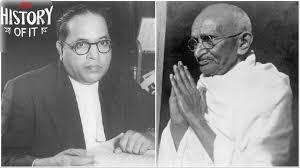
Two. Gandhi was a man of Dharma. He is a saint. Comparing him with QeA and Nehru on their terms is a category error.
Three. Ambedkar is the fourth figure. Not a man of state in the QeA or Nehru sense; not a man of Dharma in the Gandhian sense. He is a constitutional saint, in the Mahatma’s register.
Nehru and QeA may be criticised. They may not be disrespected. Gandhi and Ambedkar are a different order. Discussion of them on this blog proceeds from profound respect for their achievement: the redemption of the soul of India after a thousand years of slavery.
*Thousand years of slavery is not Precedent but rhetorical flourish. It is worth noting that all of the Pakistani commentators on BP would be subordinated “Hindustani Muslims” in the hierarchical world of the Mughals, who explicitly favoured foreign-born Turani and Irani nobles over the converted Indian majority.
Four. SD is not to be quoted on this blog. Initials only where strictly necessary. Reasons at section XII.
Part I. The Distinction
I. The Man of State
The modern state is a Westphalian inheritance: territory, a monopoly of violence, legal personality. A man of state operates inside that frame. He does not step outside it.
QeA was a man of state. He was perhaps the finest constitutional negotiator the subcontinent produced in the twentieth century. He read the Government of India Act the way a master reads a score. In his Fourteen Points of 1929, drafted in response to the Nehru Report’s dismissal of the Muslim minority, he foresaw with brutal clarity that a Westminster majority in a plural society could become a permanent tyranny once the demographic count was fixed.
According to Mohammad Ali Jinnah, “The Committee has adopted a narrow minded policy to ruin the political future of the Muslims. I regret to declare that the report is extremely ambiguous and does not deserve to be implemented.”
There is a reason Pakistanis venerate him to the extent they do. Without QeA, the Muslims of the subcontinent would have remained a set of regional identities & class interests: Punjabi, United Provinces aristocrats, Bengali. He forged a single Islamicate identity out of them and politicised it into a state. In the history of the Ummah, and indeed the world, this is almost unique.
The Two Nation Theory was not his starting point. In 1916, at Lucknow, Sarojini Naidu called him the Ambassador of Hindu-Muslim Unity, and the phrase was earned. He reached for the Two Nation Theory two decades later, when the softer constitutional instruments had been closed off by Congress intransigence and Viceregal haste.
The tragedy of QeA is that the state he called into being never settled its founding question. A secular Muslim who ate pork and drank whisky summoned an Islamic state and then, on 11 August 1947, tried to unsummon it in a speech that Pakistan has spent the rest of its history editing out of its school curriculum. The confusion was structural from day one. It is structural still.
II. The Architect and the Scaffold
Nehru was a man of state of a different temperament. Harrow, Cambridge, Inner Temple. Fabian socialist. Scientific temper. Where QeA built a state around a community, Nehru built one around an idea: that a civilisation as old as India could be poured into a parliamentary republic and would accept the mould. It largely did. We owe him this.
Continue reading Men of State, and the Great Mahatma