Iran
-
How will the Iranian Regime Survive? By Becoming Persian & Crowning a Pahlavi Queen
X.T.M argues that the Iranian regime can survive only by de-ideologising: Islam should become a civilisational substrate with Persian features. He cites the English Restoration as a model, and says…
-
New DNA research paper sheds light on proto-Dravidian and Indus Valley Civilization genetics.
A self-described non-specialist reads a new European Journal of Human Genetics paper on the Koraga, which proposes a distinct ‘Proto-Dravidian’ ancestry from around 2400 BCE, and asks what it implies…
-
Between Arab Conquest and Persian Conversion: The Sasanian Inheritance
X.T.M uses Hugh Kennedy and Ira Lapidus to argue that conquest and conversion were different processes in Iran, rejecting both the viral claim of mass forced conversion and the opposite…
-
Hijab: Between Revelation and Regulation
The author argues that the Qur’an never commands a garment called hijab, using the word for a barrier or curtain, and that it offers a theology of modesty, not a…
-
L’Opéra, Iran, and the Post-Hindu Condition
Prompted by an interview with an Iranian Bahá’í couple who founded the L’Opéra patisserie in India, the author reflects on the Iranian Revolution and the persecution of Bahá’ís. He asks…
-
Pakistan: The Realpolitik State
The author argues that Pakistani society leans on hierarchy, patronage and deference and, as a state forged through separation, has little distinct culture beyond India and Iran. He grants that…
-
The Aryan Cleft: Pakistan as the Cradle and Cusp of Indo-Iranian Civilisation
X.T.M argues that Pakistan sits at the hinge of the Indo-Iranian world, where Iranian and Indo-Aryan languages and Bronze Age migrations meet, and that British canal colonies abruptly turned a…
-
Why Indian English Loves Long Sentences
X.T.M argues that Indian English favours long, ornate sentences as an echo of Persian’s former prestige role, and that it borrows surface complexity without the deep roots of Persian, Arabic…
-
Why Pakistan Won’t Go the Way of Iran
X.T.M argues that Pakistan will not follow Iran’s path of secularisation because Pakistani Islam is inherited bottom-up and fuelled by Partition’s trauma, whereas Iran’s was imposed in 1979 and so…
-
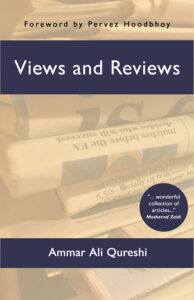
Reading the Reader: On Ammar Ali Qureshi’s Views and Reviews
Furqan Ali reviews Ammar Ali Qureshi’s Views and Reviews, a collection of essays on Punjab’s history, Pakistan, Iran and Iqbal’s love of Persia, praising its range and its melancholy portrait…