This comes up all the time, and i happened to write a long tweet about this today> As usual, no time to fix into a real article, but I am posting the whole thing here for discussion.
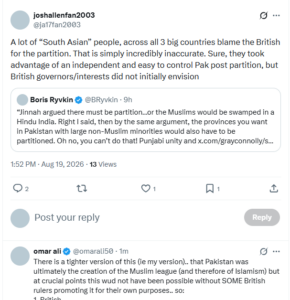
My version is that Pakistan was ultimately the creation of the Muslim league (and therefore of Islamism) but at crucial points this wud not have been possible without SOME British rulers promoting it for their own purposes.. so:
1. British imperial officials were very conscious of the need to divide and rule (they were all trained on the Roman empire, they understood these things, they were not dumb), so they relentlessly promoted local divisions (Muslim vs Hindu, Sikh vs Hindu, Upper caste vs Lower caste etc), that does not mean they CREATED those divisions, but they definitely had an interest in promoting them and did so.. That contributed to the rise of the Muslim league.
2. In 1939, INC failed to support them in an existential war. This led the viceroy to promote a relatively small party (the muslim league) to counter them. The viceroy’s favorite (sir zafrullah) wrote the Pakistan resolution. Then gandhi doubled down on his errors with the Quit India movement and that gave loyal Muslims another leg up. Pakistan propaganda operated unhindered while INC had 1000s in jail. Advantage Muslim league.
3. After the war it was American pressure, naval mutiny, British bankruptcy etc that made independence inevitable. As @Frankisalegend1 pointed out, even mountbatten’s extraordinary haste to get out was driven more by British imperial needs and less by his arbitrary and abrupt decision making. At that point most of the British official in India were likely ready to forgive the INC and keep India in one piece (the jewel in the crown) at independence, but many of them also had favorable views of the loyal muslims who had fully supported the war effort (and in any case, were looked upon as fellow manly men, not “hindoos”) and felt “we cannot abandon our loyal mussalmans to their fate”, and MORE important, some geostrategic types were thinking ahead to the world after the empire and assumed that the anglo alliance with them as junior partners to the Americans, would still run the world. In that world they were afraid of “soviet penetration” in India and wanted a loyal musalman state in the NW who may also be available for imperial duty in the Middle east… so they supported the Pakistan plan (churchill was in both groups, liked the loyal muslims AND thought ahead to the soviet threat) and their influence was important in getting the govt to accept Jinnah’s demand.. (see for example “verdict on India” type books to see how much that faction was a fan of Jinnahism). They did not give a damn about east pakistan one way or the other, but west pakistan as a buffer between fabian socialist india and communist soviets was a definite factor..
Postscript: A few tweets that followed add some (slight?) clarity to my line of thought..

“All true, but I am not saying it was the first reason, or the correct reason.. Just that it was A reason and that given the relative power and ability of the people involved, no Muslim idea could get to first base without a faction of the brits liking it or actively supporting”
“By the end, yes.. But I am saying at every step they had some role and (maybe mostly due to gandhi’s quit India error) between 1940 and 46, when the whole communal clash was set up, Muslim league benefited from British sympathy and ignited this millenarian islamist excitement”
“Obviously the islamists themselves bear primary responsibility. I think having seen them and their descendants up close, I just refuse to believe this lot cud have done it AGAINST the British”
Frank: They wouldn’t have attacked the British but simply ignited violence and chaos across India (not just the partitioned provinces of Punjab and Bengal). Imagine riots all over the Deccan, UP, Bihar, MP etc.
“Yes, by the end.. They would fold like a house of in 1940 though.. And even in 45.. After direct action they were more confident..”

By all accounts Pakistani state has not betrayed the trust west had in it . It’s foreign corp has been nimble and it’s army has kept the main land intact.
Probably had the movement for pakistan been longer, a more debated and agreed ideology might have had developed , which would have made the political side of governance smoother.
Indian freedom movement gave a frame work for this state which is still the background. For example , congress yesterday declared that they will sing only two stanzas of vandemataram as per resolution adopted by them in 1937!!
The Bombay club gave the blueprint for India’s industrialization.
If the Pakistan movement had been longer and more debated, there would not have been one Pakistan, not even a unified Western Pakistan. These guys would have been at each other’s throat long before getting their new Medina.
KK = BB
I would honestly argue that the British didn’t create the partition intentionally; rather, their main contribution mostly stemmed from his incompentence in “how” the division happened, but they didn’t cause the “why”. Ajay Varghese, in his book “The Colonial Origins of Ethnic Violence,” points out that the British contributed more to the creation of caste and tribal tensions as opposed to communal tensions. It seemed that the British perceived the Sepoy Mutiny of 1857 as principally being driven by religious conflict between the British and the Hindu-Muslim sepoys.
In the aftermath of the incident, the British mainly aimed to make policies that accommodated communal differences, including opening up government positions to members of different communities irrespective of religious origin. However, this often came at the price of worsening the conditions of lower caste induviduals (Muslim, Sikh, Jain, Zoroastrian, Christian and Hindu) and tribal groups. Ironically enough, the Princely states were communal in nature in contrast, since their rulers often relied on theological claims to maintain their position (think the Travancore royal family in Kerala’s mythological connection to Vishnu, for example). In fact, many princely states were open to including people from a wide caste background, but didn’t extend such offers to people from different religious backgrounds. In a sense, the “native” states were more communal, while the “foreign” British officials were more casteist or anti-tribal.
Furthermore, I would argue (this is my opinion) that there is a reason why the princely states were communal: specifically, religious crystallization in the aftermath of Aurangzeb’s Deccani conquest and the Maratha rebellion that ensued. Ajay Varghese, in an article, once pointed out that the regions today that suffer from communal riots tended to overlap with places where Maratha-Mughal battles took place (think Gujarat, Bengal, etc.). Furthermore, my all-time favorite academic on xenophobia, Gijis Kruijtzer, stated that communal relations between the two communities were already declining long before the British entered the picture. In fact, a minor example he talked about was the fact that the sultan of Mysore had once sent a threatening letter to a local Maratha ruler who wanted to prevent his friends intereligious marriage.
Also, it should be noted that the orthodox communities in both religious groups (who held sway in powerful places) often insulted and even encouraged actions against others. You had figures like Sirhind, Badayuni, etc., who are kinda infamous for their questionable views about non-muslims, especially Hindus and Sikhs. I still remember the incident where Ibrahim 2 of Bijapur had to literally write on his grave that he was not a jew, a Christian, a Zoroastrian, and most certainly not an idol worshipper, but he was a deeply devout muslim. Mostly due to the fact that he was very into classical music and generally very close with these Hindu vassals, in addition to his syncretism.
The Hindu side of the equation wasn’t different either. The Devalsmriti from (what is presumed to be) Arab Sindh includes many laws that explicitly forbid interactions with Muslims for long periods. Excessive interaction or living together would result in complex purification rituals and excommunication from the social community. Furthermore, Hindus (especially nobility) who converted to Islam were given a degraded social status; in fact, Hindu Rajputs would eat food given by Muslim Rajputs. Ironically enough, the muslim side was deeply suspicious of converts since sometimes an enemy Rajput king would convert to Islam and then revert immediately after the Mughal armies left.
Fascinatingly, every communal issue today has a long pre-colonial history. The consumption of cow meat and the entire fiasco that stemmed from it existed even back then. Also, Hindu texts explicitly called muslims “Mleccha,” i.e., foreign barbarian. They were even selective about it, with Maratha-era texts calling Mughals Mleccha, but not calling the Deccani sultans Mlecchas since they helped the Marathas. Hell, even the Sikh texts had a translation I saw in which the guru was talking to a muslim man about why he dresses like a non-muslim and does un-Islamic rituals at home despite publicly being muslim, which he referred to as the Mleccha religion. The reverse from the Muslim side isn’t exactly unfamiliar to everyone, including the bit where Alamgir beheaded a cow in a Jain shrine simply to spite the local mayor, who was Jain.
The British can be blamed for a lot of things, ranging from famines to, ironically enough, casteism and anti-tribalism, but religious violence is a pre-colonial thing. The British worsened the economic situation, introduced organized religious structures that crystallized religious identity, and made stupid orientalist interpretations that morphed people’s ideas of the past. Most of these things indirectly worsened an already bad religious situation.
Wonderful comment.
The British did not create the divisions thst are there today but definitely created a political culture that encourages and at times obfuscated other issues in favor of these division.
My understanding is that while these division were there wete ever present, they did not percolate to the day-to-day life of many people as they do today, largely limited to a section of religious leadership and their followers, with even the kingdoms and governance letting pragmatism guide day to day actions.
The British main contribution is the culture that exercebates these division.
Day-to-day life was actually even stranger. Most people seem to have been identified quite strongly by their caste rather than purely by religion; in fact, religion (even today, honestly) kinda served as an extension of caste. Muslim Rajputs, for example, were seen as closer to another caste subgroup. In some instances, people swapped their religious identity many times within years of each other, but they retained their caste groupings. An important difference that matters was the fact that there was never really any centralized religious structure in South Asia for all groups, unless you were a small group like Jews, Jains, and Parsis with tight-knit communities.
In the Sikh reference I was talking about, the guru explicitly says that the muslim man dresses exactly like a Hindu with the Dhoti, tilak, and the home rituals despite identifying as muslim. So, these identities on the ground level were recognized as different, but the boundaries were never well demarcated. Also, the kings didn’t force religious boundaries onto their people since it was hard to categorize people, and they genuinely couldn’t do anything. Even Aurangzeb tried to create a more homogeneous religious identity around Sunni Islam, and he failed since most of his muslim nobility were more loyal to their regional and other identities due to their porous boundaries.
This is kinda where the British worsened things, since they had a more centralized political system that could affect populations more. Furthermore, religious organizations became more organized and structured, making it possible for religious leaders to gradually establish religious boundaries and enforce orthodox puritanicalism. This crystallization seems to have ruined day-to-day interactions in hindsight, as it gave politicians a more effective manner to exploit religion for their own interests.
Oh my welcome back; Girmit, u & Calvin are immune to the IndoPak discussions..
It’s a civil war of the IndoGangetic belt.
Whether or not the British facilitated multiple successor states or not is one thing to debate, but the inability of the successor states to have mutually beneficial relations is another. The subcontinent could have had a common market, visa-free travel and a seamless train network. That would be much more valuable than a nominal unitary state.
This is very true.
The competing states will cooperate only after they are totally exhausted, as seen in Europe. They now compete in football!!!
Scotland loosing steam with its fight with England finally paved way for Scots blooming into law, medicine, colonial adventures, etc.
Asian and African states still need to get out of their identity issues, age-old rivalry and existential issues.
Perhaps England-France is a better analogy to India-Pakistan than England-Scotland.
Scotland agreed to a union with England after a century of common rule (by the Stuart dynasty) and a longer common history of religious reformation (both became Protestant). These factors more than “losing steam” paved the way for eventual peace.
England and France, on the other hand, had a longer history of conflict as well as religious differences (to this day, though religion is not salient any more). They only decided to patch up when faced with a common threat: Prussia-dominated Germany. The prospect for improvement of India-Pakistan relations then lies either in (1) the emergence of a common threat, or (2) religion losing salience in both countries.
We could even take the more recent and extreme example of Japan and China. Visa fee travel for short stays, deep corporate networks within each other’s countries, and some of the busiest bilateral aviation routes in the world. All this while being geopolitical adversaries. Do we lack the emotional maturity for this?
Do Japan and China have an active territorial dispute?
Did China send “non-state actors” into Japan to murder its citizens?
“We” do not lack emotional maturity. We lack a neighbor governed by common sense and self-interest, instead of a kleptocrats that have doubled down on the ‘original sin’ of the fabrication of ‘Pure land’
“emergence of a common threat”
The stormy skies over Pindi bled a heavy crimson gray,
A wall of tribal riders cut the garrison’s breath away,
But as the final gate collapsed beneath the fierce Mountain horde,
The Winged Hussars of Poona Horse! came thundering with the sword,
With turbans high and engines roaring, they turned the tide of the war.
If the people here are anything to go by, religion losing its salience would still see India as the enemy number 1.
Tribalism uses religion as…apparel. Isn’t necessarily driven by it.
In pakistans case, even if by some quirk of history the country becomes less religious, it’s national identity will still need to be shaped by difference from India.
Without India a lot of internal issues kind of spiral out of control.
The British created ‘India’ when they came in
The British divided ‘India’ when they left.