
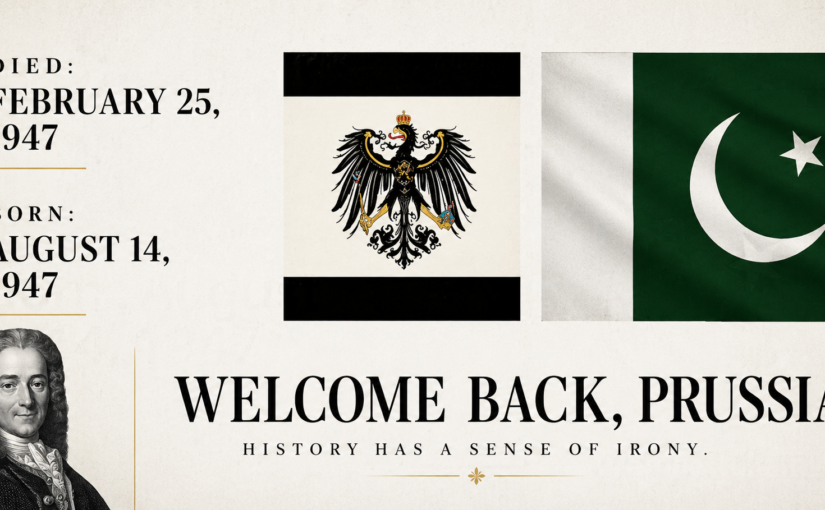
A precedent post on Pakistan’s self-exile from the subcontinent, and the geography that outlasted it
This is not anti-Pakistan polemic. Pakistan can flourish in the role she has chosen, and may continue to do so (Pakistan’s pivotal role in the US-Iran war is, on any honest reading, a legitimisation win for the current hybrid government)). The point being made here is structural, not personal.
Pakistanis are a subset of the British Raj’s Muslim population. As Punjabis, as inheritors of the Mughal cultural complex (alas one cannot destroy his Masjid and simultaneously claim to be his heir), as native carriers of the Hindustani register that becomes Urdu under one stylisation and Hindi under another, they began with a favoured position inside the subcontinent. They have traded it for a subordinate position inside the wider Muslim world. The internal hierarchies of the Islamicate, where Pakistanis rank against Arabs, Turks, and Persians, are dense and unflattering and deserve their own treatment another day.
The cause of the trade, in the end, is theological. The subcontinent runs on iconographic generosity, painted shrines, sung saints, plural deities, devotional excess. Strict iconophobia cannot live inside that civilization without breaking it. Pakistan chose the stricter line in 1947 and has progressively tightened it since. The Urdu denial, the recent insistence in some Pakistani quarters that Urdu is not really an Indian language, is the cleanest evidence of the opt-out.
Irreducibly Indo-Persian
Urdu is so deeply Indo-Persian that the Bahá’í World Centre treats it as functionally a near-cognate of the source languages.
Urdu is one of only two languages, alongside Turkish, whose closeness to Persian and Arabic permits direct translation of the Bahá’í Writings without going through Shoghi Effendi’s, the Beloved Guardian, authoritative English.
Denying India is denying the warm Gangetic soil, Urdu grew on.
Having opted out, the revisionism follows. India is re-described as a “pretend hegemon,” a state that only pretends to dominate the subcontinent. It is a comforting line. It is also strategically illiterate. The argument collapses on a map. Did India retain her two chicken’s necks?
She did. Both of them. And that is why the Republic remains intact while Pakistan’s eastern wing does not.
The first neck is Gurdaspur.
When Cyril Radcliffe drew his line in August 1947, three Muslim-majority tehsils, Gurdaspur, Batala, and Pathankot, were awarded to India against demographic logic. Alastair Lamb, in Birth of a Tragedy and Incomplete Partition, set out the case at length: an earlier draft of the Award is understood to have placed Gurdaspur in Pakistan, the announcement was held back until after the transfer of power, and Mountbatten’s interventions in the process were neither neutral nor procedurally clean. The outcome was a thin land bridge that gave Delhi her only road and rail link to Jammu and Kashmir. Without Gurdaspur, the airlift of 1947 to Srinagar is logistically impossible. Without Gurdaspur, the Indian state has no mechanism to project force north of the Pir Panjal. Kashmir is then lost not to Pakistani arms but to plain geography.
Pakistan understood this in 1947, in 1965 (a war in which Pakistan seems to have gained territory in Cholistan), and again in 1971. She never came close to severing it.
The second neck is Siliguri.
A strip of land roughly twenty-two kilometres wide at its narrowest, pinched between Nepal, Bhutan, and the eastern flank of Bangladesh. Through it run the only roads, the only railway, and the only fuel pipelines linking mainland India to her eight northeastern states. Sever Siliguri and Arunachal, Assam, Nagaland, Manipur, Mizoram, Meghalaya, Tripura, and Sikkim become an island, accessible only by air or by transit through a foreign country.
In 1971 Pakistan’s Eastern Command was destroyed before it could mount any threat to this corridor. The Indian Army moved south and east into Dhaka. Pakistan moved nowhere. The Siliguri Corridor was never even contested.
The position has since hardened in India’s favour. Bangladesh, the state Pakistan lost in 1971, now actively cooperates with Delhi against the Northeast insurgencies, has resolved its land and maritime boundary disputes peacefully, and has normalised relations even after the political turbulence of the last cycle. The neighbour through whose territory the second neck might once have been threatened is now a partner in keeping it open. That is not a fact about ideology. It is a fact about geography settling, over fifty years, into the only configuration it could.
This is the inversion that the revisionists cannot face.
A genuine hegemon-failing state would have lost one of its necks. India lost neither. Pakistan, by contrast, lost an entire wing, fifty-six per cent of her population, the demographic majority of her own polity, and the two-nation theory along with it. Niazi surrendered ninety-three thousand men at the Ramna Race Course. The Instrument of Surrender remains the largest military capitulation since the Second World War.
A fake hegemon does not produce that outcome. A fake hegemon is not what writes the Instrument. It is what signs it.
The structural picture is plainer still. India occupies roughly seventy-three per cent of the subcontinent by land area, seventy-five per cent by population, and over eighty per cent of regional GDP. By every metric used in international relations literature to define regional hegemony, relative power, geographic centrality, neighbour dependency, India qualifies and Pakistan does not register as a contender.
The two necks held in 1971. They have held since, tested at Kargil in 1999 and at Doklam in 2017, and confirmed each time.
Pakistani revisionism wants the geography to be different. It is not. The map after 1971 is the map of a structurally complete Indian state and a structurally truncated Pakistani one. No essay changes that fact. The chicken’s necks held. The wing fell.
The Prussia of Islam
Post-Pahalgam, the verdict has settled. Pakistan is the Prussia of the Muslim world. Militarised, disciplined, defined by her army before her culture. She could have been something else. With the Muhajir high culture, Delhi and Lucknow transplanted to Karachi, with the geography, the origins, the depth, the texture, the population, she had every ingredient required to be the England of the subcontinent, or even the France of it, a great civilizational power inside the region of her own birth. She chose Prussia instead. And the Prussia of the Muslim world is, on closer inspection, the “Jamadar” of the Muslim world. The word is Urdu. The rank is colonial.
The world has changed, it is now becoming the world of Central Asia
Indians like to think it has the cards and India can be the local hegemon.
Geography tells another story, India is alone cut off from Central Asia. Its neighbors in the periphery have choices. Like Sri Lanka turning to China
Worse Indias water in the North is controlled by China. Both Ganges and Indus and other rivers that flow from Tibet
—
China increasingly sees itself as a stakeholder in the Indus Waters Treaty, too. Chinese media narratives have framed India as the aggressor in the dispute, warning of the danger of using “water as a weapon” and noting that the source of the Indus River lies in China’s Western Tibet region.
https://theconversation.com/chinas-insertion-into-india-pakistan-waters-dispute-adds-a-further-ripple-in-south-asia-258891
Yes.
None of the other countries in South Asia like India’s attempts to project hegemony– or to put it more kindly to play “big brother”. The only difference between Pakistan and the rest is that Pakistan is a nuclear weapon state. We will never kneel before India.
Incidentally, “Jamadar” is the Urdu word for janitor. This is quite insulting rhetoric to use about Pakistan.
As for “leadership in the Muslim world”– personally I’m not very concerned about that. But I will note that Pakistan is the world’s second most populated Muslim-majority country (it is projected to overtake Indonesia within five years). It is also the only Muslim-majority country that is a nuclear power. Both those facts count for something.
You made good points that India’s land borders are cut off from Central Asia. They only have the ocean which was supposed to be their strength. However India failed to take advantage of globalization and free shipping lanes using it’s access to the oceans. The global order is fast changing and free shipping lanes may not exist anymore 5, 10 or 20 years from now.
IWT’s resolution will take several years, there is not much India can do to the Indus but they can try to obstruct Chenab and Jhelum. However this will take a decade at least if it even happens, and I expect China & PK are already planning the next moves on this.
If you look at a map, you will realize that Pakistan’s land borders are “also” cut off from Central Asia.
There is a country in between Pakistan and Central Asia which is not particularly fond of Pakistan and has claims to Pakistani territory.
The Pak Nationalist pipe dream of Pakistan getting energy from Iran and Central Asia will remain just that a – a pipe dream.
Pakistan will never be energy independent. Pakistan will keep importing energy from the Gulf and will keep having “load shedding”.
Pakistan doesn’t even have India’s massive coal resources which power India’s electricity grid. Hence no dependence on imported LNG which is hurting Pakistan hard. And summer isn’t even here.
And what will China and Pakistan do regarding the IWT? Build a dam on the Chinese side of the Indus? 😂
Again you are over-litigating. You have to recognise that as India becomes more Hindutva, which is its right too.
Muslims countries are equally going to respond. India, Israel & the West are trying to project in the Ummah.
Iran has put a stop to that.
What is shocking; the only Muslim country to defect is UAE. This has been devastating for the UAE globally and in the Ummah (ironically again it has the closest ties with India & Israel).
You are hoovering up the internet, Hamza, but exactly like your Alter Ego, you can’t understand the Ummah. Something has shifted. It’s requires Muslim blood to intuitively understand that.
Again, will respond via a post.
Will integrate points into a post idea I already had.
India might be friendly towards the west and Israel but it is not anti-Iran.
The world isn’t divided into two opposing alliances but a multitude of countries each operating with their own interests.
If India was truly against the “ummah”, Iran would not be selling it oil.
https://www.reuters.com/business/energy/india-set-get-first-iranian-oil-cargo-7-years-ship-tracking-data-shows-2026-04-08/
//Muslims countries are equally going to respond. India, Israel & the West are trying to project in the Ummah.//
How is Indis meddling in the middle east exactly?
How does not being in central asia contradict Indias position as a local hegemon?
Furthermore, china is only a good and useful partner as long as India is present to act as a counterbalance. Without India, china would be the one our neighbours lose their minds over. The burden of history,culture, geography link all of the subcontinent destinies together even if it has been Indias failure in converting these to tangible cooperation and trade. No doubt owing to the big brother attitude.
Indias majoroty of water comes from the monsoon, and the sources of ganga and yamuna, gangotri and yamunotri are in India. As are the multiple of its tributaries.
As far as the Brahmaputra is concerned, the dam china is making is a run of river dam, as the terrain does not suit making a reservoir dam. China can change its plans but so far the potential for control, is not that severe.
And if China wants to prevent Pakistan from starving in the future it will have to let go of waters of the Indus. That means it needs to negotiate with India and cant just unilaterally give threats
Indus flow into Pakistan from India so if China stops the Indus, guess who suffers.
Ganga originates from India itself.
Except for the Brahmaputra which is majorly rain-fed, all of India’s rivers start from within India itself including Ganga, Yamuna, the Indus tributaries etc.
It is Pakistan and Bangladesh whose rivers are completely controlled by India.
Like I said – natural hegemon.
Sri Lanka can’t “turn” to China unless it magically appears where Taiwan is.
They can have economic cooperation with China but then again Japan, Korea, Philippines have co-operation with India. Have they “turned” to India?
Not really – Pakistan is opting out of the Indian Subcontinent.
The rivers can’t though.
Again a lot of hot air. China is there on the other side.
Pakistan literally post Pahalgam has become a diplomatic champion.
It’s important to recognise where one has misstepped. Operation Sindoor has really diminished India’s standing; the special relationship with Trump.
Of course Dhurandhar was a major victory. When is Baluchistan’s Independence again?
Balochistan is not becoming independent. I myself have admitted that. Just like Kashmir, Tibet, Chechnya, Kurdistan, Xinjiang isn’t.
Demographics/geography is not in favour.
But then again Balochistan is also not completely in the control of the Pakistani estalishment. And to pretend otherwise would be foolish.
When is the Quetta team playing their first match in Quetta again?
Been a decade since they started.
Islam does not know Nations.
All these Muslim majority nations + Tibet haven’t been broken.
The Kurds refused to attack Iran. It is interesting the Ummah is cohering and refusing to be manipulated into division.
Unlike you; we wish well for the Ummah, and for Bharat, and for the West.
We find it funny when you & K “care” for the other side 🙂
Yet here we are, with the Ummah nations bombing each other.
Are they really?
I mean, an Ummah country in our region bombed a hospital of another Ummah country not too long ago.
The worst affected by Irans counterattack have been the gulf states, going a little back into the past. Turkey has neither been good to its predominantly muslim Kurds, Saudi and UAE are fighting proxy wars in Yemen and Sudan.
Pakistand Afghanistan are fighting each other. This is kind of one reason why the Ummah cohering seems very hard, there is quite a lot of bad blood unrelated to the US and Israel that will not go away soon.
//The Kurds refused to attack Iran. It is interesting the Ummah is cohering and refusing to be manipulated into division.//
The only reason the Kurds did not respond to America and Israels entreaties is because both have shown themselves to be untrustworthy, though you know better than I do whether the Kurds and other non persian ethnic minorities like the IRGC and Islamic Republic or not.
I don’t think it’s fair to equate me with BB. In my opinion, Q is BB’s Pakistani counterpart.
I have relatives living in India who are Indian citizens. I have Indian friends. I admire many aspects of Indian culture.
My issue is simply with Hindu nationalism.
If India doesn’t bomb Pakistan, I have very few issues with it.
Every few posts you do threaten the Nuclear.
I don’t think recognizing that the nuclear weapons are there and will be used in the case of an existential threat is me “threatening” anyone.
You yourself recognized that Operation Sindoor didn’t go well for India.
Also unlike Q, I live in India and don’t sing paeans to India while living in Dallas or London.
BB is far more intellectually honest.
BB is a troll.
I have never threatened to hold a gun to anyone’s head.
Neither have I made posts sexualizing Hindu women.
Again I will make a post about this (which I keep saying but I will now that I’m back).
No amount of “diplomatic victories”, alliance with China etc can change geography.
I will detail more in my post with maps, statistics etc.
The problem is that your analysis is built on a premise, “Pakistan must lose” then you marshall all your evidences accordingly.
Well, people are free to make their own analyses and present counter-evidence and make their own posts.
Just like in this post itself you have presented counter evidence to the Pakistani denial of Indian hegemony.
Exact – that is the point. We are relentlessly fair to both sides, which is why we attract ire, condemnation and engagement.
But it’s important as the Commentariat engages to also learn from their experiences rather than just repeat their favour talking points.
It is a mistake to think Pakistan has not evolved since 1971.
It went and made itself a nuclear power, despite the odds. Which is why in the new post-terrorist reprisals by India, they can only be very limited.
Territory cannot be crossed. Just as our post talks about Pakistan’s strategic failures (inability to break up Bharat); India has had the huge strategic failure that her once “Indian Northwest” is only a very consequential plays in the Muslim world.
It broke Pakistan once but Pakistan rose like a Phoenix. Even Bangladesh is precarious; Sheikh Hasina has probably turned a lot of the population pro-Pakistan.
It’s common the Yanks are Anglophiles even though they fought their War of Independence against them.
Yanks speak the same language as the British and their entire historical foundation is British and even now the American elite class is filled with WASPs.
Bangladesh has no such relation with Pakistan.
In fact the reality is, Bangladesh wasn’t even Pakistan for a long time. Just 24 years. That is basically Sachin Tendulkar’s international career.
Bangladesh has more in common with West Bengal and considering Bangladesh still has a smattering of Hindus – they have common demographics, both Hindu and Muslim.
Bangladesh has only one neighbour (leave aside that tiny strip with Myanmar) and they know their future lies with them. GenZ Jamaatis made a lot of noise but even during Sindoor Bangladesh gave a very neutral response and they couldn’t even win the election.
And even if they had won the election, they would have to maintain relations with India for mutual benefit just like “Hindutva” India does with Bangladesh, Afghanistan, GCC, Iran, Indonesia etc.
You can’t change geography.
Geography and Economics ultimately just can’t be denied. Making diplomatic PR gains is ephemeral.
Its great that Pakistan finds itself out of the pariah penalty box – Oct 7th and the Iran escalation led to the US re-discovering its geographic utility.
At a minimum, this will definitely ease some pressure on the financial chokehold that Pakistani elites have looted their way into. But realistically, short of a 50 billion dollar giveaway, the way out for Pakistan from its economic quicksand is …. unclear.
Looking a bit further down the road, one way or the other, the US-Iran conflict is bound to end. Then what? Just like after the US exit from Afghanistan, Pakistan eventually managed to extract defeat from victory, finding itself in an actual hot war with the Afghans, the prognosis for future Iran-Pakistan relations isn’t entirely as rosy as extrapolated by some on the BP comment threads. Yourself included.
Geopolitics is an unforgiving poker game. Bluffs occasionally work, but only temporarily. It ultimately boils down to what cards you have to work with. In Pakistan’s case, apart from leveraging its bloated 20th century military, it really does not have any.
‘Central Asia’ total population is what, 80 million? That’s like 30% of Uttar Pradesh.
For all of Pakistani braggadocio about being the gateway to central asia, its central asia trade is barely 25% of Indian trade, if that.
China treats central asia like the backwater it is – as a captive market for its goods. And views Pakistan as an extension of the same.
Your allergy to India is highly personal, the actual facts and geopolitical realities for Sri Lanka and India are markedly different.
Yeah, this guy just talks nonsense here. Maybe from personal bias.
SL is very pro India.
Despite all the bonhomie with Pakistanis here, SL provides visa free access to India and not Pakistan.
And Pakistan isn’t even the “gateway”.
Afghanistan lies in between.
Which is essentially Pakistan and vice versa
Don’t think the Afghans see it that way. Current events attest to that.
Which Afghans though; it’s pretty obvious a Persianate Sphere is being birthed.
We would have preferred Indo-Persian.
The ones in charge in Kabul.
And considering India-Iran relations, the Indo-Persian sphere will anyways be formed.
Contrary to Pakistani expectations, removal of US sanctions will improve India-Iran relations.
Without sanctions, India will “regain” Chabahar and considering India’s good relations with Russia, Afghanistan, Central Asian states etc it is the INSTC which will be back on track.
Tbf, even with the sanctions India still keeps getting concessions by the USA on Iranian oil and Chabahar.
India like to portray it self as picking “winners”, like Israel and the US
In my opinion India has consistently picked the loser, because India cares more about power, not principle. Much like the US
The biggest loss was Tibet.
India picked a feudal lord the Dalai Lama, who kept his serfs (people) in near slavery. China true to is principles sided with the serfs
India gave refuge to the dalai Lama never supported cross border terrorism of any kind in Tibet and is not even interfering in the succession process which will.most likely go china’s way
The only thing China can accuse India of is allowing the Dalai Lama to get a platform to air their views but that is not equivalent to siding with the dalai Lama.
Disagree with Pakistan being the inheritors of the “Mughal Cultural Complex”.
It is India who is the inheritor due to having the vast majority of the empire including all the important spots like the capitals, tombs, palaces etc as well as having the vast majority of the Hindustani Muslims STAY BACK including the nawabs and nizam who sprang out of the Mughal empire post dissolution.
“India” does not reject Mughals. One section does and that is perfectly fine in a democratic country.
Indian Muslims and leftist Indians (of all religions) are also “Indian”.
Like I have said before (and will make a post soon) India is the heir of the Mughals AND the Marathas AND the Mauryas AND the Sultanates AND Vijaynagara AND British India AND thousands of kingdoms/empire over thousands of years.
Since India has descendants of various opposing historical factions, conflict will be there – which is fine.
Not even a Hindu-Muslim issue – The Battle of Bhima Koregaon is seen differently by Brahmins and Mahars just as Ashoka is seen differently by Biharis and Odiyas.
And you can see the same in other countries too – Robert E. Lee is seen differently by White Southerners and Black Southerners.
Disagree all you like but Babri Masjid’s destruction kind of invalidated that.
The French would never burn down Notre Dame.
Babri is not Notre Dame. The Jama Masjid in Delhi is.
Babri was an inconsequential mosque whose only purpose was a victory monument.
It wasn’t even used as a mosque for decades and only came into the limelight because of the Ram Mandir. There are plenty of such small older mosques dotted around India.
Correct analogy would be some random church in Normandy.
You can litigate this endlessly but you can’t have it both ways.
It is symptomatic of why a lot of your analysis feels incomplete. It’s a series of facts trying to make a pattern.
It keeps the Qs at bay but with respect not much else.
Not having it both ways though. Will make a post as I am back.
elevating Babri to Notre Dame isn’t just silly, its simply inaccurate. we would expect better from you. 🙂
It was a 500yr old building. Kings College Chapel is 500 years old.
It is equally absurd to presume that a Nation that destroys the Mughal Monuments can emotionally lay claim to them.
This isn’t Schrodinger’s cat.
Well said.
The fundamental principle is that a constitutionally secular state cannot allow minority places of worship to be destroyed.
While you claim to know India very well but perhaps it has slipped your highness’ notice that India did enact the Places of Worship Act in the aftermath of Babri. Would love to be enlightened about Pakistani (or even Bangladeshi or any other country in the subcontinent) equivalent.
Why are you comparing a constitutionally secular state with an Islamic Republic?
This is not intellectually tenable.
“Your highness”– this is passive aggressive.
For the nth time we see the ‘110% perfect secularism for thee, Religious apartheid for me’ attack vector; And the demand that even the mere mention of this personal hypocrisy be deemed blasphemeous.
Get well soon. 🙂
Comparing a constitutionally secular state to an Islamic Republic is not intellectually tenable. Constitutionally secular states must be held to higher standards.
Even XTM agrees with me that the destruction of Babri crossed a red line.
King’s College Chapel wasn’t built over a Hindu temple that too, one of the most sacred sites of Hinduism.
I disagree with the way it was destroyed and the riots that followed but the building of the temple was the right thing.
Should have been moved to a different place peacefully (like it was done in Somnath in 1951) and the temple should have been constructed.
And the “nation” didn’t destroy anything. Using that logic the “nation” in Pakistan carries out attacks on Shias in mosques.
Yes but the point was the mobs did what the National wanted.
This is an interesting discussion actually on High Culture.
Yet again, cherry-picked history that overlooks the fact that the ‘mob’ had sought judicial relief instead of resorting to ‘mob justice’ going back multiple decades – even dating back to British rule.
The ‘mob’ tore down the Berlin wall as well. But history celebrates that.
This is not to say that the breakdown of the rule of law and the disappointing attack on the Babri Masjid site is in anyway defensible.
But context matters. You know this – you stress the importance of avoiding one-eyed jaundiced takes on BP, all the time.
X.T.M is very much pro-India but likes to throw the Pakistanis a concession here and there so they don’t leave, I have seen.
Case in point – this post where after the first paragraph on Pakistan, started pelaoing them even more than I could.
The nation cared about the mandir, not the razing down and the riots (maybe minus a minority).
Congress should have moved the mosque and built the mandir in the first place.
Gyanvapi in Kashi where there is even more overwhelming evidence is being undertaken in a more civil manner.
Inflating the importance of the old Mosque built on a site contested for multiple centuries is a choice.
Choosing to omit the monumental (pun intended) importance and sanctity of the destroyed temple for a billion+ believers, is also a choice.
Extrapolating from this contentious and debatable conflict, into accusing India/Hindus of quote “destroying Mughal monuments (plural)” is yet another choice.
I am asking you to clarify these choices.
Not that this is the thrust of your argument but 500 years is modern history in the Indian context. Sooryavanshi Thakurs of Ayodhya had abnegated from wearing turbans since they lost Ram Janmabhoomi 500 years ago. The destruction was living memory and historical trauma. Not something that can be hand-waived by some Marxist historian’s pamphlets.
It is also worth noting what Babri represented – an occupation of one of the holiest sites of Hinduism in the land that it originated in.
While there isn’t a good analog per se, a rough equivalent would be Brits destroying Al-Aqsa to build a church atop it.
Two civilizations clashed in the Gangetic plains for almost a millenium, both survived and also led to a third – the Indo-Gangetic syncretic culture. India gets to claim all three.
Pakistan has an equal claim to India’s Muslim culture but India chose to not deny itself its Muslim history. The modern Indian state is not defined by inclusion unlike Pakistan which is foundationally exclusive.
Pakistanis can claim India’s Muslim culture like the way Americans can claim Shakespeare and Austen (cue all the Hollywood adaptations) – in that they are adopting it rather than “being” it.
To add to this, the current rise of Hindutva and antipathy towards India’s Islamic heritage amongst “some” sections doesn’t negate India’s Muslim history.
Debating over whether India is the inheritor of the Muslim legacy or the Hindu legacy is like asking if a child is a mother’s child or a father’s child.
Children might have favourite parents but biology cannot be denied, just like history and geography cannot.
Babri masjid was a dilapidated mosque. Indian Muslims should have let Hindus have it if there was really was the birthplace of Ram and a holy site, out of respect for their religion. But that’s a big IF. It’s clear why they did not want to give it away because they understood the nature of Hindutva
After interacting with many of the Hindutva online and seeing how they completely invent history and mix it with mythology and act like there is absolutely no difference, seeing the facts around this I came to the conclusion that the entire story was fabricated. This is just an extension of their war against Indian Muslims, as they see every mosque in India an affront to their religious ideology. You see the same fabrications being made about Taj Mahal now and perhaps 100 years later you will see Indians climbing on top of its dome and ransacking it brick by brick.
“Perhaps” Indians will break the Taj Mahal
“Perhaps” sanctions will go and Pakistan will be able to buy Iranian oil
“Perhaps” Pakistan will be the ruler of the Islamic world
While currently
Indians are enjoying the Taj Mahal, both Hindus and Muslims (and everyone else) making that pose to post on their Instagram. 99.9999% of Pakistanis will never set foot there.
India is buying Iranian oil as US made exceptions for India (but not Pakistan)
https://www.reuters.com/business/energy/india-gets-first-iranian-oil-7-years-ship-tracking-data-shows-2026-04-13/
Currently Pakistan is running security detail for the Muslim world and instead of “rulers” are the “jamadars” of the Muslim world as specified in this point (Alongside doing “dalaali”. Sadly Trump cancelled the talks. Hope at least the bills are paid. Pakistan paused Islamabad for it.)
And speaking of Taj Mahal.
Well said.
India has actually gained territory since 1971 –
A few Balti villages in 1971
Sikkim in 1975
Siachen in 1984
There is a recurring theme whereby Bhakts will try to badmouth Pakistan and Pakistanis, especially Punjabis. It’s not just on social media, but often a common theme amongst Indian podcasters who talk how ”backward” Pakistan is, how savage its people are. We also hear comments here like how Punjabis were just roadkill for the Turks.
But on the other hand, the very same Indians are obsessed about reclaiming the same people and land. Same personailities on those podcasts would talk about reclaiming Pakistan, while in the same breath also badmouthing us.
Many hardcore nats would say it’s just the land they want, not the people, but I think there is also a racial aspect to this related to inferiority complexes found in North India, so I know they also want the people.
Its almost like an exgirlfriend you dumped that you didn’t care about much, and now she is going gaga over it, hating you, plotting against you but also wanting you. Problem is you can’t just delete her number, since she is your neighbour who has taking over your water tank and now threatening daily to shut off the taps. Absolute dramaqueen
It is Pakistan who is the “ex-girlfriend” who after a breakup wants to come back after realizing their Arab/American “situationships” just regard them as an “easy lay”, a “booty call” to be called upon when needed, not anything “serious”. Maybe Q’s insecurities regarding daughters and serious “suitors” stem from this.
Please play cricket with us.
Please buy our players in the IPL.
Please let our actors/musicians in your industry.
Please shake our hands.
Please restore the IWT.
Leave us alone, girl. Go play some other sports with the Arabs. We don’t want to play cricket with you.
must have hit a nerve there 😀 😀
Naah, quite the opposite.
It is quite a stretch to accuse Indians of having a racial complex while simultaneously living in the west and fearmongering about daughters bringing home “Central African” boyfriends.
One thing I like about this article is how @X.T.M basically weaves in multiple recent discussions into the same article – Jinnah’s inability to get Kashmir/East Punjab, Bengal SIR and the Northeast, Indian hegemony, the nature of Urdu.
Even my reply to Q about how Bangladesh is not a second Pakistan.
@XTM:
BB’s posting a picture of the Netanyahus in front of the Taj is very low signal.
Also what’s his point? I have multiple pictures of my family in front of the Taj.
China begins building world’s largest dam, fuelling fears in India
Experts and officials have flagged concerns that the new dam would empower China to control or divert the trans-border Yarlung Tsangpo, which flows south into India’s Arunachal Pradesh and Assam states as well as Bangladesh, where it feeds into the Siang, Brahmaputra and Jamuna rivers.
https://www.bbc.com/news/articles/c4gk1251w14o
As said before Pakistan has the potential to access Central Asia, via Russia, Iran China land corridors. It is up to Pakistan to wisely negotiate mutually beneficial agreements (India will for sure to scuttle such efforts via covert means)
India mean while hemmed in the North by gigantic Tibet (China). Bangladesh is another Indian headache. An overpopulated poor country which will be a source of illegal immigration into NE India. Much like Mexican (and Central American) illegal immigration into the US.
Luckily Sri Lankas neighbors Kerala and TN are doing well. In the 60’s and 70’s there was quite a bit of illegal immigration (via boats) from the neighbors
//An overpopulated poor country which will be a source of illegal immigration into NE India. Much like Mexican (and Central American) illegal immigration into the US.//
Most bengali muslims who are accused of being illegal are from areas in India where bengali Muslims already reside in large numbers. The notion that bengali muslims are migrating in large numbers for economic reasons is more social media narratives than reality. If any bangaldeshi are coming in large numbers it is the religious minorities.
I dont know about religious affiliation of the migrants
Bangladesh is less “overpopulated” and less “poor” than Central Asian tiger Pakistan.
And considering its GDP growth rates (low) and population growth rates (high) Pakistan will get poorer and more overpopulated.