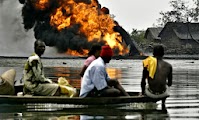
Boko Haram is fighting (and winning)

Nigeria is set to be the king of Africa (over-taking South Africa) but it is also in deep trouble. Boko Haram has gained enough strength whereby security forces are not able to keep up. A full scale war is raging and 1300 people are dead in 2 months. This misery is only exceeded by the hell fires burning in Syria. All in all a good run for Al Qaeda in its myriad forms.  

It bears repeating: if all these battles join up into a world war of sorts, it will be a royal mess with all big powers (including China) on one side of the fence. The islamic communities in the border regions will likely be devastated (people will not care much about what goes on in the hinter lands).


Matazu, 29, survived the double bomb blast earlier this month in Maiduguri, north-east Nigeria, that killed about 45 people and destroyed seven buildings. It was the latest blow by the terrorist group Boko Haram to shake the foundations of Africa’s most populous state.

Boko
Haram is believed to be responsible for killing at least 1,300 people
in the past two months and more than 130 people in the past week. The radical sect claims ties to al-Qaida and has ambitions to impose sharia law
on Nigeria’s 170 million people. In Boko Haram’s heartland, even the
national military is outgunned in what is fast becoming a lesson to the
world in how not to tackle an Islamist insurgency.

“What is clear
is that they are as ruthless as any Islamist group or terrorists
anywhere in the world,” said Antony Goldman, a west Africa risk analyst
at London-based PM Consulting. “They’re quite happy to hit soft targets,
including schools. Some in the Nigerian administration expect this to be a problem for another 10 years.”

In
some ways, the paradox of Nigeria in 2014 captures that of Africa
itself. The continent has enjoyed a decade of economic growth and the
phrase “Africa rising” has become widespread among investors and
journalists.
Yet at the same time the past six months have seen
conflicts erupt in the Central African Republic and South Sudan, while
economic growth has gone hand in hand with deepening inequality.

So
it is with Nigeria which, with oil wealth and a decade of annual growth
around 7%, is set to overtake South Africa as Africa’s biggest economy,
with a value close to $400bn.
It has been anointed one of the “Mint” emerging economies – along with Mexico, Indonesia and Turkey – by economist Jim O’Neill. Nigerians drink more champagne than Russians do.

For centuries, the region enjoyed the fruits
of Islamic civilisation. Then in the early 19th century its sultanates
succumbed to a jihad by Shehu Usuman Dan Fodio, who created a unified
caliphate that was the biggest pre-colonial state in Africa, ruling
swaths of what is now northern Nigeria, Niger and southern Cameroon.
It
had a strict interpretation of Islam and a culture of scholarship and
poetry. 

Northern
Nigeria did not escape the expansion of the British empire into Africa
and was conquered in 1903. Since then, there has been resistance to
western education, with many Muslim families refusing to send their
children to government-run “western schools”.
Shehu Sani, a human rights activist and author of Boko Haram: History, Ideas And Revolt,
said: “The north fought the British colonisers because they thought
they were bringing in western ideas and this would erode Islamic values
and erode their culture. 


The north-east
remained a centre of Islamic learning for children from all over Nigeria
and west Africa, Sani said. Its madrasas did not necessarily encourage
extremism but did shape the founders of Boko Haram, who embraced the
Qur’anic phrase: “Anyone who is not governed by what Allah has revealed
is among the transgressors.”


Some believe the trigger for the
group’s inception was a gubernatorial election campaign in Borno state,
when an opposition candidate organised a militia known as Ecomog, after
the east African intervention force deployed in Sierra Leone and Liberia
in the 1990s. Following the election, the candidate disbanded Ecomog
but did nothing to look after its members.

One of the militia’s
leaders, Mohammed Yusuf, was able to exploit the frustration and
disappointment and blend it with an Islamist agenda that rejected the
failings of secular government to form Jama’atu Ahlis Sunna Lidda’awati
wal-Jihad, People Committed to the Propagation of the Prophet’s
Teachings and Jihad. In the north-eastern city of Maiduguri, where
the sect had its headquarters, it was dubbed Boko Haram. Loosely
translated from the Hausa language, this means “western education is
forbidden”. 

Like
so many self-appointed rebels and revolutionaries, Yusuf was not poor.
He was said to be well-educated and to drive a Mercedes. In an interview with the BBC,
he set out the group’s anti-science philosophy: “Prominent Islamic
preachers have seen and understood that the present western-style
education is mixed with issues that run contrary to our beliefs in
Islam. Like rain. We believe it is a creation of God rather than an
evaporation caused by the sun that condenses and becomes rain. Like
saying the world is a sphere. If it runs contrary to the teachings of
Allah, we reject it. We reject the theory of Darwinism.”

Yusuf set
up a religious complex, which included a mosque and an Islamic school
that attracted many poor Muslim families. In 2009 Boko Haram attacked
several police stations and other official buildings in Maiduguri. The
Nigerian security forces hit back and more than 1,000 people died, not
all of them Boko Haram supporters. Yusuf was captured and killed, his
body shown on television. Boko Haram was finished.

But its
fighters regrouped under a new leader. In 2010 it attacked a prison in
Bauchi state, freeing hundreds of its supporters, and carried out deadly
bombings in Jos and military barracks in the Nigerian capital, Abuja.
Its main modus operandi was to deploy gunmen on motorbikes to kill
police, politicians and other opponents. Since then, the waves of
shootings and bombings have continued and, according to the Council on
Foreign Relations, Boko Haram is responsible for nearly 3,800 deaths
since May 2011.
The group has sworn allegiance to al-Qaida and, Sani
says, some of its members have fought in Somalia and Sudan, but a formal
link “cannot be independently confirmed”.

If anything, Boko
Haram has intensified its operations of late, including an attack that
saw 43 students shot and hacked to death and many girls kidnapped. In
response, the government closed five schools considered to be in “high
security risk areas”.

Some Nigerians who feel let down by
the government are taking the fight on themselves. Zakari Matazu,
survivor of the double bombing in Maiduguri, belongs to a youth
vigilante group in Borno state popularly known as the Civilian Joint
Task Force (CJTF). “Now Boko Haram are attacking everywhere because they
are strong – even stronger than the soldiers,” he said. “I am a CJTF
but I now know that Boko Haram can decide to attack and capture the town
of Maiduguri any time. Everybody knows that. The federal government has
abandoned us to be killed by Boko Haram.
All the people in the villages
have fled to Maiduguri, so if Boko Haram does not see people killed in
the villages, they will come to the city.”

Last month Boko Haram
threatened to strike farther afield, with potentially catastrophic
consequences for the economy. Its leader, Abubakar Shekau, threatened
attacks on oil refineries in the mainly Christian south, saying in a
video: “Niger delta, you are in trouble.” but few analysts believe the group poses an existential threat to Nigeria.


Those
on the frontline are living in a parallel universe to the champagne
parties in Nigeria’s big cities. “We are in a state of war,” Kashim
Shettima, the governor of Borno state, said recently in a plea to the president. “Boko Haram are better armed and better motivated than our own troops. It is impossible for us to defeat the Boko Haram.”

regards

HM and TTP – brothers (dis) united

No doubting the common bonds of religion, culture and most everything, however the goals are not aligned (the goal-posts have shifted) and even the playing fields have changed, all of this is causing unnecessary pain and heartburn amidst the brotherhood.

It is not even that one person’s terrorist is another person’s freedom fighter, it is one brother (freedom fighter) is denouncing the other brother’s actions as “anti-islam”. But why? HM is involved in a nationalist struggle (against Hindu dominated India) while TTP is engaged in a trans-nationalist struggle (against the secular state and for establishing Sharia). These objectives are at cross purposes only if an independent Kashmir plans to govern in secular prose and forswearing Sharia poetry. Someone (perhaps Arundhati Roy) should ask HM to clarify this point. It will be nice of her to remove all confusion, re-unite the brothers and get rid of the pain.

Upset by media reports linking a ‘militant commander’ from a tribal
area with it, the largest fighter group in India-held Kashmir, Hizbul
Mujahideen (HM), on Tuesday deplored what it termed an attempt to
tarnish its image. “Attempts to affiliate someone claiming responsibility for bomb
blasts in Pakistan with Hizbul Mujahideen to dent its credibility are
upsetting and painful,” said the group in a brief statement issued here,
in a reference to Major Mast Gul, alias Haroon Khan.

An earlier statement of the group mentioned Mr Gul by name, while
recalling that he had quit Hizbul Mujahideen before 2001. However, in a
revised statement, his name was taken off.
A section of the media had introduced Mr Gul as a Hizbul Mujahideen commander after he resurfaced in Miramshah early this month.

The Kashmiri fighter group made it clear that it deemed any militant
activity within Pakistan “nefarious and against the tenets of Islam”. 

“Hizbul Mujahideen is an indigenous freedom fighter group of
India-held Jammu and Kashmir and it is also a historical fact that the
Kashmiris hold Pakistan dearer than their lives,” it said….It paid tribute to the leadership and public of Pakistan for their
deep concern and moral, diplomatic and political support for the cause
of struggling Kashmiris. “Kashmiri people and fighters are also
prayerful for the safety of the people of Pakistan and stability of
their country.”


regards

SAsia (mostly India) and the USA


Pakistan is a major non-NATO ally of the USA and managing that relationship will
be in the best interests of the USA in order to ensure a smooth passage out of
Afghanistan (not to mention the real motivation/fear: Taliban will capture the
nuclear complex). Accordingly today we have the announcement that $280 million in military aid and $446 million in civilian aid (reduced from $703 million in 2013) will be directed to Islamabad for 2014 (this information is as per Times of India, Dawn confirms $280M mil budget but states $720M for civilian aid). The announcement from the US State Department (excerpt below) is curiously worded to say the least (suggesting perhaps that the lower amount of civilian aid will help improve US-India relations).

“The
OCO (Overseas Contingency Operations) resources will support critical US
activities such as sustaining close cooperation with Pakistan, ensuring
the safety of Pakistani nuclear installations, working with Pakistan to
facilitate the peace process in Afghanistan, and promoting improved
relations with India,
” the State Department said as it proposed USD 446
million in civilian aid to Pakistan.

Sri Lanka and Nepal are probably too deep in China’s embrace.
The dark horse is Bangladesh and how long the Hasina govt is expected to
survive (perhaps with Indian backing), the
opposition BNP won 43-34 in the local elections held in February.

The Election Commission has just announced the schedule for the Lok Sabha polls- April 7 to May 12 in nine phases over 34 days. India (right now) is very much in a cold embrace with the USA, perhaps because (a) it has
proven difficult to mobilize India against China and (b) due to lack of faith in the present regime. The question of interest is how regime change will help improve market access for US companies (unlikely, all
parties against FDI in retail for example). Even if NaMo wins, there may be a
tilt towards China and (depending on how the west reacts to his rise) a frozen relationship
with the USA.

Japan, China and Korea (and perhaps France and old-timer Russia) will
IMO outpace USA both in the commercial and government sectors. The
real bottle-neck is infrastructure development, right now the Japanese are involved
in building the transport corridors.
 The
Chinese have expressed interest as well (30% of total!!! what do they want
in return???).
 Regardless of all the
sweet
talking editorials
(see excerpt below) the USA is not proposing to sign up
for any such initiative. There lies a hope that the hammer blow on IT exports will be softened (unlikely). There are in addition a number of other trade fights looming on patents (see below) and solar PV installations. Finally, Hillary
is rumored to having a soft spot for India
so the next administration may be
more receptive to Indian concerns (but still no special relationship).

Our
successes are significant:
a
nearly fivefold expansion of US-India trade between 2000-12 to reach almost
$100 billion, a thriving defence relationship that is founded on a common
strategic vision and a commitment to expand our partnership across most fields
of human endeavour — from education to innovation, intelligence sharing to
counterterrorism, space collaboration to energy cooperation — including in
areas that once seemed impossible given where our relations were just a few
short years ago……It is becoming widely accepted that our
converging interests will shape Indo-Pacific strategic and economic geography,
and with it the future of the 21st century and half the world’s population that
call this region home.

all this sweet music composed by Neha Biswal above to be contrasted with the grim reality below

US
drug companies complain that India has rejected patents for some
blockbuster drugs (like Novartis’ Gleevec), while issuing a compulsory
licence (which ignores patent rights) for Bayer’s anti-cancer drug. They
say India is flouting established norms on intellectual property rights
(IPR), cheating patent owners of billions, and conferring a bonanza on
Indian producers of cheap substitutes (generic drugs). US companies want
the US International Trade Commission to investigate India’s treatment
of IPR, and recommend sanctions (under Section 301 of US trade laws) if
required
…..Few countries stand up to the threat of US sanctions :
the costs typically exceed the benefits. But India has refused to
co-operate even in a USITC visit to New Delhi, saying its bureaucrats
are too busy with other things. India has told the US that WTO rules
provide for all members to settle patent disputes through that body, not
through unilateral action.
India is confident that its IPR rules are
WTO compliant. For that very reason, the US has avoided WTO, and is
attempting bilateral pressure instead.  

Silver Lining: Indian
companies claim to have invested 11 billion dollars in the USA and created 100k
jobs.
If true this is quite promising. Indian (private sector) lobbying is also ramping up (but still small) and may
be in the long run more effective in managing the relationship than any govt
initiated lobbying.

One trend that is expected to continue
is the induction of more and more Indian Origin Persons (IOP) to the royal
court.
All appointments are (a bit) political in nature, the above may then reflect
favorably on the persuasion powers (aka fund-raising skills) of the
Indian-American lobby. This is certainly a good thing (in and of itself) but the I-A lobby may find itself to be a divided house re: NaMo (reflecting divisions within expat Indians).

Top
IOPs in Obama administration (total now exceeds 50): 
Rajiv Shah (administrator
of USAID), Nisha Desai Biswal (assistant secretary of State for South Asian
Affairs), Azita Raji (member, President’s Commission on White House
Fellowship), Islam Siddiqui (chief agricultural negotiator, US trade
representative), Vinai Thummalapally (executive director, Select USA,
department of commerce), Vivek Murthy (surgeon general). Awaiting appointments:
Arun Kumar (assistant secretary of commerce and director general of the US and
Foreign Commercial Service) and Puneet Talwar (assistant secretary of state for
Political- Military Affairs). If
confirmations proceed as expected, two assistant secretary of state positions
at the state department would be held by Indian-Americans.

regards

The (unsung) mutiny (1946)

A 94 year old recounts his vivid memories of those momentous events 68 years ago when the soldiers raised by the British to keep their own countrymen in chains finally revolted and (as the British saw it) the empire game was suddenly up. As a shameful and terrible consequence the mutineers were never employed by either Indian or Pakistan Navy. As they say, a good act never goes unpunished.

It’s difficult to recall a day 68 years ago when you are 94. But the
RIN mutiny, which many believe was the last nail in the Raj’s coffin,
wasn’t just any other day. And I happened to be a proximate eyewitness
to this momentous event. 

On February 18, 1946, ratings at the HMIS
Talwar, a shore establishment for signals training, went on strike,
protesting against the inedible meals and searing insults to which they
were regularly subjected.
The revolt spread like wildfire. Some
mutineers took up arms; others took to the streets of Bombay. Ratings
famously pulled down the Union Jack on rebel ships, replacing it with
flags of the Congress, the Muslim League and the Communist Party of
India.


Unlike the sepoys of 1857, who were a heterogeneous group, the RIN
ratings were by and large educated, well-trained and well-armed.
The
British adm­i­nis­tration was not so much perturbed by the peaceful
civil disobedience movement (satyagraha) launched by Maha­tma Gan­dhi as
by the spectre of an insur­rection in the modern Indian armed forces,
which they had themselves trained.

Later that evening, I went to Apollo Bunder—the Gateway of India.
Everything was quiet. Thereafter, I was taken by some friends to the
flat of one of the activist supporters of the mutiny. I learnt that the
morning’s event I witnessed was but a small part of a well-orchestrated
chain of strikes and demonstrations. No wonder the British government
was rattled.  

By February 22, the mutiny had spread to naval units across
the country. Some 20,000 sailors, 20 offshore establishments and over
70 ships are believed to have been involved. That British prime minister
Clement Attlee announced the Cabinet Mission to India just a day after
the mutiny erupted is testimony to the mutiny’s perceived threat.


The revolt was as spectacular as it was short-lived. Nei­ther the
Congress nor the Muslim League supported it; the strike committee
surrendered after talks with Vallabhbhai Patel. Hundreds of mutineers
were jailed or dismissed, never to be reabsorbed by the armed forces of
independent India or Pakistan. Never were the ratings celebrated as
heroes.


Within a year and a half of that day, India became free and the RIN
became the Indian navy. On the day of independence, I was with my
wife-to-be on a little hillock called Antop Hill. Suddenly, the sky lit
up with fireworks and I knew we had become free.
I owned a small car, a
dkw two-seater. It had seen many owners, and wouldn’t start without
pushing. That day, I had kept it on the slope of the hill so it would
start easily. My wife and I jumped into the car, which dutifully rolled
down the hill. Jubilant, we drove to Marine Drive and joined the stream
of cars going to the secretariat. 

regards

Crimean War part II

It has been a long time since the last Crimean war (1850s) which was (for the main) triggered by France and Britain in order to prevent Russia from gaining power in the Mediterranean (ref. wiki). The muslim Ottoman empire was in the alliance against the orthodox christian Russian empire. There was the memorable Charge of the Light Brigade. There were the Caucasian campaigns, the Baltic and even the Pacific ones. Russia lost the war and the rights to keep a naval fleet at Sevastopol.

Since history repeats in funny ways, Russia is standing up for Syria and now will send troops to Crimea to protect Russian naval interests. The EU, USA and the sovereign state of Ukraine is in opposition. The muslim Tatars in Crimea are expected to resist the Russian transplants (Tatars were evicted from Crimea by force during the Soviet era). These are truly good times to fight another war.

Russia’s upper house of parliament on
Saturday approved a proposal by President Vladimir Putin to deploy Russian
armed forces in Ukraine’s Crimea region. The Federation Council voted
overwhelmingly to back a proposal to use “the armed forces of the Russian
Federation on the territory of Ukraine until the normalisation of the
socio-political situation in that country.” It said the decision took
effect immediately.

Ukraine accused Russia of sending thousands of extra troops to Crimea, largely
hostile to the Kiev government which emerged from the overthrow of
president Viktor Yanukovich last weekend. It placed its military in
the area on high alert.


regards

Playing fields of Peshawar

If the T-emirate were to rule over eastern Afghanistan and north-western Pakistan, Peshawar would probably qualify as the capital. Right now as North Waziristan and Khyber Agencies explode in violence, the extremists remain focused. It is instructive to watch the heroes of battlefield Kashmir now targeting Iranian interests, perhaps the thinking is that battles inside Pakistan are more worthy than the battles outside. That said the Chaudhury Nisar offer must not be dismissed lightly (even though the Taliban themselves are sceptical), one must give peace a (sporting) chance.

A spokesman for militant commander Mast Gul, once acclaimed in Pakistan for his role fighting Indian rule in Kashmir, has claimed
responsibility of a suicide attack at Iranian consulate in Peshawar
which killed two paramilitary soldiers and wounded ten others on Monday.

“We sent a suicide bomber to target the Iranian consulate and Iranians inside the building,” the spokesman told Reuters. “They unfortunately remained safe. We will continue to target Iranian
installations and the Shia community everywhere,” he added.

With talks on a sticky wicket, the interior minister said Monday that cricket could offer hope.

“I have information that the Taliban keep an interest in cricket. So
if this message can go through to them, we can have a cricket match with
them which can have a better result,” he told reporters in Islamabad
following an exhibition game. “The Taliban follow the Pakistan cricket team with keen interest so this can be a platform.”


But speaking to AFP by telephone from an undisclosed location,
Taliban spokesman Shahidullah Shahid said his group would refuse to play
ball. “These secular people want to distance our youth from jihad and
Islamic teachings through cricket. We are strongly against cricket and
dislike it,” he said.

regards

Taking on the TTP, part X

Embedded image permalink

Postscript: I have had a lot of comments from friends on this piece and here is a summary:
1. The deep state has a coherent Afghan policy that requires maintaining Jihadi proxies. That show is still the main show. This farce will go on and the deep state probably doesnt mind the fact that it will go on. 
2. The deep state has already launched an anti-taliban operation, but not yet in Waziristan. Still, its coming. 
3. More of the same. Nothing new has happened, nothing new is about to happen. 
4. The proverbial shit has already hit the fan. Pakistan is beyond the point of no return. 
And so on.
Take your pick. I have no inside info. Every theory falls apart as you pursue it some distance (some fall apart before the pursuit starts. Alas, the left has left the building 😉 ). 

Maybe nobody is in control, but Saudi Arabia, Amrika and GHQ all think they know what they are doing and all think they are about to make monkeys of everyone else.  With that cheery thought in mind, read on..

Apparently the army is about to do something or the other against some group or the other in North Waziristan. This is big news because North Waziristan has been off limits to “operations” for years, with various jihadi groups living, training and carousing in the region with nothing to fear except the occasional drone attack. If the operation goes ahead, this may cause the TTP (the main Pakistani Taliban group) to conduct revenge operations even in the safe zones of Punjab, which may cause real anxiety in real Pakistan.

Aware of the possibility of a coming operation and being serious players, the TTP has wasted no time taking the initiative. They have made monkeys of Mian Nawaz Sharif and Chodhri Nisar  and completely hijacked their idiotic “talks” gambit. It is likely that the “talks” were always meant to be a farce, and MNS and company thought this was just a good way to expose the bloodthirsty Taliban and their civilian supporters (like the PTI and the Jamat e Islami) before the serious business of killing starts and the inevitable blowback causes the Punjabi people to look around for a scapegoat. If so, the gambit has failed spectacularly. The TTP proved cleverer and more capable than the government of Pakistan and announced their own farcical committee to hold negotiations with Nawaz Sharif’s farcical committee while their brothers continued to knock off opponents and spread terror. It has been a brilliant performance, nicely cataloged here by Ayaz Amir. 

But a bloodier phase may start soon. 50,000 Pakistanis have already died and more (unfortunately) are going to pay the price in the days to come. It probably didnt have to be this bad. More efficient ways of terminating (betraying) the Jihad experiment were possible, mostly involving cleverly cooperating with the US, India and China, but sometimes elites dont know what side they are on. Even though Pakistan’s rulers were never going to set up some Jihadi North Korea and wave the Juche flag, they couldnt bring themselves to bite the bullet and 12 years of waffling have certainly raised the casualty count and made the next phase more painful that it had to be.

But these are mere details. Since even birather China wants the Jihadi safe havens terminated with maximum prejudice, its gonna happen, one way or the other. Liberals should keep their heads down and occasionally protest the human rights abuses to come. The rest is not up to them…
The story line remains a problem though. All the indications are that operation is going to rely on the CIA-RAW conspiracy template to justify the action. This, coupled with the presence of Imran Khan and media Taliban (like Orya Maqbool and Ansar Abbasis) is going to confuse the narrative in so many ways, its hard to even describe it. The confusion is so bad, our well armed elite may end up losing the war just because it didn’t have a good enough story to fit the war.
500,000 man army, 200 nuclear weapons, 3000 tanks…but no story that can hold it all together.
Pakistan remains sui generis.
See what our tax rupees are paying for:

The Taliban meanwhile are sending some messages of their own:


So, the Taliban brought headless (freshly killed, blood soaked) bodies in an open pickup truck and dumped them on a “government controlled” road in Mohmand and filmed the scene…for 11 minutes. You can watch the video if you are up to it. I know there are bigger problems in Pakistan, but from here this seems vaguely disturbing

Baloch terrorism?

A train has been derailed by a bomb in Southern Pakistan and it seems the Baloch Republican Army may have claimed responsibility (I am relying on twitter here, I have not yet seen a formal claim of responsibility, but it is certainly a strong possibility given that there have been earlier train attacks claimed by Baloch separatists). Several children are among those killed and children have died in almost every train bombing to date. This has started the usual back and forth about terrorism as a tactic and someone mentioned the inevitable “terrorism is the weapon of the weak”.  

My first thoughts, and I hope others will step in with informed comments: 
If the BRA is responsible, then they are being very self-defeating here. It is a Pakistani myth that terrorism is the weapon of the weak. It may be a weapon sometimes used by the weak, but it has never gotten them very far on its own. From Palestine to Chechnya to Kashmir to Balochistan…it just makes the strong more easily justify their oppression. Terrorists like TTP are winning because they have inside support, they have a more coherent narrative than their enemies, they have strong (minority) ideological support throughout Pakistan and above all  because they are STRONG enough to beat up the so-called army and get away with it. 
The Baloch are not that strong. They will only increase their own suffering. Armed struggle is not an end in itself, it is a tactic. Like all tactics it has to form part of some greater whole. If sensibly applied, it can be critically important. If not, its just so much more pain and suffering with nothing to show for it…or it makes things worse. This is just sad.

Some quick additional points (just because I know from experience that they will come up):
1. I am not discussing the morality of terrorism (I personally believe deliberately targeting innocents is ALWAYS morally wrong, but that is not my point here). 
2. Can it sometimes work? Sure it can. There is no universal umpire making sure such things never work.  As part of some larger effort, where some clever and ruthless leaders are using the careful application of terror as one element in a larger strategy it can (unfortunately) be part of a winning effort. But not by itself. In this case there is no well defined and united Baloch leadership out there, who may be using these attacks as well defined parts of a larger effort.  A Baloch Lenin or Mao (or even a Baloch Molvi Fazlullah) could use terrorism as one part of a larger, well thought-out effort. A Baloch group that just blows up stuff here and there is only getting more innocents killed. 
3. Could Balochistan see a more serious and more dangerous (and potentially successful) liberation struggle in the days to come? It could, mainly because the people oppressing them are so good at scoring own goals and messing things up. Even so, it seems unlikely to succeed unless an outside power (aka the United States) makes (or is making) a VERY serious effort to make this happen. Otherwise, this struggle can go on for a long time, but it wont lead to successful secession. 
A Gandhian approach will not necessarily work either, but may be a better bet. It could conceivably co-exist with a relatively narrowly targeted armed insurgency, but not with one that uses indiscriminate terrorism…the state will simply use the terrorism as justification to wrap up the non-violent side and nobody will be able to stop them; “civil society” and international pressure will be blunted by the existence of terrorism….. and.the terrorists will not be able to help their civilian sympathizers because a bit of terrorism here and there is all they have, unlike the TTP, who can turn it on and off and negotiate concessions for their front organizations using calibrated and credible threats. 
 

GHQ Response to Taliban Demands

The TTP (Pakistani Taliban) has issued a list of 15 demands in the course of the farcical Taliban1 versus Taliban2 “negotiations” currently being used to keep ppl busy till the next operation in Pakistan.
In response, Mr Imtiaz Mahmood has issued a set of 15 demands that GHQ would have issued if it was not participating/directing/watching this insane farce.

15 point response to Taliban’s demands, should be as follows if Pakistan army had any balls, but we all know that they are deficient in that department:


1. Surrender. 
2. Face trial for your crimes against the state
3. Compensate your victims under Qisas and Diyat. 
4. Apologize to the entire world especially Pakistanis.
5. Deposit your weapons with the Pakistan Army
6. Name your handlers both in Pakistan and abroad
7. Rebuild all the schools you blew up.
8. Rebuild all the mosques, churches and Sikh Gurduwaras you blew up.
9. Confess to being child molesters and rapists.
10. Deposit all your funds in the state treasury so that these can be used to build girls schools in your area.
11. Admit that what you did was un-Islamic and against Shariat.
12. Repent
13. Take a shower.
14. Agree to voluntary castration.
15. Make a Gangam Style rendition video in FATA with Pakistani and US soldiers.

(function(d, s, id) { var js, fjs = d.getElementsByTagName(s)[0]; if (d.getElementById(id)) return; js = d.createElement(s); js.id = id; js.src = “//connect.facebook.net/en_US/all.js#xfbml=1”; fjs.parentNode.insertBefore(js, fjs); }(document, ‘script’, ‘facebook-jssdk’));

Brown Pundits