Is Kabir Right?

Kabir’s claim, is that much of the Saffroniate comes to Brown Pundits for one purpose: to litigate Pakistan, and to litigate the Muslim. Take that fixture away and the room goes quiet. The post on Hindustani classical music sinks without a ripple. The translated short story draws three comments and dies. Only the threads that arm the two camps against each other run to hundred+.

Is he right?

Continue reading Is Kabir Right?

REPOST: On identifying as a liberal

Old post – Reproduced;

My views and politics has changed in last 5 years and i would write a follow-up to this in a week or so. Just thought i would share this in light of recent traffic and comments on this blog.


This blog post was triggered by a Twitter exchange with Akshay Alladi where he questioned why I identify with the label liberal. A lot of people have – on this blog as well as on Twitter or in person have labeled me a Hindutva liberal or closet Sanghi (from the left) or a Hindutva rebel, yet I personally don’t feel comfortable with those labels. Maybe it is positive tribalism on the Saffron side or parochial wokism on the left.

Akshay also referred to me in his blogpost about Liberalism vs Conservatism and I promised I would also come up with an elucidation of my position. Before I go into attempts at formulating my position, a fair warning – I am not a particularly deep thinker on matters of philosophy and do not have an intellectual bent. I get bored with long essays and books about philosophy and religion, it’s the interactions of these abstract ideas with politics, people, and histories (as an art/science) that interests me than the ideas themselves.

It is fair to get some personal biases (which may appear contradictory) I hold out of the way

  • I am a staunch Republican and Secularist. In my early twenties years, I was more partial towards the Laicite as I grow old I become more partial towards the British or American style of secularism. (Though the recent events in France have made me reconsider my position).
  • I have had a very low opinion of Religions in the 21st century in general and Monotheisms in particular.
  • I have some sympathies with Savarkarite Hindutva (not RSS) and I have often been accused of being a closet Sanghi by leftists.
  • Though I think of myself as a patriot who is well aware of British exploitation of India, I am an Anglophile. I adore the Brits with their language, literature, culture, models of governance (Westminster model). I don’t have shame in saying “Anglo West is the best”.

I would like to explain my identification with liberalism in three progressive strains.

Roots and Personality:

Continue reading REPOST: On identifying as a liberal

India That Is Bharat: The Exceptional Uniqueness and the Dual Identity

This is a Brown Pundits Precedent Post.


We have been asked, repeatedly and in good faith, why Brown Pundits appears to handle criticism of India with more care than it handles criticism of Pakistan. The charge is that we hold a double standard. It deserves a direct answer.

The answer is that we do hold a distinction, and we are not embarrassed by it, but it is not the distinction the charge assumes.

The Distinction

Pakistan is roughly seventy-nine years old as a sovereign state. India as a sovereign state is roughly seventy-nine years old as well. As nation-states under international law, as signatories to the United Nations, as entities with currencies and armies and foreign ministries, the two are pari passu. We treat them that way and we will continue to treat them that way. On every question that applies to nation-states as nation-states, the two sit at the same table and get the same scrutiny.

But India is not only a nation-state. India is also a civilisation, and the civilisation is not seventy-nine years old. The civilisation is, give or take the archaeological argument one prefers to have, somewhere around five thousand years old. It stretches from the Indus Valley through the Dravidian-Aryan synthesis, through the Vedic period, through the great classical flowering, through the medieval syntheses, through the colonial rupture, and into the present. One can argue the exact nature of the continuity. One cannot plausibly argue that the continuity is not there. It is there in the same way it is there for China. It is there in the same way it is there for Egypt. It is there.

This is not a claim about superiority. It is a claim about category. Pakistan is a sovereign state. India is a sovereign state and a civilisation. The two facts do not cancel. They coexist.

The Civilisational Peer Group Is Short

How short is short. At the level of a nation-state that is co-terminus with a multi-millennial civilisation, the peer group is essentially India and China. Two entries. Iran and Egypt have the civilisational depth but have been transformed by the Greco-Arab conquest, in an unalterable fashion. Greece has the civilisational depth but the modern Greek state is a nineteenth-century construction with limited political continuity to the ancient polis; the Ottoman interlude was equally determinative. Israel is a unique case and we will come to it.

That leaves India and China. Two countries on the planet where the nation-state is also the civilisation, where the sovereign political entity today is a recognisable continuation of the same cultural-linguistic-religious matrix that produced its earliest texts, and where the ordinary citizen, with some education, can read something written two or three thousand years ago in a language that is still a living vehicle of the culture.

That is not a small claim. It is also not a nationalist claim. It is simply a descriptive one.

The Indian Exception Continue reading India That Is Bharat: The Exceptional Uniqueness and the Dual Identity

Open Thread + A Note on Standards

Brown Pundits has always been a forum for the kind of thinking that most outlets are too timid or too tribal to publish. We intend to keep it that way. But that standard cuts both ways, and we are raising it.

Effective immediately, the moderation policy is zero tolerance.

This is not a crackdown on opinion. We welcome disagreement; sharp, even uncomfortable disagreement. What we will no longer tolerate is noise dressed up as insight.

What does noise look like? You know it when you read it. It is the rattling of nuclear talking points that have not been updated since 1998. It is the reduction of a civilisation of 220 million people, or of a billion-and-a-half, to a single variable: the Crescent, or the Saffron. It is venom without weight, and venting without argument.

Pakistan is complex. India is complex. Every human society is, at its foundation, irreducibly complex.

Any comment that treats either as otherwise will be moderated; sometimes publicly, sometimes silently. We apply the sniff test: does it smell right, given the context? Given how tight our Editorship and Commentariat is, we will be judicious, as we have always been; for instance the Precedent post on the controversial Dhuruandar sequel remains Gaurav Lele’s.

This applies to both sides of every line we cover; geographical, civilisational, sectarian, or political.

We are not asking for bookishness. We are not asking for academic caution or diplomatic hedging. We are asking for the one thing that separates a pundit from a troll: considered thought. If you are going to cast aspersions, earn them. Make the case. Bring the weight. If you cannot, do not post.

We have a large and growing commentariat. That is something to be proud of. It is also a responsibility; to each other, and to the readers who come here because they expect better than what they can find elsewhere.

We expect better. We will enforce it.

Thank you for your attention to this matter.

— The Editors, Brown Pundits Continue reading Open Thread + A Note on Standards

Were You Colonised or Not? The UN Slavery Vote That Split the World

West vs the Rest

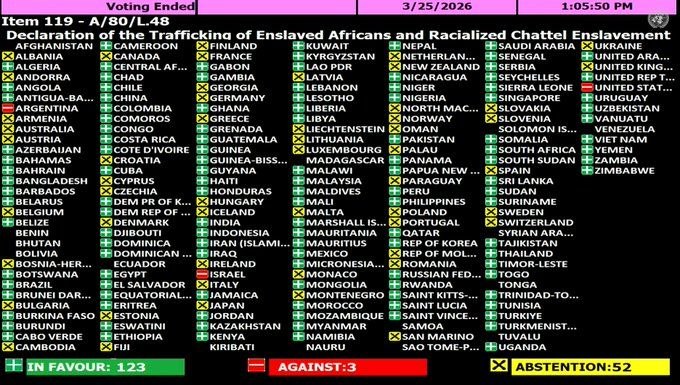
Today’s UNGA vote, 123 for, 3 against, 52 abstentions, is a clean ledger of where the world stands. The resolution declares the transatlantic slave trade “the gravest crime against humanity.” Three countries voted against: the United States, Israel, and Argentina.  The UK and all 27 EU members abstained.

The 52 abstentions are the more revealing column. The EU’s stated objection was legal: calling this the “gravest” crime implies a hierarchy among atrocity crimes, which has no basis in international law. That’s a defensible position. It’s also a convenient one for countries that ran the trade.

The US was blunter; its representative objected to the “cynical usage of historical wrongs as a leverage point to reallocate modern resources.” At least that’s honest about what reparations actually means in practice.

The UN is essentially asking whether countries whether they were colonised or not?

The 123 is the story. This isn’t Russia and China championing the Global South; it’s Africa, the Caribbean, and most of Asia doing it themselves. This marks the first floor vote at the UN specifically on transatlantic slavery as a crime, and a call for reparations.

The resolution is non-binding, so nothing material changes today. But the vote is a data point: on a question of historical accountability, the West is either against or abstaining, and everyone else is not.

That’s the fault line. West vs the Rest; and the Rest has the numbers. Gaza, Russia, Iran: all proxies for the same fracture. Russia ran an empire, but its Soviet collapse was so total it no longer reads as imperial. China likewise. So both get to stand on the other side of the line.

And underneath the EU’s legal objection, the “hierarchy of crimes” argument, is something unspoken: the Holocaust has long held the position of singular atrocity in Western moral architecture. This resolution is, implicitly, a challenge to that. The Rest is saying: your crime towards us was graver, or at least as grave. Europe couldn’t vote yes without conceding the point.

Dhurandhar 2: When the Villain Disappears, So Does the Film

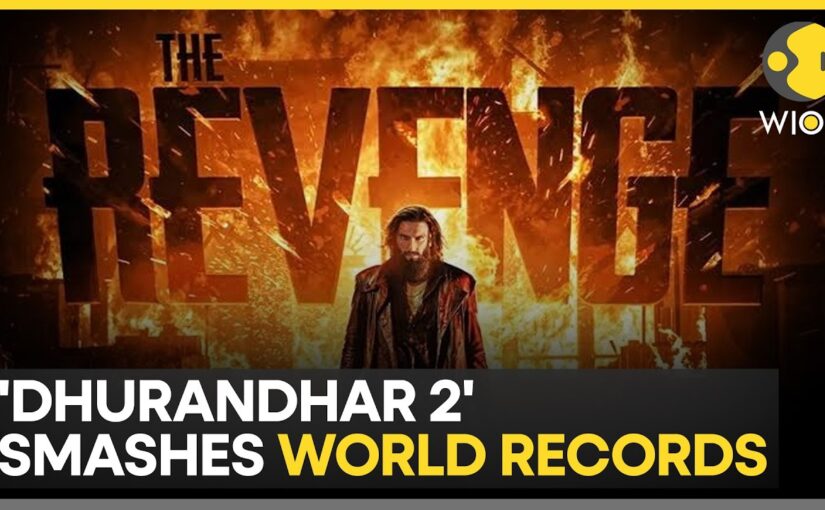
We wrote in December that Dhurandhar perfected Bollywood’s new formula: the fetishisation of Pakistan as the subcontinent’s most glamorous disaster. Dangerous, broken, desirable, and always in reach. Three months later, the world has changed more than the franchise has. Iran has seized the Strait of Hormuz. Pakistan is psychologically vacating South Asia. And Dhurandhar 2 arrives as a cinematic relic of a paradigm already dissolving.

It is not good.

The first film worked because the villain was the gravitational centre. Akshaye Khanna’s Rehman Dakait, Baloch, charismatic, smouldering, made Ranveer Singh’s Hamza credible by giving him something worth the deception. A spy story lives or dies by its antagonist. Remove the antagonist, and you don’t get a hero. You get a man punching air for four hours. That is Dhurandhar 2. Angrier, louder, emptier; and at 3 hours 55 minutes, a film that confuses scale with depth.

The structural collapse is ideological as much as narrative. Dhurandhar 1 had grey. Hamza was a man genuinely lost between two worlds; the film understood that proximity to Pakistan produces desire, not only contempt. That complexity, that slippage between intimacy and danger, was what made it aesthetically serious. Dhurandhar 2 closes that gap entirely. The Pakistani Muslim is now simply a target, and the film is at pains to multiply them faster than they can be eliminated. This is the Hydra error; the same mistake Mossad has made in Gaza. Cut off the head and ten more appear, until the only logical conclusion the audience is being nudged toward is collective punishment. You cannot make a film that glorifies this logic and then claim it is merely entertainment.

The Hindutva-Zionism convergence is now visible at the level of cinematic grammar. Both traditions have arrived at the same endpoint: the innocents cannot be separated from the combatants, therefore the innocents must go too. It is a short distance from that premise to a football scene with a severed head, which Dhurandhar 2 includes without irony. This is not complexity. This is an audience being educated to hate, and that is far more dangerous than any amount of bad plotting.

Bollywood has always used Pakistan as its erotic shadow; familiar enough to feel intimate, foreign enough to feel forbidden. That formula depended on the Pakistani figure retaining some glamour, some interiority, some capacity to make the Indian hero sweat. Dhurandhar 2 strips all of that away. What remains is a shooting gallery. The irony is that by dehumanising its villains, the film also destroys its hero. Hamza becomes less interesting the more Pakistan becomes merely a backdrop for his competence.

The music, which in the first film gave us a Persian Gulf aesthetic that became genuinely anthemic, is a significant step down. The background score intrudes rather than elevates. And Ranveer Singh, who is a serious actor, is given a character arc built almost entirely around rage; which is a waste of an instrument that can do much more.

There is a deeper geopolitical irony the filmmakers did not intend. Dhurandhar 2 is a film about Indian dominance of the AfPak axis at precisely the moment that axis is reorienting toward Iran. Pakistan is stepping into its role as a Muslim power, mediating with Tehran, psychologically decoupling from the subcontinent. The Baloch and Pashtuns are the eastern Iranians; Punjab’s future is as a lowland frontier of a broader Persianate world, not as the last redoubt of a subcontinent fixation. Dhurandhar 2 is the cinematic expression of an India that has not yet noticed.

What Dhurandhar 1 understood, and Dhurandhar 2 has forgotten, is that the most dangerous person in any room is the one you cannot stop watching. Rehman Dakait was that person. His absence is not a plot problem. It is the film’s entire problem.

The sequels that matter are the ones that deepen what came before. Dhurandhar 2 only amplifies it, and amplification without depth is just noise.

⚠️ SPOILERS BELOW – Read only if you have seen the film Continue reading Dhurandhar 2: When the Villain Disappears, So Does the Film

Dhurandhar The Revenge – The Wrath of Bharat

Writing this review now as I came home at 5 am and slept the whole day.

Will keep it spoiler-free as much as possible.

First of all, if some people had issues with the politics of the first movie, they are going to hate this one as it takes it way way beyond, shifting the overton window so far to the right.

The movie is great, super fun and keeps you engaged throughout. It is a bit looser than the first one, not having the razor sharp focus of the espionage drama that it was, instead transforming into more of an action movie.

The action setpieces are way more brutal and better choreographed and more in number compared to the first one.

The movie starts with one of the setpieces barely a few minutes in and then keeps going for a while before slowing down a bit leading to the interval (which is the best part of the movie) before building up steam and not letting go till the end.

Music, as always is a banger with a variety of remixes of old songs and some interesting needledrops.

Already on it’s way to be the highest grossing Indian movie of all time with massive crowds even in South India.

Anyways, highly highly recommended.

Ya naya Hindustan ka naya cinema hai.

The Strait That Broke the World

On February 28, 2026, the United States and Israel struck Iran.

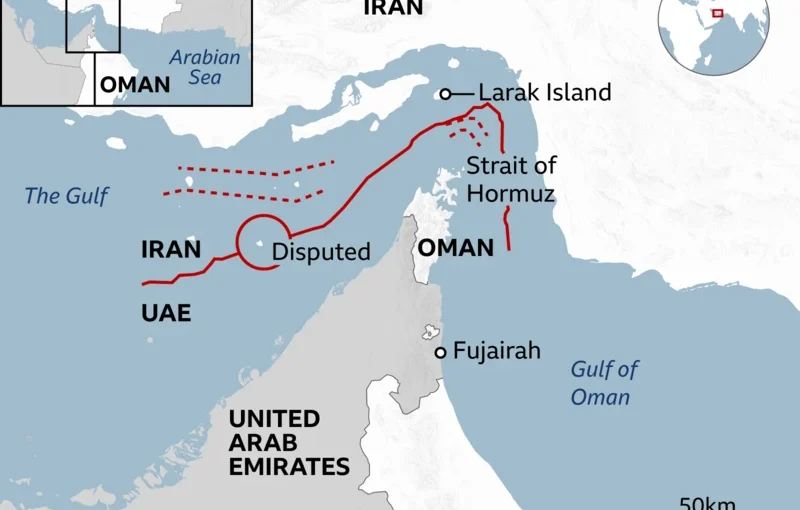
They hit fuel depots, missile sites, command infrastructure. Within seventy-two hours, the Strait of Hormuz, twenty-one nautical miles at its narrowest, carrying twenty percent of the world’s oil, closed. It has not reopened. Everything that follows from that sentence is not speculation. It is arithmetic.

The Price

Oil was at sixty-five dollars a barrel when the bombs fell. Within days it touched one hundred and twenty. Analysts at Kpler said publicly that if Hormuz stayed shut through March, one hundred and fifty was not a ceiling. Barclays agreed. The IEA called the disruption the largest in the history of the global oil market, twice the scale of the 1956 Suez Crisis. People heard those numbers and thought: petrol prices. School run. Heating bills. They were thinking too small.

The Cascade

Oil is not just fuel. It is the circulatory fluid of the entire industrial world. When it doubles overnight, everything that moves, everything that is made, everything that is insured, financed, or shipped reprices simultaneously.

Marine insurance becomes unwritable. Trade credit freezes. Every CFO at every company in every sector looks at their cost assumptions, built at seventy dollar oil, and cancels the next quarter’s capex in the same morning meeting. That coordinated freeze is not a symptom of recession. It is the recession, arriving before a single GDP figure confirms it.

The banks come next. Energy loans, airline debt, shipping company bonds, all underwritten at sixty to eighty dollar oil. At one hundred and twenty sustained, covenant breaches begin quietly. Not crashes. Tightening. The marginal credit that keeps service businesses alive stops flowing.

Then the Gulf sovereign wealth funds. ADIA. PIF. QIA. Mubadala. Two to three trillion dollars in global assets, equities, real estate, private equity, deployed as patient capital into Western markets for fifteen years. They are nominally richer at one hundred and twenty dollar oil. But their export infrastructure is disrupted, their domestic spending obligations spike immediately, and their liquidity needs arrive precisely when their asset values are falling.

The moment even one major fund moves from net buyer to net seller, it removes the price support it has been providing silently for years. Other funds follow. The risk premium they have been suppressing across global asset classes reasserts overnight.

This is not the 2008 financial crisis. That was a fire in the financial system’s wiring. This is the fuel supply to the engine failing. Different category. Larger consequences.

The Trap Continue reading The Strait That Broke the World

GDP of South Asian countries 1 : nominal vs real

In March 1776, exactly 250 years ago, Scottish economist Adam Smith published his work The Wealth of Nations, widely considered to be one of the most influential books on political economy.  In this book he highlighted the fact that people often confuse the real wealth of a country (the ability to buy goods and services) with  its nominal wealth. The idea is still relevant today, so let us have a closer look. If we rank the major South Asian countries by their per capita nominal GDP (size of the total economy in the local currency divided by the price of a dollar), the list goes as follows :

1. SriLanka : USD 4516 
2. India : USD 3051
3. Bangladesh : USD 2960 
4. Pakistan : USD 1710
5. Nepal : USD 1550
6. Afghanistan : USD 417 

Many people assume that these numbers measure how poor or rich a country is. In particular, the average Sri Lankan is 50 percent wealthier than the average Indian, and the average Bangladeshi is 70 percent wealthier than the average Pakistani. This is not really true. The nominal GDP accurately measures the real wealth of a country only in an utopian world where there are no taxes or other barriers on tradable goods, and transportation costs are completely absent. In reality, Americans can not instantly transport themselves to India to get cheap haircuts, and South Asian countries often impose huge taxes on imported goods. So nominal GDP is a flawed yardstick if we want to compare different countries.

Here’s a simple puzzle based on this idea : What steps should the Indian government take if they want to increase the country’s per capita nominal GDP from USD 3000 to USD 6000 within this year?

At first glance, achieving this may seem unattainable, given that India’s economy is currently growing at a rate of 6-7 percent annually. However, once we realize that nominal GDP also depends on trade policies, it is easy to come up with strategies to make this happen. For instance, the Indian government could implement an extra import duty of Rs 45 per dollar on all imported goods while simultaneously offering a Rs 45 per dollar subsidy (through tax incentives, free land, etc.) for all exported products. This will reduce the price of the dollar from Rs 90 to Rs 45 and double India’s nominal GDP. It’s also easy to see that this will have no impact on the real economy. Since the USD isn’t utilized in local transactions, the domestic market will stay the same. The extra tax imposed on imports will be balanced by the decrease in the dollar’s value. Likewise, the lower dollar rate will be offset by subsidies provided in the export sector.


A Deleted Tweet Just Moved the Oil Price 17%. Welcome to the New World.

The Graph Nobody Is Talking About

Oil Prices

BP Admin Note

September 2025 – Brown Pundits
Punditji

Before the oil, a brief note on Brown Pundits itself. Over recent months we have tried to move the comment threads toward a simple goal: remove noise while preserving disagreement. This is not a place for ideological conformity. It is a place where arguments should challenge substance rather than inflame style.

The density of comments has fallen slightly but the quality of disagreement has improved.

What the threads also reveal is a persistent misunderstanding about the relationship between civilisation and crisis. The caricature, that certain societies simply “fail to modernise“, misses the deeper negotiation underway.

Every tradition older than industrial modernity faces the same question: how to carry inherited principles into a world not built around them. That is not a uniquely Muslim or Persian problem. It is the defining problem of our age.

With that said, to the oil!

Oil Tanker Routes at Kimberly Clifton blog
SoH > SoM

The Only Number That Matters

Continue reading A Deleted Tweet Just Moved the Oil Price 17%. Welcome to the New World.

Brown Pundits