Iran: The Illusion of a Peace Deal| John Mearsheimer and Stephen Walt

Professors John Mearsheimer and Stephen Walt explain why U.S. and Iranian demands are fundamentally irreconcilable — and why this crisis is far from over. Instead of bringing Tehran to terms, Washington now finds itself further from a diplomatic settlement than it was in May 2025. Iran has played a weak hand with discipline and patience. The United States, by contrast, risks stumbling into another major strategic failure in the Middle East. At the core of the impasse is a basic reality: both sides are demanding the impossible. Washington insists on the full dismantling of Iran’s nuclear and missile capabilities, while Tehran seeks sanctions relief, reparations, and long-term security guarantees. Neither side is prepared to yield. The result is not a pathway to peace, but a deepening stalemate — with escalation, not resolution, the more likely outcome.

John Mearsheimer & Trita Parsi: U.S.-Israeli War on Iran: Risks of Wider Conflict

Full urgent discussion with Prof. John Mearsheimer and Dr. Trita Parsi on the escalating U.S.-Israeli aggression against Iran, drivers of the conflict, the dangers of regime change, Iran’s responses, and the real risk of a wider regional war. Organized by the Community Alliance for Peace and Justice.

Note: Trita Parsi now has a Substack 

Implications of the Escalating U.S.-Iran Conflict

A very important interview with Vali Nasr–one of the world’s foremost experts on Iran

March 3, 2026 — Asia Society Policy Institute (ASPI) hosts a rapid-response conversation following the recent and significant escalation in the U.S.-Iran conflict. Join Asia Society Trustees Vali Nasr, Majid Khadduri Professor of International Affairs and Middle East Studies at Johns Hopkins University School of Advanced International Studies (SAIS); and Hamid Biglari, Partner at RedBird Capital Partners, Executive Chairman of RedBird X (RedBird’s AI business), and Chairman of Financial Services, as they assess the strategic, political, and economic implications of this unfolding crisis.

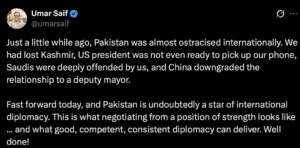
Why is Pakistan suddenly central to US-Iran diplomacy?

Note: As always, I do not tolerate anti-Pakistan comments on my threads.  If you don’t respect the red lines, your comments will be summarily deleted.  The usual suspects (they know who they are) have been completely banned from commenting on my posts.  Don’t antagonize me.

By Anwar Iqbal in DAWN:

According to these reports, Pakistan’s military and civilian leadership has been in direct contact with senior US officials, including President Donald Trump, conveying Islamabad’s willingness to facilitate dialogue and reduce tensions.

Some accounts suggest that Pakistan has even indicated readiness to host talks in Islamabad if the parties are prepared to explore diplomatic channels.

Vali Nasr, a prominent Washington-based scholar, argues that any Pakistani diplomatic initiative is unlikely to occur in isolation from Saudi Arabia:

“Pakistan will only step up if it has Saudi backing — and prodding. Riyadh is likely very much in the picture,” he wrote in a post on X.

And:

Pakistan’s value as a potential intermediary also stems from its parallel access to Tehran and Washington — a rare combination in the current geopolitical climate.

Analyst Michael Kugelman makes this point clearly: “Pakistan is far from being an unlikely US-Iran mediator. Many high-level Pak-Iran meetings over last year. The US administration is very fond of Pakistan. Trump has said (Field Marshal Asim) Munir knows Iran better than most. Also worth noting that Pakistan represents Iran’s diplomatic interests in the US.”

Update: Pakistan stands ‘ready, honored’ to host US-Iran talks, says PM Shehbaz 


“What did Op Sindoor actually accomplish”?

23rd March 2003. Twenty three years ago today, a Pakistani Operative Zia Mustafa of the Laskhar-e-Toiba walks into the village of Nadimarg, Jammu and Kashmir. Wearing fake uniforms, Zia and his accomplices wake up the the village, and then proceed to murder 11 men, 11 women and a boy after lining them up. Walking away, the terrorists hear a baby crying, and order to silence him. The baby becomes murder victim #24. Link

23 March 2026, I read a comment on a BP thread discussing the West Asia war and Iran’s defiance, and the question that is the the topic of this post is asked.

I feel obligated to answer it. The statistics of so-called ‘non-state actor’ victims inflicted by Pakistani groups on Indian soil, since the 1990s, into the 2000s and beyond are stark. For an Indian who has grown up to adulthood in these years, actually lived through multiple decades where hundreds if not thousands of Indians dying as a result of the Lashkars and Jaish of the world was just part and parcel of life – all given succor by the Pakistani military and state. The datasheet linked here shows the tragedy that has been slowly but surely being deterred – and this is only starting with the year 2000. According to SATP, more than 25000 deaths occurred in J&K between 1988 and 2000.

The change in the public response of the Indian government, starting with the surgical strikes in 2016, and then escalated with the Balakot Bombing raids, and the direct and sharp decrease in the number of terrorism incidents is unmistakable. Operation Sindoor, the 4 day skirmish that took place in May 2025 on the heels of unarmed tourists being murdered in cold blood – is the exclamation mark in a simple statement that demonstrates Indian resilience and response when challenged with terrorism. No more will such attacks go unanswered. And the ultimate sponsors of such evil – the Pakistan Military itself – will have to bear direct consequences delivered. Via Brahmos-Mail.

Nobody needs a degree in statistics, to spot the co-relation in the timeline – India starts executing public retaliation in the aftermath of terror attacks, the frequency of such attacks drops sharply.

As far as the spreadsheets accounting and the nuts and bolts of what targets were hit during Op Sindoor that would count as “actual accomplishments” – there is ample evidence available for any objective observer to get themselves informed. From satellite imagery of multiple PAF bases and runways ‘double-tapped’ into shutting down for months, to ‘hardened’ aircraft shelters being demolished and rebuilt months after the fact.

But what Op Sindoor accomplished goes beyond merely a largely one-sided ledger of inflicting losses to military bases and flagship bases of terrorist organizations – Op Sindoor was a demonstration of commitment by the Indian state – a resolve that no longer will the nuclear umbrella allow the Pakistani Military to continue waging its ‘jihad of a thousand cuts’ without the consequences of a military conflict. One that will inflict costs not just on the bankrupt Pakistani state, with FATF gray lists hurting its citizens. Send terrorists to murder Indians, and bombs will drop on Pakistani Military bases in response. Op Sindoor is a promise of resolve. The Indian government will respond militarily if you threaten the security of its citizens.

Post-script: Apart from making an unambiguous demonstration of Indian deterrence when facing up against terrorism emanating from Pakistan, arguably the greatest indicator of the success of Op Sindoor, is the Pakistani Military’s attempt at copy-pasting their own version on Pakistan’s Eastern Border. Unfortunately, the results for the second sibling that was birthed from ‘Cracking India’ in 1947, have been a lot more….mixed.

The Façade of a rules‑based international order

Politics is deeply ideological—but does ideology really matter in geopolitics at all?

A few modern (if that’s a fair word) Islamic countries—Turkey, Azerbaijan, and Pakistan—have adopted an increasingly anti‑India position. For Pakistan, this stance is ideological; for Turkey and Azerbaijan, it is clearly pragmatic. Meanwhile, India has become friendlier with the Taliban, Iran (the current war notwithstanding), and the Gulf states.

Similarly, India’s closeness to Israel is not ideological—though cheerleaders on social media often present it that way. It is strategic and does not depend on Jews being tolerant of Hinduism. I have zero insight into how Israelis view Hinduism (nor do I, as a resident of India who never intends to visit Israel, particularly care). But that should not matter, because Israel is one of the very few all‑weather geopolitical partners India has.

India needs weapons and technology, and it gets them from Israel—so Israel is important to India. India needs oil and gets it from Iran and Russia—so they are important to India.

These statements may sound childish or crude, but they capture how geopolitics actually works. It does not run on ideology or cultural history. Much of the cultural narrative that intellectuals and pop‑culture try to weave around geopolitics is post‑hoc justification meant for an idealistic public. Even dictatorships engage in such storytelling—not just democracies. There are exceptions, of course. For instance, when the Nupur Sharma controversy broke, it triggered a small geopolitical crisis for India.

Nation‑states are both products of culture and creators of culture. Cultural and political anxieties were the prime movers of the Pakistan movement. But the lived realities of Pakistan, India, and even Bangladesh as nation‑states have produced their own cultural trajectories and divergences.

So should an Indian cheer for the bombing of a friendly totalitarian theocracy at the hands of its friend which is a selective liberal democracy {only for the chosen people) ?

No—not only because Iran is a friend of India, but because emerging economies that are democracies need at least the façade of a rules‑based international order to function. Donald Trump doesn’t seem to like the façade but diplomacy of varying shades still ought to be relevant in politics for years to come.


The Hormuz Ultimatum: Wealth Doesn’t Win Wars

Wealth Doesn’t Win Wars

A contact in New York mentioned, almost in passing, that the shelves at their local (premium) supermarket were beginning to empty. Not bare, but noticeably thin, the way they go before a blizzard. People panic-buying quietly, without announcement. At LaGuardia, long queues that the local press has barely covered. The official newsflow says nothing. But the supermarket shelves don’t lie.

This is how the consequences of a war 6,000 miles away arrive in the richest city in the world; not with sirens, but with gaps on the grocery shelves and unexplained airport delays that nobody in authority seems in a hurry to explain. The information lag is itself a story. There is roughly a week between what is happening and what is being reported. Don’t believe one’s lying eyes.

BB’s thesis is that military power is ultimately a function of GDP. It is a reasonable working assumption. It is also, we would argue, dangerously wrong in the specific conditions we are now watching play out in real time.

The United States and Israel are the two wealthiest, most technologically sophisticated military powers to have ever jointly prosecuted a war. Their adversary is a sanctioned, inflation-wracked theocracy that has been massacring its own citizens and losing proxy after proxy for two years. And yet here we are, Day 23 of Operation Epic Fury, with Trump issuing a 48-hour ultimatum to obliterate Iran’s power plants unless the Strait of Hormuz is fully reopened, Iran responding that any such strike will be met with attacks on U.S. and Israeli energy and infrastructure assets, Brent crude at $112 a barrel and Goldman Sachs projecting elevated prices through 2027, and the administration having exhausted every economic lever it possesses. The richer side is losing the economic war. The question is whether they know it yet.

Iraq, Afghanistan, and the Sociology of Surrender

The pattern is not new. We have watched it twice in living memory, in the same geography, and both times the lesson was the same. Continue reading The Hormuz Ultimatum: Wealth Doesn’t Win Wars

Pakistan is the Israel of the Subcontinent

A Brown Pundits Precedent Post

I. The Ideology Before the Nation

Pakistan has a birth certificate: a 1933 pamphlet by Choudhry Rahmat Ali. Israel has the Basel Programme of 1897. Both nations emerged not from an ancient territorial consciousness but from an ideological project; one that required, as its sustaining premise, the claim that a religious minority could not coexist within a pluralist polity. This is not a slur; it is the historical record.

What makes both nations structurally similar is that their nationalism is grievance-generative by design. Israel requires the Palestinian question; Pakistan requires Kashmir. Without the wound, the ideology loses its cohering force. This is why, as Kabir inadvertently demonstrates in thread after thread, Kashmir is not merely a territorial dispute for Pakistan; it is an existential necessity. Indian nationalism has no equivalent. India does not need Kashmir to know what it is. Pakistan does.

II. Organic vs. Constructed Nationalism

Omar has made the point that durable nationalism must be organic; rooted in geography, language, ethnicity, or long civilisational memory. Bangladesh is a useful comparison: Bengali Muslim nationalism is at least tethered to a linguistic and territorial reality. The Bengalis of East Pakistan had a mother tongue, a delta, a literary tradition. When Pakistan tried to impose Urdu on them, they revolted; because Bengali identity had roots.

Pakistan’s tragedy is that Urdu itself is borrowed. It is a prestige creole, Persianised, Arabicised North Indian court language, that is the mother tongue of perhaps 7% of Pakistan’s population (the Muhajir elite but Urdu had admittedly very deep roots in Lahore). It was imposed as a national language precisely because it belonged to no one’s soil, and could therefore function as a neutral imperial medium. The irony is that Urdu is a derivative of Persian, and Persian, the language Pakistan’s nationalism effectively displaced, was the actual civilisational glue of the entire region from Kabul to Lucknow. In the Golestan framework, Persian would resume its natural role as the prestige link language. Pakistan’s nationalism requires its absence.

III. A Core-Periphery Imperial Topology Continue reading Pakistan is the Israel of the Subcontinent

Is Iran winning the war| UnHerd

While the usual suspects on BP are busy with their anti-Pakistan comments, the Iran war continues–which is far more important globally than Pakistan/India back and forth is.

The inordinate focus on Pakistan on this forum is quite something and deserves a deeper psychological explanation.

UnHerd’s Freddie Sayers speaks with Professor of Political Science at the University of Chicago, Robert Pape, to discuss the high-stakes ‘escalation trap’ unfolding between the United States and Iran – breaking down the tactical successes and failures of the US military campaign and analysing how Iran is leveraging its geographical position and control of the Strait of Hormuz through low-cost drone and missile harassment. As Professor Pape draws comparisons to the Vietnam War and 1973 oil crisis, has the Trump administration lost control of the conflict’s trajectory, and are we moving toward a dangerous ground power dilemma that threatens the global economy and the stability of the Western alliance?

Brown Pundits