Is Kabir Right?

Kabir’s claim, is that much of the Saffroniate comes to Brown Pundits for one purpose: to litigate Pakistan, and to litigate the Muslim. Take that fixture away and the room goes quiet. The post on Hindustani classical music sinks without a ripple. The translated short story draws three comments and dies. Only the threads that arm the two camps against each other run to hundred+.

Is he right?

Continue reading Is Kabir Right?

The Long Dark Night for India’s Muslims

Our own Hindufication

We write this not as outsiders pretending to diagnose India, but as people who have undergone a gentler version of the same process. Over fifteen years of family and work on the subcontinent, our own Islamicate inheritance has been quietly sifted. The Persianate was retained. The Arabic was allowed to fall away. The qawwali, the food, the manners, the ghazal, the Mughal grammar of taste. All survived. The devotional Islamicate self did not. We arrived as something close to a Anglo-Islamicate hybrid. We are leaving, slowly, as a Hindu-Persianate one. We did not plan this. We watched it happen to ourselves.

The Persian survives. The Arabic does not. The poetry survives. The prayer does not. This is the formula. Once you see it, you cannot unsee it.

We made this passage with privilege, with distance, with choice, and with somewhere else to be if we changed our minds. The Indian Muslim, the one with no other passport and no other country, is being asked to make the same passage on terms set by people who never had to make it themselves. That asymmetry is this post.

The morning song

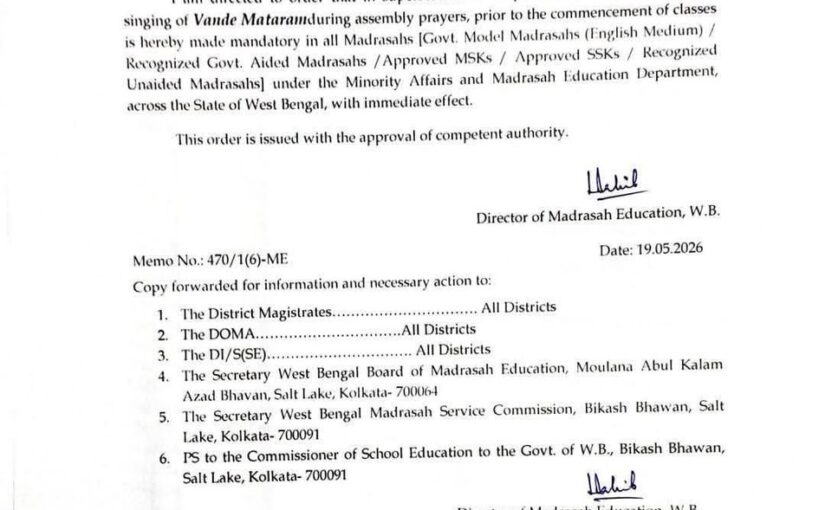
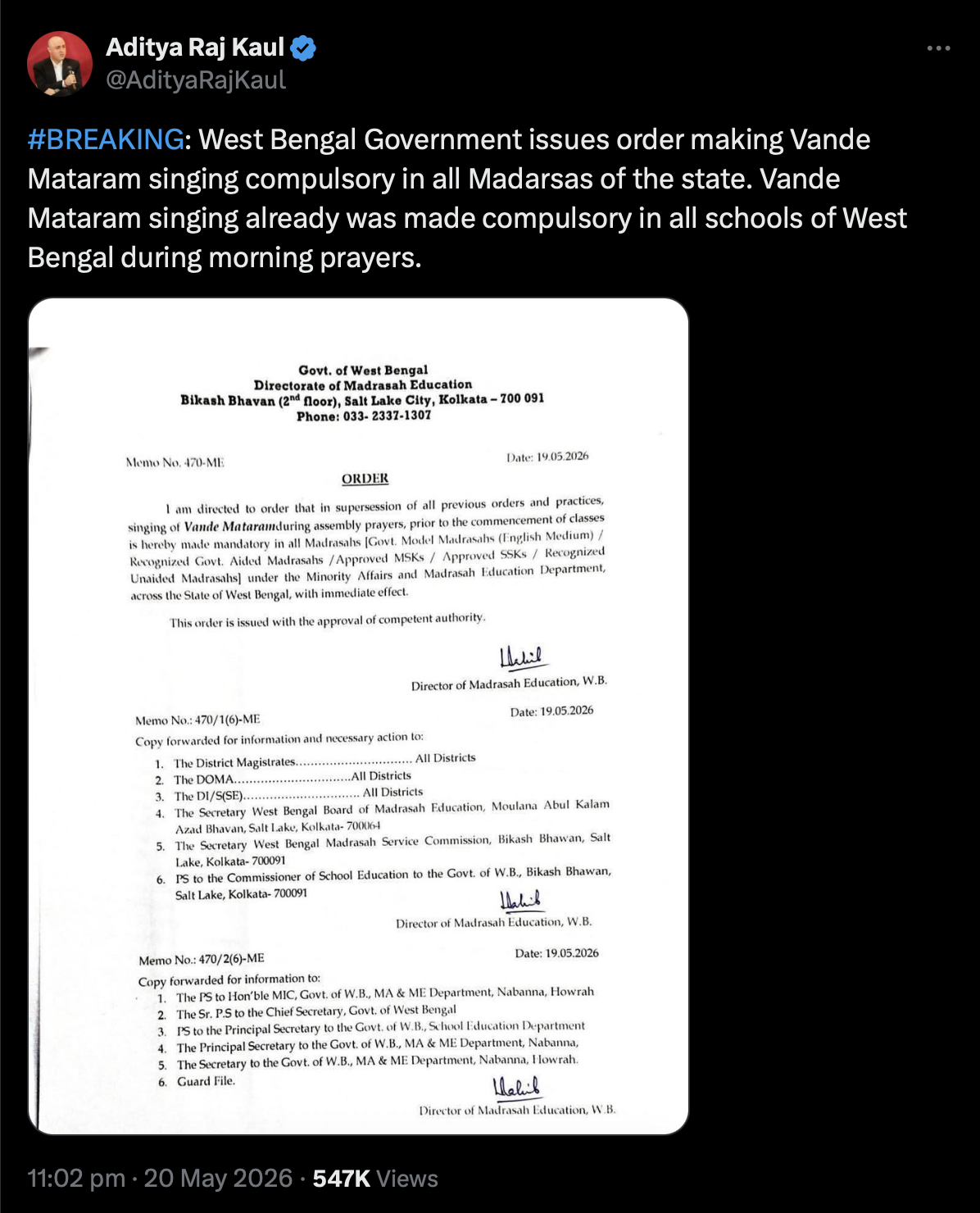
The news this week was Memo No. 470-ME, dated 19 May 2026, signed by the Director of Madrasah Education, Government of West Bengal. The order makes the singing of Vande Mataram mandatory at morning assembly in every state-recognised madrasa: government, aided, unaided, all of them. Immediate effect. Approval of competent authority.

Note the date. Suvendu Adhikari was sworn in as the first BJP Chief Minister of West Bengal on 9 May, ten days earlier, on a 207-seat mandate that ended Mamata Banerjee’s fifteen-year run. The order is ten days into the new government. Of all the actions available to a freshly-installed state administration, this is the gesture chosen. The first major item on the agenda was the Muslim schoolchild’s morning. The signal is the signal.

The Pakistani faction of our commentariat is aghast, and not unreasonably. The song is a hymn to the Great goddess Durga, drawn from a novel that called for war on Muslims, and forcing a Muslim child to recite it is a small humiliation that announces a large arrangement. One of our Pakistani commenters compared it to forcing a vegetarian Hindu to eat beef. The comparison overstates and understates at the same time. It overstates because nobody is forcing food into anyone’s mouth. It understates because food is forgotten by the afternoon, and a song sung daily for ten years writes itself into the spine.

The row is the symptom. The disease is older. Bengal is the latest frontier, not the first.

The Persianate without the Muslim

Continue reading The Long Dark Night for India’s Muslims

Sanam Saeed at Cannes, Alia Bhatt Out of Frame?

I. The Cannes Frame

The clip is short and damning. Alia Bhatt walks the Cannes red carpet as L’Oréal’s global face, waving at a thicket of photographers who never quite lift their cameras.

Sanam Saeed arrives in a white peacock couture by Hussain Rehar, fifty artisans and 2,354 hours, a tribute to Shamim Ara that the photographers actually shoot. Rehar’s accompanying showcase at Château St George is titled Lahore: A Knot in South Asia’s Loom, sitting one cabinet over from Gucci and Roberto Cavalli. The title is doing the work.

Cannes 2026 was supposed to be Bollywood’s annual export ritual. Instead, Pakistanis slid past the L’Oréal machinery and produced the festival’s most discussed South Asian image.

II. Taste Without Empire

Continue reading Sanam Saeed at Cannes, Alia Bhatt Out of Frame?

On Safety and Hinduphobia

Bombay Badshah is on vanvas. He earned it. He posted, in passing, personal details of another commenter, which he should never have been examining. He was warned, apologised, and is now serving his time in the forest. Lord Ram took Sita and Lakshman with him for fourteen years. BB is taking the IPL and Dhurandhar reruns for ten days. The proportions are different. The principle is the same. You leave the city when you have offended its order.

This is not a defence of him. It is the opposite. BP must be a safe space for reader, commenter and author. Privacy is the precondition of opinion. If a person cannot post under a handle without a hostile interlocutor looking them up, the room collapses into a lower kind of theatre. We do not run that kind of room.

Engrained Hinduphobia

But his exile is also the moment to say the thing we have been postponing. Hindus on this site have a real grievance, and it has accumulated because the language of liberal discourse equips one side of the argument with a vocabulary the other side does not have. Islamophobia is an institutional word. Hinduphobia is still scratching at the door. The asymmetry shapes every thread:

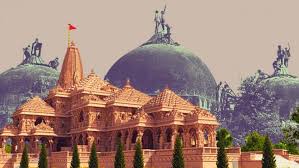
You Cannot Demolish His Mosque and Claim His High Culture

A precedent post on hybridity, custodial duty, and the elites who want it both ways

The argument running through the recent threads is sharper than the usual India versus Pakistan braggadocio. It is a claim about high culture itself. A civilisation cannot demolish a man’s mosque and claim his high culture in the same breath. The two moves cancel. The elites on both sides of the 1947 line have been performing both moves for eighty years, and the contradiction is now visible.

What high culture is

High culture is the foundational settlement of values, ordinarily anchored in religion, that a civilisation runs on. It can be syncretic in formation. Plural ownership is harder to sustain, and most attempts eventually close into a single settlement or fracture into rival ones; some imperial frames (Ottoman, Mughal, the Republic of India itself) did hold the tension for longer than the simple model would predict. The point is not that plurality is impossible. The point is that plurality is unstable, and the instability is what generates events like 1992.

England is the cleanest worked example of closure. The English high culture is a hybridisation of Anglo-Saxon, Anglo-Norman, and an absorbed Celtic remainder. Scotland and Wales sit inside the matrix without breaking it. The hybridisation closed; one settlement emerged.

Ireland is the test case in the negative. The same Anglophone substrate produced a different high culture in the Catholic south, and in the Catholic pockets of the north, because religion did the foundational work and religion would not blend. Two islands, one language family, two high cultures. Language is the medium. Religion is the substrate.

Ludwig von Mises, in Nation, State, and Economy, argued the related half. The nation is a speech community, but the speech community is shaped by what the school teaches and what the church says. Plattdeutsch villages on the Dutch border could have gone either way two centuries ago; the descendants would now be just as good Hollanders or just as good Germans, depending only on where the school and the church sat. Language carries national consciousness. The religious settlement decides which language wins.

Notre Dame: The custodial bargain Continue reading You Cannot Demolish His Mosque and Claim His High Culture

India and Pakistan Are Playing Chicken; simply to hurt themselves

Two comments are worth picking up on, and one claim worth interrogating.

N disagrees that contact ameliorates ties. EK suggests the only Islamicate voices the Indian RW respects are those who have “debased their own civilizational integrity.” We do not know who he is shadow-tweeting. It could be us, the Founders of this blog, who are Islamicate by heritage and recognisably friendly to Hindu right-wing readings. Either way, the framing is off. And then there is Q, on the thread as we write, claiming Pakistanis “will eventually take over the Islamicate world.

The cost of distance

The dominant idea of the last decade is that less contact means more security. Fewer visas. Less trade. No cricket. No artistic exchange. Reduced diplomatic warmth. This is sold as realism. It is, in large part, self-harm.

Distance does not produce clarity. It produces mythology. When people stop meeting one another, they begin imagining one another. The imagined neighbour is always simpler, darker, and easier to hate than the real one.

He is also, as Dhurandhar showed, sexier. Hatred and desire run on the same current. The more villainous the Pakistani on screen, the more the Indian audience leans in.

Civility is built by proximity. Not sainthood. Habituation. When people share space, study, trade, marriage, and culture, the room for fantasy narrows. One can still dislike the other side. But one dislikes actual people, not cartoons.

N’s response to this is that contact theory is “akin to blaming a victim for not engaging with the perpetrator.” That feels like the Israeli security story applied to the Indian Sub-continent. It assumes Pakistanis are a permanent terror-source requiring permanent counter-violence.

Pakistan obliges the narrative by behaving badly enough often enough to keep it alive. India obliges the frame by treating every bad actor as the median Pakistani. Both governments are now invested in the loop.

Pakistanis no longer defend hybrid Islamicate culture Continue reading India and Pakistan Are Playing Chicken; simply to hurt themselves

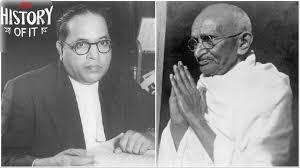
Men of State, and the Great Mahatma

A Precedent Post on Gandhi, Ambedkar, and the Authority to Speak

Kabir is right to push back on the deliberately provocative, “pure evil.” It misses what QeA & Nehru were and what Gandhi & Ambedkar were.

This post sets four Precedents.

One. QeA and Nehru were men of state. Neither evil, neither saint. To be evaluated by the standards appropriate to men who build and run states.

Two. Gandhi was a man of Dharma. He is a saint. Comparing him with QeA and Nehru on their terms is a category error.

Three. Ambedkar is the fourth figure. Not a man of state in the QeA or Nehru sense; not a man of Dharma in the Gandhian sense. He is a constitutional saint, in the Mahatma’s register.

Nehru and QeA may be criticised. They may not be disrespected. Gandhi and Ambedkar are a different order. Discussion of them on this blog proceeds from profound respect for their achievement: the redemption of the soul of India after a thousand years of slavery.

*Thousand years of slavery is not Precedent but rhetorical flourish. It is worth noting that all of the Pakistani commentators on BP would be subordinated “Hindustani Muslims” in the hierarchical world of the Mughals, who explicitly favoured foreign-born Turani and Irani nobles over the converted Indian majority.

Four. SD is not to be quoted on this blog. Initials only where strictly necessary. Reasons at section XII.

Part I. The Distinction

I. The Man of State

The modern state is a Westphalian inheritance: territory, a monopoly of violence, legal personality. A man of state operates inside that frame. He does not step outside it.

QeA was a man of state. He was perhaps the finest constitutional negotiator the subcontinent produced in the twentieth century. He read the Government of India Act the way a master reads a score. In his Fourteen Points of 1929, drafted in response to the Nehru Report’s dismissal of the Muslim minority, he foresaw with brutal clarity that a Westminster majority in a plural society could become a permanent tyranny once the demographic count was fixed.

According to Mohammad Ali Jinnah, “The Committee has adopted a narrow minded policy to ruin the political future of the Muslims. I regret to declare that the report is extremely ambiguous and does not deserve to be implemented.”

There is a reason Pakistanis venerate him to the extent they do. Without QeA, the Muslims of the subcontinent would have remained a set of regional identities & class interests: Punjabi, United Provinces aristocrats, Bengali. He forged a single Islamicate identity out of them and politicised it into a state. In the history of the Ummah, and indeed the world, this is almost unique.

The Two Nation Theory was not his starting point. In 1916, at Lucknow, Sarojini Naidu called him the Ambassador of Hindu-Muslim Unity, and the phrase was earned. He reached for the Two Nation Theory two decades later, when the softer constitutional instruments had been closed off by Congress intransigence and Viceregal haste.

The tragedy of QeA is that the state he called into being never settled its founding question. A secular Muslim who ate pork and drank whisky summoned an Islamic state and then, on 11 August 1947, tried to unsummon it in a speech that Pakistan has spent the rest of its history editing out of its school curriculum. The confusion was structural from day one. It is structural still.

II. The Architect and the Scaffold

Nehru was a man of state of a different temperament. Harrow, Cambridge, Inner Temple. Fabian socialist. Scientific temper. Where QeA built a state around a community, Nehru built one around an idea: that a civilisation as old as India could be poured into a parliamentary republic and would accept the mould. It largely did. We owe him this.

Continue reading Men of State, and the Great Mahatma

Parsi Nanis Are Gujarati

Part I of III: Hypergamy, Endogamy, and the Terminal Phase of the Parsi Model

With a nod to the Y. M. Hodiwalla thread on the Parsi Zoroastrians Worldwide Facebook page, 19 April 2026.


“The Parsis are a quarter Gujarati (genetically). Essentially their Nanis are Gujjus and interestingly enough culture is almost always transmitted via the mothers and their mothers.”


I. The Language Is the Mother

On 19 April, Y. M. Hodiwalla published a long lament on the Parsi Zoroastrians Worldwide page. He called the community’s shift from Gujarati to English a “cultural suicide,” a “refined, English-speaking whimper,” the surrender of a thousand-year linguistic inheritance for the “glittering tinsel of modern fashion.” The comments beneath agreed with him almost to a person. One commenter, KCR, asked the most interesting question in the thread, and everyone ignored it:

Did Jadi Rana tell Parsis to change their “mother tongue”? Was the language of Jadi Rana’s era called Gujarati? And no one retains MT after a couple of generations especially if their numbers are small after migration.

That single comment contains the argument Hodiwalla’s essay cannot bring itself to make. The Parsis did not “adopt” Gujarati in some conscious civilisational pact with Jadi Rana. They speak Gujarati because their founding mothers were Gujarati. The Qissa-i Sanjan gives us the romance. The genome gives us the picture.

II. The Parsi Genome

Continue reading Parsi Nanis Are Gujarati

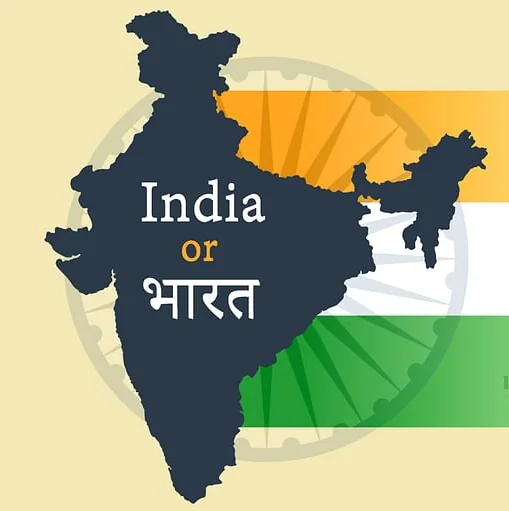
India That Is Bharat: The Exceptional Uniqueness and the Dual Identity

This is a Brown Pundits Precedent Post.


We have been asked, repeatedly and in good faith, why Brown Pundits appears to handle criticism of India with more care than it handles criticism of Pakistan. The charge is that we hold a double standard. It deserves a direct answer.

The answer is that we do hold a distinction, and we are not embarrassed by it, but it is not the distinction the charge assumes.

The Distinction

Pakistan is roughly seventy-nine years old as a sovereign state. India as a sovereign state is roughly seventy-nine years old as well. As nation-states under international law, as signatories to the United Nations, as entities with currencies and armies and foreign ministries, the two are pari passu. We treat them that way and we will continue to treat them that way. On every question that applies to nation-states as nation-states, the two sit at the same table and get the same scrutiny.

But India is not only a nation-state. India is also a civilisation, and the civilisation is not seventy-nine years old. The civilisation is, give or take the archaeological argument one prefers to have, somewhere around five thousand years old. It stretches from the Indus Valley through the Dravidian-Aryan synthesis, through the Vedic period, through the great classical flowering, through the medieval syntheses, through the colonial rupture, and into the present. One can argue the exact nature of the continuity. One cannot plausibly argue that the continuity is not there. It is there in the same way it is there for China. It is there in the same way it is there for Egypt. It is there.

This is not a claim about superiority. It is a claim about category. Pakistan is a sovereign state. India is a sovereign state and a civilisation. The two facts do not cancel. They coexist.

The Civilisational Peer Group Is Short

How short is short. At the level of a nation-state that is co-terminus with a multi-millennial civilisation, the peer group is essentially India and China. Two entries. Iran and Egypt have the civilisational depth but have been transformed by the Greco-Arab conquest, in an unalterable fashion. Greece has the civilisational depth but the modern Greek state is a nineteenth-century construction with limited political continuity to the ancient polis; the Ottoman interlude was equally determinative. Israel is a unique case and we will come to it.

That leaves India and China. Two countries on the planet where the nation-state is also the civilisation, where the sovereign political entity today is a recognisable continuation of the same cultural-linguistic-religious matrix that produced its earliest texts, and where the ordinary citizen, with some education, can read something written two or three thousand years ago in a language that is still a living vehicle of the culture.

That is not a small claim. It is also not a nationalist claim. It is simply a descriptive one.

The Indian Exception Continue reading India That Is Bharat: The Exceptional Uniqueness and the Dual Identity

The Ukrainian Interlude is over

The Iranian One has just started

Nobody seems to be interested in Pakistan’s diplomatic resurrection. What does it mean that a country written off as failed just a year ago is now the hinge of a regional peace settlement and averting World War Three on the double. This is the actual story of 2026 and it is not on our comment boards.

Pakistan: From Failed State to Diplomatic Champion

A year ago, before Operation Sindor, Pakistan was being written off in every serious strategic publication in the English language. The IMF was reluctant. Every mainstream Indian and Western analyst agreed. Pakistan was finished as a regional actor of any significance.

Today Pakistan is mediating, leading, the Iran crisis. The Hormuz situation, which could have escalated into a catastrophic closure of the world’s most important oil chokepoint, is moving toward resolution largely because Pakistan has positioned itself as the only party credible with Tehran, Riyadh, and Washington simultaneously.

The war that looked civilisational is now looking more like a pivot point. Pakistan is not a failed state. India is not uniquely ascendant under PM Modi. The question of whether the BJP holds power post-Modi is now a live one, not a theoretical one. Iran is not isolated. Israel is not unbreakable. The realignment is happening now, in real time, and almost nobody seems to be writing about it.

Iran Stood Up Continue reading The Ukrainian Interlude is over

Brown Pundits