Why Caste Formed In India and how the heck it could have been maintained! – A Structural Model

The following article is the original work of the author – Dr Rajorshi Datta. As such its views should be taken to be the opinion of the author and does not represent the opinion of Brown Pundits. If you find this article controversial the author invites you to post a respectful comment below to voice your arguments and perspectives.
 

I’ve gone back to 2014 looking at articles and podcasts posted about caste. There is information on the social and religious origins of caste within sacred texts like the Vedas and Dharmasutras. For the astute reader there are accounts from Megasthenes, Fa Hien and Xuanzhang whose writings present oblique perspectives on how caste or varna and jati was viewed by contemporary people living within or visiting the system. There’s a lot been said about the fact it exists strongly in India compared to China and Europe, and the genetic evidence to support this.

But there’s not so much about why this phenomena was so strong and strict in the Indian subcontinent and nowhere else. Here I present my thesis as to why it wasn’t luck but structural predisposition which sent India down its unique path of strict caste endogamy.

A controversial topic – why did the caste system form in India?

Continue reading Why Caste Formed In India and how the heck it could have been maintained! – A Structural Model

Conversion out of Hinduism and Caste


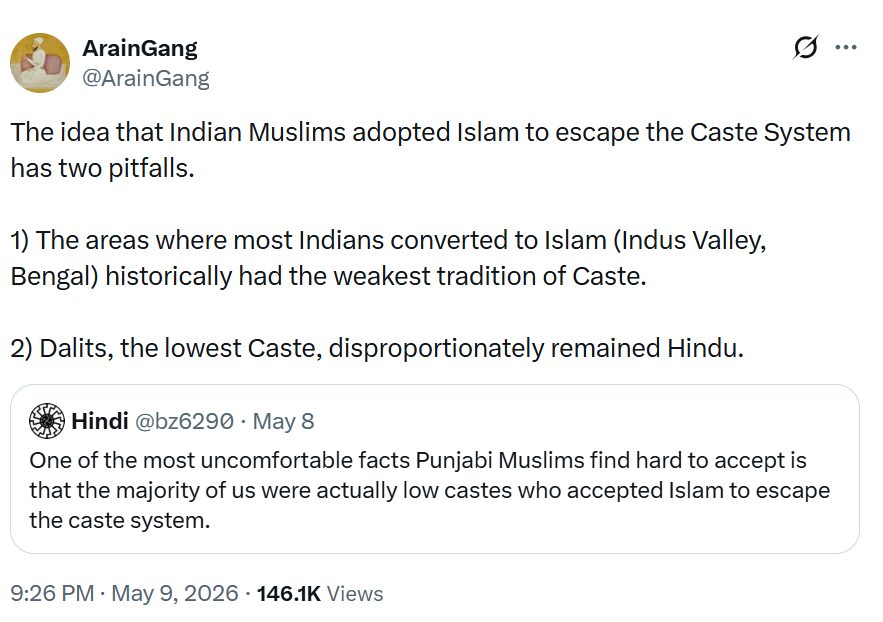
The idea that jAti-varNa – Caste system is the reason why ancient Indians converted to Islam and Christianity in olden times is often presented as a obvious wisdom. Why wouldn’t the oppressed seek new religion the instance it was offered ? But this simplistic notion is often goes against historic evidence.

As BP commentator and genetics nerd ArainGang states here – Areas of subcontinent which today form Pakistan and Bangladesh – were the least conservative regions of the subcontinent – ie – least rigid caste system. These regions also had significantly higher Buddhists than the heartland.

Christian conversions in Goa and Kerala were often but not always elite lead. Even in Maharashtra which is the birth place of Ambekarite Navayana Buddhism, significant % of Dalits remain Hindu (30-40%). Outside Maharashtra even less % of Dalits have embraced Navayana – though most regard Ambedkar as a quasi divinity. Mayawati, the longest serving Dalit CM of India hadn’t officially converted to Navayana as she assumed she would lose the non Jatav Dalit votes if she did.

Simplistic theories about history – which seem obvious to our understand often don’t stand the test of evidence. It means the simplistic models which explained the reality of Caste and mechanisms of conversion can be rejected and even their premise need to be scrutinised.


Bollywood, Brahmins, Parsis & WASPs:

Endogamy Is Optional When You Own the Institutions

Gaurav’s excellent piece on “progressive Dravidianism” pushed me to re-examine a related elite anxiety: the melodrama around intermarriage.  I am happy to be corrected on any of the specifics below, especially where a claim could be tightened with better data.

The standard story goes like this. Elites marry out. Boundaries dissolve. The group dies. This story is intuitively appealing because it treats identity as if it were a biological substance. But elites are not reproduced primarily by blood. They are reproduced by property, institutions, credentials, and networks. In that world, intermarriage is rarely a solvent. It is more often a merger.

The English aristocracy understood this early, and acted accordingly. When the old landed families were cash-poor but title-rich, they did not preserve themselves by sealing the gates. They did the opposite. They married in money. The late nineteenth and early twentieth centuries produced a whole genre of “dollar princesses,” wealthy American heiresses who married British aristocrats, trading capital for rank. By one commonly cited compilation, between 1870 and 1914, over a hundred British aristocrats, including multiple dukes, married American women; and in the broader European set, hundreds of such transatlantic matches were recorded.  This was not cultural dilution. It was institutional self-preservation by acquisition. The class survived because it treated marriage as capital strategy. Continue reading Bollywood, Brahmins, Parsis & WASPs:

The evolving understanding of varNa in Indian history

This post is triggered by some posts from XTM in the past and some discussions on the BP whatsapp group.

This is not a referenced essay but more of a summary of my evolving position on the history jAti and varNa. I am neither a history or genomics scholar and this is an essay of a reasonably well informed layperson who has gone deep in the speculative prehistory of Indian subcontinent. 

The first thing to note is the difference between jAti and VarNa.

jAti is a endogamous population – maps on to English word Caste. Identity into a jAti is a lived reality for billion Indians.

varNa is a hierarchical abstraction which is presented in Vaidik texts which does and doesn’t always map neatly on to thousands of jAti groups. I would wager that varNa mattered for the Brahmanas and at times to the Kshatriyas as their jAtis map neatly on respective varNas. 

This post will focus on varNa, I will cover jAti in some other post briefly.

For a bit more on jAti: Early Hinduism – the epic stratification – Brown Pundits

on varNa:

During the composition of the ṛgveda the priests and the warriors were the prime movers of the Arya society hence designated Brahmanas and Rajanyas. This bifurcation is common among a lot of society where the physical and spiritual power is owned by different elites who in a sense rule the society. These two communities were to become two Arya varNAs. The third varNa called the Vaishyas were originally the remaining people. The word Vaisya comes from Vish which means people. So all farmers, craftsman, artisans etc would come under the word Vaisya initially. This much can be asserted with certain degree of confidence.

The origin is the fourth varNa – Shudras is not as crystal clear but its safe to bet that initially the outsiders (non Arya) were called Shudras. The word is used to denote someone who doesn’t follow the proper Arya rituals at places or someone who is a defeated enemy or someone who is a labourer. So as Arya communities were forming during the early Vaidik period after the collapse of Harappan civilization, the outsiders who were defeated and assimilated were termed Shudras. This label also applied to populations outside the core Vaidik area who were kings and rulers in their own right in complex pastoral and farming  societies. The cultures of Deccan and Peninsular India at this time would also fall in this bracket (precursors to speakers of Dravidian languages of today).

Aryavarta (Land of the Aryas) expanded mimetically through lavish sacrifices and tall poetic tales (later Epics). Instead of building complex structures, the Rajanya class (later Kshatriyas) from the core Indo-Gangetic region (Aryavarta), focussed their wealth on conducting extravagant sacrifices (Yajnas) like Asvamedha and Rajasuya to assert their strength. The template was set by Vaidik Rajanyas and slowly people outside the core Vaidik area began to emulate their peers. Non Arya rulers invited priests to conduct spectacular sacrifices to rival the Rajanyas. These Non Aryas were gradually assigned the Kshatriya varNa along with the original Rajanyas. I would wager that priests from non Arya cultures were assimilated into the Brahmanas. Those from outside who didn’t keep their power became the Shudras. But this designation also was by no means settled.

Every now and then we have Shudra monarchs especially in the Eastern and Southern part of the subcontinent. Its worth noting that even thought a dynasty may be of Shudra origins, they likely re-wrote their histories once they attained power. Some of these rulers claim to have conducted even grander sacrifices than the Kshatriyas 1.0 and 2.0. Conversely, Kshatriyas and Vaishyas who lost their power or wealth might have lost their varNa.

a-varNa

(Co-Pilot wouldn’t help me with a representative image as its termed offensive)

Even now a vast number of people were outside this matrix of abstract varNa and secular Kshatra. As AryaVarta continued to expand it encountered the people on the margins. The template of absorbing the elites into the elite varNas would slow down eventually. Every now and then the outsiders would not be integrated into the varNas but remain outside as a-varNas. When this became happening is debatable but its safe to assume that around the time of Manu smriti, Arya-Varta had a significant proportion of a-Varna population. Over time ritual status was assigned to the outsiders and they became the untouchables.

I think this practice evolved like slavery as suppling an eternal supply of low cost labor (especially for dirty tasks). The a-varNa need to be distinguished from the Shudras who could accumulate wealth and status. So it could be a combination of (a) tribes whose professions were deemed unclean (b) defeated  people forced to do unclean professions or probably a combination of both.

Another group of people were to remain outside the Arya social system, the tribals. But it would be unfair to club the tribal communities with a-varNa. Tribal people had wide range of experience of interactions with the mainstream from domination and competition to servitude. Some tribes may have been absorbed into the a-varNa groups but that is not a generic template.

The varNa fluidity:

As Merchant guilds began becoming powerful around the times of Mahajanapadas, the Vaishya Varna began to become more associated with the Merchant class. Artisans, farmers and ordinary soldiers began to be associated with Shudra varNa. Today its quite common to associate the Vaishya varNa with traders and merchants but it wasn’t always so.

Similarly its quite possible that some a-varNa clans could lose their shackles but its fair to assume that this fluidity kept reducing in the common era. Last thousand years the varNas have not been fluid – especially for the a-varNas.

The Ossification:

I have written an entire blogpost on why the jAti-varNa matrix began to ossify and when.

Co-Pilot summary of this post:

The essay explores how early Hinduism’s caste stratification evolved through interactions between Vedic Brahmanical traditions and Sramana schools like Buddhism and Jainism. It argues that concepts of karma, rebirth, and dharma—emphasized by Sramanas—helped justify and ossify the Varna hierarchy, linking birth to karmic retribution. Over time, this moral dimension reinforced endogamy and rigid social divisions, especially during the Gupta era. The author speculates that pre-Aryan tribal endogamy combined with Vedic ritual purity and karmic philosophy created the uniquely enduring Jati-Varna system in India

The Kaliyug cope:

From the turn of the century, the subcontinent was always under attack from North West, Yavanas, Shakas, Kushanas, Hunas and final Arab and Turks. It is my belief (and also of some scholars) that the ideas of Kali-yug were a response to these invasions. A Yug when idealised Vaidik society was destroyed.

Islamic conquests of India began in the 7th century itself but it wasn’t till the 13th century that the entire subcontinent was touched by the crescent scimitar. While the concept of Kali-yug might be older than Islamic incursions into the subcontinent, I think they were imagined sufficiently during the Islamicate age. Some of the Brahamanas who survived (entire Shakhas of Vaidik learnings have been wiped out) saw Kaliyuga as the yuga where only 2 varNas exist – Brahmanas and Shudras. While some Kshatriya clans retained the memory of their ancestry during the Islamic time and reformulated as Rajputs, a lot of Kshatriyas and Vaishya lost the touch with their ancestry. While most of these groups have myths of their descent from Yadus or Ikshvakus, these claims did not get Brahmana (and Kshatriya) stamp of approval in the medieval times.

On psychological level one can understand this statement – Kali-yug contains only Brahmanas and Shudras as a coping mechanism opted under the yoke of Barbarians. Naturally wealthy landed castes who may have descended from Kshatriyas or Vaishyas were seen as Shudras. The Kadambas, Rashtrakutas, Yadavas, Chalukyas, Cholas, Gangas, Pandyas and Cheras all claimed Kshatriya descent. If this is assumed to have some merit, its not logical to assume that all the descendants of these dynasties and their power structures went extinct. Its more likely that the elites from medieval times became the wealthy landed and mercantile elites without some deviation (on the coattails of the brits).

Brits and modernity:

The Europeans began documenting varNa with the arrival of Portuguese (Casta). But the modern understanding began to truly take shape under the British rule. I will only quote the Co-pilot summary of Nicolas Dirk’s fantastic book here.

Nicholas Dirks’ Castes of Mind argues that the modern idea of caste as India’s defining social system was largely shaped by British colonial rule. While caste existed earlier, it was more fluid and intertwined with local, regional, and occupational identities. Colonial administrators, obsessed with classification, codified caste through censuses, ethnographic surveys, and legal frameworks, turning it into a rigid hierarchy. Dirks shows how this “ethnographic state” reified caste as the central lens for understanding Indian society, overshadowing other identities. The book highlights how colonial policies and scholarship created enduring structures that continue to influence politics and social life today.

In essence, varNa and social stratification is surely older than even the Roman colonisation of Britain, what we understand today as Caste is significantly shaped by the British intervention into India. The emerging economies have offered upward mobility for some while relegating others to medieval times. In many cases, artisan communities continue to see their economic status significantly degrade with mechanisation. Present Caste identities and economical realities are much more downstream of the economic exploitation and changing economy due to industrialization than abstractions like of Dharma-Shastras.

In the theatre of Indian democracy, the first-past-the-post script ensures caste takes center stage — louder, sharper, more enduring than ever before. And as present-day passions spill backward into history, they stir the ancient pot with fresh fervor, adding new tadka to a saga already simmering with spice and strife.


Post Script:

I am generally liberal with comments, but i will exercise moderation for repeated stupidity on this post.

What Genetics Can, and Cannot, Explain About Caste

A recent WhatsApp exchange between GL and Sbarr captures a recurring Brown Pundits problem: how genetic data, textual tradition, and social history get collapsed into a single argument and then talk past one another. The immediate trigger was a table circulating online, showing ancestry proportions across South Asian groups; Indus Valley–related, Steppe, AASI, and East Asian components. The numbers vary by region and language group. None support purity. None map cleanly onto caste. That much is uncontroversial. What followed was not a dispute about the data itself, but about what kind of claims the data can bear.


GL’s Position (Summarised)

GL’s argument operates at three levels: historical, linguistic, and genetic.

  1. Caste as fluid history

    GL argues that the four-fold varna system hardened late. Terms like Vaishya did not always mean “merchant” but originally derived from viś—“the people.” In this reading, Vaishya once referred broadly to non-priestly, non-warrior populations, including farmers and artisans.

  2. Elite religion thesis

    Early Śramaṇa movements, Buddhists, Jains, Ajivikas, are framed as elite projects. Renunciation, non-violence, and philosophical inquiry required surplus. Most people, GL argues, worshipped local deities and lived outside these doctrinal systems.

  3. Genes as complexity, not identity

    GL points out that Steppe ancestry and Y-DNA lineages are unevenly distributed. Some peasant groups show higher Steppe ancestry than some Brahmin groups. Maternal lines are largely local. The conclusion is not reclassification, but complication: caste cannot be reverse-engineered from genes. GL’s underlying claim is modest: simple caste narratives do not survive contact with deep history.


Sbarr’s Position (Summarised)

Sbarr’s objections are structural and definitional.

  1. Varna as stable social fact

    In lived Hindu society, Vaishya has meant merchant since at least the Dharmashastra period. Etymology does not override usage. Peasants were not Vaishyas. Shudras worked the land. Dalits lay outside the system.

  2. South Indian specificity

    Sbarr stresses that the North Indian varna model does not transplant cleanly into the Tamil world, where Brahmins, non-Brahmin literati, Jain monks, and Buddhist authors all contributed to classical literature. Claims of universal Brahmin authorship are rejected.

  3. Genes do not make caste

    Even if some peasant or tribal groups show Steppe Y-DNA, this does not make them Brahmins or twice-born. Genetic percentages are low, overlapping, and socially meaningless without institutions.

Sbarr’s core concern is different from GL’s: the danger of dissolving concrete social history into abstract theory.


Where the Debate Breaks Down

The argument falters because the two sides are answering different questions.

  • GL is asking: How did these categories emerge over millennia?

  • Sbarr is asking: How did people actually live, identify, and reproduce hierarchy?

Genes describe populations. Texts describe ideals. Caste describes power. None substitute for the others.


The Takeaway (Without a Verdict)

The ancestry table does not refute caste. The Manusmriti does not explain population genetics. Etymology does not override social practice. What the exchange shows, usefully, is the limit of WhatsApp as a medium for longue-durée history. Complex systems resist compression. When they are forced into slogans, everyone ends up defending a position they did not fully intend. That, more than Steppe percentages or varna theory, is the real lesson here.

Macaulay, English, and the Myth of Colonial Liberation

Rebuttal to When RSS-Modi Attack Macaulay and English, They Attack Upward Mobility of Dalits, Shudras, Adivasis

Follow-Up to Macaulay, Macaulayputras, and their discontents

A new orthodoxy has taken hold. It claims that criticising Macaulay or colonial education is an attack on Dalit, Shudra, and Adivasi mobility. English, we are told, was not a colonial instrument but a liberatory gift. Macaulay is recast as an unintended ally of social justice. This view is wrong. More than that, it is historically careless and civilisationally corrosive.

The Core Error

The mistake is simple: confusing survival within a system with vindication of that system. No serious person denies that English became a tool of mobility in modern India. No serious person denies Ambedkar’s mastery of English or its role in courts and constitutional politics. But to leap from this fact to the claim that Macaulay was therefore justified is a category error. People adapt to power structures to survive them. That does not sanctify those structures. To argue otherwise is like saying famine roads liberated peasants because some learned masonry while starving. Adaptation is not endorsement.

Macaulay Was Explicit

There is no need to guess Macaulay’s intentions. He stated them plainly. He dismissed Indian knowledge as inferior. He wanted to create a small class: Continue reading Macaulay, English, and the Myth of Colonial Liberation

Where Do Brahmins Come From?

The Historical, Genetic, and Mythic Answer

The idea that “all Brahmins come from Kannauj” is neat, flattering, and wrong. Kannauj is one important node in a much older, wider story. Brahmins do not descend from a single tribe or city. But they do share ancestry. That ancestry is older than Kannauj, older than caste, and visible in both texts and genes. To understand it, we must keep two truths in view at once: Brahmins have many regional origins, yet they descend—paternally—from a small circle of Vedic founders whose lineages spread across India.

This is the cleanest way to explain it without euphemism or ideology.

1. What the Kannauj Narrative Actually Refers To

When groups claim origin from Kānyakubja (Kannauj), they refer to the medieval centre that produced, housed, and exported Brahmins—especially after the Ghaznavid and Ghurid invasions pushed scribal and priestly families south and west. These migrants seeded communities in Maharashtra, Gujarat, the Konkan, Karnataka, Tamil Nadu, and Andhra. Their prestige shaped memory: “coming from Kannauj” became a shorthand for ritual pedigree. But Kannauj was only one centre among many. It cannot explain the full map of Brahmin origins.

2. The Real Landscape: Many Independent Lineages Continue reading Where Do Brahmins Come From?

BP may have just jumped the shark

In the never-ending saga of BP, we may have just hit one of the more outlandish claims:

“Like I said, I’m not defending his comments. I wouldn’t have made them.

Regardless of any provocation, calling someone ‘subhuman’ and ‘neanderthal’ is not on—especially when those words are used by a Brahmin. It’s casteist.”

I’m fully in favour of interrogating caste. But the idea that the twice-born must exercise an extra layer of self-censorship before using a generic insult is excessive. An insult is an insult; attaching caste-specific moral disclaimers to ordinary online behaviour doesn’t clarify anything. It just adds ritual guilt where none is needed.

I support the critique of caste bias, but my fundamental sympathies are with Dharmic civilisation; precisely because Dharma is pluralistic enough to allow a hundred flowers to bloom. That pluralism should extend to how we discuss caste, not collapse into moral policing tied to someone’s birth category.

Why we must talk about caste

Every few months (years?), Brown Pundits goes through its own small earthquake. A post lands wrong, a comment thread ignites, and the whole Commentariat erupts.

The latest rupture began with a mild jibe on caste. I pointed out, in passing, that caste shapes political instincts far more than many admit. The backlash was instant. A section of the readers declared a quiet boycott. The threads went cold. No one wanted to break ranks. The more one claims to have transcended caste, the clearer its caste blind-spots become. Silence itself becomes a shibboleth.

And when the silence hit, the blog froze. Continue reading Why we must talk about caste

Caste, Civilisation, and the Courage to Own It

Kabir suggested that I apologise but for what, exactly? Why should Saffroniate be considered offensive? Own it. I don’t see anything inherently wrong with the idea of Akhand Bharat; the concept of a broader Dharmic civilisation makes eminent sense to me.

Likewise, I don’t understand why questioning caste identities provokes such sensitivity. Again, own it because the more caste is repressed, the more likely it is to resurface.

At heart, I’m a reformist, not a revolutionary. I believe in improving and refining what exists, not erasing it. Cultural features should only be abolished when they are truly harmful or deleterious, not simply because they make us uncomfortable.

Brown Pundits