Ikkis: Thoughts on another Propaganda Movie

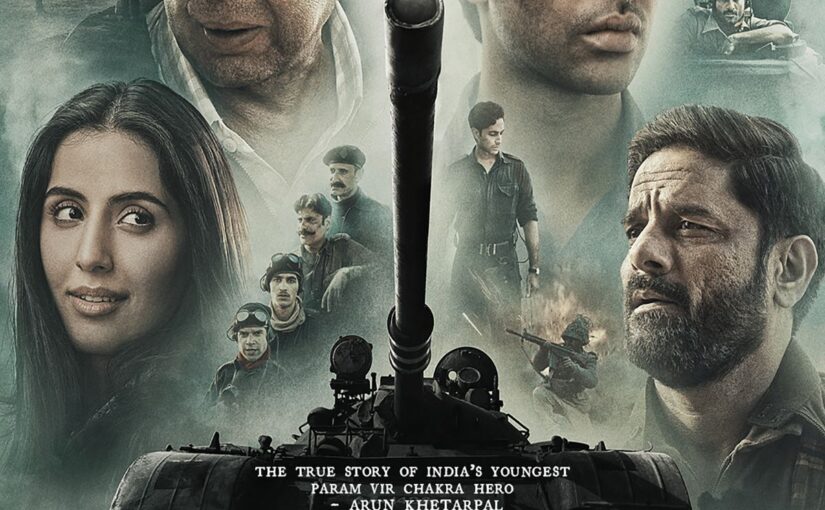
Second Lieutenant Arun Khetarpal is an Indian Army legend. A National Defense Academy (NDA) and Indian Military Academy (IMA) alum, Khetarpal was commissioned into Indian Army’s armoured regiment, Poona Horse and won India’s highest gallantry award the Paramvir Chakra, posthumously, for his heroism in the 1971 India-Pakistan war. Sriram Raghavan’s Ikkis is an autobiographical account of Arun’s life and the Battle of Basantar. A battle where Khetarpal’s Centurion tank took on the Pakistan army’s Patton tanks and fought valiantly before he succumbed to injuries on the battlefield. The movie stars Agastya Nanda, grandson of Amitabh Bachchan, as Arun Khetarpal with Dharmendra and Jaideep Ahlawat. The former plays the role of Brigadier Madan Lal Khetarpal, Arun’s father and the latter plays the role of Brigadier Nisar of the Pakistan army.

The movie recounts the visit of Brigadier Khetarpal, in 2001, to Lahore where he is hosted by Brigadier Nisar of the Pakistan Army. The senior Khetarpal is visiting Lahore for his college reunion and to visit Sargodha from where his family had to migrate in the aftermath of India’s partition in 1947. This story track runs in parallel to the story of Arun’s days at the NDA, IMA, days leading up to the battle and the battle itself. The senior Khetarpal, now in his eighties is all dewy eyed for his roots and the younger one, who has turned 21 (Ikkis is the word for the number 21 in Hindi) is eager and keen to prove his mantle on the battlefield. The retired Brigadier is serenaded by everyone, by his hosts, his former classmates and the family that now lives in his ancestral house. The young second lieutenant is learning the brutal nature of combat and the human cost of war as he rolls on towards Basantar. The dramatic arc of the movie ends with Brigadier Nisar telling the elder Khetarpal that he was the commanding officer of the Patton that shot the lieutenant’s tank and it was his assault that proved fatal.

I am a big Sriram Raghavan fan. His Johnny Gaddar makes it to every list of top 10 Hindi movies that I have ever made. Raghavan has the knack of writing stories and characters that are unconventional for commercial Hindi cinema, his plot twists don’t disappoint and nobody uses songs from Hindi movies of the 1950s, ’60s & ’70s like Raghavan. He eschews over the top dramatics and gets his actors to deliver pitch perfect performances.

Ikkis is handicapped by the fact that it is autobiographical. Raghavan has limited scope for crafting a story that surprises. This is his attempt at making a war movie and the stories of the two Khetarpals is a prop. He wants us to see that Indians and Pakistanis are the same people, there are no winners in a war, soldiers are common folk who pay with their lives for the idea of nationhood, there is common humanity that binds us all and the Pakistan army, just like the Indian army, is a professional force doing what is necessary. He uses all the tropes to make these points. Scenes of the elder Khetarpal with Brigadier Nisar’s family, his former classmates, the joyous outdoor dinner organized by the occupants of his ancestral home, the bullets ridden, lacerated bodies of soldiers and the depiction of Brigadier Nisar as an honorable gentleman who represents the best of Pakistan army. Continue reading Ikkis: Thoughts on another Propaganda Movie

Why is Pakistan suddenly central to US-Iran diplomacy?

Note: As always, I do not tolerate anti-Pakistan comments on my threads.  If you don’t respect the red lines, your comments will be summarily deleted.  The usual suspects (they know who they are) have been completely banned from commenting on my posts.  Don’t antagonize me.

By Anwar Iqbal in DAWN:

According to these reports, Pakistan’s military and civilian leadership has been in direct contact with senior US officials, including President Donald Trump, conveying Islamabad’s willingness to facilitate dialogue and reduce tensions.

Some accounts suggest that Pakistan has even indicated readiness to host talks in Islamabad if the parties are prepared to explore diplomatic channels.

Vali Nasr, a prominent Washington-based scholar, argues that any Pakistani diplomatic initiative is unlikely to occur in isolation from Saudi Arabia:

“Pakistan will only step up if it has Saudi backing — and prodding. Riyadh is likely very much in the picture,” he wrote in a post on X.

And:

Pakistan’s value as a potential intermediary also stems from its parallel access to Tehran and Washington — a rare combination in the current geopolitical climate.

Analyst Michael Kugelman makes this point clearly: “Pakistan is far from being an unlikely US-Iran mediator. Many high-level Pak-Iran meetings over last year. The US administration is very fond of Pakistan. Trump has said (Field Marshal Asim) Munir knows Iran better than most. Also worth noting that Pakistan represents Iran’s diplomatic interests in the US.”

Update: Pakistan stands ‘ready, honored’ to host US-Iran talks, says PM Shehbaz 


“What did Op Sindoor actually accomplish”?

23rd March 2003. Twenty three years ago today, a Pakistani Operative Zia Mustafa of the Laskhar-e-Toiba walks into the village of Nadimarg, Jammu and Kashmir. Wearing fake uniforms, Zia and his accomplices wake up the the village, and then proceed to murder 11 men, 11 women and a boy after lining them up. Walking away, the terrorists hear a baby crying, and order to silence him. The baby becomes murder victim #24. Link

23 March 2026, I read a comment on a BP thread discussing the West Asia war and Iran’s defiance, and the question that is the the topic of this post is asked.

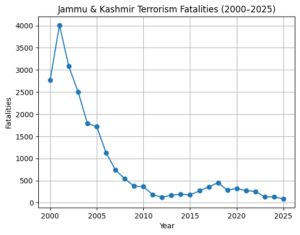
I feel obligated to answer it. The statistics of so-called ‘non-state actor’ victims inflicted by Pakistani groups on Indian soil, since the 1990s, into the 2000s and beyond are stark. For an Indian who has grown up to adulthood in these years, actually lived through multiple decades where hundreds if not thousands of Indians dying as a result of the Lashkars and Jaish of the world was just part and parcel of life – all given succor by the Pakistani military and state. The datasheet linked here shows the tragedy that has been slowly but surely being deterred – and this is only starting with the year 2000. According to SATP, more than 25000 deaths occurred in J&K between 1988 and 2000.

The change in the public response of the Indian government, starting with the surgical strikes in 2016, and then escalated with the Balakot Bombing raids, and the direct and sharp decrease in the number of terrorism incidents is unmistakable. Operation Sindoor, the 4 day skirmish that took place in May 2025 on the heels of unarmed tourists being murdered in cold blood – is the exclamation mark in a simple statement that demonstrates Indian resilience and response when challenged with terrorism. No more will such attacks go unanswered. And the ultimate sponsors of such evil – the Pakistan Military itself – will have to bear direct consequences delivered. Via Brahmos-Mail.

Nobody needs a degree in statistics, to spot the co-relation in the timeline – India starts executing public retaliation in the aftermath of terror attacks, the frequency of such attacks drops sharply.

As far as the spreadsheets accounting and the nuts and bolts of what targets were hit during Op Sindoor that would count as “actual accomplishments” – there is ample evidence available for any objective observer to get themselves informed. From satellite imagery of multiple PAF bases and runways ‘double-tapped’ into shutting down for months, to ‘hardened’ aircraft shelters being demolished and rebuilt months after the fact.

But what Op Sindoor accomplished goes beyond merely a largely one-sided ledger of inflicting losses to military bases and flagship bases of terrorist organizations – Op Sindoor was a demonstration of commitment by the Indian state – a resolve that no longer will the nuclear umbrella allow the Pakistani Military to continue waging its ‘jihad of a thousand cuts’ without the consequences of a military conflict. One that will inflict costs not just on the bankrupt Pakistani state, with FATF gray lists hurting its citizens. Send terrorists to murder Indians, and bombs will drop on Pakistani Military bases in response. Op Sindoor is a promise of resolve. The Indian government will respond militarily if you threaten the security of its citizens.

Post-script: Apart from making an unambiguous demonstration of Indian deterrence when facing up against terrorism emanating from Pakistan, arguably the greatest indicator of the success of Op Sindoor, is the Pakistani Military’s attempt at copy-pasting their own version on Pakistan’s Eastern Border. Unfortunately, the results for the second sibling that was birthed from ‘Cracking India’ in 1947, have been a lot more….mixed.


The Hormuz Ultimatum: Wealth Doesn’t Win Wars

Wealth Doesn’t Win Wars

A contact in New York mentioned, almost in passing, that the shelves at their local (premium) supermarket were beginning to empty. Not bare, but noticeably thin, the way they go before a blizzard. People panic-buying quietly, without announcement. At LaGuardia, long queues that the local press has barely covered. The official newsflow says nothing. But the supermarket shelves don’t lie.

This is how the consequences of a war 6,000 miles away arrive in the richest city in the world; not with sirens, but with gaps on the grocery shelves and unexplained airport delays that nobody in authority seems in a hurry to explain. The information lag is itself a story. There is roughly a week between what is happening and what is being reported. Don’t believe one’s lying eyes.

BB’s thesis is that military power is ultimately a function of GDP. It is a reasonable working assumption. It is also, we would argue, dangerously wrong in the specific conditions we are now watching play out in real time.

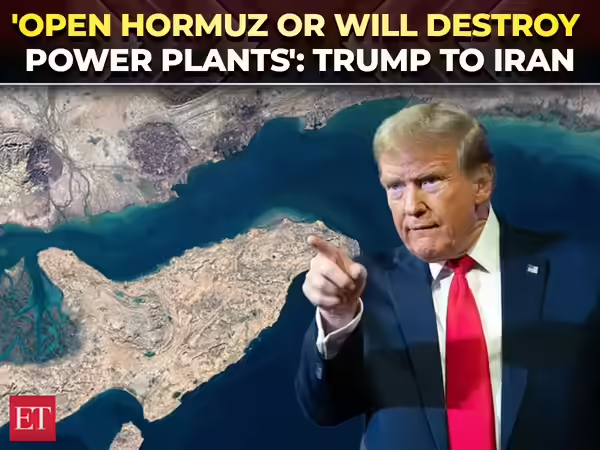
The United States and Israel are the two wealthiest, most technologically sophisticated military powers to have ever jointly prosecuted a war. Their adversary is a sanctioned, inflation-wracked theocracy that has been massacring its own citizens and losing proxy after proxy for two years. And yet here we are, Day 23 of Operation Epic Fury, with Trump issuing a 48-hour ultimatum to obliterate Iran’s power plants unless the Strait of Hormuz is fully reopened, Iran responding that any such strike will be met with attacks on U.S. and Israeli energy and infrastructure assets, Brent crude at $112 a barrel and Goldman Sachs projecting elevated prices through 2027, and the administration having exhausted every economic lever it possesses. The richer side is losing the economic war. The question is whether they know it yet.

Iraq, Afghanistan, and the Sociology of Surrender

The pattern is not new. We have watched it twice in living memory, in the same geography, and both times the lesson was the same. Continue reading The Hormuz Ultimatum: Wealth Doesn’t Win Wars

Iran Zamin Open Thread

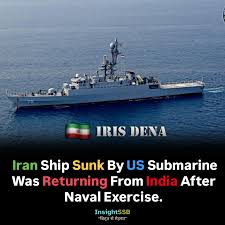
Please put all the latest news here. We would like to preface that we mourn ALL lives lost in this unnecessary conflict whether they are civilian (Iranian school girls, Israeli families, Iranian hospital patients) or military (American soldiers, Iranian sailors).

War has no victors.

Interesting screenshots after the jump. Continue reading Iran Zamin Open Thread

Operation “Righteous Fury”: Pakistani airstrikes on Afghanistan

Pakistan struck Afghanistan early Friday morning in response to Afghan attacks Thursday night on various locations in KPK.

According to Defense Minister Khawaja Asif, the Taliban have become “a proxy for India”.  Asif said: “Our patience has run out. Now there is an open war”.

Those criticizing this operation should recognize that this is exactly the playbook India used in “Operation Sindoor”.  War is obviously not a good outcome for anyone but national security trumps everything.  There had been a Qatar and Turkey mediated ceasefire between Pakistan and Afghanistan but the Taliban have clearly not clamped down on TTP.

There seems to have been a “rally around the flag” effect with even the PTI making social media posts in support of Pakistan’s armed forces.

DAWN’s live blog is here 


The Cantonment and the Clean Street: Why Pakistan’s Punjab Looks More Ordered Than India’s

A dispatch from a quieter Brown Pundits

The Observation

My Urdu teacher said something that lodged itself in my brain. India is vastly richer than Pakistan; and yet Pakistan’s Punjab, in his experience, feels cleaner. More ordered. Less like South Asia. I pushed back. Then I stopped.

The Numbers

In 2024, India’s GDP per capita was $2,695 against Pakistan’s $1,479; roughly 1.8 times higher on a nominal basis, and India’s total economy at $3.9 trillion is approximately ten times Pakistan’s $372 billion. Until 2008, Pakistan was actually richer per person; India led that measure for only 14 of the 60 years after independence. The divergence is real but recent and accelerating.

The sanitation data cuts against the perception: 81% of Indians have access to basic sanitation versus 72% of Pakistanis (WHO/UNICEF, 2024). On paper, India leads. So the paradox isn’t statistical. It is visual. The question isn’t who has more toilets. It is why certain Pakistani streets feel more governed.

The Answer: 41 Cantonments Continue reading The Cantonment and the Clean Street: Why Pakistan’s Punjab Looks More Ordered Than India’s

She Parked a Car With Her Husband. Fifty Years Later, She Is Still Waiting.

Before anything about this blog, its standards, or its arguments, I want to begin with a story; because sometimes a single human life cuts through every debate and reminds us what any of this is actually for.

Damayanti Tambay was 21 years old, a three-time national badminton champion, when she married Flight Lieutenant Vijay Tambay in April 1970. Twenty months later, war broke out. On 3 December 1971, they drove together to a garage in Ambala cantonment to park their bottle-green Fiat. That was the last time she saw him.

On 5 December, flying a strike mission over Shorkot Airbase in West Pakistan, Vijay was hit by anti-aircraft fire and ejected. Radio Pakistan later broadcast his name among those captured. Damayanti heard it alone. She felt relief. A prisoner of war comes home eventually, she thought.

He never did.

A Loving Wife’s Unending Search Continue reading She Parked a Car With Her Husband. Fifty Years Later, She Is Still Waiting.

Poorer Pakistan OutFoxes Richer India?

“No one wants a strong India. But PM Modi opened doors. He strengthened the military, advanced the economy, maintained balanced relations with the West, Russia, and China. That is serious statecraft” –Aleksandar Vučić, President of Serbia

India is richer

Strip away the noise and a simple asymmetry remains. India will almost certainly remain richer than Pakistan for the foreseeable future. The gap in GDP, fiscal depth, technology, and demographic scale is widening, not narrowing. On material indicators, India has the advantage. Yet material advantage does not always translate into strategic dominance.

India is louder

India is a mass democracy. It is electorally accountable, media-saturated, and sensitive to public opinion. Governments must justify escalation. Markets react to instability. Voters punish miscalculation. This imposes restraint.

Pakistan is tighter

Pakistan is structured differently. Power is narrower. Decision-making is concentrated within a smaller elite, with the military as the central institution. That creates rigidity in some domains but flexibility in others. Strategic continuity does not reset every five years. Public opinion matters, but it does not directly determine policy in the same way it does across the border.

Structural Differences

This structural difference shapes behaviour. India must think about global markets, coalition politics, and reputational cost. Pakistan can absorb economic stress more easily because its political system is already insulated from full electoral volatility. That insulation produces durability, even under strain.

The list gets smaller. There are six countries who sent the head of state/government to all three: 1) Beijing military parade 2) Davos Board of Peace launch 3) Washington BOP 1st meeting They are: Armenia | Azerbaijan | Indonesia | Kazakhstan | Pakistan | Uzbekistan

Like Israel Continue reading Poorer Pakistan OutFoxes Richer India?

Why is the Pakistani consumer so poor?

So a new edition of the T20 WC is coming up and it is already embroiled in some controversy. Bangladesh refused to play in India and ICC had them replaced with Scotland.

Cue the usual voices from Pakistan – “BCCICC”, “India’s money is ruining cricket” blah blah.

But it led me to ponder something – Pakistan itself has a huge population of 250 million + and it isn’t that “much” poorer than India. India’s GDP pci is $3050 while Pakistan’s is $1710 (around 1.8x) . Similarly India’s GDP is $4.51 trillion while Pak is $410.5 billion (around 11x).

So the other numbers should be in the same ratio right?

Here is where the difference comes

Revenue of cricket boards

BCCI – INR 20686 crore
PCB – INR 458 crore

That is around 45x

T20 leagues media rights

IPL – $6.2 billion for four years
PSL – $24 million for two years

That is around 130x (normalized on a per year basis)

And if you look at other stuff these huge ratios persist

Cars sold annually

India – 4.1 million
Pakistan – 200,000

Forex reserves

India – $710 billion
Pakistan – $21 billion

Stock exchange market caps

BSE – $5 trillion
PSE – $65 billion

Why do you think that is?

My theory is because the Pakistan military is stronger than the 1/10 ratio, it kind of effects everything else which leads to these lop sided ratios.

Give your thoughts in the comments below.

Brown Pundits