The historic day General Zia fooled the world using deception and illusion.
Tag: Pakistani history
Cholistan: The Desert at the Edge of Everything
There is a desert in the southern Punjab of Pakistan that does not quite belong to Pakistan. Administratively it sits in Bahawalpur Division. In practice, it is shared with Abu Dhabi. Deep in the Cholistan, there is a private airstrip, Al Habieb, also known locally as Sheikh Zayed Airport II, with a runway long enough to receive the world’s largest cargo aircraft. Each winter, C-17s and Antonov-124s arrive from the Gulf loaded with vehicles, staff, telecommunications equipment and falcons, depositing the UAE president and his court into what is effectively a private desert palace. The Houbara bustard, an endangered migratory bird that Bedouin tradition prizes above almost any other quarry, is hunted here under special permits issued by the Pakistani government to Gulf royalty. The airport at Bahawalpur proper was financed by Dubai. The international airport at Rahim Yar Khan, 200 km away, is named Sheikh Zayed International Airport after the UAE’s founding father, who considered this corner of Pakistan a regular retreat.
This is not a footnote. It is a civilisational signature. The Khaleeji sheikh pursuing the Houbara across Cholistani sand dunes is, without knowing it, re-enacting something very old: the desert as a shared zone, unbounded by the nation-states that nominally contain it. Cholistan does not belong to Pakistan. It does not belong to India, or Sindh, or Rajasthan. It is a seam; and seams, by definition, belong to no single side.
The Hinge of Seraikistan
The name Cholistan derives from the Turkic chol, sands, and the Persian suffix -istan. Both layers arrived later than the place itself. The culture that defines Cholistan is Derawali: the Seraiki dialect of the encampment, the dera. It is nomadic speech in the most literal sense. Its richness is not courtly but ambulatory.
Seraiki itself is one of South Asia’s underappreciated civilisational languages. For centuries it served as the lingua franca across the interface zones of the northwest, among Baloch, Sindhi, Pashtun and Punjabi speakers, as the language of trade and movement. Cholistan sits at the heart of Seraikistan, flanked by Sindh to the south, Rajasthan to the east, and greater Punjab to the north. It is not peripheral to these zones. It is where they meet, and where, historically, what they share becomes visible.
That structural position, edge as synthesis, is the key to understanding what Cholistan is.
The Dead River and the Living Civilisation
The Hakra River, the Sarasvati of Vedic memory, once flowed through Cholistan, fed by the Sutlej and the Yamuna. It sustained dense settlement from roughly 4000 BCE until 600 BCE, when it changed course and the floodplain became desert. Along its dried bed, over 400 Harappan archaeological sites have been catalogued; among the highest densities in the entire Indus Valley civilisation.
The people who now pursue camels across that same terrain, collecting water in seasonal pools called toba, are the cultural descendants of one of the ancient world’s great urban traditions. What looks like marginalisation is, on a longer view, adaptation. The civilisation did not collapse. It reconfigured.
This matters because it frames the deeper question: who were these people, before the Hakra died?
The Dravidian Puzzle
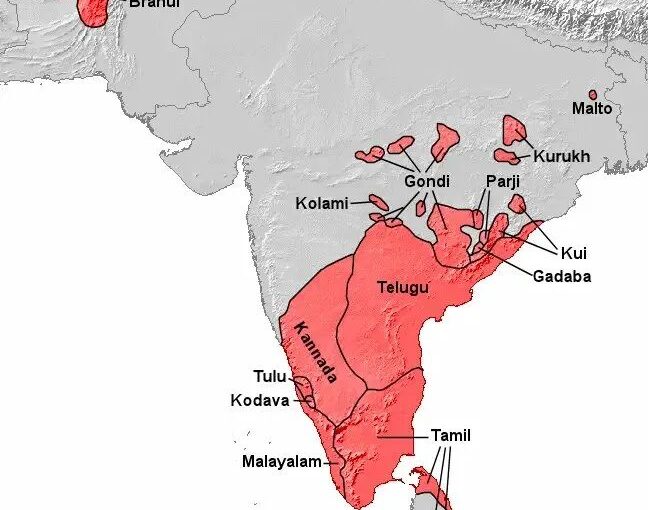
The map that accompanies this piece is one of the most quietly extraordinary images in South Asian studies. It shows the distribution of Dravidian languages today: a vast bloc across peninsular India, with isolated remnants in central India, Gondi, Kurukh, Malto, and then, stranded alone in Pakistani Balochistan, 1,500 km from its nearest linguistic relative: Brahui.
The scholarly consensus is that this map records the aftermath of Indo-Aryan expansion from the northwest after roughly 1500 BCE. Before that expansion, Dravidian languages were far more widely spoken across the subcontinent; including, most plausibly, across the Indus Valley civilisation zone that includes Cholistan. The central islands visible in the map, Gondi in Madhya Pradesh, Kurukh and Malto in Jharkhand and Odisha, are not coincidences. They are survivors.
Brahui is the most striking survivor of all. Its very existence in Balochistan suggests that something Dravidian persisted in the northwest long after Indo-Aryan became dominant; whether as a remnant population, a linguistic relic, or evidence of a deeper pre-Aryan substrate that stretched from the Indus to the Persian Gulf.
That last possibility is what the Elamo-Dravidian hypothesis proposes: a family linking the extinct Elamite language of ancient Khuzestan to Brahui and the Dravidian south. It remains a minority and contested position in linguistics, and should be read as such. But the geographic intuition behind it is not unreasonable. Khuzestan, now the Arab-majority southwestern province of Iran, was the heartland of Elamite civilisation. If Elamite and Proto-Dravidian shared a common ancestor, the implied civilisational corridor runs from the Persian Gulf coast through Makran and lower Balochistan, through Sindh and lower Punjab, and south into the peninsula. Cholistan sits directly in that corridor.
This is not established fact. It is a live and serious question, which is exactly the kind of question Brown Pundits exists to think about.
The Roma: The Longest Migration
One further thread, less speculative. The Roma, Europe’s largest ethnic minority, numbering somewhere between 10 and 15 million, originated in precisely this northwestern zone of South Asia. Genetic and linguistic evidence converges on Punjab and Rajasthan as the ancestral homeland, with significant shared ancestry also traceable to Sindhi, Balochi and Brahui populations in Pakistan. The Romani language is Indo-Aryan at root but carries innovations from the northwestern branch, Punjabi, Sindhi, consistent with an origin in the transitional zone between dialects, which is exactly where Cholistan sits.
The proto-Roma began their westward movement around the first millennium CE, passing through Persia and Armenia before entering the Byzantine world and eventually reaching Europe by the 13th century. They are the longest-range migration in South Asian history, and they began from the desert margin that Pakistani administrative maps label, prosically, Bahawalpur Division.
What Cholistan Teaches
Pakistan is discussed, almost always, in terms of its political present: the civil-military axis, the question of democratic consolidation, the India relationship, the nuclear deterrent, the IMF programme. These are real. They are also thin.
Cholistan is a reminder of the depth beneath the thinness. A Seraiki-Derawali nomadic culture whose civilisational roots predate Islam, predate the Indo-Aryans, and reach into a pre-Aryan substrate that may connect, linguistically and geographically, to the first cities on earth. A desert from which Europe’s most persecuted people likely began their diaspora. A terrain now seasonally occupied by Gulf monarchs pursuing an endangered bird across the ruins of a Harappan settlement.
The Hindu Presence
One further detail that the administrative map of Pakistan obscures: Cholistan retains a significant Hindu population. They are classified, in the caste framework, as Shudra; the lowest varna. But that classification tells you almost nothing about how they actually live.
In villages where Muslims and Hindus exist in roughly equal numbers, the communities are functionally indistinguishable by appearance, dress, or manner. Muslim neighbours organise protection for Hindu households during fairs and festivals not because there has ever been cause for alarm, but as a matter of custom and solidarity. Full social interaction is the norm. Intermarriage and commensality, sharing food across the line, are not. The boundary is observed without hostility.
What this means is precise: the racial and demographic integrity of the region is intact. These are the same people, shaped by the same desert, the same Hakra basin, the same pre-Aryan substrate. The religious difference arrived later than the people themselves. In Cholistan, you cannot tell a Hindu from a Muslim by looking. That is not erasure of difference. It is evidence of a shared civilisational root that predates the categories imposed upon it.
The Crescent and the Saffron are medieval categories imposed on a Neolithic reality. Cholistan predates both, and will outlast the argument.

Open Thread – “Open War” breaks out between Pakistan and Afghanistan
This is a quote from Pakistan’s ‘defence minister’ from a couple of hours ago. There is a shooting war on the Durand line, and the PAF has bombed Kabul and Kandahar, including the airport, Taliban ministry buildings and other non-military targets.
This round of AfPak hostilities kicked off with a ‘surgical airstrike’ by Pakistan into Afghanistan that resulted in multiple civilian deaths. The Taliban retaliated by attacking Pakistani border outposts on the Durand Line, and claim to have captured more than a dozen of them, with Pakistani POWs and KIA. In response, the PAF has now bombed Kabul and Kandahar.
The Taliban, the erstwhile creation of the ISI, is now at war with Pakistan. Where does this go from here?
Operation “Righteous Fury”: Pakistani airstrikes on Afghanistan
Pakistan struck Afghanistan early Friday morning in response to Afghan attacks Thursday night on various locations in KPK.
According to Defense Minister Khawaja Asif, the Taliban have become “a proxy for India”. Asif said: “Our patience has run out. Now there is an open war”.
Those criticizing this operation should recognize that this is exactly the playbook India used in “Operation Sindoor”. War is obviously not a good outcome for anyone but national security trumps everything. There had been a Qatar and Turkey mediated ceasefire between Pakistan and Afghanistan but the Taliban have clearly not clamped down on TTP.
There seems to have been a “rally around the flag” effect with even the PTI making social media posts in support of Pakistan’s armed forces.
DAWN’s live blog is here
Bangladesh
Bangladesh swears in its first male prime minister in 35 years Tarique Rahman.
The morning after the monsoon: Bangladesh votes for a fresh start
Bangladesh Nationalist Party leader Tarique Rahman, takes the oath as Prime Minister of Bangladesh 17 February. Screenshot BBC News report.
Intro
The electorate of this delta nation has given politicians another opportunity to build a democratic, peaceful and harmonious nation. The road ahead is challenging, but some tasks are achievable
Opinion
By Irfan Chowdhury / Sapan News
If democracy had a scent, in Bangladesh it would be the acrid smell of burning tires. For nearly four decades, elections in this delta nation have been martial events, marred by strikes, machetes, and the terrifying silence of the “hartal” (strike). Yet, as the sun rose over the river Buriganga on 13 February, the air was clear. The 13th Parliamentary Election, held the previous day, did not end in bloodshed. It ended in queuing.
For the first time since 2008, Bangladeshis cast ballots that were actually counted. And they delivered a verdict that is as decisive as it is retrograde.
As the final tallies from the election trickled into the Election Commission’s headquarters, the air of revolutionary fervour was replaced by the cold math of electoral reality. The Bangladesh Nationalist Party has returned from the political wilderness with a crushing two-thirds majority.
The numbers are startling. The Nationalist Party and its allies secured 212 out of 300 seats, an absolute majority that gives their leader, Tarique Rahman, the mandate to reshape the republic. For Rahman — the son of the late President Ziaur Rahman and former Prime Minister Khaleda Zia who passed away recently — this is a personal and political vindication. Having led the party from a self-imposed exile in London for nearly two decades, he returns to the centre of power
Pakistan’s dramatic drop in fertility
Meanwhile, Pakistan’s average number of children per woman has dropped sharply from 3.61 in 2023 to 3.19 in 2024, reflecting shifting fertility patterns. By comparison, India’s rate declined more modestly from 2.14 to 2.12.
Why women in South Asia are aging faster than in Europe, US
Those are not marginal adjustments. That is acceleration. For decades, Pakistan was treated as a demographic outlier. India fell below replacement. Bangladesh stabilised. Iran collapsed to European levels. Turkey dropped. The Gulf states hollowed out. Pakistan remained “young.” That youth dividend now looks fragile.
Economic Pressures
The fertility transition is no longer creeping. It is sprinting. The familiar explanation is economic pressure. Urban housing costs more. Education lasts longer. Children are expensive. Women delay marriage. This is all true but incomplete. The deeper shift is cultural. Modernity changes how individuals see time.
Rural Norms
In agrarian societies, children are labour, security, and continuity. In urban societies, children are choice. Once children become a choice rather than a necessity, fertility becomes elastic. It bends downward.
Social Media Continue reading Pakistan’s dramatic drop in fertility
Pakistan’s Civilisational Orphanhood
The argument over Balochistan exposed something deeper than maps or borders. It revealed a confusion about what Pakistan is supposed to belong to.
Formally, Pakistan is one of the most nationalistic states on earth. Its red lines are absolute. Its territorial language is uncompromising. Its founding trauma has hardened into doctrine. And yet, beneath this rigidity sits a quieter truth: Pakistan’s elite does not actually live inside a closed nation-state imagination. They live in English.
They think in Western legal categories, read Western literature, speak the language of international institutions, and send their children into global circuits of education and finance. At the same time, their social world remains unmistakably South Asian; family-centred, hierarchical, ritualised, and deeply embedded in subcontinental habit. They are neither fully Western nor comfortably Indic. This produces a tension that Pakistan has never resolved.
The Nation-State After 1945: A Container That No Longer Holds
Why Pakistani Liberals Remain a Colonised Intellectual Class
The exchange (which has now been removed after mutual agreement) that just unfolded was not about architecture. It was about authority.
SD made factual errors, quietly corrected them, and apologised in private. That should have ended the matter. Instead, the loudest resistance came from Kabir: a reflex insistence that disagreement was illegitimate because the author was “credentialed,” “Oxford,” and therefore beyond challenge.
This is the residue of colonisation. Pakistanis were not only carved out of British India; they were produced by the collapse of a Muslim ruling class already broken by the British after the destruction of Mughal power. What followed was not confidence but deference. The habit of looking upward, to Western institutions, American accents, British titles, for permission to speak. That habit persists. Continue reading Why Pakistani Liberals Remain a Colonised Intellectual Class
Pakistan Is Not About to Break Apart
There is a persistent habit, especially among our soi-disant commentators, of predicting Pakistan’s imminent disintegration. The arguments are familiar: Baloch insurgency, Pashtun irredentism, low Kashmiri fertility, economic weakness, and analogies to 1971. They are also, taken together, wrong.
To begin with, most people discussing Pakistan do not understand its internal sociology. They begin with a conclusion, “Pakistan is artificial and unstable”, and then select facts to confirm it. This is confirmation bias dressed up as analysis.
Consider the Pashtuns. The claim that they are natural irredentists misunderstands who they are and how they live. Pashtuns in Pakistan are not a marginal population looking across the border for salvation. They are deeply integrated into the Pakistani state, economy, and military. They dominate transport, logistics, security, and large parts of urban informal commerce. Large numbers have moved permanently into Karachi, Lahore, and Islamabad. Assimilation is not failing; it is proceeding at scale. Continue reading Pakistan Is Not About to Break Apart
A BP Retrospective: Balochistan in 2014
With Dhurandhar currently screening and causing a bit of controversy, including on this blog, it’s interesting to note that one of the earliest posts on here was actually on the same issue that was a big part of the background story of that film: Balochi independence and nationalist movements.