The United Colors of India

…..I am a Hindu, but that is an absurd thing to say….there is
nothing like a Hindu…..I am a Brahmin….that doesn’t describe me either…..I am a Hindu in a broad way….Ganga is sacred, Ramayana and the Mahabharata, Upanishads
have deep spiritual insights….All this I believe…..I believe what my
ancestors believed, that is, there is not one God…. Hinduism is also
difficult because it is based on hierarchies…..

….
We are largely in agreement with UR Ananthamurthy – hero of the left-liberals and a (Brahmin) disciple of (Shudra Socialist) Ram Manohar Lohia – that India should find a common path forward based on harmonizing Gandhian and Ambedkarite principles. Except that the true devil is in the details…Gandhi disliked Western societal mores…Ambedkar was passionate about the American way.

We would like to expand the pantheon by borrowing a liberal lion from the West, such as John Stuart Mill or Thomas Paine. If there is a demand for a C20 inspirational figure then we propose Vaclav Havel…because of his life experiences under a non-liberal regime. Next, a humanist/atheist like Richard Dawkins (or Sam Harris, Christopher Hitchens,…) because we would like India (and Indians) to move away from religion and towards humanism.  

Finally as one of the great Indians (re: Ramchandra Guha, see details below) and as a woman, we would recommend Kamaladevi Chattopadhyay (or Sarojini Naidu), the freedom fighter and social reformer.
………………….
Earlier this year, Udipi Rajago­pa­la­charya Ananthamurthy
(URA), the Jnanpith award-winning Kannada novelist, educationist and
public intellectual, had declared that he would not live in an India run
by Narendra Modi. This had provoked lacerating responses from
right-wing Hindutva supporters. URA breathed his last on August 22,
2014, before the Modi government completed 100 days in office. ….

Chandan Gowda
of the Azim Premji University had interviewed the litterateur for an
eight-part Doordarshan series, telecast in June and July. It is possibly
URA’s last major interview. Excerpts:


….
What parts of the Gandhian legacy are important for you?

His suspicion of the modern world system is one. The modern world
system will destroy the earth, will destroy the sky, will destroy the
balance bet­ween nature and man because it is very greedy. Gandhi’s
rejection was sometimes extreme. But extremes can open the gate of
heaven, that’s what they have said. 


So Gandhi exaggerated at times, but
in the main you know that. He used trains all the time. But he said we
could live without trains. He rightly feared centralisation. Gandhi was
also friendly towards nature. There are many valuable Gandhian ideas.
The whole idea that small is beautiful comes from Gandhi. So he wanted
such ideas to govern the whole country. He didn’t like big buildings.


….
How do you view Nehru’s legacy?

I can still say primary education should  be nationalised and that
the healthcare system should also be nationalised. Where do I get these
ideas from? I get them from Nehru and, later, Indira Gandhi. We get
something very wholesome from the Nehruvian tradition.


….
What has Ambedkar meant for India’s politics in the 20th century?

I think nobody can help the Dalits reg­ain their self-respect as much
as Ambedkar can. Gandhi makes them regain their self-respect, but when
they regain it, you know, they will be softer than what they are. But
with Ambedkar, they can be themselves and still get self-respect. 

..
Ambedkar was a socialist and had a legal mind. His becoming a Buddhist
is very important for me. It’s not merely a political act. It’s a deep
act of self-purification. So Gandhi and Ambedkar began with two
different directions but they meet at one point, wanting spiritually
enhanced visions.


….
Lohia has meant a lot for you as a writer and thinker. How do you evaluate Lohia’s criticism of tradition?
I learnt a great deal from Lohia—to become what I have always called a
critical insider. Lohia was a very great critical insider. He absorbed a
lot from India’s spiritual traditions. He has written a great book, Interval During Politics, which has essays on Valmiki, on Vyasa, on Rama, Krishna, Shiva. They are great. 


Another great essay called Lessons in Yoga
shows he was deeply rooted in tradition. He knew his Shankaracharya
too. But he was very critical of the Brahminical element, which becomes
more and more important as Indian civilisation evolves. He was also
critical of the Shudras behaving in Brahmin ways. His opposition to
English as a language of knowledge was important to me.


….
Lohia was able to produce more pol­itical leaders than Nehru did.
Nehru inherited his friends from his party, but Lohia created a new
leadership. You find it in Uttar Pradesh and Bihar. Mulayam Singh Yadav
and Laloo Prasad Yadav, for example, are products of Lohia’s movement.
And Karnataka too has seen many fine socialist leaders. Unfortunately,
the socialist leadership became populist in some places. Lohia himself
was critical of these trends. He wanted some anarchy so that India kept
thinking of alternatives.


…..
How have you understood your relation with the Hindu dharma?

I am a Hindu, but that is an absurd thing to say. I mean, there is
nothing like a Hindu. I should say I am a Brahmin, to be very exact. But
that doesn’t describe me either, because I have given up the
ritualistic part of the Brahmin religion. 


I am a Hindu in a broad way,
in the sense that all of us believe that the Ganga is sacred, that the
Ramayana and the Mahabharata, our two great epics, and the Upanishads
have deep spiritual insights. All this I believe. I believe what my
ancestors believed, that is, there is not one God but we can imagine
several gods and describe them in different ways…. Hinduism is also
difficult because it is based on hierarchies.


….
Has anything about Indian politics struck you as mysterious?

The fact that if you are an ascetic and if you have given up
everything, you can go beyond language, religion, caste, and appeal to
the whole country. You know when Gandhi emerged, it was a mysterious
thing, because he was neither a Bengali nor a Maharashtrian. All great
leaders until then had come from eit­her Bengal or Maharashtra.


….
How do you understand the need for swaraj in thought in India today?

I an not too passionately involved in what they call the desi,
because you will not find the pure desi when you search for it. It is
based on Sanskrit; it is mixed with Persian; it’s linked with different
rulers at different times.  There is nothing pure even in our folklore.
Therefore, I am more a follo­wer of Pampa (the 10th century Kan­­­nada
Jain poet), who wanted to combine the desi with the marga.


All my writing is a combination of the desi and the marga. I have
perhaps more marga in me than desi. But there is something like swaraj
in ideas. I have a feeling that we have become second-rate imitators of
the West. There was absolutely no original thought in India, except for
Gandhi, over the last two centuries. He was the only original thinker
and he had the courage to imag­ine a world without railways, without
technology, without whatever Britain brought to India. He could conceive
of a world without these and hence some kind of swadeshi chintana was
possible for him, that we can survive without the aid of the West. That
we can be intellectual without depending heavily on western thinkers.


….
What are the challenges facing someone who chooses to write about India in English?

Anyone who writes in English should be deeply knowledgeable about at
least one Indian language. I say this for all journalists too. You
cannot be an English journalist in Karnataka unless you know Kannada.
Similarly, for anthropological, sociological and other kinds of
writing.  I think it is very necessary to know how people think, how
people feel. You should be able to grasp that. And an ins­tinctive grasp
becomes possible if you know the language of the people.


….
Does it matter very much to you that people like you?

I enjoy being liked. Though I am ill, I forget I am ill because of
the affection and warmth I get from people who read me, who remember
what I write, who write me letters. I like it very much.


….
Could you tell us how you would like to be rem­embered?

As a Kannada writer. For having made a contribution to Kannada
through my works…that there are many younger writers who will get
something from me, because I have brought whatever I could from my own
past, from my Brahminical past, from the European world, from my various
experiences, and from my probing of my own self into the Kannada
language. It might be a threatened language in the modern world, but I
have worked against the threat and that is an achievement. I would like
to be remembered as a teacher, as a writer.

…………..

Consider, in this regard, the current invisibility from
the national discourse of Kamaladevi Chattopadhyaya. Married to a man
chosen by her family, she was widowed early, and then married a
left-wing actor from another part of India. She joined the freedom
movement, persuading Gandhi to allow women to court arrest during the
Salt March and after.

After coming out of jail,
Kamaladevi became active in trade union work, and travelled to the
United States, where she explained the relevance of civil disobedience
to black activists (her turn in the South is compellingly described in
Nico Slate’s recent book Colored Cosmopolitanism). 

After
Independence and Partition, Kamaladevi supervised the resettlement of
refugees; still later, she set up an all-India network of artisanal
cooperatives, and established a national crafts museum as well as a
national academy for music and dance. 

Tragically, because her work
cannot be seen through an exclusively political lens, and because her
versatility cannot be captured by a sect or special interest, Kamaladevi
is a forgotten figure today. Yet, from this historian’s point of view,
she has strong claims to being regarded as the greatest Indian woman of
modern times.

……

Link(1): http://www.outlookindia.com/printarticle.aspx?291808

Link (2): hindu.com/indians-great-greater-greatest

……

regards
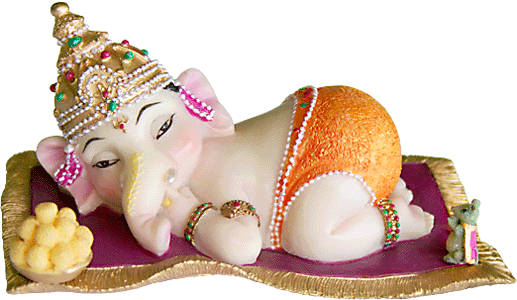
The “Disney” God and Blasphemy

….“The guy who couldn’t save his own head from being cut, how
he will save others heads is my question?….Happy Ganpathi day to morons!”….
“Can someone tell me if
today is the day Ganesha was originally born or is it the day his dad cut his
head off?”
…..“love to know from devotees a list of what obstacles he removed” ……”All tweets I put on Ganesha….unintended to hurt anyone’s sentiments…but if they did I sincerely apologize”….


….

….
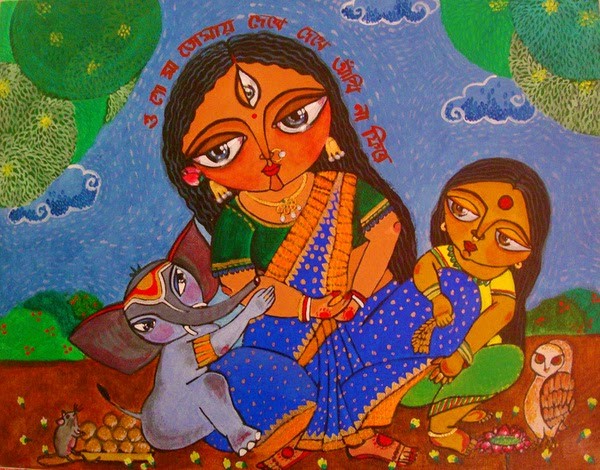
Best wishes on Ganesha Chaturthi to all believers and fans. We have to admit, we do think of Ganesha as a cutie pie. Also he is mama’s golden boy and you know that no one crosses his mom and lives to tell about it (ask the demon Mahisha-Asura).
……

…..
Incidentally this reminds us of the Tamizh commandment: kakaikku than konju pon konju….literally my crow is a golden crow.…figuratively, the love a mother feels for her child who is not blessed with the best of appearances…
…….


BTW if you are curious to know how left-liberals think about Ganesha just follow Ram Gopal Varma on Twitter. RGV is originally from Vijayawada, Andhra Pradesh and he is a super-hit director in both the Hindi and Telugu film world. His top movie is Satya (we also rate Rangeela), which Danny Boyle has claimed as an inspiration for Slumdog Millionaire (that must be a first…a western director…for real or for show….claims to being inspired by Bollywood).

In an ideal world, we would be most happy if the liberals established a hegemony in which we could crack jokes (even mean jokes) about religion and the religious…all of them. The sheer number of ridiculous religious leaders in India (and in the wider world) presents endless opportunities for (black) comedy. But we would propose to do it in a fair-minded and even-handed manner, or we are in danger of looking ridiculous ourselves. RGV we are sure, thinks twice about breaching some boundaries than others. Why is that?

Now, we should be clear that RGV is entitled to his views and opinions, but we fail to see what good comes out of this tamasha. From a political standpoint he is acting like a recruiting agent for the BJP.

Poking the crocodile is a lot of fun…sure, but then why crawl back with the apologies? Be a big boy and dish it out and be prepared to accept the consequences…in the extreme case be prepared to go to jail and start a new life-edition as a free speech martyr (we fully support him in that battle).

RGV considers himself as a man on a mission…to remove the cobwebs of superstition from the minds of deluded people. This is a fine and honest goal. Thomas Jefferson was also a man on a mission and he said that the tree of liberty must be refreshed from time to time with the blood of patriots and tyrants. RGV should have boldly stood up for (all) free speech and the free-flowing blood would have helped the tiny sapling to grow into a massive banyan tree.

We did like some of the non-inflamed responses, especially the one by “Subodh” who made a sporting attempt to respond to Shri RGV (questions marked below in bold and in red).
…………

It is painful to see that those who take pride in Hindu religion
couldn’t answer any of his questions and instead childishly chided him
for insulting Hindu gods. If you can’t answer legitimate questions about
the gods that you worship, you should stop being so religious.

His
questions were hardly that difficult to answer..With a little bit of
wit and wisdom, anyone could have answered them, but sadly the IQ levels
of ‘bhakts’ and also their knowledge about their religion is very low.

Here’s how you need to respond to silly questions..

Q-
What did Ganesha do that his brother Kumara dint do so that only
Ganesha became god? Is it becos Kumara dint get head cut off like
Ganesha?

A – He was cuter, wiser, wittier and hence gathered more
followers. Like in movie industry where more the fans you have, the
bigger screen god you become, in heavens too children of gods who gather
more followers become bigger gods.

Q – Can someone tell me if today is the day Ganesha was originally born or is it the day his dad cut his head off?
A
– Today’s the day we don’t ask silly questions about gods we worship
and use our brains to understand the symbolism behind mythological tales
of gods.

Q – Does Lord Ganesha eat with his hands or his trunk?
A – He eats with his mouth

Q – I have an innocent question…can someone please tell me how a Lord who couldn’t save his own head will save others heads?
A
– A local wrestler might not be able to win against a national or
Olympic level wrestler but he can save you from a local goon. Same way,
Ganesha couldn’t save his head from a more powerful god – his father,
but is capable of saving heads of mere mortals.

Q – Does Lord Ganesha eat much more than other Gods? My doubt is becos all the other Gods are either trim or muscular
A
– Not really. Buddha is trim when he is meditating, but when he starts
laughing and becomes ‘Laughing Buddha’ he develops a big paunch

Q – Did Lord Ganesha have a paunch in his childhood too or did it develop in the recovery time of the elephant head operation?
A – His mother, Parvati, sculpted him..and since all moms like cute and cuddly children, she sculpted him with a paunch

Q – Can someone explain how someone can cut off a child’s head who was just trying to protect his mother’s modesty?
A
– Can you explain how you can eat meat of chicken, goats, pigs and
other innocent animals knowing that the poor creatures are just trying
to enjoy life with their family

…..
No religion has a god as child-friendly as Lord Ganesha. Animal heads on
divine beings is not quite unknown in other religions. The Egyptians
had several but let’s face it when it comes to terms of endearment,
jackals and falcons just cannot compare to an elephant.

It was a particular elephant’s bad luck but Hinduism’s good fortune,
that when Lord Shiva went looking for a head to replace the human one he
had lopped off, he came across an elephant, some say Indra’s mount
Airavata and not an annoying crow or a fearsome tiger. That would have
given our Ganesha a very different temperament.

But with his elephant head, Ganesha becomes the most genial of all gods
especially for a young child. The broken tusk makes him vulnerable. The
plump belly makes him comforting. He is virtuous as gods are supposed to
be but exudes a more approachable friendliness. 

….
Though Hindu children
routinely and religiously pray to Saraswati for a little help during
examinations, no one would make a children’s film called My Friend
Saraswati. But it makes perfect sense for a lonely boy neglected by his
parents to find a buddy and fairy godfather rolled into one in the
elephant-headed god in My Friend Ganesha.

Ganesha isn’t just friendly. He also has a certain kind of smart that a kid can instantly relate to.

….

Take that story of Ganesha and Kartikeya and their great race to
circumnavigate the world. While Kartikeya huffed and puffed and set off
at great speed to go around the world, Ganesha just sat his parents down
and went around them. It was so incredible to read it on the colorful
pages of Amar Chitra Katha and know that the handsome, super-athletic
school jock didn’t always have to win the race.


….

Without being in the least bit preachy, it also told us not to
underestimate the kid who looked a little odd, the class misfit, the one
the other children might laugh at. We could instantly relate to it
because it was a story about sibling rivalry but one that thankfully did
not end in the bloody trauma of Cain and Abel. But most reassuringly,
it reiterated splendidly what as children we intuitively grasped – our
parents are the centre of our worlds. (Of course perhaps that’s also why
parents never tire of telling that story to their children.)


….

As a child there were things that mystified me about Ganesh. How did
someone of his girth ride a mouse? Why did an elephant’s head make the
rest of him so roly-poly? In the Bengali iconography during Durga Puja
he came with a kola-bou, a banana tree draped in a white sari with a red
border. Though scholars have argued whether the kola-bou was his bride
or a representation of the Mother Goddess herself, as a child I was
always worried the elephant-headed god might snack on his banana-plant
bride in an incautious moment.


…..

Amar Chitra Katha had no answers to these conundrums and Devdutt
Pattanaik had not yet written his 99 Thoughts on Ganesha. The story of
his creation itself, I discovered later, had been sanitized and
tempered. 

….
Parvati creates Ganesha as her little gatekeeper out of the
rubbings of turmeric paste she has anointed herself with. He is
Vinayaka, the son born without the help of a husband.
When Shiva lops
his head off for the effrontery of denying him entrance, Parvati is
inconsolable. Firstpost’s
Lakshmi Chaudhry recalled her daughter coming back from school and
telling her a more “family-friendly” version of that story.
 

“Parvati felt so sad when Shiva killed her little boy, she
started crying,” she said, explaining how Shiva replaced his head to
soothe his distraught wife. This was definitely not my grandmother’s
Ganesha story. 

….
My daughter’s very progressive pre-school had sanitised
the myth to fit the portrait of a happy modern nuclear family. Don’t
worry, good daddies comfort sad mommies, and make it all okay.
“No,
baby, Parvati was so angry that she vowed to destroy the entire
universe,” I corrected her,
“The gods were so terrified that they ran to
Shiva and begged him to bring the boy back to life.” The Parvati I grew
up with was not a heart-broken waif, but powerful and feared goddess
whose wrath had to be appeased in order to save all creation.

………
That says more about our discomfort with powerful females than anything
about Ganesha. But the sweetness of the teary Parvati also makes it a
better bedtime story and gives Ganesha an extra dose of cuddliness.
Ironically the very qualities that have made him both beloved and
lovable have also been his greatest handicap.

In Hinduism he might be the Remover of Obstacles but outside the faith
he has become more cute and less god. In a world of animated films where
animals routinely talk in human voices, Ganesha, to much of the world,
belongs to a different pantheon – more Disney than God. 

…..
But unlike a
Disney character he is in the public domain – free to be emblazoned on
t-shirts, keychains, lunchboxes. And unfortunately he also ends up on
things he should never be. American Eagle put him on slippers. Sittin’
Pretty put him on toilet seats. Café Press put Ganesha and other gods on
thongs and $79 yoga mats.

….
Bollywood-themed parties in the West put up
statues of Ganesha and Buddha for that exotic touch while belly-dancers
gyrate and the bartender mixes cocktails. A party organizer in San
Francisco once said she would try and educate her clients about the
significance of religious symbols and put up signage explaining them but
she was not sure that anyone cared after the “third shot of tequila”.

Were the companies intending to disrespect Hinduism? Probably not.
Ganesh to them was just a cool iconic image. But the danger of cool is
then even a God becomes a commodity to be bought and sold. The god who
removes obstacles seems helpless when the juggernaut of popular culture
turns him into a potbellied party prop.

Pattanaik says
reassuringly that though he’s been turned into celluloid cartoons and
plastic China-made dashboard displays, “Ganesha does not mind, so long
as we appreciate the realm of his mother, and aspire for the realm of
his father.” Perhaps that’s true. But still one should think long and
hard before annoying any god especially one with the memory of an
elephant.

……

Link (1): ram-gopal-varma-trolls-lord-ganesha

Link (2): the-challenges-of-being-ganesha
…..

regards

OSO for BKS

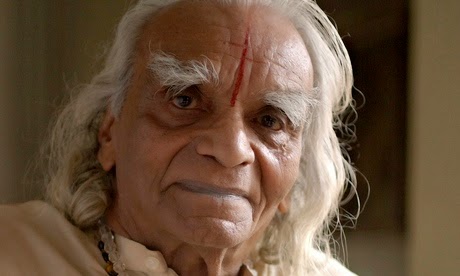
That would be Om Shanti Om (TM) – our brand new modi-fied version of Rest In Peace – for Bellur Krishnam-acharya Sundara-raja Iyengar (December 14, 1918 – August 20, 2014).
…….


He is the Guru-ji, who single-handedly created the world-wide Yoga brand (though some naughty people attribute the popularity to Christy Turlington). We are not passionate about Yoga, however it is impolite to say so in academic, left-liberal circles- both in the USA and in India.

We do believe that Yoga provides health benefits…but only for the true believers. Of course, the good thing about Yoga is that believers come in all shapes, sizes and ages. We have been amazed to see seventy year olds doing asanas with ease, the ones we had to work hard over in our teens. Today, Yoga is a multi billion dollar enterprise and Indians are not doing too poorly as new-age entrepreneurs (example: Baba Ramdev). Soft power and all that.
……


All in all, BKS was an inspiration to countless folks, a good man who said “Physical health is not a commodity to be bargained for….Nor
can it be swallowed in the form of drugs and pills – it has to be
earned through sweat. It is something that we must build up.”
Right on, dear sir, and may you enjoy your brief moments of peace up in the stars before you recycle back to this nasty old earth.
……………
BKS Iyengar, the Indian yoga guru credited with helping to fuel a global explosion in the popularity of the ancient spiritual practice, has died aged 95. Iyengar
started his yoga school in 1973 in the western city of Pune, developing
a unique form of the practice that he said anyone could follow.

…….
He
trained hundreds of teachers to disseminate his approach, which uses
props such as belts and ropes to help novice practitioners achieve the
poses. He wrote many books on yoga, which has been practised in
Asia for more than 2,000 years, and has in recent decades become hugely
popular around the world.

His insistence on perfecting the poses – or asanas – won him a huge following, among them celebrity fans ranging from the cricketer Sachin Tendulkar to the writer Aldous Huxley.

It
was an encounter with the violinist Yehudi Menuhin, who came across
Iyengar during a trip to Mumbai in the 1950s, that prompted him to take
his practice global. “Perhaps no one has done more than Mr Iyengar to bring yoga to the west,” said the New York Times in a 2002 profile of the guru.

“Long
before Christy Turlington was gracing magazine covers, decades before
power yoga was a multimillion-dollar business, Mr Iyengar was teaching
Americans, among others, the virtues of asanas and breath control.”
US
model Turlington graced the front cover of Time magazine in a
cross-legged pose for a 2001 report on the explosion in yoga’s
popularity.

Critics say the global expansion of yoga into western
gyms and fitness centres has taken the practice too far from its
spiritual origins. But Iyengar said it was unfair to blame yogis.
“It all depends on what state of mind the practitioner is in when he is
doing yoga,” he said last year in an interview with Indian newspaper
Mint. “For the aberration, don’t blame yoga or the whole community of yogis.”

His website carried a picture of Iyengar’s smiling face beside a
message that read: “I always tell people, ‘Live happily and die
majestically.’ 14 Dec 1918 – 20 Aug 2014.”

Despite suffering a heart attack at 80, he had continued to practise yoga into his 90s.
He
suffered from ill health as a child but found that he could improve his
strength by practising yoga, which he took up as a teenager.

When
he was 18, his guru sent him to teach in Pune because he spoke some
English. There, he developed his own form of yoga, eventually opening
his own institute.

There are now over 100 Iyengar yoga institutes around the world.

Iyengar is survived by a son and a daughter. He will be cremated on Wednesday afternoon.

…….

Link: www.theguardian.com/bks-iyengar-guru-global-yoga-dies

…..

regards

Hinduism is a “banyan tree”

…..The essence of
Hinduism is that it has no essence……What defines Hinduism and sets it apart
from other major religions is its polycentricity, its admission of multiple
centers of belief and practice, with a consequent absence of any single
structure of theological or liturgical power….Hinduism is
a banyan tree, in the shade of whose canopy, supported by not one but many
trunks, a great diversity of thought and action is sustained….


A wart-free, sanitized version, but nevertheless (in our opinion) a good first primer…

Most Hindus would be hard-pressed to define Hinduism (we say this as a non-believer but with deepest sincerity). Having said that it is our observation that Hinduism is evolving fast and becoming a very different entity than what it was even a few decades ago. In our opinion (and in our little corner of the world) this is just as important as the transformation of Islam into a more austere, back to the roots version (which is also very different from what it was a few decades ago).

Take the example of caste. We are admittedly a bit too fond of the – ”Syrian Christians are Brahmins” – gag (thus, Arundhati Roy is a Brahmin from her mother’s side).  Even though people have called us haters for saying this but still…we have met a fair, few SyCh-s and they have (even in short conversations) always managed to bring up this “fact.” In a country where lot of people (majority) equate folk-lore with history, such a deeply held belief probably should be accepted as fact.

In our (non-scholarly) opinion, caste is but a tribe, we have a million castes and a zillion tribes in modern India. We would even go so far as to argue that the Kayasthas of Uttar Pradesh (Saxena, Srivastava, Mathur, Bhatnagar, Gaur, Asthana, Nigam, Kulshrestha,…) are a different tribe than the Kayasthas from Bengal (Ghosh, Basu, Mitra, Dutta,…), even though folk-lore states that Kayasthas (and other super-castes) were “imported” from UP to Bengal any centuries ago.
……
What is the relationship between Hinduism and caste? Without delving too deep into the question (we do not have the knowledge base to do so) we ask another related question. Which came first: association as Hindus or dissociation as castes? If caste=tribe assumption is correct, then it may well be that society was divided into castes before developing a common set of rituals that we now recognize to be as part of Hinduism. The philosophical foundations of caste were possibly added post-hoc by Hindu scholars.

What is the significance of Gotra? It is possible of people from different castes to have the same gotra (and vice versa). To us, this seems like a contradiction in terms, unless it is also recognized that caste is not defined (and was not originally) defined rigidly.

The march towards a common Canon-feasible? The left-liberals assure us that such a thing is inconceivable. However (again as an outsider) it seems that this is exactly what the Hindutva project is all about. To the extent this process is influenced by the Arya Samaj, Hinduism should be ready to abolish idolatry, caste and ancestral worship (starting with cremation rituals). The Hindu religion (official version) will look a bit like Islam!!! But unofficially, we doubt that Hindus will ever be able to get rid of idolatry- it is actually the one big differentiator.

Is it possible to abolish caste? We are seeing this in both ways. The opinion makers- the middle class (derived from all castes and from other religions) – have become more protective about caste identity. At the same time urban lifestyle (and western values that are creeping upon us all the time) is anti-caste. Remove the iron rod of religion and no guardian can stop a Hindu boy falling in love with a Muslim girl (to take the most extreme case of societal bridge building).

Eventually we are hopeful that caste will become ceremonial in nature: yes, we like to know where you came from. But that is not your only identity or even the primary identity. You are a human being, first and foremost. Make this society (and country and world) a better place to live (preferably through non-violent means), or step out of the way. This will only happen when the Dalits get their fair share (starting with a Dalit Prime Minister).

The USA has managed to elect a black man (twice) as top dog (if one chooses to be picky about ancestry, having a Kenyan papa is not the same as having a black-american dad). In India, a Maha-Dalit (the lowest in the caste ladder) became the Chief Minister of Bihar (after Nitish Kumar was crushed by the Tsunamo and stepped aside).

The USA is also getting prepared to elect a Madame President in 2016. If Mayawati manages to secure the top spot she would do so as the first unmarried, Dalit woman, who was also mentored by a Dalit (Kanshi Ram, no relation). That would be a truly defining moment for modern India.  

Religion will probably stay with us (unfortunately). It helps define the “other” as much as it defines ourselves. Canon or no canon, Hinduism will be defined as the un-Islam, Sikhism as un-Islam and un-Hindu, and so on….
……………….

Gary Gutting: How might looking at Hinduism
alter philosophical approaches to religion that take Christianity as their
primary example?

Jonardon Ganeri: Taking
Christianity as the exemplar of religion skews philosophical discussion towards
attempts to solve, resolve or dissolve difficult philosophical puzzles inherent
in monotheism: problems about God’s powers, goodness and knowledge; attempts to
provide rational arguments for God’s existence; the problem of evil; and so on.
Hindu philosophers have traditionally been far more interested in a quite
different array of problems, especially questions about the nature of religious
knowledge and religious language, initially arising from their concerns with
the Veda as a sacred eternal text and as a source of ritual and moral law.

G.G.: Does this mean that
Hinduism is a religion without God?

J.G.: Many Hindus believe in God, but not
all in the same God: For some it is Vishnu, for others Shiva, for others again
it is rather the Goddess. Some of the more important Hindu philosophers are
atheists, arguing that no sacred religious text such as the Veda could be the
word of God, since authorship, even divine authorship, implies the logical
possibility of error. Whether believed in or not, a personal God does not
figure prominently as the source of the idea of the divine, and instead
non-theistic concepts of the divine prevail.

…..
G.G.: What do you mean by
“non-theistic” concepts of the divine?

J.G.: One such concept
sees the text of the Veda as itself divine. Its language, on this view, has a
structure that is prior to and isomorphic with the structure of the world and
its grammar is complete (although parts may have been lost over the centuries).
The divinity of the text inverts the order of priority between text and author:
Now, at best, assignment of authorship is a cataloging device not the
identification of origin. Recitation of the text is itself a religious act.

Another Hindu conception of the divine is that it is
the essential reality in comparison to which all else is only concealing
appearance. This is the concept one finds in the Upanishads. Philosophically
the most important claim the Upanishads make is that the essence of each person
is also the essence of all things’; the human self and brahman (the
essential reality) are the same.

This identity claim leads to a
third conception of the divine: that inwardness or interiority or subjectivity
is itself a kind of divinity. On this view, religious practice is
contemplative, taking time to turn one’s gaze inwards to find one’s real self;
but — and this point is often missed — there is something strongly
anti-individualistic in this practice of inwardness, since the deep self one
discovers is the same self for all.

….
G.G.: Could you say
something about the Hindu view of life after death? In particular, are Hindu
philosophers able to make sense of the notion of reincarnation?

J.G.: Every religion has
something to say about death and the afterlife, and hence engages with
philosophical questions about the metaphysics of the self. While Christian
philosophy of self tends to be limited to a single conception of self as
immortal soul, Hindu philosophers have experimented with an astonishing range
of accounts of self, some of which are at the cutting edge in contemporary
philosophy of mind.

….
G.G.: Could you give an
example?

J.G.: The self as an
immaterial, immortal soul is consistent with the Hindu idea of survival through
reincarnation. But some Hindu philosophers have concluded that mind and the
mental must be embodied. If so, reincarnation requires that mental states must
be able to be “multiply realized” in different physical states. …
This led to the
idea, much later popular among analytic philosophers of mind, that the mental
is a set of functions that operate through the body. Such an approach supports
the idea that there is a place for the self within nature, that a self — even
one that exists over time in different bodies — need be not a supernatural
phenomenon.

…..
G.G.: What sort of ethical guidance does
Hinduism provide?

J.G.: One of the most important
texts in the religious life of many Hindus is the Bhagavadgita, the Song of the
Lord. The Gita is deeply philosophical, addressing in poetic, inspirational
language a fundamental conundrum of human existence: What to do when one is
pulled in different directions by different sorts of obligation, how to make
hard choices. The hard choice faced by the protagonist Arjuna is whether to go
to war against members of his own family, in violation of a universal duty not
to kill; or to abstain, letting a wrong go unrighted and breaking a duty that
is uniquely his. Lord Krishna counsels Arjuna with the philosophical advice
that the moral motivation for action should never consist in expected outcomes,
that one should act but not base one’s path of action on one’s wants or needs.

…..
G.G.: This sounds rather
like the Kantian view that morality means doing what’s right regardless of the
consequences.

J.G.: There are ongoing
debates about what sort of moral philosophy Krishna is proposing — Amartya Sen
has claimed that he’s a quasi-Kantian but others disagree. More important than
this scholarly debate, though, is what the text tells us about how to live:
that living is hard, and doing the right thing is difficult; that leading a moral
life is at best an enigmatic and ambiguous project. No escape route from moral
conflict by imitating the actions of a morally perfect individual is on offer
here. Krishna, unlike Christ, the Buddha or Mohammed is not portrayed as
morally perfect, and indeed the philosopher Bimal Matilal very aptly describes
him as the “devious divinity.” We can but try our best in treacherous
circumstances.

….
G.G.: How does the notion
of “karma” fit into the picture?

J.G.: Let me be clear. The
idea of karma is that every human action has consequences, but it is not at all
the claim that every human action is itself a consequence. So the idea of karma
does not imply a fatalistic outlook on life, according to which one’s past
deeds predetermine all one’s actions. The essence of the theory is simply that
one’s life will be better if one acts in ways that are ethical, and it will be
worse if one acts in ways that are unethical.

….
A claim like that can be
justified in many different ways. Buddhism, for example, tends to give it a
strictly causal interpretation (bad actions make bad things happen). But I
think that within Hinduism, karma is more like what Kant called a postulate of
practical reason, something one does well to believe in and act according to
(for Kant, belief in God was a practical postulate of this sort).

….
G.G.: How does Hinduism
regard other religions (for example, as teaching falsehoods, as worthy
alternative ways, as partial insights into its fuller truth)?

J.G.: The essence of
Hinduism is that it has no essence. What defines Hinduism and sets it apart
from other major religions is its polycentricity, its admission of multiple
centers of belief and practice, with a consequent absence of any single
structure of theological or liturgical power. Unlike Christianity, Buddhism or
Islam, there is no one single canonical text — the Bible, the Dialogues of the
Buddha, the Quran — that serves as a fundamental axis of hermeneutical or
doctrinal endeavor, recording the words of a foundational religious teacher.
(The Veda is only the earliest in a diverse corpus of Hindu texts.) Hinduism is
a banyan tree, in the shade of whose canopy, supported by not one but many
trunks, a great diversity of thought and action is sustained.

…..
G.G.: Would Hinduism
require rejecting the existence of the God worshiped by Christians, Jews or
Muslims?

J.G.: No, it wouldn’t. To
the extent that Hindus worship one God, they tend to be henotheists, that is,
worshiping their God but not denying the existence of others (“every individual
worships some God,” not “some God is worshipped by every individual”). The
henotheistic attitude can accept the worship of the Abrahamic God as another
practice of the same kind as the worship of Vishnu or Shiva (and Vaishnavism
and Shaivism are practically different religions under the catchall rubric
“Hinduism”).

….
Without a center, there can be no
periphery either, and so Hinduism’s approach to other religions tends to be
incorporationist. In practice this can imply a disrespect for the otherness of
non-Hindu religious traditions, and in particular of their ability to challenge
or call into question Hindu beliefs and practices. The positive side is that
there is in Hinduism a long heritage of tolerance of dissent and difference.

….
One explanation of this tolerance of difference is
that religious texts are often not viewed as making truth claims, which might
then easily contradict one another. Instead, they are seen as devices through
which one achieves self transformation. Reading a religious text, taking it to
heart, appreciating it, is a transformative experience, and in the transformed
state one might well become aware that the claims of the text would, were they
taken literally, be false. So religious texts are seen in Hinduism as “Trojan
texts” (like the Trojan horse, but breaking through mental walls in disguise).
Such texts enter the mind of the reader and help constitute the self.

The Hindu attitude to the Bible
or the Quran is the same, meaning that the sorts of disagreements that arise
from literalist readings of the texts tend not to arise.

….
G.G.: What ultimate good
does Hinduism promise those who follow it, and what is the path to attaining
this good?

J.G.: The claim is that
there are three pathways, of equal merit, leading in their own way to
liberation. Hindu philosophers have employed a good deal of logical skill in
their definitions of liberation. To cut a long story short, for some it is a
state defined as the endless but not beginingless absence of pain; others
characterize it as a state of bliss. The three pathways are the path of
knowledge, the path of religious performance and the path of devotion. The path
of knowledge requires philosophical reflection, that of religious performances
various rituals and good deeds, and that of devotion worship and service, often
of a particular deity such as Krishna.

….
G.G.: Could you say a bit
more about the path of knowledge and its relation to philosophy?

J.G.: Knowledge can
liberate because epistemic error is the primary source of anguish, and
knowledge is an antidote to error. I might err, for example, if I believe that
I only need to satisfy my current desires in order to be happy. The antidote is
the knowledge that the satisfaction of one desire serves only to generate
another.

According to the Nyaya
philosopher Vatsyayana, this is why philosophy is important. Doing philosophy
is the way we cultivate our epistemic skills, learning to tell sound doxastic
practices from bogus ones, and the cultivation of epistemic skills is what
stops the merry-go-round between cognitive error and mental distress. So it
isn’t that philosophy and religion are not distinct, but that there is a
meta-theory about their relationship.

….
G.G.: The liberation
you’ve described seems to be a matter of escaping from the cares of this world.
Doesn’t this lead to a lack of interest in social and political action to make
this world better?

J.G.: The great narrative texts of Hinduism are
the two epics, the Mahabharata and the Ramayana. These epics are drawn on as
resources in thinking about ethical conduct; forms of just society; and the
possibility of various kinds of political and social agency. They are vast
polycentric texts, and are read as such by Hindus. ….
One of the important virtues
of these epics is that they give voice to a range of participants within Hinduism
that tend to go unheard: women, the disenfranchised, the outsider, the migrant.
They provide these groups with important models for social and political
intervention. That’s one reason they have always been very popular works within
the Hindu diaspora.

….
The mirror image of the idea that
liberation consists in the absence of distress is that a free society consists
in the absence of injustice; thus the removal of injustice, rather than the
creation of a perfect or ideal society, is the target of political action. Just
as the absence of distress is a minimal condition compatible with many
different kinds of human well-being (we are back to the theme of
polycentricism), so the absence of injustice is compatible with many different
types of well-ordered community or society.

….
G.G.: How do you respond
to the charge that Hinduism has supported the injustices of the caste system in
India?

J.G.: I think it is
important to see that Hinduism contains within itself the philosophical
resources to sustain an internal critique of reprehensible and unjust social
practices that have sometimes emerged in Hindu societies. The Upanishadic idea
that all selves are equal, and one with brahman, for example, can be
drawn on to challenge the system of caste. There are thus forms of rational
self-criticism that the diverse riches of Hindu philosophy enable, and an
individual’s social identity as a Hindu is something to be actively fashioned
rather than merely inherited.

……

Link: http://opinionator.blogs.nytimes.com/what-would-krishna-do-or-shiva-or-vishnu

….

regards

Lokayata as a “primitive” Indian folk belief?!

The masses have always been suspicious of Brahminical mambo-jumbo but this might be taking it too far:

Lokayata is a school of ancient Indian philosophy and one of three non-orthodox schools of thought. It is popular mainly among lower classes. In ancient Chinese text, it is also known as Lokaayatika, Carapace and the like. It has a very old origin and began to exert an important influence around the 6th century BCE.
Evolution and Relevant Literature – Lokayata dates back at least to the Vedic Age or earlier. Some scholars think it is associated with the earliest Ganges civilisation and primitive Indian folk beliefs.

This was astonishing as well:

In the latter 19th century CE, several thousand of a certain Sikh sect followed the same ideas with Lokayata.


Daoist-Buddhist debates- curiously, around the same time, Buddhism in India was also getting pummeled in “debates”:

However, during the period of Emperor Wuzong (reigned 840-846), Wuzong believed in Daoism, and ever called on Daoists and monks to carry out a debate on the question: “can we cultivate immorality?” “Governing a country is like a cooking” was taken as debated topic. Zhixuan said: “moralisation is the root of governing a country, while the so-called immorality cultivation is the career taken up by hermits lived in woods, and it, at the same time, requires natural gifts to some extent. So it is not suitable for the King.” At that time, Zhixuan was so eloquent in the debate and what he said shocked all the listeners, who thought that his words went against the Emperor’s order; and his neighbours, worried that he may be exiled and thought it was a pity that his talents in debate may be buried.

However, under the support of Emperor Wuzong, Daoists won in the debate, and from then on, “Exterminating Buddhism in Huichang” started. In August of the fifth year (845), the Emperor gave orders to officially exterminate Buddhism. Later, more than 4,600 temples were pulled down, 2,60,500 Buddhist monks and nuns resumed secular life, over 40,000 private temples and Buddhist monasteries were abolished, approximately 10 million qing of fertile farmland was confiscated, and 1,50,000 slaves and maid-servants were recorded to double-tax family. Li Deyu, the prime minister, offered his congratulations to the Emperor and criticised in Celebration on Demolishing Temples: “Buddhism poisons people’s mind, buries the principle taxes, and has degraded the country for more than a thousand years.”

Parsis in China:

The earliest Parsi merchant known to have sailed to China was Heerjee Jeevanjee Readymoney in 1756. In this period, as a by-product of the tea trade between China and Britain, raw cotton from western India began to be shipped to Canton (Guangzhou) to pay for the rapidly growing export of tea from China. Enterprising Parsi merchants were among the earliest to profit from the spurt in trade between Bombay and China from the last quarter of the 18th century CE. One of the earliest Parsi firms to be established at Canton was that of Cowasjee Pallanjee & Co (1794). The great Parsi merchant and benefactor Jamsetjee Jejeebhoy, who played a major role in the growth of Bombay in the first half of the 19th century CE, made his fortune in the trade with China. The raw cotton and opium trade and the shipping business with China contributed to the rise of many other prominent Parsi families as well, including the Banajis, Wadias, Petits, Tatas, Dadiseths, Camas and others. Later, when several leading Parsi businessmen ventured into the newly emerging cotton textile industry in India in the second half of the 19th century CE, they exported a significant portion of the cotton yarn produced in their factories to China.

The Parsi merchants showed a greater willingness to travel and reside in China than any other Indian merchants involved in the China trade. Jamsetjee Jejeebhoy himself travelled several times to China as a young man. As a result, hundreds of Parsi men in the 19th century CE were to be found in Canton, Macau and later Hong Kong, Shanghai and other Chinese ports. In the early years of the 19th century CE, at times there were more Parsis in Canton than there were British. They were often referred to by the Chinese as baitouren (whiteheads) on account of their distinctive white caps. Before the Opium War, Parsis lived in Macau and in the foreign factories on the Canton waterfront. One of these even came to be known as the ‘Parsi factory’. Parsi cemeteries in Canton and Macau have tombstones dating back to 1829. Parsis played a pioneering role in the early settlement and development of Hong Kong after 1842. Among those who purchased land on the Hong Kong waterfront in the first land auction conducted by the British authorities on the island in June 1841, were Dadabhoy Rustomjee, Heerjebhoy Rustomjee, Framjee Jamsetjee and Pestonjee Cowasjee. Starting out initially in the import-export trade from Hong Kong, the Parsis soon ventured into diverse business activities, including real estate, share brokerage, the hospitality industry, banking and so on. One of them, Dorabji Naorojee, founded the cross-harbour transport service that evolved into Hong Kong’s famous “Star Ferry” service. The Parsis were also known for their involvement in charitable activities in Hong Kong. The individual, who played the pioneering role in the establishment of the University of Hong Kong, was a Parsi businessman known as H N Mody. The Ruttonjee family established one of the earliest antituberculosis sanatoriums on the island.

All of the above and much much more- from Cucumber, Clover and Cotton to Sugar Making, Nagarjuna and Sun Simiao in the amazing and thoroughly awesomeEncyclopedia of India-China Cultural Contacts“.

Ban on “demonic” Yoga

….nothing wrong with stretching…but when the tenets of yoga are
included…..a worship act to spirit beings other than
the God of the Bible….A faithful
Christian can no more say they are practicing yoga for Jesus than….committing adultery for Jesus…..

……. 
Not just Yoga, but also on the dislike list are…Tai Chi and Reiki. Even pilates may not be quite kosher (see below). However only Yoga is considered demonic (for a very long, detailed explanation see link below).

Best quotation from the comments: They banned yoga from the Church Hall. Then they figured out they need the money so they withdrew the ban….not quite the impact of ye olde England pubs being converted into Muslim prayer halls but still, a living, breathing example of demonic powers….

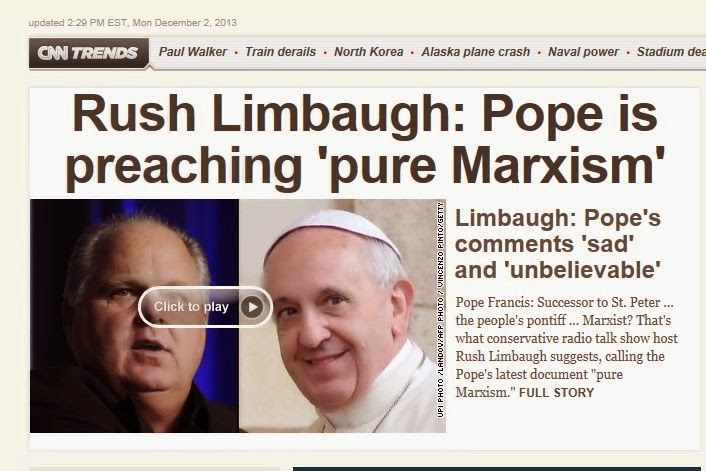
As far as Catholics are concerned, the current Pope seems to see nothing amiss with Marxism, which actually disparages religion as opium of  the masses and which has a lived record of persecuting Christians (in China and elsewhere) much more than Hindus-Buddhists have ever done.

Finally, we are not sure of how spiritual “yoga in the nude” actually is, but we recommend it strongly.
……..

In an unprecedented move against bendy people, it was reported this week that a Catholic priest has been campaigning against yoga. A missive from Father Padraig O’Baoill to his parishioners in County Donegal warns that yoga, tai chi and reiki
are “unsavoury activities”
that could endanger their souls. 

And before
there are any disparaging remarks about Donegal’s slogan being “Up here it’s different”, it should be noted that a Catholic priest in Southampton banned yoga from his church hall in 2012 because it was advertised as “spiritual”; and there is even a US pastor willing to say something extreme, outlandish and bigoted on the subject, with one spluttering, in 2010, that yoga is “demonic”.

Much
of this criticism stems from the fact that yoga has its roots in
Hinduism and Buddhism. But as anyone who has tried yoga a handful of
times knows (and it is mostly only ever a handful of times – first as a
new year’s resolution, then because you’ve spent money on the mat, and
finally, well, it’s been at least a year since you tried …), the yoga
practised in the church halls of this country comes as close to Hinduism
as your head is to your backside when you’re in an “upward facing dog”.

………..

A priest has banned yoga from a church hall because the class was “not compatible” with the Catholic faith.


Instructor Cori Withell from Hampshire said her yoga and
pilates classes at St Edmund’s Church building in Southampton were
cancelled with 10 days to go.


Father John Chandler said that the hall had to be used for
Catholic activities, and he banned it because it was advertised as
“spiritual yoga”.


Ms Withell, 37, said it “seemed terribly petty to cancel the classes”.


The ban is not Catholic Church policy and decisions are left to the discretion of individual priests.

………….


There is nothing wrong with stretching, exercising, or regulating
one’s stress through breathing. But when the tenets of yoga are
included, it’s by definition a worship act to spirit beings other than
the God of the Bible. 

By way of analogy, there is nothing inherently
wrong with intimacy, sex, and pleasure. But when the tenets of adultery
are included, it’s a sinfully idolatrous worship act. A faithful
Christian can no more say they are practicing yoga for Jesus than they
can say they are committing adultery for Jesus.


A little over a year ago, I said yoga was demonic. My stance hasn’t
changed since then, but I thought I’d take this opportunity to provide a
much fuller and comprehensive teaching on what yoga is and why it is in
fact demonic.
 

By demonic I mean it’s a spiritual act to a being other
than the God of the Bible. And, for those unfamiliar with me, I’m no
raging Christian fundamentalist. My most vocal critics tend to be from
the fundamentalist tribe as I do drink alcohol, have been known to use
strong language, and talk very frankly about the joys of married sex.
I’m no prude, but I am a pastor.


Giving sound teaching on yoga is important because there is
increasing adoption of yoga by our culture, with over 15.8 million
people practicing yoga and nearly every store you go into selling all
kinds of yoga products. 

It’s gone mainstream. As such, Christians are
also adopting it as a healthy aspect of exercise and lifestyle—complete
with things like “Holy Yoga,” which is an oxymoron. 

Saying yoga can be
Christian because you do it for Jesus is a bit like going into a mosque,
going through the worship practices, and then saying you’re not a
Muslim because you’re doing it for Jesus. They don’t mix.


When looking at the acceptance of yoga in the Christian church, I
find that there are two issues at hand: (1) People simply don’t
understand what yoga is, its roots, and its tenets; or (2) People think
that they can engage in yoga because it’s just stretching, while
ignoring the religious aspects of the practice of yoga.


As one woman who identified herself as a mainline Protestant said in
an article about my comments a year ago, “Here we go again with
fear-based, black-and-white thinking. . . . It’s not fair to say yoga is
demonic. In fact, I find it insulting. There are many ways to grow
spiritually.” To this I would reply, “No. There are not many ways to
grow spiritually. There is one way, which is through the power of the
Holy Spirit provided through Jesus’ death and resurrection on the cross,
as part of God the Father’s plan for salvation.” 

Comments like this
woman’s are the exact reason why it’s important to explore what yoga
really is and what it teaches, and to understand that the spiritual
elements of yoga make their way into our life and culture in ways we
don’t necessarily see overtly.


In this lengthy post, I’ll define what yoga is, give a history of
yoga, talk about the various forms of yoga, and take a look at yoga
through the “receive, reject, or redeem” matrix that I commonly use.

…………..

Link (1): http://www.theguardian.com/commentisfree/2014/jul/11/father-obaoill-yoga-unsavoury-irish-priest

Link (2): http://www.bbc.com/news/uk-england-hampshire-19729211

Link (3): http://pastormark.tv/2011/11/02/christian-yoga-its-a-stretch

……..

regards

Ramayana, Mahabharata true accounts, not myths

…If Ayodhya is not the place of Ram, where did he live? Looking at the
present structures in Ayodhya, we can see people still living the way
that finds a mention in the Ramayana. Historians can only give their
opinion to enlighten people.
….

The problem with left-liberal academicians (DN Jha, Sumit Sarkar and others) is that the secular fan-base in India is microscopic and there is not much love from minority communities (who are to be sure appreciative of the majority bashing).

Conservative Muslims are least interested in the “secular” record of Akbar, they hate him for his out-reach (and the plan to kick-off a new religion). 

Conservative Sikhs are repulsed by praise for “marxist-atheist” Bhagat Singh, they believe that Sardar Singh was a faithful follower of the Panth. 

The Dalits dislike the liberals intensely since the ideologues are primarily drawn from the super-caste community- red/pink Bengal has remarkably seen only Brahmin Chief Ministers for the past two decades. Even Navayana – the pro-Dalit megaphone – is led by the non-Dalit firebrand S Anand.

There are now dark clouds on the horizon, the new govt will be sympathetic towards Hindutva scholarship and will be headed by people like Rao who are convinced that “folklore is history.” Going forward, any book considered anti-saffron will not be publishable in India. That leaves only the West and the public forums afforded by the New York Times and the Guardian (and others). That will be one crowded space already occupied by super-stars.
……………………………………………………..
The media describes him as an RSS man and the author of the
Mahabharata Project, but very little is known about the mild-mannered
historian from Telangana in academic circles. 
Yellapragada Sudershan Rao,
the new chairman of the Indian Council of Historical Research (ICHR),
describes himself as a colonial historian and argues that faith and
reason can go hand in hand in the writing of history.


………
You have lashed out against Marxist historians and their
interpretation of history. Why is the writing of history a Right vs Left
debate?


I think it is time to think about India’s history from an Indian
perspective. 

For the last 60 years, our writing and understanding of
history has been influenced by the West. Indian research has been far
too dependent on the West to write its own history. We are dependent on
their translations and interpretation. And, these are my personal views,
history writing in India is Euro-centric and imperialistic. The ICHR, I
understand, is in the process of acquiring digital records from centres
of history in the US and Europe. This will not only give us access to
our own records but will also aid us in writing history from our
perspective.


You have been appointed by the BJP government. Don’t you think institutions such as the ICHR should be free of politics? 
The MoU (memorandum of understanding) prepared by the founding fathers
of ICHR gave the powers to the government to appoint heads of social and
historical institutes. I have no qualms in admitting that these
appointments are political. 

Have previous heads of social institutes
been questioned about their appointments? Why are these questions asked
only about me? The government has been formed by a democratic process.
It has been elected by the people. To question that is to question
democracy itself. Unlike other social institutes, the ICHR attracts a
lot of attention because history is an important subject. But history
belongs to the people. We have not shown or written a comprehensive
history of India to the people of India. History is by the people, for
the people and of the people.


….
You are the author of the Mahabharata project? What is the project about?

There is a certain view that the Mahabharata or the Ramayana are
myths. I don’t see them as myths because they were written at a certain
point of time in history. They are important sources of information in
the way we write history. What we write today may become an important
source of information for the fut­ure in the future. 

When analysed, of
course, they could be declared to be true or false. History is not
static. It belongs to the people, it’s made by the people. Similarly,
the Ram­ayana is true for people…it’s in the collective memory of
generations of Indians. We can’t say the Ramayana or the Mahabharata are
myths. Myths are from a western perspective.


What does that mean?

For us, the Ramayana and the Mahabharata are true accounts of the periods in which they were written.


….
But shouldn’t the writing of history be rooted in historical evidence and research?

Western schools of thought look at material evidence of history. We
can’t produce material evidence for everything. India is a continuing
civilisation. To look for evidence would mean digging right though the
hearts of villages and displacing people. We only have to look at the
people to figure out the similarities in their lives and the depiction
in the Ramayana and the Mahabharata. 

For instance, the Ramayana mentions
that Rama had traveled to Bhad­ra­chalam (in Andhra Pradesh). A look
at the people and the fact that his having lived there for a while is in
the collective memory of the people cannot be discounted in the search
for material evidence. In continuing civilisations such as ours, the
writing of history cannot depend only on archaeological evidence. We
have to depend on folklore too.


….
Are you for correcting the writing of history?

I won’t put it that way. But real history has to come through. I am a
follower of truth. The ICHR should encourage research about India and
Greater India—from Southeast Asia all the way to Afghanistan, Iraq and
Iran. There is enough archaeological evidence to show the connect of our
civilisation there.


….
What is your view on Ayodhya?

Is it not a fact that mosques as structures came to be in India in
1000 AD? Is it not a fact that the mosque was built by a lieutenant of
Babur? A historian can only enlighten people on the facts of history.
Historians can at best say evidence of earlier remains of a Hindu
structure are there. Conflicting views are created by political leaders. 

If Ayodhya is not the place of Ram, where did he live? Looking at the
present structures in Ayodhya, we can see people still living the way
that finds a mention in the Ramayana. Historians can only give their
opinion to enlighten people.


…..
Doesn’t correcting history pose a problem? Why only cast it
in the context of two communities? How about Dalits and untouchability?


The question of untouchability is relatively recent, as recent as
3,000 years. And it has its basis in the economy. It was not based on
social status. Did we hear of untouchability before this period of 3,000
years? Let me give you an example. Sage Vishwamitra went to a Dalit hut
and asked for dog’s meat as he was hungry. The Ramayana and Mahabharata
are replete with instances of different castes, did we find a mention
of untouchability there?


…..
As a historian, are you trying to give a religious interpretation to history? 
I am a Hindu and a Brahmin. To be a Hindu isn’t a religion. In my
personal practices, I can adopt religious practices of the community to
which I belong—as a Shaivite or a Vaishnavite. But that is not what
being a Hindu is about. 

Reli­gi­ons are recent manifestations. I feel
the­re’s only Sanatana Dharma. There was no conflict between communities
or on religious lines as there was only one sanatana dharma. Now there
are several reasons for conflict to take place. 

Besides, Muslims are the
only ones who have retained their distinct culture. Can Christians or
Muslims say all religions are one? A Hindu can say that. There was no
conflict when there was sanatana dharma, Conflict or contests came about
when temples were destroyed and mosques built on the sites in medieval
times.


….
Didn’t Hindus destroy Buddhist monuments?

I agree. But Buddhism was on the wane then, in decline. But were
thousands of people killed as they were in the raids to the Somnath
temple? I won’t use the word corrections here. But the real history has
to come up.

…..

Link: http://www.outlookindia.com/printarticle.aspx?291363

……

regards

Tulsi Gabbard: defender of the faith

There is no soft way to say this: brown Hindus need a white sister to help them out in face of virulent opposition from the likes of Syed Bukhari and John Dayal in India and Katherine Mayo (aka Katrina Lantos) in the west. A saffron salute to her courage in standing up for defence-less and powerless Hindus at home (America) and abroad.
….
Several eminent officials and experts from both
India and the US have told lawmakers that a BJP-led government at the
center would be detrimental to the basic rights of the religious
minorities in India.


Testifying before the influential Tom Lantos Human Rights Commission of
the US Congress (TLHRC) on ‘The Plight of Religious Minorities in
India’, the US Commission for International Religious Freedom (USCIRF)
Vice Chair Katrina Lantos yesterday said the USCIRF has been closely
monitoring the situation in India.

“Many religious minority communities have reported to USCIRF that they
fear that a BJP win, and the election of Narendra Modi as the country’s
Prime Minister, will be detrimental to them and religious freedom. The
BJP last led the national government between 1998 and 2004,” Lantos
said.

“Between 2002 and 2004 USCIRF had recommended that the State Department
designate India a ‘Country of Particular Concern’ (CPC) for the
government’s systematic, ongoing and egregious violations of religious
freedom,” she said.

She said the USCIRF has long been concerned about the BJP’s and Modi’s close association with Hindu nationalist organisations.

“The activities of these groups, especially those with an extremist
agenda or history of using violence against minorities, often negatively
impact the status of religious freedom in the country,” she said.

“Sangh Parivar entities aggressively press for governmental policies
that would promote a Hindu nationalist agenda, and adhere in varying
degrees to an ideology of Hindutva, which holds non-Hindus as foreign
to India,” Lantos said.

Meanwhile, Congressman Tulsi Gabbard, the first ever Hindu lawmaker in
the US Congress, questioned the timing of the Congressional hearing and
alleged that its goal is to influence the Indian elections.
“I do not believe the timing of this hearing is a coincidence. The
national elections in India begin on Monday and continue until May 12. I
am concerned that the goal of this hearing is to influence the outcome
of India’s national elections, which is not an appropriate role for the
US Congress,” Gabbard said.

….
regards

Hinduism: is it only sex (and death)?

A critique of Doniger which steers away from the Hindutva-secular fight and asks some pertinent questions, one of which is: does the distinguished professor know (or care) about what is special (or unique) about Hinduism?
….
Such a shared core may well be close to, among other ideas, the
Upanishadic monism that crystallized in the seventh century CE into the
non-dualistic Vedanta of Shankara who established it both by
interpreting the classical texts and by refuting the competing
philosophical schools of the day. Early evidence of an incipient monism
is mentioned, for example, by Mohanty (2007, p. 24):  While the Vedas contain a myriad of different themes, ranging from
hymns for deities and rules of fire sacrifices to music and magic,
there
is no doubt that one finds in them an exemplary spirit of inquiry into
“the one being” that underlies the diversity of empirical phenomena, and
into the origin of all things.  

If this core truly pervades popular belief today then it cannot be
easily explained as a late nineteenth and twentieth century product of
colonialism as many on the left try to do.
This is not to deny the
presence of other orthodox and heterodox traditions in this core, only
to say that such a monism’s mass appeal must surely have preceded
colonial times. Doniger and her supporters never acknowledge this wider
humanity in their arguments and so end up attacking a straw man.
 

For instance, Vamsee Juluri’s essay
articulates an attitude that may be widely shared by modern practicing
Hindus. He clearly differentiates it from militant Hindutva by making
plain the diverse and plural heritage of Hindu thought. But he
simultaneously argues against Doniger by saying her interpretations
flagrantly contradict the lived experience of devout Hindus.
This
dialectical argument raises many difficulties for both sides, and sets
up a tension between Hinduism seen as an intellectual object and as a
sacred practice. 

Second, however, it may be asked, shouldn’t the lived experience of
religious symbols and myths be part of what is explained by inquiry?
That is, shouldn’t the external, intellectual stance account for the
internal, experiential facts? For example, if one holds that the Shiva
lingam represents Shiva’s erect penis, how does this square with the
interpretive community’s view (e.g. possibly something abstract like
Shiva’s sexual and creative power or just Shiva himself)? In a parallel
situation, is it right to describe the Holy Communion in Christianity as
a cannibalistic rite?
Certainly there is a connection between a penis
and a Shiva lingam as there is between the body and blood of Christ and
the ritual bread and wine, but do these connections involve the literal connotations of “penis” and “cannibalism”? 

Doniger’s book is not about revelatory insights into the Hindus but
generally about completely worldly things like sex, death, and material
pursuits.
While Eros and Thanatos are undoubtedly powerful forces in
human lives and while material pursuits are indispensable to survival,
Doniger succeeds only in clarifying that the Hindus, like other humans,
were and are part of the animal kingdom.
 

Much of what she says is
probably true—the Brahmins did eat beef early on, for example—
and the
Hindus who have been offended by such facts ought to recognize that
religious values are not eternal but emerge through history. But, for
her part, Doniger fails to make sufficiently salient how unique and
humane the impulse of vegetarianism was as a response to the barbaric
conditions of material life
in all early human civilizations. She passes
up such opportunities over and over again.


For the aims she chose, her cultural history needed to
have been more of an intellectual history. She never explores what the thinkers
of Indian civilization did—whether Brahmins or non-Brahmins, men or
women—when they confronted conceptual problems like the origins of the
world and how we might come to know it.
No logic of inquiry or
argument is described as it would have to be if one wanted to “show the
presence of brilliant and creative thinkers entirely off the track.” 

Indeed, there is hardly any speculation about the metaphysical instincts
of the Hindus at all.
Her materialism, while right in spirit, is
summoned too soon and all one gets is the subterfuges and stratagems of
the ancients. No doubt these existed as they are an inevitable part of
human nature and no doubt they played some role in the worldviews of the
Hindus, but do they constitute what is special and unique about Indian
civilization, or any civilization for that matter?

regards

An agnostic bats for ahimsa

…and death with dignity. This is from the golden pen of Khushwant Singh who is no more with us. RIP

Killing
is not right. Killing animals to eat them is not a civilised thing to
do, but carnivores exist in nature and in many places, humans have to
subsist on non-vegetarian food for reasons beyond their control. But
wherever possible, vegetarianism must be practised. Hurting people
physically or mentally, whether by word or action is wrong. Ahimsa is
more important than prayer. Ahimsa should be the central principle of
your faith, but you have to raise your voice against injustice.
Then, if
you hurt someone who has hurt other people, it is justified. But the
death penalty is barbaric — it is murder by the state.


So, life should be lived with
compassion and non-violence. I think a lot about life and the way we
live it; I also think about death and how we deal with it. The basic
point is, we don’t know where we come from; we also don’t know where we
go after death.
In between, we might know a little about life. 

People
talk a lot about body and soul — I’ve never seen a soul, nor do I know
anyone who has seen one. So for me, death is a full stop. I don’t
subscribe to the theory of rebirth endorsed by Hinduism and Buddhism nor
do I believe in the Judeo-Christian belief in a heaven and hell.
Ghalib
said: “We know the truth about paradise but to beguile your mind is not
a bad idea.”


When I met The Dalai Lama, I told him I didn’t
believe in God. He threw his head back and laughed, saying, nor do
Buddhists. I often wonder, how only Hindu and Buddhist children relate
incidents from previous births while Muslim and Christian children
don’t. There is nothing unique about death. 

Death comes to all who are
born. So we don’t need to pull a long face when death comes.
Of course,
it is human nature to grieve for someone you’ve lost. But that’s no
reason to create a big fuss, wailing and screaming. Nor is there any
need to have elaborate rituals.


Death is in the order of
nature — when your time comes, die with dignity. I’m a member of the
‘Die with Dignity’ society formed by Minoo Masani 20 years ago. I can’t
say I don’t fear death — but I’m more concerned about whether it is
going to be a long drawn out painful process.


Iqbal wrote: “If
you ask me about the sign of faith/when death comes to him/he should
have a smile on his face.” I’m all for the ancient tradition of
celebrating death. When people over 70 years die, their death should be
marked with celebrations including music, dancing and feasting. It is a
sign of maturity and acceptance of the inevitable. 


I’ve discarded all
religions, but I feel closest to Jainism.
Every person has the right to
end his life — after having fulfilled his worldly duties and if he feels
he has now become a burden on others. It is legitimate to want to
extinguish your life. Acharya Vinoba Bhave and Jain munis have done
this. 

I wish to be buried with just a tree planted over my grave — no
tombstone, nothing. If you live close to the sea, go for burial at sea.
It saves wood.

regards

Brown Pundits