Persiana

Mouth-watering Persian recipes from Sabrina Ghayour.
Following the book reviews for Persiana, we conclude that it is one of the best (primarily because we are fan of no-frills cooking).

Here is our recommendation: try and follow any one of her simple recipes, put out the candles for dinner and bring out the smiles in your significant other. Remember: everyday is Valentine’s day!!!

….
The walls of Sabrina Ghayour’s Earl’s Court flat are lined with family
photographs and Persian poetry. Ghayour and her mother have lived here
for 36 years and it’s where she began hosting supper clubs two years
ago. “I was worried my diners would think the poems were terrorist
scriptures,” she says. “I fretted too much about what people would think
of me back then.”


When we meet, Ghayour, 38, is preparing a family feast to celebrate
the Persian New Year, an occasion that coincides with her publisher
sending over the first copy of her debut cookbook Persiana.
Filled with 100 recipes she’s refined over the years, it also draws on a
childhood spent in the kitchen: “I was precocious,” she says. “My mum
and grandmother couldn’t cook for toffee – so at 11 years old, I became
the cook.” 

There’s a photo in Persiana of Ghayour, aged six,
stirring a pot with a wooden spoon as long as her arm: “That was the
first time I ever cooked – boil-in-the-bag cod mornay.”

Born in
Tehran, Ghayour moved to London in 1979 at the beginning of the Iranian
revolution. “We were lucky,” she says. “My mother had been studying in
the UK and had this flat.” Her parents separated around the same time,
her father moving to Los Angeles with his new wife, while Ghayour, her
mother and grandmother settled in west London. “My mum had me when she
was 20, so we’ve always been more like sisters, and I was very close to
my grandmother – we shared a room.”

After school she spent 15 years working in events and marketing for restaurateurs, including Ken Hom,
as well as corporate catering in the City of London. Made redundant in
2011, around the time of Thomas Keller’s £250-a-head pop-up version of
The French Laundry in Harrods, Ghayour half-joked on Twitter about doing
her own, The French Launderette,
for £2.50. Within hours – still via Twitter – she had more than 30
bookings. “I was offered the use of a restaurant on a Sunday, when it
was closed, and ingredients – meat, fish, wine. Jason Atherton’s Pollen Street Social team offered to do my front of house.”

In
the end Ghayour served 80 people, raising £4,000 for Action Against
Hunger. Since then she’s been hosting up to three supper clubs a week,
as well as taking private cheffing jobs and teaching Persian cookery:
“It’s exhausting, but I am constantly aware of how lucky I am. I was
never a chef, just the dorky events girl that loved food.”

…..

regards

Sir Jaguar

The honor is well deserved for a man who has helped save precious manufacturing jobs in the UK. A Persian doing business in India by making cars in the UK and selling them in China. Bravo!!!

The
Queen Elizabeth II on Thursday conferred the rank of Knight Commander
(KBE) on former chairman of the Tata group Ratan Tata.  The KBE is one of the highest honours given by the queen to civilians.

Ratan Tata was given the honour for his “services to UK/India relations, inward investment to the UK and philanthropy”.


The Tata group is highly popular in UK.
Iconic British car brands Jaguar and Land Rover became part of the Tata
group in 2008. The company employs over 16,000 people at its
manufacturing facilities in the UK, including 3,500 engineers at its two
product development centres. 
  

 Tata’s association with UK academia also dates back to the
establishment of the Sir Ratan Tata Department at the London School of
Economics. Subsequently called the Department of Social
Sciences, it was set up to research the causes of poverty. Its first
lecturer, Clement Attlee, went on to become the British prime minister
who gave India its independence and also set up the British National
Health Service
Tata has maintained close links with the London
School of Economics through a research collaboration with the Tata
Institute of Social Sciences.

 .

regards

Sacrificing humans easier than goats

Why did the US ambassador to India suddenly resign? Is it because of the need felt by the Imperial Court to have a reset with this particular mansabdari? Since no public explanations are given, private speculations are helping to fill the vacuum.

Moving beyond business, if one was to look at other areas in the
bilateral relations between India and the US, then the Devyani
Khobragade issue was definitely one that became a major stumbling block
for meaningful progress in their ties. And for this, the US government
and the ministry of external affairs of India should both be blamed. If
the US “mishandled” the Indian diplomat and treated her like a “common
criminal,” then the jingoistic reaction in India contributed to its
snowballing into a major controversy.
While the American government was
being blamed for the humiliation of the Indian diplomat, the fact that
she had also violated a domestic law in the US was totally ignored and
brushed off the Indian table.


If, in this drama, Powell is to be blamed then it is perhaps for the
decision of one of the US diplomats in the consular section to give a
visa to the Indian maid Sangeeta Richard’s husband and children to
travel to the US even as a case against her was pending before the
Indian court.
 

The US diplomat involved in the consular section was since
withdrawn and taken back to Washington. But some of the Indian
decisions that include stripping US diplomats of special privileges and
removing the barricades from in front of the embassy in Chanakyapuri,
remain in force.


The third reason being cited for Powell’s removal from the post is
because of her handling of Gujarat chief minister and BJP’s prime
ministerial candidate, Narendra Modi.
The US continued to be the last
“holdout” among western diplomats to engage with Modi. Even though the
European Union ambassadors broke their post-Godhra moratorium of
engaging with Modi, the US embassy in Delhi only decided to do so early
this year after all the others.


By all indication, Nancy Powell’s departure from the scene may allow
the US to re-set its relations with India.
But it may soon find out that
making a scapegoat of Powell only solves half its problem relating to
India. The other half may well prove to be much tougher to resolve in
the coming days.


regards

Pakistan and India: divided by a common culture

The aam aadmi on both sides of the border will mostly agree with the sentiments expressed by the author (but the elites will not). The cultural (and many other) bonds that are still intact have to be placed alongside the antipathy generated by the hot/cold war that has been going on for the last 67 years. To tell the truth, apart from the Balkans, there are probably few other examples that match the hostilities generated by the British partitions of India, Palestine, Cyprus, and Ireland. Finally, the mixed emotions about Indian movies are relevant for an Indian (middle-class) audience as well.

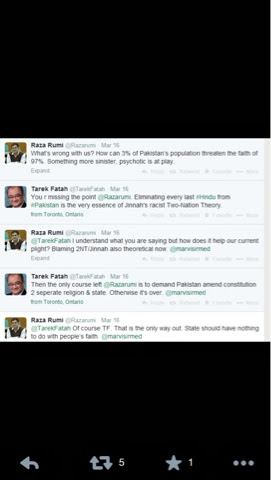
The only place where I disagree with the author (and this comes back from Zachary’s earlier note of a Pakistani and Indian muslim friendship) is that Pakistanis (and by extension the global media) automatically assume that Indians culture is primarily (even exclusively) Hindu, or even more alarmingly a muslim culture polluted by Hindu sentiments. In contrast I would imagine (perhaps wrongly) that  muslims in Kanpur and Karachi will be able to find a significant amount of overlap in their culture and world-views- to take one specific example, Indian muslims are jut as strongly anti-zionist as their brothers across the Ummah.

The reason I am pessimistic about even a cold peace is because the ideological differences are so hot and stark. Peace will come only when the elites will have had enough of war, that is for sure.

As India and Pakistan struggle to resolve their political differences
presently, there is an India/Pakistan-related struggle going on inside
me too.


My inner instincts tell me that a big part of my cultural heritage
relates to India. However, Pakistani ideologues and even some close
relatives tell me that it is unpatriotic to assert any cultural
attachment with India due to Pakistan’s political differences with that
country. Is it possible for a Pakistani to separate cultural and
political issues and simultaneously maintain cultural affinity but
political differences with India?

One must first analyse the
extent of similarity between Indian and Pakistani cultures. Culture
refers to societal ideas, customs and social behaviours and encapsulates
the domains of art, dress, language, food, family structures, religious
practices, festivals, traditions, values etc. There is admittedly
enormous cultural diversity within both countries and sweeping
comparisons between the two cultures are inappropriate.

However,
it is also true that there is large similarity in the cultures of
Pakistan’s eastern regions (Sindh, Punjab and Azad Kashmir) and India’s
northern and western regions along most cultural aspects mentioned
above, eg art and dress. While Pakistanis living in the country’s
western regions obviously have more cultural linkages with Pakistan’s
western neighbours (eg Afghanistan), Pakistan’s eastern regions host the
bulk of the population. Thus, for the majority of Pakistanis, the large
cultural overlap with India is undeniable.

Religion obviously is
the main realm of exception to this cultural similarity
and since it
influences many traditions, there are differences too between Indian and
Pakistani cultures. Additionally, over the last three decades,
middle-class cultural values in the two countries have become more
dissimilar.

Parts of the Pakistani middle class have unfortunately
become more conservative, xenophobic and intolerant. Conversely, the
Indian middle class has become more liberal and Westernised. This,
positively, has meant greater tolerance for diversity but also,
negatively, greater focus on materialism within Indian society in
contrast to the high degree of frugality that Indian middle classes
practiced traditionally.

The most visible manifestation of this
increasing difference in values is in movies and the media. Indian
movies are now increasingly exploring themes, eg in movies such as
Bombay Talkies, which can barely be mentioned even in liberal Pakistani
newspapers. On the negative side, it means that it is often difficult
now to watch Indian movies with family.

Despite
religious differences, I and a lot of other expatriate Pakistanis that I
know usually find it easier to relate with expatriate Indians due to
the strong linguistic and cultural linkages than with Muslims or
non-Muslims from Africa, the Middle East and Far East. Given these
cultural similarities, it does not make sense to disown such a large
part of one’s cultural legacy, especially one to which Muslims
contributed so much over the centuries before Partition. 

Trying to
disown such a large part of one’s cultural legacy can only have
negative repercussions for the individual and collective national
psyche. One must have the self-confidence and a sense of balance to be
able to assert cultural similarities with India without feeling ashamed,
guilty or unpatriotic.

Thus, over the last few decades, India has
arguably become the second largest exporter of culture (through the
export of its movies, music, food, etc) in the world after the US. I
must admit that whenever I see such Indian cultural artefacts being
appreciated globally, in places as diverse as Addis Ababa, Vietnam and
Israel, I cannot help feeling some sense of pride and personal
connection too.

Yet Indian movies portray Islam with respect and often on an
equal footing with Hinduism. In contrast, it is rare to see Pakistani
movies showing respect and positivity towards Hinduism. However,
when it comes to Pakistan, Indian movies are largely silent or portray
Pakistan negatively even though Pakistan is probably the biggest market
for them after India.

regards

The Taj is Indian..or is it?

Symbols are very important, often they help define a nation. The students make a convincing case that the Taj is “Pakistani,” they make an even more convincing case that studying history is important.

Yet, in a class of undergraduate students at one of Pakistan’s best
universities, precisely this question was animatedly debated during a session
on Pakistan’s history, with some students stating that the Taj was part of
Pakistan’s history, and others implying that it was ‘Pakistani’.
These students had all taken a course
in Pakistan Studies prior to starting their undergraduate degree…


Pakistani history has been a contentious topic where different sets of
narratives give differing accounts of what Pakistani history is and, hence, how
one imagines Pakistan. Given the eventual partition of British India and the
creation of Pakistan, some historians have claimed that Pakistan was ‘created’
in 712 AD when an Arab invader came to what is now part of Pakistan.


Hence, if the history of Pakistan is the history of Muslims in India, and
just as Mohammad bin Qasim can become part of a certain legacy and heritage and
can be caricatured as the ‘first Pakistani’, so too can the Taj as ‘being’
Pakistani. Pakistani history and a history of Pakistan’s people and their land,
become two conflicting narratives.


As a consequence, ‘Pakistani’ history, ignores the history of the people who
live in what was Pakistan (West and East) and what is left of it. Mohenjodaro,
Harappa, and the history of the people
of Pakistan is dominated by a north Indian (largely Hindustani) Muslim history,
and that too only of kings and their courts.


In the most ingenious and creative recent book to be published on Pakistan’s
emergence as a political idea, historian Faisal
Devji
in his Muslim Zion raises
some fascinating and sophisticated arguments which complicate any simplistic
notion of what passes as Pakistani history.


His book is a highly nuanced and multilayered understanding of the ideas
which led to the justification and creation of Pakistan, and while many of
Devji’s conceptualisations need to be contested, for our purposes his statement that Pakistan’s history lies
outside its borders, gives rise to some of the problems of imagining a history
of Pakistan described here, and allows some to claim the Taj Mahal as
‘Pakistani’.


Moreover, if this claim that Pakistan’s history lies ‘outside its borders’
is valid, and indeed in many critical ways this is certainly the case, it also
implies, that the country which came into being called Pakistan, in this
hegemonic notion of history, really has no history of its own. The so-called
‘freedom movement’ was fought in a foreign land, the land of the Taj Mahal, not
the land of the people who inherited a country called Pakistan where their
ancestors had lived for millennia.


regards

Don’t cry for me, Parsi

An old article on how the Vulture Program has been started by the Parsis.
Like the vultures on which they once relied, Parsis are disappearing. Their religion, Zoroastrianism, once dominated Iran but was largely displaced by Islam. In the 10th century, a large group of Zoroastrians fled persecution in Iran and settled in India. Fewer than 70,000 remain, most of them concentrated in Mumbai, formerly known as Bombay, where they collectively own prime real estate that was purchased centuries ago.
Among the most valuable of these holdings are 54 acres of trees and winding pathways onMalabar Hill, one of Mumbai’s most exclusive neighborhoods. Tucked into these acres are three Towers of Silence where Parsis have for centuries disposed of their dead.
This contrasts quite well with a more recent article, Your Ancestors Your Fate:
Inequality of income and wealth has risen in America since the 1970s, yet a large-scale research study recently found that social mobility hadn’t changed much during that time. How can that be?
The study, by researchers at Harvard and Berkeley, tells only part of the story. It may be true that mobility hasn’t slowed — but, more to the point, mobility has always been slow.
When you look across centuries, and at social status broadly measured — not just income and wealth, but also occupation, education and longevity — social mobility is much slower than many of us believe, or want to believe. This is true in Sweden, a social welfare state; England, where industrial capitalism was born; the United States, one of the most heterogeneous societies in history; and India, a fairly new democracy hobbled by the legacy of caste. Capitalism has not led to pervasive, rapid mobility. Nor have democratization, mass public education, the decline of nepotism, redistributive taxation, the emancipation of women, or even, as in China, socialist revolution.
Elite cultures are difficult to dispose of and sometimes can masquerade as small minorities (especially trading ones like Jews, Parsis, Jains and Phanariotes). 
Brown Pundits