The Kerala girls….probably beyond help

“In
zones of conflict, there’s no freedom. As diplomats we are trained to
see every difficulty as an opportunity. There’s no free will in zones of
conflict”

 
The Kerala nurses have been kidnapped and moved to Mosul, deep inside ISIS held territory (they were previously in Tikrit where the Shia and Sunni armies are at a stand-off). Of course miracles can always happen. But it is unlikely that the Caliphate is going to voluntarily surrender 46 Christian girls.

It is time for the Govt (Ministry of External Affairs-MEA) to think out of the box. Why not request the Hon. Salman Khurshid to lead an all-Sunni delegation to plead with al-Baghdadi (with Saudi patrons serving as intermediaries)?

The MEA should also consider requesting the Owaisi brothers from Hyderabad to plead with their fellow brothers in Iraq. Akbaruddin – “remove police for 15 mins, we will finish off 100 crore hindus” –  Owaisi has always been a vocal and consistent supporter of Christian sisters from Odisha (who were being tortured by Hindutva-vadis). We imagine that he would be just as eager to help out his Christian sisters from Kerala who are being imprisoned (and perhaps subjected to worse indignities) by Sunni thugs.

Finally, since this is a humanitarian endeavour (and thus beyond sectarian and national politics) we would request the (Indian American) Muslim organizations to help out. The Milli Gazaette article lists some of these high profile organizations (http://www.milligazette.com/Archives/01122001/26.htm):
….
Today four such organizations exist in US. They are: 1.
Washington DC: The Association of Indian Muslims of America. 2. Chicago:
Consultative Committee of Indian Muslims. 3. San Francisco: Indian Muslim
Relief Committee. 4. Detroit: American Federation of Muslims from India. 

Through these organizations, Indian Muslims in US are trying to help their
Qaum back home,
by supporting programs for the improvement of education
among the youth, provide financial relief in the event of natural
disasters and anti-Muslim riots and do public relations work to draw
attention to instances of injustice to their community in India. 

Alumni of
the Aligarh Muslim University have established fairly successful Alumni
Associations in Washington DC, New York, Chicago, San Francisco Atlanta
and Detroit.
Generally, every year in October, they organize annual
get-togethers and Mushairas to celebrate the birth anniversary of Sir Syed
Ahmad Khan, the founder of the university.

…….
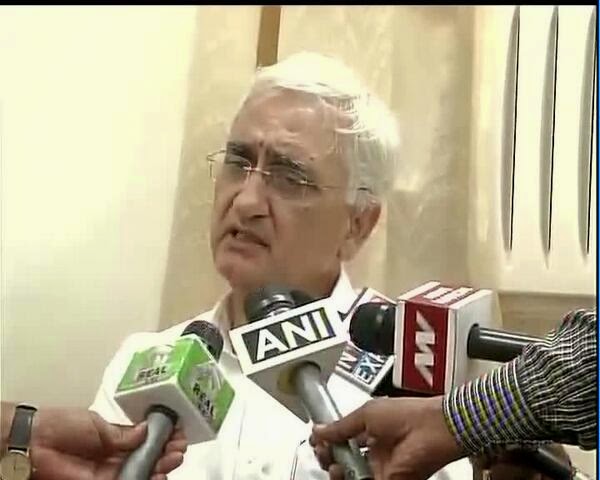
The Islamic State of Iraq and Syria (ISIS) rebels have forced 46 Indian nurses to move out from Tikrit to Mosul in Iraq.


“Indians have also been asked to leave Karbala, Najaf and
Basra. Regarding the nurses in captivity, we have confirmed of people
seeing them unharmed, but in captivity. A short while ago they were
moved to another location. All of them are unharmed. 

The external
affairs minister has been in consultation with Kerala Chief Minister Oommen Chandy.
Our embassy continues to be in touch, even as they are moving to
another location,” MEA spokesman Syed Akbaruddin said in New Delhi.

“In
zones of conflict, there’s no freedom. As diplomats we are trained to
see every difficulty as an opportunity. There’s no free will in zones of
conflict,” he said.

The Indian nurses have now been
relocated to Mosul, which is under militants’ control. All the 46 nurses
who have been moved are from Kerala.

“Tickets have been given to 900 Indians to fly out of non-conflict zones in Iraq right now,” he said.

…..

Link: http://indiatoday.intoday.in/story/more-trouble-for-indian-nurses-in-iraq/1/369700.html

…..

regards

Who killed Sunanda Pushkar?

The
head of the AIIMS forensic department on Thursday [03 July, 2014] stuck to his
controversial claim that pressure was brought on him to manipulate the
post mortem report on Sunanda Pushkar

The ISI may be the #1 intelligence agency in the world but Dr. Subramaniam Swamy is without question the #1 secret agent. Just after Sunanda Pushkar’s death Swamy had claimed that she was killed with “russian poison.”  

The chief of forensics @ All India Institute of Medical Sciences (AIIMS) has now confirmed (and re-confirmed) that he was being pressurized (by then Union Minister and AIIMS president Ghulam Nabi Azad) to cover up the matter.

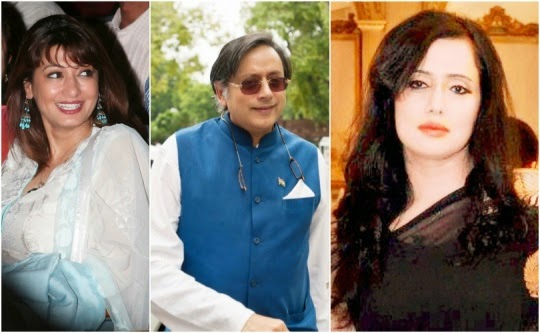
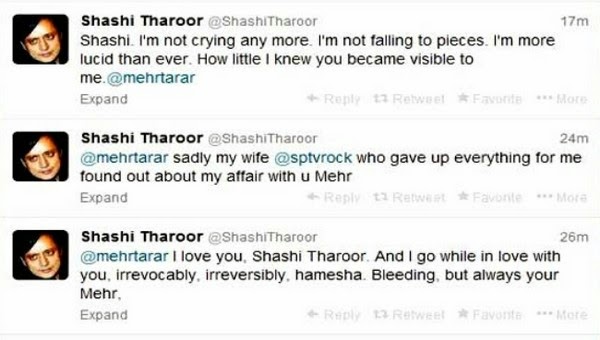
As we have noted before, Sunanda’s fate was probably sealed when she spilled the beans about her husband’s activities, which have been linked to the Dubai underworld. It was Pakistani journalist Mehr Tarar (as alleged by Sunanda herself) who helped trap the flies nicely in her spider-web (elite men are always so reliably vain and stupid). Thus once more it is made clear that the ISI is the #1 intelligence agency in the world. Bravo.
……..
In an explosive revelation, senior journalist Nalini Singh has said that
Sunanda Pushkar was tensed and crying hard hours before her death.
Notably, the TV journalist was the last person Sunanda called from her mobile.


In an exclusive conversation with Zee Media, Singh said she
received a call from Sunanda at 12:10 am on January 17, hours before she
was found dead in the room of a five-star hotel here.

“At 12:10 am on January 17, I received a call from Sunanda. She was
crying hard and was very tensed. I thought it is because of the then
ongoing Twitter spat between her and Pakistani scribe Mehr Tarar. But
Sunanda told me that Shashi has deleted messages from his BlackBerry
Messenger. She said that as a media person, I should help her in
retrieving those messages.
..”

…….

Less than six months after her death, Pushkar’s death has
once again made news with the head of forensic sciences at AIIMS, Dr
Sudhir Gupta, alleging in an affidavit submitted to the Central
Administrative Tribunal (CAT) that he was “pressurised” by former Union
minister and AIIMS president Ghulam Nabi Azad to act in an
“unprofessional” manner
and to cover up the matter.

“(The)
applicant could not muster courage of openly placing the facts in black
and white as the former president of AIIMS Ghulam Nabi Azad was an
immensely powerful politician and the then health minister, and the
husband of late Sunanda Pushkar was also a minister and a powerful
politician,” the affidavit stated.

….
 The
head of the AIIMS’ forensic department on Thursday stuck to his
controversial claim that pressure was brought on him to manipulate the
post mortem report on Shashi Tharoor’s wife Sunanda Pushkar

A day after the premier health institute denied his claim, Dr Sudhir Gupta said, “I stand by what I said”. “How do they know there is no pressure on me? Who were they to clarify
that there is no pressure on me? What was the hurry to call a press
conference?,” he said.

….

Soon after Pushkar’s death, BJP leader Subramanian Swamy had
alleged that she did not commit suicide, but that it was a case of
murder. He had also questioned Tharoor’s nervousness regarding his
wife’s death. He had also claimed that Pushkar had been given “Russian
poison”.

Investigators had pointed out at that time that Pushkar’s body had 12
injury marks including a bite mark on her hand. However, the injuries
were not life-threatening but raised questions as to whether she was
physically assaulted before her death. 

Other theories that did the
rounds at that time said that she had overdosed on sleeping pills. 

Pushkar’s autopsy report had stated that the cause of death was
unnatural. The report also indicated that she died of drug overdose,
most likely a combination of sedatives, other strong medicines and
probably alcohol. What isn’t clear is whether she was forcibly
administered the same or did she willingly consume it herself.

The Delhi Police which is investigating the
case has sought a third opinion to ascertain her cause of death. After
contradiction in AIIMS and CFSL reports, the Delhi Police has asked
Forensic Science Lab to carry out advanced tests to ascertain whether
alprax turned into metaboloids. Experts, however, say there are chances
cause of her death may never be known.

…..

Pushkar’s
marriage to Tharoor wasn’t the first marriage for either party. Both of
them had been married earlier as well. Both had met at a party in
October 2009. They got married in 2010 after Tharoor was elected as an
MP.

Tharoor was earlier married to Tilottama Mukherjee
and later to his UN colleague Christa Giles. Sunanda’s first marriage,
to fellow Kashmiri Sanjay Raina, had ended in divorce. Her second
husband, Keralite businessman Sujith Menon, died in an accident in 1997.
They had a son, Shiv.

In April 2010, Pushkar had relinquished her estimated Rs.70-crore
stake in IPL when allegations of corruption against Tharoor had caused a
furore. It was alleged that Tharoor had used her as a front to collect Rs.70 crore to help the Kochi owners get their IPL team.

…..

Link (1): http://timesofindia.indiatimes.com/India/Sunanda-Pushkar-death-case-AIIMS-forensic-head-sticks-to-stand/articleshow/37690684.cms

Link (2): http://zeenews.india.com/news/nation/shashi-tharoor-deleted-bbms-to-mehr-tarar-sunanda-pushkar-wanted-to-retrieve-them_944725.html#

Link (3): http://indiatoday.intoday.in/story/sunanda-pushkar-death-10-things-you-should-know/1/369490.html

…..

regards

Sexiest woman in the world

…as voted by FHM magazine (we strongly disagree, it should have been Vidya Balan). Deepika Padukone, with all due respect, is not the strongest character actor (she claims she got the crown because of her work). She has displaced Katrina Kaif who was voted #1 three times in a row.

We wish her all the best. In a few decades time can we expect a “women have to leave the crown in the garage” thesis from her as well? Nah…once the chains fall off they never come back.

…..

Link: http://www.dnaindia.com/entertainment/report-deepika-padukone-displaces-katrina-kaif-in-fhm-100-sexiest-women-in-the-world-2014-1999264

…..

regards

“leave that damned crown in the garage”

“…You might be president of PepsiCo.But when you enter this house,
you’re the wife, you’re the daughter, you’re the daughter-in-law, you’re
the mother. Nobody else can take that place. So
leave that damned crown in the garage”…. 

Well, we have already noted the example of the ideal Bharatiya Nari- Shrimati Jashodaben Narendrabhai Modi. She still prays daily for the welfare of her missing in action husband and in his glorious victory, her blessings presumably counted just as much as that of the First Mother.

Now we have the self-spoken example of Indra Nooyi who was sent out to get some milk, the night she was informed that she has been appointed President of PepsiCo. Her husband was “tired” and her own mother told her to “leave that damned crown in the garage.”

We are admittedly in awe. In the Bong-world, there are no brave souls who will dare ask the lady of the house to “leave that damned crown in the garage.” Even faux-thugs like Tapas Pal are known to hide behind the convenient pallu (wife, didi) when threatened.

Since we are playing with extra fine Iraqi oil here, let us throw in a matchstick as well. Long long time ago, when we were looking to “settle down” a suitable boy gave us the ultimate advice about Indian women. North Indian ladies, he claimed, were modern on the outside (traditional inside), while South Indian ladies were the opposite. How about Bongs? Well, it is your destiny to be oppressed for the rest of your life!!! 
……..
While interviewing Indra K Nooyi, the CEO of PepsiCo, at the Aspen Ideas Festival Monday, David Bradley,
who owns The Atlantic, asked two questions that elicited as frank a
discussion of work-life balance as I’ve seen from a US CEO. Below is a
lightly edited transcript. The second question was preceded by a brief
discussion of Anne-Marie Slaughter’s “Why Women Still Can’t Have It
All.”

You come home one day as president of the
company, just appointed, and your mom is not that impressed. Would you
tell that story?


This is about 14 years ago. I was working in the office. I work very late, and we were in the middle of the Quaker Oats
acquisition. And I got a call about 9:30 in the night from the existing
chairman and CEO at that time. He said, Indra, we’re going to announce
you as president and put you on the board of directors … I was
overwhelmed, because look at my background and where I came from — to be
president of an iconic American company and to be on the board of
directors, I thought something special had happened to me.


So rather than stay and
work until midnight which I normally would’ve done because I had so much
work to do, I decided to go home and share the good news with my
family. I got home about 10, got into the garage, and my mother was
waiting at the top of the stairs. And I said, “Mom, I’ve got great news
for you.” She said, “let the news wait. Can you go out and get some
milk?”

I looked in the garage and it looked like my husband was
home. I said, “what time did he get home?” She said “8 o’clock.” I
said, “Why didn’t you ask him to buy the milk?” “He’s tired.” Okay. We
have a couple of help at home, “why didn’t you ask them to get the
milk?” She said, “I forgot.” She said just get the milk. We need it for
the morning. So like a dutiful daughter, I went out and got the milk and
came back.

I banged it on the counter and I said, “I had great
news for you. I’ve just been told that I’m going to be president on the
Board of Directors. And all that you want me to do is go out and get
the milk, what kind of a mom are you?” 

And she said to me, “let
me explain something to you. You might be president of PepsiCo. You
might be on the board of directors. But when you enter this house,
you’re the wife, you’re the daughter, you’re the daughter-in-law, you’re
the mother. You’re all of that. Nobody else can take that place. So
leave that damned crown in the garage. And don’t bring it into the
house. You know I’ve never seen that crown.”

What’s your opinion about whether women can have it all?

I don’t think women can have it all. I just don’t think so. We pretend
we have it all. We pretend we can have it all. My husband and I have
been married for 34 years. And we have two daughters. And every day you
have to make a decision about whether you are going to be a wife or a
mother, in fact many times during the day you have to make those
decisions.
And you have to co-opt a lot of people to help you. We
co-opted our families to help us. We plan our lives meticulously so we
can be decent parents. But if you ask our daughters, I’m not sure they
will say that I’ve been a good mom. I’m not sure. And I try all kinds of
coping mechanisms.

I’ll tell you a story that happened when my
daughter went to Catholic school. Every Wednesday morning they had
class coffee with the mothers. Class coffee for a working woman — how is
it going to work? How am I going to take off 9 o’clock on Wednesday
mornings? So I missed most class coffees. My daughter would come home
and she would list off all the mothers that were there and say, “You
were not there, mom.”

The first few times I would die with
guilt. But I developed coping mechanisms. I called the school and I
said, “give me a list of mothers that are not there.” So when she came
home in the evening she said, “You were not there, you were not there.”

And I said, “ah ha, Mrs. Redd wasn’t there, Mrs. So and So wasn’t there. So I’m not the only bad mother.”

You know, you have to cope, because you die with guilt. You just die
with guilt. My observation, David, is that the biological clock and the
career clock are in total conflict with each other. Total, complete
conflict. When you have to have kids you have to build your career. Just
as you’re rising to middle management your kids need you because
they’re teenagers, they need you for the teenage years.

And
that’s the time your husband becomes a teenager too, so he needs you
(laughing). They need you too. What do you do? And as you grow even
more, your parents need you because they’re aging. So we’re screwed. We
have no … we cannot have it all. Do you know what? Coping mechanisms.
Train people at work. Train your family to be your extended family.

You know what? When I’m in PepsiCo
I travel a lot, and when my kids were tiny, especially my second one,
we had strict rules on playing Nintendo. She’d call the office, and she
didn’t care if I was in China, Japan, India, wherever. She’d call the
office, the receptionist would pick up the phone, “Can I speak to my
mommy?” Everybody knows if somebody says, ‘Can I speak to mommy?’ It’s
my daughter. So she’d say, “Yes, Tyra, what can I do for you?”

“I want to play Nintendo.”

So she has a set of questions. “Have you finished your homework?” Etc. I
say this because that’s what it takes. She goes through the questions
and she says, “Okay, you can play Nintendo half an hour.” Then she
leaves me a message. “Tyra called at 5. This is the sequence of
questions I went through. I’ve given her permission.” So it’s seamless
parenting.

But if you don’t do that, I’m serious, if you don’t
develop mechanisms with your secretaries, with the extended office, with
everybody around you, it cannot work. You know, stay at home mothering
was a full time job. Being a CEO for a company is three full time jobs
rolled into one. How can you do justice to all?

You can’t. The
person who hurts the most through this whole thing is your spouse.
There’s no question about it. You know, Raj always said, you know what,
your list is PepsiCo, PepsiCo, PepsiCo, our two kids, your mom, and then
at the bottom of the list is me. There are two ways to look at it.
(laughing) You should be happy you’re on the list. So don’t complain.
(laughing) He is on the list. He is very much on the list. But you know,
(laughing) sorry, David.
 
…….

Link: http://timesofindia.indiatimes.com/business/india-business/Women-cannot-have-it-all-PepsiCo-CEO-Indra-Nooyi-says/pmarticleshow/37689157.cms

…….

regards

China….big inspiration for Big M?

This is actually the million dollar question (comment by Shah Alam). As an imagery of a dystopian future this may well catch on with the academic left – naga sadhus hand (force) feeding muslims during Ramzan. So, will He, or wont He? 

The easy (and lazy) answer is that India is not China (and hindu-muslim power equation is nothing like the han-muslim equation). However it may be worthwhile to explore this question in some detail.

(1) First and fore-most: What did the electorate have in mind when it handed a super-vote to the BJP? Was it for war on poverty or war on religion?

(2) How does the BJP behave when in power? We can learn from the precedence of the NDA government and there are multiple state govt ruled by the BJP (including post-2002 Gujarat).

(3) Finally, did Hindutva-vadis learn any lessons from Gujarat 2002? What are their priorities??

It is hard to decipher how the Brahmins of Nagpur are thinking (they do not go much for public discussions). But if they are really the long-war thinking types (and RSS chief Mohan Bhagwat is an unusually astute politician) then the first order of business is to arrange for a realignment of Indian politics. And that can happen only by finishing off the Congress for good.

The way things are right now, this should not be hard to achieve. All dynasties disappear beyond a point- that has been the perennial Indian story. But indications are that with Rahul being decisively rejected by the masses, Sonia is planning for a comeback. She is also extremely astute. A single mis-step and she will destroy the saffrons for another decade.

So the most probable answers are: (1) the electorate will be very impatient with poor economic performance and already many external factors are darkening the horizon (rise in oil price due to civil war in Iraq), 
(2) BJP while in power has generally had a more moderate record than the so-called secular parties, plus Modi has made a show of co-operation- inviting all SAARC nations to his inauguration, there are also plans for a SAARC satellite, 
(3) Hindutva-vadis will likely be impatient for the ram temple but they may be willing to give the BJP a long rope, in the long run their turn will come (they think).

This is not saying that there will be no discrimination. Muslims are likely to be neglected at the expense of other backward castes (shudras). The building of a permanent OBC vote-bank will be key for transforming BJP into the natural ruling party of India.

Game-changer: If there is a repeat Mumbai like attack, then India and Pakistan will go to war. That will be a nightmare because most of us in India will not survive to tell any tales. 

regards

Amaravati: ancient spiritual capital, renewed

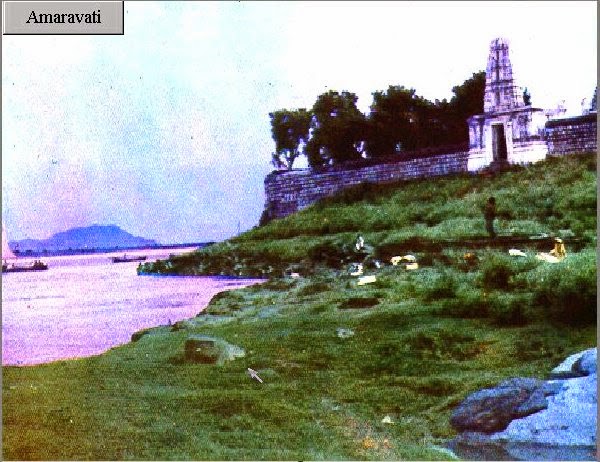
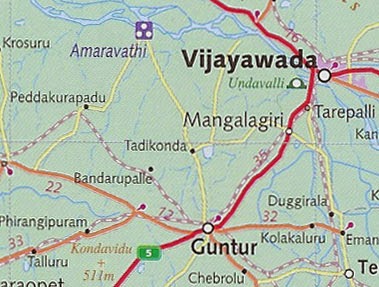
The partitioned state of Andhra Pradesh is looking for a new capital (Hyderabad is capital of Telengana). Amaravati situated on the banks of the Krishna river (see map below) and located near the commercial nodes of Guntur and Vijayawada is the old spiritual capital of the Andhra dynasty.

When the Maurya dynasty fell (post Emperor Ashoka) a giant kingdom rose south of the Vindhya mountain range (the traditional south-north divide in India). They were the Andhra Satavahanas. 
The Andhras are a curious mix: most likely Maratha-Telugu in origin (Shudras or Other Backward Caste- OBC), Aryan-like for war-faring and Dravidian-like in devotion (followers of Shiva). In that sense they can claim to be the first son-of-the-soil, north meets south, Hindu as we know now, empire. 

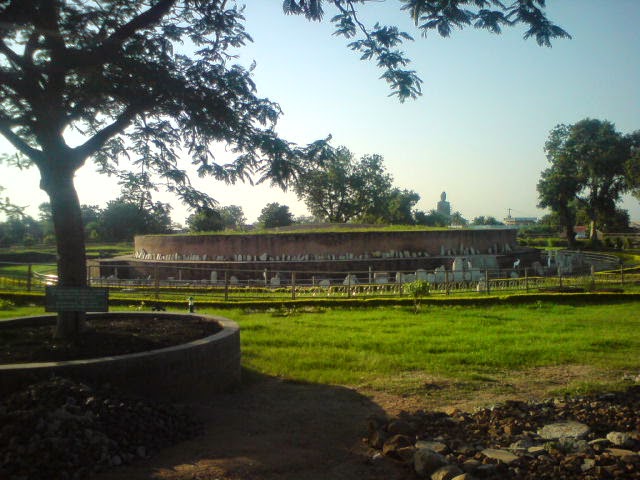
During Ashoka’s time (and even during the Satvahana period) Amaravati
was reputed as one of the fore-most Buddhist centers (stupa pix above,
see below for wiki excerpts),
however when Hieun Tsang paid a visit in
640 CE, Hindus were again in the ascendant.

Just like the Shia vs. Sunni 1000 years war, India has
experienced long, brutal battles between the followers of Shiva and Vishnu.
This is a major point of contention between hindutva-vadis and marxist
historians, examples of Turk-Mughal led genocides are countered by examples of Shaivaite vs. Vaishnavaite genocides (similar to the Gujarat 2002 vs. Punjab 1984 we are holier than thou arguments). Amaravati is the seat of Amareswara (Shiva) and Chamundeshwari (Shakti).

Intra-Hindu religious wars died out mainly due to the imposition of 1000 Years slavery (TM). There are now the five major
paths – as authorized by the Prophet Adi Shankaracharya (from Kerala) – 
Ganapati, Shiva, Vishnu, Shakti and Surya. Incidentally, the Brahminical pecking
order reserves the elite positions for the Namboodiris (also from Kerala).

Thus only Namboodiri priests can ring the bell in Kedarnath, the al-Aqsa
of the Hindus.

We note that in 2014 the Hindu leadership have anointed Varanasi as the new Jerusalem- this is also the seat of Vishwanath (Shiva) and Annapurna (Shakti). In that sense the new Hindu kingdom is a renewal of the old Andhra kingdom. The more things change the more they remain the same.
……..
The
new capital city of Andhra Pradesh will be built around the ancient town
of Amaravati, once home to the powerful Satavahana dynasty, a senior
minister and highly-placed government sources said.

With chief
minister N Chandrababu Naidu keen on developing a new city on both
sides of the Krishna river, officials zoomed in on Amaravati after
realising that price of land in Mangalagiri, Babu’s earlier choice, was
too high. Plans are afoot to link a few mandals in Krishna and
Guntur districts, spread on either side of the river, with a six to
eight lane bridge between Achampet mandal in Guntur and Nandigama in
Krishna district. Another bridge will also be built between
Kanchikacherla in Krishna district and Amravati in Guntur district,
officials who are working on the blueprint said.

….
….
[ref. Wiki] The Śātavāhana Empire ….was a royal Indian dynasty. The territory of the empire covered much of India
from 230 BCE …until around 220 CE.
Sātavāhanas started out as feudatories to the Mauryan dynasty, but declared independence with its decline. They are known for their patronage of Hinduism.
The Sātavāhanas were one of the first Indian states to issue coins
struck with their rulers embossed. They formed a cultural bridge and
played a vital role in trade as well as the transfer of ideas and
culture to and from the Indo-Gangetic Plain to the southern tip of India.

They had to compete with the Sungas and then the Kanvas of Magadha to establish their rule. Later, they played a crucial role to protect a huge part of India against foreign invaders like the Sakas, Yavanas and Pahlavas. In particular their struggles with the Western Kshatrapas went on for a long time. The great rulers of the Satavahana Dynasty Gautamiputra Satakarni and Sri Yajna Sātakarni were able to defeat the foreign invaders like the Western Kshatrapas and stop their expansion. In the 3rd century CE the empire was split into smaller states.
…….
[ref. Wiki] The recorded history of Amaravati and nearby Dharanikota dates from 2nd century BCE. It was the capital of Andhra Satavahanas who ruled from 2nd century BCE to 3rd century CE. 

After the decline of Satavahanas, Andhra Ikshvakus and later Pallava kings ruled Krishna river valley. Subsequently, Eastern Chalukyas and Telugu Cholas held sway over the region. Kota Kings were in control of Amaravati during the medieval times. Kota kings were subdued by Kakatiyas in 11th century CE and Amaravati became part of the unified Telugu empire.
……..
[ref. Wiki] The town was the site of a great Buddhist stupa originally built during the reign of emperor Ashoka. It was completed in 200 CE. It is decorated with carved panels which tell the story of Buddha’s life. The region between Krishna and Godavari rivers was an important place for Buddhism from the 2nd century BCE and some ancient sculpture in low relief has been found here. 
….
During the Satavahana period (2nd century BCE-3rd century CE), Dharanikota
near Amaravati was chosen as the capital. The stupa was then adorned
with limestone reliefs and free standing Buddha figures. During the
period of the decline of Buddhism, this stupa was also neglected and it was buried under rubble. There is a 14th-century inscription in Sri Lanka which mentions repairs made to the stupa and after that it was forgotten.


Around the year 1796 CE, Colonel Colin Mackenzie, who visited the
site twice, prepared drawings and sketches of the relics in the area.
Eventually, several European scholars including Sir Walter Smith, Robert
Sewell, James Burgess and Alexander Rea excavated the site and
unearthed many sculptures that once adorned the stupa. Many bas-relief medallions and paneled friezes decorated the Amaravati stupa. 

….
Similar to Sanchi Stupa,
the stupa was decorated with carvings of life and teachings of Buddha
and events of Jataka Stories, e.g. taming of a rogue elephant by Buddha.
The 95 ft tall stupa was made of brick with a circular dome and
platforms protruding in four cardinal directions. Recent excavations
have revealed remains of an Ashokan pillar, the first such example of Mauryan art to be found in South India.


This stupa is related to the Vajrayana teachings of Kalachakra, still practiced today in Tibetan Buddhism. According to the Kalachakra tantra texts, Suchandra, the King of Shambhala and many of his retinue received the initiation into this practice by the historical Buddha. For this reason, the Dalai Lama of Tibet conducted a Kalachakra initiation at this location in 2006.

….
Art historians regard the Amaravati art as one of the three major
styles or schools of ancient Indian art, the other two being the Gandhara style and the Mathura
style. Some of the Buddhist sculptures of Amaravati betray a
Greco-Roman influence that was the direct result of the close trade and
diplomatic contacts between South India and the ancient Romans. Indeed, Amaravati has itself yielded a few Roman coins. The Government Museum at Egmore (Madras Museum) and British Museum, London host the “Amaravati Gallery”.


….

Chinese traveller and Buddhist monk Hiuen Tsang (Xuanzang)
visited Amaravati in 640 CE, stayed for sometime and studied
‘Abhidhammapitakam’. He observed that there were many Viharas and some
of them were deserted, which points out that Hinduism was gaining ground at that time. Xuanzang wrote a glorious account of the place, Viharas and monasteries that existed.

……
Link(1): http://timesofindia.indiatimes.com/india/Andhra-Pradesh-capital-in-Amaravati/articleshow/37602031.cms


Link(2): http://www.bharatadesam.com/history/satavahana_empire.php

…….

regards

Brown Pundits