Objectives Resolution: Logical Culmination or Building Block?

The creation of Pakistan was a culmination of the ‘Indian Muslim National Project’ that was started by Muslim Elites primarily based in UP. It was bound to be a country where religion took center stage in the political arena. Led by a charismatic, populist British lawyer, All India Muslim League was a hotchpotch of landed gentry and titled aristocracy. The Second World War paved the way for an early exit by the British and handed a historic chance to Indian leaders to decide their destiny. It is difficult to predict if a ‘United India’ would have survived for some time in the absence of British interlocutors since fratricide and ethnic cleansing in Potohar had started much before the actual partition. The Muslim Elite (Ashraf) that founded Pakistan decided that the country would be an ideological state, the ideology was chosen to be Islam. Not because the elite overwhelmingly consisted of Islamists (with a few exceptions) but because religion is an easy way to manipulate people. The Khilafat movement had provided a glimpse of what mixing religion and politics could achieve and Muslim Leaguers were well-aware of its power, which is why they used the ‘Islam in Danger’ card during the 1945 election.

Continue reading Objectives Resolution: Logical Culmination or Building Block?

A Story from 1971

The following story was narrated by a dear friend and he didnt want to use the captain’s name. I felt it should be preserved, even if without names. So here is my friend’s verbatim account, with names and punjabi curses redacted:

I met a retired army officer (let’s call him captain X) while stationed in a small town in Punjab in the 1990s. People said he had been traumatized by 1971 and it had changed his life, but he didnt like to talk about it. As we became better acquainted, I asked him about that period. At first he wouldn’t talk about it, but one day after chatting about many things, he agreed to tell me his story:

The retired captain was a young army officer in early 1971 when he was informed that he was being posted to East Pakistan. His father was a retired (senior) army officer and a coursemate of General Z, who was a two-star general in Dhaka. He called General Z and mentioned that his son was coming over and to “take care of him”. General Z said “I will do more than that for you old friend, I will put him on my staff, he will be totally safe”.

Captain X arrived and joined Generaz Zs staff in Dhaka. His main job was to manage General Z’s various appointments and to arrange an endless series of lunches and dinners for the senior officers at Dhaka garrison. In the course of these duties, he became very familiar with the catering staff at Dhaka Intercontinental hotel. Life was easy and pleasant until December 1971, when bombing began in earnest and the war finally reached Dhaka. On the 16th of December, Eastern command surrendered to the Indian army and like everyone else in the Pakistani army, young captain X was depressed, sad and angry; but like everyone else, he gave up his side arm and became a POW. Initially the Indians were very disciplined and well behaved and the young officers were simply put under guard in their own officers mess. The General meanwhile had shifted to the Intercontinental hotel.

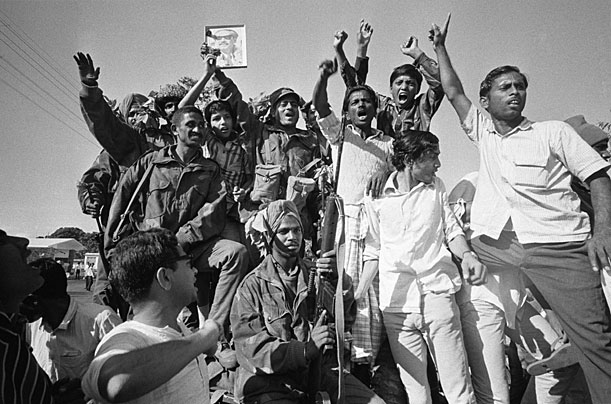
By the next day, the Indian officers were getting drunk and some became rowdy and verbally misbehaved with their prisoners, but nothing too serious happened. That evening two young Indian officers showed up at the mess and asked for him by name. They had learned that he used to handle catering arrangements and they were planning a big celebratory lunch the next day and wanted him to help with arrangements. He told them that catering used to come from the Intercontinental hotel, so they put him in their staff car and headed that way. He was in the front seat with a driver and the two officers (both mildly drunk) sat in the back. On the way, the car got stuck in a mob of Bengalis shouting Joy Bangla and looking for collaborators and sundry enemies. When one of the officers (a Sikh) stuck his head out of the car, he was recognized as an Indian and the crowd started cheering and shouting slogans for the Indian army. As the crowd pressed around the car, the Indian officers thought they would have some fun and they told the crowd “this man is a Pakistani officer, how does he look now?”. The crowd immediately grabbed hold of captain X’s hair and several people slapped him and spat upon him. He held on to the door handle and fought for dear life as some of the crowd tried to pull him out. This went on for a few minutes and he was badly beaten around the head and neck but he held on to the handle and they could not open the door.

After initially laughing at his discomfort, the two Indian officers thought things were getting out of hand and told the driver to move on and pushed the crowd back. At the same time an older Bengali in the crowd started berating the crowd and saying “don’t kill the poor man, he is only a kid”.  Pro-Indian feeling was high, so they got their way and managed to pull away. As they drove off, the Indian officers joked that “this is only a trailer, maybe we will bring you back tomorrow and watch the crowd finish you off”.

Captain X was shaking with terror and humiliation. His clothes were torn and his face swollen. He was bleeding from several cuts. They got to the hotel and stopped at a side gate and he managed to ask the guard to call xyz from catering. As he was standing there waiting (the hotel being a declared safe zone, was off limits to most Indian soldiers) he suddenly spotted General Z standing at the main gate a 100 feet away, chatting with some people. The main gate was open and was only guarded by a hotel guard. There seemed to be no Indian soldier there. Thinking “these officers will probably kill me tomorrow”, and still stunned and bleeding from his beating, captain X saw his chance and took off for the main gate, shouting “General Z, General Z, please save my life, these Indians will kill me”.

The Indian officers, taken by surprised, were a few yards behind him as he ran for dear life.
General Z looked up, saw the captain, grasped the situation.. and ran. He ran inside the gate and shouted to the guard to close the gate. By the time captain X got there, the gate was closed. He stood banging helplessly at the gate, watching General Z running into the hotel as he screamed “Sir, they are going to kill me, Sir, please help!”.

The two Indians caught up with him and gave him another thrashing. Then they took him back. He was never taken into the city again and spent the next year in captivity, dreaming of nothing else except the day when he would get back to Pakistan and kill General Z.

When he got back, his friends (who had heard him say as much hundred of times) told his father about his plans. His father forcibly took him home and got him out of the army and made him promise never to see General Z again in his life. And of course, he broke off all relations with General Z. General Z called his father several times and even wrote to him to say “please listen to my side of the story first” but dad was done with General Z.

Until one day, 10 years later, General Z, now retired and holding a senior civilian position (that being the norm in the army) came to their town. His staff showed up at their house, insisting that General Z wanted to meet for lunch. General Z himself called and spoke to Captain X’s mother, who was unable to say no and agreed to have General Z come over for lunch. Dad then searched his son’s room, found a pistol and took it away and locked him in the room, forbidding him to come down. Mom made him promise on her life not to do anything stupid. There was a very cold lunch, with dad absolutely refusing to say or hear anything about 1971. General Z came and left. They never met again.

Captain X says if it was not for his mother making him promise on her life not to carry out his threat, he would have strangled General Z at that lunch with his bare hands.

And so it goes.

Many stories about East Pakistan are now recorded in various books written by Pakistani officers who served there, but this particular incident has not made it into history. In somewhat redacted form, I hope this post will preserve it for posterity.

1971: From East Pakistan to Bangladesh

This excellent article was written in 2002 by the redoubtable Dr Hamid Hussain. Still relevant.

Demons of December —
Road from East Pakistan to Bangladesh

Columnist Hamid Hussain makes an excellent analysis of events leading to 1971.

Introduction

Great blunders are often made, like large ropes, of a multitude of fibres. 
Victor Hugo’s Les Miserable

December is the anniversary month of the independence of Bangladesh and break up of Pakistan. The memories of that critical period of the history of the two countries are very painful for everyone who was affected in one way or the other. There has been very little attempt to dispassionately and critically analyze various aspects of that period. Most of the writings have been limited to accusations and counter-accusations and mud slinging. In the absence of a serious government or academic inquiry, most of the facts have been clouded in only opinionated rhetoric. Some have picked up on one person and blamed him for the whole disaster. Others have tried to defend their favourite and passed the buck to someone else. Various individuals have played an important role during that critical time period and everybody had their share in the outcome. Most of the discussion has been limited to the last act of the play, which was played in 1971, ignoring the whole historical context. At the end stage of a crisis when the powerful currents of history are in full swing, as one commentator has correctly pointed that an individual cannot alter the movement of historical forces, which are far stronger than any individual actor.1

Several ethnic sub-groups in Pakistan, in addition to the clash on material issues have jealousies, deep-rooted prejudices and stereotypes about each other. In this environment of mistrust of each other and absence of conflict resolution models, open clash between various groups including use of violence becomes the general rule rather than exception. The ruling elite of Pakistan views the political consciousness of ethnic groups as subversive. They have tried to use ‘the twin instruments of Islam and the state to overcome this subversive force’.2 The state’s assertiveness to impose an artificial unity from above, where the ruling class is composed of a dominant ethnic group results in an expected response from other ethnic groups. They perceive it as imposition of the value system of the dominant ethnic group and loss of their own ethnic identity.3 This creates a vicious cycle, where every attempt to centralize control over periphery results is hardening of the attitude of the one’s at the receiving end. The threat to state’s territorial integrity ‘tends to arise out of local reaction to the centre’s heavy handed imposition of uniformity on diverse communities in the first instance, and the violent repression of subsequent local dissent’.4 This is the essential component of the whole affair. Bengalis had genuine grievances against the Western wing, but ‘their success came, when it did, not because their assumptions were more accurate than those permeating the Pakistani elite-culture but because their strategic alliance with Delhi and Moscow gave them an advantage Islamabad was unable to match’.5

Historical Background


‘You at least are not a Bengali’. Three different delegates from West Pakistan starting their conversation with Karl Von Vorys during All Pakistan Convention of Basic Democrats in 1962 6
The prejudice against Bengali Muslims has a long history and was quite prevalent long before Pakistan emerged as an independent state. Muslim intellectuals, elites and politicians, which belonged to northern India, had the picture of a Muslim as tall, handsome and martial in character. These characteristics were applicable only to Muslims of northern India. As Bengali Muslims didn’t fit into this prejudiced and racist picture, therefore they were ignored at best and when even allowed to come closer, were considered inferior. Bengalis were shunned despite their political advancement and strong resentment against oppression and tyranny. A large portion of Bengali Muslims was converts from Hindu low castes. The ‘noble borns’ of Bengal claimed foreign ancestry (Syed, Afghan, Mughal). The majority of Bengali Muslim population which had customs common with Hindu peasantry and had a proud sense of their language was not considered as ‘proper Muslims’ by some Bengali ‘nobles’ and almost all of West Pakistan. This perception later influenced the official decision to ‘Islamize’ and ‘purify’ East Bengali culture in Pakistan after 1947.7 The British theory of ‘Martial Races’ was generally well received by the natives in this background. The British classification considered Bengalis as part of ‘feminine races’. They were considered ‘feeble and spineless but clever’.8

In later part of nineteenth and early part of the twentieth century, several important Muslim leaders advocated division of India on the basis of separate Muslim identity. The prejudice against Bengali Muslims was so prevalent and widespread, that no body cared about them and did not consider them as part of Indian Muslim community. In fifty years, about 15 such schemes were proposed but not even a single one mentioned Bengal or Bengali Muslims.9 Sir Muhammad Iqbal who proposed the idea of Pakistan in his famous Allahabad address in 1930 did not include Bengali Muslims in his scheme. Chaudry Rehmat Ali who coined the word ‘Pakistan’ for his new country did not bother to fit the majority population of future Pakistan in his name. Generally speaking, Muslims of northern India considered themselves superior and more pure blood and despised Bengali Muslims, which they seem to equate more with Hindus rather than accepting them as brothers in faith. The Bengali leader, Fazlul Haq who presented the Pakistan Resolution in 1940 was forced to resign from Muslim League in September 1941. The Muslim League leadership never trusted Hussain Shaheed Suharwardy, who was the elected Chief Minister of Bengal. He was not given a seat at Working Committee of All India Muslim League. Upper class elite dominated Bengal Muslim League. It got political support from Khawaja Nazimuddin, financial support from Mirza Abul Hassan Ispahani and media support from Maulana Akram Khan.10

In 1947, when the new state of Pakistan emerged, there was a very unique and difficult dilemma facing the new nation. More than a 1000 miles of hostile territory of India separated the two wings. East Pakistan contained more than half of the population but only one-sixth of the land. In Eastern wing, population was more homogenous ethnically and linguistically while Western wing had five clearly diverse groups (Punjabis, Sindhis, Baluch, Pushtuns and newly immigrated Muslims from India called Muhajirs). In eastern wing, the non-Muslim population was 23% while in western wing only 3 %. Peasant proprietors dominated agriculture sector in Bengal compared to large feudal estates in West Pakistan.11 Bengalis were the most politically conscious group of Pakistan. In addition, there was a long tradition of strong leftist presence in Bengal. Literacy rate was 30% in East compared to 20% in West Pakistan.12 In 1950, East Bengal Provincial legislature passed a landmark bill called East Bengal State Land Acquisition and Tenancy Act of 1950. This law abolished the permanent settlement, which ended the Zamindari system that supported the landed elite. The land holding was limited to 100 Bighas (about 33 acres) which affected both Hindu and Muslim landlords.13 In my view this little known single piece of legislation was a crucial factor which would impact the future course of relationship between the two wings. This law rang the alarm bells in West Pakistani ruling elite, which was dominated by the landed aristocracy.

The demand for Pakistan had a ‘millennial appeal, which, for a while, covered up the deep divisions within the Muslim community’. After the emergence of Pakistan, there were demands for clarity as to what it stood for, and fissiparous tendencies began to set in.14 This is the historical context of the events up to independence in 1947, which is very important in understanding of the events, which plagued the country later.

Second Class Citizens of the New Nation
Your music is so sweet. I wish to God, you Bengalis were half as sweet yourself. Field Marshal Ayub Khan to his Bengali friend.

After independence, several factors contributed to the gradual widening of gulf between the two wings. The fundamental factor was the difficulty of West Pakistani elite to accept Bengalis as equal partners. The rapid alienation of Bengalis was partly due to the fact that Bengali elite’s access to power had traditionally been through political mobilization and not bureaucracy. In the absence of a democratic culture and stark absence of Bengalis from the two most important decision making bodies, civilian bureaucracy and military, made the Bengali apprehensions acute. The establishment of a highly centralized regime in 1958 and banning of political parties effectively cut them out of the national scene with no voice at national level.15

Poorly thought out decisions made by a small clique, which were either made in total ignorance of ground realities or with deep-seated prejudice against the Bengalis contributed to increasing Bengali alienation. In the absence of detailed thought out policies, which are discussed at various forums, resulted in total ignorance on part of the general population of West Pakistan what was being done to the Bengali majority in the name of national unity. The initial discontent was based on the language issue, when Pakistan government decided that there will be only one national language and that will be Urdu. Even Bengali Muslim League leaders (Tajuddin Ahmad and Abu Hashim) expressed their apprehensions about the neglect of Bengali and its consequences. In September 1947, government of Pakistan printed currency notes, issued coins, printed money orders and post cards in English and Urdu only. In 1947, the circular of Pakistan Public Service Commission had made provision of Urdu, English, Hindi, Sanskrit, Latin and other languages but made no provision of Bengali. In an attempt to ‘purify’ Bengali culture of Hindu influences, Pakistan government decided to change the script of Bengali. In total disregard of the local sentiments and even constitution itself, central government set up centres teaching Bengali in Arabic script.16 The Bengali protest started on this language issue. Pakistan government was forced to acknowledge Bengali as one of the state language in 1954 due to overwhelming Bengali demands but in the process, the gulf between two wings further widened.
Every genuine demand by Bengalis was denounced as a conspiracy to destroy Pakistan. The ruling elite dubbed the Bengali advocates of their rights as ‘anti-state’ and ‘anti-Islam’ and used epithets like ‘dogs let loose on the soil of Pakistan’. Suharwardy was threatened with the loss of his citizenship.17 The Punjabi Governor of East Pakistan, Firoz Khan Noon described the Bengali voice of dissent as a conspiracy of ‘clever politicians and disruptionists from within the Muslim community and caste Hindus and communists from Calcutta as well as from inside Pakistan’.18 These ill-thought policies of central government further hardened the Bengali attitude.

The debates about the future constitution of the country further revealed the different thought process prevalent among the representatives of the two wings. A very important fact, which has been overlooked, is the membership of first Constituent Assembly. It had 44 members from East Bengal, 22 from Punjab, 5 from Sindh, 3 from North West Frontier Province and one from Balochistan. In 1949, the Basic Principles Committee submitted its report and recommended a federal democracy for the new nation. The members from Punjab objected that just because of being larger in number, Bengalis should not be allowed to have a dominant position (a similar stand taken by Zulfikar Ali Bhutto in 1971 when he stated that the bastions of power are Punjab and Sindh). They probably had a different idea about parliamentary democracy. If this view is accepted then this means that ‘certain citizens are more equal than others’.19 Bengalis accepted the principle of parity in the legislature on the assumption that same will apply to Bengali representation in other areas including economic, civil service and military. Fearing the prospects of Bengalis joining hands with smaller provinces of the Western wing to press for their demands, Ayub Khan (who was C-in-C and also Defence Minister) came with the idea of ‘Unification of West Pakistan’ and initiated the process of merger of four provinces.20 After the 1958 coup, Ayub held the firm control and ran all affairs with the help of civilian bureaucracy. Ayub’s own hand picked cabinet members from East Pakistan (Muhammad Ibraheem, Abul Qasim Khan and Habib ur Rahman) demanded greater autonomy during discussions on Constitution and warned of grave dangers of a highly centralized government. Several 4:3 votes (there were four members from West Pakistan and three from Eastern wing) during these deliberations clearly indicated a genuine different thought process and different perspective among ministers from the two wings.21 Ayub’s response to the arguments of ministers from East Pakistan was that after the promulgation of the constitution, he dropped all three from the cabinet.22 This shows that Ayub kept these three Bengali ministers during the deliberations to show that the Bengali view was being considered while actually, he resented their views. As expected, the promulgation of 1962 Constitution resulted in massive protests in Eastern wing led by the students.

Similarly, economic issue was also a thorny one. The central government kept avoiding this on one or other pretext but was forced to address it as there was a unanimous consensus of Bengalis on the economic issue. In 1951, Sir Jeremy Reisman was invited to evaluate the existing allocation of revenues and recommend any changes. His recommendations were accepted as an Award. The results of this award gave credence to Bengali point of view. The revenue deficit of East Pakistan came to Rs. 7 million in 1952-53 from Rs. 40 million in 1951-52.23 The highly centralized rule of Ayub Khan further alienated the Bengalis as their representation in military and civilian bureaucracy was very low. The Bengali disaffection was obvious even to a blind man but the rulers chose to ignore it. In July 1961, Intelligence Bureau (IB) report about the feelings of Bengali population clearly stated that, “The people in this province will not be satisfied unless the Constitution ensures them in reality equal and effective participation in the management of the affairs of the country, equal share of development resources and, in particular, full control over the administration of this province. The intelligentsia would also like to see a directive principle in the Constitution to increase speedily East Pakistan’s share in the defence services as well as equal representation of East Pakistanis in the central services”.24 Alas, a mid-level police official of IB was more farsighted than the rulers of the country.

Face To Face
‘Does it not put you to shame that every bit of reasonable demand of East Pakistan has got to be secured from you at tremendous cost and after bitter struggle as if snatched from unwilling foreign rulers as reluctant concessions’. Awami League’s Leader Sheikh Mujeeb ur Rahman, 1966

1971 did not occur in a vacuum. It was the logical outcome of the trends, which were operational for at least few decades, and no attempt was made to address the fundamental issues. The initial Bengali attempts were to get their due share in the country’s decision-making process. It later evolved into Bengali nationalism and moved from greater autonomy to finally into struggle for complete independence. Every ill-thought step taken by the central government from banning the poetry of Rabindranath Tagore on national media to administrative and economic measures radicalized the Bengali population one step further. Even thirty years later, with all the hindsight, Pakistan is unable to comprehend the root causes of Bengali alienation. In 1998, a retired Lt. General is of the view that, “Bengali nationalism was only incidental, fostered by India to serve her purpose and larger interests in the region’.25 Major General (r) Rao Farman Ali (the political advisor of the military regime in East Pakistan and most informed person about the crisis) with all the hindsight has this to say about the landslide victory of Awami League in 1970 elections, “Total 37% votes were polled. Of this 20% were polled by Hindus from India, Awami League got 15% and Jamaat-e-Islami 2%”.26 Another commentator views the poor relations between Pakistan and Bangladesh due to the ‘stubbornness of Indian lobby in the bureaucracy of BD (Bangladesh)’ and this according to him is due to the ‘self-assigned objectives of keeping both the brothers apart’.27 Complete lack of understanding about the basic facts about their own society and paucity of information is quite evident from such assumptions.

Bengali politics was not monolithic. The Muslim League leadership consisted of landed elite and cosmopolitans from Calcutta. Later, vernacular leadership (Fazlul Haq and Maulana Abdul Hameed Bhashani) based on support from rural masses came to limelight. 1954 provincial elections were a watershed in the history of Pakistan. The United Front (consisting of Fazlul Haq’s Krishak Sramik Party and Suharwardy’s Awami League) swept the elections. United Front won 223 of the 237 Muslim seats and had many allies among the 72 non-Muslim elected members. Muslim League was wiped out of the East Bengal during this election. West Pakistani ruling elite’s apprehensions about the new Bengali leadership were re-enforced by the international politics and Pakistan’s attempts to join US sponsored military pacts against the Communism. Now a complex set of factors including domestic, personal and class interests, regional and international came into play which impacted the nascent democratic process of the new nation. When the defence treaty with United States was announced in February 1954, there was a general protest in East Bengal. Several demonstrations were held and newly elected assembly members signed a protest statement. This signature proved to be the death sentence of the provincial assembly. The ruling group in Karachi (Governor General Ghulam Muhammad, C-in-C General Ayub Khan and Defence Secretary Sikander Mirza) saw this situation as a grave threat to their vision for the country and future relationship with US, which would be a foundation stone of this policy. They concluded that to show to Washington that Pakistan was a serious ally and in full control of its house, East Pakistan’s political process has to be checked. On May 19, 1954, the mutual defence agreement was signed in Karachi between US and Pakistan and eleven days later, Governor General dismissed East Bengal Provincial Assembly on the flimsy charge that Fazlul Haq had uttered separatist words to Indian media. One day before the dismissal of the assembly, Pakistani Prime Minister while confiding with the US Charge, told him that Governor rule was planned for East Pakistan to route the communists. He revealed that the matter was not even discussed with the cabinet or Chief Ministers as information may be leaked to Peking and Moscow via Fazlul Haq.28 The central government sent two of its most notorious bureaucrats as Governor (Sikandar Mirza) and Chief Secretary (N.M. Khan) to East Pakistan to bring Bengalis in line. The plan was not for a short- term scuttling of the political process but a long-term as Ayub Khan confided with US ambassador. Pakistani decision makers always feel more at home with foreigners rather than their fellow countrymen. Ayub very candidly told the US ambassador that, “it would be necessary to keep military rule in effect in East Pakistan for a considerable length of time”.29
Ayub’s rule from 1958 to 1969 with banning of political activity and running of government through a strong central authority pushed Bengalis further in the background. The protests continue to simmer throughout this period, which finally exploded in Ayub’s face in 1969. By that time, Awami League under the leadership of Mujeeb was the dominant force. The major base of League’s support was in urban areas but Mujeeb was successful in getting the support of rural areas also, which markedly strengthened his position. The central government co-opted few Bengalis to give a facade of Bengali participation. Ministers and Governors belonging to East Pakistan held their offices at the pleasure of ruling elite. They had no popular base. Out of 16 East Pakistanis who served as ministers in Ayub government, 4 were from civil services and one journalist. The remaining 11 members were secondary leaders of Muslim League, 8 of whom had contested and lost the election of 1954 (the only election held in East Pakistan on the basis of adult franchise). The governor of East Pakistan, who held the office for seven long years, had lost so heavily in 1954 elections that his deposit was forfeited.30 This is the brief account of fundamental differences between the two wings which lasted for 24 years before the day of reckoning dawned in December 1971.

Dance of Death
The excesses committed during the unfortunate period are regrettable. General Pervez Musharraf writing in the visitors’ book at Savar Memorial for the Martyrs of 1971 in Dacca, July 2002 31
When Yahya Khan took control of the state in 1969, the country was effectively divided on all known fault lines. The separation between the two wings had been completed at the psychological level. The wisdom of Solomon was needed at that time to avoid a civil war but the only commodity in abundance was ignorance mixed with raw emotions and rhetoric. The military elite failed to understand the dynamics of their own society. They embarked on an ambitious but un-realistic goal of higher level of national cohesion in the absence of genuine participation. In March 1971, they took the fatal decision on the basis of their thoughts that the conflict is an artificial one and they will control it by attacking it directly and with brutal force. In this assumption, all the civilians of West Pakistan (including civilian bureaucracy and all political parties) were in agreement with the military’s point of view.

In the background of general mistrust and prejudice against Bengalis, when Bengali demands increased, so was the anger against them. The phenomenon was universal in West Pakistan affecting both civilians and army officers. By early 1971, there was a general consensus among the military leadership with probably very few exceptions (Lt. General Sahibzada Yaqub Khan was one) that the only solution left was the use of force. Yahya Khan called a meeting of Governors and Martial Law Administrators (MLAs) on February 22. Lt. General Yaqub Khan recalled the thought of Yahya Khan about use of strict measures. “He thought that a ‘whiff of the grapeshot’ would do the trick and reimposition of the rigours of martial law would create no problems”.32 To be fair to Yahya, he was not alone in this assessment. Almost all civil and military leadership was of the same view. To understand the decisions taken by the leadership, one has to understand the thinking of the senior officers at that time. Niazi explaining the apprehensions of West Pakistanis states, “They were also apprehensive about the Hindu influence on Bengali politics… The government would be formed by Bengalis, the iron fist in the velvet glove would be that of Hindus. To ensure that the Hindu was nullified, the parity system was evolved… This was aimed at protecting the interests of the West Pakistanis from exploitation by the Hindu-controlled Bengalis”.33 After the sweeping victory of Awami League in 1970, Yahya’s intelligence Chief, Major General Akbar Khan stated that, “we will not hand over power to these bastards”.34 In June 1971, in a divisional commander’s meeting, almost all generals disapproved negotiations with Awami League and stated, ‘we must finish this thing’.35 During a visit to Dacca during the March 1971 operation, a close associate of Yahya stated, “There can be no political settlement with the ‘Bingos’ till they are sorted out well and proper”.36 The civilians of West Pakistan in general had the same thinking. Bhutto had claimed that the bastions of power of Pakistan were Punjab and Sindh. The civil service held the general idea that, “a taste of the danda — the big stick — would cow down the Bengali babu’.37 The civilian bureaucrats serving the regime, like Information Secretary Roedad Khan were advising the generals about ‘putting some fear of God’ in Bengalis and how to purify Bengali race and culture by Arabising the Bengali script.38 The ruling elite was totally lost and the events were moving too fast for any of them to fully comprehend, let alone respond in any meaningful way. The rulers were now really suffering from delusions, unable to see beyond their boots. When the Bengali soldiers, police officials, diplomats and airline pilots were defecting en masse, the members of the regime were re-assuring the Pakistani envoys (Major General Ghulam Omar, Information Secretary Roedad Khan and Foreign Secretary Sultan Muhammad met with Pakistani envoys in Tehran and Geneva) that everything was under control and the majority of Bengalis were with Pakistan.39 This was being told when they could not get a single Bengali to work at Dacca radio station and in an ironic twist, Pakistani representative (Abu Saeed Chowdhry) attending a human right conference at Geneva had defected. They really thought that the world is blind.

This general thought process was not limited to only senior level. In soldier’s mind when conclusion was reached that Bengalis are traitors then the next line of action was quite obvious. You don’t negotiate with traitors, you finish them off to save the country from their ravages. Soldier was now ready, mentally prepared to deal with a group who was seen as coward and only to be dealt with force. A Pushtun ex-cavalry officer has eloquently expressed this thinking. During a conversation in early 1971, he dismissed Bengalis as cowards and predicted that they will run when first shot is fired. He confidently stated, “Do you know what an armoured regiment can do in Bengal? It will go through the Bengalis (he used the derogatory term ‘Bingo’) like a knife through the butter”.40 In March 1971, when the military action started, most officers and rank and file justified their actions on the basis of whatever seems plausible to them. At 16th Division HQ, Anthony Mascarenhas was told, “we are determined to cleanse East Pakistan once and for all of the threat of secession, even if it means killing off two million people and ruling the province as a colony for 30 years”.41 At 9th Division HQ at Comilla, Major Bashir justified the military action by stating that Bengali Muslims were “Hindu at heart” and this was a war between pure and impure. His superior Colonel Naim justified the killing of Hindu civilian population to prevent a Hindu take over of Bengali commerce and culture.42 A senior officer in Khulna told Maurice Quintance of Reuters, “It took me five days to get control of this area. We killed everyone who came in our way. We never bothered to count bodies”.43 Captain Chaudhry commented after the March operation that, “Bengalis have been sorted out well and proper — at least for a generation”. Major Malik agreeing with this assessment, remarked that, “Yes, they only know the language of force. Their history says so”.44
Secessions and civil wars are brutal and very violent. They run their course in a vicious cycle. The March 1971 military operation resulted in deaths of a large number of civilian Bengali operation. Bengalis being not in a position to tackle the well-organized army, turned their rage at the non-Bengali community amidst them. A vicious campaign of murder, rape and utter destruction was unleashed against the civilian non-Bengali population. These atrocities in turn brought the ire of the army, who simply went out of control in extracting a heavy price from the Bengalis for their rebellion. This orgy of bloodshed and outrageous atrocities against non-combatants is the most shameful and painful part of the collective history of the peoples of the two wings. Wanton murder committed by anybody should be condemned. It becomes critically important in case of organizations, which are held to higher standards than mobs. On Bengali side, some have given exaggerated accounts of atrocities, while on Pakistan side there has been total denial, which has resulted in much confusion. Now there is enough evidence to suggest that there was a planned and systematic killing of civilians, especially educated elite and Hindu civilians.45 Information provided by senior Pakistani officers points towards that. Niazi on his assumption of command in East Pakistan, issued a secret directive to all formations which stated, “Since my arrival, I have heard numerous reports of troops indulging in loot and arson, killing at random and without reason in areas cleared of the anti-state elements. Of late, there have been reports of rape… There is talk that looted material has been sent to West Pakistan through returning families”.46 A former Brigadier stated that Farman Ali was the principle architect of the plan to crush the Bengalis with force and was directly involved in the Hindu Basti massacre.47 Niazi also admits that a ‘scorched earth policy’ was carried by Tikka Khan and his orders of ‘I want the land and not the people’ was carried out in letter and spirit by Major General Framan and Brigadier Jehanzeb Arbab in Dhaka’. He also admitted that tanks and mortars were used against university students and 7th Brigade under Arbab not only killed people in Dacca but also resorted to looting banks and other places.48 The figures may be disputed by different parties but the fact remains that large scale death and destruction ensued since March 25 army operation. Enough information from Pakistani side and from Bengali side has emerged to support this conclusion.

Military Aspect
The military by its nature is excessively sensitive to criticism, which makes the task of learning from its mistakes and inadequacies very difficult for it.49
The defence policy of Pakistan was shaped by small group of senior officers without any serious debate and discussion. The idea of ‘defence of East Pakistan from West Pakistan’ adopted by West Pakistan dominated senior military elites had its roots in the British traditions. The British C-in-C of Indian forces prior to partition, Field Marshal Claude Achinleck considered East Pakistan as ‘strategically useless’. This assertion was based on the observations that the country was flat and easy target for invasion, Bengalis had few martial traditions and the lands possessed few natural resources and no valuable industries. He, therefore, concluded that it was not prudent to invest in the defence of East Pakistan.50 In April 1947, Achinleck wrote about the defence concept of East Pakistan, “ the effort involved in providing adequate defence against aggression for this region would seem to be out of all proportion to its economic or strategic value”.51 From a colonial standpoint, this assessment may be correct but for an independent country to adopt such a policy of defence, where the region with majority population is considered useless, was simply absurd. By adopting this policy, essentially, one wing of the country was telling the other that ‘you are worthless and indefensible’, therefore we will allow the enemy to occupy your land and subjugate you while we defeat him somewhere else and then on the negotiating table we will try to win back your freedom. It will be very hard to find such an absurd examples in military history. Achinleck was highly regarded by almost all senior officers, many of whom had worked under him and his words and ideas were gospel truth. This one example shows the lack of independent thought and critical analysis among the senior officer corps regarding vital issues. Any serious discussion about this concept was discouraged by Ayub. (He wrote an angry letter to Prime Minister about the naval chief Vice Admiral H. M. S. Chaudhry and suggested his removal because he wanted to discuss this issue). In the absence of Bengali officers in the higher ranks, no one was there to challenge the idea and present an alternative view about defence of that area by someone who considered the area his homeland. At General Headquarters (GHQ), there was no well-thought out plan of how Pakistan will respond, if India attacked East Pakistan. With all the hindsight, a former Pakistani general in 2001 still insists that the policy of defence of East Pakistan from West Pakistan was a sound policy. The reason he gives is that West Pakistan was the ‘heartland’ and ‘hub of industrial and military power’.52 These esteemed and patriotic soldiers fail to understand the basic fact that no group of a country wants to see itself as ‘strategically useless’ or ‘gateway’ and hence dispensable while others elevating themselves to the ‘core’ and ‘heartland’ of the state worth fighting and dying for. 1965 war with India brought to open the hollowness of the idea of defence of East Pakistan from West Pakistan. On the Western front, the war was a stalemate despite better Pakistani equipment with no significant territorial gain. East Pakistan had only an under-strength division (14th Division commanded by Major General Fazal Muqeem Khan) and 15 Sabre jets. All communications between the two wings were cut off and East Pakistan was vulnerable. This heightened the sense of insecurity among the Bengalis along with the bitterness that they have been put at risk of Indian occupation to take Kashmir territory.53 The cost of 1965 war was not military but political. In my opinion, it was after the 1965 war that Bengalis in general started to question the viability of union of two wings under a single central government.
In early 1971, the rapidly deteriorating situation in East Pakistan forced the Pakistani GHQ to send two divisions (9th and 16th ) to the eastern wing. These two divisions were the strategic reserve of the country. Two more divisions were raised to replace the reserve divisions sent to East Pakistan. Thus, when the war came in November 1971, the strategic reserve divisions were in their infancy. ‘Pakistani GHQ had a naively simplistic attitude towards Bengali separatism. They did not realize that political problems could seriously compromise the strategic equilibrium of the army’.54 The military problems of East Pakistan had been clearly seen by US consular at Dacca as early as 1958, several months before the Ayub Khan’s coup. In his telegram to State Department on May 29, 1958, he wrote, “To hold East Pakistan, a dictator would have to strengthen army here, now one under-strength division, including two Bengali battalions which might mutiny. To strengthen army here means to weaken it in West Pakistan. Army here is thought capable of maintaining internal security, but this estimate is based on prospect of riots and local disturbances, not an open revolt aided in all likelihood by another country. Civil war is bitter and unrelenting as we know from our own experience and that of other countries”.55 Such foresight would be a very rare commodity in Pakistani leadership.

In a multi-ethnic state, the composition of the armed forces has both negative and positive impact on the society at large. This becomes especially important when military as an institution is involved in the direct running of the state as is the case of Pakistan. Pakistan army is the continuation of the army of the Raj. Both factors of low inclination of Bengalis towards soldiering and British theory of ‘Martial Races’ were responsible for almost no Bengali representation in the armed forces of Pakistan at the time of independence. In view of dominance of few ethnic groups in the military, it is viewed ‘as the instrument of specific regional interests’ and when armed forces assume the country’s leadership, this image is exacerbated.56 The country’s founder, Muhammad Ali Jinnah ordered the raising of Bengali regiment. The first battalion of East Bengal Regiment (EBR) was raised in February 1948. It was popularly called Senior Tigers. The second battalion of EBR was raised in December 1948. This policy of incorporating the Bengalis was done half heartedly in the beginning as by 1968, there were only four Bengali regiments. There were several reasons for that. In a multi-ethnic society, where one dominant group defines the parameters of national security and proper code of patriotism, the group, which has different opinion, is seen as less ‘patriotic’. If the Bengali is less inclined to join the armed forces (which may have historical, social or cultural reasons), then it is assumed that he is less patriotic and his allegiance to the state is suspect. This will mean that he is not welcome in the institution when he decides to join. The general principle in this situation becomes that ‘groups that are less allegiant to the state or the regime have to be enlisted — but enlisted as late as possible and in such a fashion that the political cost is not intolerable for the elite’.57 This is exactly what Pakistani leadership did in case of Bengalis.

The British theory of Bengalis being non-Martial was also prevalent among the Punjabi and Pushtun officers (the dominant groups in Pakistan army). In Air Force and Navy, the numbers of Bengalis were steadily increased. There were several reasons for that. Compared to army, these two arms of armed forces are less politically involved in coups. Second, these two arms require more technical skills and higher education standards to run state of the art machines and Bengalis were able to perform these functions. In the military academy, Kakul, the Bengali cadets were considered inferior to the ‘Martial Races’. One former instructor at the academy in 1950s stated that Bengalis were generally given poor grades and seldom given any higher appointments. Many of them were shunted out as ‘Duds’.58 The gulf between Bengali and non-Bengali officers was as wide as between the general populations of the two wings. The total disregard of Bengali sentiments can be gauged by one incident which one Bengali cadet experienced during his stay at Kakul in 1970. At a dinner night, Major Shabbir Sharif (a good and well-respected officer of 6 Frontier Force Regiment who died in action in 1971 at Suleimanki sector) was sitting at the table with the Bengali cadet. He commented about the recent devastating cyclone in East Pakistan that more than hundred thousand people have perished. He then added that there were so many Bengalis that ‘I’m sure they will not be missed’. The young Bengali cadet was shocked to hear these words from an officer who was the role model for young cadets and everybody aspired to emulate him.59

In 1969, Yahya Khan ordered the raising of new Bengali regiments but like all other decisions it was too late. Bengalis have been too politicized and too alienated by that time. Compared to other regiments in West Pakistan, the EBRs were not mixed with other ethnic groups. The single class Bengali regiments assured that whenever the Bengali units decide to revolt, it will be en masse, and that is what happened in March 1971. Whenever a EBR revolted, the first thing they did was to kill their officers who were from West Pakistan. This would mean ‘no return’ for everybody and would keep even the reluctant ones in line. This is strangely reminiscent of the rebellion of the native sepoys of Indian Army in 1857. The Bengali officers and soldiers who were stationed in East Pakistan revolted en masses after the March 1971 operation and left with whatever equipment they could get their hands on. They later formed the core of Mukti Bahini. 1 EBR at Chandpur was significantly reduced in numbers. The regiment was moved to Jessore, where it was disarmed but some soldiers succeeded in escaping with arms. 2 EBR at Joydebpur rebelled on the night of March 28-29 and escaped with their arms and equipment. Two companies of 3 EBR at Ghoraghat and Gaibanda after rebellion moved to Hilli area. 4 EBR at Brahmanbaria and Shamshernagar after rebellion moved to Sylhet area to join rebels. The trainees at East Bengal Regimental Centre at Chittagong
(9 EBR was being raised at the time) rebelled on the night of March 25-26. There were also desertions in 10 EBR (another newly raised battalion which was National Service Battalion) while the remaining trainees were sent on leave. Of the total strength of 17,000 of the paramilitary force, East Pakistan Rifles (EPR), only 4,000 could be disarmed while the remaining decamped with their arms.60 Indian army organized the Bengali military, paramilitary and police personnel. The activities of the Mukti Bahini were code named “Operation Jackpot”. The country was divided into eight military sectors, each commanded by a Major, who had deserted from Pakistan Army. When India attacked East Pakistan, Bengali forces were organized into three brigades and attached to Indian forces in different sectors.61

There were about 28,000 Bengali armed forces personnel in West Pakistan. This group was caught in the middle of a very difficult situation. Some officers deserted and slipped into India. Pakistan army now was in a dilemma. It could not trust any Bengali officer but at the same time it could not act against anyone unless they have shown any sign of mutiny. The result was decisions, which were not practical. In one case, a Bengali officer was given the command of a platoon on the frontline where he will be charging the Indian forces but not given a personal weapon. When he asked about this unusual practice, the embarrassed commanding officer told him, “You have all the machine guns and anti-tank weapons under your command. Why do you need a personal weapon?”. He failed to give any reason of why all other non-Bengali officers of the regiment were keeping their personal weapons.62 After the ceasefire, they were imprisoned although they have not been guilty of any crime except being present at the wrong place at wrong time. They were later used as pawns in negotiations with India.

Strict adherence to professionalism and improved training with broader horizons for the senior brass are essential. Institutional control mechanisms should be in place to check any aberrant behaviour. Rhetoric, hyperbole and irrational thinking has no place in any institution let alone in the armed forces, which are involved in life and death situation. I’ll give few examples of the thinking of the senior brass regarding tactics and strategy and let the readers make the judgment. The commander of Eastern theatre, Lt. General Amir Abdullah Khan Niazi’s plan which he presented to the central government in June 1971 (when he was facing a full blown rebellion of his own population with no heavy equipment and air force), in his own words was, “… I would capture Agartala and a big chunk of Assam, and develop multiple thrusts into Indian Bengal. We would cripple the economy of Calcutta by blowing up bridges and sinking boats and ships in Hoogly River and create panic amongst the civilians. One air raid on Calcutta would set a sea of humanity in motion to get out of Calcutta”.63 In summer of 1971, when Niazi was asked what will be his strategy in case of war, he had these words, which he uttered in the presence of senior military officers, “Have you not heard of the Niazi corridor theory? I will cross into India and march up the Ganges and capture Delhi and thus link up with Pakistan. This will be the corridor that will link East and West Pakistan. It was a corridor that the Quaid-e-Azam demanded and I will obtain it by force of arms”.64 A former Air Force Chief, Air Marshal Jamal Ahmad Khan while commenting about the pathetic performance of the air force in 1971, boasted that, “if India was not supported by Soviet Union, Pakistan Air Force would have crippled Indian air force”.65 These words are uttered by a former chief of air force in the presence of stark facts that Pakistan has evacuated all its fighter pilots (total of 14) from East Pakistan on December 8 and 9, seven days before the surrender as no airfield was functional. In the Western wing, air force was unable to give any meaningful support to the army or adequately protect its cities due to paucity of resources.66 Total lack of responsibility for one’s actions and severe compromise of professionalism of the senior brass due to involvement in non-military ventures is quite evident from this thinking.

The most difficult part in Pakistan is holding uniformed officers accountable for their acts of commission and omission. The severe decline in respect for army is the direct result of this approach where individuals are protected at the cost of the institution. The tragic part is that no one was held accountable let alone punished for the tragedy. Zulfikar Ali Bhutto became the powerful chief executive of the country in the aftermath, therefore who was going to question him about his role? Many civilian bureaucrats close to regime enjoyed the same immunity. None of them felt any remorse or acknowledged even a grain of responsibility for their actions. Information Secretary of Yahya Khan, Mr. Roedad Khan continued to climb the ladders of promotions and retired with all perks and privileges from the senior most post. Mr. Ghulam Ishaque Khan weathered the socialism of Bhutto and Islamization of Zia very smoothly and ended up occupying the President House for quite a while. The military as institution also failed in this regard. Even if one accepts the notion that a particular individual has not committed any wrong, decency demands that in the wake of such a disaster, one should honourably leave the scene quietly and let others take charge. Rather than held accountable, many key players in 1971 tragic drama rose in ranks and held cushy appointments after retirement. Yahya Khan died while he was confined to his house. To his credit, when the time came to face the truth and informing the nation about ceasefire, he said, “The responsibility is mine and I am not going to shift it to anybody else. Whether it is popular or not, I will do it”.67 Chief of General Staff (CGS) Lt. General Gul Hassan became C-in-C for a while and after being fired from the post accepted the ambassadorial assignment in Austria. Air Force Chief Air Marshal Rahim Khan became ambassador to Greece. Lt. General Tikka Khan (the architect of Operation Searchlight in East Pakistan) rose to become Chief of Army Staff (COAS). Major General Rahim Khan (he was accused of deserting his command and escaping in a helicopter to Burma hours before surrender at Dacca) became CGS after his return from Burma. After retirement, he served as Defence Secretary and later Chairman of Pakistan International Airline. Major General Rao Farman Ali (Political advisor of the regime in East Pakistan) became Managing Director of Fauji Foundation. He also served in the election cell set up by General Zia in July 1977, to utilize his skills of political manoeuvring which he had sharpened in East Pakistan. Director General of Inter Services Intelligence (DG ISI) Major General Akbar Khan served as High Commissioner to United Kingdom. Director General of Military Intelligence (DG MI) Major General Iqbal Khan rose to become a four star general and Chairman of Joint Chiefs of Staff Committee (JCSC). Major General Ghulam Omar (Secretary of National Security Council) served as Chairman of National Language Authority after retirement. Director General Military Operations (DGMO) Major General Majeed Malik was promoted to Lt. General. After retirement, he served as ambassador to Morocco and later Minister of Kashmir Affairs. Lt. General Niazi states that he sent back Brigadier Jahanzeb Arbab to West Pakistan on charges of corruption.68 Arbab rose to become Lt. General, Corps Commander and Governor of Sindh province. After retirement, he served as ambassador to United Arab Emirates. Niazi after his release from India, became a politician for a while and started to address public rallies. The in charge of Khulna Naval Base, Commander Gul Zareen took a gunboat and escaped towards sea, where he was picked by a foreign ship. This occurred on December 7, nine days before the surrender. It is not known what action, if any, was taken against this officer. 

General Musharraf’s comments about accountability of officers accused of misconduct in 1971 is not correct. He stated, “It was a tragic part of our history but the nation should move forward rather than living in the past. We should leave the matter to history. As a Pakistani, I would like to forget 1971’.69 If the nation forgets 1971, it is more likely that the mistakes will be repeated. Many actors of 1971 have died. It is the moral duty of those who are living to honestly admit about their role. The duty of a soldier in this regard is critical to rehabilitate the image of the institution. Admitting one’s mistake is a sign of greatness and not weakness. In the strict legal sense, everybody is innocent as no one has been tried in a competent court of law and convicted. There are more higher values, which need to be upheld. The code of conduct of a soldier and moral law necessitates that those individuals who are still alive should come up with the truth rather than attempting to save their distorted sense of ‘honour’.

Conclusion
In a multi-ethnic society like Pakistan, where all ethnic groups are not represented in the institution of armed forces can result in a very complicated situation when army takes control of the state. The military’s ‘seizure of power have the effect of ethnicization of areas of politics not formerly ethnically salient and/or intensifying ethnic awareness where it already exists’.70 This is a prelude to a violent showdown between the state and the aggrieved ethnic group. The country has seen this with Bengalis, Baluchs, Sindhis and Muhajirs. The success of Bengali nationalism ‘with direct Indian intervention, was the most extreme example of the links between domestic repression, regional intervention and extra-regional competition’.71

The social problems of Pakistan are multi-factorial and need a long term planning and working. If past is any guiding light, it amply teaches us that the solution to present dilemma is a representative form of government, where every member of the federation feels that it is part of the decision-making process. The participation at grass-root level of local representatives to address their problems is critical. Just a symbolic figurehead of the government from a minority ethnic group would not solve the problem. Until this fact is brought home to the ruling groups, the central authority of the state will be in permanent conflict with one or the other group in the periphery, keeping the state off balance perpetually. It should be remembered that, ‘it is the dominant elite’s own goals and behaviour that threaten to bring about disintegration’.72 If Hamood-ur-Rahman Commission was published thirty years ago, the nation would have closed that chapter. The reason of opening of old wounds thirty years later is the tragic fact that the nation and its leaders refuse to face the facts. As a nation, the first step for Pakistan is to admit its mistakes and tender apology to Bengalis for the conduct in 1971. For a fresh start, it is essential that all skeletons in the closets should be taken out. Unless, all old demons are taken out from darkness and exorcised, they will keep haunting the nation forever.

Neither to laugh, nor cry, just to understand — Spinoza

Notes
1Amin, A. H. The Western Theatre in 1971 — A Strategic and Operational Analysis. Defence Journal (Karachi. Online Edition. All further references are from online edition), February 2002
2Binder, Leonard. Islam, Ethnicity, and the State in Pakistan in Banuazizi, Ali and Weiner, Myron (Ed.) The State, Religion and Ethnic Politics: Pakistan, Iran and Afghanistan (Lahore: Vanguard Books, 1987), p. 265
3Hussain, Asaf. Ethnicity, Identity and Praetorianism in Pakistan. Asian Survey, Vol. XVI; No: 10, October 1976, p. 925
4Ali, Mahmud. The Fearful State (London: Zed Books, 1993), p. 252
5Ibid, p. 249
6Von Vorys, Karl. Political Development in Pakistan, (Princeton, New Jersey: Princeton University Press, 1965)p. 155
7Murshid, M. Tazeen. A House Divided: The Muslim Intelligentsia of Bengal in Low A. Donald (Ed.) The Political Inheritance of Pakistan (London: MacMillan, 1991), p. 147
8Metcalf, Barbara D. & Metcalf, Thomas R. A Concise History of India, p. 111
9Rahman, Hafizur. Why was Bengal Ignored? The News (Lahore. Internet Edition), February 17, 2001
10Murshid, Tazeen. A House Divided, p. 159
11Talbot, Ian. Pakistan: A Short History (New York: St. Martin’s Press, 1998), p. 24-25
12McGrath, Allen. The Destruction of Democracy in Pakistan (Karachi: Oxford University Press, 1996), p. 4-5
13Baxter, Craig. Bangladesh: From Nation to a State (Boulder, Colorado: Westview Press, 1997), p. 72
14Murshid, Tazeen. A House Divided, p. 159
15Talbot, Ian. Pakistan, p. 163
16Zaheer, Hassan. The Separation of East Pakistan (Karachi: Oxford University Press, 1994), p. 24
17Murshid, Tazeen. A House Divided, p. 165
18Zaheer. The Separation, p. 26
19Jafferlot, Christopher. Nationalism Without a Nation: Pakistan Searching for its Identity (London: Zed Books, 2002), p. 18
20Zaheer. The Separation, p. 38
21Von Vorys, Karl. Political Development in Pakistan, p. 218
22Gauhar, Altaf. Ayub Khan: Pakistan’s First Military Ruler (Karachi: Oxford University Press, 1996), p. 100-101
23Budget Speech of Finance Minister in Constituent Assembly (Legislature) of Pakistan Debates (CALD), Vol. 1; No:2 (15 March 1952), p. 44 cited in Hasan, Zaheer. The Separation, p. 51
24Gauhar, Altaf. Ayub Khan, p. 98-99
25Lodhi, Sardar F. S. Lt. General (r). Security Concerns of Pakistan. Defence Journal, December 1998
26Salasal, Jalees. Court Martial, p. 232
27Siddique, A. Pak-Bangladesh Relations. The Nation (Lahore: Online Edition. All further references from online edition)), August 03, 2002
28Prime Minister’s meeting with US Charge, Emmerson on May 29, 1954 in Karachi. Foreign Relations of the United States (FRUS). 1952-1954 Volume XI. Department of State Publication 9281 (Washington: U.S. Government Printing Office, 1983), p. 1864, hereafter referred as FRUS
29The ambassador in Pakistan (Hildreth) to Department of State on subject of conversation with General Ayub Khan on July 15, 1954 (Secret). FRUS, p. 1856
30Maniruzzaman, Talukdar. Group Interests and Political Change: Studies of Pakistan and Bangladesh (New Delhi: South Asian Publishers, 1982), p. 86
31The Nation, July 30, 2002
32Lt. General Sahibzada Yaqub Khan’s conversation with Hasan Zaheer in Zaheer, Hasan. The Separation, p. 141
33Niazi, Amir Abdullah Khan. Lt. General (r). The Betrayal of East Pakistan (Karachi: Oxford University Press, 1999), p. 34
34Interview of Major General Rao Farman Ali who was present in that meeting cited in Hassan, Ali. Pakistan: Generals aur Siyasat, Urdu (Pakistan: Generals and Politics) (Lahore: Vanguard Books, 1991), p. 167
35Major General M. I. Karim’s account of the meeting in Zaheer, Hasan. The Separation, p. 346
36Salik, Siddique. Witness to Surrender (Karachi: Oxford University Press, 1977), p. 107
37Akhund, Iqbal. Memoirs of a Bystander (Karachi: Oxford University Press, ), p. 211
38Siddiqi, A. R. Brigadier (r). Military in Pakistan: Image and Reality (Lahore: Vanguard Books, 1996), p. 195
39Zaheer. The Separation, p. 310-311
40Akbar, Ahmad S. Pakistan, Jinnah and Islamic Identity: The Search for Saladin (London: Routledge, 1997), p. 238
41Mascarenhas, Anthony. The Rape of Bangladesh (Delhi: Vikas Publications, 1971), p. 117
42Loshak, David. Pakistan Crisis (New York: McGraw Hills Book Company, 1971), p. 112
43Ibid, p. 108
44Salik. Witness, p. 78
45For details of eyewitness accounts of killing of Bengali university professors, see Malik, Amita. The Year of Vulture (New Delhi: Orient Longman Ltd., 1972), p. 75-77 and Kabir, Mafizullah. Experience of an Exile at Home: Life in Occupied Bangladesh (Dacca: Asiatic Press, 1972), p. 35, 40 & 41
46Confidential instructions sent from HQ Eastern Command to formations dated April 15, 1971, provided by Niazi to his interviewer cited in Salasal, Jalees. Court Martial, p. 187
47Ali, F. B. Brigadier (r). Good, Decent Men, But… The Frontier Post (Peshawar. Online Edition), August 25, 2000
48Niazi. The Betrayal, p. 46 & Herald (Karachi), September 2000, p. 29
49Masood, Talat. Lt. General (r). Pitfalls of the Military’s Over-Stretch. Dawn (Karachi. Online Edition), August 20, 2001
50‘The Military Implications of Pakistan’, memorandum by Claude Achinleck attached to a letter from Achinleck to Mountbatten, 24 April 1947, Jonh Ryland’s University Library of Manchester, Achinleck MSS, File 76, No:1224b, 2 cited in Wainwright, Martin A. Inheritance of Empire: Britain, India, and the balance of power in Asia, 1938-55 (Westport, Connecticut: Praeger, 1994), p. 74
51Hamid, Shahid. Major General (r). Disastrous Twilight, Appendix IX, p. 335
52Arif, Khalid M. General (r). Khaki Shadows: Pakistan 1947-1997 (Karachi: Oxford University Press, 2001), p. 125
53Jahan, Rounaq. Pakistan: Failure in National Integration (New York & London: Columbia University Press, 1972), p. 166-67
54Amin. The Western Theatre
55FRUS. Publication 1996, p. 649-50
56Malik, Iftikhar H. State and Civil Society in Pakistan: Politics of Authority, Ideology and Ethnicity (Lahore: M. Anwar Iqbal for MacMillan Publishers, 1997) p. 79
57Enloe, Cynthia. Ethnic Soldiers: State Security in Divided Societies (Athens, Georgia: University of Georgia Press, 1980), p. 52
58Malik, Tajjamal Hussain. Major General (r). The Story of My Struggle (Lahore: Jang Publishers, 1992, Second Edition), p. 29
59Author’s interview with a former Bengali officer of Pakistan army, October 2002
60Zaheer. The Separation, p. 169-70
61Heitzman, James & Worden, Robert L. (Ed.) Bangladesh: A Country Study. Federal Research Division, Library of Congress. (Washington, D.C: Government Printing Office, 1989), p. 209-211)
62Author’s interview with a former Bengali officer of Pakistan army, October 2002
63Niazi. Betrayal of East Pakistan, p. 66
64Akbar, Ahmad. Pakistan, Jinnah, p. 239
65Interview with Air Marshal Jamal Ahmad Khan in Salasal, Jalees. Court Martial (Urdu) (Karachi: Al-Jalees Overseas Publishing Svc., 1999), p. 218
66Indian jets had attacked oil refinery in Karachi and sent sorties to different cities. On Sindh border, Indian pilots had a field day of target practice, where half of a tank regiment (22 tanks) was knocked out of action.
67Zaheer. The Separation, p. 424
68Herald, September 2000, p. 29
69The Nation, September 12, 2000
70Enloe, Cynthia. Ethnic Soldiers, p. 129
71Ali, Mahmud. The Fearful State, p. 14
72Ibid, p. 252

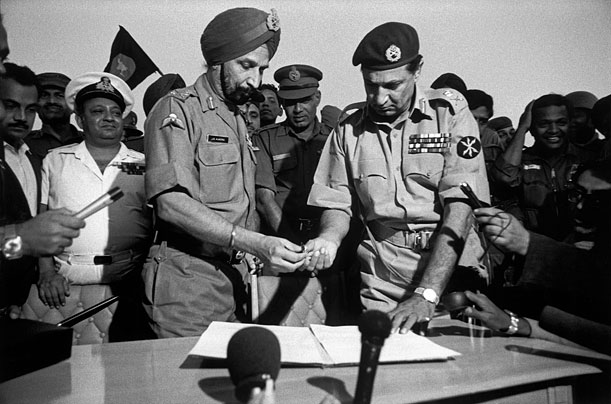
East Pakistan to Bangladesh, some comments

An op-ed from Brigadier Samson Sharaf published in “The Nation”, with some comments from regular contributor Dr Hamid Hussain. Well worth a read

(The comments in red italics are from Dr Hussain. Samson Sharaf’s op-ed is Pakstudies-lite/Jinnah-Institutish, so it is mostly of interest if you are curious about how a Pakistani army officer who is not totally nuts or Islamist works this out )

REVISTING 1906-1971
Samson Simon Sharaf

PART I

As West Pakistan nears the end of its 44th year of separation from the East, suffice to comment that lessons if any were ignored by the elastic conscience and political opportunism of leaders. The people absolved themselves by viewing it a fait accompli by unrepresentative ruling elites. In military terms there was no debriefing and therefore lessons not learnt are being repeated. Losing more than half the population never result in introspection. Despite this political culture and insensitivity, what remains of Pakistan holds together due to geographical contiguity that did not exist in case of East Pakistan. Pakistan’s corrupt political and socio-economic systems continue to overrule the aspirations of the people whose majority is either too lethargic or disconnected from nationhood to exercise the power of ballot. The realization and national urge for a closure and way forward thereof is missing. The style of politics adopted by politicians of the west has worsened by time. The fact that Pakistan has survived owes much to its small cadre of hardy people, geopolitics and armed forces.

Here is the debate. If from 1906 till 1947, the east and west were part of the same struggle in which the east provided the platform, intellectual inputs and direction, why they parted ways after the battle was won? In West Pakistan, this question became a taboo for far too long, while the separatist (if we call Awami Leaguers so) in Bangladesh that comprised only 24% of the electorate chose a violet route. For West, the question that this tragedy set aside the idea of a united Pakistan rots in the trash of inventive history.

As the sole self-proclaimed custodians of ‘Ideology of Pakistan’ created by a dictator, West Pakistanis cannot eclipse historical facts. After the partition of Bengal and Muslim Majority self-rule, the idea of separation came predominantly from the Muslims of East Bengal. Muhammadan Education Conference of the Aligarh modernity school changed to All India Muslim League at Dacca in 1906. The first convener was Nawab Sir Khawaja Salimullah of Dacca who mentored two stalwarts; A. K. Fazlul Haq who wrote the first Creed of the League and Choudhury Khaliquzzaman.

The thesis of separation mostly advocated by Bengali leaders with the obvious experience of history was ignored till Allama Iqbal as President of Punjab Muslim League reflected the concept in his famous Allahabad address. Though he met the Bengali leaders many times, his address referred only to India’s North West Muslim provinces and ignored East Bengal. The reason was that the league was seeking autonomy within the Indian Union and Punjabi/UP leaders resigned Bengali leaders to fight their own struggle. The fact that Pakistan’s inventive history credits Allama Iqbal more than the founders of this idea is an historical distortion. These frustrations are reflected in the many twists and turns Bengali leaders they took thereafter, and recorded in many dissenting notes and speeches of A. K. Fazlul Haq, the Sher-e-Bangla. Knowing that North West that comprised NWFP and Punjab was dominated by Unionists and Congress sympathizers (Khan Abdul Ghaffar Khan), Bengalis continued to provide the impetus for a Muslim Identity. At that point of time, Old Balochistan and the State of Khairpur in Sindh were out of contention. Punjab centrism with a shadow of the UP lobby caused irreparable damage to the federation of Pakistan; yet these are the unfortunate lines on which the West Pakistani narrative was built. (There is a historical context to the discussion. In later part of nineteenth and early part of the twentieth century, several important Muslim leaders advocated division of India on the basis of separate Muslim identity. The prejudice against Bengali Muslims was so prevalent and widespread, that nobody cared about them and did not consider them as part of Indian Muslim community. In fifty years, about 15 such schemes were proposed but not even a single one mentioned Bengal or Bengali Muslims. Sir Muhammad Iqbal who proposed the idea of Pakistan in his famous Allahabad address in 1930 did not include Bengali Muslims in his scheme. Chaudhry Rehmat Ali who coined the word ‘ Pakistan ‘ for his new country did not bother to fit the majority population of future Pakistan in his name. Generally speaking, Muslims of northern India considered themselves superior and more pure blood and despised Bengali Muslims, which they seem to equate more with Hindus rather than accepting them as brothers in faith. The Bengali leader, Fazlul Haq who presented the Pakistan Resolution in 1940 was forced to resign from Muslim League in September 1941. The Muslim League leadership never trusted Hussain Shaheed Suharwardy, who was the elected Chief Minister of United Bengal . He was not given a seat at Working Committee of All India Muslim League.)

A. K. Fazlul Haq, the Chief Minister of Bengal and Choudhury Khaliquzzaman with reluctant support from Sikandar Hayat Khan of Punjab (a Unionist whose buck stopped short of separation) managed to push through the Lahore Resolution on 24 March 1940. The final interpretation of the Resolution was left to a committee that ignored the question of States within a Union. Obviously, it was to keep Sikandar quiet. After the impromptu Cabinet Mission Plan that Congress rejected, the League pushed for a single Pakistan with two wings. This partition of India was pursued in haste to the chagrin of Bengali leaders, leaving many questions of autonomy under federalism unaddressed. The result was that within the first few years of independence, intransience on part of the west accounted for wiping away support of the League in East Pakistan. As early as 1954, the East was vying for greater autonomy within the federation. Once the 1956 constitution ignored the questions of federation, the separatist movement was a question of time.

By August 1947, differences between leaders of East Bengal and those from UP and Punjab widened. There was serious dissent in East Pakistani leaders over adoption of Urdu as the national language, Objective Resolution and non-federal constitution of 1956. Bengali leaders were particularly sensitive about relegation of religious minorities that comprised more than 15% population of East Pakistan. These were mostly Dalit who under the leadership of Jogendra Nath Mandal (Pakistan’s first law minister) had thrown their lot with Pakistan. Though after partition, Muslim League managed to form the first government; by 1954 it was edged to insignificance by United Front, Communist Party and the Awami League. The United Front ruled the province till imposition of Martial Law in 1958. (Things as they stood at the time of emergence of Pakistan in 1947: In 1947, when the new state of Pakistan emerged, there was a very unique and difficult dilemma facing the new nation. More than 1000 miles of hostile territory of India separated the two wings. East Pakistan contained more than half of the population but only one-sixth of the land. In Eastern wing, population was more homogenous ethnically and linguistically while Western wing had five clearly diverse groups (Punjabis, Sindhis, Baluch, Pushtuns and newly immigrated Muslims from India called Muhajirs). In eastern wing, the non-Muslim population was 23% while in western wing only 3 . Peasant proprietors dominated agriculture sector in Bengal compared to large feudal estates in West Pakistan . Bengalis were the most politically conscious group of Pakistan . In addition, there was a long tradition of strong leftist presence in Bengal . Literacy rate was 30% in East compared to 20% in West Pakistan . In 1950, East Bengal Provincial legislature passed a landmark bill called East Bengal State Land Acquisition and Tenancy Act of 1950. This law abolished the permanent settlement, which ended the Zamindari system that supported the landed elite. The land holding was limited to 100 Bighas (about 33 acres) which affected both Hindu and Muslim landlords. In my view this little known single piece of legislation was a crucial factor which would impact the future course of relationship between the two wings. This law rang the alarm bells in West Pakistani ruling elite, which was dominated by the landed aristocracy.)

Because leaders in West Pakistan looked at Hindus within the construct of India, Bengali leaders and prime ministers were viewed with suspicion. Due to this divergent stance East Pakistani leaders were perceived less patriotic. The conspiracy theory of the west that Hindu presence diluted the Ideology of Pakistan in the East was accepted without logic and reason. It also downgraded the famous speech of Qaid e Azam Muhaammad Ali Jinnah on 11 August 1947 on political inclusivism. While these fissures widened and League’s support in East Pakistan waned, the Governor-General of Pakistan dismissed A. K. Fazlul Haq from public office on charges of inciting secession. Later, Ayub Khan banned him from politics. Ever since, this suppression of the east and the progressive left has marred genuine political reforms in Pakistan. No lessons have ever been learnt. (Every dissent is viewed through a self righteous lens. The Punjabi Governor of East Pakistan, Sir Firoz Khan Noon described the Bengali voice of dissent as a conspiracy of ‘clever politicians and disruptionists from within the Muslim community and caste Hindus and communists from Calcutta as well as from outside Pakistan ‘. This was in 1950s and look at the statements about Baluchs today. Read the following sentences written in Intelligence Bureau (IB) report dated July 1961 about the feelings of Bengali population: ‘The people in this province will not be satisfied unless the Constitution ensures them in reality equal and effective participation in the management of the affairs of the country, equal share of development resources and, in particular, full control over the administration of this province. The intelligentsia would also like to see a directive principle in the Constitution to increase speedily East Pakistan’s share in the defense services as well as equal representation of East Pakistanis in the central service’. A mid-level police official of IB was more farsighted than the rulers of the country.)

While the West dominated the events after 1947, there was no effort or narrative to counter the political humiliation and alienation caused to leaders of the East. It was only a matter of time that the inevitable happened. Free and fair elections under a military dictator in 1970 exposed the hidden cracks. No single party emerged as a symbol of federation. Awami League (a breakaway faction of Muslim League) in the East led by Shiekh Mujeeb ur Rehman and Pakistan People’s Party led by Zulfiqar Ali Bhutto in the West emerged as two irreconcilable belligerents. Imprisoned Sheikh Mujeeb ur Rehman was flexible and insisted autonomy but not division. Bhutto’s politics were exclusive and inflexible. Exploiting the ignorance on part of the military regime and lack of communications amongst Pakistani politicians, India inserted its narrative into the void. Armed forces fell into the trap and became the fall guy. (The last sentence is a bit disingenuous. Army was in full control of the country from 1958 right up to the day of surrender in 1971. If there was a trap, it was weaved meticulously by army leadership. Just as a backgrounder of the saga to highlight how domestic and international factors coalesced in the context of East Pakistan. A complex set of factors including domestic, personal and class interests, regional and international interests came into play which impacted the nascent democratic process of the new nation. The Muslim League leadership in East Pakistan consisted of landed elite and cosmopolitans from Calcutta . Later, vernacular leadership (Fazlul Haq and Maulana Abdul Hameed Bhashani) based on support from rural masses came to limelight. 1954 provincial elections were a watershed in the history of Pakistan . The United Front (consisting of Fazlul Haq’s Krishak Sramik Party and Suharwardy’s Awami League) swept the elections. United Front won 223 of the 237 Muslim seats and had many allies among the 72 non-Muslim elected members. Muslim League was wiped out of the East Bengal during this election. West Pakistani ruling elite’s apprehensions about the new Bengali leadership were re-enforced by the international politics and Pakistan ‘s attempts to join U.S. sponsored military pacts against the Communism. When the defense treaty with United States was announced in February 1954, there was a general protest in East Bengal . Several demonstrations were held and newly elected assembly members signed a protest statement. This signature proved to be the death sentence of the provincial assembly. The ruling group in Karachi (Governor General Ghulam Muhammad, C-in-C General Ayub Khan and Defence Secretary Sikander Mirza) saw this situation as a grave threat to their vision for the country and future relationship with US, which would be a foundation stone of this policy. They concluded that to show to Washington that Pakistan was a serious ally and in full control of its house, East Pakistan ‘s political process had to be checked. On May 19, 1954 , the mutual defense agreement was signed in Karachi between US and Pakistan and eleven days later, Governor General dismissed East Bengal Provincial Assembly on the flimsy charge that Fazlul Haq had uttered separatist words to Indian media. One day before the dismissal of the assembly, Pakistani Prime Minister while confiding with the US Charge, told him that Governor rule was planned for East Pakistan to route the communists. He revealed that the matter was not even discussed with the cabinet or Chief Ministers as information may be leaked to Peking and Moscow via Fazlul Haq. The plan was not for a short- term scuttling of the political process but a long-term as General Ayub Khan confided with US ambassador that, ‘it would be necessary to keep military rule in effect in East Pakistan for a considerable length of time’. Remember this he was saying in 1954, four years before the 1958 coup. Pakistani decision makers always feel more at home with foreigners rather than with their fellow countrymen. Those who want a good dose should read Wiki Leaks cables of Pakistani civil and military leaders.

To my knowledge, no one has looked at the contribution of defense policy towards Bengali alienation. Pakistan adopted the most preposterous defense concept and publicly announced it stating that ‘the defense of East Pakistan lay in West Pakistan. All defense resources were concentrated in West Pakistan calling it the heartland. Bengalis surrounded on three sides by hostile India were told that in case of war, West Pakistan will try to conquer as much Indian territory on western border and India allowed to walk over East Pakistan. Then at negotiation table Pakistan would be able to extract concessions and get East Pakistani land back. I don’t know whether many Pakistani know the facts that for the first few years after independence, Pakistan allotted a grand total of two infantry battalions (8/12 FFR and 2/8 Punjab Regiment) for the defense of whole East Pakistan. It was not until 1950 that two infantry brigades were provided for East Pakistan. No armored regiment was thought worthy to be sent there. Pakistan Air Force stationed its sole permanent fighter jet squadron in East Pakistan in 1962. In military matters, it is normal to allocate resources depending on threat perception. However, citizens of a part of the country cannot be simply told that they are dispensable. One cannot call one region heart and soul of the country worth defending while another region as periphery and not worth defending. Even if military policy dictates such a course then two elements are essential; first the ‘periphery’ population’s representatives are involved in decision making process and second armed forces should have adequate representation from the ‘periphery’ population. This reassures them that they are equal citizens and following an agreed policy which may have some risks involved for their lands. In my view 1965 war convinced even otherwise patriotic Bengalis that their future was not with united Pakistan. They saw that country’s leadership had embarked on a major conflict with a larger India for few lakh Kashmiris and endangered the survival of half of the country’s Bengali population. To add insult to injury no one had the courtesy even to ask for Bengali opinion as they were not in the decision making process. Bengalis had no interest in Pakistan’s major quarrel with India over Kashmir.

“Great blunders are often made, like large ropes, of a multitude of fibers.” Victor Hugo’s Les Miserable

Pilot Officer Rashid Minhas Shaheed and Flt Lt Mati ur Rahman Shaheed. Heroes.

Matiur rahman.jpg

On August 20 1971 Flight Lt Mati ur Rahman and Pilot Officer Rashid Minhas died in the crash of a T-33 jet trainer near the Sindh coastline, 32 miles on the Pakistani side of the border with India. BOTH pilots were awarded the highest gallantry award available. Pakistan awarded the Nishan e Haider to Pilot officer Minhas and (2 years later) the newly independent state of Bangladesh awarded Flt Lt Rahman the Bir Sreshto, the highest gallantry award in BD. Educated Pakistanis are likely to know why Rashid Minhas is a hero (though some of the details they learned are less certain than the popular stories imply). Meanwhile it is my impression that even educated Bangladeshis are not as informed about Matiur as we are about Minhas. So here, as a public service, is what we know about this episode.

When the Pakistani army launched operation Searchlight in March 1971, the aim was to crush the movement for Bengali autonomy with overwhelming and decisive force. As a first step in the crackdown, the Bengali military and paramilitary units in East Pakistan were disarmed (and in several cases, most egregiously in Comilla, massacred en masse in the next few days). Those who got wind of the crackdown revolted and grabbed what territory they could (most successfully in Chittagong, which was mostly overrun by Bengali troops and where Major Zia ur Rahman was able to announce the independence of Bangladesh from the radio station) before the West Pakistani troops were able to bring superior numbers and firepower to bear and drive them out. Those who escaped capture or execution went to India where (with Indian help) they organized the Mukti Bahini and started a guerrilla war in East Pakistan.

Bengalis serving in the armed forces in West Pakistan were not subject to arrest or execution and the steps taken against them varied very widely. But partly because the autonomy movement did have very wide support and partly as a reaction to the extreme harshness of the crackdown, they were also overwhelmingly pro-Bangladesh. A few of them went to great lengths to escape from West Pakistan (e.g. via Kabul, or even by the hazardous route of sneaking across the Kashmir or Sialkot border into India) to join the nascent Bangladeshi resistance in India but given the difficulties involved, most remained, albeit unhappily, on their jobs. Many were reassigned to duties where they would not have access to sensitive materials or weapons, while some continued to perform their usual duties and a few were genuinely loyal to Pakistan and did all they could to convince their superiors of the same and aggressively participated in the West Pakistani war effort when permitted to do so.

Pilots serving in the Air Force were generally reassigned to ground duties. Several Bengali officers serving in Masroor airbase in Karachi were assigned to such duties and were supposed to be kept away from flying. One can get some idea of the intensity of nationalist feeling aroused in them from the fact that the entire group started trying to figure out what, if anything, they could do to play their part in Bengali resistance. They knew there were being watched by intelligence, so they did not discuss politics or make plans in any obvious meeting. Instead, they would discuss plans in short snatches in the course of normal work activities while appearing to be discussing work-related matters. Flt Lt Mati ur Rahman was assigned as deputy flight safety officer, an assignment that allowed him into the flight area a bit more than the others. He and his friends decided that he would try to hijack an aircraft and take it to India. Sneaking into and starting a fighter aircraft without ground crew assistance was practically impossible, so they decided he would hijack a T-33 jet trainer when it was being taken for a solo flight by one of the junior trainees. His fellow officers were to take his wife and infant daughters to the Indian consulate while he carried out his plan (this did not actually happen, the family was arrested but later released and repatriated). They themselves would face whatever consequences came their way. He apparently obtained a replica pistol that was recovered from the wreckage, so it seems that the hijacking was to be carried out using that weapon.

On the morning of the hijacking, young pilot officer Rashid Minhas was going for the second solo flight of his short carrier. As he started to taxi towards the main runway, Matiur drove his Opel Kadett to a point on the taxiway where it was obscured by some bushes and where his actions were not visible to the air-traffic control. No one knows exactly what happened on that taxiway, but it is assumed that he signalled the young officer to stop and seeing the deputy flight safety officer on the taxiway, the young pilot naturally stopped his plane. It is assumed that Matiur than climbed on to the aircraft and got into the instructor’s seat behind Rashid. He may have used his replica pistol to order Rashid to take off. In some versions put out later (for example, in the TV movie made by PTV with Air Force assistance) Rashid is knocked out using chloroform and hit repeatedly by Matiur, but there is no proof of either occurrence.

 What we do know is that the plane headed out to the runway with both of them on board and that Rashed was able to send out a message saying he was being hijacked. Given the unexpected nature of the call and the occurrence, it is no surprise that air traffic control took a few minutes to figure out what was happening and by the time the order to scramble interceptors was given, the T-33 had already disappeared flying close to the ground where it was not visible to radar. Matiur was aware of the gaps in radar coverage and may have used that knowledge but nothing is known for sure about what happened on that flight during this time. In any case, the Sabre jets scrambled to intercept the T-33 never caught sight of it.

Ground control and the airborne Sabres did try to radio Rashid to eject, knowing that he could actually eject BOTH pilots (with the rear seat pilot being ejected first) thus ditching the aircraft and bringing an end to the affair. But for whatever reason, he never did that (or never got a chance to do that).

But just 32 miles short of the Indian border, something did happen. According to eyewitnesses on the ground, the aircraft seemed to fly erratically before it crashed into the ground, killing both pilots. Later investigation showed that Rashid went through the instrument panel at the point of the crash, indicating that he had been in his seat inside the aircraft when it hit the ground. But Matiur Rahman’s body was found some distance away and seemed to have been thrown out of the aircraft while it was in flight at high speed. The cockpit canopy was found some distance away and forensic examination indicated that it had flown off in flight and hit the tail section at high speed. This has led to the conjecture that Rashid opened the canopy deliberately, pulling Matiur out of his seat (he was not strapped in because the rear seat harness is locked away during solo flight). That Matiur was squatting on the seat without a cushion may also have impeded his ability to control the aircraft (he was without a seat cushion because in the T-33 the pilot’s parachute IS the seat cushion and he did not have one). The aircraft has dual mechanically linked controls, so neither party can override the other completely without a struggle and both can interfere with the flight.

A few hours later, Karachi airbase learned that their missing plane was down within Pakistan and rescue choppers headed out for the wreckage (and the base commander probably heaved the biggest sigh of relief ever heaved east of Suez). The next day the air chief went to see President Yahya and recommended that Rashid be given a Sitara e Jurat (the third highest gallantry award in Pakistan), to which Yahya replied “Why Sitara e Jurat? Give the boy the Nishan e Haider!”.  Meanwhile Matiur Rahman’s body was brought back to Karachi and buried in a graveyard near the airbase. Naturally, he was also vilified as a traitor and backstabber.

It seems as if there was not much notice taken in East Pakistan until 2 years later, when the young Republic of Bangladesh gave him its own highest gallantry award and later named the Jessore airbase in his honor. After a long campaign by a small but determined band of Bangladeshi nationalists, his body was finally brought to Bangladesh in 2006 and buried in the martyred intellectuals graveyard in Dhaka with full honors.

Nobody is certain if a struggle actually occured on that plane. It seems likely that there was a struggle, but there are other theories, including one that says the canopy blew off because the pilots forgot to lock it, this pulled the un-belted (and squatting) Matiur out of the plane and led to a crash, with no need to posit a struggle.

In any case, both were treated as heroes by their respective countries.

Feel free to add comments with information that may change or add to this story.

Much of this account is derived from Kaiser Tufail’s excellent blog post on this topic. which I reproduce below. In addition, i have used a report from Cecil Choudhry (also reproduced below), another usually reliable and relatively objective source.
I remember reading a longish article from (or based on the account of) one of the Bengali officers who was with Matiur at Masroor Airbase, but cannot remember where it was published. If anyone knows what I am talking about, please comment.


The T-33 seat, with and without the parachute used as seat cushion. Explains why Matiur did not have an easy flying job ahead of him.

Picture
Matiur Rahman’s daughter prays at his grave in Pakistan in the 1990s.

Picture
Khaleda Zia at the state funeral in 2006

PHOTO: DAILYMOTION
another picture of Rashid Minhas


 “Bluebird-166 is Hijacked” By Kaiser Tufail 

“Why only a Sitara-i-Jur’at?  The boy deserves nothing less than a  Nishan-i-Haider,” retorted President Yahya Khan as PAF’s C-in-C, Air Marshal A Rahim Khan informed him of the hijacking incident that had taken place hours before.[1]  The Air Chief, who was hosting the President at lunch in Peshawar on 20 Aug, 1971, had recommended the lesser award, but was pleased to know that the PAF was being honoured with its first Nishan-i-Haider.[2]  The same day, announcement of the highest gallantry award was made.  In deference to the hallowed nature of the award, the Board of Inquiry into the aircraft accident was suspended and, eventually scrapped without finalisation.  The final moments of the flight of the hijacked T-33 have, therefore, been open to more than one interpretation over the years.  This write-up looks at some officially recorded vital bits of evidence (indicated in bold-face text), to reconstruct what really happened.

In the aftermath of the military crackdown that started in East Pakistan on 25 March 1971, the Bengali pilots in the PAF were grounded for fear of an adverse reaction.  As the situation became more complex and war clouds started gathering, it was felt prudent to withdraw the flying clothing and equipment of Bengali aircrew, with hijacking of aircraft being precisely one of the fears.

The Bengali pilots at PAF Base Masroor (Karachi), sensed the surveillance cover of Intelligence Units and agreed not to meet collectively.  It was decided that a charade of friendly relations with the Base personnel would be maintained, and any kind of protest avoided to the utmost.  In the meantime, short, meaningful meetings would be conducted in the course of normal activities.  The consensus on hijacking an aircraft to India emerged in no time, with the underlying thought being that the incident would call world attention to the cause of Bangladesh freedom movement.  It was also agreed that the backlash of the hijacking would be borne with fortitude by the remaining Bengalis.[3]

At first, the Bengalis mulled hijacking one or more F-86 Sabres, but the mere presence of a Bengali pilot on the tarmac would have been viewed with suspicion.  Besides, starting up a jet aircraft without help from ground crew and support equipment was a difficult proposition.  How about sneaking into an already started one – a two-seater being flown by a single pilot?  The idea sounded enticing, because gullible students going for their solo missions in the T-33 at No 2 Squadron seemed easy prey.  Students would surely obey any instructor’s command from outside, especially if it had something to do with aircraft safety.  A visual signal for a fuel or hydraulic leak, a flat tyre, even a finger pointed generally at the aircraft would get an immediate response from the student.  Chances were that the student could be sufficiently alarmed through hand signals about some external malfunction with the aircraft, and he would stop to find out more about the problem.

Flt Lt Matiur-Rehman had been an instructor in No 2 Squadron till he and his Bengali colleagues were grounded soon after the start of the counter insurgency operation in March. He was, however, given charge of the Ground Safety Officer with a mandate to check malpractices in aircraft maintenance and operations, thus authorising him to move around on the flight lines and tarmacs in an official transport.  Given his affability and, his wife’s friendliness with neighbourhood ladies, Matiur-Rehman was considered the least likely of the Bengalis to arouse suspicion.  He fitted the plot perfectly.  Apprehensions about the safety of his wife and two daughters were allayed by his Bengali colleagues when it was decided that the family would be moved, with prior coordination, to the Indian Consulate in Karachi, before the Hijack Day.[4]

Relaxing in the squadron crew room, Minhas ordered his Mess breakfast to be heated.  He could take his time to eat comfortably as he was not scheduled to fly that day, the visibility being poor for solo flying by students. Those scheduled for dual flying were busy checking their mission details, so as to prepare the briefing boards and get the pre-mission briefing from their instructors. One of them noted the scheduling officer adding Minhas’ name on the scheduling board for a ‘Solo Consolidation’ mission.[5]  The change in scheduling took place as the visibility had improved and students were cleared to fly solo.  This was conveyed to Minhas who was waiting for his breakfast in the Squadron tea bar.  He jumped up, half-excited, half-prepared and proceeded to get the mission details. After being briefed by his instructor Flt Lt Hasan Akhtar, Minhas quickly gathered his flying gear.  Breakfast had to wait, but Minhas hastily gobbled up a couple of gulaab jamans, the pilots’ favourite high-energy snack. He also shared a few swigs of a cold drink with his course-mate Plt Off Tariq Qureshi, before he headed to the flight lines to make good his 1130 hrs take-off time.  “That was the last we saw of him, munching snacks on his way out,” recalls Qureshi. Preliminaries and start-up was uneventful as the T-33, with the call sign ‘Bluebird-166,’ taxied out of the main tarmac.

In the meantime Matiur-Rehman, who had earlier checked the students’ flying schedule during a brief visit to the squadron, sped off in his private Opel Kadett car to the north-eastern taxi track that led out of the main tarmac. The sides of the taxi-track had thick growth of bushes, which concealed his position both from the ATC tower as well as the tarmac. As the aircraft approached, he was able to stop it on some pretext, as expected.  Seeing the instructor gesturing, Minhas must have thought that some urgent instruction was to be conveyed. After all, his mission had been scheduled as an after-thought, and something might have gone amiss in the haste.  He expected Matiur-Rehman to plug in his headset and talk to him on the aircraft inter-com.  Not encumbered by his flying gear (parachute, anti-G suit, life jacket and helmet), Matiur-Rehman easily stepped on to the wing and slipped into the rear cockpit through the open canopy.[6]

Squatting on a seat without a parachute (which also doubled as a seat cushion), Matiur-Rehman was in an awkward position to properly control the aircraft himself.[7] To compel the student to follow his instructions would have required the threat of use of lethal force; else, the student could have turned back, or just switched-off the aircraft.  A replica pistol recovered later from the wreckage explains Minhas’ predicament.[8]

At 1128 hrs, ATC Tower received Minhas’ call: “Bluebird-166 is hijacked!”  In the rough-and-tumble that followed, the T-33 got airborne from Runway 27 (heading 270°), at 1130 hrs.  The aircraft turned left, (a non-standard turn out of traffic) and started steering 120°.  It was seen to be descending down to low level and, in no time, disappeared from view.  Two more frantic calls, “166 is hijacked,” were the last that were heard from the T-33.

Not sure if he had heard it right, Flt Lt Asim Rasheed, the duty ATC officer understood what was going on only when the aircraft did an abnormal turn out of traffic and ducked down very low. Asim called up the Sector Operations Sector (SOC) to inform about the unusual incident; however, when the Sector Commander started asking for details, a quick-witted Asim dropped the phone to save precious time and called up the Air Defence Alert (ADA) hut.  “A T-33 is being hijacked. Scramble!” he ordered. Wg Cdr Shaikh Saleem, OC of No 19 Squadron, who had just arrived in the ADA hut after inspecting the flight lines, immediately rushed to the nearby F-86s along with his wingman, Flt Lt Kamran Qureshi.  Kamran, the sprightlier of the two, got airborne first, with the leader following closely; the pair was airborne within the stipulated time. The SOC had, however, no clue about the T-33’s position as it had descended to the tree tops and was not visible on radar.  In any case, about eight minutes had already elapsed since the T-33’s  take-off, and the scrambled pair of F-86s would not have been able to catch up before the border, even at full speed.  Some more critical time was also wasted when the F-86 pair was mistakenly vectored onto a B-57 recovering from Nawabshah after a routine mission.[9]

After a while, another pair of F-86s led by Flt Lt Abdul Wahab with Flt Lt Khalid Mahmood as his wingman, was scrambled. Wahab, who had been watching the unusual departure of the T-33 from outside the pilots’ standby hut, recalled later, “We knew something was wrong, we had seen the aircraft taxiing dangerously fast. After we got airborne, there was a lot of confusion. Nonetheless, we gave fake calls on ‘Guard’ channel that the F-86s were behind the T-33 and, it would be shot down if it did not turn back. However, with no real prospects of scaring Matiur-Rehman with warning bursts from the F-86’s guns, the only option that remained was to order Minhas to eject.  A flurry of radio calls then started, asking Bluebird-166 to eject.  There was no response, but the calls continued for several minutes, being repeatedly transmitted by the F-86s, as well as the SOC.”[10]

Crash site is roughly in centre of picture
The situation remained confused and it was apprehended that the hijack might have been successful.  The prevailing uncertainty was cleared up in the afternoon, when a phone call was received from Shah Bandar that a plane had crashed nearby and the aircrew had not survived.  The Base search and rescue helicopter was launched immediately and it was able to locate the wreckage at a distance of 64 nautical miles from Masroor, on a heading of 130°.  The tail of the T-33 showing its number 56-1622 could be seen sticking out in water-logged, soft muddy terrain at the mouth of Indus River, just 32 nautical miles short of the border. Estimated time of the crash was 1143 hrs.

Minhas’ body was found still strapped in the seat, 100 yards ahead of the wreckage, while Matiur-Rehman’s body was found clear of the seat, lying further ahead.  Both ejection seats had been thrown clear of the aircraft on impact and, there seemed no sign of ejection. The location of Matiur-Rehman’s body away from the ejection seat indicates that he was not strapped up, having being unable to free the stowed harnesses after he had hurriedly stormed into the cockpit.[11]

Investigators were baffled when the canopy was found to have a prominent scrape mark of the tailplane, while the tailplane was correspondingly dented by the canopy.  Normally, during ejection sequence or jettison of canopy alone, the canopy would have been rocketed up and, would have cleared the tail by a wide margin (this being the very purpose of the rocket thruster).  Now it seemed that the canopy had merely inched up into the airflow and had been blown into the tailplane.  Could Minhas have actuated the canopy opening lever to throw the unstrapped rear seat occupant overboard, and then safely recover the aircraft?[12] A proper procedure, though, would have been to use the canopy jettison lever which would have rocketed the canopy well clear of the tailplane. In the heat of the moment, it seems that Minhas did what came naturally to him.[13]

The massive canopy hitting the elevator would have deflected it downwards, causing a sudden nose-down attitude at a precariously low height.  Minhas would have then yanked back on the controls to prevent the aircraft from going into the ground.  The sudden and violent pitch-up – which was confirmed by eyewitnesses – resulted in the aircraft stalling out.  This is partially corroborated by the wreckage report of aircraft flaps found in the down position, implying a desperate need for vital lift to prevent stalling.  The rather flat attitude in which the aircraft fell, as well as the compact spread of the wreckage, also confirms the stalled condition of the aircraft.

Confronted with a very complex situation requiring quick thinking and steel nerves, Minhas was eventually able to counter Matiur-Rehman’s cunning design.  Despite having the option of ejecting safely, and in the course of action also tossing out the hijacker who did not have a parachute, Minhas ostensibly tried to save the aircraft. Sadly, the unusual attempt at opening the canopy had resulted in a chain of uncontrollable events that eventually caused the crash. Nonetheless, Minhas did manage to prevent the aircraft from being hijacked to an enemy country, laying down his life in the process.  He was destined to become the youngest star on Pakistan’s firmament of valiant heroes.  May Allah bless his soul and may his Nishan-i-Haider be an inspiration for the future defenders of Pakistan.

Cecil Choudhry’s account:

A few months back I had the opportunity along with a friend to spend an evening with Group Captain (R) Cecil Chaudry. Obviously the time was spent discussing his experiences. As it turned out Cecil was responsible for investigating the Rashid Minhas crash back in 1971 and told us a some details which are not known publicly.

The episode has become controversial over the past few decades with some people claiming that the Nishan-e-Haider award was politically motivated and perhaps the young Pilot Officer never deserved it. Also the media and school books information/portrayal of this episode has created some factual distortions. In the interest of hi story I am reproducing here substantially what Cecil told me about the incident. Obviously given that this discussion took place quite sometime back I do not remember his narration word to word but am reproducing the essential information. Also, I do not claim to have done any independent investigation but I believe that Cecil’s narration of events is an important input.

Now coming to the story,

It is important to remember that Rashid Minhas was a very young and inexperienced pilot. The crash took place during his second solo flight on T-33 aircraft. In the run up to the 1971 crisis the PAF had grounded all East Pakistani pilots in PAF and had assigned them ground jobs. As part of this Flt Lt Mati ur Rehman was made the Deputy flight safety officer of the base. The Flight Safety Officer was Flt Lt Basit (if I remember the name correctly).

Flt Lt Basit as FSO used to on occasions do surprise checks on the OCU students at the base. As part of this he used to stop these students while they were taxing out on a sortie and check if they had correctly stowed equipment in the cockpit or would query them on emergency checklists etc. As one would expect the student would get reprimanded if he was found wanting on any of this.

On the day of the crash when Rashid Minhas was taxing out on a dusk training sortie and saw Flt Lt Mati ur Rehman (Deputy Flight safety officer) signalling him to stop he naturally assumed that the purpose was to do a similar check. Therefore, he not only stopped but his attention shifted to the cockpit. This allowed Flt Lt Mati ur Rehman to enter the instructor seat and initiate roll for take off. By the time Rashid Minhas realized this the aircraft was well into the take off sequence. On this Rashid gave a call to the ATC saying that the aircraft is being hijacked. Now this was 1971, aircraft hijacking was not considered an imminent possibility that too in Pakistan and at an air force base. The ATC requested confirmation of the call and got one from Rashid. On this fighters on ADA were scrambled to intercept the aircraft Again as hostilities were not imminent at that time the fighters were not at the highest ADA level (I forget exactly the ADA level Cecil mentioned but I think that it was 10 minutes). However given that Mati ur Rehman knew where the Radar gaps were (being till recently an active pilot) and the dusk conditions an interception was not made.

No further information became available till late at night when the PAF base got a call from a police station near the Indian border stating that an aircraft had crashed near a village bordering India. Next morning a team was dispatched to the crash site. Following this an investigation into the incident was launched.

Now coming to the factors that led Cecil to believe that a struggle for control took place and the crash was perhaps intentional.

As the aircraft overflew a number of villages some eyewitnesses were available. According to them the aircraft was not flying straight and level but was banking or pitching up and down. If Mati ur Rehman had been in complete control of the aircraft this would have resulted in a straight and level flight. Only a struggle resulted in an erratic flight with probably Rashid Minhas trying to control the aircraft in one way and Mati ur Rehman counter acting.

Fl Lt Mati ur Rehman’s body was found some distance before the crash site while Rashid Minhas body was at the crash site, had gone through the instrument panel and in the nose of the aircraft. The aircraft had crashed nose first. Mati ur Rehman’s body also had a sand blasting type effect on one side which indicated that he was blown off from the aircraft and dragged quite a bit on the desert surface.

This evidence linked in with the earlier events. The manner in which Mati ur Rehman took over the aircraft did not allow him time to strap on. During the likely struggle for aircraft control he used his greater experience to counter Rashid’s efforts. Also he was sitting on the instructor’s seat and could over ride some of Rashid Minhas’s actions. However, the option to jettison off the canopy in an emergency was available with both pilots. Near the point of crash Rahid Minhas in his efforts, either intentionally or accidentally, jettisoned the canopy. As Mati ur Rehman was not strapped on he was blown off explaining the way his body was injured and the fact that it was found before the crash site.

This resulted in sudden force on the controls of the aircraft in one direction, as force applied by Mati ur Rehman to control the aircraft was removed. This along with perhaps the effect caused by the loss of canopy, low level and Rashid Minhas’s inexperience resulted in the crash of the aircraft.

I hope this clarifies some of the issues regarding this incident. Personally I would like to get hold of the PAF‘ official investigation report into the incident which should be more detailed and should also shed more light into the incident.

———————————————————————————————-

Ismaili Shias Massacred in Karachi. Iron Hand Promised

Many Ismaili families from Gujrat moved to Karachi after partition. They became part of a prosperous, hard-working community. They kept a low profile. As in any community, everyone could not be rich enough to buy large houses next to the Bhuttos and Zardaris in Clifton. Some of them therefore bought land on the outskirts of town, where it was cheap, and built a housing society there and called it Al-Azhar Gardens.

People moved in 8 years ago and as is the tradition in this particular community, they maintained their colony exceptionally well. Almost everything was available right there. Proud residents boasted about the well designed housing, the community facilities, the cleanliness, the security.
But you still have to get to town to work and go to school and so on. So they ran a shuttle bus service.

Today, the shuttle left Al-Azhar Gardens with 60 or so people on board. Someone else got on at Safoora Chowrangi. Armed men stopped the bus and using 9 mm pistols, systematically shot dead women and children, one by one, at close range. It is said that a few children were spared, or survived by hiding. Or something. The dead include women and the elderly.
Imagine the scene in the bus. The mind boggles, does it not?


Who did it? Jundullah (and/or the Islamic State, they are one and the same in any case and these days the name IS will sell better), a well known anti-shia group with a long history in Karachi (including a history of getting people out of police custody in mysteriously easy escapes) has claimed responsibility.

Not to be left behind, Mubasher Lucman, Pakistan’s most popular “paknationalist” anchor has blamed the Indian “Relatives and Wives Wing” (otherwise known as RAW) for the attack.

save image

Most people seem to take Jundullah/IS at face value, with their history of dragging Shias off buses and shooting them in the head. But there are those who blame MQM (supposedly operating on the instructions of RAW and Mossad). But whoever did it (I tend to go with Jundullah, but cannot claim to know for sure, so we will leave it at that), someone stopped a bus at a major crossing, calmly shot 60 people (43 of them now dead) and walked away without getting caught (and without any fear of getting caught). That does not look good. Not good at all.

save image

We may soon hear that this is Pakistan’s 9-11. Unlike Amrika, Pakistan is rich in 9-11s. It depends on how you count. Using the standard formula of 1 Sunni Punjabi=3 Shias= 5 FATA Pakhtoons there have been at least nineteen 9-11s till now (more if you start counting poor people as humans, but that would be just too much). Unfortunately, I am afraid there may be more in the days to come.

The Prime minister has condemned it. He has also “ordered the police to arrest the culprits”. I am not kidding. He actually ordered the police to arrest the culprits!

 More to the point, the army chief has called up the Aga Khan and said he will use his iron hand at the earliest opportunity. Coalitions support funds may have been mentioned. Life goes on.

Before I am accused of cynicism, let me paint two (fictional) scenarios. Which one is more likely?

1. General X has figured out that Pakistan’s policy of nurtuting Jihadist terrorists as force-multipliers against India has blown up in its face. He wants to change things root and branch. Not just the Kashmir Jihad and strategic depth (a direct consequence of that jihad), but the whole shebang. Mufti Naeem and his ilk will be terminated with maximum prejudice. All training camps will be shut down. All militants will be reformed or terminated (with the same maximum prejudice). India will be offered a deal: Lets both stop using this kind of terrorism for any reason and settle all future disputes via negotiation or all out war, like civilized countries. No more shooting of random people sleeping on the platform at Chatrapati Shivaji Railway terminus. But General X realizes that 50 years of Islamic-Paknationalist education has prepared a generation of morons who cannot be told the whole truth without having their heads explode. So General X is going to lie, deceive, dissimulate and detour his way to a future TNT-free Pakistan. Sometimes his public actions will appear contradictory. Sometimes he will have to make up all sorts of bullshit about RAW and Mossad to get his way. He will do what has to be done. But in the end, we will have a defanged Pakistan where every poor man’s son (or daughter) has the chance to become a toll-collector on the Pak-China-Economic-Corridor. Then, our problems will be no different from those of Thailand or Phillipines (both of whom have some Islamist terrorists, but the government are not in bed with them). And so on…

2. General Y has figured out nothing but even he can see that something has to be done. Ismailis have been killed in cold blood and the Aga Khan is on the phone. Next the damn American ambassador will call and before night falls he will even have to pretend to have a meeting with the prime minister. He is pissed off. He promises to deal with everyone with an iron hand. He sends general Z to see the big boss in the Pentagon and General Z reports that the Pentagon is pretty pissed off too. Block E/F F-16s will not be free. Loans will have to arranged and then paid back at 27% compound interest by fleecing the patriotic people of Pakistan. But all is not lost. Brigadier April Glaspie does seem to have hinted that a transfer of mujahideen into IOK would probably be OK with the US. Or at least, that is what General Z gathered from the conversation. He also met the Chinese ambassador, who served the best halal dimsum in Islamabad and nodded and smiled through most of the dinner. General Z reports that all seemed higher than Himalayas and deeper than the Indian ocean, though his excellency Sun Weidong did become a little stern after that last shot of Mai Tai and said something like “we hope the fraternal people of Pakistan will do whatever is necessary to establish good public order”. But mostly he smiled. Not for lack of language skills. The man speaks perfect English and Urdu (and our man in the embassy reports, also some Punjabi) but most of the time, he just doesn’t speak. One hopes for the best.
All the corpse commanders nod their heads at these words of wisdom from General Z. The bearer brings in the tea and Peak Freans biscuits. Iron hands are waved around. All will be well.

Which (fictional) scenario sounds more plausible?

It started with the Kashmir Jihad (which started back in 1947, so Zia is not the only culprit). That jihad is the gift that keeps on giving. Everytime one of the foot soldiers in these massacres is caught (sometimes, they are. In fact, we even had Malik Ishaq in custody for a while), it turns out that they either went to a Kashmir Jihad training camp or were trained by people who got their start in the glorious Kashmir Jihad. Strategic depth. Where would we be without it?

For more on Shia-killing in Pakistan, see here.

btw, here is something I wrote four years ago. See the halva story at the end to understand what the PPP government in Sindh is doing. In fact, since people don’t like to click through, I will paste that four year old article here too. Try to figure out what has changed and what has not.

Pakistan: The End Of The Affair (June 11 2011)

We have been here before, but it is being said that the unhappy marriage between the Pentagon and GHQ  has deteriorated further and once again, those watching this soap opera are wondering if this union can last.  Writing in Al-Arabiya, GHQ’s own Brigadier Shaukat Qadir says that the US appears to be “gunning for Pakistan’s top generals”, who are said to be bravely resisting this latest perfidious American plot against General Kiyani.  
And why is the US trying to undermine the good General?
Because at a meeting with President Obama he made clear “that this soft-spoken, laid-back, easy-going general, far from being overawed by the privilege of meeting President Obama, would still give back better than he got.” 
This interesting article (I highly recommend reading it twice to get the full flavour) can be read in a number of ways, all of which are worrisome.
One is to assume that Brigadier sahib means exactly what he is saying. That there is some core Pakistani interest that General Kiyani bravely insisted on defending, and for that sin, he is now being systematically undermined. 
Note that Pakistan’s elected government did not decide what this core interest is supposed to be, nor was it consulted before General Kiyani decided to defend this core interest against US imperialism. In fact, Brigadier sahib hints that the elected regime may include “powerful individuals who have no loyalty to this country and its people”. No, this core interest, for which Kiyani sahib is supposedly willing to risk a clash with the United States (and by extension, NATO, Japan, etc) is defined by GHQ, as it has been for decades.
“Strategic depth”, it seems, is alive and well and we can live with bombings, insurgencies, electricity shortages and all sorts of economic and social crises, but we cannot live without strategic depth
For the sake of this strategic depth, we kept the Taliban alive and made sure the new American-installed regime in Afghanistan would not stabilize. And when the Americans leave (something that everyone in GHQ seems convinced is happening very soon), we will restart a civil war in Afghanistan, with “our side” led by the Haqqanis and Mullah Omar. This war we expect to win in very short order, after which we will move on to our Central Asian Nirvana.
Having antagonized all the hardore jihadis by siding at least partially with the US, we are now to antagonize the US and its allies by sticking by the Taliban. This is known as GHQ’s “Sau Gunndey tey Sau CHittar strategy”. [1]
The problems with this approach are manifold and include:
  1. “The imperialists” are unlikely to leave as soon as imagined. This alone puts the whole strategy in question because as in Kargil, there seems to be no plan for the possibility that the “enemy” may not do what we expect it to do.
     
  2. “Our side” is unlikely to win all of Afghanistan even if the Western imperialists leave according to our timetable.  Given the opposing interests of many regional powers, that struggle is likely to be even more prolonged and bloody than the last attempt to fill the Afghan vacuum.
     
  3. “Blowback” from this war will be worse than the blowback from the current confused operation. The Taliban refused to cooperate with us against anti-Shia terrorists even in the good old days of the nineties. This time around, they will be much more difficult to control. We cannot even control the current (relatively small) Islamic Emirate of Waziristan. To imagine that we will control the much larger and more fractious Islamic emirate of the future seems to be a pipe dream.
     
  4. Any exit of the imperialists and return of the Taliban will inevitably be followed by a house-cleaning of Western “fellow travellers” in Pakistan. That cleansing may not be on the army’s immediate agenda, but pressure to Islamize Pakistan will be hard to resist once the Islamists are winning. The establishment may then find it expedient to try and get rid of the ANP, Pakistani liberals and other riff-raff that the army has tolerated in the Sulah e Hudaybia phase. Naturally the Americans will respond with retaliatory measures of their own and a liberal efflux will have some modest but detectable negative impact on the economy and the state; the final outcome, in a weak and fractious state, may not even be up to North Korean standard.
But that is only one interpretation of Brigadier sahib’s views. There is another: it may well be that cooperation with the United States is set to continue, but the haze of lies that surrounds the relationship now needs to be raised to new heights.  Pakistan’s deep state is highly “Westernized” in very practical ways and has always been a willing and even eager partner of the CIA and the Pentagon in the region. But both the state and its American minders have been operating with the view that those who matter will calculate profit and loss, and everyone else can be kept suitably entertained with our own peculiar version of Jihadi kool-aid (a uniquely Pakistani mix of Islam, militarism and the “two nation theory”).
In one of the more spectacular “own goals” in history, this convenient and previously useful propaganda has now created a large constituency within the rank and file of the armed forces and the semi-educated middle class. How now to tell them the truth, smack dab in the middle of a crisis? Better to just update the kool-aid, pray to Allah, and keep going while hoping for a miracle. In this version, no breach with America is intended or desired, but the natives are restless and the Jihadi/Pak nationalist credentials of the supreme commander must be burnished to prevent any unplesantness, hence the article and others like it. The problem with this version is that it means the state will continue its policy of trying to appease both the Islamists and the Americans and this only postpones the day we fall between two stools, it does not alleviate that risk.
Yet another version holds that this is simply more of the “controlled burn” strategy, the aim being to get the Americans to cough up more money by raising the threat of a “rogue” nuclear state (a strategy with which we have long years of practice by now). The problem with this version is the one pointed out by Mr. Lincoln a long time ago; you cannot fool all the people all the time. What happens if someone decides to call our bluff?
It is hard to say which of these theories is correct. If I had to pick, I would pick the last one because I am a cynical person, but there is little objective evidence based on which an outside observer can decide between these theories.
It is even possible that all three (and others I have failed to imagine) are ALL simultaneously true.
Pakistan’s biggest curse and the army’s most treacherous gift to the nation is its culture of secrecy and double-dealing. Domestically, the army (and particularly its intelligence agencies) have thoroughly undermined the credibility and effectiveness of politicians, civil bureaucrats and the media by decades of behind the scenes manipulation. They have done the same thing abroad by keeping foreign policy under their opaque control. This is fertile ground for conspiracy theories of every stripe (including the three I have managed to outline above) and the truth is impossible to know for sure (“loose change” aficionados will no doubt feel it’s the same in the United States, but the murkiness in Pakistan is an order of magnitude above anything an American can imagine).
And the same opacity and confusion may now extend to the supreme command; it is possible that not only are we unable to discern what is going on, the corps commanders who meet every month are equally clueless and confused. Not being the best and the brightest, and acutely conscious of their intellectual shortcomings but determined to stay in charge no matter what, they may be flying blind too….this final irony raises the disturbing possibility that the past may not be an adequate guide to the future and very nasty black swans may be swimming just beyond the next bend in the river.
Perhaps India should prepare for an influx of Pakistanis seeking refuge from chaos that even the worst enemies of Pakistan may not have imagined. Being our cousins, and with a bureaucracy not known for its boldness and vision, one doubts that India will have a policy adequate to the needs of this mother of all black swans. The rest of the world may be equally unprepared. The Chinese, supposedly used to thinking one hundred years ahead, may be our only hope.
[1] “Sau Gunndey tey Sau CHittar strategy”: Literally, one hundred onions and one hundred lashes. A man was to be punished and was given the choice of eating a hundred onions or getting a hundred lashes. He opted for the onions but after 3-4 onions, he thought this is too hard and switched to lashes. But after 5 of those the pain was too much, so he switched again to onions..he ended up with a hundred of both. GHQ runs the risk of being punished by both sides to the full extent of the law. Picking one poison might have been a more rational choice.
Post Script: Sufi masters in upstate New York have sent a sufi teaching story that they claim has some relevance to why the hapless civilian regime is having so little success in Pakistan; It is not known if these are true sufis or impostors, so the story may or may not apply. Halva strategy: The Mongols were coming and the capital was in a state of panic. A holy man showed up and his followers claimed he had magical powers and could stop the Mongols. He was invited to take over and do his thing. He took over command and ordered the ministers to prepare the finest halva. They did so, he ate and let others eat as well. Next day, they said the Mongols are only 100 miles away, what now? He asked for more halva. It was done. This went on for days, every day the Mongols got closer and he asked for more of the best halva. Finally the Mongols arrived at the gate. He packed up his sleeping bag and said “I am off, do what you can to save yourself”. Everyone screamed “but what about the your magic”? He said “dudes, I came for the halva and I had lots of it and it was indeed good. The Mongols are your problem. Good bye.”

Good Night and Good Bye. 

Naw beats Aye

The British have always loved partition…for other people. In each case the justification was that the sub-nations are unable to co-exist side by side. This is when the British played not an insubstantial role in stoking the communal fires – the (in)famous divide and rule policy.

The two nation theory which is best summarized as “our heroes are their villains” has no doubt been hugely successful….in compounding misery of all the communities involved.. The wrongs of the past should have been dealt with a truth and reconciliation commission (just like in South Africa).  

The irony is that separation did not reduce the rancor one iota: Pakistan-India and Israel-Palestine have fought four (official) bitter wars, things are not too much better in Northern Ireland.

But when it comes to Britain herself, the answer was made clear today. Partition is never a solution to the problems, it also makes all of us poor as people. The cultural lines are never clearly drawn and purity is over-rated. Speaking of India specifically, the answer to a prosperous future is to encourage more secularism (and mixed marriages aka love jihad) not to create more ghettos and breed intolerance.

The bad blood that has been created over this partition fight will not (easily) go back into the bottle. The polls are clear on this point: the English now resent the Scots just as much as the Scots look down upon the English. The dividing lines will be sharper once a vote is announced for a Brexit from the European Union. Alex Salmond and Nigel Farage are smart ambitious politicians, they are unlikely to take no for an answer.

All that said we are happy for the Brits. Yes, it is certainly better together.
……
Scottish voters have rejected independence, deciding to remain part
of the United Kingdom after a historic referendum that shook the country
to its core.The decision prevented a rupture of a 307-year
union with England, bringing a huge sigh of relief to the British
political establishment. Scots voted 55 per cent to 45 per cent against independence in a vote that saw an unprecedented turnout.

 …..
A
majority of voters did not embrace Scottish First Minister Alex
Salmond’s impassioned plea to launch a new state, choosing instead the
security offered by remaining in the United Kingdom.

Salmond
conceded defeat, saying “we know it is a majority for the No campaign”
and called on Scots to accept the results of the vote. He said the voted “has been triumph for the democratic process.“

“If
that is the result for the referendum then clearly I am deeply
disappointed,” Scottish National Party (SNP) deputy leader Nicola
Sturgeon told the broadcaster. Votes cast for and against
Scotland’s independence in a historic referendum were running virtually
neck and neck, but leading “No“ campaigners had suggested that victory
was in sight.

Scottish
Secretary Alistair Carmichael, a “No” supporter, told AFP: “It’s early
days but it’s looking fairly good.“ Michael Gove, Conservative former
minister and confidant of Prime Minister David Cameron, told Sky News
that “fingers crossed”, the union appeared safe. “The result looks
disappointing,” admitted Patrick Harvie, a member of the Scottish
parliament for the Green Party and “Yes” campaigner.

Crowds
gathered for all-night parties in Glasgow and Edinburgh, draped in the
blue-and-white Saltire flags of Scotland and setting off flares. “We
are going to stay out till the result,” said Dylan McDonald, 17, one of
Scotland’s 16- and 17-year-olds who have been able to vote in a
referendum for the first time after the qualifying age was lowered.

The
historic decision gripped many Scots who previously took little
interest in politics, igniting passions and raising the prospect of deep
changes to the governance of the union no matter the result. Cameron
promised greater powers for Scotland’s parliament in a last-minute bid
to convince voters to stay in the union, prompting politicians in his
Conservative party to call for the same treatment for England.

He
will speak on the future of the United Kingdom as soon as the referendum
outcome is issued, and if independence is rejected he is expected to
announce plans to change the division of power in the highly-centralised
union.


Some ballot boxes were brought by helicopter and others by boat from
remote islands to be counted after polls closed, with the final result
predicted to arrive in the early hours of Friday.

The closure of the airport on the Isle of Lewis due to fog meant ballot boxes would have to travel by slower fishing boat.

At
the counting centre in Scotland’s oil city Aberdeen, boxes of postal
votes were tipped out onto tables at the stroke of 10:00 pm when polls
closed, and officials immediately began sorting the ballots.

Election
officials in Glasgow said they had contacted police over a handful of
allegations that people had turned up to vote only to find their names
already crossed off the ballot sheet.

The question for voters at
Scotland’s more than 5,000 polling stations was “Should Scotland be an
independent country?” and they are asked to mark either “Yes” or “No”.

International
media descended on the Edinburgh venue where the city’s ballots will be
totted up to witness a count that could have repercussions from Spain
to Canada.

The SNP has said it hopes for full independence by 2016
if it wins, and a range of separatist movements sent representatives to
Scotland to learn from the election.

“Scots, please, vote yes,
for yourselves, but also for us,” Daniel Turp from the Parti Quebecois
said at a press conference in Edinburgh where 29 European separatist
movements also signed a declaration calling for self-determination.

Leaders of France and Spain warned that separatism risked undermining Europe in the run-up to the vote.
A palace spokesman told Sky news Queen Elizabeth II was following events from her family home Balmoral Castle in rural Scotland. She is “kept abreast of information… from her team of advisers in London and Edinburgh,” the spokesman said.


Many people in the rest of the United Kingdom are concerned about the
prospect of Scottish independence, which would sever a deep bond and
cut the UK’s surface area by a third.

“At last the threat we have
over Scotland’s future may be lifted if people vote the right way,” said
pensioner Alistair Eastern, 60. “We just have to hope that it turns out
with the right result and Scotland isn’t ripped out of the United
Kingdom by the nationalists.”

….

Link: dawn.com/scots-reject-independence-in-historic-vote

….

regards

Bangladesh forgives Jamaat

Delwar Hossain Sayedee is the Nayeb-e-Ameer (Vice President) of Jamaat-e-Islami of Bangladesh and has been accused of war crimes (mostly against Hindu civilians) in 1971. He was awarded the death penalty which has now been down-graded to life in prison.
…..

…. 
This, in our opinion, is a good (but not fair) ruling. Bangladesh urgently needs a working compromise between people who swear by Partition-I (freedom from Bengali Hindu oppression) and those who are loyal to Partition-II (freedom from Punjabi Muslim oppression). People (Bengali Muslims) need to forgive and forget the past, else more people are dead and broken in the present (total death count from last year’s riots was in excess of 100).


What about the (Bengali Hindu) minorities? To our infinite regret we have to agree here with Professor Sharmila Bose (Oxford University). These people are so irrational that they are still clinging on to their bhitey-mati (home and land). However time is not on their side- legal and extra-legal means have been used to grab an estimated 2 million acres as of date (45% of all Hindu owned land). As Professor Abul Barkat (Dhaka University) observes “when it comes to land there is no secularism.”

The recorded change in Hindu-Bangladeshi population: 22% (1951), 18.5% (1961), 13.5% (1974), 12.1% (1981), 10.5% (1991), 9.2% (2001) and 8.5% (2011), see below for more details and links. We have faith in history as a (persistent) teacher, the Hindus will eventually get the message and clear out. 
……
……over 9 lakh Bangladeshi Hindus have vanished from the country during the past decade. This has been reported officially by the Bangladesh Statistical Bureau (BSB) and the National Population Research and Training Institute (NPRTI).

Currently, Hindus account for 8.5 per cent of the total population of the country. However, in the 2001 census, the Hindu population of Bangladesh was 9.2 per cent. The Muslim population was 89.7 per cent in 2001, but increased to 90.4 per cent.

The two census reports identified 15 districts in the country where the Hindu population has decreased alarmingly. The institutions were quoted by the speakers as having claimed that the ‘missing population have not shifted anywhere in the country’…..

Professor Abul Barkat of Dhaka University’s Department of Economics, in
his survey on the status of Hindus since independence, found that the
Vested Property Act was the single largest cause of migration of Hindus
from Bangladesh.
The law, which allowed the government to possess
property abandoned by those who fled during Partition, soon
metamorphosed into something abused by both citizens and the state.

The study found that 2.01 million acres, comprising 45 per cent of the
land owned by Hindus, was lost due to this Act.
Though there were
attempts to amend the law, little has changed. Sustained campaigning on
the issue led to the Awami League government passing the Vested Property
Return Act 2001. 

But this law to return appropriated land is caught in
bureaucratic and legal tangles. “When it comes to land, there is no
secularism. All parties have been involved in land grabbing and no one
is keen on implementing this law,” Hossain said. 


…..

While fingers will point many different ways in order to diffuse (or deny) the blame for the ongoing ethnic cleansing, we prefer to characterize this process as a tribute to the two nation theory. At least the Hindus have an escape route north, west and east, across the border, do spare a thought about the Urdu speaking “Bihari” Muslim minorities rotting away in Dhaka slums, neither the Islamic Republic of Pakistan nor the secular republic with Islam as state religion Bangladesh have time or space for them.

An important side-effect of TNT may be observed in the recent by-polls in India (held after the Lok Sabha elections in May).  In most cases the BJP lost miserably all across India – Bihar, Uttar Pradlesh, Uttarkhand, Rajasthan and Karnataka. Even in Gujarat BJP has under-performed. But there is a bright spot: victories in Basirhat Dakshin in West Bengal and Silchar in south Asom. Both are regions bordering Bangladesh and the rise of the BJP shows that the migrant Hindus have abandoned the “secular” formulations (Trinamool Congress and the Communists) and voted in favor of the Hindu-Hindi party. In its own way (and in not a good way) this is a sign for the times to come.
….
Bangladesh’s
Supreme Court on Wednesday commuted the death sentence of Delwar
Hossain Sayedee, a top Islamist preacher whose sentencing last year
triggered the deadliest political violence in the country’s history, ,
to life term.

In a surprise ruling, the court said Sayedee
should spend “the rest of his natural life” in jail, attorney general
Mahbubey Alam said. “We had expected that the court would uphold his death sentence,” Alam told reporters.

Lawyers for Sayedee said they were not satisfied with the court’s
ruling on the 74-year-old, who was convicted last year on eight counts
including murder, rape and persecution of the country’s minority Hindu
community. “He should have been acquitted of all charges as the
case was tainted by a number controversies,” Khandaker Mahbub Hossain
told reporters.

Last February’s judgement by a war crimes court
triggered weeks of bloody protests left more than 100 people dead and
plunged the impoverished nation into a major crisis.

Security
was tightened nationwide ahead of Wednesday’s ruling, with thousands of
police, the elite security force, Rapid Action Battalion, and the
paramilitary border guards being deployed in major cities and towns.

Sayedee, vice-president of the Jamaat-e-Islami party, was one the
country’s most popular Islamic preachers with millions of followers. In his heyday he would draw hundreds of thousands to his preaching sessions, and CDs of his speeches were top sellers.

He has said the original judgement was influenced by “atheists” and pro-government protesters who wanted to see him executed.

Link (1): timesofindia.indiatimes.com/Bangladesh-court-commutes-top-Islamists-death-sentence

Link (2): assamtribune.com

Link (3): timesofindia.indiatimes.com/Door-out-of-Dhaka

Link (4):  facebook.com/after-pakistan-bangladesh-will-be-almost-hindu-less-nation-soon

regards

Made (for India) in Pakistan

….Our actors work there…our musicians
have been popular there…..does that mean we have to
modify our content to suit their tastes?….
If only the answer was a simple
binary choice…..One cannot peel away all the layers of history within a
single article….money is as real today as
it was in 1947…..


Adi Abdurab (head screenwriter for the TV series Burka Avenger) has raised an important question which has implications on cross-border cultural exchanges (and the impact thereof).

……
[ref. Wiki] Burka Avenger is a multi-award winning Pakistani animated television series created and directed by famous Pakistani rock star and social activist, Aaron Haroon Rashid. The show features Jiya, an “inspirational teacher” whose alter ego is a burka-wearing superheroine. Jiya uses “Takht Kabaddi”, a special martial art
that incorporates books and pens, to fight crime. The Urdu language series first aired on 28 July 2013. 

…….
Our feeling is that Adi Sahib is unduly worried about Pakistani culture losing its way and getting merged with India, though we agree that Pakistanis have the right to be paranoid.  

The PTV serials which are making waves in India are doing so because of fascination with a conservative culture and old-fashioned Punjabi, which appeals to an older generation in North India (and may also appeal to youngsters looking for something different). As such these productions already meet the “something different to digest instead of the same drudgery” standard that Adi claims to be aspiring for.
….
That said some cross-border no-no-s do exist. Pakistani movies that depict a thumping victory over evil Indians on (or off) the battlefield will not work in India (and vice versa). As to the critique that an excess of rona-dhona is necessary to melt Indian hearts, we are not convinced. There have been a number of Indian movies of late starring Vidya Balan which are not tear-jerkers (Bobby Jasoos, Kahani) and which have been fairly successful.

How about a Hindu boy – Muslim girl romance (or the other way around)? That formula has been made to work in India of the past, though we are not so sure about today (see Love Jihad). Perhaps this is what Adi means by the “peeling away layers of history” – the fading history of Hindus and Muslims living side by side in imperfect harmony.

We may be wrong but the impression we get about Pakistan today is that any show that highlights minority-majority community bonding (for example, Shia boy – Sunni girl) will not be popular. If true, this points to the nature of the threat(s) facing Pakistan (and the cultural scene): the enemy inside is way more formidable than the one across the border.

There are also places where Adi contradicts himself: if we accept that 10% of India (market wise) will be more sizable than Pakistan (his words), then it is not just a secondary market (his words again) anymore. Indeed this is exactly the logic which enthuses the cited producer and (as we see it) it is a cause for alarm for Adi.  

Also his analogy of Turkey vs. Pakistan with Pakistan vs. India is not credible – the cultural distance between Pakistan and India is less than that which exists between Pakistan and Turkey. Then again this IS the root cause of paranoia. In a few decades Pakistanis will stop worrying about Indian cultural imperialism (while embracing Arabic cultural imperialism).

Finally, back to the Burka Avenger. As we understand it, this serial has been appreciated internationally. It is a smart way to undermine the patriarchy that permeates all of South Asia. Adi Sahib should just continue the good work and make movies/shows about strong women (who of course will not cry even under the most trying circumstances). We are sure that such a product will be a success in Pakistan, India and beyond. Best of luck!!!
…..

I was once approached by a producer for making a movie. The
prevailing notion was that we need to make something that sells well in
India. The producers were willing to go to any lengths to ensure that
outcome; from hiring Indian actors to outsourcing key production tasks.

This got me thinking:

Bollywood already makes their own
blockbusters, so why would they patronise what would, at best, be our
tribute to them? We already have such talented individuals in our own
country; why outsource?

Waar is the most lucrative movie in Pakistani history and not a Bollywood blockbuster. Why not try to replicate that success instead?


To
be clear, this is about introspection, not hate.
It’s about learning,
and to that end, I ask you: should Pakistan be making entertainment
primarily for Indian audiences? 

Our content is slowly becoming India-centric with each passing
iteration, simply because we are gaining traction there.


..
Zindagi Gulzar Hai was picked up
for regular telecast. Our actors work there frequently, our musicians
have been popular there for decades now. So, does that mean we have to
modify our content to suit their seasoned tastes? Should we not be
giving them something different to digest instead of the same drudgery
they can just source locally?

If only the answer was a simple
binary choice. One cannot peel away all the layers of history within a
single article, so I won’t even try. However, money is as real today as
it was in 1947, so let us look at it from a strictly business
perspective.

India has a population of just over 1.25 billion.
For such a massive audience, even 10 per cent penetration generates more
business than the Pakistani average. It makes perfect sense to market
(even pander) to that region.

For the same outcome, we should put
serious efforts in making our content more commonly available in China,
even a tiny portion of those accumulated eyes on our product will be
more than what Game of Thrones does on a good day.


The
cardinal rule of business is that you don’t turn away a paying
customer. If any country wants our content, it should be sold happily —
there can’t be any limitations there.

However, they remain a
secondary market. Our primary market is Pakistan.
If we prioritise the
secondary market, our content will lose traction in the primary market. To simplify, we cannot hope to sell a product in any international market if it fails to succeed locally.

But
what’s happening is that producers and writers are creating bipolar
content: content that has shifted focus to generic situations that
translate well across the border featuring the likes of atypical
relationships and oh so much crying; trumping content pertinent to
Pakistanis on a personal level.

To put it into perspective, imagine the immensely popular Turkish dramas turning into something akin to Humsafar and Bulbulay. That
is very unlikely because these shows are designed to generate business
in Turkey. Whatever business they do here is a bonus. India might be a
huge market, but it is still just that — a bonus.

In recent times,
everyone from Nusrat Fateh Ali Khan, Adnan Sami Khan, Junoon and Ali
Zafar built their personal brands first. They did not start out by
creating music specifically for India. They created original content
that made such a huge impact it was felt over the border.


With regards to cinema, our films are rapidly anchoring themselves to what are rather disjointedly named as “item songs”.

In
the meeting with the aforementioned producer, there was talk of hiring
an international studio for CG work, even though there are studios in
Pakistan which had successfully worked for illustrious projects like Spiderman 3, Tomb Raider, Discovery Channel, Audi Ad campaigns to quote a few examples.

One’s
identity should be a matter of pride, especially when catering to the
whims of Pakistani audiences has proven profitable in the past. Content
creators should not water at the mouth so voraciously at the prospect of
taking it across the border that they end up trampling our own
audiences to get there.

We have spent a lifetime cultivating our own identity, and fickle as it’s often made out to be, it does exist. When
we refuse to take ownership of it, others impose their presumptions. If
we work harder at pleasing the world over ourselves, we risk losing
both. And that would be really bad for business.

…..

Link: dawn.com/should-pakistani-entertainment-cater-to-india

…..

regards

Babri Masjid Redux (just say no)

….Ram Pal who raises pigs, said, “We celebrated Holi and Diwali along with Christimas…..people were asking….If you’re a
Christian, how can you be a Dalit?
…..danger
is that the re-converts will seize the church and put up a temple…..“We will not let another church come
up….there is no Christian left,” said Rajeshwar Singh….

….


Just say NO to any C21 sequel of Babri the horror movie. The powers that be are of the opinion that beating up on minorities will help win elections. This is from the Gujarat playbook but the success there was more out of a sense of Gujarati asmita than Hindu pride. Already there is evidence (recent by-polls in Uttarkhand, Bihar, and Karnataka) that a backlash is taking shape. Finally, people who live by the sword must be prepared to die by the sword as well…a number of ruling party leaders/workers in UP have been murdered in the past few weeks.

As far as the Valmikis (Dalits) are concerned, the important question is how they survive in difficult conditions not their status as Hindus or Christians or Muslims. Religious status is not helpful for improving social status….otherwise there would be no need for separate Dalit Christian burial grounds and Dalit Muslim Mosques.

Religious conversion is a dangerous game and we are ambivalent about the ways to deal with this “problem.” A
true liberal will be for the freedom to convert (and
re-convert). Also if we were truly disadvantaged we would be happy to take money
from all of them buggers and adopt a new religion every week (that will
teach them).

As an aside, we would love to hear Prof. Kancha I-laiah defending pork eating as a millenium old Dalit tradition and his plans to support the cause of the pig-farmers – the Valmiki community – by launching a national pork festival (just like the beef
festivals he supports with so much enthusiasm).
…………
Another contentious issue is foreign money. We do not like Hindu NRIs or Christian Evangelicals or Wahabi Saudis to fund extremists in India and contribute to social disharmony. Religion is one of the most moneyed businesses in India, if people really want to fight conversion battles they can/should fight with local money.

Finally while we are not enamored of constructing yet one more temple or mosque or church, is it OK to insist that these folks first pay up for a 1000 toilets? And while they will be responsible for maintaining the place of worship, they should also take care of maintenance of the toilets. Call it the Temple-Mosque-Church-Toilet scheme (Yojana).
…………..

For 10 years, 29-year-old Ram Pal was a practising Christian, but
three days ago he converted and become a Hindu. The change in faith,
however, has not tangibly altered his life as the struggle to make ends
meet and the worry about the future of his children continue unabated.


….
Despite converting to Christianity in 2001, seven Valmiki families in
Asroi village were not accorded minority status. Instead, the village
register – maintained by the district administration – continued to
identify them as Scheduled Caste. This continued for over a decade, but
Ram Pal said that over the past few years, this ambiguous identity of
being neither a Christian nor a Dalit was becoming increasingly
difficult.


….
Ram Pal, who like others in his community raises pigs, said, “We
still used our SC identity to get our children admission in schools and
avail to various government schemes. We celebrated Holi and Diwali along
with Christimas. But people were asking questions. If you’re a
Christian, how can you be a Dalit?”


Another such Dalit, 44-year-old Ram Chandra, said, “Our children go
to school, on the basis of their SC certificates. But most drop out in
their teens and look for work in Hathras and Aligarh. Now that we’re
Hindu, at least no can doubt that we’re Dalits.”


….
On Wednesday, a church belonging to the 7th Day Adventists that
functioned from a small room in the village was “converted” into a
temple through a “shuddhikaran” (purification) ceremony that saw the
“ghar wapsi” (reconversion) of 72 Dalit Valmikis in the seven families
by various Hindu groups, including the RSS, VHP, Bajrang Dal and Arya
Samaj, said villagers.


….
Ram Pal said that the Dalit community did not want the puja to take
place within the church. “But, they said it was the only way for us to
become Hindus again,” he said.


Meanwhile, Khem Chandra, the Sangh pracharak and pramukh of Dharam
Jagaran Vivad in Aligarh asserted that the conversion was a “conscious
choice made by the Dalit Valimiki community”. However, the news of the
appropriation of the church spread tension in the area.


….
Fearing an outbreak of violence, the district administration locked
the room on Thursday. The Shiva poster, which was put up in the place
where a framed-photograph of Jesus Christ used to hang, has been taken
off  “and kept in a safe place.”
The belongings of the church – a cupboard, Christmas-lights and a single copy of the Bible – has also been kept in a locker.

….
The Christian community has alleged that such conversions were a part
of an RSS conspiracy, aimed at reaping electoral benefit. Seeking
immediate action against the perpetrators, civil rights activist John
Dayal said, “It is the right of an individual to convert to any religion
of his choice. But such mass conversions imply political, social and
physical coercion and the threat of violence.  I condemn the coercion
and conspiracy of the Sangh Parivar which is using it to polarise the
religious environment in the state with an eye on the elections.”


….
Father  Dominic Emmanuel, community leader and the editor of a
Christian magazine in Delhi said, “With the BJP in power, these groups
have become aggressive.”
The village pradhan also pointed out that the BJP, for the first
time, had received an overwhelming majority of the votes in the village.
“Usually, the votes go for RLD. This time the elections was about
Hindus and Muslims and every one voted for Modi. That has been reflected
here,” said Vikas Choudhury, pradhan of Asroi.


….
But, while the RSS and the VHP have been making in-roads into the
village by working with the Dalit-Christian community, villagers said
that it was not simply a matter of faith, but also economics.
 

“Over the years, the activities of the Church here have receded. We
were promised schools, health care and better lives, but nothing came of
it. We haven’t been accorded minority status and soon, we feared, our
Dalit status would also be taken away from us,” said 54-year-old Guji
Lal, who added that Hindu groups in the past months had been
increasingly active in the village, convincing people to ‘reconvert’ to
Hinduism.


…….

When the
demolition of the Babri Masjid was threatened in 1991, Parliament en acted a
law prohibiting the conversion of any place of worship of one religion into
that of another, the only exception being the Babri Masjid itself. Back then,
the Vishwa Hindu Parishad sought to demolish 3,000 mosques, claiming these were
once temples.


This threatened 3,000 more clashes of the Babri Masjid variety,
stoking communal carnage and destroying Indian secularism. The Masjid was
ultimately demolished, but the new law helped prevent the disease spreading to
other places of worship.

The
problem has returned in unexpected fashion in Aligarh. It must be tackled
before it can grow.

In
Aligarh, several dalits were once converted to Christianity by the Seventh Day
Adventists. That organization then built a church for its new converts.
However, 72 of these dalit Christians have been re-converted to Hinduism by the
Dharam Jagran Vibhag (DJV), an RSS branch aiming to stop conversions of Hindus
to other religions, and attempt re-conversion.

The DJV
organized a “shuddhikaran” (cleansing ceremony) to wash away the Christian
“taint” in Aligarh. A Shiv poster was put up in the church, but later removed.
The alarmed Seventh Day Adventists locked up the church.

The danger
is that the DJV and re-converts will seize the church and put up a temple
there. “We have found a place near the chabootra (verandah). That is where we
will set up the temple. I don’t have anything to say for the church. We have
done the shuddhikaran in the building, whether they want to uproot the church
or raze it to the ground is their headache. We will not let another church come
up because there is no Christian left,” said DJV pramukh Rajeshwar Singh, who
came from Uttarakhand for the re-conversion.

Khem
Chandra, a local member of the DJV, added, “We will think about the church
building. It belongs to the missionaries, but the ground on which it stands
belongs to Hindustan. We will not compromise on our dharti (earth). We will
meet the villagers and decide about the temple (coming up).”

Now, our
Constitution and laws clearly permit the conversion and re-conversion of
individuals from and to any religion. The use of financial and other
inducements for conversion is illegal, but voluntary conversion is permitted
freely. The Seventh Day Adventists and the DJV both have a right to convert
people to their respective faiths. 


The RSS claims that foreign Christian money
is being used to “buy” converts to Christianity. This has certainly happened in
some countries, leading to the derisive term “rice Christians”. But the
Christians point out that overseas Hindus pour enormous sums into Indian
religious organizations. Besides, Indian temples and organizations have
humungous wealth. If indeed faith can be bought, Hindu organizations have a
distinct financial advantage in India, and can easily outbid Christian ones.

But this
is just a distraction. Financial inducements for conversions are illegal. Only
voluntary conversions are legal.

What is
clearly illegal, however, is the destruction of a place of worship, or its
conversion into a place of worship for another sect or religion. The 72 dalits
in Aligarh can follow any religion they want, but cannot claim ownership of the
church, which belongs to the Seventh Day Adventists.


The mere fact that the 72
dalits worshipped in that church does not make it their personal property, to
be disposed of as they like. They can build a temple on any other land, close
or far from the church. But they cannot claim, as DJV leader Khem Chandra has
done, that the church building may belong to the Christians, but the ground
underneath belongs to Hindustan.

Hindustan
does not mean the exclusive land of religious Hindus. Historically, Hindustan
simply meant the land of the people of the Indus valley. The Constitution is
very clear that India is a land of multiple religions where persons of all
faiths are equal, and none can be discriminated against.

……

Link (1): stop-new-babri-movement-against-churches

Link (2): indianexpress.com/didnt-get-minority-status-so-embraced-hinduism

…..

regards

Brown Pundits