
Thorium reactor #1 (only by 2025)

Hopefully the powers that be mean what they say and say what they mean. The dream of a Thorium reactor lives on, even as we get to hear of rumors that the huge thorium reserves in Kerala and elsewhere are being depleted at a rapid scale (sold off to the Chinese?). Since this is India, of course anything is possible.

Design of the world’s first mainly thorium-based nuclear reactor is ready. Indiatoday.in
brings you the first look of the design and prototype of the Advanced
Heavy Water Reactor (AHWR). It is the latest Indian design for a
next-generation nuclear reactor that will burn thorium as its fuel.

The
design is being developed at Bhabha Atomic Research Centre (BARC) in
Mumbai and is an important step towards the third stage of  Indian
nuclear power programme, which envisages use of thorium fuel cycles for
commercial power generation.

The AHWR is a vertical pressure tube
type reactor cooled by boiling light water under natural circulation.
The unique feature of this design is a large tank of water on top of a
primary containment of vessel called gravity-driven water pool (GDWP).
This reservoir is designed to perform several passive safety functions. Dr
R.K. Sinha, chairman, Atomic Energy Commission, in an exclusive
interview to Indiatoday.in said: “This reactor can continue to cool its
core after passive shutdown without an external source of cooling water
and electricity and even without any operator action for nearly 110
days.”

The AHWR will be fuelled by a mix of uranium-233 and
plutonium, which will be converted from thorium and uranium-238
respectively by previously deployed and domestically designed fast
breeder reactors. Another version of the AHWR called AHWR-LEU will use
low enriched uranium along with thorium.

Thorium is an element
that is three times more abundant globally than uranium. India’s
reserves of thorium constitute 25 per cent of the world’s total
reserves.

Earlier, India had set up KAMINI – a 30 kWth
experimental reactor at Kalpakkam which incidentally is the world’s only
reactor fuelled by U-233 derived from thorium.


The
AHWR, a technology demonstrator, is supposed to be launched during the
12th five-year plan and will take seven to eight years for completing
the construction. Thus generation of electricity from AHWR is expected
to be somewhere in 2025.  

regards
Real life lesson (how to be a communication expert)

As they say it is never pretty to watch (and learn) how a pizza (or sausage) is made but the process is highly instructive. 

Alternatively you can hang on to simple morals: be nice to people as you go up (and stay at the top), they will be nice to you as you come down.

Mekota said this is how Blazek
responded to her request to connect on LinkedIn:

“We have never met. We have never
worked together. You are quite young and green on how business connections work
with senior professionals. Apparently you have heard that I produce a Job Bank,
and decided it would be stunningly helpful for your career prospects if I
shared my 960+ LinkedIn connections with you – a total stranger who has nothing
to offer me.

“Your
invite to connect is inappropriate, beneficial only to you, and tacky,”
the email continued. “Wow, I cannot
wait to let every 25-year-old jobseeker mine my top-tier marketing connections
to help them land a job. Love the sense
of entitlement in your generation.
And therefore I enjoy denying your
invite, and giving you the dreaded ‘I Don’t Know’ [scribbled-out name] because
it’s the truth.

“Oh,
and about your request to actually receive my Job Bank along with the 7,300
other subscribers to my service? That’s denied, too. I suggest you join the
other Job Bank in town. Oh wait – there isn’t one.” The email ends with
“Don’t ever write me again.”

 Blazek, a self-described “Job Bank Mother” was named “2013 Communicator of the Year” by the Cleveland Chapter of the the International Association of Business Communicators for her work
compiling job openings in the marketing, public relations, digital
communications, media, journalism, graphics, and nonprofit management
positions throughout Northeast Ohio.

Hours after the emails went viral via Twitter shares, Facebook posts and
emails, Blazek issued her own statement saying: “I am very sorry to the
people I have hurt.”

regards

Dr David

One gun-shy, low-power doctor is standing up against the high-powered National Rifle Association and may even win. Suddenly the second amendment is in danger due to alien beliefs held by people who were (till recently) aliens. First they take away the jobs from deserving natives and now they are after the guns as well.

“Dr Murthy’s record of political activism in support of radical gun
control measures raises significant concerns about his ability to
objectively examine issues pertinent to America’s 100 million firearm
owners and the likelihood that he would use the office of the Surgeon
General to further his preexisting campaign against gun ownership,” the
NRA said in a letter to Senate Majority Leader Harry Reid and Minority
Leader Mitch McConnell, seeking to torpedo the Indian-American’s
nomination.

“Given Dr Murthy’s lengthy history of hostility
towards the right to keep and bear arms, along with his calls for the
full weight of the federal government’s health apparatus to be used to
target lawful gun ownership, there is little reason to believe that he
would not work to further a gun control agenda if confirmed as Surgeon
General. Simply put, the confirmation of Dr Murthy is a prescription for
disaster for America’s gun owners,” the letter said.
Murthy, who is
only 37, was examined closely about his stand on gun control during his
confirmation hearing. He trod carefully on the hot-button, hair-trigger,
issue in a country that has argued itself hoarse on the right to bear
arms enshrined in the Second Amendment.

Senator Paul has indicated he will use procedural maneuvers to put a
hold on Murthy’s nomination. But Democrats say they have enough votes to
overcome the block. In confirmed, Murthy will become the highest
ranking Indian-American official in the U.S administration, not to speak
of the youngest surgeon-general in 150-plus years the office has been
in existence.

regards

Fight to the bitter end

How much do we the browns value “clean chits” from our superiors- the whites (of course they are our superiors in every way)? Evidently a lot. Unlike the original Battle of Britain some 60 years ago, the new battle of Britain (and the USA) will be a hand to hand combat experience. The funny thing is that the “visa question” may even benefit Modi (victim status confirmed) more than it hurts him (and it must hurt a lot).

A debate on BJP prime ministerial candidate Narendra Modi’s controversial
past sparked a row at a meeting within Britain’s parliament complex.

Human rights groups and organisers of ‘Narendra Modi and the Rise of Hindu
Fascism’
at a committee room in Parliament building on Wednesday claimed they
had been subjected to intense pressure and death threats from Hindu right-wing
groups in the UK to cancel the debate.

“This meeting has been held under extremely difficult conditions, in the
face of death threats. It just highlights the inability of Narendra Modi’s
supporters to tolerate anything other than their narrative and attempts to
suppress free speech,” said Chetan Bhatt, director of the Centre for the Study
of Human Rights at the London School of Economics (LSE).

The meeting received the backing of a number of British parliamentarians,
led by Labour MP John McDonnell, as well as celebrated India-born British
artist Anish Kapoor. “We are in a moment of great danger and your call to our
sense of justice is much needed,”
Kapoor said in a message read out at the
event.


regards

A world built on Slavery

As late as 1940 under sustained duress by France, Haiti was still spending 80% of its budget paying slave-owners compensation for their 1791 independence and emancipation. Essentially it took Haitians 150yrs to buy their own freedom as a free people and then we have the temerity to ask why is Haiti a poor nation?

http://www.juancole.com/2014/02/world-built-slavery.html?utm_source=feedburner&utm_medium=feed&utm_campaign=Feed%3A+juancole%2Fymbn+%28Informed+Comment%29

I’m interested to consider whether one-drop rule had much to do with the lingering effects of slavery in Anglo-America?
Consider, for example, the way the advancement of medical knowledge waspaid for with the lives of slaves.
The death rate on the trans-Atlantic voyage to the New World was staggeringly high. Slave ships, however, were more than floating tombs. They were floating laboratories, offering researchers a chance to examine the course of diseases in fairly controlled, quarantined environments.  Doctors and medical researchers could take advantage of high mortality rates to identify a bewildering number of symptoms, classify them into diseases, and hypothesize about their causes.
Corps of doctors tended to slave ports up and down the Atlantic seaboard. Some of them were committed to relieving suffering; others were simply looking for ways to make the slave system more profitable. In either case, they identified types of fevers, learned how to decrease mortality and increase fertility, experimented with how much water was needed for optimum numbers of slaves to survive on a diet of salted fish and beef jerky, and identified the best ratio of caloric intake to labor hours. Priceless epidemiological information on a range of diseases — malaria, smallpox, yellow fever, dysentery, typhoid, cholera, and so on — was gleaned from the bodies of the dying and the dead.
When slaves couldn’t be kept alive, their autopsied bodies still provided useful information. Of course, as the writer Harriet Washington has demonstrated in her stunning Medical Apartheid, such experimentation continued long after slavery ended: in the 1940s, one doctor said that the “future of the Negro lies more in the research laboratory than in the schools.” As late as the 1960s, another researcher, reminiscing in a speech given at Tulane Medical School, said that it was “cheaper to use Niggers than cats because they were everywhere and cheap experimental animals.” 

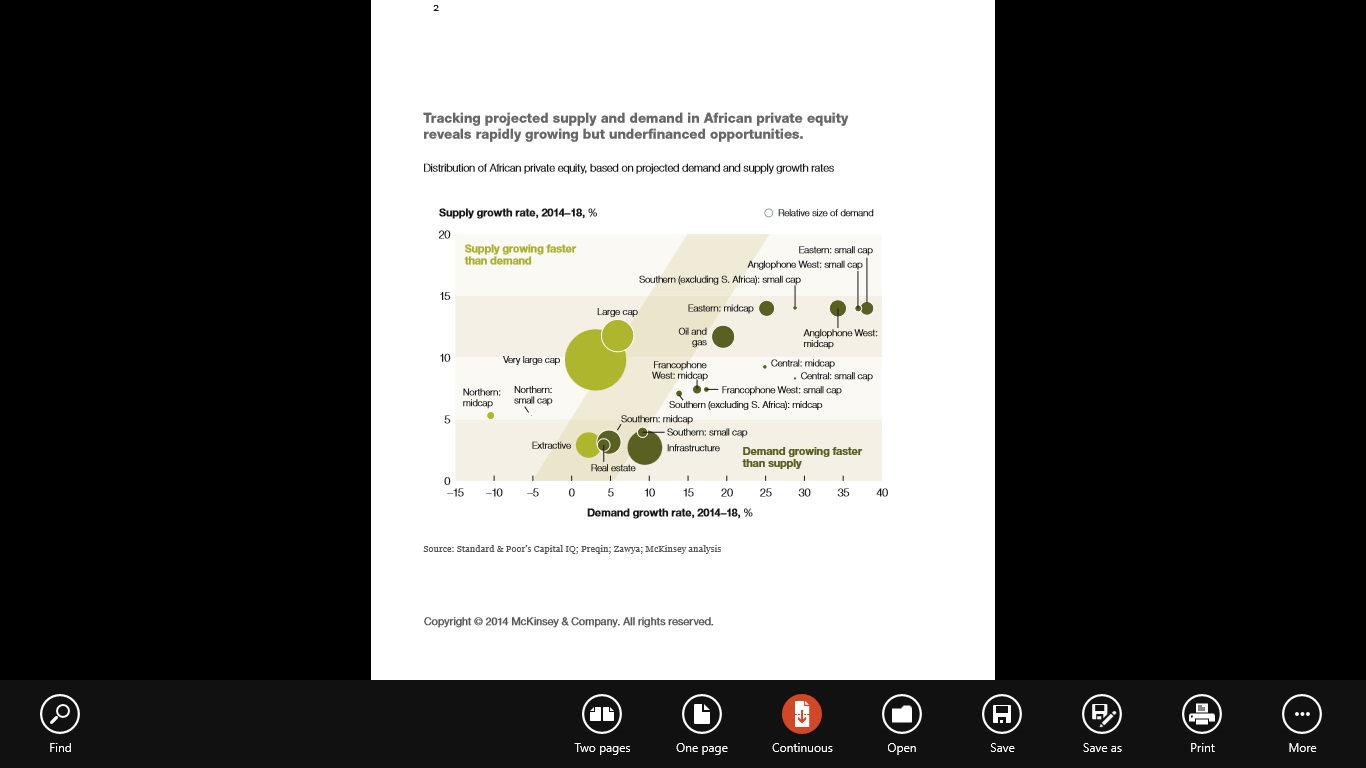
East Africa’s growth potential from a Private Equity Perspective

This is the one graph you need to know to understand the Rise & Rise of Uganda (despite being the headlines for all the wrong reasons). Demand for Capital is going to be most intense from medium-cap funds in Anglophone Eastern Africa. Isn’t the definition of Serendipity being about at the right place at the right? It’s almost as if the McKinsey Report is describing TLG Capital.

http://www.mckinsey.com/Insights/Africa/Uncovering_hidden_investment_opportunities_in_Africa

The americans are keeping (a careful) watch

Quick question: How frequently does Pew conduct opinion polls on election eve in foreign (third world, poor, no hope) countries?

Since it is conventional wisdom that polls conducted by Indian organizations are bogus (americans are saying so, one TV channel is also up with a sting operation) the next logical step is for the US organizations themselves to roll up their sleeves and step up to the plate and clear up all the confusion (+/- 3.8% is pretty credible). This in turn shines a spotlight on how much the americans are prepared to invest to make sure that they are well aligned with the coalition that will presumably rule India for next five years.

A Pew Research Center survey conducted between December 7, 2013 and January 12, 2014 based on face-to-face interviews with 2,464 randomly selected adults and a margin of error of 3.8% says

The survey has been conducted in all corners of India (Kerala excluded) and across all categories/divisions (gender, age, education, income, rural vs urban) BJP bests Congress by a huge margin.

At the lower end of the scale are the following: low income group (+37), 50+ age group (+37), women (+38), urban (+39). At the higher end we have the following: college degree (+52), middle income group (+49), men (+48) and (high) school certificate (+48).

What conclusions can we (imperfectly) draw from this? The Indian muslim population is less wealthy and more urbanized, this may help explain the low points. The middle class, well educated men form the backbone of the IH community so the high points are also not a surprise. Thankfully women appear to be (just a bit more) sensible as compared to men and aged people may recall the good old days of Nehru/Gandhi. Since the old generation will be fading away it appears that the hope for a secular India lies with her women. Stree Shakti is the best, it seems (as it was in the Vedic past when goddess Durga rode into battle against Mahisasura).

As far as regional differences are concerned: North (+74), followed by South (+42), West (+33) and East (+27). The southern anomaly is the most interesting data point of all. Explanations are (1) poll is crap, (2) shudras are relaxed about Sir-ji (why not? he is one of them, no?), (3) Kerala was not counted, (4) a bit of all of the above. If true this suggests that the southern leader-ess and others who may be thinking of jumping into bed with BJP will not be suffering any serious backlash if they decide to jump.

All in all Pew appears to confirm that the middle-caste, sons of the soil are ready to take back the power invested with mixed blood (also foreign blood) monarchs who have (mis)ruled India almost without break for so many centuries past. The shudra king of a shudra nation will not be stopped in his tracks by a bunch of liberal, pseudo-secular, activists. This is how democracy works, folks.

regards

Why the elite in the Rest yearn for the West

I’ve become an old hand in the developing world since I’ve done a fair bit of travelling.

I’ve noticed that elites throughout the world (and middle classes) dream of the West even when they lead fairly prosperous lives at home.
I could never really fathom why this was the case because if one has money (and lots of it) what’s the functional difference between Bombay and London (also the advantage being in the developing markets one can be part of the elite class at much lower wealth levels, which are not possible in the West).
I’ve realised that it’s all to do with self-actualisation and the stress of individuality that seems to be the distinctive hall mark of Western culture. In the East & global South the collective spirits is so strong that people take human connections for granted.
In the West self-actualisation is so pronounced that human ties take a very secondary role to the life of the individual (reality is far more blurred but this is the ideal).
So when Hollywood and Cable Tv bombard images of well turned-out successful Western individuals it takes a hold on the national imagination. Hence the global developing elites aren’t necessarily yearning for personal prosperity but the dream of becoming one’s own self that only seems possible in broadly prosperous and largely middle class societies (even if the US may be among the more unequal societies the huge size of its middle class still holds pronounced cultural sway).

Hello from Baroda

It’s my fourth visit to India since Dec’12. I’m very find of the place but it seems the Indian economy is definitely in slow-down mode, most of the bill boards around Calcutta airport were empty of ads.

The new airports cropping up in the metros are simply amazing (admittedly I’m referencing this to Africa but Bombay Airport’s can trump even Heathrow – the brief given to the interior decorators at Bombay airport was that amenities should be of such a standard that “people should miss their flights”).
I think the world is beginning to segment where we are also beginning to see a “Frontier” First, the urban regions (probably coastal America, Ny-Lon, Tokyo-HK) that are on the cutting edge of development and than the stable First World (Berlin, Paris). 
I think that the upcoming elections in India are going to be a watershed and it seems that Modi will be good for the economy. However the Gujarat riots were really something else (in the aftermath of those riots however they’ve come to a complete stop) since apparently there were detailed lists of minority-owned businesses and it had spread from Ahmedabad old town to the prosperous suburbs (one Hindu woman who had owned a Benneton? business with her Muslim husband had to stand outside it and recite the Gayatri Mantra? to prove she was Hindu).
Anyway I think that though Modi’s track record is patchy (the riots do seem to be a failure either way) he is the man to bring India back on track. Big government just cannot work here (or in Africa or elsewhere for that matter) since the largesse gets distributed all around.
My journeys to India now span east (Calcutta), south (Chennai), west (Mumbai, Baroda, Kolhapur) but ironically not the heart and north of India (the most “Pakistani” parts of the country Lolz).

Where is My Family In the Media?

Ever since the first Cheerios commercial last year showing an interracial family in a banal non-controversial context, there has been a lot of talk in the media about the topic. But one thing that has stood out in these treatments is a relatively narrow understanding of what interracial is. This is illustrated by an op-ed in The New York Times, Where Is My Family on TV? I looked up the various references to an interracial family/individual/relationship within the piece (I don’t watch television, so many were unfamiliar to me), and every single instance except for the very last, pointing out Bruno Mars at the Superbowl, is of a black-white nature.

The problem is illustrated by this pie chart produced by the Census: most interracial interaction in the United States is no longer black-white. About 20% of the people who chose more than one race on the 2010 Census selected black and white. When the original controversy over the first Cheerios ad occurred I remembered a Facebook share which featured interracial families. From what I saw ~80% were of the black-white variety. Perhaps this is the reflection of the background of the family in the Cheerios commercial, but it does get a little tiresome that a broad and general term like “interracial” gets totally specified in a way that excludes many people.

To be fair, perhaps I am not being especially sensitive to the history of black-white relations in the United States. Though most minorities in this nation are no longer black, the vast majority were black until the 1965 immigration reform, and this remained the case up to the 1980s. America’s history of race is to a great extent its history of black and white, and modern non-black minority consciousness is strongly influenced by this older template. And to be honest I don’t think of my own family as “interracial” very much, because in my own life race is not that big of a day to day factor. And, unlike the very cute actress in the Cheerios commercial my daughter is not visibly of mixed race*, so presumably her primary interaction with racial issues is going to be the small moments of surprise people feel when they realize that the brown-skinned man is her father. All this is likely related to the emergent reality of America’s true race dynamic being that of a black/non-black divide.

But if that is really what’s going on here, we need to update it more explicitly. Too often the media seem to assume a world that is stuck in 1965, with a white majority and a black minority. We’re nearly 50 years on from that. Our discourse should reflect that in some consistent manner.

* It seems that people of mixed South Asian and European ancestry can look totally South Asian or European in appearance, with most in the middle. My daughter for whatever reason happens to be much closer to a European appearance.

Brown Pundits