Eternal youth

the promised land where (rich) people will stay young forever.… as always…Bahamas

Bahamas resident Peter Nygard says he is receiving stem cell therapy
and that a study from the University of Miami suggests he is getting
younger, the Bahamas Tribune
reports.  

“They are looking at me, and my markers have shown exactly
that I have been actually reversing my ageing and getting younger,” the
70-year-old says.


regards

Gorakh Hill for a quiet time

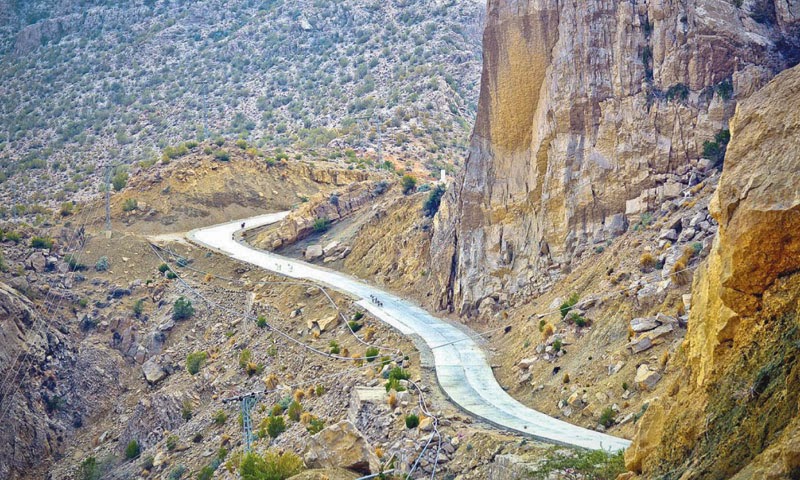
The highest point of Sindh, due for a major makeover. The views are remarkable and the journey is for the adventurous. Pleasantly surprised by the fact that Sindh has a 5688 ft peak and also by the name (probably since ancient times).

Yet as we climbed up towards the summit of Gorakh Hill, the mountain
hues were stunning. There was grey, ochre, brown and a speckle of green
here and there. The natural sculptures, fashioned by wind and water no
doubt, were a sight to behold. The climb was only punctuated by the
occasional sighting of a lonely shepherd tending his flock or a camel
herder watching over his beasts, or construction workers being hauled to
the top.


The sights as one climbed up the hill were indeed something for sore
eyes, reminiscent of the Grand Canyon in the US. At night, a canopy of
stars was visible in the clear sky above — more stars than one could
count. What is more, the silence was all-encompassing while the air was
crisp and cool.


A VIP rest house exists along with a regular guest house, while staff
quarters and tourist huts are under construction. While the weather in
Dadu and Johi below was pleasant, on Gorakh Hill it was absolutely
nippy. And as the sun came down, the cold started to bite. Late at
night, as load-shedding hit and the wind started howling on the pitch
dark hilltop, the feeling was otherworldly.

regards

The (unsung) mutiny (1946)

A 94 year old recounts his vivid memories of those momentous events 68 years ago when the soldiers raised by the British to keep their own countrymen in chains finally revolted and (as the British saw it) the empire game was suddenly up. As a shameful and terrible consequence the mutineers were never employed by either Indian or Pakistan Navy. As they say, a good act never goes unpunished.

It’s difficult to recall a day 68 years ago when you are 94. But the
RIN mutiny, which many believe was the last nail in the Raj’s coffin,
wasn’t just any other day. And I happened to be a proximate eyewitness
to this momentous event. 

On February 18, 1946, ratings at the HMIS
Talwar, a shore establishment for signals training, went on strike,
protesting against the inedible meals and searing insults to which they
were regularly subjected.
The revolt spread like wildfire. Some
mutineers took up arms; others took to the streets of Bombay. Ratings
famously pulled down the Union Jack on rebel ships, replacing it with
flags of the Congress, the Muslim League and the Communist Party of
India.


Unlike the sepoys of 1857, who were a heterogeneous group, the RIN
ratings were by and large educated, well-trained and well-armed.
The
British adm­i­nis­tration was not so much perturbed by the peaceful
civil disobedience movement (satyagraha) launched by Maha­tma Gan­dhi as
by the spectre of an insur­rection in the modern Indian armed forces,
which they had themselves trained.

Later that evening, I went to Apollo Bunder—the Gateway of India.
Everything was quiet. Thereafter, I was taken by some friends to the
flat of one of the activist supporters of the mutiny. I learnt that the
morning’s event I witnessed was but a small part of a well-orchestrated
chain of strikes and demonstrations. No wonder the British government
was rattled.  

By February 22, the mutiny had spread to naval units across
the country. Some 20,000 sailors, 20 offshore establishments and over
70 ships are believed to have been involved. That British prime minister
Clement Attlee announced the Cabinet Mission to India just a day after
the mutiny erupted is testimony to the mutiny’s perceived threat.


The revolt was as spectacular as it was short-lived. Nei­ther the
Congress nor the Muslim League supported it; the strike committee
surrendered after talks with Vallabhbhai Patel. Hundreds of mutineers
were jailed or dismissed, never to be reabsorbed by the armed forces of
independent India or Pakistan. Never were the ratings celebrated as
heroes.


Within a year and a half of that day, India became free and the RIN
became the Indian navy. On the day of independence, I was with my
wife-to-be on a little hillock called Antop Hill. Suddenly, the sky lit
up with fireworks and I knew we had become free.
I owned a small car, a
dkw two-seater. It had seen many owners, and wouldn’t start without
pushing. That day, I had kept it on the slope of the hill so it would
start easily. My wife and I jumped into the car, which dutifully rolled
down the hill. Jubilant, we drove to Marine Drive and joined the stream
of cars going to the secretariat. 

regards

Thorium reactor #1 (only by 2025)

Hopefully the powers that be mean what they say and say what they mean. The dream of a Thorium reactor lives on, even as we get to hear of rumors that the huge thorium reserves in Kerala and elsewhere are being depleted at a rapid scale (sold off to the Chinese?). Since this is India, of course anything is possible.

Design of the world’s first mainly thorium-based nuclear reactor is ready. Indiatoday.in
brings you the first look of the design and prototype of the Advanced
Heavy Water Reactor (AHWR). It is the latest Indian design for a
next-generation nuclear reactor that will burn thorium as its fuel.

The
design is being developed at Bhabha Atomic Research Centre (BARC) in
Mumbai and is an important step towards the third stage of  Indian
nuclear power programme, which envisages use of thorium fuel cycles for
commercial power generation.

The AHWR is a vertical pressure tube
type reactor cooled by boiling light water under natural circulation.
The unique feature of this design is a large tank of water on top of a
primary containment of vessel called gravity-driven water pool (GDWP).
This reservoir is designed to perform several passive safety functions. Dr
R.K. Sinha, chairman, Atomic Energy Commission, in an exclusive
interview to Indiatoday.in said: “This reactor can continue to cool its
core after passive shutdown without an external source of cooling water
and electricity and even without any operator action for nearly 110
days.”

The AHWR will be fuelled by a mix of uranium-233 and
plutonium, which will be converted from thorium and uranium-238
respectively by previously deployed and domestically designed fast
breeder reactors. Another version of the AHWR called AHWR-LEU will use
low enriched uranium along with thorium.

Thorium is an element
that is three times more abundant globally than uranium. India’s
reserves of thorium constitute 25 per cent of the world’s total
reserves.

Earlier, India had set up KAMINI – a 30 kWth
experimental reactor at Kalpakkam which incidentally is the world’s only
reactor fuelled by U-233 derived from thorium.


The
AHWR, a technology demonstrator, is supposed to be launched during the
12th five-year plan and will take seven to eight years for completing
the construction. Thus generation of electricity from AHWR is expected
to be somewhere in 2025.  

regards

Brown Pundits