Maoists driven back (by women voters)

Unlike in Kashmir (Srinagar recorded only 25% votes yesterday) there seems to be fresh hope for electoral democracy in Chattisgarh. Two key things will have to happen for democracy to flourish: maximum possible devolution of power to the lowest level possible, and implementation of social schemes without fear or favor.

Congratulations are due to the Raman Singh led BJP govt for doing well on the governance front. However the Maoist menace will remain for a long time to come (it cant be wished away). The worst thing (as in Nigeria) is for the govt to become complacent.
…..
Defying the Maoist threat of poll-boycott, Chhattisgarh
has indeed created a record of sorts in the just concluded Lok Sabha
polls in the state, registering not only the highest ever turnout of
69.48% but also witnessing an overwhelming participation of 68.04% women
voters.

As compared to a turnout of 55.29% in 2009 and about
52.09% in 2004, nearly 70% of the 1,76,23,818 electorate exercised their
franchise in these elections. Even the so-called “red areas”, where
Maoists had given called for a poll boycott, voters remained undeterred,
with Bastar and Kanker regions recording a turnout of 59.4% and 70.29%
respectively, another first in the state.


Statistically
speaking, the second phase of polling in Rajnandgaon, Mahasamund and
Kanker witnessed the highest turnout of 73.04%. This was followed by
69.60% in the third phase, which concluded on Thursday.

Poling
in the first phase in Bastar was the lowest in the state at 59.40%.
However, this turnout was much larger than the 43.33% in 2004 and 47.33%
in 2009.

The increase in the participation of women voters has
been the other hallmark of these polls. As compared to 52.33% in 2009
and 45.50% in 2004, 68.04% of the 8714762registered women voters
exercised their franchise.

Even in the Maoist infested areas of
Bastar and Kanker, women participation was high at 49.85% and 49.27%
respectively. In fact the near 50% participation of women in Bastar has
been the highest in the state.

Reasons for high turnout: While
increased voter awareness, thanks to the massive campaigns undertaken by
the EC, is being considered the main reason for the high voting trends,
the hype surrounding the high pitched polls has also contributed to the
turnout. The BJP, which is hoping to come to power at the centre with
Narendra Modi at the helm, had been virtually in the poll mode for the
last one year and didn’t lose steam even after winning the assembly
elections. Some even attribute the advent of AAP on the state’s
political scene for the increase turnout.

The BJP has a lot at
stake and thus a lot to lose in these elections. It had won 10 of the 11
seats in the last two Lok Sabha polls and observers feel that it might
not be that easy for it to repeat the same performance. With punters
betting on 9 seats for the BJP, the gain of even one seat for the
Congress would mean a 100% increase for them.

…..

Link:
…..

regards

India before Japan (World Bank)

Economy #3 as ranked by the International Comparison Program (ICP), hosted by the
Development Data Group at the World Bank.

These gross numbers are a bit meaningless anyway, still India would do much better off if the conflict level was lower in the sub-continent, OTOH the situation is more stable than Middle East North Africa (MENA) nations which are superior in HDI rankings.
……..
In a
matter of six years, India emerged as the world’s third-largest economy
in 2011 from being the 10th largest in 2005, moving ahead of Japan,
while the US remained the largest economy closely followed by China,
latest figures have revealed.


“The economies of Japan and the
UK became smaller compared to the US, while Germany increased slightly,
France and Italy remained the same,” according to data released on
Wednesday by the International Comparison Program (ICP), hosted by the
Development Data Group at the World Bank Group.

“The relative
rankings of the three Asian economies — China, India, and Indonesia — to
the US doubled, while Brazil, Mexico and Russia increased by one-third
or more,” the report said. The world produced goods and services worth
over $90 trillion in 2011 and that almost half of the total output came
from low and middle-income countries, it said.

According to the
major findings of the ICP, six of the world’s 12 largest economies were
in the middle-income category (based on the World Bank’s definition).

When combined, the 12 largest economies accounted for two-thirds of the
world economy and 59 per cent of the population, it said.

The
purchasing power parities (PPPs)-based world GDP amounted to $90,647
billion, compared with $70,294 billion measured by exchange rates, it
said, adding that the share of middle-income economies in global GDP is
48 per cent when using PPPs and 32 per cent when using exchange rates.

The six largest middle-income economies — China, India, Russia, Brazil,
Indonesia and Mexico — account for 32.3 per cent of world GDP, whereas
the six largest high-income economies — US, Japan, Germany, France, UK
and Italy — account for 32.9 per cent, the report said.

Asia
and the Pacific, including China and India, account for 30 per cent of
world GDP, Eurostat-OECD 54 per cent, Latin America 5.5 per cent
(excluding Mexico, which participates in the OECD and Argentina, which
did not participate in the ICP 2011), Africa and Western Asia about 4.5
per cent each.

“China and India make up two-thirds of the Asia
and the Pacific economy, excluding Japan and South Korea, which are part
of the OECD comparison. Russia accounts for more than 70 per cent of
the CIS, and Brazil for 56 per cent of Latin America. South Africa,
Egypt, and Nigeria account for about half of the African economy,” said
the report.

“At 27 per cent, China now has the largest share of
the world’s expenditure for investment (gross fixed capital formation)
followed by the US at 13 per cent. India, Japan and Indonesia follow with 7 per cent, 4 per cent, and 3 per cent, respectively,” the report said.

China and India account for about 80 per cent of investment expenditure in the Asia and the Pacific region. Russia accounts for 77 per cent of CIS, Brazil for 61 per cent of Latin
America and Saudi Arabia 40 per cent of Western Asia, it said.

The report said low-income economies, as a share of world GDP, were
more than two times larger based on PPPs than respective exchange rate
shares in 2011.

Roughly 28 per cent of the world’s population lives in economies with
GDP per capita expenditure above the $13,460 world average and 72 per
cent are below that average.

The approximate median yearly per
capita expenditure for the world — at $10,057 — means that half of the
global population has per capita expenditure above that amount and half
below, it said.

The five economies with the highest GDP per capita are Qatar, Macao, Luxembourg, Kuwait and Brunei. The first two economies have more than $1,00,000 per capita, the ICP report said.

Eleven economies have more than $50,000 per capita, while they
collectively account for less than 0.6 per cent of the world’s
population. The US has the 12th-highest GDP per capita.

Eight
economies – Malawi, Mozambique, Central African Republic, Niger,
Burundi, Congo, Comoros and Liberia — have a GDP per capita of less than
$1,000.

The five economies with highest actual individual
consumption per capita are Bermuda, US, Cayman Islands, Hong Kong and
Luxembourg.

The world average actual individual consumption per capita is approximately $8,647, it said.

…….

Link:
……

regards

Black money for (smooth) roads, (sturdy) lamposts

The most memorable (bone-chilling) promise made to the (about to be independent) nation by our esteemed first Prime Minister: 
“In an independent India,” Nehru declared in one of the first speeches he made on June, 1945, “such black marketeers will be hung from the lamp posts

Arvind Kejriwal on why Nehru’s party has (till very recently) been reluctant to retrieve black money hoarded in foreign banks (let alone call in the guillotine):

What will this notorious pot of gold get us? Lalu Yadav promised to use the black money for constructing roads (in Bihar) that will be as smooth as Hema Malini’s cheeks (if true this would be money well spent). We should be able to afford a few (metaphorically speaking) robust lamp-posts as well.

The names of the infamous black money hoarders have been finally disclosed. The only question is why the inordinate delay in releasing information from 2009? No need to answer that question though.

Well OK, it is only the Liechenstein Bank* and only a piddly count of 26 account holders. That said, this is a very promising crack in the Great Black Wall. We are confident that if the full power of the Indian state is made to bear the Swiss will also divulge the black-data (just like they have for the USA).

The actions of the govt today make us exclaim with joy: Yeh Dil Mange More”
……
The government on Tuesday has disclosed the names of all 26 account holders in Liechtenstein Bank to the Supreme Court. 

It has also made public the names of 18 account holders against who
proceedings have been launched and the names of the remaining 8 account
holders have been given in a sealed cover.
The names were given to India by Germany in 2009.

Out of the 18 names made public, 5 are from Dhupelia family who are
trustees of Ambrunova trust, 4 from Manichi trust, 4 from Ruvisha trust,
KM Mammen of Webster Foundation and two others.

……
Link: http://indianexpress.com/article/business/economy/black-money-govt-submits-18-names-of-account-holders-in-liechtenstein-bank/
…….
regards 

Slum-dog vs. Hans Solo

John Oliver is a British comedian, an Emmy winning writer and has his own HBO show (Last Week Tonight with J.O.). He makes a few salient points about Indian elections.

Re: why America should care-“Don’t pretend you aren’t interested
in this, America. The last time you heard a rags-to-riches story about a
tea-selling Indian kid, you threw a fcuking Oscar at it.”

Re: evidence America does not care-   ….a clip of debates on American news
channels about the Indian elections, where a guest can be seen saying,
“India is not even in the same hemisphere and there’s no point of
discussing it.”

Re: Rahul Gandhi-
Rahul Gandhi, calling him ‘Indian Hans Solo’ and pointing out
how despite his political lineage is likely to lose to a ‘tea seller’
.
….. 
Re: Narendra Modi-
“No election is
complete—or entertaining—without a little scandal, a ‘je ne sais,
genocide’.”
 

Re: Western Media-
CNN in
India for using the title “One Billion Votes” for a story about the
election, when India actually has only 800 million voters, saying “Their
own graphic is wrong by the entire population of Brazil.”

Re: India Media-
“Do you have a ludicrous number of people
shouting at each other in a TV debate? Check.

.
Link: https://www.youtube.com/watch?v=qO2U4wRYE1M
………

regards

TCS (soft)powers India to Premier League

Once upon a time what was good for General Motors was also automatically considered good for America.
We presume the same thing holds true for TCS and India at present.

The rankings are a bit confusing, but whichever way you look (revenues, profit margin, employee count, market cap, growth rate) TCS is doing very well, perhaps only next to IBM.
……
This is a landmark for Indian IT. The country’s largest IT services
provider, Tata Consultancy Services (TCS), has broken into the league of
top 10 global IT services companies (by revenue), moving from the 13th position in
2012 to the 10th spot in 2013.


“Talk to any incumbent western
service provider today, and the one making them all tremble from the
sub-continent is TCS,”
writes Jamie Snowdon, executive VP of research
operations at HfS Research, the consultancy firm that compiled the
ranking.


TCS is estimated to have IT services revenues of $10.1
billion (out of its total revenues of about $12.5 billion). IBM ($54.4
billion), Fujitsu ($32.1 billion), Hewlett-Packard ($29.2 billion) and
Accenture ($25.4 billion) lead the list.


India-based companies Cognizant,
Infosys, Wipro and HCL are at the 15th, 18th, 20th and 25th positions,
respectively, all of them rising by one to three spots compared to 2012.
HfS Research believes that Cognizant could be in the top 10 in the next
2-3 years, may be at the expense of US IT company CSC. CSC’s revenues
last year had dropped compared to the year before.


“The firm is increasingly being perceived by
many today as an alternative provider to the Western Tier 1s, that can
come in and fix messy contracts and implementations;
it has shown an
appetite and willingness pick up a lot of the low-margin, low-value work
that seemingly every Western Tier 1 wants out of and make the deals
profitable and leverageable across clients,” said Phil Fersht, CEO of
HfS. TCS also has an extraordinary profit margin, something that’s
normally difficult to achieve in conjunction with high revenue growth.

……..
Below is a September 2013 report from Forbes magazine. Time sure flies when you are in the (F1) driver’s seat.
…….
Mumbai-based Tata Consultancy Services (TCS) and made it the world’s second most-valuable IT services company after IBM. That puts it ahead of rivals like Accenture and Hewlett-Packard.

TCS’ market valuation recently crossed $60 billion, ahead of
Accenture’s $50 billion and HP’s $43 billion, but trailing way behind
IBM’s $202 billion.


TCS is currently amongst the fastest-growing IT services companies
worldwide. TCS’ stock commands a huge premium, trading at around 27 times its
profits of the past 12 months, a five-year high, whereas rival IBM
trades at 12 times and Accenture trades at 17 times its latest earnings
per share. Its share price has spiked over 40% in the past three months.


TCS is notable in terms of employee count and geographical spread. In
March this year, its headcount was 276,196 employees. Rival IBM had
430,000 workers at last count, a bulk of them in India. In geographical
reach, the North American market – a vital market for India’s
outsourcing companies – accounts for half of TCS’ revenues. But a fifth
of its revenues come from emerging markets.


TCS is expected to continue to show strong revenue growth. TCS’ CAGR
in the past three years leading to FY13 was 22% compared with 13% for
Infosys and 10% for Wipro. However, TCS substantially lags behind IBM in
revenues and trails Accenture,too.

……
Link (1): http://www.businessinsider.in/Tata-Consultancy-Services-Joins-Top-10-Global-IT-Services-Companies-Club/articleshow/34076733.cms
Link (2): http://www.forbes.com/sites/saritharai/2013/09/13/indias-tcs-is-second-most-valuable-it-services-firm-globally/
…..
regards

Indian Navy hit by stiff waves

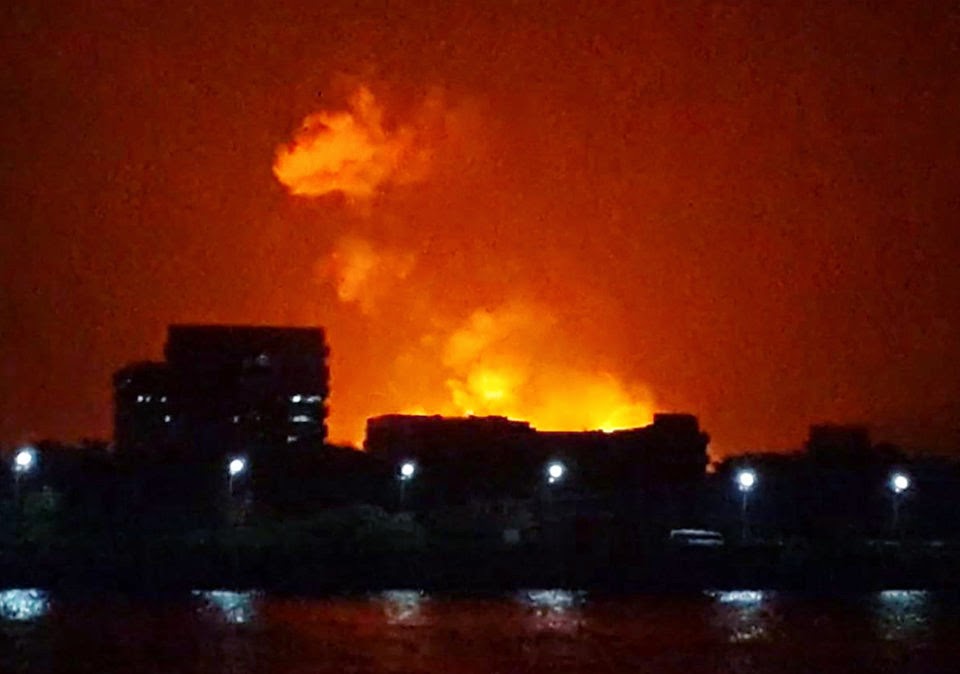
First the submarine (Sindhurakhshak) exploded killing 18 sailors. Next another sub (Sindhuratna) caught fire and two more sailors were lost. Admiral DK Joshi assumed moral responsibility and resigned. Now the ripples have extended to appointment of the new admiral as well.

Vice Admiral
Shekhar Sinha has resigned as Robin Dhowan has been promoted ahead of him. Such
events fall in the rarest of rare category-
General AS Vaidya became Army chief in 1983 ahead
of  Lieutenant
general SK Sinha, and Air Chief Marshal SK Mehra became IAF chief by
superseding Air Marshal MM Singh


The
government, on Monday, approved the “voluntary retirement” of Vice
Admiral Shekhar Sinha, who had put in his papers after Admiral Robin
Dhowan superseded him to become Navy chief last week, even as the Army
commanders’ conference kicked off amid uncertainty over its own line of
succession.

The Navy is now headed for a reshuffle in its top brass, with the two
crucial posts of vice-chief and WNC (Western Naval Command) chief becoming vacant. The force’s
line of succession, of course, has also gone for a complete toss, with
present National Defence College commandant Vice Admiral Sunil Lamba now
slated to succeed Admiral Dhowan as the Navy chief in May 2016.

The defence ministry felt that Vice Admiral Sinha had to take his share
of the blame for the recent string of warship mishaps under the WNC.

This came after Admiral D K Joshi owned “moral responsibility”for the
accidents and quit as the Navy chief on February 26 — a resignation
which was accepted by the MoD with unseemly haste.

But the
MOD’s junking of the seniority principle has sparked some concern in
military circles because successive governments have almost always stuck
to it in appointing service chiefs. The chain of seniority in Indian
military is considered virtually sacrosanct, with supersession being
exceptionally rare.

……
Link:  http://indianexpress.com/article/india/india-others/dhowan-takes-over-as-navy-chief-superseded-sinha-resigns/
…….
regards

17/7 Rajputs for 24/7 defense (against China)

The 17/7 Rajput regiment is in charge of guarding the North-Eastern (India) borders aka “undisclosed high-altitude location under Eastern Command”

Most of us are not really familiar with the (Indian) military and its ways. For example, is a Rajput regiment composed of only Rajputs (khatris)? Look deep and ye shall find. 

The “barhe chalo” regiment was raised during the WWII by Field Marshall Cariappa and fought in the North-Eastern Frontier (Kohima, Nagaland on the Indo-Burma border) against the mighty battalions of the Japanese Imperial Army. They will now be prepared to defend the north-east frontier once more, this time against the mighty battalions of the People’s Liberation Army.
….
“Among all
battalions of the Rajput Regiment, 17 Rajput has a unique place in present day
history of the Indian Army. It was raised during the period of Quit India
Movement in 1942. It was also among 10 other Rajput Battalions that were raised
following outbreak of World War-II from 1940 to 1943.”


In so far as its historical significance is concerned, 17/7 Rajput as it was
then known, was the only ‘War Raising’ battalion by any Indian officer who was
none other than Lt col KM Cariappa, OBE, popularly called ‘Kipper’ who went on
to become the first Indian commander-in-chief and later the chief of army
staff. He was also conferred the highest rank of field marshal on April 28,
1986.


17/7 Rajput was raised at Fatehgarh on April 15, 1942 as the Machine Gun Battalion
of the erstwhile 7th Rajput Regiment.
A distinctive colour of maroon and blue
was adopted for the new outfit. On August 1, 1942, the battalion was converted
into a Regiment of Indian Armoured Corps (IAC) and designated 52nd Rajput
Regiment IAC (Bawanja Risala) and moved to Lahore.


On September 15, 1942, the battalion was converted into a ‘Lorried Battalion’
and moved to Secunderabad to form part of 268th Lorried Brigade. On March 16,
1943, Kipper was transferred and succeeded by Lt Col G.B. Macnamara. In May
1944, 17/7 Rajput moved to Kohima and later deployed at Imphal.


Informed readers may know that Rajput Regiment is one among the senior most
regiments of our country. It must therefore, logically, rank higher in the
hierarchy of the nomenclatures. Then why the seventh standing? Evidently, Maj Gen Parr, who had commanded the 7th Rajput in Mesopotamia during
world war-I desired that the Regiment to which his battalion belonged be named
7th Rajput Regiment.
The suffix ‘7’ was adopted and remained so for all
battalions of the Rajput Regiment between 1920 till Independence, where after
it was dropped altogether.


In the redesignations that followed, Barhe Chalo became 17th Battalion of the
Rajput regiment on May 1, 1948. Later when its founding father, Lt Gen KM
Cariappa became Army Chief on January 15, 1950 (commemorated as Army Day), an
honour was bestowed on the battalion. The distinct maroon and royal blue hackle
of the unit was now adopted by all Rajput Regiment battalions. 

In 1965, Barhe
Chalo participated in Op Riddle as part of 7th Infantry Division, where it
successfully executed its task of capturing Bedian bridge. The unit also
participated in Op Cactus Lily in 1971 as part of 86 Infantry Brigade in Dera
Baba Nanak sector, where it captured Khokherke and Sadhuwan posts of enemy and
provided a firm base for Op Akal. The unit was also successful in capturing a
crucial enemy post for which Capt Nawal Singh Rajawat and Late Sep Satyawan
Singh were awarded VrC.


In 1982, the battalion underwent a change in class composition and reorganised
to include Rajputs, Gujjars, Brahmins, Bengalis, Jats, Ahirs and Muslims in
equal percentage composition.

The battalion was also the first unit of Rajput Regiment to be inducted in
Siachen Glacier in 1991. The unit had a successful tenure without having a
single fatal casualty, which indeed is a unique achievement.


Among the wars and major operations that Barhe Chalo participated include world
war-II, between May to August 1944, Indo-Pak War of 1965 between September 1965
to February 1966 and Indo-Pak War 1971, from October to December 1971. Among
the various military operations include Operatons Orchid, Rhino, Vijay, Rakshak
and Parakram.


Glory to the Barhe Chalo has been brought through its gallant officers and
soldiers through 2 Military Cross, an OBE and PVSM each, 7 Kirti Chakras, an
AVSM, 4 Shaurya Chakras, 3 Vir Chakras, 12 Sena Medals, 3 VSM, 6
Mention-in-Despatches, 38 COAS, 7 VCOAS and 33 GOC-in-C Commendation Cards
including several other gallantry certificates.


The battalion is presently serving at an undisclosed high altitude location
standing vigil under Eastern Command. The Barhe Chalo battalion is presently
being commanded by Colonel Balbir Singh Siwach, a second-generation army
officer, commissioned in December 1990.


regards

(slow) Train to Ernakulam

We are familiar with strange truth (stranger than fiction). Here is an example of plain scary truth (not as scary as flying by Malaysian Airlines, but still….)

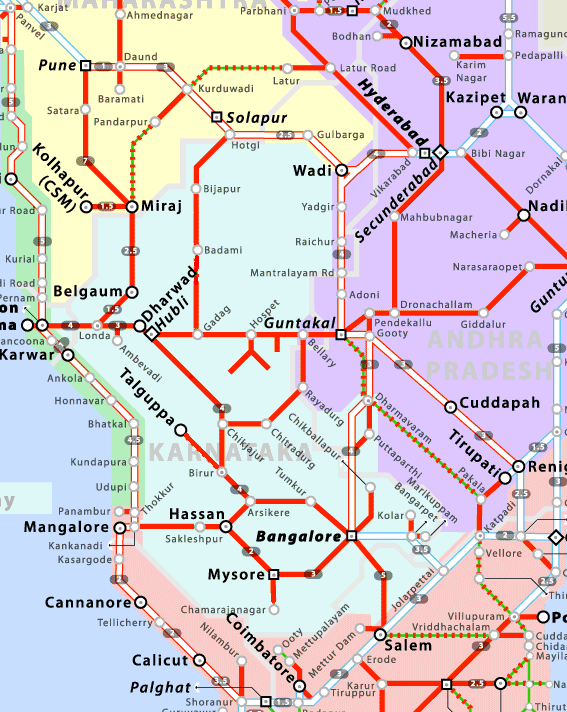
Above we have the map of (Indian Railways) South-Western Zone. The original route was along the west coast (Konkan Railway shown in green). Instead the train got diverted to Pune (top left corner in yellow zone). At that point it should have moved directly south to Miraj and from thereon turn west to reach Goa. Instead it traveled south-east (right-wards in the map) to Solapur and then on to Gulbarga, a few hundred km on the wrong track.

Not a single official noticed (the passengers eventually did). BTW Udupi is a town on the west coast near Mangalore.


Passengers
of the Okha-Ernakulam express from Gujarat to Kerala were stunned when
they saw that their train had reached Gulbarga station in Karnataka on
Tuesday.

The train was on track till 10.30pm on Monday but
passengers were alerted at Punwale that due to an accident near
Ratnagiri, the train would be diverted towards Pune and then it would
reach Wadgaum in Goa via Miraj. But at Pune, the train was mistakenly
diverted to Solapur and then to Gulbarga.

Passengers were
shocked early morning when they saw their train at Solapur station at
6am. They informed the station master at Solapur and were told the train
would be diverted at Guntakal to Hubli….

..
The train reached Gulbarga at 11.30am and
was parked 1km from the station and later taken to the station.

..Keerthan, a passenger
on the train who was supposed to reach Udupi at 11am Tuesday, got down
at Gulbarga and took a bus to reach his destination. He said almost 30
passengers in the bus he was traveling, were passengers from the
mis-routed train.

…..

regards

Ugly duckling hopes to be a swan

Many many people question the value of democracy in a country like India filled with poor, illiterate, low information people. This thinking can be logically extended to the necessity of a popular ballot. After all the elections will consume of the order of $5 Bil. Why do it?


One answer to the above question is that it demonstrates at least one area where the Indian state does a gargantuan job reasonably well (also getting better with time with further scope for improvement). Heavy-weight candidates lose elections by a 1000 votes and accept the result without comment. This is such a remarkable fact…that it is ignored for the most part. 

The Economist is inspired by the election process (if not the headline candidates) and inspects the functional parts of the Indian state and considers how to improve the non-functional parts. Excellent advice for the most part.

One thing that did not merit a few bytes is the importance of (appearance of) non-partiality. The reason the Election Commission is so widely respected because it calls out ALL the bandits in equal measure. Thus both Azam Khan (muslims won Kargil war) and Amit Shah (hindus should consider taking revenge) have attracted the maximum penalty. In a country like India it is essential that the government is fair and seen to be fair. Nothing else will do.


On the face of it, such a triumph is puzzling. Ask Indians about the
capacity of their state, and the typical reaction is dismissive. Much else
organized by public officials is notably shoddy: try making use of state-run
schools or hospitals, getting help from a policeman, or relying on food-subsidy
schemes. Corruption, waste, delays and mismanagement are depressingly common….

How can India get the electoral process to work so well, when much else is done
so badly?

One answer is that elections are narrowly focused tasks of limited duration
that are regularly repeated.
Where similar conditions hold, bureaucrats prove
similarly successful.

A second answer is that state employees respond
well when given tasks of great prestige and put under careful public scrutiny.

Thus India’s space agency last year launched a spaceship to Mars which
continues on course, for a remarkably small budget. Similarly, public-health
officials recently announced that India had eradicated polio. 

A third answer is
that bureaucrats succeed when free from political meddling and corruption.


The electoral process may hold lessons that could be applied elsewhere. One
is the value of setting a simple, well-defined target. How about next telling
officials to reduce by ten places a year India’s rotten ranking of 134th (out
of 189) on the World Bank’s “ease of doing business” index? 

Another lesson is
the importance of transparency.
It is harder for politicians to meddle and
steal when bureaucrats, like election officials, are under intense public
scrutiny. Extending the country’s right-to-information law, however
embarrassing the rot that has been exposed, has proved immensely valuable. 

Last, bureaucrats become more efficient, and less corrupt, when they lose
discretionary powers.

…..

regards

The
contrast with bloody elections experienced by the neighbours—Pakistan,
Bangladesh, Sri Lanka, Nepal and even the Maldives—could not be more
stark.
On the face of it, such a triumph is puzzling. Ask
Indians about the capacity of their state, and the typical reaction is
dismissive. Much else organised by public officials is notably shoddy:
try making use of state-run schools or hospitals, getting help from a
policeman, or relying on food-subsidy schemes. Corruption, waste, delays
and mismanagement are depressingly common. Notice, too, the
embarrassing failures of India’s navy, plagued by fatal accidents in the
past year, the prolonged lack of investment in the national railways,
or the state’s failure to build enough roads, power lines or ports. How
can India get the electoral process to work so well, when much else is
done so badly?
One answer is that
elections are narrowly focused tasks of limited duration that are
regularly repeated. Where similar conditions hold, bureaucrats prove
similarly successful. One example is the ten-yearly national census;
a newer success is a scheme to build the world’s largest biometric
database, which has enrolled some 600m people, scanning their eyes,
fingerprints and more. (Whether this data will be put to good use is
another matter. It is worth noting, too, that much work was done by
private contractors overseen by public officials.) A second answer is
that state employees respond well when given tasks of great prestige and
put under careful public scrutiny. Thus India’s space agency last year
launched a spaceship to Mars which continues on course, for a remarkably
small budget. Similarly, public-health officials recently announced
that India had eradicated polio. A third answer is that bureaucrats
succeed when free from political meddling and corruption. The Election
Commission, like the central bank, is independent. And whereas policemen
spend much of their time collecting bribes to pay to their superiors,
election officials have neither big budgets to divert, nor much
opportunity to extract bribes.
The electoral process may
hold lessons that could be applied elsewhere. One is the value of
setting a simple, well-defined target. How about next telling officials
to reduce by ten places a year India’s rotten ranking of 134th (out of
189) on the World Bank’s “ease of doing business” index? Another lesson
is the importance of transparency. It is harder for politicians to
meddle and steal when bureaucrats, like election officials, are under
intense public scrutiny. Extending the country’s right-to-information
law, however embarrassing the rot that has been exposed, has proved
immensely valuable. Last, bureaucrats become more efficient, and less
corrupt, when they lose discretionary powers. Those who organise
elections have no discretion to decide who is allowed to vote or where;
they are only supposed to ensure it all works efficiently, leaving
little incentive for people to bribe or bully them. Whoever wins this
year’s election could do worse than look at the electoral process itself
as a model of how to sharpen up India’s bureaucracy.
– See more at: http://www.economist.com/blogs/economist-explains/2014/04/economist-explains-1#sthash.B7JUWtsd.dpuf

Sikhs (15th Ludhiana infantry) save Sahibs

In all the talk we hear about how advantageous it was for India to have been a British colony (no one doubts that) we never hear how Britain benefited enormously from having an Indian colony- as it marched to victory in the World Wars on the back of Indian soldiers. There will be no reparations but even a few words of gratitude (and a few paragraphs in British history books) is still better than nothing.

….

An
Indian soldier, immortalized by his act of selfless heroism and valor
while fighting for the British armed forces in World War I has come in
for heavy praise from UK Prime Minister David Cameron.

Cameron
has also floated the proposal that British children must be taught “in
the years to come about the role that the 1.2 million soldiers from the
Indian subcontinent played in World War I”.


The soldier Cameron
was referring to was Manta Singh, who served with the 15th Ludhiana
Sikhs, an infantry regiment of the Indian Army who was seriously injured
during the Battle of Neuve Chapelle in March 1915 – one that saw a
large number of casualties for the Indian Army – over 4000 in just three
days.

During the battle, Manta Singh witnessed an English
comrade Captain Henderson who had suffered. Singh himself was hit by
machine gunfire in his left leg but that didn’t stop him from rescuing
his fellow officer Captain Henderson. Manta pushed him to safety in a
wheelbarrow he found in no-man’s land.

Singh and his wounded
comrades were later shipped to Brighton’s Royal Pavilion which was
turned into a hospital for Indian soldiers. Here, his wounds
became infected with gangrene. He was told his legs would have to be
amputated to save his life, a thought which filled him with despair. He died from blood poisoning a few weeks later.

Remembering the soldier, Cameron said “This year, as we commemorate the
100th anniversary of WW1, it is also perhaps worth saying something
specific about how British Sikhs have served in our armed forces with so
much devotion, bravery and courage over so many years”.

Cameron added “Stories like that of Manta Singh, who fought at The
Battle of Neuve Chapelle, that massive battle on the Western Front in
1915, and when his English colleague was wounded alongside him, he
picked him up, carried him, took him to the dressing station while being
wounded himself, and then sadly, tragically died afterwards. Stories of
heroism, stories of valor – the Sikhs have always had this
extraordinary courage and bravery, and it’s been demonstrated so often
in the British Armed Forces”.

Interestingly Manta Singh and the
injured man he rescued, Captain Henderson, had become firm friends as
well as brothers in arms.

When Manta Singh died, Henderson
ensured that Singh’s son Assa, was taken care of. He encouraged him to
join the Sikh Regiment too. Throughout the Second World War, Assa Singh
and Henderson’s son, Robert served together, in France, Italy and North
Africa.

To this day, the Singh and Henderson families remain close friends.

Assa and Robert have passed away but their sons Jaimal and Ian are in regular contact.

Singh was born in 1870 near Jalandhar and as soon as he left school he joined the 15th Ludhiana Sikhs.

At the start of WW1, the regiment was sent to reinforce the British
Expeditionary Force fighting in France. By late autumn of 1914, one in
every three soldiers under British command in France was from India.
After long months of trench warfare, in March 1915, Manta Singh’s
regiment prepared to engage in the first major British offensive on the
Western Front, the Battle of Neuve-Chapelle. Half of the Commonwealth fighting force, 20,000 men were Indian Army soldiers.

General John French, commander-in-chief of the BEF in France at this
time, planned to take the village of Neuve-Chapelle, which formed a
German salient (bulge) in the British line.

On March 10, four
divisions, comprising 40,000 men, gathered on a sector of the front
which was only three kilometres wide. The infantry attack was preceded
by heavy but concentrated shelling from 342 guns. In 35 minutes, the
bombardment consumed more shells than the British Army used in the whole
of the Boer War 15 years earlier.

While the British and the
Indian Corps advanced rapidly through the lightly-defended village, the
Garhwal Rifles suffered heavy losses as they attacked a part of the
German line left untouched by the bombardment.

After an initial
success, in a matter of hours, the British became paralyzed by poor
communications and a lack of munitions, and their advance ground to a
halt.

It was in this chaotic field of battle that the 15th Ludhiana Sikhs fought.

Records say “Fighting ceased on March 13 with British gains limited to
an area two kilometres deep and three kilometres wide for a loss of
7,000 British and 4,200 Indian soldiers, either killed or wounded. The
Germans suffered similar losses and 1,700 of their soldiers had been
taken prisoner”.

….

regards

Brown Pundits