Boko Haram is fighting (and winning)

Nigeria is set to be the king of Africa (over-taking South Africa) but it is also in deep trouble. Boko Haram has gained enough strength whereby security forces are not able to keep up. A full scale war is raging and 1300 people are dead in 2 months. This misery is only exceeded by the hell fires burning in Syria. All in all a good run for Al Qaeda in its myriad forms.  

It bears repeating: if all these battles join up into a world war of sorts, it will be a royal mess with all big powers (including China) on one side of the fence. The islamic communities in the border regions will likely be devastated (people will not care much about what goes on in the hinter lands).
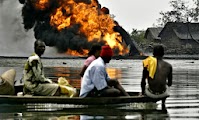
 

Matazu, 29, survived the double bomb blast earlier this month in Maiduguri, north-east Nigeria, that killed about 45 people and destroyed seven buildings. It was the latest blow by the terrorist group Boko Haram to shake the foundations of Africa’s most populous state.

Boko
Haram is believed to be responsible for killing at least 1,300 people
in the past two months and more than 130 people in the past week. The radical sect claims ties to al-Qaida and has ambitions to impose sharia law
on Nigeria’s 170 million people. In Boko Haram’s heartland, even the
national military is outgunned in what is fast becoming a lesson to the
world in how not to tackle an Islamist insurgency.

“What is clear
is that they are as ruthless as any Islamist group or terrorists
anywhere in the world,” said Antony Goldman, a west Africa risk analyst
at London-based PM Consulting. “They’re quite happy to hit soft targets,
including schools. Some in the Nigerian administration expect this to be a problem for another 10 years.”

In
some ways, the paradox of Nigeria in 2014 captures that of Africa
itself. The continent has enjoyed a decade of economic growth and the
phrase “Africa rising” has become widespread among investors and
journalists.
Yet at the same time the past six months have seen
conflicts erupt in the Central African Republic and South Sudan, while
economic growth has gone hand in hand with deepening inequality.

So
it is with Nigeria which, with oil wealth and a decade of annual growth
around 7%, is set to overtake South Africa as Africa’s biggest economy,
with a value close to $400bn.
It has been anointed one of the “Mint” emerging economies – along with Mexico, Indonesia and Turkey – by economist Jim O’Neill. Nigerians drink more champagne than Russians do.

For centuries, the region enjoyed the fruits
of Islamic civilisation. Then in the early 19th century its sultanates
succumbed to a jihad by Shehu Usuman Dan Fodio, who created a unified
caliphate that was the biggest pre-colonial state in Africa, ruling
swaths of what is now northern Nigeria, Niger and southern Cameroon.
It
had a strict interpretation of Islam and a culture of scholarship and
poetry. 

Northern
Nigeria did not escape the expansion of the British empire into Africa
and was conquered in 1903. Since then, there has been resistance to
western education, with many Muslim families refusing to send their
children to government-run “western schools”.
Shehu Sani, a human rights activist and author of Boko Haram: History, Ideas And Revolt,
said: “The north fought the British colonisers because they thought
they were bringing in western ideas and this would erode Islamic values
and erode their culture. 


The north-east
remained a centre of Islamic learning for children from all over Nigeria
and west Africa, Sani said. Its madrasas did not necessarily encourage
extremism but did shape the founders of Boko Haram, who embraced the
Qur’anic phrase: “Anyone who is not governed by what Allah has revealed
is among the transgressors.”


Some believe the trigger for the
group’s inception was a gubernatorial election campaign in Borno state,
when an opposition candidate organised a militia known as Ecomog, after
the east African intervention force deployed in Sierra Leone and Liberia
in the 1990s. Following the election, the candidate disbanded Ecomog
but did nothing to look after its members.

One of the militia’s
leaders, Mohammed Yusuf, was able to exploit the frustration and
disappointment and blend it with an Islamist agenda that rejected the
failings of secular government to form Jama’atu Ahlis Sunna Lidda’awati
wal-Jihad, People Committed to the Propagation of the Prophet’s
Teachings and Jihad. In the north-eastern city of Maiduguri, where
the sect had its headquarters, it was dubbed Boko Haram. Loosely
translated from the Hausa language, this means “western education is
forbidden”. 

Like
so many self-appointed rebels and revolutionaries, Yusuf was not poor.
He was said to be well-educated and to drive a Mercedes. In an interview with the BBC,
he set out the group’s anti-science philosophy: “Prominent Islamic
preachers have seen and understood that the present western-style
education is mixed with issues that run contrary to our beliefs in
Islam. Like rain. We believe it is a creation of God rather than an
evaporation caused by the sun that condenses and becomes rain. Like
saying the world is a sphere. If it runs contrary to the teachings of
Allah, we reject it. We reject the theory of Darwinism.”

Yusuf set
up a religious complex, which included a mosque and an Islamic school
that attracted many poor Muslim families. In 2009 Boko Haram attacked
several police stations and other official buildings in Maiduguri. The
Nigerian security forces hit back and more than 1,000 people died, not
all of them Boko Haram supporters. Yusuf was captured and killed, his
body shown on television. Boko Haram was finished.

But its
fighters regrouped under a new leader. In 2010 it attacked a prison in
Bauchi state, freeing hundreds of its supporters, and carried out deadly
bombings in Jos and military barracks in the Nigerian capital, Abuja.
Its main modus operandi was to deploy gunmen on motorbikes to kill
police, politicians and other opponents. Since then, the waves of
shootings and bombings have continued and, according to the Council on
Foreign Relations, Boko Haram is responsible for nearly 3,800 deaths
since May 2011.
The group has sworn allegiance to al-Qaida and, Sani
says, some of its members have fought in Somalia and Sudan, but a formal
link “cannot be independently confirmed”.

If anything, Boko
Haram has intensified its operations of late, including an attack that
saw 43 students shot and hacked to death and many girls kidnapped. In
response, the government closed five schools considered to be in “high
security risk areas”.

Some Nigerians who feel let down by
the government are taking the fight on themselves. Zakari Matazu,
survivor of the double bombing in Maiduguri, belongs to a youth
vigilante group in Borno state popularly known as the Civilian Joint
Task Force (CJTF). “Now Boko Haram are attacking everywhere because they
are strong – even stronger than the soldiers,” he said. “I am a CJTF
but I now know that Boko Haram can decide to attack and capture the town
of Maiduguri any time. Everybody knows that. The federal government has
abandoned us to be killed by Boko Haram.
All the people in the villages
have fled to Maiduguri, so if Boko Haram does not see people killed in
the villages, they will come to the city.”

Last month Boko Haram
threatened to strike farther afield, with potentially catastrophic
consequences for the economy. Its leader, Abubakar Shekau, threatened
attacks on oil refineries in the mainly Christian south, saying in a
video: “Niger delta, you are in trouble.” but few analysts believe the group poses an existential threat to Nigeria.


Those
on the frontline are living in a parallel universe to the champagne
parties in Nigeria’s big cities. “We are in a state of war,” Kashim
Shettima, the governor of Borno state, said recently in a plea to the president. “Boko Haram are better armed and better motivated than our own troops. It is impossible for us to defeat the Boko Haram.”

regards

How does a Sharia state work?

It is instructive to learn from Malaysia. The particular advantage of using Sharia as a sword is that people rising up in protest (against miscarriage of justice) would think twice before giving aid and comfort for supposedly blasphemous/sinful actions.

A Malaysian court convicted opposition leader Anwar Ibrahim
of sodomy and sentenced him to five years in prison on Friday….the ruling bars Anwar from running for a seat in the
state assembly of Selangor this month, a move that would likely have
paved the way for him to become chief minister of Malaysia’s most
populous state
— a potent platform from which to attack the government
ahead of the next national election.

If Anwar, 66, loses his
federal court appeal, he would face jail and would be barred from
contesting the next national election that must be held by 2018.
“It’s
(happening) all over again after 15 years,” Anwar, who was sacked as
deputy prime minister and finance minister in 1998 and convicted a year
later, told reporters.

regards

Crimean War part II

It has been a long time since the last Crimean war (1850s) which was (for the main) triggered by France and Britain in order to prevent Russia from gaining power in the Mediterranean (ref. wiki). The muslim Ottoman empire was in the alliance against the orthodox christian Russian empire. There was the memorable Charge of the Light Brigade. There were the Caucasian campaigns, the Baltic and even the Pacific ones. Russia lost the war and the rights to keep a naval fleet at Sevastopol.

Since history repeats in funny ways, Russia is standing up for Syria and now will send troops to Crimea to protect Russian naval interests. The EU, USA and the sovereign state of Ukraine is in opposition. The muslim Tatars in Crimea are expected to resist the Russian transplants (Tatars were evicted from Crimea by force during the Soviet era). These are truly good times to fight another war.

Russia’s upper house of parliament on
Saturday approved a proposal by President Vladimir Putin to deploy Russian
armed forces in Ukraine’s Crimea region. The Federation Council voted
overwhelmingly to back a proposal to use “the armed forces of the Russian
Federation on the territory of Ukraine until the normalisation of the
socio-political situation in that country.” It said the decision took
effect immediately.

Ukraine accused Russia of sending thousands of extra troops to Crimea, largely
hostile to the Kiev government which emerged from the overthrow of
president Viktor Yanukovich last weekend. It placed its military in
the area on high alert.


regards

Understanding the geographic context for Islam

 I hope I’m not sounding too much of a geographic determinist but it does echo what I’d be droning of for years as Islam as predominantly a mercantile and arid faith. Islam’s borders can be pretty much defined by the prevalence of pork in the East, West & South (Uganda is 15% Muslim but pork is a very favoured meat here).

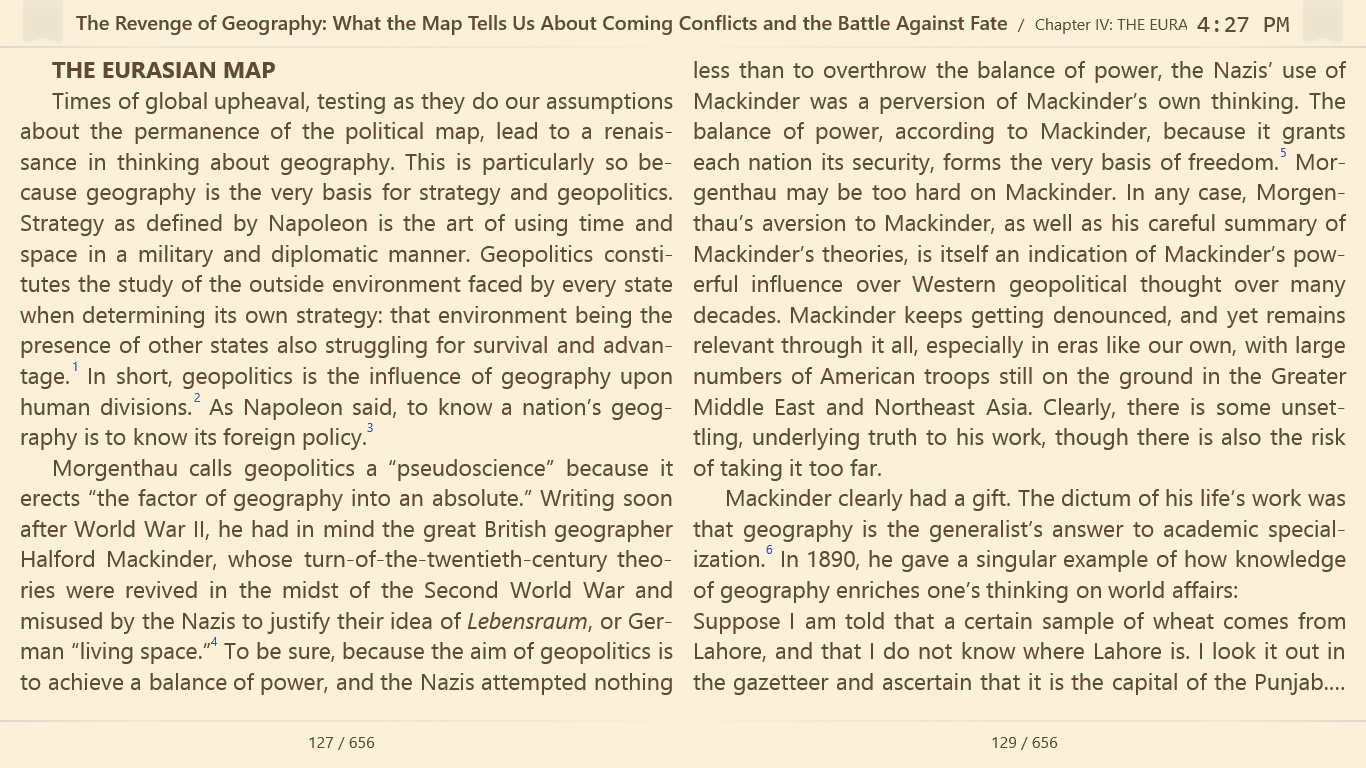
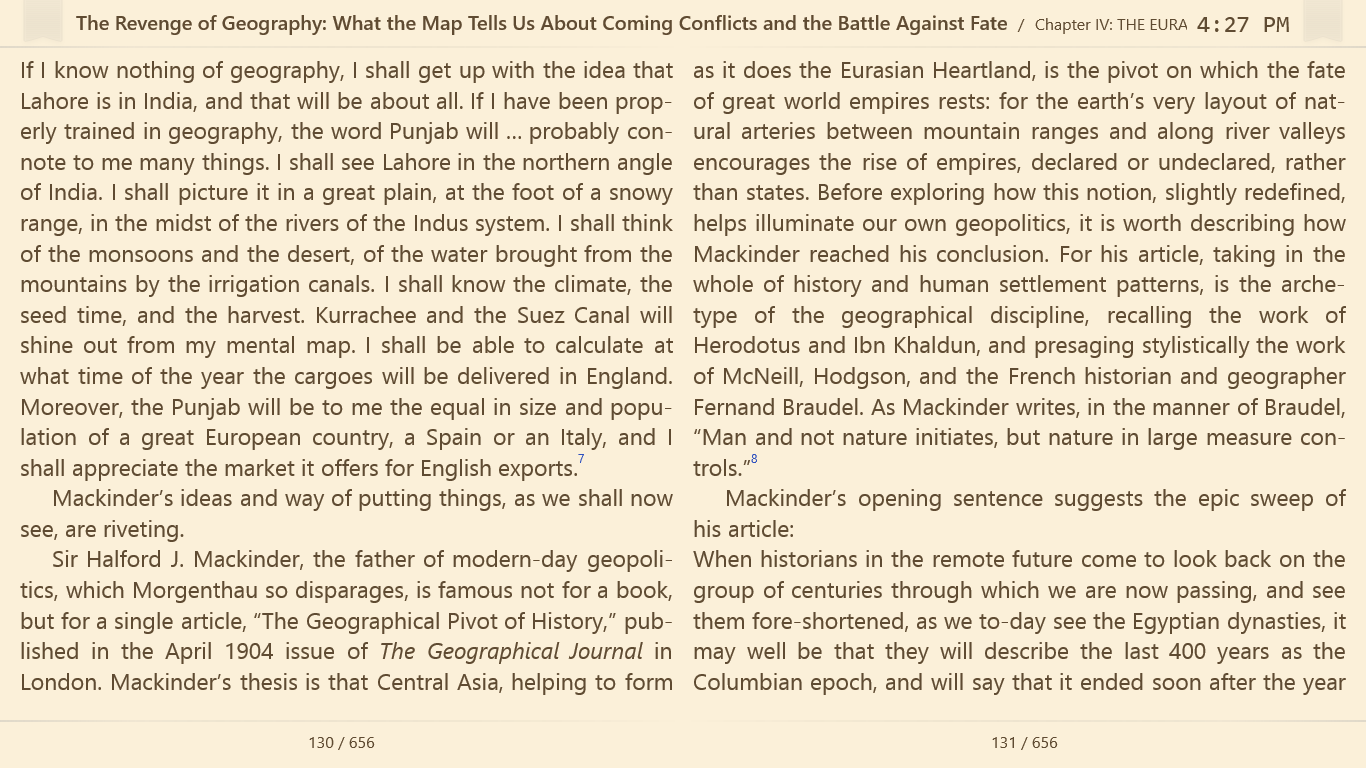
The wonderful story given by the demi-god Mackinder on Lahore is the last paragraph of the top page and continues on. Oh and by the way Russia is not a European power but a North Asian one.

Jab We Met: Encounters between Islam and Hinduism in Early-Medieval Punjab

Yesterday, I posted a piece on my blog (http://barbarikon.blogspot.com) that may be of interest to readers on Brown Pundits as well. So, at Zach’s suggestion, I am posting it here as well.

If the exhortation to pity the nation that forgets is own
history is taken seriously, few nations are more pitiable than Pakistan today.
Occupying one of the most historically rich pieces of land on the
planet, modern Pakistanis go about their business oblivious to the echoes of
the past that swirl all around them and the layers of history that lie buried
under their feet. And more’s the pity for a better understanding of this
historical past could explain a lot of the present and its problems, and
perhaps even help solve them.
One of the most interesting and least understood periods in
the history of the region is the time between 711 CE and 1200 CE, i.e., from
the time when the first Arab conquerors under Muhammad bin Qasim established
the so-called Emirate of Sind to the end of Ghaznavid rule in Punjab. One
reason why this period is of special significance is that it represents the
first extended encounter between Islam and the religious traditions of India,
notably Hinduism (Buddhism too, but more on that another time). Given how the
interaction and conflict between these two traditions has shaped – and
continues to shape – the history of the region, looking back to the earliest
encounters is especially important.
Though not studied as intensely as some other periods, the
history of the early medieval period in Northwestern India has attracted its
share of scholarship, from the contemporary writings of Al-Biruni,
Al-Maqdisi
and Ibn Hawqal to the
work of modern historians such as Romilla Thapar1,
Finbarr Flood2,3
and Derryl MacLean4.
These works describe a fascinating process of interaction, integration and
antagonism between two great cultures in an ancient land. In this piece, I will
only consider a narrow but interesting set of issues, motivated, as often, by a
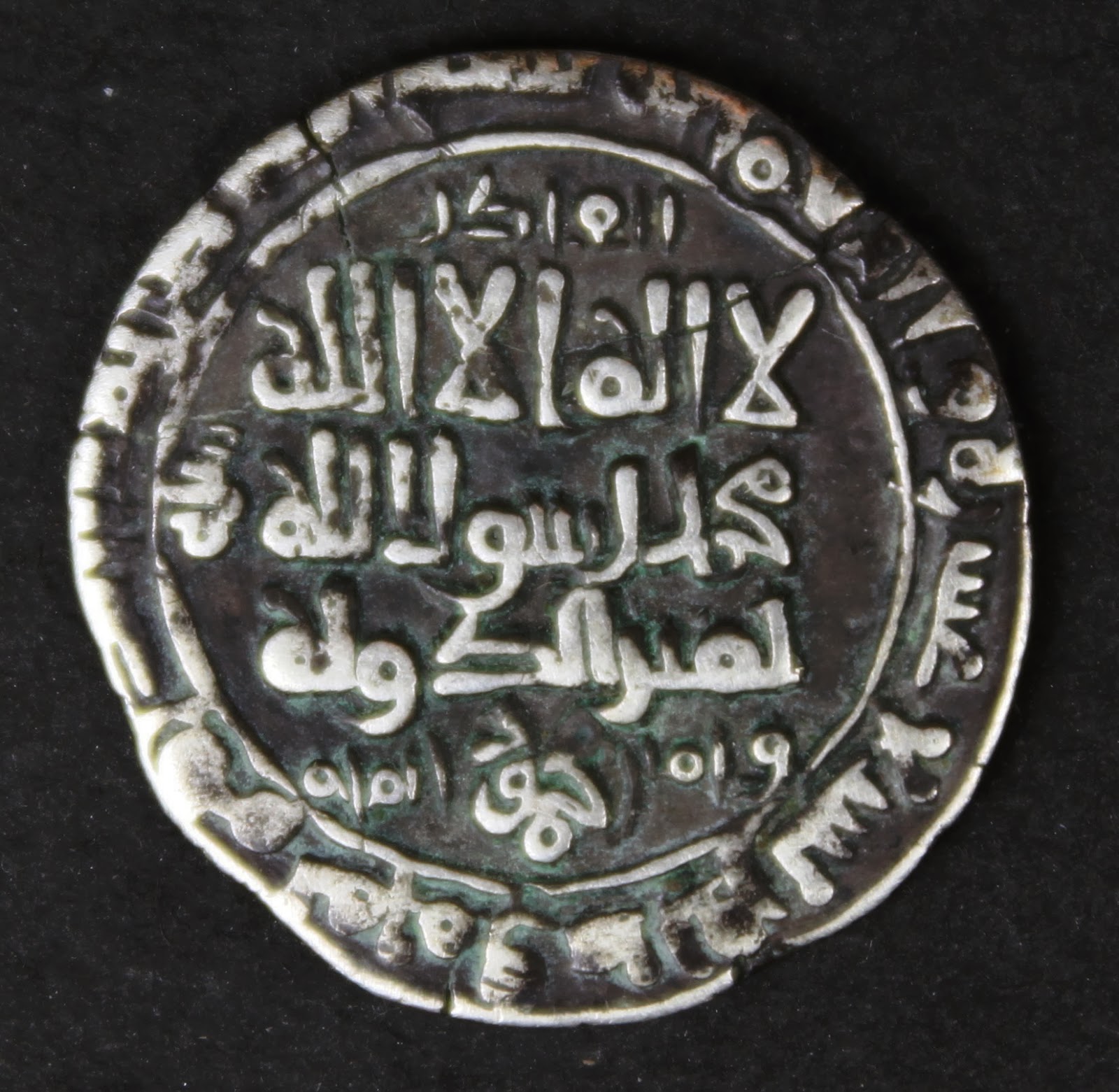
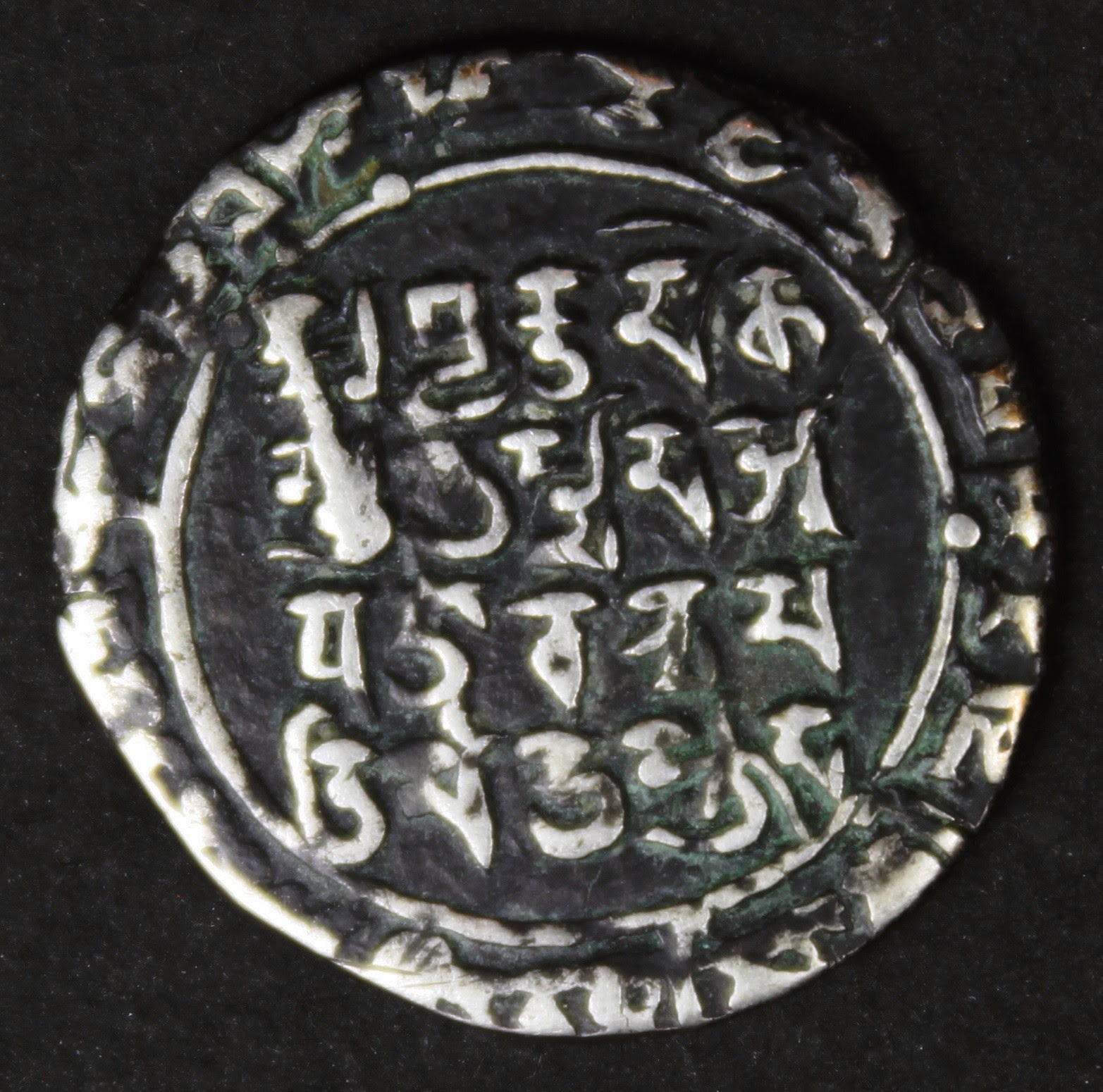
coin in my collection – a bilingual
Ghaznavid dirham
circa. 1128 CE, shown below.
                                            

The silver coin was minted in the name of the greatest ruler
of the Ghaznavid dynasty, Mahmud, who is famous – at least in South Asia – for
his repeated attacks on India and his destruction of the great temple at
Somnath in 1024. While his attacks ranged over large parts of northern India,
Mahmud annexed only regions that lie in modern Pakistan. The coin was struck in
419 AH (1028 CE) at Lahore, which was then known as Mahmudpur – itself an
interesting bit of historical information (the name “Mahmudpur” can be read
clearly in the margin of the image on top at the 6 o’clock position). The
complete inscription in the margin reads (as far as I can reconstruct it from
this and other similar coins): bismillāh
zuriba hādha-al dirham mahmudpur tis’a ‘ashra wa arba’ mi’ah
(In the name
of Allah. This dirham struck at Mahmudpur 419). The central text on this side
of the coin reads: lā-ilāha ill-allāh /
muhammad rasūl-ullāh / yamīn-ud dawlah / wa amīn-ul millah Mahmud
(There is
no God but Allah / Muhammad is His messenger / protector of the state / and
custodian of the community Mahmud). The inscriptions at the 12 o’clock and 9
o’clock positions together read al-qādir
billah
, which was the name of the Abbasid caliph in Baghdad, to whom Mahmud
nominally professed allegiance (more on this below).
Even more interesting is the reverse side of the coin, shown
on the bottom. The text is in Sanskrit, written using the Sharada script, which was
used throughout the region at the time and is the ancestor of the Gurmukhi and
Kashmiri scripts. The text in the margin declares that the “tanka” – the Indian
equivalent of the dirham – was struck in Mahmudpur on the given date, but it is
the central inscription that is most interesting. The text reads: avyaktam ekaṃ, muhamadaḥ avatāraḥ, nrpatiḥ
mahamudah
. This translates as: The
Invisible is one; Muhammad is His manifestation (avatar); Mahmud is the king
.
The margin also has a Sanskrit translation of the statement about the mint and
date, including the Arabic bismillāh
(in the name of Allah) translated as avyaktīya
nāme
(in the name of the Invisible). I rely on the reading reported by Flood
in Objects
of Translation: Material Culture and Medieval “Hindu-Muslim” Encounter3
(with
citations to several other works),  but
also given by Thapar in Somnatha:
The Many Voices of History
1, and other
sources, such as the entry for coin number 39207 in
the Zeno Oriental Coins database and CoinIndia.
This inscription, which is the first known “official”
translation of the Muslim declaration of the creed (shahada) into Sanskrit, is
interesting for three reasons. First, the very fact of putting a Sanskrit
version of the shahada on a coin signals a certain outreach to the conquered
Hindu population. After all, they were the only ones who would be expected to
read the Sanskrit version. Perhaps there was also an element of proselytization
in the move, trying to acquaint Hindus with the basis of Muslim belief. In any
case, it was a remarkable acknowledgement of the need to communicate across communal
lines. Second, the exclusive Islamic declaration, “There is no God but Allah”
is translated as “The Invisible is one” (or sometimes as “the Unmanifest is
one”), which excludes nothing. Indeed, it is best read as an affirmative
statement declaring the unity of all that is ineffable and immaterial – the
great world spirit, so to speak. For Hindus who believed in the undefinable,
unchangeable reality – Brahman – at the core of everything, this would not have
been a stretch at all. This is especially so if
MacLean is correct
and the major form of Hinduism prevalent in the area was
Pasupata Saivism with
its strongly monotheistic beliefs. Finally, the most remarkable aspect of the
translation is the declaration that the Prophet Muhammad is a manifestation
(avatar) of God – not a messenger, as Muslims believe.  From an orthodox Islamic viewpoint, this is a
heretical statement, but there it was on the coins of that most pious protector
of Islamic orthodoxy, Mahmud “the idol-breaker”!
It is worth noting that, as far as is known, these bilingual
coins were issued only at Lahore, and only for two years (418 and 419 AH). In
an end note, Flood
(p. 279) quotes Tye
and Tye 5
, as suggesting that these might have been fiduciary
coins for local use. Nevertheless, given the importance of Lahore to the empire
– it was virtually a joint capital with Ghazni – and the fact that in 1028
(when the coins were issued), it
was governed by Mahmud’s hand-picked governor
, Malik Ayaz (of Mahmud-o-Ayaz
fame), the issuance of the bilingual coins and the text of the Sanskrit inscription
cannot be dismissed as an anomaly. Clearly, there was an explicit and official
attempt to reach across the communal divide, not only in form but also in ideas
– perhaps to promote a version of the Islamic creed that would win greater
acceptance among the Hindu populace. Nor was this the only such example.
Mahmud’s son, Mas’ud I, also issued coins depicting
Hindu iconography
, including an image of Nandi, the bull of Shiva, which
had been a prevalent motif in the Hindu Shahi coinage before the Ghaznavids.
Indeed, these Hindu
motifs continued to be used on Ghaznavid coins
by Mahmud’s successors in
clear contravention of the orthodox Islamic proscription against images. Some coins also used Sharada
inscriptions naming the king
and occasionally invoking Hindu deities. These
iconographic practices persisted
into the Ghorid dynasty as well.
But the history of bilingual coinage and syncretism between
Islam and Hinduism in the region goes back somewhat further, and has some ironic
twists.
As far as is known, the first bilingual coins by any Muslim
rulers in India were struck in Multan by the Sāmid Amirs who reigned there in
the 10th century. Multan was then the capital of what is sometimes
called “Northern Sindh”. After the initial Arab conquest in 711, Sindh was
rules by a succession
of governors
appointed by the Umayyad administration, and then by the
Abbasids after they took over in 750 CE. However, the hold of the caliphate on
Sind became increasingly tenuous, and by the early tenth century, the region
had split into a southern part, ruled from Mansurah by descendants of ‘Umar bin
‘Abd-ul-‘Aziz al-Habbāri
, and a northern part, ruled from Multan by the
descendants of Sāmah bin Lu’ayy
. Both dynasties were of Qurayshi Arab
origin, and professed nominal allegiance to the Abbasid caliph in Baghdad.
Multan, at the time, was famous for its magnificent Sun Temple, which was a
major center of Hindu pilgrimage. The Sāmid rulers seem to have supported the
temple and a tolerant, perhaps syncretic version of Islam. However, sometime in
the mid-tenth century, the rulers of Multan converted to Ismai’ili Islam, and
transferred their allegiance from the Abbasids to the Fatimid caliph in Cairo,
who was also the Isma’ili imam. Initially, the Isma’ili religious leadership in
Multan appears to have continued on a tolerant course, but this aroused the
wrath of the Fatimid Caliph, Al-Mu’izz, who sent a new preacher (dā’i), Jalam
bin Shayban
, insisting that the Isma’ili Amir of Multan purify the local
religious practice (per Isma’ili doctrine, of course), and end support of “idol
worship”. In a famous incident, the Caliph, hearing that a major local idol had
been destroyed by the new preacher, asked that the head be sent to him as proof
of destruction. It has been believed, on the authority of Al-Biruni, no less,
that this refers to the destruction of the Sun Temple and its idol, but other
evidence, summarized by MacLean, suggests
that it was probably another, lesser idol. Nevertheless, it is ironic that the
first recorded instance in Punjab of systematic idol-breaking in the name of
Islamic purity came from Isma’ilis rather than orthodox Sunnis. A second irony
is that it was the Isma’ili presence in Multan that attracted the most famous
of “idol-breakers”, Mahmud, to attack
Multan in 1010 CE
, depose its Isma’ili ruler whom he regarded as an
apostate, and annex the province into the Ghaznavid empire. Apart from
his religious objections, Mahmud may also have been motivated to punish
the rulers of Multan for transferring their allegiance away from the
Abbasid caliph, to whom Mahmud pledged nominal fealty.
 

The bilingual coins are thought to be from the early
Isma’ili period Multan around
965 CE
. As shown in the examples from my collection (above), the text on
these very small coins is usually hard to read. However, one side had the name
of the ruler in Arabic (left panel) while the other often had a Sanskrit word,
written in the Sharada script, with Hindu religious significance (right panel).
According to Flood3,
four distinct Sanskrit inscriptions have been identified – two referring to
Vishnu, one to Lakshmi, and the fourth to “Madhumadi”, which is regarded as the
Sanskritized version of “Muhammad” (also used elsewhere in India at the time). If
this is true, the coins represent an attempt to insert the Prophet of Islam
into the Hindu pantheon. Perhaps it was such practices that raised the ire of
al-Mu’izz and motivated him to send a “purifier”.
To summarize the sequential ironies of the situation: First,
Isma’ili Muslim rulers in Multan attempted to create a syncretic culture among
the Hindus and Muslims of their emirate; then they were chastised by an
Isma’ili Caliph in Egypt who ordered them to destroy idols and temples – which
they did; but their Isma’ili faith was still seen as heretical by the pious
Sunni king, Mahmud, who invaded and annexed their kingdom; and then, Mahmud’s
own hand-picked governor in the region made another similar effort at syncretic
outreach, minting coins with statements that orthodox Muslims would have
regarded as heretical – but only in Sanskrit!
History is a lot more complicated than we think!
References:

1.       R. Thapar (2005) Somanatha: The Many Voices of a History. Verso.

2.        F.B. Flood (2011) Conflict and Cosmopolitanism
in “Arab” Sind. In: A Companion to Asian
Art and Architecture
, R.M. Brown & D.S. Hutton (eds), pp 365-397. Blackwell.

3.      
F.B. Flood (2009) Objects of Translation: Material Culture and Medieval
“Hindu-Muslim” Encounter
. Princeton University Press.

4.        D.N. McLean (1989) Religion and Society in Arab Sind, Brill.

5.        J. Tye and M. Tye (1995) Jitals: A Catalogue and Account of the Coin Denomination of Daily Use
in Medieval Afghanistan and North West India
. John Tye.

The global face of Islam

More Muslims live in India & Pakistan than all of Mideast & N Africa.

It seems Islam has really grown in the last decade, for some reason I’d always there were around a billion Muslims but it seems I was off by a fair margin. Global Religions:
Religion Adherents
Christianity 2.1 billion
Islam 1.6 billion
Secular*/Nonreligious*/Agnostic/Atheist ≤ 1.1 billion
Hinduism billion
Chinese traditional religion* 394 million
Buddhism* 376 million
Ethnic religions excluding some in seperate categories 300 million
African traditional religions 100 million
Sikhism 23 million
Juche* 19 million
Spiritism 15 million
Judaism 14 million
Bahá’í 7 million
Jainism 4.2 million
Shinto 4 million
Cao Dai 4 million
Zoroastrianism 2.6 million
Tenrikyo 2 million
Neo-Paganism 1 million
Unitarian Universalism 800,000
Rastafarianism 600,000
Scientology 500,000
Brown Pundits