“Vanguards of Khorasan”

…..Khorasan historical region….northeastern  Iran, southern Turkmenistan, northern  Afghanistan…. established by the Sasanian dynasty, the last Iranian empire before the rise of Islam, in the 3rd century….”The Land of the
Sun,” a reference to its eastern location…..

 …
These days people are engaged in branding exercises in order to foster some or other group identity.  
The trick is to build up a platform that has some basis in culture and in history and try to shoe-horn your agenda in a manner that makes it acceptable to a substantial fraction of elites and sub-alterns.

As an example consider the two principal sub-continental politico-social-cultural brands: Hindutva and Islam. For the record, we are not a fan of either brand because we consider religion to be a divisive force and that in our opinion it should be banished from the public square.

What is the Hindutva agenda and how is it helpful towards brand building? Take a specific example:  the movement to protect cows (and as an extension promote vegetarianism). The cow occupies a special place in the Hindu pantheon, especially the association with Krishna and the Yadava clan (even in modern day Mumbai the milk supply chain management in our colony as well as many others is a Yadava monopoly).

For the recent Lok Sabha polls Amit Shah deployed this save the cows strategy to weaken the Muslim-Yadava alliance in Bihar. Perhaps due to this (as well as many other factors), Lalu Yadav lost, big time (he is back on his feet again, having set up a grand alliance with Nitish Kumar and the Congress).
….
It is surprising (to us) how potent the humble cow is, as a symbol. The liberal-lefties sneer at such “backward sentimentality,” claiming (with some justification) that ancient Vedic people used to relish eating cows (and horses and many other animals).  

As is usual, in their arrogance, the liberals miss the wood for the trees. The point is that Hinduism has evolved, many violent practices like sacrificing bulls and goats is now frowned upon. This year, a major theme in Kolkata is a non-violent Durga. According to devotees, the slaying of the Mahish-asura is merely symbolic, what counts is the killing of the demons within us.

Such symbolism allows Hinduism to build bridges within the fold (with Vaishnavites) and without (with Jains) and this evolution contributes to the endurance of Hinduism as a philosophy even in the age of democracy.  

Shiva and Parvati are not Vedic gods, let alone the idol of the sub-alterns – Kali. Yet, they have been brought within the fold and now a majority are followers of the power couple (and their son Ganesha).

Not eating cows (and vegetarianism) is also frequency wise well matched with the modern day religion of environmentalism. There is yet no vegetarian culture as deep rooted and mass based anywhere else in the world. Without becoming as austere as the Jains (even roots and tubers are forbidden), Hinduism is the next best house for vegetarians.

Politically, also cow protection is good for branding because the main competitor (Islam) has little to say (doctrinally or otherwise) about vegetarianism (even though there are muslim vegetarians…in India). If we were a Hindutva brand manager we would run a high-profile campaign on pig protection as well – after all one of the ten avatars of Vishnu is the Varaha – but the situation here is a bit complicated.  Muslims do not eat pigs because they are sacred, the consideration is that pigs are “unclean” (and so are dogs).

Still a campaign on the basis of vegetarianism can help unite a large section of Hindus and non-Hindus, elites and the masses. Even committed irreligious, non-vegetarians like ourselves may not object to a less-meat and eventually meat-less society (from a sustainability standpoint). After all there is a proposal to have meat less Mondays in the USA (and being fiercely opposed by Big Food). There is every indication that vegetarianism will become mainstream in the next few decades in the West.

When it comes to Islam there is one solid advantage and one strong disadvantage. Islam dictates that we are all equal before Allah, hence no to caste system and it forbids idolatry, now enforced much more strictly than in the past. Unfortunately, muslims in South Asia have not been able to leave the bounds of caste, Ashrafs (like other elites) continue to impose the 80:20 rule. Also, Indians are strongly in favor of idolatry, this includes Sikhs and Buddhists (where idolatry is doctrinally forbidden). After six decades of partition it may be easier for Pakistanis (less so for Bangladeshis and even less for Indian muslims) to bury the vestiges of a culture replete with references to idolatry.

For these reasons above we feel that while Brown Muslim is a powerful brand, it will gain momentum in the sub-continent only when Pakistan and Bangladesh agree to create a social, economic and cultural union (political re-union may not be possible or necessary). The key compromise is that Bangla and Urdu are to be`placed on an equal footing. Our opinion is that it will take many decades before Punjabis agree to this (but we may be wrong).

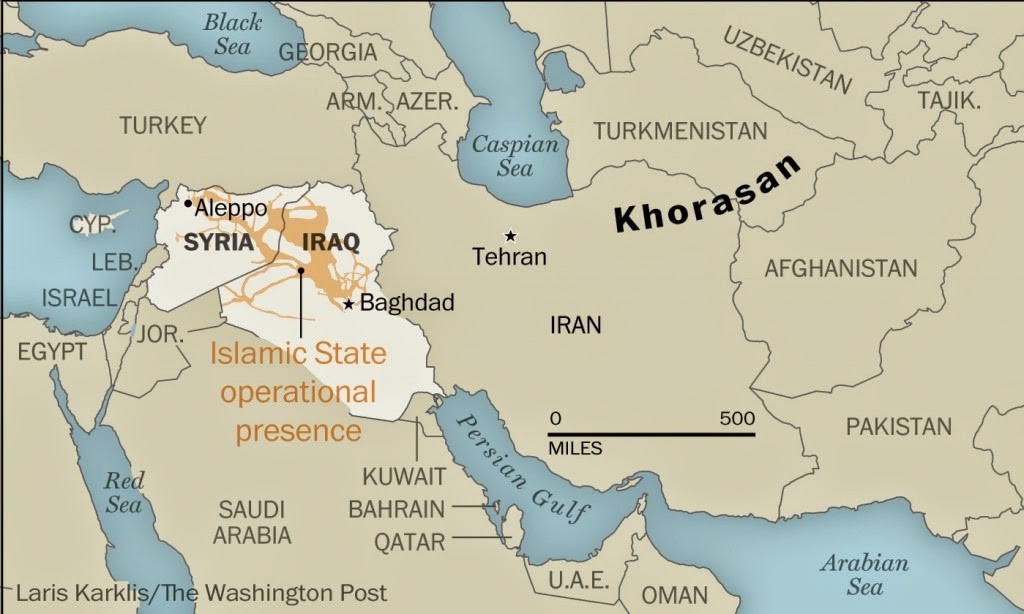
Moving away from South Asia we now focus on the age-old Khorasan brand and its implications for the Middle East. From the Washington Post we have this:

After the region was taken over in an Arab
conquest in the 7th century, Khorasan became a part of the Umayyad
Caliphate, and with that, part of early Islamic culture. Notably, a widely
discussed (though
disputed) Hadith speaks of how “black banners will come out of
Khorasan” in the end times. Will McCants of the Brookings Institute notes
that the prophecies derive from the 8th century Abbasid revolution,
a
revolution that began in Khorasan and saw the end of the privileging of
Arabs over non-Arabs in the Islamic empire

As an outsider we remain puzzled by this move. The Caliphate Brand has proven to be highly successful, people from the world over are joining the ranks of the Daesh. If anything the Khorasan brand will dilute the appeal of the Caliphate and will also highlight the reality of non-Arab cliques. Will the dominant Arabs tolerate such brand dilution?

OTOH it may well be the case that with a diversified brand (much like sister companies) there will be greater buy-in from the common people (who may not be all Arabs, now and in the future). Such a step may prove to be helpful in recruiting warrior men (and women devoted to such men) from Greater Khorasan. Only time will tell if  this is a net positive for the Islamist brand.
….

What’s in a name? When you’re an Islamist extremist group believed to
pose an existential threat to the Western world, everything. In the past few
months, we’ve seen the strange and somewhat revealing saga of what to call the
group alternatively referred to
as ISIS, ISIL, the Islamic State and Daesh.


Now, within a timeframe of just days, the Islamic State has been sidelined
by a new name in the world of Islamic extremism: “Khorasan.”
U.S. officials say that Khorasan, often referred to as “the Khorasan
group,” is a small al-Qaeda linked outfit operating in Syria.
They are portrayed as a more direct threat to U.S. interests than the Islamic
State, which is still largely focused on operations in Syria and Iraq.
U.S. officials say that their strikes against Khorasan appear to have been a
success, killing the group’s leader, Mushin al-Fadhli. 


However, some
analysts are perturbed by the lack of information about the group and why it
was targeted. Even an examination of one of the most basic elements of the
group – its name – paints a complicated and inconclusive picture of
what the group actually is, and why it is being targeted.


As most reports on the group have noted, Khorasan refers to a
historical region that encompassed northeastern Iran,
southern Turkmenistan and northern Afghanistan. It was established as
a region by
the Sasanian dynasty, the last Iranian empire before the rise of
Islam, at some point in the 3rd century. Its name literally means “The
Land of the Sun,” a reference to its eastern location.


After the region was taken over in an Arab conquest in the 7th century,
Khorasan became a part of the Umayyad Caliphate, and with that, part of
early Islamic culture. Notably, a widely discussed (though
disputed) Hadith speaks of how “black banners will come out of
Khorasan” in the end times.


Will McCants of the Brookings Institute notes
that the prophecies derive from the 8th century Abbasid revolution, a
revolution that began in Khorasan and saw the end of the privileging of
Arabs over non-Arabs in the Islamic empire.


Over the years, the Khorasan region had a fractious history, and
was eventually swallowed up by a variety of different states. A part of
Khorasan eventually became Khorasan state in modern Iran, and “Greater
Khorasan” is generally used to refer to the larger historical region.

In part due to its place in Islamic history, the term Khorasan is used by
modern Jihadist groups, especially those based outside Arab states. 


The
online magazine of al-Qaeda in Afghanistan is called “Vanguards of
Khorasan,” for example, and J.M. Berger, an independent terror analyst,
says that al-Qaeda has often signed its communiques as emanating from Khorasan
over the years.


“Jihadists deny the legitimacy of most modern nation states; they
prefer using historical terms, typically the ones that were used during the
time of the great Caliphates
(which is obviously what they want to go back
to),” Peter Neumann, director of the International Centre for the
Study of Radicalization, explained in an e-mail.

..
In particular, the hadith mention gives the reference added
power. “The symbology of this has been important for jihadis since
the so-called black banners being raised in Afghanistan, which is part of
Khorasan, in the ’80s against the Soviets until now,”
 Aaron Zelin of
the Washington Institute for Near East Policy
said, adding that Islamic apocalyptic literature has
become a central theme for some jihadist groups fighting in the Middle East.

….

Link: washingtonpost.com/khorasan

regards

Silk Sense

….concept of a historic Silk Road by which camel
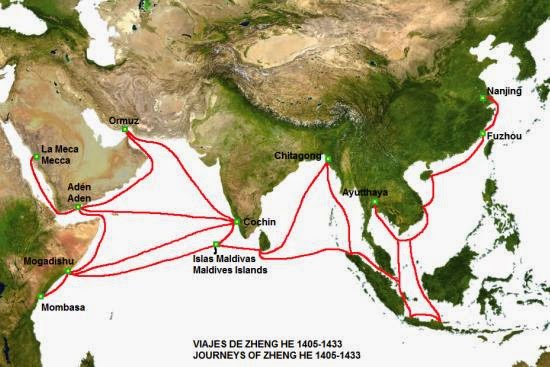
caravans wend among the mountains and deserts of Central Asia ….re-establishing maritime networks…Chinese Admiral Zheng He…naval armada across
the Indian Ocean…..China’s leaders promote ancient
trade routes…emphasize role as a harbinger of peace and prosperity.
….minor problem….history is distorted….
….
Who is Professor Sen?…Prof Amartya Kumar Sen of Shanti-niketan, Delhi School of Economics, Cambridge and Harvard represents the old guard in his (sincere) attempts to bring South Asian Hindus and Muslims together. Now is the age of Hindi-Chini shadow boxing, and the man who is best informed about the thought processes of our Chinese overlords is Prof Tansen Sen of Peking University, University of Pennsylvania and Baruch College.
….

…..
Tansen Sen is the author of Buddhism, Diplomacy, and Trade: The Realignment of Sino-Indian Relations, 600-1400 (University of Hawai’i Press, 2003) and co-author (with Victor H. Mair) of Traditional China in Asian and World History (Association for Asian Studies, 2012). 

He has edited Buddhism Across Asia: Networks of Material, Cultural and Intellectual Exchange (Institute of Southeast Asian Studies, 2014) and guest-edited special issues of China Report (“Kolkata
and China,” December 2007
; and “Studies on India-China Interactions
Dedicated to Ji Xianlin,” 2012).
With Wang Bangwei he has co-edited India and China: Interactions through Buddhism and Diplomacy: A Collection of Essays by Professor Prabodh Chandra Bagchi (Anthem Press, 2011).

….

While the scholarship is impressive, we confess to be charmed by the name Tansen Sen.  

We presume that the good prof is named after [ref. Wiki] Mian Tansen (born 1493 or 1506 as Ramtanu Pandey – died 1586 or
1589 as Tansen) a prominent Hindustani classical music composer,
musician and vocalist….He was among the Navaratnas (nine jewels) at the court of the Mughal Emperor Jalal ud-din Akbar. Akbar gave him the title Mian, an honorific, meaning learned man.…It was only after the age of 5 that Tansen showed any musical talent….he was a disciple of Swami Haridas, the legendary composer from Vrindavan and part of the stellar Gwalior court of Raja Man Singh Tomar (1486–1516 AD), specializing in the Dhrupad
style of singing. His talent was recognised early and it was the ruler
of Gwalior who conferred upon the maestro the honorific title ‘Tansen’.

……

The romantic concept of a historic Silk Road by which camel
caravans wend among the mountains and deserts of Central Asia is back in
the news. So is talk on re-establishing the maritime networks by
which the Chinese Admiral Zheng He steered his naval armada across
the Indian Ocean seven times. China’s leaders promote the ancient
trade routes, most recently during the Chinese President Xi Jinping’s
visits to countries in Central and South Asia, to emphasize the
nation’s historic role as a harbinger of peace and prosperity.


One minor problem in China’s history-based campaign— the history is distorted. In September 2013, less than a year after assuming the position of
general secretary of the Central Committee of the Communist Party of
China, Xi launched new foreign policy initiative known as the “Silk
Road Economic Belt.”  


In an address at Kazakhstan’s Nazarbayev
University, calling for cooperation and development of the Eurasian
region through this new Silk Road initiative, Xi presented five
specific goals: strengthening of economic collaboration, improvement
of road connectivity, promotion of trade and investment, facilitation
of currency conversion, and bolstering of people-to-people
exchanges.


….
A month later, at the 16th ASEAN-China Summit held in Brunei, Chinese
Premier Li Keqiang proposed the building of a 21st century “Maritime
Silk Road” to jointly foster maritime cooperation, connectivity,
scientific and environmental research, and fishery activities. A few
days later, in his address to the Indonesian Parliament Xi confirmed
this idea and stated that China would devote funds to “vigorously
develop maritime partnership in a joint effort to build the Maritime
Silk Road of the 21st century,” stretching from coastal China to the
Mediterranean Sea.


In both speeches, Xi underscored China’s historical linkages with the
respective regions and suggested that his proposals were intended to
reestablish ancient friendly ties in a modern, globalized world. In
Kazakhstan, Xi credited the Western Han envoy Zhang Qian with
“shouldering the mission of peace and friendship” and opening up the
door for east-west communication and establishing the “Silk Road.” In
Indonesia, he praised the Ming dynasty Admiral Zheng He for
bequeathing “nice stories of friendly exchanges between the Chinese
and Indonesian peoples.”


Not mentioned, however, are the backdrops of conflict and the push to
spread a Sinocentric world order. In trying to portray the past as a
utopian epoch, the purpose of Zhang Qian’s mission
to the so-called Western Regions was misrepresented. The Han emperor
dispatched Zhang to find an ally to fight the powerful Xiongnu
Confederacy, the leading adversary of the Western Han Empire. 

….
Because of
its expansionist policies, the Han Empire was responsible for
transforming the originally nomadic Xiongnu people into a semi-state
entity that offered resistance to the Han forces. In 138 BCE the
empire sent Zhang to Central Asia to locate the Yuezhi people,
previously routed by the Xiongnus. His mission was a failure,
however, as he was captured by the Xiongnu and forced to marry a
local woman. Escaping after 10 years of captivity, he found that the
Yuezhi were not interested in a military alliance. Zhang Qian’s only
contribution was to inform the Han court about the polities and
people in Central Asia. 


Similarly, the portrayal of Admiral Zheng He
as an agent of peace and friendship is problematic. In reality,
Zheng’s seven expeditions between 1405 and 1433 included use of military
force in what are present-day Indonesia, Malaysia, Sri Lanka and
India to install friendly rulers and control strategic chokepoints of
the Indian Ocean. He intervened in dynastic politics of Sri Lanka
and Indonesia and brought back prisoners to Nanjing, the Ming
capital. 


Ming Emperor Yongle originally dispatched Zheng to the
Western seas to look for his nephew whom he had deposed from the
throne and to promote the virtues of the Chinese civilization. In the
course of these expeditions, Zheng brought back many kings and
princes to kowtow to the emperor and exchange gifts. The voyages were
abandoned when it turned out to be too expensive and gave excessive
power, in the view of the Confucian court officials, to eunuchs such as
Zheng He.


….
The Han Empire used similar tactics in Central Asia, especially at
strategic locations of the trade routes. Thus neither the overland
route nor the maritime channels, termed collectively as the Silk
Routes, were peaceful or fostered friendly exchanges through Chinese
presence, as modern narratives would suggest.   


There is also a problem with the term “Silk Road” or “Silk Routes.”
German geographer Ferdinand von Richthofen coined the term in 1877 for
the ancient overland trade route through Central Asia.


Since then,
many routes that linked China to the outside world have been called
“Silk Roads” or “Silk Routes” despite the fact that silk was neither
the earliest nor the most commonly traded commodity on any of these
routes. Additionally, the term, enthusiastically employed by Chinese
scholars, places unwarranted emphasis on the role of China in
pre-modern intra-regional interactions. 


This comes at the expense of
neglecting external influence on Chinese societies and economies
throughout the past 2000 years.


Perhaps, like many Chinese, Xi’s views about the Silk Roads were
shaped by the PRC educational system that prevents critical analysis
and proper deconstruction of historical sources. It’s also possible
that Xi was genuinely influenced by the fact that his family hails
from near the ancient Chinese capital Xi’an, known in history as
Chang’an, a place recognized in history books as the starting point
of the overland Silk Road.
Either the president is unaware of the
negative reactions that use of Chinese cultural symbolism in the
arena of foreign policy induce among some foreign states or is
adamant about pushing these through with the economic muscle China has
toned over the past several decades.


Several countries are willing to accept these distorted historical narratives for economic reasons.

The Sri Lankan government, for example, last year received a
gold-plated statue of Zheng
as a gift from China’s International Tour
Management Association. The two sides declared that Zheng He and his
expeditions represented ancient commercial and peaceful relations
between China and Sri Lanka. Neglected were the details that Zheng
had instituted regime change in the region; abducted a local ruler,
Alaskawera; and brought him to Nanjing as a prisoner. Zheng also
carried off the famous Tooth Relic of the Buddha at Kandy, long a
symbol of Sri Lankan political sovereignty.


Military conflict also took place in Indonesia, where some local
newspapers applauded Xi’s proposals noting that they could bring
“enormous opportunities for regional development.” Not of concern was
the fact that in Sumatra, in 1407, Zheng had instituted a regime
change
by abducting a local ethnic Chinese leader named Chen Zuyi,
whom the Ming court portrayed as a pirate. After Chen was publicly
executed in Nanjing, he was replaced by a person representing the
Ming court’s interest in the region. In the same year, Zheng also
intervened in the internal affairs of the Majapahit polity in Java,
seemingly to weaken the main regional power in Southeast Asia. 


These military interventions like those in others regions that used
the pretext of ushering in a harmonious world order under the Chinese
Son of Heaven were objectives of the Zheng He expeditions. 


The Silk Roads initiative of the Chinese government, with substantial
influx of money and investment, could boost the economies of several
countries in Asia and Europe that are willing to claim ancient links
to the Middle Kingdom. For China, the success of the initiative will
open new avenues for investing its vast monetary reserves. 


It will
also mark a major step towards recreating the Chinese world order of
the ancient times known as tianxia, that is, all regions of
the known world that belonged to the heavenly-mandated emperor of
China. This new world order will not be simply rhetorical, but could
impose significant geopolitical implications.
        

….


Sources:

Nicola Di Cosmo, Ancient China and Its Enemies: The Rise of Nomadic Power in East Asian History. Cambridge: Cambridge University Press, 2002. 

Edward L. Dreyer, Zheng He: China and the Oceans in the Early Ming, 1405–1433. New York: Longman, 2007.

Étienne de la Vaissière, Sogdian Traders: A History. Leiden: Brill, 2005.

Louise Levathes, When China Ruled the Seas: The Treasure Fleet of the Dragon Throne, 1405-1433. New York: Oxford University Press, 1994.

Tansen Sen, “Changing Regimes: Two Episodes of Chinese Military
Interventions in Medieval South Asia.” In Upinder Singh and Parul P.
Dhar (Ed.), Asian Encounters: Exploring Connected Histories. New Delhi: Oxford University Press, forthcoming.


Geoff Wade, “Ming China’s Violence against Neighbouring Polities and
Its Representations in Chinese Historiography.” In Upinder Singh and
Parul P. Dhar (Ed.), Asian Encounters: Exploring Connected Histories. New Delhi: Oxford University Press, forthcoming.

….

Link: outlookindia.com

regards

Brown Pundits