 A journalist associated with NPR made some prejudiced comments about Hinduism, and she is probably going to get in trouble. By the name, her background is that of a South Asian Muslim.
One of my immediate reactions is that this sort of comment about Hinduism is very common among South Asian Muslims. Growing up people would joke about Hindus drinking piss and obsessing over cow dung all the time. This is a widespread private comment, and this woman’s mask just dropped in public.
But, there is another aspect that emerged in discussion with a Hindu reader of this blog: the Muslims making these sort of jokes were not the very pious, but the more liberal and secular sort. Extremely religious Muslims did not talk about Hinduism in jocular terms, because they feared Hinduism.
This actually goes back something foundational in the Abrahamic religions, and that is the Hebrew suspicion and fear of foreign gods. Note that in the Hebrew Bible the Israelites repeatedly turned away from Jehovah, and sacrificed to the gods of the Canaanites. These religions and cults were tempting. The original Hebrews were clearly henotheistic, not monotheistic in a deep metaphysical sense. They did not reject the existence of other gods but were devoted to a particular god, their own tribal god.
In the Greco-Roman period, Jewish and Christian thought took the next step: they demonized the gods who were not their God. When I say they demonized the gods who were not their God, I mean demonized in a literal sense. The early Christians believed that the pagans worshipped demons, who were deceiving humans as to their true nature. These religions were not false religions because people worshipped the non-existent, but because they worshipped evil or deceptive beings who were not the true God.
There are still Christians who hold to the old ways. Some evangelical Protestants believe they are in a spiritual “war” with devils who are all around us. Which brings me to Calvinism. There is a line of argumentation that John Calvin and his heirs “rationalized” Christianity to such an extent that they drained the demons and supernatural from the universe. They were atheists and materialists except for the exception of their one God and his retinue. This was a sharp break with the older Christian tradition, whereby the gods of other religions were false gods, but real gods (after a fashion).
I don’t know what I think about this argument, though it seems plausible. But, the sort of Muslim who makes fun of Hindus has been shaped by this way of thinking. They do not fear Hinduism. They do not think that Hindus believe in anything real. Their gods are no-gods. In contrast, many devout Muslims believe Hindus worship devils.

 Another BP Podcast is up. You can listen on Libsyn, iTunes, Spotify, and Stitcher. Probably the easiest way to keep up the podcast since we don’t have a regular schedule is to subscribe at one of the links above.
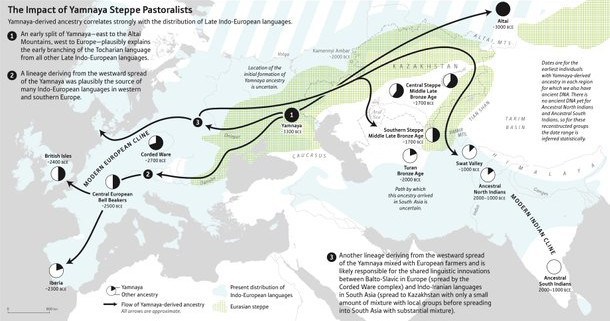
 This show is an interview with Vagheesh Narasimhan. The two papers are freely available at his website. Many of the papers mentioned are at the Reich lab website (free). We do mention a Southeast Asia ancient DNA paper that is from the Willerslev group.