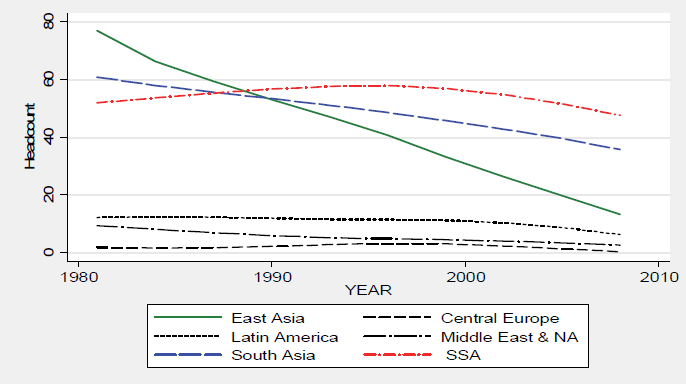
The poverty picture (Africa)

Sub-Saharan Africa may very well be the next big opportunity but it pays to look at the ground conditions (India is facing  the same problem)

….
John Page and Abebe Shimeles, authors of a recent
study published by the World Institute for Development Economic Research,
think they have found an answer: not enough workers have moved from the fields
to offices and factories….. 

Indeed, in Tanzania and Uganda, jobs have moved
in the other direction, from services to agriculture.

The authors measure how responsive employment is to GDP growth and find
sub-Saharan Africa has the most unresponsive labour markets in the world….. 

Page and Shimeles reckon that if employment
shifted away from farming, poverty levels would dive.

Rwanda has experienced such a shift in recent years. Agriculture made up
three quarters of its employment in 2000; that fell to 52 per cent in 2011. A
mining and construction boom emerged.  

Page and Shimeles calculate that the
sectoral shift was almost wholly responsible for Rwanda’s subsequent fall in
poverty.

There are lessons here for countries like Nigeria….Yet in 2010, 44 per cent of
Nigeria’s workforce was still employed in the agriculture sector.
For a big
drop in poverty, the jobs market needs to change.

regards

PKR World Champion

Some skeptics and naysayers (what can we do without them) are complaining that Saudi Arabia/GCC contribution of $1.5B comes with hidden strings (weapons for Syria). Conspiracies also tied it to the (lack of) progress in the ongoing Musharraf trial (summary: he did not show up).

Most plausible is the explanation that the money is a token of friendship that runs deep between the Saudis and Nawaz Sharif. The gift is being referred to as halal dollars.

Getting to #1 is a significant achievement. Now the only thing to do is to maintain the momentum, and to tell the Taliban (sweetly) to knock it off.
….
Pakistan’s rupee surged 5.2 percent
this week, the best performance among world currencies, as the
nation’s rising foreign reserves and improving economy buoyed
investor confidence.


The country’s currency stockpile climbed to $9.52 billion
this week, Finance Minister Ishaq Dar said yesterday, from $8.3
billion at the end of 2013. The economy is on course to achieve
the official target of 4.4 percent expansion in the year ending
June 30, he said, after the prior period’s 3.6 percent growth. A
planned global bond offering, an auction of third-generation
mobile-phone licenses and an International Monetary Fund loan
are set to boost fund inflows, according to the central bank.


The rupee rallied 7 percent this month to 98.08 per dollar,
according to data compiled by Bloomberg. The currency, which
touched the strongest level since June of 97.7870 yesterday,
slipped 0.2 percent today. JS Global Capital Ltd., a Karachi-based brokerage, said it raised its year-end forecast for the
rupee yesterday to 106 from 111.


“Foreign-exchange reserves have a huge hand in this”
rally, said Muzzammil Aslam, Karachi-based managing director at
research firm Emerging Economics Research. “Expectations for
further inflows are high, including the IMF loan tranche and the
3G auction scheduled for next month.”


Pakistan plans to raise as much as $500 million in its
first overseas bond sale since 2007, according to Finance
Minister Dar. The offering is expected to take place by end-March and may be followed with a sukuk issuance, Dar said in
Dubai on Feb. 9.


The State Bank of Pakistan may leave its benchmark interest
rate unchanged if the government meets targets under an IMF
program to draw inflows of as much as $3 billion by June, Hamza Ali Malik, director of the monetary policy department at the
central bank, said in a Feb. 17 interview. The rupee may soon stabilize amid concern its rally will
threaten exports, according to Khurram Schehzad, chief
investment officer managing stocks, bonds and commodities worth
$150 million at Karachi-based Lakson Investments.


“Reserves have improved and there is a sentiment shift,”
said Farrah Marwat, head of research in Karachi at JS Global
Capital. “You can see the government has picked up pace on all
the commitments such as the Eurobond, privatization and the 3G
auction.” 

regards

10 mil millionaires

Dollar millionaires have one advantage over the rest of us: skin color (such as ..ahem, brown) is not that important (though fine distinctions will be made with respect to ownership of second homes, painting collections, antique cars in the garage etc.).

And in the USA alone there are now 10 million of them (58% growth from 2008), suggesting that while many of us will be struggling to get on to the (non-existent) career ladder, they are polishing up on their gangnam routines (and have recovered just fine from the great depression).

The immediate bracket below is doing fine as well, 1.6% growth in 2013 to reach 29 million (10% of the population).

Thus regardless of what skeptics claim, the heart of capitalism (US upper and middle-class) is in pink form. However if you want to afford a top flight university you may have to double up as a porn star. .

….
There was a record 9.63 million households in the U.S. with a net worth of $1 million or more last year, according to new market research. The number of millionaire households surged 58 percent from a dip in
2008, when there were 6.7 million households worth $1 million or more
(not including primary residences). In 2007, there were 9.2 million
households worth that amount, reports market research firm Spectrem
Group. At the wealthiest levels, there were
132,000 households with a net worth of $25 million or more, up from
125,000 in 2007, before the recession.


The number of affluent households worth between $100,000 and $1
million was also up in 2013 from a year earlier. There were 28.97
million households in that category last year, a jump of 500,000 from
2012.

In contrast India has 182,000 dollar millionaires. There are also 180,000 NRI millionaires.

If (as some of us wish for) a Chairman Mao like person came along and got rid of all Indians except a couple of million, we can be overnight as prosperous as the United States. Food for thought.

regards

Made in Bangladesh

Over at The Aerogram there is a post, Made in Bangladesh, which is addressed to the young woman who posed topless in the American Apparel advertisement. I’m rather ambivalent about the whole thing. American Apparel knows how to get publicity, and sells clothes with ads which make Abercrombie & Fitch seem a little less on the pornish side. Additionally, the whole virtue of being made-in-America doesn’t hold much appeal for me when put next to the fact that the textile industry has reshaped the economic possibilities of the less well off female population of Bangladesh.

On the the other hand I found Taz Ahmed’s style to be condescending and self-congratulatory. Perhaps more important the interpretative framework of radical Left politics and Critical Race Theory is so thick and cloying  that the simple and spare critique is almost suffocated by nods to nearly every trope in this mode of analysis. There’s the weird contradiction of celebrating free choice and individual freedom, and then totally removing all agency from the subject of critique, and making implicit accusations of false consciousness. Many of the commenters, who seem to be mostly Bangladeshi, did not react positively to this style of delivery (see this post at Medium).

I think the commenters were a little too harsh, and as uncharitable to her as Taz was being to the model in the advert. Nevertheless, it has to be admitted that of thinking about the economic ramifications of the textile industry and trade, the post made to consider how Cultural Marxism can make anyone seem like a smug narcissist to all those outside of the small core audience of fellow travelers who are also marinated in their private lexicon.

Dementia

Many of us are likely to suffer from dementia as we drink, breathe and wallow in an ever more poisonous environment (SAsians more than most). It is imperative to be able to predict this condition in advance. Once the tell-tale signs are confirmed, we can go out and have a gala party, sign off on the will (please do that anyway), take a boat out to the sea and…jump in with the fishes.

Only one small question: 90% accuracy sounds very impressive (also likely to improve over time), but is it??


A
study, published in the journal Nature Medicine, identified 10
molecules in blood could be used to predict with at least 90% accuracy
whether people will go on to develop mild cognitive impairment or
Alzheimer’s.

“The lipid panel was able to distinguish with
90% accuracy these two distinct groups: cognitively normal participants
who would progress to MCI or AD within two to three years, and those who
would remain normal in the near future,”
said one of the study’s
authors, Professor Howard Federoff.

Dr Doug Brown, director of research and development at
the Alzheimer’s Society, added: “Having such a test would be an
interesting development, but it also throws up ethical considerations. “If
this does develop in the future people must be given a choice about
whether they would want to know, and fully understand the implications.

regards

(21st century) jobs for women

For Indian society to progress we need more and more women to be liberated from domestic slavery and provide both men and women the ability to shift from back-breaking, tedious jobs to 21st century jobs (in part by incorporating technology and upgrading work practices, see article excerpt below).


Armal Ali lives in one of the poorest neighborhoods of Lucknow, the capital of Uttar Pradesh, India.
The family of 11 occupy a breeze-block shack with no windows. Ali works
all day at a hand loom, sitting cross-legged on the ground, making
embroidered saris that are highly prized across the subcontinent. But
local residents know too well that such work wrecks eyesight and causes
chronic backache.

Ali hopes that his daughter Ousma, 9, will lead a
different life. “Nothing special,” he says, “but at least sitting at a
desk, for instance, with plenty of light around her.” He would also like
her to speak English, like “the people in suits who talk about money
all day on television”.

When you are lacking in “good jobs” women can progress only at the expense of men. Fortunately, the private sector already values women as employees and is responding strongly. Unfortunately, violence aimed at women is causing immense harm by restricting employment hours, especially the peak hours during evenings/nights when clients/teams in the west are available for interaction.


The formal/organized sector is the benchmark for middle class gender
bending.
It is here that employment is stable; compensation is adequate
and working conditions bearable. It is not as if nothing has changed
since 1947.  

Formal employment has increased, albeit marginally, and
today is around 29 million or just 5% of total employment. Whilst women
have benefited disproportionately, their share in formal employment
increased inadequately from a low 15% in 1995 to a miserable 20% today.
 

The private sector which has lower institutional and
labour market rigidities, is already responding, on a strictly “value
for money” basis to enlarge women employment. Since 1995 the formal
private sector added 2.8 million jobs, of which 39% (1.1 million) went
to women.
Their share has increased from 20% in 1995 to 24% today. 

It is in public sector formal employment that more needs to be done.
Public sector formal employment shrank by 2 million jobs since 1995 to
17.5 million today. Despite the shrinking pie of government jobs, jobs
for women increased by 0.6 million to 3.3 million or 18% of total public
sector employment:
way behind their share in the private sector.

It will hurt men directly but government must reserve 50% of entry
level positions for women across the board in the civilian cadres of
government, including within the existing quotas for scheduled caste,
scheduled tribe, other backward caste, and minorities (a few states).
Income based “brownie points” in selection and a “one-time quota
benefit, not transferable to children” can serve to churn the ensuing
benefit better. 

The average Indian woman looks for succour from just four public
horrors; (1) the lack of public safety in the street and often also at
home; (2) informal gender bars for education; (3) biased job recruitment
and assessment and (4) rigid work environments,
which do not recognizes
their multiple roles as bread winner; home stabilizer and comforter.
Their effective participation in the public space needs to fit in within
this framework. 

 
….technology is the biggest gender bender but the government
does not use it strategically.  

Monitoring outcomes effectively and
improving access to services are two sorely neglected areas.
 

Policing in
India continues to be a low tech, “danda” swinging profession.
Why
cannot an FIR be filed electronically, with a phone number attached for
authentication, thereby putting the onus on the police to follow up with
the complainant? Why are mixed gender police patrols, armed with smart
phone access, to record and report crime and access the crime database,
not visible to citizens? 

Why are blood samples not collected at home in
rural areas by mobile agents of laboratories and reports sent
electronically to users? Why are interactive phone based health and
education counselling services, on the Tamil Nadu pattern, not scaled up
nationally? Why do development babus still not have specific household
specific, annual targets for the multiple social benefit schemes of
government? Why do they have the discretion to fish for beneficiaries?

regards

Sensex @ 22k

New record.….the market is (maybe) signalling confidence about a stable govt post elections….also perhaps a return of investor confidence in India

Steady buying by foreign investors has led to a strong rally in Indian
markets. Overseas investors have bought heavily into India as a sharply
narrowing current account deficit and a more stable rupee have increased
confidence in a country that only last year was in the midst of its
biggest market turmoil since the balance of payments crisis of 1991.


Foreign Institutional Investors (FIIs) bought Indian shares worth Rs. 1,273 crore on Thursday, extending their buying streak to a 15th consecutive day for a net of over $1 billion. (Read: FIIs mark their biggest daily purchase since December 19)


Market analyst Sanjeev Bhasin told NDTV that Friday could see more
gains though the real bull market could be witnessed in broader indices,
where stocks have given almost 50-100 per cent returns from recent
3-month lows.


“Foreign flows have turned positive amid an easing in inflation, better
cash management by the government with current account deficit hitting
an 8-year low and the rupee rising to a 3-month high. All this has meant
that India has outperformed the emerging markets,” he added.

This is an useful site for latest updates in election news…we now have poll tracker for individual states….IMO multi-corner contests will be highly tricky to predict (much more so than the USA)

current forecast for  
UP: BJP (41-49) out of (80), 36% of the vote
Bihar: BJP+LJP (22-30) out of (40), 38% of the vote

This is a good article (conclusions below) on electoral studies. In this respect it is imperative that Indians engage in better data gathering and analysis and building better tools (rather than trying to suppress information anytime the ruling party is in trouble…as it usually is).

In view of the quantity and quality of election studies in India, it may
be said that relative to other developing countries, India is
advancing. But compared to studies in developed countries, there is
still much to be done. A systematic accumulation of data for individual
voting behaviours seems to be necessary. The Lokniti programme of CSDS
made a breakthrough in the study of electoral behaviour by inventing
most effective methodology unlike other studies in the field. The
publications in this direction provide enormous materials to carry out
the different aspects of electoral behaviour. Most studies which
examined the confidence of people in the election system or the efficacy
as citizens showed that people had faith in the election system.
Socio-economic status like gender, caste, religion, education, and
income were important in explaining political awareness, exposure to
political propaganda, sense of personal effectiveness in politics, and
party preference. Caste, religion, and to a lesser degree, economic
status, are especially important variables for explaining party
preference. Opinion polls of large-scale samples conducted after the
1980’s are important indicators of overall popular issues and
sentiments. The most important issues of the electorate are those
related daily lives of people such as rising prices or unemployment.
These are undercurrents affecting the party preference of people.

regards

The (Lady) Enforcer

What is striking about Manju Bhatia’s profile is that she comes from a low profile background, is only 27 years young and running a 500 crore business. India needs more women like this to assume leadership in new areas understood as “mardon wala kaam”. Also it is not possible (neither practical) to dream of a class-free and caste-free sister-hood but these ladies can take a free-wheeling approach- derive their strength from traditional and modern society as well.

Enter Manju Bhatia, joint MD of Vasuli Recovery, an all-female loan recovery agency. “Women are given respect all across the country, we are not
discounted,” she said in a telephone interview. Really? Yes, she
countered, “Look at our banks, from ICICI Bank to Dena Bank to the State
Bank of India, they’re all led by women.”

No surprise if Bhatia identifies with the likes of Chanda Kochchar
and Arundhati Bhattacharya
because they too, like her, have blazed their
trails in male bastions. Perhaps, it is this unprejudiced world view that made her entry into a male-dominated business–of loan recovery–easy.

At 27, Bhatia’s Vasuli handles recoveries valued at over Rs 500 crore
annually, with more than 250 staff in 26 locations across India. The
company has come a long way in the eight years since it first began
operations, with a monthly income of Rs 25,000, eight employees and one
client, the State Bank of India. It now boasts most of the country’s
publicly owned banks as clients.


As a 16-year-old growing up in Indore, Bhatia began working as a
receptionist at a pharmaceutical company the day after her last
twelfth standard board exam, in 2003.
In no time, she was handling
accounts and trading in raw materials.
Over the next two years she learnt the inner workings of the
business, including how to get export licenses and increasing the client
base, while getting her bachelors in law. It was then that her boss and
family friend Parag Shah asked her to help out with his loan recovery
company, Vasuli.
“There was only one client then, State Bank of India, and they
provided a list of defaulters,” Bhatia said. One of the defaulters was a
high profile minister, whom Bhatia decided to tackle. “The bank said he
won’t be accessible at all but I just called and got an appointment,”
she said. It turned out the minister had no idea he’d missed his loan
payments and the matter was sorted out in no time.


She decided to get into the recovery business full time and started
populating her team with women of all ages and for all roles – from
revenue licensing to legal procedures to recovery agents and everything
in between.
In 2007, Bhatia moved the company to Mumbai to be closer to
the major banks.


But, there have also been stray instances of violence that forced
Bhatia to now send recovery teams with police protection and
videographers. During a visit to a factory near Aurangabad to carry out
an inventory, the workers at the site locked Bhatia’s employees inside
the warehouse. Another time even the police weren’t of much help as the
defaulters rained down acid on the Vasuli employees and accompanying
police officials who had come to make collections.

But the dividends have made it all worth it. Bhatia’s success in
giving women purpose and putting their skills to constructive use pushes
her everyday. She had a real victory when talking to the Police
Commissioner of Kolkata about security protection last year. “I explained what we did and he was very interested,” she said, “and
then he asked if I could take on the widows of officers who had died in
duty so that they would have a revenue stream and come out of their
depression… I was very overwhelmed and said yes immediately.”

From smaller accounts and agricultural equipment, Vasuli has now
added property auctions to its retinue of services offered. Bhatia
continues to challenge herself by pursuing her PhD in law alongside
running the business.


On being asked what her advice would be to women entrepreneurs she
said, ”Belief is very important…if your mind can conceive it you can
achieve it.”
She illustrated her point by describing how family members
mocked her during the early days of Vasuli and how her conviction helped
her carry on.

regards

Chinese folly in Eithiopia/Kenya

China may be the next best imperial beast but it should be prepared to get bloody noses everywhere (not that it particularly cares) within the hard as well as soft boundaries.

Africa’s fourth-largest lake could drop by 20 metres, causing an ecological and human disaster to rival the shrinking of the Aral Sea in central Asia, if Ethiopia goes ahead with massive irrigation projects linked to a giant dam, according to a university paper….Lake
Turkana, located almost entirely in Kenya but fed by the river Omo,
which rises in Ethiopia, will be severely impacted by the 243 metre-high
Gibe III dam, which is due to be completed this year, says the study,
published by the University of Oxford’s African Studies Centre. It suggests water levels could drop by half, devastating the lake’s fisheries and affecting the livelihoods of 170,000 agro-pastoralists.

…. protests outside the Chinese embassy in Nairobi, with campaigners calling on
Beijing to halt funding for the scheme. Angelei says the Nairobi
government is divided on the issue, but that at least protests are legal
in Kenya, unlike in Ethiopia, and she urges donors to heed Human Rights Watch’s concerns that “funds given to Ethiopia are not used to oppress its people”….Although
progress on Gibe III has been considerably delayed by funding
constraints, China signed a memorandum of understanding last year to
finance construction on another mega dam on the Omo, Gibe IV, and plans
further dams on the Blue Nile as well.

Ethiopia’s plans for
constructing dams on the Nile have traditionally met with robust
opposition from Egypt, which has tried to maintain control of more than
half of the Nile’s flow through the colonial era Nile Waters Agreement, as well as through threats of armed force.
…Perhaps
reflecting Cairo’s recent decline as regional strongman, Burundi last
week joined five other upstream nations in the new Nile Basin Initiative,
creating the two-thirds majority of riverine states required to put the
new treaty into force, and thereby effectively wresting control of the
Nile waters from Egypt and Sudan. It threatens Egypt’s right to 55.5bn
cubic metres annually, conferred by the previous agreement.

regards

(HIV) Cure is a 4 letter word (miracle is 7)

We can go back to having as much sex as we want  (unfortunately STDs are again on the rise). However the promise of GM cure is now endless and that must be a good thing (we like living like Mr Micawber). The best goodies (like age reversal therapy) will be reserved for the 1%, the “annual income twenty
pounds, annual expenditure twenty pounds ought and six” folks will perhaps need to wait for Indian origin generic therapy to take shape (and if WTO approves).

Scientists have been excited about the prospect of genetically modifying
patients’ immune cells to make them resistant to disease since doctors
effectively cured an HIV patient in 2008. Timothy Brown, also known as
the Berlin patient, had a bone marrow transplant to treat his leukaemia.
Spotting their chance to treat both conditions, his doctors found a
donor who carried the rare mutation that made their immune cells
resistant to HIV. Immune cells are made in the bone marrow. Since the
operation, Brown has had no detectable level of HIV in his body and no
longer takes anti-HIV drugs.

Bone marrow transplants are risky
operations and cannot be given to everyone with HIV. But modifying
patients’ immune cells might be the next best thing.
One shortcoming of
the latest therapy is that the patients still make normal immune cells,
which can and will be infected by the HIV virus. Levine said one
hope for the future was to genetically modify stem cells in the
patient’s bone marrow that grow into immune cells. Those patients might
then produce a steady flow of resistant immune cells, leaving HIV
nowhere to hide.

The latest treatment was not without its problems. Writing in the New England Journal of Medicine,
the authors report a total of 130 mild or moderate side effects, 32 of
which were linked to the modified cells rather than the infusion
procedure. The most common reactions were fever, chills, headaches,
muscle and joint pain. One patient was taken to the hospital’s emergency
department after falling ill. The scientists note too that the
patients’ body odour took on the smell of garlic, a consequence of them
breaking down dimethyl sulfoxide, used to preserve the genetically
modified cells.

regards

Brown Pundits