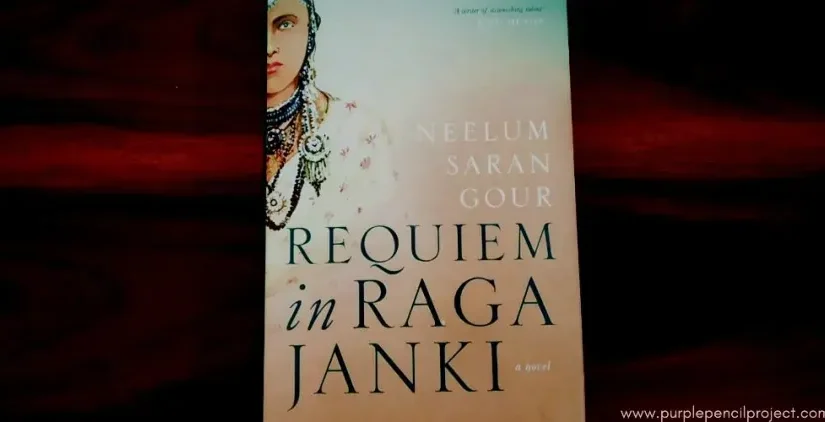
Review: Requiem in Raga Janki by Neelum Saran Gour

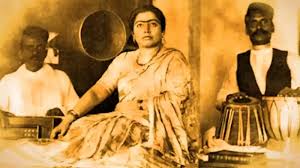
Neelum Saran Gour’s novel Requiem in Raga Janki (Penguin Random House India, 2018) is a fictionalized biography of Janki Bai Ilahabadi (1880-1934), one of the most famous Hindustani classical singers of the early twentieth century. Janki Bai was an extremely successful gramophone artist in the early days of recording. She performed at the Grand Delhi Darbar in December 1911, where George V was crowned as Emperor of India. She also wrote Urdu poetry, most famously the Diwan-e-Janki.

Gour begins the novel by describing one of the most famous stories associated with Janki Bai, when she was stabbed by a jealous lover (depending on the version of the story, the man was either her lover or the lover of her father’s mistress). Janki received 56 stab wounds, which led to her receiving the nickname “Chappan Churi” (56 knives). After the stabbing, her father’s mistress, Lakshmi, ran away and Janki’s father abandoned his wife and children to go searching for her. Janki and her mother Manki Bai were then sold to a brothel in Allahabad. In order to protect her daughter from becoming an ordinary sex worker, Manki Bai arranged for her to recieve a high level of musical training from Ustad Hassu Khan of the Gwalior gharana (school) of Hindustani classical singing. Her success at this art is what made Janki a bai or courtesan– a highly valued female entertainer.

The rest of the review can be read on Substack 
 

Review: The Disciple

Since this is a slow week on BP, I am taking the liberty of sharing this film review of Chaitanya Tamhane’s The Disciple. 

Early in The Disciple, we hear a voiceover which states: “If you want to make money, sing film songs or love songs, don’t tread this path. If you want to tread this path, learn to be lonely and hungry.” This immediately identifies the theme of the movie: the arduous journey to make a career in Hindustani classical music (shastriya sangeet).

The Disciple–directed by Chaitanya Tamhane, known for Court (India’s official submission for the 88th Academy Awards)– is a Marathi-language drama that revolves around an aspiring Hindustani classical singer, Sharad Nerulkar (played by Aditya Modak–himself a classical singer). The film originally screened at the 77th Venice International Film Festival in September 2020–the first Indian film since 2001’s Monsoon Wedding to compete at the festival–where it won the International Critics Prize and the award for Best Screenplay. It was subsequently picked up by Netflix. Continue reading Review: The Disciple

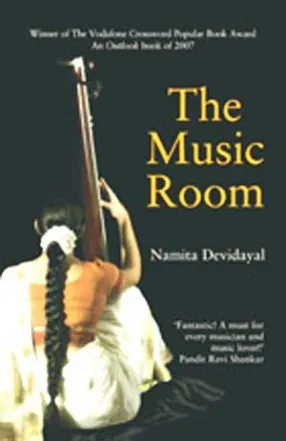
Review: The Music Room by Namita Devidayal

In an attempt to cool the temperature, I am sharing this review of Namita Devidayal’s book The Music Room.  I appreciate that BP is not afraid to tackle controversial and fraught topics relating to India-Pakistan but we need to mix it up with less controversial (but no less important) topics. 

Namita Devidayal’s memoir The Music Room is a chronicle of her relationship with her guru Dhondutai Kulkarni (1927-2014). The book describes Devidayal’s initiation into Hindustani classical music as a reluctant ten-year-old from Bombay’s upper-middle class. Along with describing her growing appreciation for Dhondutai and the music that she imparts to her, the narrative also tells the story of two other important figures in Hindustani music: Ustad Alladiya Khan (1855-1946)–the founder of the Jaipur-Atrauli gharana–and Keserbai Kerkar (1892-1977)–one of the most famous khayal singers of the 20th century. Through telling the stories of these individuals, Devidayal elucidates several important themes such as communalism and “Hinduization” of music as well as the place of women in classical music.

Devidayal describes the process through which Hindustani music became communalized and “Hinduized”. Though Dhondutai is extremely proud of the musical legacy passed on to her by Alladiya Khan Sahib’s family, she still expresses some bigoted views about Muslims. When pressed on this by Devidayal, Dhondutai attempts to square the circle by telling her that Ustad Alladiya Khan was not a real Muslim since he was (allegedly) descended from a Brahmin singer who had been forced to convert to Islam by a Muslim king. She also notes that he always wore the caste thread usually worn by Brahmins. This story allows Dhondutai to hold the belief that Hindustani classical music is essentially Hindu despite the fact that many of the most prominent gharanas had Muslim founders. Dhondutai’s prejudices connect back to the broader process through which–during the colonial period– Hindustani music was “Hinduized” by reformers such as Pandit Bhatkhande and Pandit Paluskar. Bhatkhande wanted to create a “national music” and believed that Hindustani music had been degraded by Muslims and dancing girls and needed to be rescued from both. This process has been extensively discussed by Janaki Bakhle in her book Two Men and Music: Nationalism in the Making of an Indian Classical Tradition. Unfortunately, while most ethnomusicologists agree that Hindustani music is a syncretic tradition, many (on both sides of the India-Pakistan border) persist in claiming it for one or the other religion. Continue reading Review: The Music Room by Namita Devidayal

Reflections: Vikram Seth’s ‘A Suitable Boy’–An Epic Portrait of 1950s India

I’m sharing this excerpt from an essay about one of my favorite novels–Vikram Seth’s A Suitable Boy.  The entire essay can be read here. I have also reviewed the BBC adaptation here

There are some works of literature that are like comfort food–ready for one to dip into whenever one is in need of a pick-me-up. For me, Vikram Seth’s 1993 magnum opus, A Suitable Boy, is one such work. The characters–ranging from the anxious and melodramatic Mrs. Rupa Mehra to the crazy Chatterjee family to the beautiful Muslim courtesan Saaeda Bai Firozabadi– are like old friends whom one has missed after a long absence. Every time I read the novel (and I have read it several times) I find new things to delight and ponder.

The novel begins with what in my opinion is one of the best openings in modern literature, one that immediately alludes to Jane Austen. Just as Pride and Prejudice begins with the narrator stating “It is a truth universally acknowledged ,that a single man in possession of a good fortune must be in want of a wife”, A Suitable Boy opens with the sentence: ” ‘You too will marry a boy I choose,’ said Mrs. Rupa Mehra firmly to her younger daughter.” With this sentence, Seth immediately lets the reader know what the book will be about: Mrs. Rupa Mehra’s search to find a suitable match for her daughter Lata. The novel opens at the wedding of Lata’s elder sister Savita. It will conclude with another wedding, that of Lata herself.

Though the plot ostensibly revolves around getting Lata married off, the novel is really a portrait of 1950s India, similar to the “condition of England” novels of the mid- 19th century. These novels (such as Charles Dickens’s Bleak House) contain, apart from their fictional plots, a debate or discourse about the current state of the nation. Just as Bleak House draws attention to the problems of the London slums and the need for reform of the Chancery courts, A Suitable Boy includes plot lines devoted to issues of land reform and religious communalism. Seth also includes several other aspects of Indian culture in the novel, such as the tradition of courtesans, Urdu poetry, and Hindustani Classical Music. Continue reading Reflections: Vikram Seth’s ‘A Suitable Boy’–An Epic Portrait of 1950s India

On Safety and Hinduphobia

Bombay Badshah is on vanvas. He earned it. He posted, in passing, personal details of another commenter, which he should never have been examining. He was warned, apologised, and is now serving his time in the forest. Lord Ram took Sita and Lakshman with him for fourteen years. BB is taking the IPL and Dhurandhar reruns for ten days. The proportions are different. The principle is the same. You leave the city when you have offended its order.

This is not a defence of him. It is the opposite. BP must be a safe space for reader, commenter and author. Privacy is the precondition of opinion. If a person cannot post under a handle without a hostile interlocutor looking them up, the room collapses into a lower kind of theatre. We do not run that kind of room.

Engrained Hinduphobia

But his exile is also the moment to say the thing we have been postponing. Hindus on this site have a real grievance, and it has accumulated because the language of liberal discourse equips one side of the argument with a vocabulary the other side does not have. Islamophobia is an institutional word. Hinduphobia is still scratching at the door. The asymmetry shapes every thread:

Courtesan Culture

There has been some discussion of courtesan culture on X.T.M’s recent thread.

While BB is probably trolling, I am using the opportunity to provide links to some pieces that I have written discussing courtesan culture.   These pieces can be read by anyone who is interested in an informed discussion of the topic.

I will briefly quote from my essay Thumri and Social Change (originally written as part of my Masters coursework):

Thumri was traditionally associated with tawayafs, a Persian word which appears in Hindi/Urdu around the middle of the 19th century. Although currently associated with prostitution, the word originally denoted high class courtesans who were highly-skilled singers and dancers trained in the arts of poetry and conversation. Aristocrats would send their sons to tawayafs to be trained in manners and etiquette (Du Perron 2007: 1-2). Prior to colonial rule, courtesans were associated with royal courts. With the decline of these courts, courtesans increasingly began to entertain in their own private salons. They were often wealthy and, because of their unmarried status, were able to move around freely (2). Thumri was one of the principal genres of courtesan performance. The texts often express female desire, usually in the form of love-in-separation (viraha). The heroine either curses the day her lover left her or pleads with him not to abandon her. These themes made thumri ideal for courtesan performance as the performer could act out the anguish and desire experienced by the song’s heroine (3).

Asides from the above piece, some further relevant links are:

Review: Siren Song: Understanding Pakistan Through Its Women Singers by Fawzia Afzal-Khan 

Review: Umrao Jan Ada by Mirza Ruswa (translated by Khushwant Singh and M.A. Husaini) 

Review: Tawaifnama by Saba Dewan 


What Being a “Center-Left” Pakistani Means to Me

Since my center-left credentials are frequently questioned on BP, I am sharing this post here.  Perhaps  it can stand as a precedent post so that this debate can be put to rest once and for all.

I have been repeatedly accused on BP of not actually being “Center-Left”. A commenter has said “Pakistani liberal is an oxymoron”. I have been called an “Islamist” and “Islamofascist”. While it doesn’t particularly make a difference to my life what some random people (whom I am unlikely to ever meet in reality) think of me, I would like to take this opportunity to define what precisely being center-left means to me. I do not attempt to speak for other Pakistanis–though I believe there is a significant proportion of the population who share some of my beliefs– but only to describe my own personal background and ideology. This exercise will also hopefully help me to examine some of my own assumptions.

As I have previously mentioned in some comments, I come from a family that believes in Nehruvian Secularism and in the “idea of India”. This ideological influence comes primarily through my father. My paternal grandmother was from Agra and came to Pakistan only after her marriage to my grandfather (who was from Peshawar). My grandfather was an official in the Pakistan Railways and prior to the 1965 war, my father and his siblings used to travel by train to Agra every year to see their maternal grandparents and relatives. The war unfortunately put an end to that. While I never had an in-depth discussion with my grandmother about what exactly Pakistan meant to her, my father has told me that she was deeply saddened by the fact that she was separated from her parents and one of her brothers. Such tragedies were common in many Pakistani and Indian Muslim families. I was lucky enough to be able to visit India as a child and spend time in my dadi’s ancestral home. There are pictures of me in front of the Taj.

On my mother’s side, my maternal grandfather was born in Amritsar (though he was ethnically Kashmiri). In 1947, he was living in Sialkot and married to my nani (who was from West Punjab). However, his relatives came to Sialkot as refugees from Amritsar. For decades, they continued to carry the keys to their houses in Amritsar. In fact, when my mother spent time in Indian Punjab in the 1990s (while doing some international development work) people there were surprised to learn that she could describe Amritsar neighborhoods in great detail without ever having been there before.

It is also important to note that though I was born in Pakistan, I spent most of my formative years growing up in the United States. My parents had many Indian friends. Also, my entire family was deeply involved with Hindustani classical music and this naturally tends to be an Indian diaspora activity. My ustad was Bangladeshi-American but very few of his students were Muslim. While I was learning to sing khayal, I also learned bhajans and shabads in various ragas. Continue reading What Being a “Center-Left” Pakistani Means to Me

Some Thoughts on Pakistani Culture

Since XTM’s latest post discusses Pakistani culture, I am excerpting from one of my articles “Some Thoughts on Pakistani Culture”.  You can read the complete essay on my Substack

One of the dominant explanations for the decline of Hindustani music in Pakistan is that these musical genres were not compatible with Pakistan’s national identity. The 1947 Partition of British India was largely justified by the “Two Nation Theory”–the idea that the Muslims of British India were a different “nation” from the Hindus and were therefore entitled to their own state. It is argued that while the proponents of this view succeeded in achieving a sovereign Pakistan, they struggled to define a new cultural identity not shared with India. Since it was a part of the syncretic Indo-Islamic culture, classical music became entangled in this struggle to separate Pakistan’s culture from India’s.

In actual fact, there was no concerted action on the part of the state to define a national identity. Rather, many opinions were in circulation in which the xenophobic ones were not met with sufficient resistance. It is ironic that the one committee founded in 1968 to frame a national policy on art and culture, under the leadership of Faiz Ahmed Faiz, came to a conclusion contradicting the narrow-minded national identity viewpoint. In the report, Faiz responded to the contention that Muslim or Islamic ideologies were the rightful frame for defining Pakistani culture. He noted that this position “ignores the reality of the non-ideological components of culture, e.g. language, dress, cuisine, architecture, arts and crafts, non-religious customs and social observances, etc. These are mundane products of historical origin and geographical environment and cannot be dubbed Islamic or un-Islamic”. He noted that what differentiates one Islamic state from another is their nationhood or culture. Faiz concluded quite categorically that “There is little justification, therefore, for any ambivalent or apologetic attitude either towards Pakistan (sic) nationhood or towards Pakistani culture” (Salim and Ishfaq 2013: 50).

When I say that Pakistan is a South Asian country and that our culture is South Asian, I am referring to what Faiz called the “non-ideological” components of culture (language, food, dress, art etc).

I disagree with XTM that Pakistan should have opted to claim a Persianiate identity.  I think most Pakistanis would have found Persian even more foreign than they find Urdu.  I myself attempted to learn Persian at the Middle East Institute in Washington, DC.  I took the course for two semesters and while I did fine, it wasn’t a language that I particularly related to.

Where I differ from some of the “Saffroniate” commenters on BP is that I don’t think that the fact that Pakistan shares a lot of cultural elements with North India necessarily de-legitimizes the Pakistani nation-state.  It is just a fact that historically what is now Pakistan has been ruled from Delhi-based empires.


Bhatkhande: The Contradiction of Music’s Modernity

As a follow up to my piece “A Brief History of Hindustani Music”,  I’m sharing this essay on Pandit Bhatkhande.  

Also see my review of Max Katz’s Lineage of Loss: Counternarratives of North Indian Music (Wesleyan University Press, 2017). 

In her book Two Men and Music: Nationalism and the Making of an Indian Classical Tradition (Oxford University Press 2005), Professor Janaki Bakhle extensively discusses Vishnu Narayan Bhatkhande (1860-1936), a musicologist largely responsible for the standardization of Hindustani Classical Music. Bakhle describes Pandit Bhatkhande as “one of Indian music’s most contentious, arrogant, polemical, contradictory, troubled and troubling characters. It may be better to view him not as a charlatan or a savior, but as a tragic figure, one who was his own worst enemy. All through his writings, there is ample evidence of elitism, prejudice, and borderline misogyny” (99). She goes on to note the irony that though Bhatkhande is revered as a great figure in Hindustani music, his vision for the art form is not being followed today. For example, Bhatkhande wanted to create a national tradition for Indian music, not necessarily a Hindu tradition. Yet today, much of Hindustani Classical music is “suffused with sacrality” (99). Bakhle describes how at a recent musical gathering in Bombay, Bhatkhande’s portrait was adorned by a marigold garland with a silver incense stand placed in front of it. She asks the crucial question: “How did it happen that a vision that began with scholastics, debate, and secularism culminated in garlands and incense?” (100).

Vishnu Narayan Bhatkhande was born on August 10, 1860, into a Brahmin family in Bombay. Although neither of his parents was a professional musician, he and his siblings were taught music. This was not unusual in a family of his class background. At age 15, Bhatkhande began receiving instruction in sitar and studying Sanskrit texts on music theory, a field of inquiry that would remain his obsession throughout his life. In 1884, he joined the Gayan Uttejak Mandali, the music appreciation society, which exposed him to a rapidly expanding world of music performance and pedagogy. He studied with musicians such as Shri Raojibua Belbagkar and Ustad Ali Husain, learning a huge number of compositions, both khayal and dhrupad (100-101).

In 1887, Bhatkhande received his LLB from Bombay University and began a brief career as a criminal lawyer. After the death of his wife in 1900 and of his daughter in 1903, he abandoned this career to turn his full attention to music. The first thing he did was to embark on a series of musical research tours, the first of which was conducted in 1896. He traveled with a series of questions. His major project was to search out and then write a “connected history” of music and it began with these tours, which he believed would give him some clues to help recover some missing links. He was less interested in the actual performance of music than in the theory that underpinned the education of the musician. He kept several diaries of his tours, which served not only as an account of his travels but also as blueprints for his future writings. Bakhle notes that he “did not interview the people he met so much as he interrogated them, seeking out what he judged to be their ignorance. In all these encounters Bhatkhande met only men. He had little regard for women musicians and did not believe he could learn anything from them” (103). Continue reading Bhatkhande: The Contradiction of Music’s Modernity

A Brief History of Hindustani Music

As a follow up to some comments on the thread on Afghan musicians, I am sharing this brief history of Hindustani music. 

Hindustani (North Indian) Classical Music is one of the most beautiful products of the Indo-Islamic culture of North India (including today’s Pakistan and Bangladesh). It would not exist in its current form without the Muslim influence, having evolved in the Mughal courts after it left the precincts of the temples, which is where Hindu music was originally based. I do not know much about Carnatic Music or South India in general so I will restrict my observations to the North Indian system only.

It is my aim in this post to briefly outline the history of Hindustani music. If there is interest, I can then go back and fill in the details as and when I get time.

Like all Indian Music, Hindustani Classical originated during the Vedic period. It was at this time that the distinction between “Gandharva” (ritual music) and “gana” (incidental music) became clear. One of the most ancient treatises on the performing arts in India is the “Natya Shastra”, attributed to the sage Bharata Muni and dated to between 200 BCE and 200 CE. The text consists of 36 chapters with a cumulative total of 6000 poetic verses describing performance arts. The subjects covered by the treatise include dramatic composition, structure of a play, and the construction of a stage to host it, genres of acting, body movements, make up and costumes, role and goals of an art director, the musical scales, musical instruments and the integration of music with art performance. The treatise is also notable for its aesthetic “Rasa” theory. It is in this text that the seven basic notes (the saptak) are named: Sadja (Sa), Rsabha (Re), Gandhara (Ga), Madhyama (Ma), Panchama (Pa), Dhaivata (Dha), and Nishad (Ni). These note names are still used today, equivalent to the Western Do, Re, Mi, Fa, Sol, La, Ti.

With the arrival of the Muslim rulers of North India, music emerged from the temples and became part of the entertainment of the royal courts. While for Hindus, music was preeminently religious in subject matter and spirit, for the Muslims it was a purely secular art. Hazrat Amir Khusrow (1253-1325) was a Sufi musician, poet and scholar. He was a mystic and a spiritual disciple of Nizamuddin Auliya of Delhi (1238-1325). Born near Etah in modern day Uttar Pradesh, he was the son of Amir Saif ud Din Mahmud, a man of Turkic extraction and his Indian Rajput wife, Bibi Daulatnaz. Khusrow grew up in the house of his maternal grandfather, Rawat Arz (known by his title as Imad-ul-Mulk). He grew up very close to the traditions and culture of Indian society and was not alienated from it in the way that the ruling Turkic classes may have been. Continue reading A Brief History of Hindustani Music

Brown Pundits