By such sentences as “That thou art,” our own Self is affirmed. Of the untrue and that of the 5 senses – the Sruti says, “Not this, not that” (Neti, Neti) (Avadhuta Gita)
Only people who are NOT Cis, White or Male can understand and express the real truth of oppressive society. IF this is true, there is no point in struggling within the US system (or even within the US) because more people ARE Cis, White or male. This will always be a minority effort, doomed to fail. IF it is not true, then it is pointless and self-defeating posturing.
My child, how can there be illusion and non illusion, shadow and lack of shadow? All this is one Truth, all this is of the nature of space and without taint.
I am neither a scholar of the Vedas, nor a learned Hindu, so this is not an expert view or an insider’s view. These are impressions; I mean to learn, not to teach. Perhaps we can learn some things together, so please add comments, criticisms and links to articles.
The Vedas are among the oldest extant books in the world and there are four of them. The Rig Veda is the oldest of the four and can be said to be the most important (the other three are in some ways derivative, consisting in large part of rearrangements, commentaries and instructions regarding the proper interpretation and usage of the Rig Veda). It was composed (at least in its final form) in the Northwest of India in the region known as Sapta Sindhu, the land of the seven rivers (for the most part, what is now Pakistani and Indian Punjab) but it almost certainly includes older layers that refer to events, experiences, beliefs and Gods that date from times and places before the Indo-European migrants arrived in India.
One of the earliest Indo-European sacred books has been preserved with great care and fidelity and remains available to us today. This book is the Rig Veda (there are 3 other Vedas which are more or less derivatives or appendages of the Rig Veda). The original Sanskrit text is available to us today, but is of course not accessible for me. I have to rely on translations; translations have been made into several European languages, beginning in the 19th century (Schopenhauer thought the availability of a window into these ancient texts to Europeans should count as the greatest advantage of the 19th century over past centuries!). An English translation by British Indologist Ralph Griffith (who lived most of his life in India, was the principal of Benares college in the Hindu holy city of Benares, and is buried in South India) is available online in its entirety at this site: http://www.sacred-texts.com/hin/rigveda/index.htmand . A more recent and scholarly translation is now available but is very expensive. I read a more or less random selection of these hymns. My initial impressions follow. I look forward to reading more, and to suggestions for the same.
The Rig Veda consists of 10 books or Mandalas, of varying length. These hymns give us a window (and probably the most complete and most ancient window we have) into the Indo-European world that played such a huge role in the creation of the present cultures of much of Eurasia..their heroic age, so to speak.
In the original Sanskrit, the hymns are arranged in stanzas and follow particular rules of rhyme and meter (hear a sample at the end of this review). They are meant to be sung in particular religious rituals, mostly sacrifices to the Gods. The ten books were not all composed at the same time, or by the same authors and there are differences in style and subject. The tenth book in particular is different from the others and is more didactic and philosophical and is thought to be the last to be composed (and was composed by persons well acquainted with the earlier books). There are three hymns about creation in the tenth book and one of them has a certain skeptical and questioning tone that has made it the best known piece from the Rig Veda, frequently anthologized and quoted. I am reproducing it in full here, but also adding the two others that follow it, to give a more complete flavor of the original context:
HYMN CXXIX. Creation
THEN was not non-existent nor existent: there was no realm of air, no sky beyond it. What covered in, and where? and what gave shelter? Was water there, unfathomed depth of water? 2 Death was not then, nor was there aught immortal: no sign was there, the day’s and night’s divider. That One Thing, breathless, breathed by its own nature: apart from it was nothing whatsoever. 3 Darkness there was: at first concealed in darkness this All was indiscriminated chaos. All that existed then was void and form less: by the great power of Warmth was born that Unit. 4 Thereafter rose Desire in the beginning, Desire, the primal seed and germ of Spirit. Sages who searched with their heart’s thought discovered the existent’s kinship in the non-existent. 5 Transversely was their severing line extended: what was above it then, and what below it? There were begetters, there were mighty forces, free action here and energy up yonder 6 Who verily knows and who can here declare it, whence it was born and whence comes this creation? The Gods are later than this world’s production. Who knows then whence it first came into being? 7 He, the first origin of this creation, whether he formed it all or did not form it, Whose eye controls this world in highest heaven, he verily knows it, or perhaps he knows not.
HYMN CXXX. Creation.
THE sacrifice drawn out with threads on every side, stretched by a hundred sacred ministers and one, This do these Fathers weave who hitherward are come: they sit beside the warp and cry, Weave forth, weave back. 2 The Man extends it and the Man unbinds it: even to this vault of heaven hath he outspun, it. These pegs are fastened to the seat of worship: they made the Sāma-hymns their weaving shuttles. 3 What were the rule, the order and the model? What were the wooden fender and the butter? What were the hymn, the chant, the recitation, when to the God all Deities paid worship? 4 Closely was Gāyatrī conjoined with Agni, and closely Savitar combined with Usnih. Brilliant with Ukthas, Soma joined Anustup: Bṛhaspati’s voice by Brhati was aided. 5 Virāj adhered to Varuṇa and Mitra: here Triṣṭup day by day was Indra’s portion. Jagatī entered all the Gods together: so by this knowledge men were raised to Ṛṣis. 6 So by this knowledge men were raised to Ṛṣis, when ancient sacrifice sprang up, our Fathers. With the mind’s eye I think that I behold them who first performed this sacrificial worship. 7 They who were versed in ritual and metre, in hymns and rules, were the Seven Godlike Ṛṣis. Viewing the path of those of old, the sages have taken up the reins like chariot-drivers.
HYMN CXC. Creation.
FROM Fervour kindled to its height Eternal Law and Truth were born: Thence was the Night produced, and thence the billowy flood of sea arose. 2 From that same billowy flood of sea the Year was afterwards produced, Ordainer of the days nights, Lord over all who close the eye. 3 Dhātar, the great Creator, then formed in due order Sun and Moon. He formed in order Heaven and Earth, the regions of the air, and light.
The hymns of the ten books (as long in total as the poems of Homer) tell of a people who worship many Gods, with a few being mentioned very frequently, including Agni, Indra, Varuna and Soma. The hymns speak repeatedly of great warriors, with “beauteous horses and of kine, In thousands”, who indulge in lots of soma drinking and fort-breaking.. These warriors hoped to win ” wealth, renowned and ample, in brave sons, troops of slaves, far-famed for horses”. They also had priests who wanted the warriors to be generous with gifts (including mead). And they gambled, and got into trouble because of it:
The following hymn is fascinating, but also a rarity in being unusually didactic:
HYMN XXXIV. Dice, Etc.
“1. SPRUNG from tall trees on windy heights, these rollers transport me as they turn upon the table. Dearer to me the die that never slumbers than the deep draught of Mujavan’s own Soma. 2 She never vexed me nor was angry with me, but to my friends and me was ever gracious. For the die’s sake, whose single point is final, mine own devoted wife I alienated. 3 My wife holds me aloof, her mother hates me: the wretched man finds none to give him comfort. As of a costly horse grown old and feeble, I find not any profit of the gamester. 4 Others caress the wife of him whose riches the die hath coveted, that rapid courser: Of him speak father, mother, brothers saying, We know him not: bind him and take him with you. 5 When I resolve to play with these no longer, my friends depart from me and leave me lonely. When the brown dice, thrown on the board, have rattled, like a fond girl I seek the place of meeting. 6 The gamester seeks the gambling-house, and wonders, his body all afire, Shall I be lucky? Still do the dice extend his eager longing, staking his gains against his adversary. 7 Dice, verily, are armed with goads and driving-hooks, deceiving and tormenting, causing grievous woe. They give frail gifts and then destroy the man who wins, thickly anointed with the player’s fairest good. 8 Merrily sports their troop, the three-and-fifty, like Savitar the God whose ways are faithful. They bend not even to the mighty’s anger: the King himself pays homage and reveres them. 9 Downward they roll, and then spring quickly upward, and, handless, force the man with hands to serve them. Cast on the board, like lumps of magic charcoal, though cold themselves they burn the heart to ashes. 10 The gambler’s wife is left forlorn and wretched: the mother mourns the son who wanders homeless. In constant fear, in debt, and seeking riches, he goes by night unto the home of others. 11 Sad is the gambler when he sees a matron, another’s wife, and his well-ordered dwelling. He yokes the brown steeds in the early morning, and when the fire is cold sinks down an outcast. 12 To the great captain of your mighty army, who hath become the host’s imperial leader, To him I show my ten extended fingers: I speak the truth. No wealth am I withholding. 13 Play not with dice: no, cultivate thy corn-land. Enjoy the gain, and deem that wealth sufficient. There are thy cattle there thy wife, O gambler. So this good Savitar himself hath told me. 14 Make me your friend: show us some little mercy. Assail us not with your terrific fierceness. Appeased be your malignity and anger, and let the brown dice snare some other captive.”
There are also occasionally names of rivers, astronomical observations, names of animals and plants that may point to where the composers were living and what was going on around them. …One thing is clear, a lot of fighting was going on. So naturally, there are hymns to weapons, including this one which not only mentions bows and arrows, but also the coiled arm-guard that would protect an archer from the friction of the bowstring:
From Book 6 HYMN LXXV. Weapons of War
He lays his blows upon their backs, he deals his blows upon their thighs. Thou, Whip, who urgest horses, drive sagacious horses in the fray. 14 It compasses the arm with serpent windings, fending away the friction of the bowstring: So may the Brace, well-skilled in all its duties, guard manfully the man from every quarter. 15 Now to the Shaft with venom smeared, tipped with deer-horn, with iron mouth, Celestial, of Parjanya’s seed, be this great adoration paid. 16 Loosed from the Bowstring fly away, thou Arrow, sharpened by our prayer. Go to the foemen, strike them home, and let not one be left alive. 17 There where the flights of Arrows fall like boys whose locks are yet unshorn. Even there may Brahmaṇaspati, and Aditi protect us well, protect us well through all our days. 18 Thy vital parts I cover with thine Armour: with immortality King Soma clothe thee. Varuṇa give thee what is more than ample, and in thy triumph may the Gods be joyful. 19 Whoso would kill us, whether he be a strange foe or one of us,
Book 9 is unique in being entirely devoted one diety: Soma. The identity of Soma remains disputed to this day, but it was clearly the juice of a plant and was much admired for its ability to give vigor in battle and clarity in thought. The following extracts give a flavor of these hymns:
HYMN XXIII. Soma Pavamana.
1. SWIFT Soma drops have been effused in streams of meath, the gladdening drink, For sacred lore of every kind. 2 Hither to newer. resting-place the ancient Living Ones are come. They made the Sun that he might shine. 3 O Pavamana, bring to us the unsacrificing foeman’s wealth, And give us food with progeny. 4 The living Somas being cleansed diffuse exhilarating drink, Turned to the vat which drips with meath. 5 Soma gows on intelligent, possessing sap and mighty strength, Brave Hero who repels the curse. 6 For Indra, Soma! thou art cleansed, a feast-companion for the Gods: 1ndu, thou fain wilt win us strength 7 When he had drunken draughts of this, Indra smote down resistless foes: Yea, smote them, and shall smite them still.
From HYMN XXX. Soma Pavamana. Pour on us, Soma, with thy stream manconquering might which many crave, Accompanied with hero sons. 4 Hither hath Pavamana flowed, Soma flowed hither in a stream, To settle in the vats of wood. 5 To waters with the stones they drive thee tawny-hued, most rich in sweets, O Indu, to be Indra’s drink. 6 For Indra, for the Thunderer press the Soma very rich in sweets, Lovely, inspiriting, for strength.
With a little effort, you can imagine an HBO series about these people (and it would be worth watching).
The underlying philosophy is pagan and heroic and may not strike many of us as particularly deep, though I guess that someone like Christopher Beckwith (who writes about central Asian history with great feeling) would say this IS a deep philosophy, even an attractive one.
And of course these are, after all, hymns that are meant to be recited. Their very sound is supposed to have quasi-magical properties. Their addressees are higher beings who can bestow favors or withdraw them. This level of usefulness is meaningless to a modern secular person, but even a modern secularized Hindu may feel the recitation creates a psychological connection to his or her people, to their language and sounds, and to their traditions and community values. .. Just like reciting the Quran and hearing it being recited provides some psychosocial connection/rootedness/whatever to an Arab (or a wannabe Arab for that matter) and (magical or placebo) benefits to the true believer.
All of which is not without consequences.
It seems to me that Shinto and Japanese cultural traditions may be a good example of what a successful and relatively intact pagan religion of this type might look like today. Modern Hinduism may be too much of a “wounded civilization” to be a good model of what the original Indo-European religion could have evolved into…the ways of the ancients are now buried under centuries of dust, reinvention, editing, myth-making, mixing and plain old monotheist beating-down. But who knows, those wandering warrior pagans may have their day again..
The closing hymn of book 10: HYMN CXCI. Agni.
1. THOU, mighty Agni, gatherest up all that is precious for thy friend. Bring us all treasures as thou art enkindled in libation’s place 2 Assemble, speak together: let your minds be all of one accord, As ancient Gods unanimous sit down to their appointed share. 3 The place is common, common the assembly, common the mind, so be their thought united. A common purpose do I lay before you, and worship with your general oblation. 4 One and the same be your resolve, and be your minds of one accord. United be the thoughts of all that all may happily agree.
All in all, worth downloading on Kindle for free.
What it sounds like..
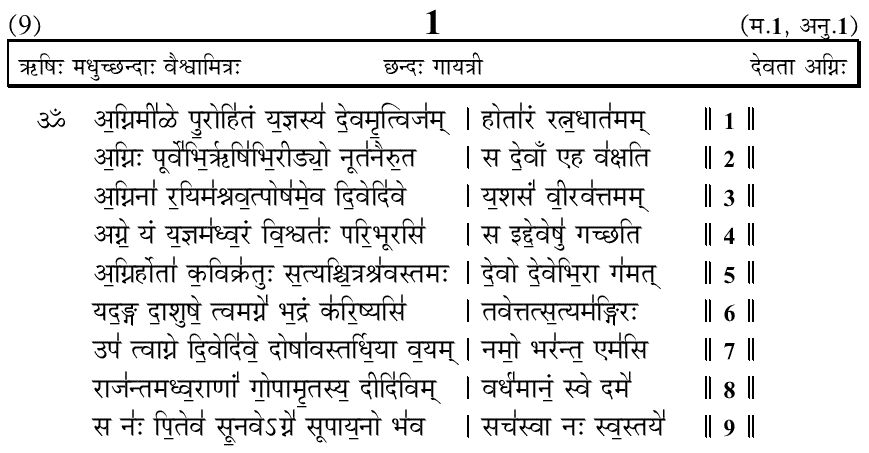
And looks like when written (which was actively discouraged for a very long time; it was supposed to be recited and memorized, not written down)
1. LET US with tuneful skill proclaim these generations of the Gods,
That one may see them when these hymns are chanted in a future age.
2 These Brahmaṇaspati produced with blast and smelting, like a Smith,
Existence, in an earlier age of Gods, from Non-existence sprang.
3 Existence, in the earliest age of Gods, from Non-existence sprang.
Thereafter were the regions born. This sprang from the Productive Power.
4 Earth sprang from the Productive Power the regions from the earth were born.
Dakṣa was born of Aditi, and Aditi was Dakṣa’s Child.
5 For Aditi, O Dakṣa, she who is thy Daughter, was brought forth.
After her were the blessed Gods born sharers of immortal life.
6 When ye, O Gods, in yonder deep closeclasping one another stood,
Thence, as of dancers, from your feet a thickening cloud of dust arose.
7 When, O ye Gods, like Yatis, ye caused all existing things to grow,
Then ye brought Sūrya forward who was lying hidden in the sea.
8 Eight are the Sons of Adid who from her body sprang to life.
With seven she went to meet the Gods she cast Martanda far away.
9 So with her Seven Sons Aditi went forth to meet the earlier age.
She brought Martanda thitherward to spring to life and die again.
We can divide the different belief structures by three traits, openness to exploration of ideas, attitudes to internal differences, attitude towards external entities . And we can trace the evolution of different belief structures and how they influenced the world and have been influenced by the world.
I think I would perhaps be correct in claiming India has the largest body of oral knowledge created, preserved and transmitted than any thing else in the world. Jainism, buddhism,atheism owe their origins to vedic speculations being preserved and their debating /speculating culture. Philosophical speculation is just not possible without memory being preserved in some way, it just wasnt true for anyone else except for vedic people. So, i disagree on this issue. As for Indus valley, there seem to be aspects of goddess worship of some kind and associated human sacrifice. Many cults of human sacrifice continued with Goddess worship, kali for example.
Brihadaranyaka upanishad, for example is quoted by both carvakas and Buddha himself. It is probably the most ancient upanishad, it asks the interesting question as to what survives after death, speculation is from, atman, to karma, idea of all things going back to their source, earth element to earth, water element to water, it compares the answer to what survives after a plant is uprooted, so if one qualifies question with God, what survives after death then one ends up with most of the spectrum of beliefs that come from India.
atheism- no God,no cosmic karma,no atman
ajivika- No God, no karmic force, no atman, naturalistic force, fate
sankhya- (ancient sankhya is unknown now, latest sankhya has similar model to david chalmers(they really deserve credit, this theory has been brought back independently by david chalmers), ofcourse there are differences, but one can bracket sankhya with david chalmers somewhat. consciouesness, matter being origin for everything else including intelligence.
buddhism- no God, karma cosmic force, no atman
jainism- no God, karma cosmic force, atman yes
advaita- No God, karma cosmic force,atman yes
other hindu schools have God, karma,atman etc combination of things.
There are other reasons to believe this, upanishads record sense objects, sense organs and knowing through them, this is reflective of later buddhism, One of Buddha teachers was a person who taught him an ancient form of sankhya. Buddha himself is to have spoken of different groups of vedic teachers to be authentic than others. In absense of memory preserving culture I do not know how can any of these ideas could have been speculated , recorded and preserved for generations growing into a community. This isnt possible, it might be a case that the people were from non vedic social back grounds were taking parts of vedic,Upanishads principles bit by bit as they saw fit and then have own schools but the ideas do seem to come only from vedic system of knowledge. Again, in order to have any worthwhile philosophical speculation of any kind one must first possess an ability to remember and pass it along for generations. This ability was possessed by vedic system
One of our authors wrote a post with the title “Should Hinduism Survive“? I think it should, but leave that aside for the moment and consider a different question: CAN Hinduism survive? And if so, in what form (or forms) will it survive?
I do not consider myself knowledgeable enough to answer these questions with any confidence. What I intend to do instead is to set out some random thoughts and observations, and hope that our commentators can help us approach an answer (or more likely, a range of possible answers)
One response to this question (and for various reasons this response is common among my liberal, secular and leftist Hindu friends) is to say: Of course it will survive. It is non-Hindus who should be afraid of extinction. Hinduism is the religion of over a billion people. It has survived for thousands of years. Groups that claim to be “Hindutvadi” are in power at the Federal and state level in India. Indians who are not Hindu are said to live in a state of fear and trepidation, with the specter of “Hindu-Fascism” hanging over their heads. Conversely, if you ask Hindu Nationalists you may be surprised to get a very different response. While there is a fair amount of jingoism and occasionally there is outright triumphalism, the dominant response is surprisingly pessimistic. I have not done a scientific poll, but I have asked this question of many friends and acquaintances who consider themselves “pro-Hindu” in some sense or the other, and a decisive majority tend to answer that better organized, better prepared and better funded “Abrahamic” religions are taking over India. Hindu survival is hanging by a thread and we probably won’t make it into the next century. Some of this is just the usual way Right wingers in all countries complain that the traditional mores of the people are under threat, the barbarians are multiplying and our leaders are weak. The sky will fall tomorrow unless XYZ is made the supreme leader and drastic (usually extra-constitutional) steps are taken to reverse our present course. But at least in my experience, the Indian version is more deeply pessimistic and a lot of smart people really do feel their culture and religion will not make it past this crisis. Are they right?
The basis for philosophy in science are religion https://manasataramgini.wordpress.com/2013/09/11/the-basis-for-philosophy-in-science-especially-biology-and-religion/
Don’t want to comment on the specific issue but one point i would like to make: Hindu liberals would never make the argument about *Hinduphobia* lest they be labeled parochial bigots: Muslim liberals have no such compunctions. Observe around and see if you can really disagree.
Disclaimer: As this post deals with an academic discussion on the Swastika symbol, I have included various images containing Swastika below. If you are repulsed by the symbol or do not like to look at it, please consider yourself warned. Also, for the same reason, this post is NSFW.
Growing up in India, I had developed this habit of drawing symbols of auspiciousness and good luck on my exam answer sheets. I have no recollection of who taught me to do that or when I started doing it but I can clearly remember even during my bachelor studies, I would collect the answer sheet from the invigilator and immediately proceed to draw an ‘ॐ’ (Om), a ‘श्री’ (Shree) and a ‘卐’ (Swastika, albeit with 4 dots in the middle as one would draw in India) at the top of the first sheet of the answer paper. This rather innocent practice wasn’t unique to me. Apparently many other students used to do this until the universities started cracking down on this ‘malpractice’ for ‘displaying symbols of faith on answer sheets’ and ’emotionally appealing to the evaluators’. In a religiously polarized India of the 2010’s, I don’t expect any less ham-handed response from our University VCs. But, personally, what prompted me to stop this practice was my move to Germany for my master’s.
In the first few weeks of the semester, all international students took part in an orientation program at the university. One of the most shocking things I learnt that day was that any public display of Swastika was BANNED in Germany. I was not ignorant of Germany’s sordid past. Watching ‘Schindler’s list’ beamed onto the wall of a dark classroom with my fellow drama club members in high school is one of the most vivid memories I have. I was just 15 then and the movie shocked me to my core. It was one of those instances of loss of innocence in my life when cruelty, inhumanity, Germany, Hitler, Jews and hate took on a whole other meaning in my psyche. In spite of that, discovering Swastika, an omnipresent sign in India that I had grown up seeing everywhere and that which is considered good and auspicious by everyone around me, could be a banned symbol of hate in the country I had just moved to, was another instance of loss of innocence.
Just like me, many Indians who have moved to the west have discovered this in their own way. The subreddit r/AITA (no connection with raitas 😛 ) has quite a few posts from hindus who have been mistaken for a white-supremacist (Oh! The irony!) for displaying Swastikas as a pendant gifted by grandmother, in the form of a rangoli/kolam in their frontyard, a tattoo on the arm they got while in India, having portraits of hindu gods at home, etc. All these instances happened in the US. From my personal experience, I have found the germans to have better awareness about Swastika; it’s use as the Nazi party symbol, a hate symbol of neo-Nazis and also as the auspicious symbol for many asian religions and cultures. This is because of two reasons:
1. The curriculum at schools explore all aspects of Germany’s sordid past with a level of frankness that I can only describe as ‘very German’. The curriculum makes the differentiation between the two symbols very clear as you can see from this children’s website that takes them on a german historical journey of the last 100 years.
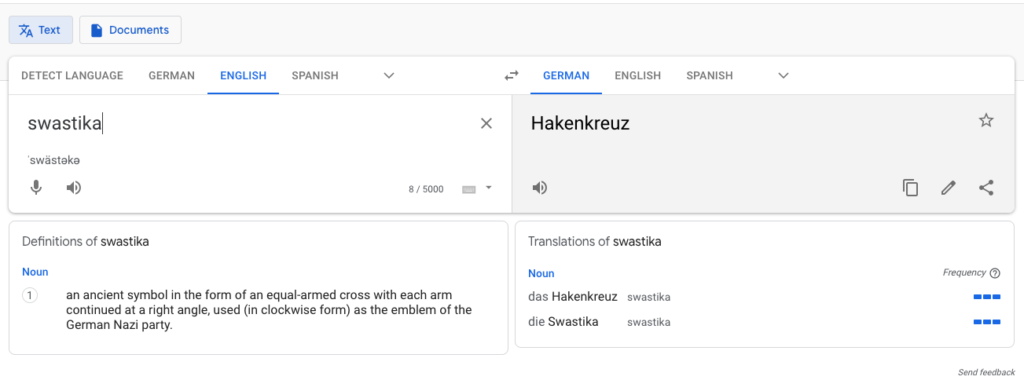
2. The germans use two different words for this symbol. The symbol of hate used by Hitler and the neo-Nazis is called ‘Hakenkreuz’ while the auspicious symbol of the orient is called ‘Swastika’. Just the existence of two different words makes it easy to differentiate the meaning of the two symbols.
Funnily enough, even though I lived in Germany for 5+ years, I was not aware of the existence of ‘Hakenkreuz’. I only came to know about it in the past year or so through twitter! It was probably through a thread by True Indology (lost when his account was suspended) that I became aware of the german word ‘Hakenkreuz’ that when translated to english means hooked cross and not Swastika. The problem lies with the current mistranslation of Hakenkreuz in English.
Google translate translates Swastika as Hekenkreuz in German. Notice the possible translations of the word – das Hakenkreuz and die Swastika. Also notice the definition of Swastika in english. It only defines the Hakenkreuz, the symbol used by Hitler.
Instead of translating into hooked cross, it is translated as Swastika, which is clearly wrong. So, why IS it mistranslated to Swastika? Who first translated Hakenkreuz to English as Swastika and how did that translation stick? More importantly, did Hitler adopt the eastern symbol Swastika as the anti-semitic symbol of his political party or did the inspiration come from elsewhere? These were some of the questions that recently led me to write a thread on twitter (you could also read it on the thread reader app here). I will summarize my findings below.
Colonialism and imperialism in the 18th and 19th century CE brought about a great deal of interest in the eastern cultures by the west which gave rise to the field of oriental studies and orientalism. All things east were considered exotic and the ‘popular’ phenomenon of cultural appropriation led to the adoption of various eastern symbols in the west. One among those was the Swastika. It shot up in popularity among the western academicians in the 1880’s and pretty soon entered the pop culture scene as a symbol of good luck, akin to today’s good luck charms like Maneki-neko (Japanese beckoning cat), Chinese fortune cookies or the Irish shamrock.
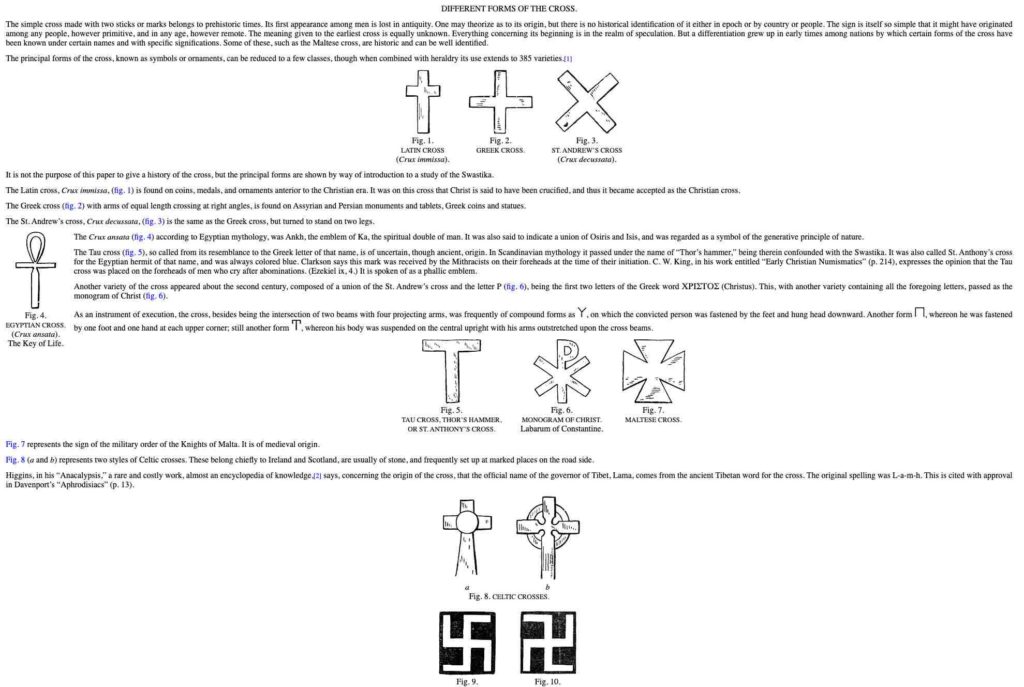
A report by Thomas Wilson titled ‘THE SWASTIKA, The earliest known symbol, and its migrations; with observations on the migration of certain industries in prehistoric times” for the US National museums in 1894 wonderfully compiled the then existing knowledge of Swastika. It is meticulous and very clearly written with almost no bias from Mr. Wilson. This also happens to be the first recorded instance where an English speaker tried to compile all the crooked cross like symbols and used the umbrella term of Swastika in English. Until then, the word Swastika did not exist in any english dictionary or encyclopedia. He writes in the preface:
An English gentleman, versed in prehistoric archæology, visited me in the summer of 1894, and during our conversation asked if we had the Swastika in America. I answered, “Yes,” and showed him two or three specimens of it. He demanded if we had any literature on the subject. I cited him De Mortillet, De Morgan, and Zmigrodzki, and he said, “No, I mean English or American.” I began a search which proved almost futile, as even the word Swastika did not appear in such works as Worcester’s or Webster’s dictionaries, the Encyclopædic Dictionary, the Encyclopædia Britannica, Johnson’s Universal Cyclopædia, the People’s Cyclopædia, nor Smith’s Dictionary of Greek and Roman Antiquities, his Greek and Roman Biography and Mythology, or his Classical Dictionary. I also searched, with the same results, Mollett’s Dictionary of Art and Archæology, Fairholt’s Dictionary of Terms in Art, “L’Art Gothique,” by Gonza, Perrot and Chipiez’s extensive histories of Art in Egypt, in Chaldea and Assyria, and in Phenicia; also “The Cross, Ancient and Modern,” by W. W. Blake, “The History of the Cross,” by John Ashton; and a reprint of a Dutch work by Wildener. In the American Encyclopædia the description is erroneous, while all the Century Dictionary says is, “Same as fylfot,” and “Compare Crux Ansata and Gammadion.” I thereupon concluded that this would be a good subject for presentation to the Smithsonian Institution for “diffusion of knowledge among men.”
In this report, Wilson examined different forms of crosses that had been found all around the world and concluded that Swastika is the most ancient one of them all.
Different cross-like symbols examined by Thomas Wilson in THE SWASTIKA
He complied various definitions of Swastika as recorded by different researchers and it was commonly understood to mean ‘good being’ or ‘good fortune’ in Sanskrit. The symbology was interpreted by different academicians differently. Although mostly everyone agreed that it is an auspicious symbol for the hindus and buddhists, there was no consensus on how to interpret the symbology. He writes,
Many theories have been presented concerning the symbolism of the Swastika, its relation to ancient deities and its representation of certain qualities. In the estimation of certain writers it has been respectively the emblem of Zeus, of Baal, of the sun, of the sun-god, of the sun-chariot of Agni the fire-god, of Indra the rain-god, of the sky, the sky-god, and finally the deity of all deities, the great God, the Maker and Ruler of the Universe. It has also been held to symbolize light or the god of light, of the forked lightning, and of water. It is believed by some to have been the oldest Aryan symbol. In the estimation of others it represents Brahma, Vishnu, and Siva, Creator, Preserver, Destroyer. It appears in the footprints of Buddha, engraved upon the solid rock on the mountains of India. It stood for the Jupiter Tonans and Pluvius of the Latins, and the Thor of the Scandinavians. In the latter case it has been considered—erroneously, however—a variety of the Thor hammer. In the opinion of at least one author it had an intimate relation to the Lotus sign of Egypt and Persia. Some authors have attributed a phallic meaning to it. Others have recognized it as representing the generative principle of mankind, making it the symbol of the female. Its appearance on the person of certain goddesses, Artemis, Hera, Demeter, Astarte, and the Chaldean Nana, the leaden goddess from Hissarlik, has caused it to be claimed as a sign of fecundity.
Until then, Swastika, as a symbol was known by different names in different languages because the symbol existed almost everywhere in the world, in Asia, Europe, northern Africa and the Americas. Also in Great Britain. So, what did the English call the symbol? Fylfot. Wilson writes,
In Great Britain the common name given to the Swastika, from Anglo-Saxon times by those who apparently had no knowledge whence it came, or that it came from any other than their own country, was Fylfot, said to have been derived from the Anglo-Saxon fower fot, meaning four-footed, or many-footed.
So, there existed a word for the 卐(crooked cross) symbol in english but only for the 卐 found in and around great britain. Instead of using this word for all crooked crosses in English, Mr. Wilson instead chose to use the word Swastika since he found it to be the most ancient of them all. This was a ham-fisted move because the Indic name swastika corresponded to the 卐 that symbolized auspiciousness which the other crooked crosses did not. Even Wilson admits that by quoting a letter by the famous Indologist Prof. Max Müller,
I do not like the use of the word svastika outside of India. It is a word of Indian origin and has its history and definite meaning in India. * * * The occurrence of such crosses in different parts of the world may or may not point to a common origin, but if they are once called Svastika the vulgus profanum will at once jump to the conclusion that they all come from India, and it will take some time to weed out such prejudice.
So, in 1894, the word Swastika was proposed by Mr. Wilson to denote all crooked crosses in english language and we see that the practice stuck since the use of the word in english language increased since then. So, is this when the German word ‘Hakenkreuz’ started being called as Swastika? Interestingly, no! In fact, the report mentions finding variants of swastika in Germany but mentions no name in German. ‘Hakenkreuz’ was barely used until then and was relegated to 19th century vocabulary books like the Bailey-Fahrenkrüger’s Wörterbuch der englischen Sprache and the Deutsches Wörterbuch von Jacob Grimm und Wilhelm Grimm (yes, they are the Brothers Grimm of Grimm’s fairy tales). So, to answer one of the questions posed above, ‘Hakenkreuz’ wasn’t actually translated into English. By the time germans started using Hakenkreuz as the word for the infamous anti-semitic symbol, the English speaking world had already picked up on the word Swastika and called any crooked cross symbol as such.
So, when and why did the Nazis adopt the Hakenkreuz as their anti-semitic symbol? The reason goes all the way back to Troy, the location of the fabled trojan war (it’s an interesting story, you can read a detailed article here). When a german businessman and amateur archeologist Heinrich Schliemann found the remains of the mythical city of Troy in modern day Turkey in 1871, along with the ruins, he found the 卐 symbol on everything – pieces of pottery, ruins of buildings, marble carvings, etc. Being an amateur archaeologist he did not understand the significance of his find. So, he consulted his orientalist friends – Max Mueller(yes, the same guy who didn’t want to call ‘Swastika’ found outside India as Swastika) and Émile-Louis Burnouf, a leading expert of Sanskrit. Fun fact: Bernouf was also an anti-semite and a propounder of Aryan master race.
Burnouf made a bunch of dubious claims (debunked by Wilson in his monumental report on Swastika) which was covered in Schliemann’s book ‘Troy and its remains‘ and concluded that Suastika (that was the spelling he went with) is an essential symbol of the Aryan race. The popularization of this flawed idea led to its appropriation as the symbol by the German ‘Völkisch‘ national movement gaining steam at the juncture of 19th and 20th century. It was a nationalistic movement which propounded that Germans belong to the Aryan ‘master race’ and hence need to dominate the world. Poetically, the year Burnouf breathed his last, 1907, was also the year when the Swastika was first used as a symbol of Aryan dominance by a secret society called ‘Order of the New Templars’ (Ordo Novi Templi, or ONT) in Austria by Lanz von Liebenfels, an Austrian racialist. So, in early 20th century, as most of the west started embracing Swastika as a ‘cool’ motif, it was also being appropriated secretly by an anti-semitic and racist underground movement becoming a symbol of racial supremacy for various organizations until it was mainstreamed by Hitler in the Nazi flag in 1920.
Flag of the ‘Order of the new Templars’. This was the first instance of Swastika used as a symbol of Aryan dominance in 1907.
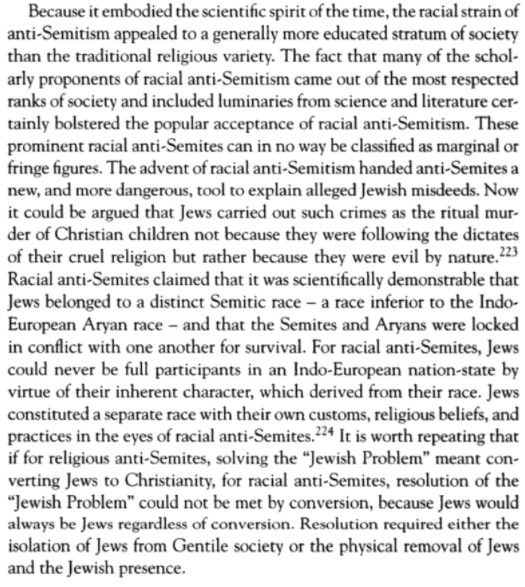
What inspired Hitler to choose this symbol for his political party? Was it just the connection to Aryan race or did the inspiration come from elsewhere? The anti-semitism displayed by the Nazis did not arise from a vacuum. Anti-semitism or anti-Judaism has existed in Europe since pre-Christian times but morphed into ‘religious anti-semitism’ due to the early christian belief that jews were collectively responsible for the death of Jesus Christ. This sentiment and the associated conflict intensified after Christianity spread as a state religion in Europe. However, the pseudo-scientific racial theories that became widespread in 19th century Europe threw up an additional strain of ‘racial anti-semitism’ where the basis of discrimination and persecution was the ‘scientific evidence’ that jews belongs to a separate lower ‘non-Aryan’ race. The combination of these two strains of anti-semitism, one historic and one modern, manifested politically in the form of Hitler’s Nazi party.
Professor William Brustein’s book, Roots of hate delves deep into pre-Holocaust anti-semitism in Europe
Adolf Hitler was a complicated man to understand. Forests have been felled to publish books speculating his inspirations and motives. Most scholars however agree that although Hitler distanced himself away from Christianity in his later years, he leaned heavily towards christianity in his early years. His catholic upbringing, his admiration for
Amish Tripathi is an author who also has a popular youtube channel where he regularly posts videos about aspects of Hinduism/Dharma. I happened to run across the above video and wanted to start a discussion about the topic, and about how “pro-Hindu” (or if you prefer, pro-Indic) influencers tend to address this question and if that approach can be improved.
The fourth article in this series will focus on why so many in global academia, global establishment, global media, global entertainment, global culture and the global public are so scared of and opposed to eastern philosophy, Swami Vivekananda and Ramakrishna while simultaneously appropriating much of eastern philosophy encoded in new language without attribution.
Part of the attack against eastern philosphy and Hinduttva derives from a hatred of the West and the fact that Western philosophy draws heavily from the east in four periods. Ancient Arya history or more than 3,000 years ago. During exchange from Alexander the Great through the Roman period. During European Enlightenment Classical liberalism [in many ways a derivative of Arya Hindu Chaarvaaka Darshana], and what is now called Post Modernism [which derives from Karl Marx’s study of India]. Much of it derives from many other causes which I am trying to understand.
Note that a stand alone post is planned to discuss the above presentations by Professor Jeffery D. Long, Professor Makarand Paranjape, Professor Anantanand Rambachan, andPprofessor Sharada Sugirtharaja. Brown Cast plans to interview Professor Jeffrey D Long with respect to Sanathana Dharma and Indology. If you have any questions for him, please leave it in the comments.
The below discussion between the San Francisco academic Vamsee Juluri and Hinduism’s great atheist Kushal Mehra discusses the Hinduphobia in global academia:
[Add summary of above video]
In the above video discussion Anjali George discusses why the Indian supreme court has forced the shut down of the ancient Sabarimala temple. Sabaramila is a brain therapy facility where woman and girls send their dysfunctional boys and men to–in order to fix them. To join the program and visit Sabaramila temple boys and men had to practice a very rigorous difficult 40 day regiment. Because most males are stupid fools, their woman and girls would:
gently persuade them to join [who are we kidding, in some cases girls aren’t that gentle and intimidate their men and boys into joining]
help them complete the regiment [in eastern philosophy and Toaism intelligence (medha) is female and males aren’t that bright, which is why they needed the help of their girls and woman]
keep a much more luxurious temple for themselves, a woman’s Sabrimala if you will.
Eastern philosophy is a matriarchal system of the divine feminine. Woman and girls run things. Woman and girls set up a brahmacharya Ayyapa tantra (technology) facility to help improve males. Pre pubescent girls and post menopause females can conduct the 40 day regiment and visit the brain therapy facility too.
However the supreme court of India appears to have mandated that females of child bearing age, pre-pubescent girls and post menopause woman and males need to be able to visit any part of the temple they wish at will, without completing a difficult 40 day sadhana. Naturally India’s females are furious at the Indian supreme court. Many of India’s woman see this as a me too attempt to harass Ayyapa, a celibate young male. Many of India’s females also see this as an attempt to let males be lazy and not complete their 40 day Sadhana. India’s woman are also furious that the global press, global entertainment and global academia are using this incident to demonize eastern philosophy. Which is rich, considering that the east has been feminist for thousands of years before Christ. Indian females who oppose the global “woke” narrative are being demonized as proto Nazis or proto fascists or proto male misogynist supporters of the patriarchy. One eastern female being so demonized is Anjali George. Anjali George defends eastern woman from the post modernist and caucasian intelligentsia (baizuo) critique.
Here is another perspective on Hindutva:
This appears to attribute Hindutva to a backlash against “secularism” where secularism appears to be defined as cultural marxist post modernist woke SJW.