F*ck Your Algorithm, My People Are Still Colonised

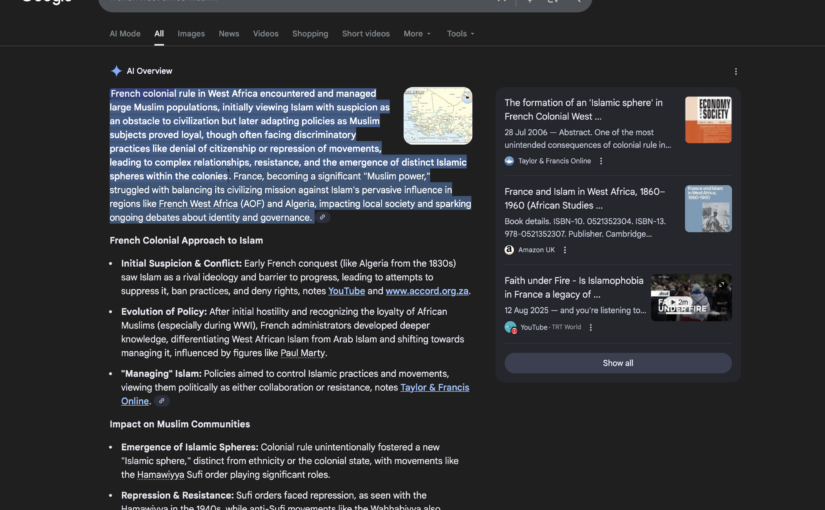
I was not browsing an archive or reading a colonial memoir. I was looking at an AI summary produced by Google’s Gemini system. What stopped me cold was not the history. It was the voice.

Islam was described as an “obstacle to civilisation.” French colonialism was reframed as a “civilising mission.” Muslim societies appeared as a “pervasive influence” to be managed. Colonial domination was softened into administration. Dispossession was translated into balance. This is not neutral language. It is the vocabulary of empire.

“French colonial rule in West Africa encountered and managed large Muslim populations, initially viewing Islam with suspicion as an obstacle to civilization but later adapting policies as Muslim subjects proved loyal, though often facing discriminatory practices like denial of citizenship or repression of movements, leading to complex relationships, resistance, and the emergence of distinct Islamic spheres within the colonies. France, becoming a significant “Muslim power,” struggled with balancing its civilizing mission against Islam’s pervasive influence in regions like French West Africa (AOF) and Algeria, impacting local society and sparking ongoing debates about identity and governance.”

Islam is fundamental to West Africa

Continue reading F*ck Your Algorithm, My People Are Still Colonised

Greenland, Trump, and the Comfort of White Intermediaries

What people are missing in the Greenland debate is not a technicality of citizenship or electoral legality. It is the structure of power that keeps repeating itself across the settler-colonial West.

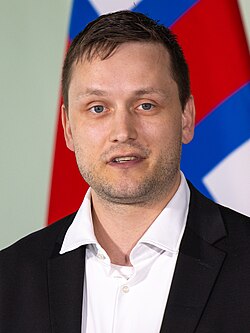
This is not really about whether the Greenlandic Prime Minister, Jens-Frederik Nielsen, can lawfully hold office.

Of course he can. He has a Danish father and a mother born and raised in Greenland, and he meets every formal requirement. That point is trivial, and focusing on it is a way of dodging the real issue. The real question is why, across every settler-colonial society; Indigenous welfare and political destiny are so reliably mediated by white-presenting figures, even when those societies are overwhelmingly Indigenous in population.

Greenland is 90 percent Inuit. Yet when power reaches its most visible, internationally legible form, it is once again carried by someone who presents as Danish, speaks the language of European governance fluently, and is immediately readable to Western capitals as “safe.” This is not accidental. It is structural. Continue reading Greenland, Trump, and the Comfort of White Intermediaries

Venezuela as Pakistan: A Template, Not an Accident

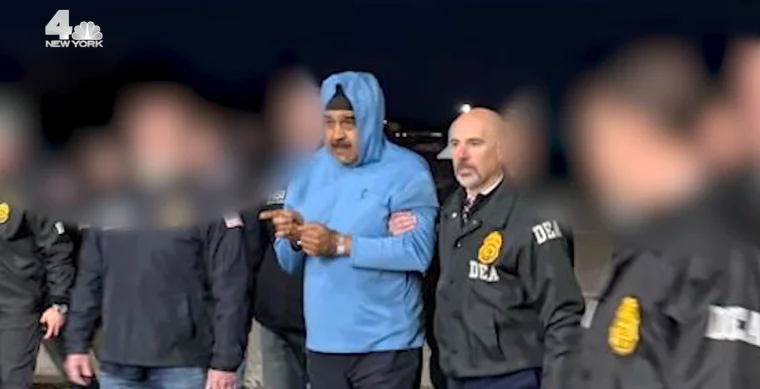
Venezuela is not being punished. It is being re-made. Not into a liberal democracy. Not into a stable autocracy. Into something more useful. Into a Pakistan. By this, I do not mean a people or a culture. I mean a regime form (as what Bush did to Maduro’s earlier Iraqi doppelgänger): a state kept permanently unstable, permanently securitised, and permanently dependent; yet intact enough to sign contracts, police its population, and function as leverage against rivals. This is the form Empire prefers when it can no longer rule directly.

1) Why Venezuela Matters

Venezuela is not peripheral. It is inconveniently rich.

  • The largest proven oil reserves in the world (over 300 billion barrels)

  • Significant natural gas

  • Large gold reserves

  • Access to rare earths

  • Control of the Caribbean–Atlantic corridor, close to major shipping lanes and the US mainland

A sovereign Venezuela is not a local problem. It is a potential pole. This is why it cannot be allowed to work. Donald Trump said the quiet part out loud: Venezuela has “all that oil.” It should be “ours.” The language was crude. The intent was orthodox. What matters is not the tone, but the continuity of aim.

2) Sanctions as a Weapon System Continue reading Venezuela as Pakistan: A Template, Not an Accident

Brown Venezuela to be Invaded

Excerpts from an Article on NakedCapitalism

Donald, you just wrote the most honest colonial confession of the 21st century. When you say Venezuela must “return” its oil, land, and assets to the United States, you are not talking about law. You are talking about ownership. You are saying, out loud, what empire has always believed in private: What lies under Venezuelan soil belongs to Washington.

The money quote: “you know the old days, when you had a war, it was ‘to the victor the spoils.’”

Venezuela has the largest proven reserves of heavy crude in the world, with an estimated 303 billion barrels, as well as the largest reserves of light crude oil in the Western Hemisphere. But it’s not just that Venezuela is home to the largest oil reserves on the planet, it’s that those reserves are sitting “right next door” to the US, as Trump himself said in 2023:

President Trump’s obsession with seizing other countries’ oil goes back a ways, to even before he entered politics. Here he is explaining in 2011 why the US should seize half or more of Libya’s oil after murdering its leader, Muammar Muhammad Abu Minyar al-Gaddafi, and plunging what was arguably the richest country in Africa (on a per-capita basis) into total chaos.

There are, of course, a plethora of other reasons for the US’ aggressive moves against Venezuela that we’ve discussed before, including the country’s large deposits of gold, rare earth minerals and freshwater; the opportunity to open up a mid-sized country’s market to rampant privatisation and liberalisation.

It is, after all, the US, mainly during Trump’s two presidencies, that has been stealing all kinds of Venezuelan assets, from the country’s gold reserves to the oil tanker seized in the Caribbean last week, to the president’s official plane, to Venezuelan oil company Citgo.

Exxon has a long, rich history in Venezuela dating back over a century. Its predecessor, Standard Oil, was one of the first companies to explore for oil in the South American country in the 1910s

But that all came to a halt in 2005, when Hugo Chávez ordered all existing “operating agreements” with foreign oil companies to be converted into joint ventures in which the state oil company, Petróleos de Venezuela (PDVSA), held a mandatory majority stake (over 50% ownership and operational control). Exxon refused to sign while most other companies, including BP, Total and Chevron, took the deal.

That high-intensity conflict is now closer than ever. But it needs to be packaged and sold to US lawmakers, media, members of the armed forces, and Trump’s war-weary MAGA base. And that is where CSIS’ “experts” come in. And they appear to be marketing this war on behalf of a company (Exxon) that has much to gain from a military intervention, and which bears the biggest grudge against Venezuela’s Bolivarian movement.

https://www.nakedcapitalism.com/2025/12/shining-a-light-on-how-exxon-mobil-bankrolls-think-tank-experts-pushing-for-regime-change-war-in-venezuela.html

Notes From the Backend

Traffic has slowed a bit, and instead of trying to force momentum, I’ve gone into backend mode. When the front-end quiets, the only sensible response is to strengthen the foundations. That’s where all my energy has gone this week.

1. The theme is fighting me.

I’ve been stuck on a simple problem: author name, date, and comment count are not appearing under the post title.This is basic metadata. It should be visible. Instead, it’s buried at the bottom of every post. I mentioned this on WhatsApp; Furqan said the alternative theme I was looking at “looks archaic.” Fair. And yet the current setup is forcing my hand. To fix this I may need to build a child theme, which is technically more involved, but necessary if we want BP to look and function like a proper archive rather than a hobby blog. These are small details, but they shape usability.

2. Categories finally make sense. Continue reading Notes From the Backend

Note on Moderation

In light of Omar stepping down from active management of BP, i wanted to share this note. As I have immense respect and gratitude towards Omar I wouldn’t want the brand he and others have built up (and i have contributed a bit) over last decade and half to just go downhill. Despite the success of Substack and X (and video platforms) I feel the BP blog presents nice niche with its moderate reach and past history of extremely insightful authors and commentators – I feel BP is a community/blog worth maintaining into the coming years (and hopefully decades).

Given the recent fracas on the blog and in between its authors and commentators, I think we ought to indulge in some moderation – how much is the question that can only be addressed as we go ahead.

In light of this i hope to:

  1. Write a bit more frequently on the blog.
  2. Moderate comments (not every day) and weed out filthy content which crosses a certain red line. I generally tend to be pretty liberal with my tolerance for free speech so i hope i do not indulge in too much censoring. XTM can take his call – everyone sees moderation different and being the admin and founder – his authority on moderation (along with Razib) will be the final call. But i know even he is pretty liberal with respect to comments.
  3. Where i think reasonable standards will apply viz commenting are BP authors. It lowers the Brand of Brown pundits if people who are authors on this platform indulge in trollish and racist behavior. All always authors can moderate their threads as they deep fit instead of indulging in shitposting with trollish comments. If someone wants to have a banter in comments I hope they remember this line. I am in no way an authority but i think what i have written here wrt different standards for authors makes sense.

As I have mentioned above I do have pretty liberal standards with speech. Giving a concrete example – I did not find the jibe “subhuman” or jibe as Elitist/Islamist/Brahmanical/Fascist (ideological) as crossing a Red-Line in general. Context is important and one off comment of such nature doesn’t alarm me (It might be a redline for someone else i do not disagree) – even if directed at me. After all isnt a Troll also a subhuman ? but we are fine to call people we disagree with as low IQ trolls all the time without getting offended. Having said this – different standards ought to apply to authors but i would leave it to XTM (though i would drop him a line)

I hope i am able to stay regularly active on this space as and when time permits. As XTM has said multiple times, moderating in a thankless mandate and i hope i can slightly reduce his burden going forward.

Racism Is Wrong. So Is Calling People Sub-Human.

It is wrong to dehumanise anyone. One of the recurring issues on BP is this histrionic insistence that individuals “own” the truth. The truth is broad, multi-layered, and something we all approach imperfectly. No single person has a monopoly on it.

I obviously reject racism in every form; that should go without saying. But I also find it nonsensical to claim that it is a moral imperative to call a racist “sub-human.” That is a classic moral slippery slope. Once you begin dehumanising others, even for views you find repugnant, you simply replicate the logic you oppose.

What I’ve noticed recently is that people are increasingly confusing ego with ideology. That never ends well. This is a blog. Nothing here is existential. We should be able to disagree fiercely without crossing into territory that strips others of their humanity.

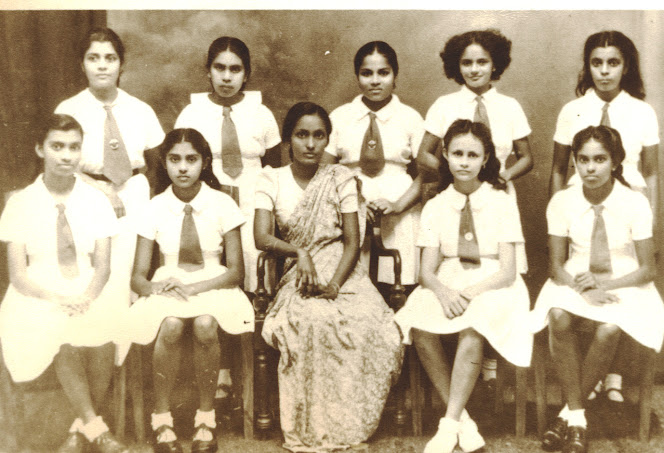
Multi Racial Multi Cultural Family in Ceylon

Banner Image: Photo from around 1940.
Standing far left: My mother Peace born 1926 (same age as Queen Elizabeth II) Standing one but Last with Afro, Estelle. Father a Judge from Barbados via England (African Heritage). Mother Eurasian
Seated. In Saree Miss Gnana (History Teacher, Tamil), Next to her: Miss White, Eurasian


This is about the maternal side of the family. My grandparents were one of the first inter racial marriage in the Deep South. It is also about how a children of an inter racial marriage do not belong and forge an independence of thinking (my mother and myself as examples). Even more so growing up in a cosmopolitan segment of Sri Lankan society

Let us start from the beginning. My Grandmothers mother was an Irish Nanny. Hearsay and rumor confirmed by my DNA tests. The Irish Nanny had my grandmother with my GreatGrandFather and left Ceylon. My GreatGrandfather did not have children so my grandmother was adopted by her father. Inherited all the wealth which was considerable. GreatGrandFathers family (Tillekeratnes) had been Administrators under Dutch and British times and were Sinhalese in the Deep South. Possibly were Anglicans during British times.
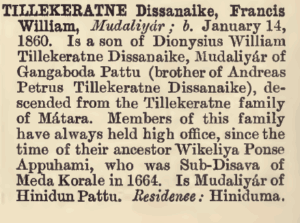

Tillekeratne Family of Matara.
From Golden Book of India and Ceylon (1900) Roper Lethbridge

My Grandmother married a Jaffna Tamil (from the North), a surveyor posted to Galle in the Deep South. My grandmother built a house in Galle so that it was convenient for work. Her ancestral home was even more deeper in the South in Matara.

Galle Town proper was very small, probably about 25,000 pre WW2. Still small about 150,000 now (2025), However, Galle was very Cosmopolitan because of the Harbor. It was the Main Harbor till the Colombo breakwater was built. My mother (and her sisters) attended a Catholic Convent, which was cosmopolitan. (a school photo and some names attached).

My mother and I dont really identify with any community in Sr Lanka. However, very Sri Lankan Nationalist. My mother never spoke about her opinions. Many in Galle thought they were Eurasians but they were not part of the Eurasian (Burgher) community. Burghers were a Fun crowd, parties dancing and Drinking (including women). (I would have liked to be part of that community) My mothers family were quite austere, their idea of nice time was probably singing hymns and big meal afterward. A lot of imported stuff from what I recall as a 6 year old. Edam Cheese, hams, sausage, puddings and homemade ice cream in churn. We inherited the ice cream churn after my grandfather died. Eventually rusted and was no longer usable.

Dual Six-Quart Ice Cream Maker
Old fashioned Ice Cream Churn.

Because we dont really “belong” to any community we dont have a need to behave as society demands. Mother would dress like a street sweeper, without footwear even to extent of going to nearby shops. On the flip side she would go to Colombo to get her dresses made. Wore platform shoes, high heels, pastel light shade dresses and sarees. (There were some in her wardrobe when we were children).
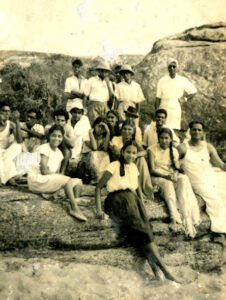

Mother in White Dress (left in image) on a Trip to Yala National when she was a teacher.  Probably around 1952
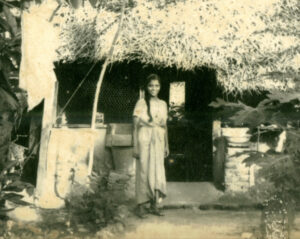

Mother in Batticola just after marriage. Parents lived there for 5 years.  I was conceived in Batticola just before they left.  Born in my grandmothers house in Galle. 

Another big issue was she traveled alone, without chaperones since an older teenager. I think she just couldn’t deal with the slow pace of Sri Lankans. One gets the impression that she was some kind dress up person. Anything but, workaholic like her father and mother. Mothers father died at 84 getting ready to go to work surveying. Most Stories told by Katrina Hamy who was about my mothers age. I think mother liked her more than her sisters, some of whom were big time gossips. Apparently even as a young teenager would come home and help in cleaning, toilets, drains washing up. Hated cooking but was a reluctant good cook when we were children. We did not have “help” as my mother didnt approve of “help”

Anecdote told by Katrna Hamy
Mother was the youngest in the family. Somewhere in her teens she took it upon herself to supervise some coconut properties that belonged to my Grandmother. She would get up at 4:00am and take the first train (5am night Mail). She was supposed to go with a chaperone. Mother does not wait for anyone. Once she is ready she leaves. The walk to the train station (about a mile) is dark and lonely. As she was walking there was a man following her. Mother probably heard the footsteps and turned and walked back to the man and he just ran. Probably thought my mother was Mohini a female demon who dresses in white.
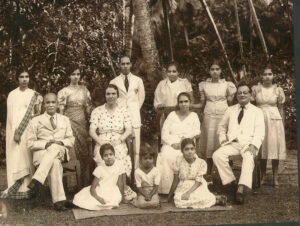

Mother family
Seated:  Sanford BeeBee (Jaffna Tamil), 2nd from Right Lilian Edith Tillekeratne (Half Sinhalese, Half Irish. note: No Jewellery). The two westerners are Mr and Mrs Graves. Missionaries
Seated on Ground. Peace BeeBee (my mother), next to her Katrina Hamy
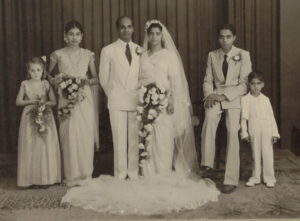

Parents Wedding Photo Galle, 1953
LR: Ms Anthin (Swedish Missionaries daughter), Sunethra neighbor and family friend, Sinhalese, AC Barr-Kumarakulasinghe (Jaffna Tamil), Peace Beebee (mother), Wilson Allegacone (fathers nephew, Tamil), Lal Liyanage (mothers nephew, Sinhalese)
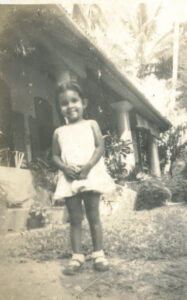

Grandmothers House in Galle


*For those who think this is boast. End of the line for my male Paternal line (about two males who carry the surname in Malaysia). The same for my grandmothers fathers line. The last in the male line was a classmate. As the Buddha says everything is Impermanent

Brown Pundits