
First up, I want to admit that I been a harsh critic of Pakistan Army’s interference in political matters, their gross inefficiency during all the wars that they fought (and lost), their myopic worldview and land grabbing in the garb of ‘National Security’. However, I believe that two very common misconceptions about our army need to be addressed.
- While talking about General Zia, an Islamist dictator who ruled Pakistan for eleven years (1977-88), many people refer to his role in the ‘Black September’ events from 1970. If you try to look this up on the internet, there are conflicting stories about his involvement. What we know for sure is that he was stationed in Jordan as part of a military training mission (Read here) sent by Pakistan in the aftermath of the 1967 Arab-Israel war. The Deputy Chief of Mission (DCM) in Amman at the time was Mr. Tayyab Siddiqui. According to an article he wrote in 2010, (Read here)
“Following the June 1967 military debacle, the Arabs requested Pakistan for military training. Pakistan sent training contingents to Syria, Jordan and Iraq.”
In August-September 1970, the Palestinians, aided by the Syrians, revolted against the Hashemite Kingdom of Jordan. During the battle, the Commanding Officer (CO) of a Jordanian infantry unit deserted. King Hussain asked Brigadier Zia to take charge of that unit temporarily. Zia sought permission from the embassy where Mr. Siddiqui established contact with Secretary Defence, Mr. Ghiasuddin. Ghias’s comments are the most cringe-worthy issue in this whole affair. He cabled Amman that
“We had [performed] Istikhara, Hashmite Kingdom’s star is ascendant. Go ahead. Follow king’s commands.”
In Ambassador Siddiqui’s words:
“That the foreign and defence policy of Pakistan was formulated not on a dispassionate analysis of the situation but on the dubious religious invocation still amazes me”.
Zia took temporary charge of the unit but before any fighting could take place, the Syrians withdrew and the offensive ended. Later on, Zia developed contacts with Palestinian leadership and was not accused of being the ‘Butcher of Palestinians’ by any Palestinian fighter. In fact, Yasser Arafat visited Pakistan three times during Zia’s regime.
2. You might have seen a picture of a soldier inspecting a Bengali man’s Dhoti, from 1971. That is provided as a proof that Army folks there used to inspect Bengali men’s genitals to decide if they were Muslim or not (based on circumcision status). While the Pakistan Army indulged in some of the worst atrocities against the Bengalis, this picture is not a valid evidence.
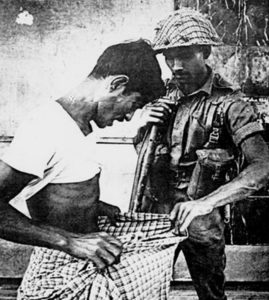
This picture was taken by Indian photographer Kishor Parekh. In an interview, his son Swapan Parekh mentioned that it was a photograph of Indian army personnel checking the [Bengali] collaborators for weapons. The caption in Kishor Parekh’s book validates this backstory.