By Furqan Ali
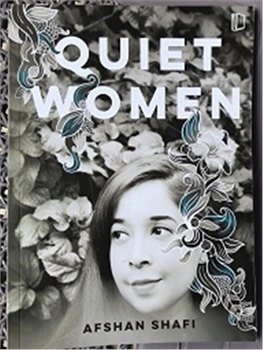
I’ve known Afshan Shafi for a while now as a mentor and a senior poet in the Pakistani Anglophone poetry scene (which is growing rapidly). Especially through the Dead Poets Society of Pakistan, a collective I founded, I’ve had the chance to learn from her presence and support. I still can’t believe we started just 2–3 months ago, and already we’ve grown to over 50 members, with nearly 30 actively contributing to our first anthology volume.
Anyway, I’ve tried here to annotate a poem from Afshan’s book Quiet Women, titled: Ganesh, in a confectionery mill.
Stanza I:
Last November’s basilica is crumbling,
The taffy foundry found to the char, the last scruff of meal
rotten.
still aerate masses dispense themselves
Onto the curd, and enter the extruder to be filled with
Shiny viscera,
Palm oil kidneys blossoming under the churn,
The winds percolating soft while
The clouds widen their tangerine irises,
This modernist-lyrical poem positions the Hindu deity Ganesh, traditionally a remover of obstacles and God of beginnings, in an absurdly industrial, even grotesque setting: a confectionary mill. It layers Hindu symbolism with post-industrial imagery, a surrealist aesthetic, and biting socioeconomic subtext.
The opening line juxtaposes Ganesh, a spiritual figure, with confectionary mill—a symbol of capitalist excess, mechanized desire, and sweetness-turned-sinister. The “basilica” references crumbling sacred spaces, showing how religion itself is industrialized or decaying in a consumerist age. The “taffy foundry” being burnt and the meal rotting suggest both spiritual and material entropy.
Further, it presents visceral industrial birth. A grotesque fusion of biology and production. “Palm oil kidneys” evoke cheap globalized ingredients, outsourced and mechanized labor. The clouds’ “tangerine irises” lend a psychedelic, possibly apocalyptic aura, where even nature gazes on in artificial hues.
Stanza II:
Ganesh wakes with a strawberry smile
his Styrofoam lips expunge bliss from leather jowls,
lashes and white hoarfrost of the eye
refract petroleum flora and
The textile of his palm, offers a hilltop of
Pink candy and glucose intaglio.
no satyr could have envisaged him thus, with
this clutch of winching blades and death ribbons
in rococo hands; he loosely wills to the green lotus.
a noose, hammer, axe, tusk, and garland,
a comely exhibition of rage.
Ganesh is now awakened, but with synthetic, sterile parts: “Styrofoam lips,” “leather jowls,” “petroleum flora.” This re-engineering of divinity underscores how capitalism and mass production cannibalize the divine, reconfiguring joy as pre-packaged euphoria. “Glucose intaglio” suggests even meaning is etched in sugar, brittle and saccharine.
We see an inversion of traditional religious iconography; Ganesh’s usual items (lotus, tusk) are now joined by industrial tools and “death ribbons.” Rococo—an ornate, decadent European aesthetic—is ironically placed in the deity’s hands, symbolizing colonial residues and grotesque excess. His rage becomes a beautiful but hollow spectacle.
Stanza III:
he, who galumphed through the century’s rain-carousel,
like a little girl
in his emerald playground, iliac metal suffused
with humectants, sacred sugars cohering his cross bones
and the toppling caul of an
ancestral-star, across his neck.
his delicate calf, frozen, in supplication to the woodbulb
of his throne,
for a being so strong
his gaze is weary, adolescent,
has no gunpowder to sustain the promise
of violence and eldritch-rosy,
He does not even possess the tranquilized regret
of the aesthete or the shaman
though one can see him across the
astral esplanades, chalking out his charkas,
hope scotching across the sediment, not even
alert to the cosmic sanguinity of his pleasure,
roaring beyond
the elongated shadows.
Ganesh is reimagined as childlike and vulnerable, “galumphing” playfully—an echo of Carrollian absurdity—but in a world of “iliac metal” and “sacred sugars.” This verse mourns the death of sacred innocence in a world overrun by commodified spirituality and mechanical ritual. The “ancestral-star” falling suggests cosmic disinheritance.
There’s a paralysis of divine strength. Ganesh kneels before an industrial “woodbulb,” a bastardization of enlightenment or throne. His adolescent gaze captures a mood of spiritual fatigue and confusion, as if divine power itself is exhausted in late capitalism.
Even violence is rendered inert, “no gunpowder” to fuel change. Neither divine fury nor aesthetic contemplation is viable anymore. The aesthete and shaman, both archetypes of deep feeling and mystical insight, are absent, replaced by a numb spectator god.
The poem ends on a note of withdrawal and loss of awareness. Ganesh remains, perhaps in form, but is disconnected from his own pleasure, joy, or purpose. His “chalked chakras” become meaningless diagrams. “Hope” is burning uselessly, never catching flame.
-
- Since 2020, $42 trillion in new wealth was created, with 63% ($26 trillion) captured by the top 1%.
- From 1995–2021, the top 1% gained 38% of global wealth growth, while the bottom 50% got only 2%.
- In Pakistan, the richest 10% earning 16x the poorest, and landed aristocracy (nearly 52% of National Assembly members) exempting itself from tax.
- Land Ownership in Pakistan: 5% of large landowners hold 64% of farmland; 65% of small farmers own just 15% of land.
- Public neglect of social welfare: education spending slashed, health stagnant, and the HDI plunging.
CODA: The holy has decayed, not because gods have abandoned humans, but because humans have converted gods into icons of consumption. This poem is not just an abstract surrealist poem. It is a lament and a critique, a religious and political satire, invoking a plastic deity in a sugarcoated hell. It mourns the erosion of the divine, critiques structural injustice, and questions whether even the gods plasticized and commodified, can feel pleasure or rage anymore.