
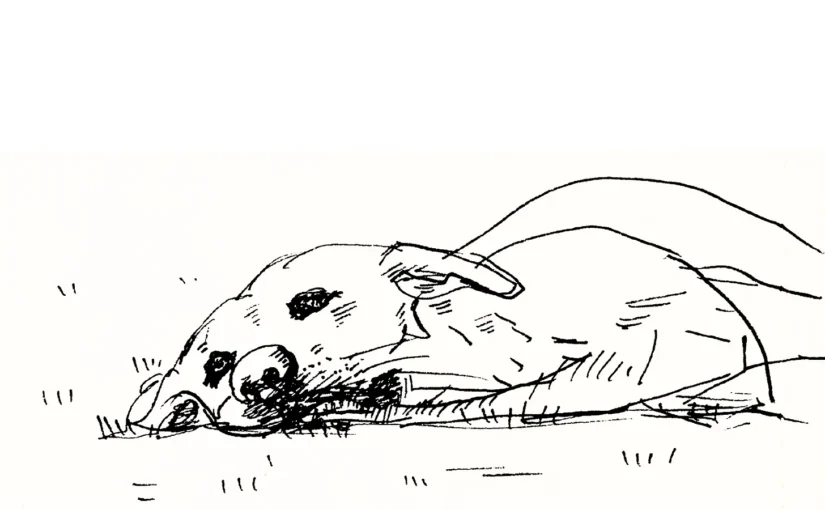
I am sharing an excerpt from my translation of Bilal Hasan Minto’s short story “Postmortem” from his collection “Model Town”. The story is about the death of a beloved pet dog and a little boy’s desire to give him a proper funeral. This desire comes into conflict with the norms of Islam which forbids funerals for animals. The entire story can be read in the June issue of The Peshawar Review.
It was a frost-laden evening in December when our Happy stopped eating. Naveed Bhai went into the garden, where Happy was sitting quietly tied to his post, to cover him with a coat. Happy looked at Naveed Bhai with barely opened eyes, and smiled. Then he moved his tail weakly from left to right. That was it. This was unlike him. He didn’t stand up and wag his tail vigorously, or play around with Naveed Bhai. Naveed Bhai was worried.
“Happy, Happy,” he cajoled.
Happy didn’t even open his eyes and just moved his tail from right to left. It was clear even that was not easy for him and he did it only out of love for Naveed Bhai. Naveed Bhai’s eye fell on his bowl. Happy’s afternoon meal was sitting there untouched,flies buzzing around it.
That night at the dining table, Naveed Bhai told Abba about Happy’s condition and said with concern it seemed he was ill because he hadn’t touched his afternoon meal. Abba said maybe he hadn’t liked it.
“But he gets this food every day,” I said, “and he always eats it.”
“Perhaps that’s why. If you got the same thing every day you would get tired one day too, wouldn’t you?” Abba said.
“Oh! So now I have to prepare a new feast for him every day!” Ammi said angrily. She hated Happy.
“Anyway, let’s see if he eats anything tonight,” Abba said, wanting to end the conversation.
“But why didn’t he move? I even had to put on his coat while he was lying down,” Naveed Bhai said anxiously.
“Maybe he has a cold. It’s freezing. If he doesn’t eat at night or is the same tomorrow, take him to Dr Walter,” Abba said.
That evening, Naveed Bhai and I took Happy his meal. Naveed Bhai had asked Ismail to make qeema and soft rotis. The rotis had been crumbled and mixed with the qeema,everything topped with yogurt. We had prepared a very delicious meal for our beloved Happy — Naveed Bhai had even given it a name: ‘Happy mix.’ I had garnished it with some cilantro so that the elegant presentation and the cilantro’s freshness, smell, and color would attract Happy’s attention.
Happy was not generally fed late because then he would sleep through the night. Although he didn’t do much anyway, it was still reassuring that Happy was awake while we were fast asleep. Aside from this false comfort, there wasn’t any point in keeping him up all night. Naveed Bhai thought it was cruel to do that and allow him only two meals while we had three and could take fruits and drinks from the fridge whenever we wanted besides. But Abba had consulted some reference book to decide the rules for Happy’s living and eating so Naveed Bhai had to obey this regimen of two meals a day.
Happy didn’t bark much. Sometimes,he would if there was a special reason,and we would be thrilled. We could never figure out what motivated it — the impetus seemed mysterious. He wouldn’t bark at any passing stranger nor at any cat or mouse. He did bark at cars speeding away from him but not at those approaching. He would run after the departing cars, barking all the while, and if they stopped, he would immediately do so as well,stop barking, and turn around to run inside the house. Abba had told us Happy thought departing cars were running away because they were afraid of him. He felt brave thinking they were afraid and pursued them,relishing their fear. So when they stopped,he turned around quietly,disappointed they weren’t scared anymore.
It was not just Ammi who disliked Happy. Happy also disliked Ammi but despite the fact that she was always scolding him, he never barked at her.
“Don’t sit in the verandah,” Ammi would say for no reason although the verandah was an open space with only two or three chairs. And it wasn’t even as if Happy would sit on those chairs.
“Get out of here,” Ammi would often say. She said that even when Happy was sitting alone on the lawn or in some other place.
“Don’t you dare come near me” — as if he were really fond of coming near her.
When Ammi would scold him he had to do as she said,but he would look at her and make a face. That made Ammi even angrier. Abba would always remark that there was no reason for anger. Just as she didn’t like Happy, he didn’t like her. Ammi would say at least she didn’t make a face and that making a face at your elders was extremely rude. Then to prove the point, she would say to me: “Listen, you! If I ever catch you making a face at your elders, I will skin you alive and hand you the skin” which was an obvious impossibility because human skin is very fine and cannot be removed like a bear’s or stag’s and even if that were possible there isn’t a man with fortitude enough that his skin could be removed and he would hold it quietly in his hand. The depiction of such a person cannot be found in any book of history, true or false.
“You can speak and scold him. He can’t talk, so he makes faces,” Abba had said once.
But Ammi’s question was how Happy knew she didn’t like him. Abba had responded that dogs could even smell people’s emotions and she actually screamed at Happy. Both Naveed Bhai and I had really liked this bit about ‘smelling emotions.’ Often, when guests scared of dogs came to our house and Happy would sniff their shoes and clothes, we would smugly reassure them and say “Don’t worry, he’s only smelling your emotions.” Some would relax on hearing that and some would be surprised.
Some others would become agitated as if Happy were a spy and after smelling their hidden emotions would report them to us. When such people were flustered, they might do something strange. Women would start screaming and men would begin speaking rapidly or they would walk quickly towards the door to get inside fast — leaving us, whose house it was, behind. This would sometimes, but very rarely, cause Happy to bark at them and it would appear as if he were mocking them. At such times we would be delighted to hear him bark, forgetting that our laughter would upset our guest.
Once, when such a frightened guest dashed out of the house, Happy bit him by mistake. Perhaps, he bit him out of confusion, seeing this human behaving so strangely without any reason — he had just arrived and now he was running out. The man whom Happy accidentally bit died after a few days, not from Happy’s bite but from a fatal heart attack, of the kind that frequently occurs.
The afternoon meal was still untouched in Happy’s bowl. Maybe there aren’t flies at night. Maybe they go somewhere or go to sleep, because at this time, there were none on the food. Ismail picked up the bowl and went out of the gate. He emptied it on the trash heap and brought it back. Naveed Bhai and I just stood there,looking at Happy. Naveed Bhai would call to him from time to time: “Happy Happy, puch puch.” But now he did not wag his tail or open his eyes. We would have thought he was dead if his stomach were not rising and falling with his breath.
On the wall between our house and Apa Sughra’s, a cat appeared. Naveed Bhai immediately made a sound to rouse Happy, the kind one makes with dogs, making a clicking sound and then saying “Ush.” “Happy… look there… karak, uuush.”
I was irritated and asked why he was going through this pointless exercise. Happy was hungry and still wasn’t even looking at his food. Had he ever in his life said anything to a cat or a mouse? Does he look like he’s going to start chasing the cat just because of your karak and ush? Naveed Bhai didn’t reply. He was worried.
When Ismail brought the bowl back, Naveed Bhai put the “Happy mix” in it and put it right in front of Happy’s nose so the smell would make him hungry. Happy didn’t move. Naveed Bhai picked up a piece of roti and touched it to Happy’s nose but there was no effect.
“Try feeding him by hand,” I suggested.
“How?” Naveed Bhai asked.
“You pull his mouth open and Ismail will put the food in it,” I said.
“And you? You will just watch?” Naveed Bhai asked,laughing.
“When he tastes the cilantro and yogurt,he might feel like eating,” I changed the subject sheepishly.
With much effort, Naveed Bhai opened Happy’s mouth a little — very little, hardly half an inch — and Ismail picked up a small piece of roti and tried to force it in. Naveed Bhai also kept calling “puch puch, Happy Happy, hoot hoot.”
“Puch puch,Happy Happy, hoot hoot.”
“Hurry up! I can’t keep his mouth open very long,” he said.
Happy’s mouth began to close by itself and Naveed Bhai quickly pulled his hand away. His finger scraped against one of Happy’s sharp teeth and a drop of blood appeared on it — just as these days diabetes patients take a drop of blood from their fingers to test their blood sugar. Naveed Bhai wiped off the blood on Happy’s dog coat.
“We’ll have to take him to Dr Walter tomorrow,” he said.

Such a moving story. The innocence and pure hearts of those young children who see all creatures as equal was beautifully brought out in the story.
Thanks for your comment.
Bilal Minto’s choice to have the narrator of most of the stories in the collection be a pre-adolescent child was quite inspired. It allows him to comment on the hypocrisies of the adult world in a way that is not too heavy-handed.