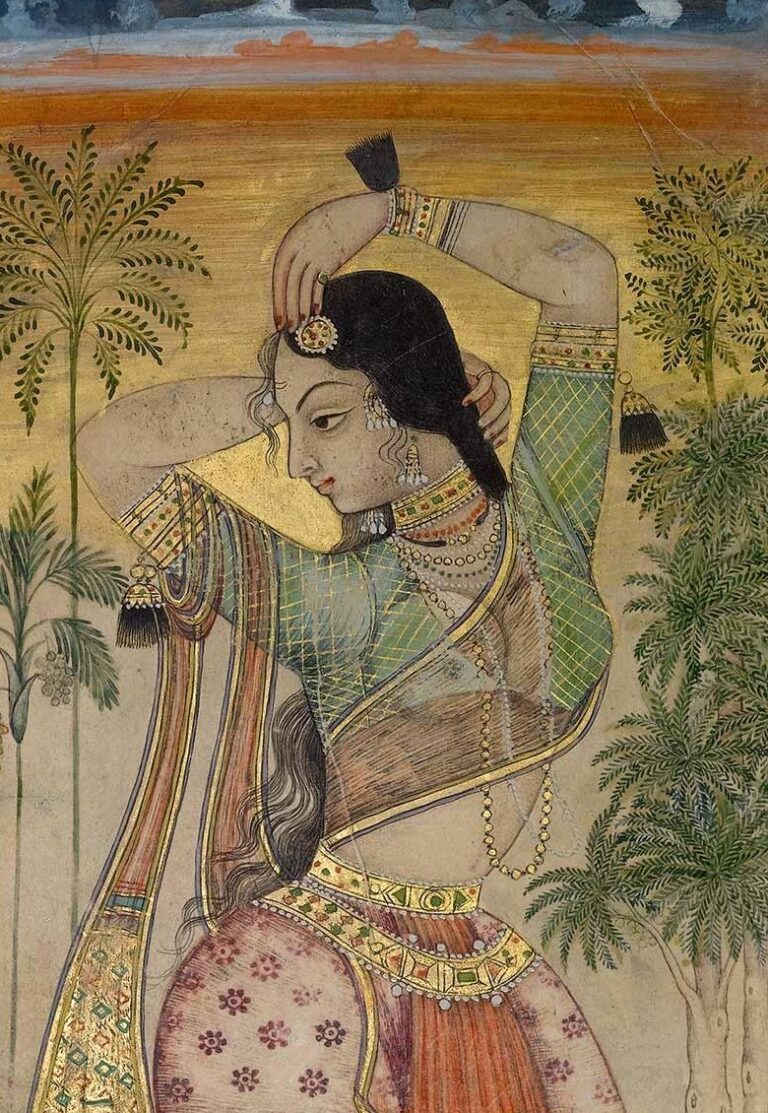

There is one fault line under everything that happens here, and it is old. Pakistan stands, whether it wishes to or not, as the proxy for the Muslims of the subcontinent, and India as the proxy for its non-Muslims. This is not a quarrel of the last election or the last war. It is a wound more than a thousand years old, set running when Muhammad bin Qasim landed in Sindh in 711, and it has been arguing with itself in the subcontinental subconscious ever since. Every thread on this site is a small, late episode of that argument.
There is a scene in The Devil Wears Prada, the cerulean one, where a colour chosen by Miranda Priestly (Meryl Streep) at the summit of fashion is followed down the seasons, runway to department store to clearance bin, until Andy (Anne Hathaway), who fishes it out is sure her choice owed nothing to any of it.
The subcontinent’s argument works the same way. Bin Qasim’s landing in 711 was a decision taken at the top of history, and it has filtered down through thirteen centuries of conquest, doctrine and memory into a comment thread, where two strangers swapping insults are certain the quarrel is about this week. It is not. It was chosen for them a thousand years ago, and they are wearing it without knowing the name of the colour.
What is new is that the argument is going quiet, and quiet is worse than loud. The subcontinent is partitioning itself a second time, in the mind. Indians increasingly talk only to Indians, Pakistanis only to Pakistanis, each inside a feed built to agree with them. The 1947 line cut the map; the algorithm is cutting the conversation. Against that, the value of Brown Pundits is simple and almost embarrassing to state. It is one of the few open places left where the two sides still argue with each other in public and mean it. That is worth defending even when the argument is ugly, because the alternative is not a calmer argument. It is no argument, and two rooms that never open the door.
Is BP sui generis on the Internet?
Ask the question plainly. Where else are Indians and Pakistanis actually talking to each other, not writing past one another from separate rooms, but going forty rounds in the same thread and coming back the next morning? Sapan News does serious cross-border peace journalism, but it is syndicated reporting, not a contest in public. 3 Quarks Daily is curation, done beautifully, but a reading list is not an argument. The Juggernaut is paywalled and diaspora-facing, more interested in the second generation in Queens than in Lahore arguing with Delhi. Reddit and Substack are individuated by design; everyone gets their own room. We cannot name another. That absence is the whole case. A talking shop can be replaced by a better talking shop; this cannot be replaced by anything, because nothing else is doing it.
The Missing (Indian) Muslim
The composition tells its own story. The two groups that dominate the threads, the North Indian Hindu and the Pakistani Muslim, hold the most bigoted notions of one another that we publish. The cooler register comes from the edges: an Indian Christian in Calvin, a South Indian in girmit, and from the Hindu side Nachiketa, who argues from curiosity rather than from a side. And there is a silence we should name, because it is the loudest thing in the room. We have no Indian Muslims here at all (except when they want to ask about their community genetics). The community the contestation is most about, two hundred million people, is the one voice missing from the argument over its own fate.
Wrong on Balochistan
When the two sides do engage, the failure has a signature, and it is instructive because it is fixable. The Indian commentators are strong on facts and weak on lived experience. Watch the Balochistan argument. Indians flatten Balochistan into Kashmir as though the cases were the same, and the texture vanishes: the Baloch are spread across Sindh and South Punjab, are a minority even within Balochistan, and are mostly not separatist, with the insurgency a thin slice that commands little of the world’s attention. The ancient older unity of the Indus valley, Kashmir included, vanishes with it.
Wrong on Caste in Pakistan
The caste argument this week was the same error in another key. Citing professors on caste in Pakistan is not wrong about the data; it is wrong about the register. The Ashraf categories are largely invisible, salient in a narrow context the way WASP hegemony is salient, not the all-pervasive, ever-present ordering that caste is in the Hindu world. There is a real perniciousness in that invisibility, and Pakistanis are too quick to deny it exists at all, but invisible is not the same as absent, and to equate the two is to argue from low knowledge dressed as citation. The Pakistanis misread in the other direction, reciting tropes about Hindus until the Hinduphobia surfaces and the cycle restarts. Each side feeds the other.
How we hold the Peace between the Factions
This is why the moderation looks as it does. We do not delete much, we do not farm the brawl for traffic, and we rarely enforce a precedent against a single comment. What we read is intentionality. When someone relitigates Balochistan as though the precedent threads were never written, the question is not whether the comment breaks a rule but whether the person is arguing or trolling, and we moderate the person, not the sentence. The one hard line is separation: when two parties cannot speak without acrimony, we keep them apart. These are principles deduced case by case and then kept by everyone, a common law rather than a code. The boundary is wide. It is not wide enough to launder a massacre, and that is where the bridge stops.
Do we all deserve a Nobel Peace Prize?
Kabir asks whether this is an intellectual forum. Perhaps the better question is whether it is a necessary one. Wherever the borders close, the hatred fills the gap, and the threads show that the hatred runs on misinformation that only contact can correct. People arrive carrying their trauma. Given time, they begin to explain it, and explanation is where understanding starts.
We would rather run an imperfect, sometimes ugly bridge than a perfectly curated room with nobody crossing it. A wound thirteen centuries old will not close in a comment section. But it will not close in two sealed rooms either, and a sealed room is what the rest of the internet is quietly building.
Muzzling certain commenters, banning them from responding to a subset of comments or threads, is not quite the unsealed room that we are going for is it?
The right to a safe space trumps free speech in anonymous online spaces?
This is a Precedent Principle now re Safety. You are obviously welcome to exercise Authorial Privilege and dispute it but we are satisfied with that.
No one is muzzled or barred as far as we can see. It also doesn’t impinge on free speech; those 150 comments we removed weren’t particularly high signal to be fair and we would prefer a quieter more reflective space than a noisier reactive one.
The “ceasefire” has been imposed because certain people could not restrain themselves from getting personally nasty.
I have a right to a cordon sanitaire around myself where I cannot be personally attacked.
Nothing stops RNJ or BB from responding to Q or EK. Unless, they push those guys to the point where they also ask for a no-engagement policy.
“Tolerance” does not mean that one will accept being attacked or bullied. Such behavior is not part of civilized debate.
I remember watching Audrey Trushke in some podcast and she mentioned this which was so true: she said that the Hindutva ideologues literally have no conception of time, they will talk about things than happened 100’s of years ago (even thousands) as if those things happened yesterday and contruct their narrative and entirety of their modern politics based on that. Once you see all Hindutva and modern Indian arguments through that prism, you understand where they are coming from and you also understand how unreasonable these people are.
The India Pakistan beef is due to this reason alone, the Indians have been told that they were one glorious united Dharmic country, and that the Muslims divided India, and that Pakistan was “Hindu” land. Whether its a BJP and Congress supporter, they both dream of Reconquista when in fact there is no ‘Re’ here. And this is also the primary reason why they are so hostile and genocidal against their own Muslim population even when the Indian Muslims are mostly removed from power.
I think the only leader India ever produced that wanted to concede Pakistan was actually Vajpayee, however it is douttful that his view was actually shared by the Indian deep state.
They simply want to reenact their mythology of dominating the region, and do not want to accept that Pakistan does not want to be dominated.
Okay, this is a very kinda wierd arguement you are making here. Firstly, Audrey Truscke is basically a grifter at this point, and I say that as someone who is left-leaning (by the standards of this blog) in addition to being someone who doesn’t outright shit on the Mughal empire.
Secondly, that is not really a Hindutva view since every community in India looks at things through a wide timeframe. I have literally seen Kannada, Telugu, and Maratha people argue over their respective claims on the Satavahana dynasty. Even my own minor Christian community literally talks about its history through a 2,000-year perspective. Additionally, it’s an easy 500-year grievance when you literally have Mosques being built atop old temples; it’s hard to forget when history is an ever-present reality.
Thirdly, I am pretty sure only Congress and Indian Muslims actually cared about having India and Pakistan as one country. Congress, from its very start, never really liked partition and had a hangover about the whole issue. I remember hearing about how Nehru opposed Israel since their Zionist ideology shared the same basis (from his perspective) as the 2 nation theory that existed at the foundation of Pakistan. Even Vajpayee (despite being a BJP leader) seemed to hold a similar view to his Congress predecessors; at the same time, he made overtures to China as well in an effort to mend ties after 1962. So, there was nothing unique about his views here.
Fourthly, the BJP doesn’t even shit about Pakistan, quite frankly, since they agree with the 2 nation theory to begin with. Most BJP supporters see India as the main Hindu Heartland and want an even stricter version of Partition, where they would expel even more muslims. Also, Pakistan was never really a centre of Hinduism or possessed any major Hindu sites to begin with. Sikhs probably have more religious sites in Pakistan than Hindus. Why would they even want to Reconquista? Maybe some terminally online people might care about this, but even then, I haven’t heard anything as much either.
Lastly, the majority of issues between the two countries are about Kashmir and the stupid amount of actual wars, as well as the excessive shadow conflicts. Quite frankly, the rise of the BJP kinda ended any sense of “India and Pakistan are the same country” sentimentality, and people have wholeheartedly accepted the partition. The dispute these days is over what the nature or Identity of the Indian state should be.
Excellent comment
The only point I would disagree with is on important Hindu sites not being in Pakistan. Hinglaj Mata and Sharada Peeth are major Shakti peethas still functional. The rest (Hindu and Buddhist) have clearly been destroyed systematically from Qasim’s time to the point that there are no extant Buddhist structures in Pakistan anymore.
One obvious example of destroyed Hindu sites is of the Prahladpuri temple.
May I introduce you to Katas Raj?
https://en.wikipedia.org/wiki/Katas_Raj_Temples
“There are no extant Buddhist structures in Pakistan any more”– Do you know that for sure? Because the Dharamarajika Stupa begs to differ.
These kind of pontifications about Pakistan with complete certainty just reveal one’s own ignorance.
A simple Google disproves your point entirely.
To be clear, by extant I don’t just mean the physical structure. For Dharmics, a structure holds meaning only when its consecrated and is a place of active worship. Ignorance is indeed bliss.
Pray tell how many Buddhists are still in Pakistan?
Atleast the ruins tell the story of Dharma despite attempts to destroy it entirely.
Also incidentally, a ceremony was recently held at the Dharamarajika Stupa which featured monks from Sri Lanka, Thailand, Nepal, Vietnam and Myanmar.
https://www.dawn.com/news/1997060/ancient-dharmarajika-stupa-in-taxila-echoes-with-dhamma-sermon-after-1500-years
No Buddhists from Pakistan presumably?
There are no buddhist in the Indian subcontinent outside of Sri Lanka to begin with.
Naah.
There are Buddhists in Ladakh, Sikkim and Arunachal who have always been Buddhist (or at least for a long time).
Of course, we have the Neo-Buddhists in Maharashtra too.
Bhutan is also Buddhist majority plus Nepal has a decent minority.
In fact, India’s Buddhist population is bigger than Pakistan’s Non-Muslim population.
Maybe I should have said peninsular India instead. Buddhism died out in the indo Aryan and dravidian heartland, except Sri Lanka.
quite a funny picture tbf hah but good job on Pak
Also,may I introduce you to the Tilla Jogian complex?
https://en.wikipedia.org/wiki/Tilla_Jogian
The point is that your assertion ” The rest have clearly been destroyed systematically from Qasim’s time” is a gross generalization.
Admin Note to All: Please cool the tone to all.
You just don’t like losing an argument.
Feel free to have the last word.
Don’t worry. There’s no fear of my “losing an argument”. I am quite confident about my debating ability compared to most of the commentariat.
Your assertion about temple destruction in Pakistan was a gross generalization. I’ve already disproved it by providing the evidence of Katas Raj and Taxila.
Btw, I’ve been to both Katas Raj and Taxila. Prior to the India-Pakistan border being closed post Pahalgam, Indian pilgrims regularly used to visit Katas Raj.
Also, may I introduce you to the Taj Mahal?
I agree with Q. By “Reconquista” he perhaps means the notion of “Akhand Bharat”. This is certainly a BJP notion and not a Congress one. Congress accepts that India is a modern nation-state created in 1947.
I have written about “Akhand Bharat” here:
https://kabiraltaf.substack.com/p/on-civilization-states-vs-nation
We can also observe even on this blog that Pakistan takes up a disproportionate share of mindspace among North Indian Hindus. We see this in the repeated assertions that Pakistanis are “Muslim Indians gone astray”. Obviously, this sentiment is very offensive to Pakistanis since it is meant to de-legitimize our nation-state.
Bangladesh doesn’t elicit the same extreme reactions on this blog. Perhaps because we don’t have regular commentators from West Bengal.
There is definitely a psychological aspect to this that deserves elaboration in a dedicated post.
See, Akhand Bharat is a completely irrelevant concept that is only talked about terminally by online people. The only people who talk about this concept in a serious tone are far right (even for the median conservative voter) or people who criticize Hindutva. This concept lacks any political salience in the offline political world outside of being a vague concept mentioned as part of a long list of talking points. Also, the idea was centred around the entire region being part of a singular cultural sphere, which I mean, pretty sure they copied outright from the idea of Indosphere used to describe pre-Islamic political entities in Southeast Asia.
This doesn’t seem to be anything close to the Reconquista because I don’t think anyone wants to conquer Pakistan. Quite frankly, this idea is somewhat of a dog whistle, like Ghazwa I hind concept. The only people who talk about it seriously are very far right, even for the BJP, or people who are providing disingenuous criticism, usually by people who have stereotypical views about India and Hinduism. Similar to Ghazwa i Hind, mainly referred to by Islamic extremists or by non-muslim indian trying to criticize Muslims (especially indian muslims) via stereotypes and shitty remarks.
Also, I don’t think you understand either Hindus or Hindutva here. The main point of Pakistan in the Hindutva imagination is to serve as a reminder for Hindus. Pakistan represents a country that “Indian” Muslims created for themselves, and look at how they treat their minorities *cough* Hindus *cough*, this is what will happen if you let Indian Muslims run amok. Hindutva is centred around the politics of paranoia; everything else is a byproduct of that belief. Its success stems from propaganda on one hand and the general non-indian very orientalist or racist caricatures about Indian generally and Hindus more generally. The point is to reinforce a sense of isolation and paranoia, which is easy to do since no one really understands what India is, and most people construct an illusory version of what it is.
Honestly, even this blog suffers from these issues. So much of the discourse here about India feels more like what an outsider thinks India is like, versus the actual reality. A lot of the Indian commentators here feel somewhat like an outlier in comparison to the median voter, and they seem to be missing a lot of social subtext that is clearly being communicated by the general population.
Lastly, Bangladesh absolutely has a massive impact on the same level as Pakistan these days, especially in North Eastern circles. You are understanding how much of an impact it has on discourse; it’s just that people here lean more to the Northwest or South.
“Akhand Bharat” is deeply offensive to Pakistanis (and Bangladeshis etc) since it is basically a de-legitimization of our country.
The fact that it is talked about by members of your ruling party and that there is a map of “Akhand Bharat” in your parliament (as I referred to in my essay) makes it very different from “Ghazwa-e-Hind” which honestly no mainstream political party in Pakistan speaks about. When has Shahbaz Sharif–or even our Field Marshal– spoken about ‘Ghazwa-e-Hind”? They don’t do so because Pakistanis are fine with the existence of India. Our only issue is the Disputed Territory of Occupied Kashmir.
I do agree with you that the Indian commenters on here don’t represent the average voter. By and large, they seem to me to represent a Hindu Right demographic. The only commenters who I wouldn’t call “Hindu Right” are yourself, Calvin and girmit. And of course, you and Calvin are not even Hindu.
Agreed that this blog doesn’t have commenters from West Bengal (as far as I know) hence there isn’t the same angst about Bangladesh as there is about Pakistan.
XTM pointed out that the commenters of this blog don’t include Indian Muslims. Indian Muslims are being fought over by Pakistani Muslims and North Indian Hindus. It would be good to hear them speak for themselves.
Firstly, I am pretty sure that was a map of the Mauryan empire since it excluded both the Southern and the Northeastern regions. Also, you kinda are proving my point here. Like, I don’t even think the BJP put as much thought into the concept of Akhand Bharat in the manner you are describing here. I have literally never heard of this concept from people actually living in India, as much as I have heard it from people on the internet. One exception in real life was seeing a random picture of it on a car in Canada, but that checks out since a portion of South Asians in Canada are oddly nationalist conservatives for some reason.
The only other times Akhand Bharat even appeared extensively would be in a foreign newspaper for some reason. However, foreign news reporting doesn’t report on India with any form of nuance, so I don’t think that reporting on Akhand Bharat means anything here. I honestly to god looked up a Reddit form and searched up “Akhand Bharat”, where the first comment literally called Akhand Bharat and Ghazwa e Hind a stupid concept with multiple upvotes. There were many similar comments, and this was a very conservative forum. Even though they think this is a very stupid concept, it tells you a lot.
Most politicians just don’t care about this concept as much. Quite frankly, I think this idea kinda lost value after Modi 2.0, since Modi 3.0 seems to be quite directionless and seems to be internally spiraling too much. We are reaching political saturation for Hindutva Ideology, so I think they care about Akhand Bharat very little. I feel like this is a concept that isn’t even worth getting mad over, since no one really cares about this topic on the ground.
Lastly, no Indian muslim would ever want to come here. I randomly ended up in spaces with indian muslims once; God, the amount of times Pakistani nationalists and Hindu nationalists forced themselves in was a lot. Pakistani Nationalists tried to make Indian muslims share their negative opinion about India, while Hindu nationalists tried to underplay the violence they faced and questioned their loyalty. None of this included their own internal squabbles between conservatives yelling about how everything is Shirk, or the odd anti-Shia tirades about the Bohra community for selling out to the BJP. There were other centre-leaning people talking about how we focus on the community, build bridges with other Hindu groups, and build grassroots networks.
Most indian muslims seem to gravitate to centre-left-leaning spaces since they can somewhat express themselves there. I doubt you want to come here, a blog that is explicity centre to the right-leaning. Honestly, the fact that I, a Gay Christian male college left-leaning person, ended up on this blog is kinda weird. At the same time, I find the Pakistani ragebait to be quite ineffective since they don’t understand Indians or India (from my perspective), and the same applies to the Hindu right as well. Honestly, I might just have taken rage bait literally and written paragraphs until the other person got tired.
Frankly, I feel like this place is gradually turning into a weird echo chamber, where Hindu right and Muslim right people are yelling the same argument over and over again. There really needs to be more rules here, or else this will gradually turn into a right-wing echo chamber of pointless arguments.
Agree with you that this forum wouldn’t be particularly attractive to Indian Muslims. The presence of so many Hindu right people would definitely be a turn off.
Also agree with you on the blog turning into a right-wing echo chamber (both Hindu Right and Muslim Right). For what’s worth, I identify as a center-left Pakistani. I only vote in the US and in that country I have always voted Democrat straight down the line.
You might be interested in my review of Komail Aijazuddin’s “Manboobs”. It’s nice to see LGBTQ representation here.
https://www.brownpundits.com/2026/04/26/review-manboobs-by-komail-aijazuddin/
everyone is allowed to shope BP as they want to .. in fact we think very good light comes out of the comments. it makes us ponder and reflect on the central cleft.
if the Indian Subcontinent healed its divide; it would be unstoppable
I agree with the fact that everyone should have the capacity to express their opinion freely to produce nuanced debates. However, the problem remains that most of the time this requires people to be somewhat about looking beyond their perspective, but most people here have an opinion about a specific subject that they hold onto quite strongly, without reflecting on their own position. The result would be an endless circular argument, where everyone makes the same arguments over and over again with no nuance or end in sight. I, myself, am guilty of this on certain occasions.
The blog format has clear limitations since you can’t explain a lot of nuanced and complex subject matter in a single post. I end up writing big paragraphs all the time since there are many aspects that are worth discussing here, which can’t be summed up in a single comment or post.
On top of that, a sizeable portion of the discussion about anything South Asia requires additional cultural knowledge and education (via readings or schooling) on many subjects in order to have certain discussions. I can’t explain the intricacies of caste to someone who neither lives in such a cultural context nor is extensively well-read on the subject matter. It’s kinda why I don’t comment on Pakistani issues since I lack that cultural context.
The last main point here is that people here treat their opinions as fact. I, myself, have accidentally done this on some occasions, but I try to point out my references for factual information whenever I can.
There is a lot of useless heated argument over subject matter due to missing context, overgeneralization, or cultural differences. This makes debate fruitless and pushes away the median voter that represents the majority in these countries.
I will just leave his quote from the Inquiry into the True Nature of Things by Raghunatha Siromani, the first modern philosopher of South Asia and a major figure in the Navya Nyaya school:
I think what he is referring to is how incidents from the past are used to settle scores today.
In this regard much of the conversation on Indian musliks and indian christians seems to flatten time and space and make the average indian muslim or christian accountable for something a state they had no role in did
I have seen some people literally ask accountability from Goan catholics for the actions of the portuguese despite they themselved being victims of portuguese colonialism in the same vein, Indian Muslims are regularly linked with mughal emperors or something ghori or Ghazni did everytime there is some sort of conflict. Even modern day conflicts like Pahalgam see Indian muslims bring asked to take accountability, when the actual link between the average muslim and any terrorist or antinsocial element or muslim king is tenuous at best.
Agreed.
Indian Muslims have been called “Babur kay aulaad” (Babur’s Children). If I’m not wrong, “Hindu Hriday Samrat” has himself used this phrase.
Obviously it’s a bad idea to hold present day Muslims or Christians accountable for the actions of invaders.
However, it certainly doesn’t help if IM’s idolize Aurangzeb or Afzal Khan or for Indian Christians to literally pay obeisance to Francis Xavier (the primary instigator of the Inquisition).
Francis Xavier called for an inquisition of the portuguese jews or muslims who may have been hiding in goa
Goa was already christianized by thr time he came for his sojourn and you dont hear his bigoted views echoed by Indian christians at all.
The fact that he, not the Portuguese king who was the actual person who authorizer inquisition on native population almost 70 years after his death and the bishop of goa at the time are not given the center piece in talking of the inquisition shows how history is being used to weaponize grievances against people today.
I don’t have the patience to write tomes correcting you, but please at least read a bit on the topic before spouting nonsense.
https://en.wikipedia.org/wiki/Goa_Inquisition
The Goa Inquisition: the terrible tribunal of the East by A K Priolkar.
Lastly, how did you infer that I implied that his bigoted views are attributable to the Christians of Goa? Is it not true that the embalmed body of the bigot lies in a Church where people pray to him? Its an affront to those who were tortured, converted forcibly or killed brutally.
Goa was known as the Kashi of the West before the barbaric Portuguese destroyed it.
Francis Xavier was not responsible for the inquisition on Indians. It was the reigning monarch John III.
He wanted an inquistion for the portuguese muslims and jews who werw hiding in goa. Furthermore, there is nothing to correct. The fact that most of those who speak about the inquistion conveniently dont refer to the bishops and the king who were the actual reigning authorities, but focus on Francis Xavier who barely spent any time in goa, barely had any impact in his lifetime and was one of the way goan catholics absorbed catholicism leaving aside all of his bigotry, is a sign that this discourse is also trying to settle present grievances.
The inquisition primarily focused on the New Christians accused of secretly practising their former religions, and Old Christians accused of involvement in the Protestant Reformation of the 16th century.[1] Also among the targets were those suspected of committing sodomy; they were given the second most harsh punishments.[2][3] The inquisition was established in 1560, briefly stopped from 1774 to 1778, and was reconvened and continued u ntil it was finally abolished in 1812.[4]
Crypto-Hinduism practiced by the Goan Catholics was viewed as a challenge to the Church’s doctrine. Those accused of such practices were often instructed to confess and realign with Catholic teachings. Imprisonment, torture, death penalties, and intimidating people into exile were used by the Inquisition to enforce Catholic religious control.[5][6][7][8][9] The Inquisitors also seized and burned books written in Sanskrit, Dutch, English, or Konkani, as they were suspected of containing teachings that deviated from Catholic doctrine or promoted Protestant, Hindu or Muslim doctrine. The Inquisitors aimed to ensure Catholic teachings were absolutely enforced.[10]
In 1545, Francis Xavier wrote to King John III of Portugal requesting a Goan Inquisition.[13][14][15] Between the Inquisition’s beginning in 1561 and its temporary abolition in 1774, around 16,000 persons were brought to trial. Portuguese authorities sought to enforce Catholic doctrine in Goa. When the Inquisition ended in 1812, the majority of its records were destroyed by Portuguese officials, making it difficult to determine the exact figures of those prosecuted and the nature of their cases.[6][5] However, the few records that remain indicate that approximately 57 individuals across the 249 year long inquisition were sentenced to execution for significant religious transgressions, while an additional 64 were symbolically condemned after they had died in custody. These numbers reflect the rarity of such punishments amid efforts to enforce compulsory Catholicism over many decades, partly because people avoided prosecution by fleeing Goa.[16][17]
I know what the inquisition was for, what it involved, and unlike many others who was the one who authorized it and who were the ones who carried it out.
//In 1545, Francis Xavier wrote to King John III of Portugal requesting a Goan Inquisition.//
As mentioned before, and if you would see the letters your source is quoting, he wanted an inquisition against portuguese who he suspected of being hidden muslims and jews, not native Indians. This nasty yet inconvenient fact is omitted in public and online discussions to use as a cudgel against goan catholics who largely came to believe in Francis hagiography, due to their need to raise their standing in a catholic world, for which Francis was a convenient figure( bigotry notwithstanding)
Your deliberate obfuscation and gaslighting the poor victims of the Inquisition is condemnable. Shame on you.
What started as a witch hunt against Jews in Portugal was then expanded to hunting recent converts of the indigenous folks in Goa. The net then widened to include Hindus, Muslims and Christians of other denominations.
As somebody whose forefathers fled Goa precisely due to the Inquisition, spare me the gaslighting.
My forefathers were also victims of the goan inquisition so dont accuse me of gaslighting.
Did I deny that the inquisition was tortorous, or nasty or violent, then who am I gaslighting?
I am simply saying that in public and online discourse the role of John III and the bishops in charge of goa is rarely mentioned but Francis Xavier letters where he is begging for the king to be harsher on the portuguese for not following their religion is used to make him a centerpiece of the inquisition, which he was not so that goan catholics can be talked about poorly, it is people who obfuscate the real perpetrators( John III and the larger goan clergy of that time) to settle scores today that are gaslighting you, not me.
All sources literally point to Xavier as the primary Instigator of the Inquisition in Goa. Just because he wasn’t present to enforce it does not absolve him of the crimes for which he was more than a willing accomplice.
And if your forefathers were also persecuted at the hands of the Portuguese, all the more reason to cast him aside. Why would you revere such a figure?
//All sources literally point to Xavier as the primary Instigator of the Inquisition in Goa. Just because he wasn’t present to enforce it does not absolve him of the crimes for which he was more than a willing accomplice.//
Do they? Because the sources only show the below.
1) He did not like other religions and particularly Brahmins, like most of his countrymen.
2) He himself was not even sure that his letter to the King would be read.
3) The letter where he calls for stricter enforcement of catholicism of is one in reference to growing laxitude of practise among portuguese christians.
4) He also expressed glee at temples being brought down by former converts.
What is happening in most sources you find on the internet is letter where 1) and 4) is mentioned and where 3) was requested are brought together, selectively quoting 3) so that his focus on portuguese christians is not clear. I dont think you have read the letters that he actually wrote but excerpts.
Anyone who has taken the time to know what kind of society portugal was after reconqista would know that opinions expressed by him are not unique, nor was he a trendsetter, they would also know that the final authority rested with the King and Francis Xavier was just one more missionary in goa in his time,with his voice having no more greater than value than any of the other bishops or clergy who would be saying the same thing, then why so much focus on Francis Xavier?
//And if your forefathers were also persecuted at the hands of the Portuguese, all the more reason to cast him aside. Why would you revere such a figure?//
Because saints are not suppsed to be perfect human being, but their devotion is supposed to lead them to being better versions of themselves. My community members know he was a victim of the culture he was born in, and appreciate the kindness he showed to the new converts despite it, plus as he grew in stature post his cannonization, goan catholics who wanted to move up higher in portuguese social hierarchy found him a useful figure due to his association with goa. My community members know that the culture of portugal at the time, particularly the intertwining of state and faith, made more puritanical due to reconquista are where Francis views come from, and above all put the blame on the King who had the authority to launch the inquisition.
Tldr; Francis Xaviers views are entreaties are nothing new and would have been repeated to the King by others who came from the same cultural mileu, using his later increase in stature to retroactively put him in center of the decision to do the inquisition, rather than King John III is misinterpreting huge parts of the why inquisition occured.
No point engaging with you on this.
Have you read Priolkar’s book? If not, your sources are suspect.
I have read Francis Xaviers actual letters that are quoted to know what the context was and when he had written which letter. What historians call primary sources.
These are one of the sources in Pirlokars book, that are most relevant to St Francis Xaviers role.
Then its a one eyed view, isn’t it? Doesn’t give you the complete picture. Sorry, this defence of Xavier is clearly even more biased.
Lol what? So bringing out basic facts that there is no letter where Xavier called for inquisition to be launched against Hindus is taking a one sided view, but bringing together different letters and through selective quoting saying that he was the insitgator, conveninently also leaving out that neither did he have the authority to do so, neither were his views unique for this time and neither did he have the stature for his requests to be taken seriously is not being biased with a view to obfuscate the role that culture of 15th century portugal played in the inquisition, or how important the king is.
Please read more books aside from Pirlokar, you will know how much of what I say is correct.
Lol rich coming from the apologist of the architect of the Inquisition. Perhaps you ought to read more accounts that shed light on how a “harmless bigot” lit the match that destroyed countless lives.
Keep making ridiculous excuses, cherry picking to absolve your hero.
You literally dont know what apology is.
//Lol rich coming from the apologist of the architect of the Inquisition//
Since you have read Priolkar, maybe you can tell me where he has said Xavier is the architect of the inquisition. He calls him the moral architect, conveniently the moral word is dropped in public discourse. I wonder if you jave actually read Priolkar ( not Pirkokar) to begin with.
The moral architect claim is based on his letter and retroactively assuming Francis had ad much stature as he gained later with his sainthood. Even Priolkar did not deny that the final authority rested with the king.
Taking away the increase in his stature, even if we account for Francis having influence it is not so much that he can mold policy or make the state do something they dont want to. At best his views woild get consideration but have to align with the monarch and clergy
Had you read any book after Priolkar 1961 account you would know both the concept of the inquisition and the views he espoused wete common in Portugal and this is the reason why the inquisition eventually came.
Francis is complicit like most of his society but not thr one responsible. If you cant see nuance of what point I am making and have yourself not even read any book but Priolakr 1961 works thst gives more context to the events dont throw that word around just because you care more about putting the blame on Francis than what actually led to the victims torture.
Ps: the culture was already primed to launch an inquisition due to the reconquista. It is this culture nor Francis entreaty that put the idea of inquisition in peoples head. If you did not want to put the blame on Francis no matter what this will be clear. Sending a letter saying something many other in the clergy is hardly lighting the fuse, given then wide purchase of many of his views thst he did not create
Yeah, not buying your long winded “apology “.
Xavier remains the most visibly present symbol of the horrors of the Inquisition whether you like it or not. To dismiss it as “culture ” and deflecting the blame is a convenient excuse. Not the first time you’ve done this.
He was complicit in crimes against humanity just because they were not Catholic or Catholic enough for him. Aided and abetted ably with the rest of the scum you name. Does not diminish his role in the least. But you do you.
There’s nothing more to say.
//Xavier remains the most visibly present symbol of the horrors of the Inquisition whether you like it or not. To dismiss it as “culture ” and deflecting the blame is a convenient excuse. Not the first time you’ve done this.//
Xavier is the most visible symbol because he is the one most focus is given due to the need to find cudgel against catholics not anything he had done thst makes him more than a part of a larger system.
You think saying that Xavier was the way he was because of the society he was born in and this society rather than a single individual should be credited with the spark that lit the inquisition and other people in more priveleged positions wete the real moral architects constitutes an apology you need to ask yourself whether you want to simply find a cudgel to settle present scores or actually unpack what led to the inquisition.
//He was complicit in crimes against humanity just because they were not Catholic or Catholic enough for him. Aided and abetted ably with the rest of the scum you name. Does not diminish his role in the least. But you do you.//
I dont deny he is complicit but his role is the same as one of the numerous people who did not know better in Portugal at the time. Titles like moral architect belong to John III and the bishops who actually made the decision and created the architecture to establish the inquisition why you want to make him the centerpiece and not the people who were at the center is something you need to think about. Because the only one who is obfuscating is narratives that dont even mention these people or the society ag large Xavier came from.
Maybe read a book by people like TR dsouza who also gets quoted in blogs that yoh might have gotten your info from.but holds more nuanced views.
Chiming in to say I agree that the hyperfocus on SFX isn’t earnest historical inquiry. It’s more like a quick referendum on whether catholicism was a force for good or not. The vast apparatus of clergy and imperial administrators would be a much more sincere place to investigate. Unless the idea is to say, “we don’t object to venerating founding fathers of catholicism in India per se, but we don’t think he passes the threshold criteria of compassionate humanism , given his position on what would be the inquisition”. The context within which I tend to find this debated usually betrays a more contemporary squabble. It’s probably best discussed within our own region where we live with the legacy and future consequences of these debates.
I dont mind catholicism being blamed for inquisition even if it was portuguese culture at the time that produced the version of catholicism that led to it.
I myself have admitted that Francis Xavier was a bigot towards others, he most definitely would have known that calling for greater application of faith on the portuguese in India would land them in serious trouble, and I am 50/50 on whether he would support the inquisition on natives, given that latin american priests themselves were divided on how much pressure should be put on new converts with regards to the practise of catholic faith.
My main point is that the focus on him over John III or any other clergy member who would have similar views to him and many more authority in his lifetime, is a way to use this history to speak negatively about goan catholics, not inquiry into history.
are you really asserting that any discussion of the Goan Inquisition is simply ‘weaponized grievance’?
If your discourse on the goan inquisition does not blame the reigning monarch at the time John III or thr bishop of goa who actually ordered and ran the inquisition respectively but only on Francis who was made into a hagiography figure san his bigotry by goan catholics in a society where their race was a cause for discrimination, then your discourse is not entirely interested in history only
where do you get the “not blaming monarch but only Francis” strawman from?
This smacks of an attempt to fabricate a talking point against discussions of the Goan Inquisition tbh. Quite defensive. I guess its a lot easier to interrogate the ‘flaws’ of religions objectively when you can ‘otherize’ them.
Look at the above discussion, whenever I mention that goan catholics are blamed, someone comes and says that the reverence for Francis invites these accusations.
This is a direct response of Francis Xavier but not John III or any of the bishops of goa at the time being talked about in wider discourse, but Francis Xaviers bigotry( which is condemnable) and his request to instigate an inquistion against portiguese in goa( not native Indians), being made the centerpoint in these kind of discussion, for very obvious reasons.
>>>>Francis Xavier was not responsible for the inquisition on Indians. It was the reigning monarch John III.
I scrolled up and found the above comment from you.
He was not, neither did he have the authority, nor did the letter he wrote mention laucnhing an inquisition against Indians but portuguese catholics who he suspected to be muslims and jews.
His bigotry that he had, is typical of a portuguese person and is not practised by goan catholics by and large.
>nor did the letter he wrote mention laucnhing an inquisition against Indians but portuguese catholics who he suspected to be muslims and jews.
Sorry, but this seems like pedantic hair-splitting. You yourself have admitted that the horrors of the Goan inquisition did in fact target all Indians not just those suspected to be ‘muslims or jews’.
Yeah under orders of the King of Portugal John III, not Francis Xavier who at best only wanted this on Portuguese christians.
The pendantic hair splitting is due to people bringing Francis Xavier into this because of his later growth in stature ignoring that he was a nobody who did not even think his letters would be read in his lifetime and how online discussion seem to completely act like John III had the final say and it was his decision in the end.
Blaming Francis obfuscates the larger portuguese society he was a part of, to find a cudgel against present day goan catholics.
Yes, easier to be objective when it comes to others.
I have not said a single false thing in this whole discussion FYI and given criticism where it is due.
On the other hand, others are not even looking into criticism of their own views, choosing to accuse me of lack of objectivity.
//This smacks of an attempt to fabricate a talking point against discussions of the Goan Inquisition tbh. Quite defensive. I guess its a lot easier to interrogate the ‘flaws’ of religions objectively when you can ‘otherize’ them.//
Did I deny that Francis is a bigot, as was most of his society at the time, did I say the goan inquisition was not violent or nasty?
Since you seem to have some confusion, the goan inquisition is a product of catholicism entanglement with the state since Roman times that made christian opposition to worship of others not just an opinion but a threat to christian society. I dont agree that people who have these beliefs cant live with others, but that is conditional on a clear line being drawn between government and religious belief. So no, when I say that the discourse on the goan inquisition purposely ignores the role of John III or the bishops of the time in goa to hyperfocus on Francis Xavier so that goan catholics can be talked about negatively, I am not coming at it from a defensive position but a position against weaponization of history.
One would think that actually calling out the individuals in the portugues state responsible would be important rather than focusing on a figure who became prominent in later centuries among goan catholics for different reason unrelated to his bigotry.
Do you still need me to criticize catholicism role more? Or will you finally read what I am writing rather than thinking everything you may not agree with is an apology.
I am not at all linking historical incidents to present day Goan catholics. But I find it…….notable that you choose to equivocate when it comes to the inquisition.
I’m not trying to offend you, but it does not across as a good-faith argument.
//I am not at all linking historical incidents to present day Goan catholics. But I find it…….notable that you choose to equivocate when it comes to the inquisition.//
What am I eqiuivocating? I am not hiding anything, but bringing up a way the inquisition is used to target others.
Please tell me what do you think I am hiding?
It’s not about settling scores; there is another layer to this. I once read a study where researchers asked Indian participants about their views on Muslims and the broader connection to Hindu Nationalism. The results showed that the majority of the participants didn’t actually care about past grievances; rather, they cared about what would happen in the future.
For example, Aurangzeb destroyed our temple in a violent rampage. If Indian Muslims are allowed to take power in the future, they would destroy our shrines or treat us as Pakistanis treat their minorities. The main issue they see in these past incidents is more about what will happen rather than what has happened. Another study pointed out that their views were shaped not by past grievances but by personal interactions that happen all the time. So, if a Hindu person has enough negative experiences with a Muslim figure, then it often builds up over time, cumulating in negative opinions and violence.
I remember this article (by Frontline) about a village in Bihar that avoided communal violence, where the reporters talked to a local and asked them about Muslims. Some context, the village had an informal agreement about eating habits, where muslims don’t consume beef and Hindu give space for muslims to pray. One of the villagers said (I am paragraphing): “When I hear about Muslim on the news, I think that they are bad people, but then I see my neighbour and I think that maybe the news isn’t fully true”.
Another part that is worth mentioning here would be the fact that communal tensions in some sense mask caste, class, and other conflicts. The Nuh violence of 2023 had a strong caste element as the Meo Muslims (who have an overlapping identity with and helped out the Jats) faced violence at the hands of the Hindu Gujjars (who hated the very Hindu/Sikh Jats), and the Jats were not a part of the rioting group. I wonder why that happened. Quite frankly, most communal reporting fails to account for the existence of cross-religious caste, class, and gender conflict. If a Muslim merchant is being attacked by Hindu workers yelling JSR, the underlying issues might be class one, hidden underneath a religious garb to make it palatable to everyone else.
In “The King and the People: Sovereignty and Popular Politics in Mughal Delhi” by Abhisek Kaicker, there is a unique reference to a religious riot. Specifically, there is a reference to a Holi riot that happened during the reign of Muhammad Shah. There were a bunch of Muslim shoemakers who lived in Delhi at the time. Over time, a Hindu Baniya merchant moved into this region and started taking up all the business from the shoemakers. Class tensions simmered over time between the two groups until one day a Muslim shoemaker was accidentally colored during Holi.
This triggered the Muslim shoemakers, who took this as an affront to the dignity of the Muslim community and decided to riot. They went to a Qadi/Judge’s homes to get religious/legal legitimacy, but the judge didn’t come out, and the muslim crowd threw rocks at his home. The Muslim mob decided to riot either way, and they proceeded to attack the Hindu Baniya merchant’s home, which was defended by his muslim bodyguards. The merchant didn’t have anything to do with the Holi colour incident. The person recording this called the riot a “religious” riot, but it was quite clearly a case of class tensions that was given a religious appearance to make it appealing to broader populations. If this were a religious riot, they would be attacking a temple and not a merchant’s home. The same dynamic applies to modern communal conflicts, but in reverse.
This is what I mean by weaponization.
Rather than actually taking the time to understand the cultural complex and the caste and class character of the Muslims who ran these empires or even seeing how deeply the nostalgia amongst the upper class section of muslims trickles down to the lower class muslims they interact with you make assumptions and form your own view on them.
I have always been fascinated by this obsession with seeing muslims in India through a throughly negative lens whete unless you criticize other muslims or praise some form of hindu philosophy like APJ Abdul Kalam you are basically just a bigot in waiting where lack of power not any actual cultural characteristic is what is missing.
This is a result of many Indians not knowing or not taking the time to know about many other communities and as a result seeing a bunch of nobodies to be more dangerous than they really are.
very good comment
I think you just misinterpreted everything I said. Firstly, I was talking about how the BJP generally presents its argument to Hindu constituents in electoral districts and how those arguments shape people’s views about one another. I am in no way supporting or agreeing with their opinions on this matter, considering my political leanings are on the other side.
Secondly, my entire argument was that class and caste shape communalism. The Muslim shoemakers attacked the Hindu merchant because they were driven by class inequality stemming from the Hindu merchant’s monopolization of the local markets. Abhisek Kaicker’s entire book was about re-examining religious politics in the late Mughal empire, which explicitly tries to break the general narratives about Muslims presented by Hindutva, you know, the thing that you are literally complaining about.
My entire point was that poverty and caste violence are justified using religion, like the Nuh violence is a good example here. The Hindu Gujjar had a complex caste feud with the Hindu/Sikh Jats. The muslim meo community happened to be close to the Jat after they provided milk during a period of scarcity faced by the local Gurudwara, which mainly happened since the Gujjar refused to provide milk. In fact, there was a political consolidation of Jats and Meos under one banner, which clearly the right and the Gujjars wing didn’t like. The Gujjar triggered a riot against the Meos and used religion as cover, probably egged on by the right wing. The Jat did not participate and seems to be pissed off. You can see how cross-religious caste conflict is being expressed through the medium of religious communalism.
This was my only point; if I didn’t express it well or used poor examples, then shame on me. Also, I was born in Kerala, where none of these empires ruled over this land, and they have a somewhat foreign culture that has literally nothing to do with me. Everything I know about these empires is mainly from academic sources, which care about fine details and the complex intricacies of these communities. I am not even talking about academics in India; I am talking about well-established figures, Daud Ali, Gijs Kruijtzer, and many others. Many of whom come from the very communities you are literally talking about here in excess.
In terms of nostalgia, I only have extreme nostalgia for Kerala and nowhere else. The only muslim politicians that I know are P.K. Kunhalikutty, the leader of the Kerala Muslims league, and I don’t even have either a negative or a positive opinion; he is just a normal politician. I don’t even know or care about any non-Kerala politicians unless I am forced to read about them, like in the case of Modi. I grew up in a mixed neighborhood with Christians, Muslims, and Hindus all my life, I am familiar with these commuity (in the context of Kerala). All of which is supplemented with academic material.
Honestly, what even is your problem? Like, I am not (at least intentionally) trying to morally judge a bunch of shoemakers in the Mughal empire or the people of Nuh for their actions here. From my perspective, they are normal people suffering from economic scarcity and are exploited by the elite (often land-owning) classes. So, we should focus on trying to resolve economic inequality via targeted welfare and affirmative action. This is a very generic statement that doesn’t particularly seem controversial. I think it’s been my wording or a poorly thought-out explanation.
I am not the one who is trying to use mughal empires atrocities as others who you mentioned are. Dont know why yoy think otherwise.
I agree that communal faulting have various non religious reasons. I am not the one picking civilizational fights with others based on their religion using examples across time snd space.
I think my words have been misunderstood I am saying others who you use history as a weapon dont takr the time to understand muslims as people not yoy definitely. Similarly a lot of sympathy for mughals comes mainly from the different Ashraf historians who see the mughals same way a familiar would see the cholas. It is not sympathy for their crimes thst prompts sympathetic portrayals or normalisation of their behaviour but wanting to have your own great past that many historians in India want to aud them with as well. Not directed towards you definitely.
it is interesting that the Goan Inquisition is dredged up to cover the relatively recent and illegal annexation of Goa.
Goa has been demographically overwhelmed in a way HK hasn’t fwiw
I dont agree, for starters no one not even the goan catholics or the world at large see the goan annexation as illegal. Not even portugal.
The inquisition is brought up because it fits the need of history that has become popular in recent times, especially because it is very less known outside of goan universities. Even now as seen from this conversation beyond a book by Pirlokar on the goan inquistion, nothing much about goa seems to known.
Yeah the native Konkani population is only 59% of the population now, with many migrants from neighboring states but it is not demographically overwhelmed, gentrification and environmental degradation are bigger problems in goa.
that’s very interesting – we are happy to be corrected and apologise for our comment.
we were worried about the post-colonial structure of annexation, where Goa could be seen as a Baluchistan.
but obviously we are wrong.. we do have our general misgiving with post colonial independent polities, which tend to also snuff out smaller sub-cultures but India really is sui generis in this regard
we are reflecting, with amusement, maybe an independent Tibet would want to accede to India..
//we are reflecting, with amusement, maybe an independent Tibet would want to accede to India..//
There is not going to be an independent Tibet though.
And it is not like Konkani culture is not declining, especially konkani catholic culture, in favour of marathi culture and sanskritic culture more generally. But this is not a state led thing, more due to internal migration and population differences and greater out migration of goan catholics.
Goa isn’t really comparable to Baluchistan in any way. The Portuguese have themselves ceded it to India at this point and it was only done after lengthy decade long negotiations with the Portuguese dictator Salazar failed. It isn’t like this was the only Portuguese post-colonial misadventure, they had much worse luck in Angola or Mozambique. Entire generations of Portuguese men were lost to war to defend territories which were forcibly declared as core parts of Portugal instead of what they truly were which was colonial provinces far from the Portuguese heartland. Today, Goans are some of the most privileged citizens of India with the some of the highest per capita incomes of the country. Many might carry minor grouses for being restricted from carrying out Christian conversions in neighboring states or having disagreements regarding historical figures but these are at the end of the day minor grouses.
In comparison the Khan of Kalat was executed by the Pakistani army when he decided to rebel against Pakistan. Every generation of Baluch rebels harken back to the dishonorable execution of their tribal leaders. If Pakistan had papered over these military excesses with economic and political concessions to the Baluch people, then the province would’ve perhaps been better integrated with the nation. However, today around 70% of Baluchistan lives in multi-dimensional poverty. Most of the resources extracted from Baluchistan are not compensated to the state. According to certain estimates the proportion of children out of school remains the highest in Baluchistan (around 60%). According to certain articles, around 80% of Baluch households are unable to afford adequate nutrition. Now, if this was the case in any Indian state some level of insurgency would be a given.
In conclusion, although there might be some surface level comparisons possible between Baluchistan and Goa’s accessions into their respective unions. The Baluch people have been integrated in a much worse manner than Goans have been. The only real way to end such an insurgency is to provide political and economic answers to people so they do not have to find revolution attractive.
“illegal”. ha.
I’m …..not even going to bother with this.
Annexations usually are ..
For instance Indonesia couldnt annex East Timor in the end
Annexations usually are ..
Begs the question – is “annexation” of a colony in to its civilizational whole can ever be illegal? I can see that being the case if you are coming from an Anglo-Western pov.
Of course they can be; if the people involved feel they are a people in their own right..
That’s the point – the Goans hadn’t yet been deracinated enough to feel like they are being annexed. Same with the Telugus in Andhra (barring the Muslim elite perhaps).
Comparing these to Baluchistan are is MO of Pakistani trolls frothing at the mouth for the dismemberment of Endia. Arguments which itself trace their roots to the British use of subversion and subterfuge to keep Indians divided.
The present day Muslim elite are also okay with India.
Even Owaisi is very pro India.
The diaspora might not be but then they are stuck in the diaspora time freeze like Pahlavists and South Vietnamese and Khalistanis where the homeland has moved on.
That Hyderabadi diaspora author mentioned had his grandfather move abroad in the mid 1960s so grievances remained frozen.
Admittedly many from the Homeland want to join the Diaspora ..
This chap is PhDing at Harvard and has a substantive following.
I wish them well in their new country.
The point is what the population identify as.
East Timor was Christian majority.
Goa was Hindu majority even during Portuguese rule and post 1960 has become even more so due to Catholics emigrating and low TFR. And even the Catholics identify as Indian.
There never has been an insurgency in Goa similar to the long running one in Balochistan.
Possibly because they couldn’t have one..
Goa was surely overwhelming Catholic at annexation ??
No, goa was <40% catholic. Although, the colony was divided between nova conquista and velha conquista, and that latter region was 75% catholic as it was a colony for nearly half a milenium
Thanks for the correction – ok so it’s been a fairly stable situation .
No it wasn’t.
I’ve deliberately stepped back from engaging here for a while.
My original draw to this blog — sometime around 2018-19 — was to find interpretations of Indian history and culture that weren’t filtered through ideological agendas. My university history education was heavily Marxist in orientation. My history prof in college was also a Christian Malayali lesbian who was notorious for picking on North Indian, upper caste men because we were the top of oppressor hierarchy in her worldview.
When I came back to the blog late last year, I was hoping to find the old version of Dr. Sahab, Razib and later Furqan sharing perspectives that I personally find refreshing. Instead, I found myself drawn into unproductive rhetorical warfare that reads like comment sections on X or Reddit – neither productive and nor conducive to mental health.
So, a few things I want to say directly.
Thank you. Your comments have challenged my priors and taught me things I wouldn’t have encountered otherwise. The Raghunath Siromani thread was exactly the kind of rabbit hole I’ve wanted to fall into — Indian philosophy has always interested me, but I’ve never made the time.
What I also appreciate is your capacity to take the other side seriously. The average Indian left-liberal truly doesn’t understand the paranoia that exists in the Hindu community about Muslim hegemony. Having seen my family suffer through acts of unprovoked violence from the Muslim community, a lot of my own positions are a result of this paranoia. It subconsciously shapes how I think, and I’ll be honest, years at one of India’s most left-leaning universities haven’t fully dislodged that.
All of this is a long winded way of thanking and imploring you to consider authorship. Some of your comments would rank among the best long-form posts this blog has seen. I understand the paralysis — since XTM extended an invitation to me, I’ve been stuck choosing between the dozen threads I want to write, and have defaulted to commenting instead. But you should make the jump. I’d be glad to help however is useful if you’re seriously considering it.
wonderful comment – also we’ve realised that a lot of the Commentariat don’t exercise their Authorial Privileges.
u can also ask us to look at a long form comment and develop a post out of it.. our goal is to vary the voices and perspectives.
for instance your priors are interesting to interrogate.
also you can exercise the “Online Safety” Precedent, you need no reason to disengage from any other commentator and we will enforce that.
“Online Safety Precedent” is there to protect the Commentariat into descending into Rhetorical Warfare or Ragebait; if you find a particular commentator is triggering you, then we would strong suggest exercising that safeguard for your Cognitive Hygiene.
We simply don’t want to police the threads anymore..
Thanks XTM!
If you are interested in Raghunatha siromani, I would highly suggest the works of Jonardan Ganeri, specifically, “The Lost Age of Reason,” in addition to the work “A Time of Novelty: Logic, Emotion, and Intellectual Life in Early Modern India, 1500-1700 C.E.”. The works of Navya Nyaya are very important to learn since they represent a form of pre-colonial modernity that had so much potential, but was unable to flourish since it was overshadowed by British colonialism. There is a study called “RAGHUNATHA SIROMA~I AND THE ORIGINS OF MODERNITY IN INDIA” that delves deep into this subject matter.
Also, I would highly suggest that you read “Xenophobia in Seventeenth-century India” by Gijs Kruijtzer. I would say that this is the most important book you can read here, since the author tries extensively to explain religious sectarianism and caste conflicts within the context of the 17th century in as close to an ideologically neutral manner as humanly possible. He understands how both the right and left sides of the political spectrum see these conflicts, and he tries to find the middle ground. If you have the time, I would suggest you read this book; it genuinely helps in understanding the finer nuances.
I am just going to list a few books that are quite useful for further reading:
This might sound very strange, so forgive me. So, I have a Reddit profile that exclusive use for Indian history and I use these sources extensively. I don’t hide my post history, and I am quite fine if you want to look through it. The profile I used was u/Responsible_Ad8565, it’s the one with comments in r/Indianhistory. You will literally find big chunks about a wide variety of subject matter, which I have occasionally found very flawed. I ask for forgiveness beforehand. If you want any more resources, just look at my Reddit profile, since I usually am more active, and I am quite shit at using this blog. I am sorry for giving these weird suggestions.
maybe good for the book club? we get a suggestion from this list
Thank you for the recommendations. The reading list is a a nice departure from what I typically reach out for.
Your comments have been incredibly educative and instructive, so please continue to engage.
the book club is a worthwhile idea fwiw.
BP is the community; just noticed just how much content there is on Substack.
Wonderful suggestions thank you for suggesting them.
As others have said you should definitely write more about your historical knowledge and information, we clearly have a lot to learn from you.
Thanks for giving me a reason to go back to r/Indianhistory. I was getting a bit bored with some of the topics covered there.
I hope you do continue to give your thoughts in the future since we can all really benefit from this.
The Commentariat need to shape BP as well as a community space as well..
It would be interesting to read more on Indian Christianity.
I understand the paranoia that you are talking about here, but I don’t think it’s exclusive to Hindus at all; rather, it seems to be an Indian thing. Like I have been in many online spaces with a wide variety of people ranging from Hindus, Christians, Muslims, Atheists, in addition to people from both the Left and Right. Almost a significant portion of people in these areas are oddly paranoid a lot of the time, to the extent that some of them have just started making conspiracy theories about the other groups. I wouldn’t say this is a phenomenon limited to South Asia, since the same things have happened in Western spaces as well. It’s not just a you thing, rather it is a lot more common than you can imagine.
In terms of your college experiences, well, I can explain why you feel the same way by sharing a particular experience from my own college years. So, I studied at a Canadian university, and I happened to take a class on Afrofuturism in my 3rd year. It was an entire class that explicitly discussed racial politics in the context of science fiction with close references to Marxism, Feminism, Post Modernism, Intersectionality, and your generic progressive frameworks for analysis. Through that entire course, I got to experience how these theories were originally interpreted and used within the original Western cultural setting as their original author intended. A lot of these ideas, while useful in understanding society, are often discussed and written by authors who lived in European settings. There is always this underlying assumption of universality to a lot of concepts that are heavily Europe-centric in some sense. Like a lot of class discussions in Marxism centred quite heavily on how class works in the context of Early Modern Europe.
India has completely different cultural structures that separate it from Europe, which means that a significant portion of those frameworks has to be changed in order to avoid making Eurocentric assumptions about a society that is non-European. For example, caste creates a situation where social, economic, and political capital aren’t shared by the same group, like how race in the West causes a singular group (Caucasian) to control all those capitals. In India, Vaishyas or Merchantile jaatis like Jains, Zoroastrians, Baniya, etc., control commerce, but that doesn’t translate to direct political power that agriculturalists like Yadav yield via electoral processes due to numerical superiority.
Caste isn’t consistent either, since a Jaati dominant in one state might be marginalized in another state, hence there are a lot of contextual differences that you need to account for. However, most Indian left leaning induviduals fail at this since they take this framework whole without meaningful consideration of cultural differences. It’s kinda the basic reason why caste discussion purely centres around Brahmin vs Dalit, but doesn’t account as much about every other group in between, since these two varnas are the only consistent ones from one region to another. Like I have read indian feminist blogs where the writer tries to transplant Western feminist ideas wholesale into an indian context, and there is a visible mismatch since the West is a post-industrialized state, while India is still in the early stages of Industrialization. There is a very clear social and political reality that is different.
Additionally, this creates another problem as well, since most of these authors do not use a cultural language that is comprehensible to ordinary indians since they wholesale transplanted these ideas without considering the audience’s background. Like India has a specific style of rhetoric called the Nyaya method that is quite commonly used here, but also extensively in a Western background. If you don’t consciously pay attention to rhetoric, it affects how audiences feel about the subject matter.
Another factor I should mention here would be the fact that Western academia is still somewhat haunted by the legacy of oriental historiography. Many of the early studies done about India were often done by British Orientalists who presented a notion of India being a static, unchanging society steeped in spiritualism. Even Karl Marx had a concept called “Asiatic mode of production”, which is a stupid concept that is steeped in orientalism. The only person who seemed to argue extensively against this tide was Max “one of the founders of sociology” Weber, who argued that things like caste were a product of material conditions rather than religion, which didn’t get popular until much later on.
Even post-colonial historians who tried to decolonize Indian history ended up kinda being in the shadow of oriental scholarship since they rejected a lot of aspects (many that were bad) from orientalist scholars, but that involved rejecting the pre-colonial elements in these works. Think of how Hinduism is a name given by the colonial officials to the present-day religion. Many post-colonial scholars reject this identification since it was an orientalist category placed on a complex tradition. However, Hinduism was already crystallizing into a clear religion before the British, and by rejecting the label wholesale, you end up rejecting the pre-colonial aspect. None of this includes the underlying assumption that the non-Hindu groups were any different. There was a lot of fluidity between religious identities and grey areas that often got missed.
Now, Western academia has definitely improved a lot in more recent times, and academics have attempted to overcome these assumptions. However, most lay left or right leaning person has access to any of these works, and they mainly rely on older, trashier works that are deeply outdated. When I was at university, I was told that work that is more than 5-10 years old is outdated, and you have people referencing works from the 1800’s. God, this shit annoys me so much. The result is very obvious: you have a bunch of people referencing outdated material that isn’t relevant in academia today, and the legacy of colonial historiography has created a lot of questionable assumptions about indian society.
This leads to an entirely missing and perspectives, which creates social grey that makes an information desert. For example, Orientalist assumptions make it seem as if Hindus are the only ones who have caste in India, and other groups like Muslims lack or have a weakened form of caste. If you look at caste from a material rather than an orientalist perspective, this wouldn’t exist. This makes a blind spot for cross-religious caste tensions that implode in everyone’s face, and we don’t understand anything, leading to a lot of missing information and paranoia with things like “would so and so community cause this violence, what happens if they gain power etc”. The paranoia comes from things not fully adding up or clear explanations.
Honestly, everything I said isn’t unique or new to me. I literally use intersectionality and other leftist ideas, but I accounted for orientalism, cultural differences, and used indian philosophical ideas to explain it in a manner you can understand culturally. I explain things poorly, but I am presenting a new idea or giving nuance; rather, I am trying to bring a clearer picture hidden underneath the exterior appearance. Also, the new political polarization has only made so many of these problems worse, and even I am having a hard time keeping up with these discussions these days.
P.S. I wanted to write something, but I seem to have a hard time figuring out how to make a post, and I don’t get emails from this blog for some reason. Maybe one day I will figure it out.
we have emailed you
I think your writing is very cogent and easy to understand.
The topics you pick up are what need some time to ruminate and think over because they are complex.
For us readers, not you obviously.
Absolutely BP rewards the long form .. since the Commentariat are so engaged.
Whereas Substack doesn’t seem to have that since it’s so singularly focussed on the Authors.
SS model very Imperial / Global North; ours is Global Southern.
Great to read your nuanced take on caste among many other things. This will resonate with many of our experiences, but you’ve expounded on it so well.
Did you go to Ashoka?
Haha no! I wish I came from a privileged enough background to afford Ashoka for undergrad. I prefer to not name but it was one of the NLUs.
I am sorry but you have the wrong read on BJP and also the wrong read on Congress with respect to Pakistan (we know because we face it).
The BJP and the Congress are two sides of the same coin, the Congress is much more subtle.
Both of them want Akhand Bharat. You can literally see BJP supporters here one one hand mocking Pakistan but also on the other hand trying very hard to prove Pakistan’s relation to India.
Nothing irks Indians more than Pakistanis wanting nothing to do with them, and it irks them even more when Pakistanis are proud of their culture and history, and still do not want anything to do with India (this shorts the Hindutva circuit)
Pakistan was not the centre of Hindu religion in the past 2000 years, but if you want to go to a time before that (and Hindutvadis love to because they want to show everyone how their religion is the oldest) then you have to go to Pakistan. Vedic Hinduism and all it’s history, culture and language originated in Pakistan that later moved east. IVC is a Pakistani civilization, and the Indus runs through Pakistan not India.
I also think that this is racial. This is controverrsial but true in my experience. Indians don’t care about Bangladesh the same they care about Pakistan. This has to do with the most common Indian want, associating with white skin. Pakistanis generally have whiter skin relative to Indians, and therefore the lamentations about them seperating and a huge fetish to reabsorb them.
Your BJP Minster of Defense literally called to re-take Sindh just few months ago so I think we have a very accurate read on what BJP wants
https://thewire.in/south-asia/rajnath-singh-says-sindh-may-return-to-india-again-pakistan-calls-remark-provocative-rhetoric
Untrue. Pakistanis speak an Indian language from Awadh and their national cuisine is also appropriated from there. “Pride in culture” would never lead to the denial of native language/culture.
Again untrue. It included regions which are part of current day India – Punjab, Haryana and Kashmir.
Again untrue. It is Pakistanis who have a superiority complex regarding “white skin”. Even though there is no discernible skin color differences between Pakistanis to the east of the Indus (the vast majority) and North Indians (technically they are both North Indians).
We can see it here too with the fearmongering about “Central African” boyfriends. Which to me seems weird considering most kaala African countries are doing better than Pakistan including many Central African ones. Maybe being left behind by the rest of the subcontinent (and the world) means that Pakistani seek solace in skin colour (but where does that leave them vis a vis “fairer” Afghanistan?).
Thankfully with the modernization/liberalization of India, such thoughts are being expunged from the Indian mentality, including Indian Muslims.
Dark skinned Bhojpuri Muslim Indian cricketer Sarfaraz Khan recently had a “love marriage” with fair skinned Kashmiri Muslim Romana Zahoor. There was pushback from the Kashmiri Muslim incel community who were outraged that one of “their women” was being taken away but thankfully these voices are only online and in a minority.
May their tribe grow even more.
Have you been to Pakistan?
I do see their mentality in the “online community”. In cricketing twitter, Pakistanis frequently mock darker Indian cricketers using casteist slurs like “bhangi”/”chamar”/”chuhra”.
In fact, Pakistani mediapeople on live TV have called Pandya a “chappri”, a casteist slur – https://www.youtube.com/shorts/hN3zD9W0N98
Now of course, this phenomenon might be a minority within Pakistan and might only exist on the internet/media, but then again I am not the only one making inferences off social media/media.
BB u over read and haven’t lived the reality and make pronouncements on the back of that with respect..
You are pronouncing on a country and a community that you don’t have much experience with one way or another.
It is fine but your words are trying to will your interpretation into reality.
You are an atheist but you have not yet been able to concede that it was a huge miscalculation re Iran .. so the only heuritistic u adopt is “Pakistan bad.””
The Saffroniate tend to do that; whereas the Cresceniate have their comforting narratives but at the same time are more clear eyed because they aren’t so invested in India underperforming in the same manner.
Just out two cents
I am not the one pronouncing mistruths extrapolated from diaspora experiences.
But it wasn’t – if you are talking of Modi’s visit to Israel.
India-Iran relations remain unaffected.
Araghchi himself has wished for India to continue development in Chabahar, despite the wishes of the Crescentiate here.
https://www.youtube.com/watch?v=T32aQVdzpdc
Chahbahar is history now. The Israelis & Americans have destroyed it and in any case, Pakistan is not letting it come back online, hence the mediation.
It isn’t history. It will come back online once the war is over as Araghchi has said.
What IS history is the Iran-Pakistan pipeline.
Wait, something has to exist before it is history.
Pakistan doesn’t “let” BLA and TTP from causing havoc in its own territory yet they still do.
Maybe Pakistan should be more focused on being a “net security provider” to itself first?
I see SQ and EK do the exact same thing in reverse, no?
we have different standards for different participants.. for instance it’s how they shape the space..
Q.EK are commentators but they don’t necessarily have a stake in the space, whereas with BB the standards are higher. Since he presumably wants to share the space as well.
You are just trolling now- you ignore complex precedent threads to propagate just mistruths.
Pakistan appropriating Urdu and North Indian Muslim culture.. etc etc
I mean it works both ways.
For all the talks of “Akhand Bharat” when has India even officially made a claim on Pakistani territory?
India has not even initiated an attack on “Pakistani Occupied Kashmir” in human history.
https://www.ndtv.com/india-news/sindh-may-return-to-india-rajnath-singhs-borders-may-change-remark-9686581
Agreed. “Sindh may return to India” was an incredibly offensive remark.
Sindh was one of the first provinces to vote for Pakistan.
The Muslims of Sindh have absolutely zero desire to be ruled by Hindus.
“Kashmir Banega Pakistan” is equally offensive to Indian ears. No matter how vociferously the regressive delusional demands for re-litigating partition are, and how ‘righteous’ they may sound to Pakistani ears.
Kashmir is an internationally disputed territory that is not part of India.
When Pakistan COAS claims that his aim is Ghazwa e Hind, then you can claim equivalency.
presumably if he does that – that’s war..
That “internationally disputed” also applies to the Pakistani side so that isn’t Pakistan?
The only reason it is “internationally disputed” is because other countries don’t want to get involved so it remains in limbo.
Most maps show the Indian side as India and the Pakistani side as Pakistan.
It operates like any other part of India – vote in Indian elections, are Indian citizens with Indian passports, foreigners need an Indian visa to go there.
Post 370 revocation, the barriers that existed are also gone. People can buy property there and become “Kashmiri”.
Heck, when India was hosting G20 they even did a summit there.
>That “internationally disputed” also applies to the Pakistani side so that isn’t Pakistan?
Officially it is not, even though GB wants to be the 5th province but they are held back by AJK and the UN resolution.
Indians can cook up whatever justifciation they want, it’s an internationally disputed territory and that is not going away unless international law is disposed off entirely.
Be happy with that “internationally disputed” tag when no one “internationally” is going to even interfere in this.
The removal of Article 370 barely got any response from the world.
Pakistanis can add a few more minutes of silence if it makes them feel less impotent.
They can release yet another military funded music video as cheap copium.
Yes we are under no illusion that international mediation is not going to make India give up Kashmir.
However when winds are favorable (and currently we are heading in that direction) when Pakistan decides to restart the insurgency in Kashmir, the international power brokers will be fully on board.
Indians went in this very thread from ”India doesn’t care about Pakistani territory” to ”So what if defence minister claimed Sindh , you claim Kashmir” to “So what Kashmir is an interntional dispute, we don’t care”
This is the type of gaslighting attitude is the reason why Pakistan will always be against India and will willingly take Chinese and Western help to put them down.
Hehehe, Iran-Pakistan pipeline, “Restarting” Kashmir insurgency with the support of international brokers as the “winds are getting favorable” – Khayali pulao is free
Pakistan can’t even “decide” to stop insurgency in Balochistan/KPK. They are in no position to “restart” anything in Kashmir (not like they haven’t been trying). The winds became unfavourable many many years ago .
Like I always say, Pakistan should focus on being a “net security provider” to itself first.
Mauka mauka
Mauka mauka
Delusional RW Pakistanis operate on ‘whats mine is mine, whats yours is also mine’ principle.
The problem with assessing the credibility of ghazwa e hind and akhand bharat is that ,on one hand we can take a realist approach and view all states as opportunistic and seeking dominance perpetually, including territorial expansion and consider them only tempered by deterrence risk/reward calculations. The Republic of India and Pakistan are both amply imperialistic from their beginnings. You can layer a class dimension on that as well where states are just instruments of elite interests anyway, although I would argue that the elite classes of both countries are no longer composed the same way as they originally were, which is good in many ways. On the other hand, as you have insisted, ghazwa e hind is not a serious idea among the Pakistani leadership class. From an Indian perspective, even if nukes were off the table, annexing pakistani territory is not just ridiculous, but also impossible. Moreover, it confers almost no advantages to the elite here, other than a corridor to other trading blocs, something that one day (distant future) thawed relations could solve. The paranoia about these two concepts doesnt seem helpful. At best they help characterize the adversary’s world view, but not necessarily their agenda. The akhand bharat map is analogous to a map of the hellenic world that reaches into the middle east and sicily, or italians with one of the roman empire. Its just an affirmation that the indic ecumene was expansive at some point, which is meaningful even if embellished. Likewise, a lot of arabs, (if not muslims in general), are proud of once holding iberia, not implying a concrete intent to retake it. Ghazwa e hind, i can only imagine, suggests that there was an unfinished civilizational transition in bringing India fully into the fold of Islam. It probably obvious that i’m against that, but its not crazy that someone would dream it. It would be a lack of ambition not to. These tensions exist across the world, and with far more bloodshed, but allowing for relations to not be completely abandoned. At any rate GeH and Akhand Bharat are not so outrageous as fantasies to preclude all trust between parties.
Both India and Pakistan are expansionist (their annexation of princely states in 1947-48 set the tone)
If Pakistan is handed free territory, it will take it with both hands no matter the makeup of the population. However there is no desire to expend political and ecomonic capital to acquire more territory.
Pakistan was created by the Indian Muslim elite on an ideological basis to retain and preserve Indo Islamic culture. They took power in Pakistan initially and if there was any yearning to bring back the Mughal Empire, it was back then. They have not been in power since the 1958 and much has happened since then. The ideology has evolved from that to just remaining independent from Indian hegemony. Punjabis who are now in power in Pakistan are not concerned about taking over India since they have never ruled India so they don’t think they have lost anything and are unwilling to strive for it as the cost is deemed too high. The North Punjabis who dominate the military actually do not want anything to do with India and hate associating with them (not even with the Sikhs). Their struggle on Kashmir is one third inertia, one sixth ethnic ties and one half water & strategic security of Pakistan.
This is very different from what the discourse in North India is. We did not know much about this and only heard it through mosques or military sources before so we never believed but the fantasy of Akhand Bharat seems to be very ingrained in North India (it doesnt matter left wing or right wing) Now we have Indian podcasts, Indian social media that shows this desire to bring Pakistan back to India, by force if necessary, openly and repeatedely.
The Indian elite has not given up Kashmir despite a hostile population, despite it being an economic sinkhole, and their fantastical dream is to do the same in Pakistan. Yes the Gujrati overlords may not be ideoogically invested and more interested in money, but they have usurped power using the same Hindutva ideology so they have to go where this monster leads them as they are holding its reigns.
This is the rule in geopolitics that all big states that see themselves as ‘superpowers’ or ‘regional’ powers, are uninterested in having friendly neighbours and more interested in wanting subservient neighbours. India is no different, they want a subservient neighbourhood and see the neighbours as natural enemiy as per Chanakya’s Mandal Theory. And their problem is that Pakistan sees itself the same. So the friction with Pakistan will continue. They could resolve the Pakistan issue by resolving the Kashmir dispute but they choose not to and have been gaslighting us since the 50’s on this, because neighbouring states are considered natural enemies in the Arthashastra.
It is kind of fascinating how the long gestating political capital of Hindustani and Bengali muslims was spent in creating Pakistan, for it to finally be a fortress of sovereignty for Punjabi muslims. In some ways Pakistan shows itself as a poltical successor to the Khalsa Raj structurally, but with the founding house displaced. Even the great conflict around Kashmir is inherited from it being a vassal of the the latter and passing to Dogra regency. The Kashmiri diaspora in north Punjab and their intelligentsia in Lahore informs the centrality of the region in the imagination of Punjabis. Finally with Punjabi muslims contributing so much personnel to the British war efforts, it makes for a origin story that converges nicely, not for what was birthed in ’47 but for what emerged in say the 80s. The meta-narrative is that the subcontinent was inexorably moving towards a large frontier state like this, TNT or not.
Wow wonderful comment – the idea of the wings of India having basis in geography is certainly a very arguable one.
In fact Pakistan, the Brits & the Mughals have “Indianese” the Indus populations.
Punjabi is the Hindification of Lahnda dialects (the Lahnda-Punjabi dialectical continuum).
Kashmir is “resolved” as far as India is concerned.
It is Pakistan who seeks to change the status quo.
politicians coveting territory across the Radcliffe is much more a Pakistani thing than an Indian.
“Kashmir banega Pakistan” is a public touchstone for literally every single Pakistani politician. A non-trivial fringe even publicly support the ghazwa-hind nonsense. Recall the idiotic tv commercial made with Pakistani children (children!) fantasizing about ‘conquering India and then celebrating by eating snacks in Bombay and Delhi.
I have noticed a marked uptick in ‘aggressive’ rhetoric from official Indian ministry statements regarding Pakistan over the last few years. And to me, its a part of ‘messaging’. The way I interpret it is a signal to PakMil – ‘Cease and desist on the ‘non-state actor nonsense, or the consequences will keep escalating’.
The Pakistani mindset was that they would keep playing dirty while India would keep being clean.
We can see it even in the commentariat here where secular India is held to higher standards.
Recent aggression by Indian officials as well as Balochistan based activities are basically India beginning to play “dirty”.
Hence the Pakistani aversion to Modi and love for the Congress.
Modi is the ideal Pakistani leader, except for religion.
Pakistan has not played dirty since Musharraf era, but I think it’s time to play dirty again and ramp up insurgency in Kashmir.
26th November 2008, Bombay. This happened after Mushy was ousted.
So many proven verifiable jihadi murders in India since then.
Openly advocating for terrorist violence is a choice. A despicable one, but a choice that you are clearly comfortable making.
Is Bombay in Kashmir? Musharraf pretty much dismantled Kashmiri networks during his reign (and there were two failed assasination attempts on him for it)
Pakistan has been playing dirty all this while, just getting foiled.
Lack of ability is not equal to lack of desire.
Anyways, they have got their hands full due to “ramped up” insurgencies in Baluchistan and KPK.
As time goes on, the relative impotency of Pakistani state to cause ‘terrorist nuisance’ in India, outside of hate-speech and lies at occasional UN meetings, is petering out.
Just like current generation Pakistani cricket fans have given up chest-thumping about Pakistani cricket over Indian, the likes of SQ and EK will eventually fade and the next generation of Pakistanis will grow up more honest in acknowledging the actual reality when it comes to Ind-Pak.
Its such a good feeling for folks who have endured and lived through Pakistan inflicted mass murder of the 90s and 2000s.
Yup, people are often stuck with the worldview that they grew up with.
Hence, a lot of Pakistanis from the older generations still think they are a “peer” to India and that Bangladesh is “beneath” them. They are loathe to admit the realities they grew up with no longer exist.
Thing is facts don’t care about feelings.
There will be a peace in later years when the boomers die out, more on India’s terms than Pakistan’s as befitting the differential (which will be even more then).
The only peer nation that Pakistan competes with in the subcontinent on per capita GDP is Nepal. Even Bangladesh has long left them behind.
Even Nepal is leaving them behind. Already way higher HDI and will surpass them in GDP pci in a few years.
https://www.imf.org/external/datamapper/PPPPC@WEO/NPL/PAK
By the time the 2040s roll around, Pakistan will stick out like a sore thumb in the subcontinent.
this feels too deterministic tbh
Naah, we can revisit this over the years.
Per capita income is an inaccurate measure of standards of living. Using that measure Bangladesh has also left India behind and the Maldives is far ahead of everyone in the region but that obviously oversimplifies economic realities.
I have never seen any Pakistani flex ‘higher gdp per capita’ on Indians when we had that .. but since India started to get a higher gdp per capita, if I had a rupee for everytime I see an Indian flexing this useless shekel-per-goy stat, I would be a millionaire. It channels a very loserish energy.
The best reply to this is just this clip:
https://www.youtube.com/shorts/L98DBdjjWC4
Because social media hardly existed then as it was so long ago. Pakistanis were also barely literate then (even lower than now) to even know what “per capita GDP” even meant.
This highlights the “blind spot” and disconnect I was talking about regarding the diaspora. The Pakistani in the diaspora living in a first world country with extremely high per capita incomes can make fun of it as it doesn’t affect him but the real Pakistani living in Sub-Saharan conditions would surely like a few more “shekels”.
Admin Note: S Qureishi don’t go personal please.
will wait for BB’s emails if he wants to edit these out. these feel offensive tbh
Again an example of the diaspora Pakistani blindspot.
Obviously an average Pakistani living in a first world country will be richer than an average Indian in India.
There are way more Indians living in the first world than Pakistanis and they are richer than said Pakistanis.
There are way more Indians living in the homelands than Pakistanis and they are also richer than those Pakistanis.
The average Pakistani is even dirt poorer than Indians and would be very impressed with the “statpadding”. Of course, due to lack of internet access/literacy most of them are not people you can “interact with online”.
The economic gap exists and is a reality. The Iran-Pakistan pipeline is not nor is Pakistani control over Kashmir. Delusional is more apt for some Pakistanis.
Sir you may be an average Indian but I am certainly not an average Pakistani. So your needless statkanging comes across as pretty childish to me and – I am sure – to the rest of the English speaking Pakistani population who are just amused at this behaviour.
We are under no illusion that Pakistan is a poor country and that there are many challenges ahead of us. But none of us are getting impressed with an average Indian producing only $2,800 in GDP every year, this is dirt poverty level. So what is even your point? You keep repeating this again and again needlessly, so there must be something we are missing here.
Like honestly I have had heated discussions with people from other 3rd world countries with GDP per cap figures of $4000-$8,000 and not even once did anyone retort “haha look you guys are so poor your GDP per capita is only $1800 ours is $4000!” Nobody is under the delusion that their country is a third world shithole with common third world problems that need resolved. But it’s only Indians who think their streets smell of roses instead of gobar.
Sir,
if BB is the average India and you are not the average Pakistan then it’s a real indictment on Pakistan.
it amply demonstrates BB’s point of view that India is able to produce people who are deftly sparring with Elitestanis..
BB seems to have won this round fairly conclusively.
India has no writ in Kashmir, you guys have to force a million troops in an area the size of Connecticut just to keep it under India cause the people there hate your guts.
India has way more writ in Kashmir than Pakistan has in Balochistan or KPK where they too “force a million troops”. Recent events attest to that.
Hahaha absolutely not and nor does Pakistan need a million troops in either of those provinces, in fact our entire active duty force in the entire country and overseas is the same size of your occupational forces in IoJK. Paratroopers like the Frontier corps and local tribal lashkars are enough to deal with the Indian-sponsored Dhurandar terrorists.
By that same metric India does not have a ‘million’ troops in J&K – Big chunk of those are the equivalent of ‘Frontier corps’ etc.
But then again, you aren’t trying for honesty and accuracy, more about jingoistic bravado and BS propaganda.
Carry on. 🙂
Neither are they Indian sponsored nor are they being “dealt” with.
Maybe this can be challenged in another thread but the number of “occupying” military personnel is ~80k. The J&K police contribute another ~50k, but they are almost entirely local and those numbers are not in excess of what any region would have for basic law enforcement based on population.
.
https://youtu.be/RB4KUCT8hro
I think if the likes of EK ever got lucky enough to visit Bombay/Delhi or even Pune/Bangalore/Hyderabad, their minds would be blown.
But its ok. until then. 🙂
Bro my mind got blown last time I went to Pune. Missing link is so nice, its like a 9 km tunnel followed by a rope bridge followed by another tunnel. Even the outskirts of Pune’s got such great high rises.
I was in Bombay recently. Coastal road kicks ass as does the new metro. Skyline also looking real real nice.
I haven’t been following this thread closely (partly because when threads get over 200 comments they become unwieldy) but BB has been trolling Pakistanis as usual. I have seen the insurgency in Balochistan mentioned multiple times as well as “Mauka Mauka” which is incredibly low-signal.
“BB seems to have won this round fairly conclusively”– Why are you incentivizing this pointless India-Pakistan back and forth?
I would recommend closing this thread. There is a newer open thread for people to comment on.
Please stop engaging with BB. This pointless trolling detracts from BP’s intellectual aspirations.
No it just shows I currently have too much time engaging with low level rage bait. I actually low key enjoy it.
If people with $2,800 GDP per capita are so insufferable, just imagine how much more insufferable they will be at $2,900 GDP per capita.
I have not even ever seen Bangaldeshis be like this.
I never said I was an average Indian. I am way more privileged than the average Indian.
Nor did I say India isn’t a poor third world country.
But I am fully “Indian” for lack of a better word.
There are no fully “Pakistani” posters here.
And that is the greatest indictment as has been mentioned by @XTM.
Again, a diaspora blindspot.
And is actually a good example of my point.
70% of India has internet access and it’s all 5G.
India is “third world” but it is less “third world” than Pakistan which still does not have 5G.
https://www.ookla.com/articles/5g-map-2026
See, if you have to resort to “doubt those numbers” then you have already lost.
Those are by Ookla, an American company based out of Seattle who did the test themselves. They are not numbers “coming out of India”.
What does that make Pakistan which is even poorer then? Fifth world? Sixth world? Jahannum on earth?
Seattle also has a lot of student drivers, can’t trust those numbers anymore.
Imagine, Indian student drivers being allowed into USA while Pakistanis gets immigration stopped because of “high risk of U.S. Public Benefits Reliance”.
It is very telling that Pakistanis can’t even compete with student drivers.
https://travel.state.gov/content/travel/en/News/visas-news/immigrant-visa-processing-updates-for-nationalities-at-high-risk-of-public-benefits-usage.html
Pakistani diaspora competes and fails pretty much everywhere there are Indian alternatives – from the gulf to Europe to North America. Explains the resentment, when they see Indian CEOs and Managers galore, while they seemingly just can’t get past the fringe.
Pakistani doctors and pilots are banned and their credentials not trusted in the gulf right? While Indians do not suffer the same hindrance.
It acts as an accelerant to the pre-existing hinduphobia and Indophobia…
Ahahaha this is so funny considering Indians are the poster child of h1b abuse and white collar crimes. The increasing Indophobia in the west has less to do with Pakistanis and more to do with the behaviors of your compatriots.
What is funny is Pakistanis being unable to compete with the “poster child of h1b abuse and white collar crimes”.
Being unable to compete with high quality human capital is one thing.
Being unable to compete with “low quality” capital (in your words) – well, what does it say about Pakistanis?
Indophobia is a function of success and visibility. With dozens of Indian CEOs, and the data on rich Indian immigrants – Its now India’s turn to wear the bullseye from the envious and bigoted.
We have seen this cycle with Japan in the 80s, and with China in the early 2000s. A decade or so ago, there was huge social media shitstorm on chinese immigrants ‘buying up properties’ in Canada/California etc. Its a normal pathway. And it is likely to get worse before it gets better, as India gets richer, more Indians are going to be be similarly visible. Its the cost of doing business.
>ndians are the poster child of h1b abuse and white collar crimes
If we are going to talk about “social media” and perception, I am………not even going to mention what sort of crimes Pakistanis are seen as poster child for.
I mean, terrorism, and grooming gangs aint exactly a good look, hombre.
BB, do you really think you can convince these guys? Its futile to use logic, facts, data and reasoning here 🙂
I don’t need to convince them. They already know.
Just showing the fallacy of comparing Pakistani diaspora with Indians in India.
I think he is just enjoying himself as are the others.
Lol true
Those numbers are falsified. Can’t trust anything from the Modi regime and Infosys/Cognizant propaganda cells.
India is a poor, un-deveolped country. We see your best and brightest “student drivers” all the time. The only people living in delusions are Indian nationalists who think India is some super power yet most of India is in worse living conditions than equatorial Africa. Most of the Indians on here are part of the Brahmin overclass so you’re shielded away from the reality of the 95% of Indians who live in abject poverty.
comments like these remind me of the bumpkin jihadis sent to Bombay in 2008, whose voices were recorded live as they shot and murdered innocents at the Taj hotel. Their minds were blown by the opulence they saw.
EK can spit as much toxicity in his comments as he likes, even his ‘supreme leader’ the failed Marshal calls his country a gravel filled dump truck compared to India’s Mercedes.
I mean, even when your chest-thumping bravado includes an admission like this….
🙂
The whole world knows about India’s “opulence” lmao, just log onto X or any social media app of your choice and you’ll see what the world thinks of you. Get out of your delusions or maybe step out of India someday (if its even possible).
“The whole world”. Talks about X – filled with bots and right wingers. We can also see what the whole world thinks of Pakistan on X lmao.
Pakistan can’t even match this “opulence”.
RNJ literally lives in the USA. I have visited multiple times for vacation.
No Indian is saying India is a first world country.
But it is way more “opulent” than Pakistan where 70cc bikes are the automobile of choice.
The Pakistani terrorist is closer to the average Pakistani than some diaspora American.
Again, like I said a diaspora “blind spot”. The comparison being made is not with the rest of the world. It is with Pakistan.
Pakistan is a higher source of immigration than India. India’s annual net immigration figures are around 700-800k, Pakistan’s are 1200-1300k.
First time CPEC is ever mentioned in this conversation.
Nobody even buys Tata nanos anymore. Update your lingo it was always about Altos.
This is the major thing. In spite of having like 1/5th the population, their emigration rate is 2x. It speaks to the lack of economic opportunities/growth in Pakistan.
Exactly what someone from the west would say. Pakistan has an even more negative opinion.
India isn’t the one where immigration is banned from.
No it doesn’t. Pakistan is poorer than India in every socioeconomic metric.
“Taste” and “aesthetic sense” are subjective metrics but even in the objective markers there are for such things (awards/designations etc) – Pakistan does way poorer than India in all of them (Indian fashion/cuisine/cinema on the global stage vis a vis Pakistan).
He was born and raised in India though which is more than can be said about some “Pakistanis” here.
A car discontinued in 2019. 70cc bikes still ply Pakistani roads.
And Pakistan doesn’t even have the manufacturing capacity to build a Nano.
There are no Indian terrorists like Kasab.
I am neither high caste nor am I the one with the blind spot. India is no superpower but it is way better off than Sub-Saharan African tier Pakistan.
Only “95%” Indians you say? why not 125%. If you are gonna make up numbers, go ‘yuge’. go bigly.
🙂
Laughing at the misery of of the 1.4 billion Indians behind your high caste privilege won’t change reality and if anything it just shows how disconnected and privileged high caste Indians are from the Indian masses. India really hasn’t had its Bolshevik revolution yet.
It is the diaspora Pakistani who is disconnected from the Pakistani masses.
I think the country with a military dictatorship where feudalism is still rampant (which was abolished in India in the 1950s by socialists) is the one conductive to a “Bolshevik” reovlution.
“revolutions’ are conducted by poor hungry masses who are oppressed. Look a bit closer to home and you’ll find an alphabet soup of revolutions just clamoring to challenge the state – BLA, TTP, PTM, etc etc
Again, diaspora sampling bias. There is a reason Pakistani immigrant visas are banned and Indians aren’t. For non-immigrant visas, Pakistanis have way higher visa rejection rates than Indians (52% compared to 22%).
The “best and brightest” of Pakistan aren’t even allowed to enter the USA. Imagine how much worse they must be than the Indian “student drivers”
These are not numbers from the “Modi regime” but by the US State Department.
It is not India that is poorer than Sub-Saharan Africa
I think that would apply more to the diaspora Pakistani who doesn’t even have to live in Pakistan which is actually poorer than equatorial Africa.
The last time I was at DBX for a stopover a couple of years ago, a chacha from Karachi asked me for money to feed his family, claimed he was stuck at the airport for 36 hours and kids had not eaten. I knew he was bullshitting, but he was an older guy and I said I won’t give you cash but I’ll pay for whatever food you want at the McDonalds. The guy actually picked up a couple of combo meals and walked off without a thank you. I mean, I know he was scamming, but I think of it as a good deed.
I think I have mentioned it before but when I was on vacation in Madrid, I met a Pakistani female taxi driver.
We started chatting and she spoke really good English so I assumed she came from a middle class family.
Apparently she illegally immigrated along with her family.
I was shocked because this class would never illegally immigrate from India. That is more the domain of more rural poorer people.
Like XTM said, an Indian’s Pakistani counterpart is actually occupying a higher percentile in Pakistani society,
I personally know almost a dozen friends and former colleagues who have ‘reverse’ migrated back to India – for greener career pastures. And I am talking white collar folks, not folks with inheritance or personal business or ‘real estate’ mooches.
India of course still has millions of strivers, for whom the personal economic arbitrage equation favors temporary or permanent foreign migration.
But the comparison to Pakistan???? It aint close. Ask literally any college educated Pakistani and almost universally they will be desperate to leave.
India’s domestic capabilities are one main reason why Indians live a way better life than Pakistanis in spite of “only” about 2x pci.
Pakistan sells around 150,000 cars a year. India over 4 million.
Why?
India manufactures its own cars. Pakistani imports and assembles. Richer Indians pay lesser money for the same models than poorer Pakistanis.
Same with electricity. India is able to use the massive coal reserves on its eastern side to have completely domestic electricity generation. Pakistan relies on imported LNG.
Hence, richer Indians pay lesser money for the same amount of electricity than poorer Pakistanis.
But then again diaspora Pakistanis don’t really have to deal with poor public transit, load shedding etc so they can ignore it.
One of these dudes lives in the US.
EK, I highly recommend you stop engaging with these guys all together.
This is an incredibly pointless exchange and detracts from BP’s intellectual aspirations.
India is obviously a poor third world country but if these guys get off on being better than Pakistan it says more about them then it does about us.
I hope you do some soul searching about the origins of that privilege coming from a feudal slave state where 40% of kids don’t even get to see school. Pakistan is a living embodiment of “The ones who walk away from Omelas” but they do not even carry the guilt of their actions.
Why not pay heed to your advice and do some soul searching about how you benefit from the Brahminical state of India as a high caste Indian.
Why not pay some heed about the millions of hungry Pakistanis. Unlike Pakistan my country is willing to feed 800 million people for free.
Pakistan is a very generous society. Pakistanis and Muslims in general are known for being very charitable and take good care of the poor, that’s why we don’t have a hunger crisis on as large a scale as India.
https://www.aljazeera.com/news/2022/10/15/india-hunger
Yes that was the reason people were dying in stampedes during flour distribution right.
2022.
Keep up with the times.
In the latest rankings, Pakistan is worse off than India.
https://www.globalhungerindex.org/ranking.html
All the copes are disappearing year by year.
I’m sorry, but who are you?
I am privileged because I come from an educated family. My ancestors were doctors and lawyers under the British. My parents have graduate degrees from the US. My dad is a PhD from Stanford. My parents lived in the US and earned in dollars. We are part of the World Bank class.
I myself have degrees from the best institutions in the US and UK.
Out-of-school children is a serious problem in Pakistan but it shouldn’t be weaponized by a citizen of a hostile state to make a rhetorical argument.
Anyway, all this discussion of who is more privileged is really neither here nor there.
You don’t know who I am or my family background so don’t make these types of comments. My mother has written an entire book about the failures of foreign aid to Pakistan especially where it concerns women and children.
You brought privilege into the conversation. All I’m hearing about you is how you are immensely disconnected from the avg Pakistani due to your family’s privilege.
Kabir please don’t violate the rules by referring to BB etc
I literally am not high caste but you do you.
Actually it isn’t. It gives a very good idea about “average” living standards.
Maldives has the best “average” quality of life even though the population is very small.
As far as Bangladesh and India is concerned, they are on par. They even have the same HDI vlaue of 0.685.
As far as Bangladesh surpassing India goes, India will surpass them again next year but again these are minor differences. They will remain in the same “range”, like say countries across western Europe who are all at par in spite of some country being slightly richer or poorer.
Pakistan’s issue is that it is not even in this range (which is quite low by global standards anyway) and is more in line with Sub-Saharan Africa, both HDI and GDP pci wise.
The same old excuse is always trotted out as a ‘hurdle to peace’.
Modi is too ‘Hindooootva’. If only we had Indian PM like Vajpayee.
Vajpayee is ‘too hindoootva’, if only we had Nehru.
“Nehru is too hindoooootva, must habe separate country”.
Bottomline is that Pakistani TNT fanaticism was always based on otherizing its fellow sub-continental hindu – regardless of how secular or religious.
Pakistan is subcontinental version of the American South – the folks who fought a civil war because they wanted an even more extreme version of apartheid – slavery.
The creators of Pakistan (mny ancestors) spoke Urdu, it’s a Pakistani language. Indians outside of some in Lucknow, cannot speak Urdu properly. I would rather hear rural Punjabis speak Urdu than Indians butcher it with their bad pronounciation.
Natural parts of Pakistan
There is a clear difference in not just skin color but also phenotypes which runs from a NW to SE cline. Indians hate AASI which is their largest ancestral component (so its self hatred).
I think your examples just reinforce the fact that Indians fetishizes Pakistan just like they festishize Kashmir – it’s due to skin color.
Don’t take it from me, here is an Indian advertisment whch shows this longing to be white:
https://www.youtube.com/watch?v=ahdvo70fRhk
The creators of Pakistan ie Hindustani Muslims mostly stayed behind including the descendants of Jinnah and the Raja of Mahmudabad. Urdu is an Indian language.
Current day Urdu is the Indian version, evolved by the descendants of the creators. Pakistanis speak a more archaic version.
Like say theatre actors using “Ye Olde English” compared to the more modern English used in England (innit, guv’nor).
Not possible to be a part of something that did not exist pre 1947. Always was/is/will be Indian.
More of a Pakistani thing hence all the adopted fathers.
I don’t understand Pakistani rejection of dark skin considering that dark skinned men (possibly Indian) had such a huge role in their culture.
I’m sure you have heard of Al-Zutt.
When you lose the ability to pronounce basic Urdu letters: ق ز ح خ ژ غ ظ ,ض it’s called devolution not evolution.
There was no evolution here, Urdu has a history of being suppressed in India (one of the reasons why the Urdu-speakers felt the need to create Pakistan). Now you can’t speak it, it’s your own doing. Stop trying to claim it.
Urdu really wasn’t a driver for Pakistan.. it was definitely the religion that QeA had to leverage.
It’s a very secondary reason.
Urdu would have absolutely prospered in Unified India; 40% of the population would have had it as a native tongue or identified with it..
Urdu has shattered as a consequence of Partition
Urdu is the national language of 250 million Pakistanis.
The Urdu/Hindi controversy–mostly an issue of which script would be used for writing– was a major aspect of elite Hindu/Muslim contestation.
Urdu was the main driver of Pakistan. A nation requires a language and Urdu filled that role in TNT. Urdu dailies carried out massive pro Pakistani and Pro Muslim League propaganda in North India to win them the elections. Urdu poetry shifted tone from anti colonial to pro Pakistan movement overnight in the 40’s. There was a reason why Jinnah insisted it be the national langauge of Pakistan despite barely speaking it himself, he understood its power and role.
this is a very good comment..
Naah, it is an Indian language. Was created in India and the descendants of its speakers live and speak it in India, in a mroe evolved form. Still official language across North India.
Of course, Pakistanis are free to adopt it like the Australians did English from England.
This gradation of whiteness is a Pakistani pathology.. it’s why Pathans have such a privileged position in Pakistan
It’s true that the Punjabis glaze Pathans because of skin color, but it’s a stretch to say they have a privileged position in Pakistan. Other ethnic groups don’t glaze them, don’t want to intermarry with them as they are considered bumpkins for their straighforward approach to everything.
The problem Q is that what you mock in Indians is
Exactly how everyone sees Pakistanis..
The same colour obsession etc, if anything you prove how identical both are
The color obsession exists mainly in Punjabis, just like it does in most Indians. I’m not mocking, I am stating out the cold true facts.
For the past 3,500 years, lighter skinned people have conquered the region repeatedly and installed themsleves at the top. This is evident in the caste hierarchy so there is an innate preference for white skin. I don’t think it shows similarity since many Africans appear to have the same preference.
That’s not true. “Fair and Lovely” and “Fair and Handsome” did massive business in India. Shahrukh Khan was the brand ambassador for “Fair and Handsome”.
Nandita Das did an entire campaign called “Dark is Beautiful” or something.
The aspiration for fair skin is common in South Asia.
There is a bhajan in which Lord Krishna says to his mother “Radha gori main kyun kaala?” (Radha is fair why am I black?)
Fair skin is associated with socio-economic background since obviously people who labor in the sun will be darker than those who don’t.
Firstly, politicians and government bureaucrats say a boatload of crap all the time just to show strength or power, but they don’t always follow through with their actions. So this statement doesn’t have the grand meaning you think it does; it was a way of displacing their show of power or whatnot.
Secondly, it is vedism is a distinct religion from Hinduism, and most of its major centres are actually located in present-day India itself. In fact, the Rig Veda (the oldest of all the Vedas) was completed during the reign of Kinda Sudas from the Kuru kingdom located in South Eastern Harayana today. Shudas is famously remembered for the battle of the ten kings that resulted in the forced merger of the Puru tribe into the Ishavaku tribe to form the Bharata tribe. The remainder of the Vedas were written after the Aryans settled in the Gangetic valley.
None of this includes the fact that the majority of Hinduism was formed almost exclusively in the Eastern Gangetic valley around Magadha. There are foreign elements in the religion, specifically the Kushan empire, but these states were more centred around Central Asia and Iran. The only community that holds quite extensively to the old Vedic ways was the Namboori community of Kerala, which still does the Vedic era sacrifices to this very day. Also, the Indus Valley’s culture, religion, and everything else are relatively unknown, which causes it to be claimed by many people, including Tamils.
Hindu nationalists care about the Vedic religion’s origin, specifically about its origin from outside South Asia, which gives it a “foreign” look. It only matters so much since the Veda forms a key part of Hinduism (especially for the orthodox sects). Pakistan does not really come into this discussion at all, since the main point is about the indigeneity of the Vedas.
Secondly, there is an issue with the fairness in India, but Pakistan doesn’t really come into it. Most indians centre their views on fairness mostly in relation to Western countries and white populations that live there. Many indians primarily imitate their practices as the land becomes more westernized over time. None of this is related to Pakistanis, since only people from the Northwest have any commonality with Pakistan due to overlapping ethnic identity.
In terms of cultural conflicts between the two groups stems from something else entirely. Pakistan and India have overlapping ethnic groups, which means that many cultural practices overlap extensively all the time. When Pakistan celebrate their culture, the problem becomes that its Indian halves have the same culture and they feel like their culture is being co-opted by an outside group. The reverse also applies. Often, the main issue is about cultural appropriation and exclusion, nothing more than that, really. You don’t really see South Indian or Eastern Indian complain extensively about cultural practices, while the Northwestern Indian complain since one group does not share an overlapping identity, while other shares does.
Thirdly, Congress and the BJP overlap on certain policies due to pragmatism, but they do not share the same ideology. Congress’s opposition to the distinction between India and Pakistan stems from its opposition to the partition from the very beginning, since it hated the two-nation theory. BJP agrees with the two-nation theory, and by extension, they are quite happy to the extent that they wish for more population exchanges. None of them particularly cares for Pakistan outside of geopolitics and overlaps with Hindutva politics. The grand notion of a unified India and Pakistan has gradually faded under the deep cynicism of new-age conservatism.
Lastly, you are suffering from a case of confirmation bias here. This blog seems (from my perspective) to be centred around debates about India and Pakistan specifically, which basically means it attracts people who care about that subject matter. People who don’t think about Pakistan don’t come to this blog, which means the people you interact with express certain values. None of the median voters who make up the majority in India hold those values. A good example would be the Israeli-Palestine conflict; you would think that the majority supports Israel, but that’s not true. A Pew study from 2025 showed that 34% held a favorable view, 29% held a negative, and remaning 37% didn’t seem to have an opinion. Even more microscopically, 11% out of the 34% had a very favourable view, while 17% out of the 29% have a very unfavourable view. So, it seems that the majority of Indians are a lot more neutral since both sides even out, unlike what you see on the internet. This blog suffers from the same issue.
“People who don’t think about Pakistan don’t come to this blog, which means the people you interact with express certain values”–
Agreed. I’ve been saying this for the past twelve months. The Indians on this blog are largely Hindu Right.
Prominent members of the “Saffroniate” (I won’t take their names because I don’t want to start gratuitous beef) have no other agenda other than to come here and snipe at Pakistan and trigger Pakistanis.
I’m sure that there are many more “normal” Indians who don’t care about Pakistan one way or the other.
It’s safe to say most Indians are nationalists if not part of the Hindu right. It’s not just this blog, it’s a pervasive behavior I’ve noted across many different platforms for several years now. Unless you’re saying none of the Indians on the internet and none of the Indians I’ve come across in real life who share these same anti-Pakistani views aren’t “normal Indians” I think you need to reevaluate what you consider a normal Indian cause these are their normative views.
Only about 30% of Indian voters vote for the BJP.
This blog honestly represents a small slice of Indian views. It is mostly center-right to right-wing Indians who comment.
There don’t seem to be any Congress supporters. Congress is the main center-left party in India.
I think I am on safe ground in saying that Pakistan is not the top issue for the average Indian. Just as India is not the top issue for the average Pakistani.
Let’s not extrapolate too much from BP.
I agree with you. In fact I’d further add that most Indians do not wish to hide behind a façade of pretentious civility and have started saying what they think.
Umm, racism much? The average Pakistani just as ‘brown’ as the Indian. This imagined skin color superiority is just so…delusional.
And clearly is ingrained in even educated Pakistanis.
I think this is the most delusional things I have read this week.
It’s not racism if its true. So you try to deny it’s true.
What in the world would make you say something like this.
That isn’t completely true. Savarkar himself was known to have mourned for the splitting of the sacred geography at partition. No Hindu Nationalist was happy at the occurrence of partition.
That isn’t entirely true either. The BJP remains rather ardent in their objectives of expanding their reach beyond what would be considered Hindi Heartland. They’ve embarked on a real journey to encompass the depth of the entire country. At this point they are the party that best represents the country in terms of the diversity of its leadership. States as diverse as Maharashtra, Gujarat, Haryana, Delhi, Bengal, etc are all under direct BJP leadership and several southern states like Karnataka, Telangana, Andhra Pradesh, etc have BJP as the main opposition or in coalition with the ruling party. Furthermore, 10% of muslims are voters for the BJP in almost every election, they are often derided as ‘sarkari musalmans’ by secular parties but it is important to remember if the BJP remains at the center for the foreseeable future that might change rather quickly. The BJP already has significant voter bases among Shias, Dawoodi Bohras, etc.
high signal comment.
though we suspect BJP support among “Muslim minorities” is overstated for political expediency..
India Pakistan conflict are built on recent events. Had we not gone to war so many times our relationship would be quite different.
The thing about having no conception of time is absolutely true when it comes to Indian muslims, with recent incidents of violence being seen as part of a long chain of violence directed towards them even if most Indian muslims were excluded from most power structures in medeival times.
India-Pakistan conflict has been going on since 1947.
1947 is quite recent compared to some of the other things Indian muslims have been blamed for.
Indo Pak conflict is basically a clash of two fundamentally different worldviews that boil down to the age old battle between monotheism and polytheism.
Much of this conflict and difference is manufactured.
India has good relations with many african and middle eastern countries and Pakistan with China and decent relationship with neighbours except India The number of Gods you worship is not a factor.
It is if anything a conflict of dominance over resources by elite muslims and elite hindus, with religion being used as a justification. Narratives like this only make an artificial difference seem more real than it is
Why are you downplaying the fact that India and Pakistan have a specific violent history that goes back to Partition as well as an active territorial dispute in Kashmir?
But I do agree with you that “age old battle between monotheism and polytheism” is a reductive and counterproductive narrative.
Yeah duh, we don’t share land borders with them!
Downplaying the role of religion in this entire situation doesn’t change facts. The responses that are elicited on this forum when tempers rise are due to comments on religion.
While this forum is certainly not representative, Ambedkar’s magnum opus on the subject has analysed this in detail. If anything the rupture has only widened since 47 or before.
To trivialize it to just a quarrel between a handful of elitists does not address the fundamental issue at all.
Such serious issues are seldom settled with a superficial closure and leave simmering tensions permanently on the boil.
More than border, we dont have same cultural history with them.
Cultural history that under British Divide and rule has turned disagreements into civilizational battle.
Even today the Pakistani opposition towards India is driven by elites who want to use India as a scapegoat for their failures, similarly pakistan also seems to have become a mirror to manage expectations as well.
If basis of our politics in india,pakistan and bangladesh changes from protection against an enemy towards something more productive like preventing environmental collapse, a lot o truism about thr nature of these disagreement would be overturned.
“Cultural history”?? What’s that?
Punjabis may have something in common with Pakistanis, but certainly not the rest of India. As Fly Die and BB both have elaborated extensively, there’s literally nothing in common with the folks across the border anymore.
That distance paradoxically might be a good thing in the step towards normalization once Pakistan stops being the client state of its army.
Pakistan and large parts of India were both part of the persianate world.
First of all, I do talk to Indians. “The Peshawar Review” has published Professor Harbans Mukhia and Sourav Roy. Professor Mukhia has another piece in our upcoming June issue.
Professor Mukhia’s earlier piece can be read here:
https://thepeshawarreview.substack.com/p/partition-my-father-and-his-wife
It is true that interaction between Indians and Pakistanis is decreasing and what interaction there is is rarely without acrimony. BP does serve an important function in at least allowing that conversation to take place–though it would be much better for all concerned if that conversation follows the norms of civilized debate.
On “intellectual” forums: I do stand by my conviction that an intellectual forum is one that features a mix of topics including Literature, Philosophy, Science and Art. Geopolitics (and India-Pakistan contestation) is fine but it should be kept in proportion.
beautiful article; very moving and very sad. why aren’t u posting more content from the Peshawar Review.
be the change you want to see 🙂
Here’s another piece you might like:
Sourav Roy shares a translation from the Bangla of Manindra Gupta’s biography of artist Ramkinkar Baij–who brought Modernism to Indian sculpture
https://thepeshawarreview.substack.com/p/ramkinkar-grit-and-glaze
By the way, TPR is always looking for submissions. We are a literary magazine and as such the submissions we accept are almost entirely non-political. But we would welcome submissions from BP commentators. The submission guidelines are clearly stated on the site.
For example, one can write about a book that had an impact on you (not a traditional book review but more of a personal essay). Translations are of course an option. I had a translation from the Urdu in the first issue in January and another one will appear in the June issue. Original fiction is also an option.
This piece was also originally published in TPR:
https://www.brownpundits.com/2026/05/13/repost-sphygmomanometer-translation-from-the-urdu/
Also, there was this work of original fiction by my mom. It’s called “Mother in the Jamun Tree”
https://thepeshawarreview.substack.com/p/mother-in-the-jamun-tree
See, I think there are more issues at hand as to why Indians and Pakistanis don’t interact as extensively. From what I see, both groups are culturally diverging at this point in extreme ways. There aren’t that many people who share experiences or memories of the undivided times under British rule. The old Ganga-Yamuna Tehzeeb and the broader Hindu-Muslim syncretic culture that acted as a common denominator between the two countries is gradually fading away. It is being replaced by an international Anglophonic cultural ethos embodied by the use of English, modern concepts, non-traditional clothing, and a general breakdown of traditional boundaries.
Many of the concerns that Indians (Muslims, Hindus, Sikhs, Christians, and others) discuss daily diverge heavily from what an average Pakistani might care about. Like Pakistan is a multiethnic Islamic state, both socially and legally, while India is a secular republic legally, with a strong ethnonationalist undercurrent socially, more in line with American Christian Nationalism these days. Their realities are just diverging in many ways, and the commonality that can be used as an anchoring for further discussion is deteriorating quickly.
None of this includes the fact that only Bengalis and Punjabis have anything in common with the ethnic groups across the border, while other groups like Dravidians, Sino-Tibetans, or Tribal groups have nothing in common. Even among the Indo-Aryans, I would argue that more urban populations of Delhi and Uttar Pradesh share some form of cultural history with the populations that migrated to Pakistan. However, they are culturally shifting in a different direction as modernity and cultural drift start to set in. For the remaining non-urban populations that exist in these regions, many of them gravitate more closely to a vernacular/regional identity rather than the broader Indo-Persianate elite culture. The Muslims who shared in this vernacular culture (such as the Manghanhar singer) tended to remain behind in India since most of them fell into the underprivileged groups that were closely tied to the land.
With time, I am pretty sure both countries will diverge into their own distinct identities. I would say in a similar process to Kerala breaking away from the Tamilakam due to political as well as migratory shifts in the region, which is somewhat happening in the West Bengal part of India today. Oddly enough, I think the diaspora seems to preserve the older cultural aspects due to the fact that they are kinda in a time capsule, culturally speaking. I remember people talking about how the culture they are given by their parents is the culture that their parents had when they left the homeland. Also, the diaspora has an overarching political identity as they are citizens of a different country, so the social divides between Pakistanis and Indians dissipate a lot.
In essence, this divergence does present a pathway for a better future since it allows people to focus on the internal matters of their own country and develop an identity separate from past ones. People-to-people interactions in some sense have made relations between India and all its neighbouring countries exceptionally bad; a little distance is probably for the better for everyone. Of course, this comes at the price that both groups have a reduction in interactions and fewer spaces for people to people communications since overlapping interests gradually decline.
“Only Bengalis and Punjabis have anything in common with the ethnic groups across the border”
You are forgetting the Muhajirs. My own paternal grandmother was from Agra. I still have relatives living in the ancestral home.
Also, I think you are underplaying the interest in the common culture. Until recently, Bollywood was quite popular in Pakistan (“Sindoor” has changed that). Pakistani dramas such as Humsafar and Zindagi Gulzar Hai were popular in India. Indians were listening to Pakistani Coke Studio. I have personally met an Indian guy in New York who knew more about Pakistani Coke Studio than I did.
The two interest groups that really don’t want there to be people-to-people contact are the Pakistan Army and the Hindutvadis. For the Pakistan Army, people-to-people contact weakens the TNT and the idea that Hindus and Muslims are distinct nations. For Hindutvadis, the more Indians realize that Pakistanis are normal human beings, the harder it is to demonize them.
I grew up in the US. My family probably had just as many Indian friends as Pakistani ones. We might have even had more Indian friends since we were heavily involved in Hindustani classical music. Generally, we got along well because these people were sensitive enough to not insult Pakistan or Islam in front of us.
I think Indians and Pakistanis can be much more normal around each other than one would infer from reading BP.
I already somewhat addressed the Muhajirs. They came from urban centres that possessed a specific urban culture that stemmed from the historic Indo-Persianate cultural landscape. This culture is essentially dying a gradual death, and it is being replaced by a more internationalist modern cultural value system. Persianate is replaced by Anglophonic culture with vernacular roots. The Agra that your grandmother saw isn’t the Agra of present-day India; that version of the world has been long gone for a while now.
Take grandmother, for example, she was born into a conservative, traditionalist, land owing christian joint family, where women were literate, but lacked education beyond the primary level. Female relatives of my age have post-secondary education, were born in nuclear families, live a middle-class life, and are less religious in general. My grandmother was born one year before 1947, and my female relatives were born after that year. The world changed in three generations’ time, and the old culture has more or less faded or evolved in a different direction.
Also, Bollywood was declining in South Asia generally before the war even happened, and it was losing cultural clout over time. That’s why they are trying to appeal to religious nationalism to stay relevant. I doubt there would have ever been a difference, even if the war hadn’t happened. Pakistani dramas were more of a fad than anything else in India since it was part of the soap opera genre that was already dying in North India. Soap operas retain their popularity in the South, where Pakistani dramas wouldn’t have been appealing due to cultural differences.
Lastly, any people-to-people interactions that they will have with each other are through the internet, not in person. I doubt that kind of interaction will ever be good, considering the amount of propaganda and blind nationalism in these spaces. Also, I doubt the very Islamic Pakistani population and the very ethnonationalistic North Indian population don’t exactly seem like ones that will genuinely like one another. South Indians will probably never particularly care for Pakistan, and the left-leaning populations that might try to make an effort are not the main groups leading discourse. In this context, people-to-people interactions objectively help no one. I mean, the Pakistani Military and the BJP reflect a wide segment of opinions, whether either one of us likes this.
I disagree with you on people-to-people contact.
I grew up abroad. North Indians and Pakistanis get along fine by and large. When we are away from our own countries and our own toxic media, we find that we actually have a lot in common. Urdu/Hindi, Hindustani music, food, clothing etc.
Of course, our Indian family friends didn’t criticize Pakistan or Islam in front of us (and vice versa) but that’s ordinary sensitivity that is normal in face to face relationships.
But here the thing, the experience abroad involved physical interaction with people daily, which isn’t plausible between Indians and Pakistanis living in two separate countries. The media is the only real point of interaction between the two groups at this point, and that well is nicely poisoned.
Another thing would be the fact that when you live in a Western country, the main social pathway of interaction is via Race. Indians and Pakistanis are “brown” people in a “caucasian” country, where distinctions between national identities fade in favor of race. You end up being part of the same in-group.
This is also the reason why I believe @XTM has such a blind spot regarding Pakistan.
In the diaspora the big bad is “colonial whitey” so it makes sense to form a sort of “brown” coalition.
Hence, very idealistic aims of a unified subcontinent (not politically but via integration similar to EU).
Also, because of his Pakistani roots, he genuinely is a well wisher of Pakistan and recognizes that the road to prosperity for Pakistan lies via India.
But the people running things in Pakistan don’t think that.
I do believe there will be a course correction in the future but it will require the current day boomers running things to die off.
They are too set in a worldview they imbibed in their youth, not accounting for present realities.
Yup. This is a point that even I have made.
https://www.brownpundits.com/2026/05/07/india-pakistan-pop-culture-and-future-trends/#more-24393
1947 was nearly 70 years ago. And while Pakistanis were “Indians” till then, both countries have since gone in different directions – in terms of values, economics etc.
We can see it here too where Indian “right wingers” are beef eating atheists while Pakistani “left wingers” celebrate the desecration of democracy by “Pak Fauj”.
Even if there was no conflict, the average Indian and Pakistani are diverging by a lot due to different trajectories of the two countries.
In 25 years the gap will be as big as South Koreans vis a vis North Koreans (and they started out way more similar).
Who does metrosexual ripped inked T20 world champion Punjabi Kohli have more in common with?
Metrosexual ripped inked T20 World Champion Telugu Tilak or more “peindu” Punjabi Babar?
https://www.facebook.com/share/v/1EMfw9dhbw/
The above gives some alternate perspectives on the subject matter.
Some very broad points for…..
1) Mohammed Bin qasim is literally unknown in Hindu india. He is half a line in a history lesson of our schools.
2) his conquest is a point for the political Hindu of RSS type. Hence the mention of 1200 years of slavery etc.
3) since the time hindu sindhis came here, they are known primarily as businessmen and an occasional snooker player. before partition sindh (Sindhu ghatta) for most was known as a place with good cow breeds.
4) the religious places of sindhis are not generally the most visites places for other Hindu pilgrims like kashi, mathura, puri, nashik, tirupati etc.
Pakistanis consider Bin Qasim as the founder of Pakistan.
For Indians, Islam arrived nearly 400 years later with Mahmuds of Ghazni and Ghor.
Some assignments to XTM, to check with his family :
1) Sindhi hinduism appears ‘lite’ as compared even to Punjabis, Marwadis and Gujaratis who are their geographical neighbors. Is it because all sindhi Brahmins were killed by MD. Bin qasim? I heard that this priesthood was managed by Gujarati Brahmins. We have never come across a Sindhi Brahmin.
2) It is noticed that havan and puja is Hindu sindhis is not as intense as other nortthies.
4) do Hindu sindhis visit their ancestors’ land for pilgrimage? I don’t think so as compared to sikhs going to nankhana sahib.
4) what was/is the Hindu Sindhis connection to river ganga? Probably they did not go to haridwar even for immersion of ashes as Sindhu was nearby.
5) where do Hindu bhils fit into all these?
Pakistanis consider Bin Qasim as the founder of Pakistan.
For Indians, Islam arrived nearly 400 years later with Mahmuds of Ghazni and Ghor.
Apart from people who are tuned into these matters, most Indians have no idea who Bin Qasim is.
In fact the region that is now Pakistan has never been that important historically and was sparsely populated.
The British canal colonies are what led to some increase in population.
In fact, in the 1951 census West Pakistan had a population of only 33.7 million, less than almost 11 times India’s population.
So you can only imagine the population numbers pre canal colonies.
Post-partition population has exploded due to lack of family planning, lesser autonomy of women, lower education/incomes vis a vis the rest of the subcontinent (including former East Pakistan which actually had more people prior to 1971).
The missing demographic here is not the Indian Muslim, but the Pakistani Muslim.
As in the Pakistani Muslim born and raised in Pakistan, educated in Pakistani institutions and the ones still living and working in Pakistan.
It is very easy to say “Pakistan Zindabad” living in the comforts of a first world country or with the benefits of a first world passport/education.
The actual Pakistani wouldn’t be so eager to sing paens to the glory of Pakistan.
The actual Pakistani has to live in Pakistan and live with all that entails – rising poverty rates, ever worsening security situation, high inflation, lack of electricity (including massive load shedding in even the biggest cities), poor internet access, conservative society, lack of entertainment options etc etc (the list is very long).
There is a reason Pakistan has more than twice India’s net emigration despite having lesser than one-fifth of the population.
Pictured:
Net migration – India and Pakistan.
India had a net emigration of 495,753 people in 2025. Pakistan more than twice at 1,235,336.
https://data.worldbank.org/indicator/SM.POP.NETM?locations=IN-PK
Forgot to add weak passport, visa rejection rates, lack of democracy etc. Like I said the list is very long.
Again this sounds good but is not the reality; the connections between Pakistan and diaspora are extremely intertwined ..
There are many valid criticisms of Pakistan and Pakistaniat but they are subtle and complex, rather than hammering it down
As it is in India which has a much larger (and older) diaspora.
We have members of both the Indian diaspora as well as non-diaspora (me so that’s at least one) here.
It’s very easy to sing paeans to Pakistan when one doesn’t live there.
I remember an off-hand comment by a member of the Crescentiate about how metro infrastructure is not important and Pakistan will get in the future some day if/when there is money. This is very easy to say when you are enjoying first world transit systems.
My question is simple:
Why are there no “Pakistani” Pakistanis here?
There might be but there is no subtle criticism of some aspects of Pakistan like the denigration of democracy or financing terrorist activities. Unlike India’s “alleged” ties to BLA, there are/were actual UN designated terrorists in Pakistan.
Pakistan has been on the FATF grey list. And Osama was found there.
I am not North Indian. And while I was born Hindu, I am a beef eating atheist.
The entire “cooler register” is Indian. Where is the presence of the Pakistani edges?
There are Indian Christians here (Calvin, Fly Die). Where are the Pakistani non Muslims? Pakistan has a higher non Muslim population percentage than India’s Christian percentage.
In fact, where is the “actual” Pakistani Muslim, the one without the benefit of a first world passport?
I am the first to admit that India is no egalitarian utopia but there is no “sem2sem” in this case.
Indeed, I’m not sure it’s accurate to describe you as a hindutvadi or saffroniate. That you are a pan-indian nationalists comes through, and a critic of political Islam as well, but these aren’t necessarily all that saffron in flavour. Philosophically, you could even be a Congress supporter but objecting under political considerations of that party’s internal culture.
Correct. I am more Patel than Modi.
I am not particularly fond of BJP’s excesses especially with regards to Muslims.
There are elements of BJP’s manifestos I agree with – reclaiming of temples in a non-violent manner with proper ASI surveys done, a Uniform Civil Code etc.
But then I do not agree with the beef ban. If Muslims want to eat beef, they should be allowed to. Have it be in special slaughterhouses and the need to mark restaurants with a “beef served” label (similar to halal certified) so that Hindus can avoid it if they wish to do so.
Nor do I agree with the rejection of Muslim history. For better or worse, that is part of our history and we have to embrace it – warts and all. Doesn’t mean present day Muslims have to be punished for excesses of some Muslim rulers.
But because the current Congress is so bad, I have to support the BJP for the time being.
I bring up Modi just to troll the Pakistanis. He really gets their goat.
In a way, he is their idealized leader – just the wrong religion.
interestingly on the other hand, I have seen in some Muslim owned ‘small non veg hotels ‘ in a few Muslim areas of Bangaluru, “no beef” on the name board, primarily to attract Hindu customers!!!!
Thing is even if beef is unbanned, due to market dynamics most Muslims won’t serve it in restaurants and will be for personal use only.
BB threatened me– a Pakistani Muslim– with violence.
A Congress supporter would never speak of “infiltrating” Pakistan and making a Pakistani Muslim say “Bharat Mata ki Jai” at gunpoint.
This is clearly Hindu Right behavior.
I don’t want to keep bringing this up but downplaying this threat of violence is incredibly offensive.
we will allow this, this time. but now in the time of cease fire we don’t want any of the trio (BB+RNJ vs. u) referring to each other in any way. we will remove those comments.
BB is capable of astonishing adaptation and does Dhurundhar the Pakistani supremacy that is on full display on this blog..
he also is the only one who steers the commentary in an silent and subtle manner..
Girmit is one of our highest signal commentators, they can make opinions without giving rise to “offence.”
My point was that it is laughable that someone who issues a threat of violence to a Pakistani Muslim then says that he is not a “Hindutvadi”. That’s pure cognitive dissonance.
I thought that the “ceasefire” means we are not allowed to reply to each other’s comments not that we are not allowed to refer to each other.
If that’s the case then BB’s latest post needs to be taken down because it is basically a sub-tweet of me and directly mentions my name. I’m fine with that but that would be consistent.
Also, to clarify: I wasn’t offended by girmit’s comment. I was offended by BB’s assertion that he is not a Hindutvadi.
BB isn’t Hindutva; he is an Indian nationalist. More like Q
but of course Indian Nationalism is deeply intertwined with Hinduism
When has Q ever threatened anyone with violence?
I do agree that Q often responds in a manner that I do consider trolling but I’m not in charge of what he does.
This back of forth reminds me of Ghalib’s couplet:
Baazicha-e-atfal hai duniya mere aage
Hota ha shab-o-roz tamasha mere aage
Tomb of Ghalib, Delhi, India
I recall that, and it was an extreme statement. He was using a very flippant tone which was incongruent with the earnestness you voice your positions with. I don’t want to minimize the disrespect towards you (as someone who has shared their public identity), but there’s a context to his jibes. BMKJ is not above lampooning in the Indian discourse, its not an actual religious slogan. There is absurdity to ultra-nationalism and its rhetoric artifacts, and dhurandar, cricket and other mass media references are part of the theatre we have no choice but to perform in.
The point is that no one else on BP has issued a threat of violence to anyone.
An Indian Hindu speaking about “infiltrating” Pakistan is an absolute red line.
Speaking about “inflitrating” Pakistan is not something that any Congress supporter would ever do. So for him to pretend he is not right-wing is beyond ridiculous.
You give Congress people too much credit.
The only difference between Congress and BJP is that Congress people will do sem2sem with Pakistanis and try to deny our identity in nicer words, while BJP will openly claim seperation and hostility while secretly hope for sem2sem.
Both have Akhand Bharat fantasies. One is methodical, and the other is delusionally fanatical.
The only saving grace for Congress is that they don’t hate their own Muslim population while the BJP is increasing the genocidal rhetoric towards them.
Congress doesn’t believe in “Akhand Bharat” or in the “civilizational state”.
Congress admits that the Republic of India was created on August 15, 1947 at the exact same time as Pakistan.
Congress governments have conducted multiple dialogue processes with Pakistan–including on Kashmir.
Admin Note; BB not a good look to admit to trolling.
I don’t think the Pak contingent here gets the hyperboles that you employ to make your points. All of them seem to take comments literally ignoring the contextual background.
We’re obviously not going to understand Indian contexts, it’s a different culture. similarly Indians don’t get Pakistani humor and take offense to a lot of stuff we say. I remember them trying to cancel Waqar Younis for a harmless joke.
EDIT: If this is referring to the death threat BB gave to Kabir then you can’t gaslight, deny and reduce that to just “banter” – it was a clear threat of violence. He’s now trying to spin it to save face.
What was the Waqar Younis incident?
https://x.com/waqyounis99/status/1561001177445269504?utm_campaign=fullarticle&utm_medium=referral&utm_source=inshorts
Can’t see it, not on twitter. Seems to have been deleted.
Opens just fine for me. His account is probably blocked in India.
Yes, I think all normal people can agree that threats of violence are not “banter”.
Excellent comment as per usual
Threats are being downplayed as usual (not by girmit)
“That was obviously reference to a scene from Dhurandhar”
“I like having a bit of fun”
No Indian is ever allowed to speak of “Infiltrating” Pakistan. This must be an absolute red line.
Whether or not something is dialogue from a film, for a Hindu to tell a Muslim that he will be made to chant a Hindu slogan at gunpoint is beyond disgusting and absolutely unforgivable.
Kinda obvious who lives in who’s head rent free.
LOL!
I’m perfectly happy with the “ceasefire” between BB, RNJ and myself. I was the one who was pushing for this.
An Indian threatening to “infiltrate” Pakistan is not hyperbole. It is absolutely unforgivable and a red line.
For a grown man to have an unhealthy obsession with “Dhurandhar” is more than a little troubling.
Haha ok sure 🙂
Btw, I do agree with you that the constant Indo Pak tug of war is getting tedious and tiresome.
I enjoyed your translations of Bilal Minto’s stories. Very useful insight into Pakistani society.
Yes, the constant contestation is honestly becoming “low-signal”. It would help if there are posts on neutral topics that don’t really have to do with either India or Pakistan.
Thanks for your appreciation of my translations. I honestly don’t have much experience translating. This was just a project I did during covid.
Definitely the stories provide good insight into Pakistani society. Though since they are set in the late 1970s, they are basically historical fiction at this point.
Another one has just been published in “The Peshawar Review”. I’ll post an excerpt here later today.
the survey post will be up for a week ..
we are going to work on our newsletter for a little bit.. but want to capture all the salient data
It will definitely be interesting to see what the results are.
not a good look for BB to admit to trolling..
thanks for the flag though next time in email please