
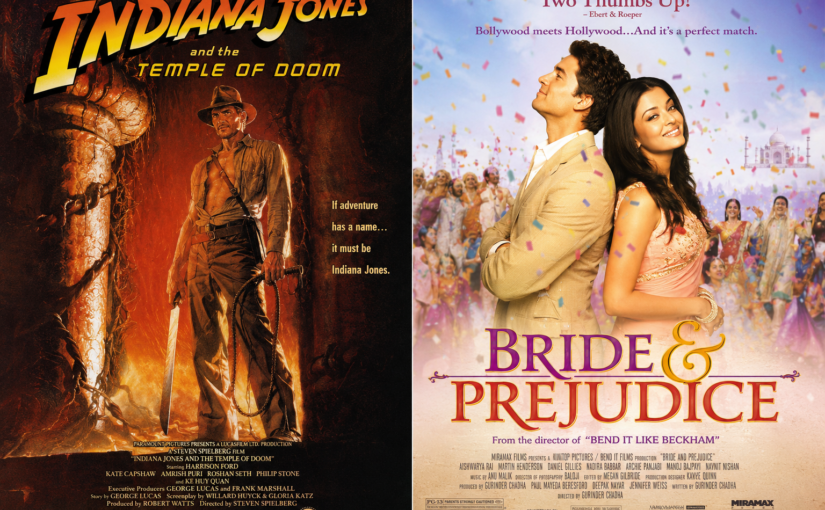
To make a change from some heavy topics, here is an essay I wrote during my undergraduate for a course at LUMS entitled “Culture, Media and Representation”. I just found a hard copy of this in my files and re-typed it. If I recall correctly, the two films under review were chosen by the instructor.
Cinema is a very powerful medium that can influence how people view the world. However, it is mainly a commercial industry concerned with maximizing profit through entertainment and audience appeal. For this reason, films often do not project a balanced view of reality, relying instead on stereotypes. Stereotype, according to Stuart Hall, reduces people to a few, simple, essential characteristics which are represented as fixed by nature (Hall 257). The two films that I will be reviewing in this paper, Indiana Jones and the Temple of Doom and Bride and Prejudice represent India and Indians in very different ways, neither of which are accurate or realistic depictions.
The particular ways that a film represents its subjects depends on many factors, including genre, creator, time period, and audience. Indiana Jones is an action/adventure movie made in 1984 by Steven Spielberg and George Lucas. One of the main conventions of the adventure movie is that character development and complexity are sacrificed in favor of plot. The conflict often revolves around confrontations between stereotypical “good guys” and “bad guys”. In this film, the good guys include Indiana Jones and his sidekicks, while the bad guys are the Thugees led by the fanatical priest Mola Rom.
The film does not depict all Indians in the same way. Rather, they are presented as two distinct groups, one consisting of dark and evil fanatics, and the other consisting of naive and childlike peasants. The “evil” group consists of Mola Ram and his followers, devotees of the Thugee cult that worship Kali Ma, the Hindu goddess of destruction. Throughout the film, these characters are shown as eating such things as snakes and chilled monkey brains, practicing voodoo and committing human sacrifice. They are also shown as oppressive, having enslaved all the children of a nearby village to dig for sacred stones. The naive and childlike group consists of the villagers who look to Indiana Jones to save them. A scene which typifies the behavior of this group is one that occurs near the beginning of the movie. As soon as Indian Jones steps off his boat and arrives in the village, all the villagers gather around him and hail him as their savior. The priest tells him “You were sent by Shiva to save us from evil.” This relation of the Western man as hero and the natives as supplicants strongly recalls the notion of the “white man’s burden” that obliges the West to civilize and save the natives from themselves.
Critics of the movie have argued that these characterizations arise because of the film’s ideological assumptions. In their article “Indiana Jones and the Temple of Doom: The return of the repressed” Moishe Postone and Elizabeth Traube argue that the film legitimizes Western domination of others by presenting imperialism as a socially progressive force and associating oppression with indigenous systems of rule: “Hence the film does not represent a blanket condemnation of Indian otherness, but rather it divides that otherness into two categories, which correspond to an oppressed peasantry and an oppressive, exploitative ruling class” (Postone and Traube). Ella Shohat and Robert Stam make a similar point when they argue that “In a classic splitting operation, the Third World is both demonized and infantilized: non-Western adult characters are evil; children are eager, innocent and pro-Western… Indeed the series shows most of the unwashed masses of the Third World passively waiting for Indy to save them from religious nationalists like Mola Ram” (Shohat and Stam 137). While this argument seems persuasive, it can be countered by pointing out that the film presents a whole range of characters in a stereotyped manner. In addition to the Indians and Chinese, western women themselves are stereotyped, which cannot be placed in the category of an imperial objective. The nightclub singer Willie Scott is portrayed as extremely shallow and obsessed with her appearance. During a heated shootout and car-chase, when Indy hands her his gun, she drops it and exclaims “I burnt my fingers and cracked a nail.” She is also shown as being completely unsuited to surviving in nature and much fun is poked at her expense. It could be argued that this is because the genre of the adventure movie is intended to appeal to an audience composed mostly of young men who would enjoy this depiction of women as objects of fun and ridicule. Thus, it is a plausible argument that profit maximization is just as important a factor as the desire to project an imperial worldview.
Bride and Prejudice is a very different film from Indiana Jones. Made by Gurinder Chada, a UK-based Indian woman, it is a combination of two genres, the Bollywood movie and the romantic comedy. In addition, it was made in a very different historical period than Indiana Jones. Since the 1980s, India has emerged as a global power and its culture (e.g. Bollywood, music, food, fiction) is increasingly popular around the world. This phenomenon is exemplified in the popular Hollywood movie Moulin Rouge, which drew much of its inspiration from Bollywood and also by the breakthrough on Broadway of the musical Bombay Dreams. Finally, the film was meant to appeal both to the Indian diaspora and to the Western audience.
Bride and Prejudice shares several elements of the Bollywood genre such as song-and-dance sequences, and a focus on festive occasions such as weddings. For example, early in the film three young women are shown shopping in a bazaar for the upcoming wedding of one of the girls. In an extended musical sequence, the entire marketplace joins in the celebration of the occasion. These sequences are repeated at various points throughout the film and include scenes of dancing at a wedding as well as partying in a Goa resort.
The film also reveals an India not afraid to make fun of itself. The character of Mrs. Bakshi is a parody of the Indian mother obsessed with getting her daughters married off, preferably to a wealthy NRI. Another example of this parody is the scene where one of the daughters performs her “snake dance”, a hilarious set-piece that is a send-up of traditional Indian dance. A third group which is caricatured is the “Americanized” Indian immigrant. One of the potential suitors, Mr. Kohli,continually goes on about how he lives in a mansion near Beverly Hills with three swimming pools. Because the film was made by an Indian, it is not worried about offending its audience by good-naturedly poking fun at them.
The film also breaks from the stereotype of the Indian woman as submissive and docile. The heroine, Lalitha Bakshi, stands up to everyone, speaks her mind and dresses in a modern fashion. In her conversations with Will Darcy, she is not afraid to question his credentials and disagree vociferously with his viewpoint. Similarly, she is able to articulate her objections to Mr. Kohli and talk about the kind of man she wants to marry. In a way, Lalitha’s character is symbolic of modern India standing as an equal with the West.
A final point to be made about Bride and Prejudice is that it presents most of its characters sympathetically, regardless of their race. Although the movie is mostly set in an Indian milieu, the “white” characters are also presented as complex people, neither all good nor all bad. The leading male character, Will Darcy, is an important example of this. Although in the beginning of the film, he comes across as somewhat insensitive and patronizing about Indian culture, he is shown to deeply care about Lalitha and her family, helping to find her sister Lucky after she runs away. Another major “white” character, Jonny Wickham, is shown to be a spiritual hippie deeply interested in Indian culture. However, by the movie’s end, he has been revealed to be a con-man. Thus, instead of “othering” the white characters, the movie presents all its characters as human beings with different facets to their personalities. Because the movie must appeal both to Indians and to westerners, it takes care to cause as little offence as possible to any particular group.
Bride and Prejudice has also evoked angry reactions for an alleged negative portrayal of Indian society. I would argue that it is unrealistic to expect mainstream filmmakers to present an entirely balanced view of the societies they portray or to take on a normative role and work towards education and social change. Because commercial cinema is a profit-based industry, films rely on all techniques including stereotypes in order to entertain their audiences. In doing so, commercial cinema does reinforce prevailing stereotypes and is thus a socially conservative medium. The way a particular film represents its subjects is highly dependent on its genre, creator, time period and audience. There are distinct cinematic genres such as the art movie or cinema verite that present human beings in their complexity. This, however, is not the role of a movie that aims to be a commercial blockbuster.
Bibliography
Hall, Stuart. “The Spectacle of the ‘Other’” in Representation: Cultural Representations and Signifying Practices, Stuart Hall (ed). London: Sage Publications,2001. Pgs. 225-277.
Postone, Moishe and Elizabeth Traube. “Indiana Jones and the Temple of Doom: The return of the repressed”. Jump Cut, no. 30, March 1985, pp. 12-14.
Shohat, E. and R. Stam. “The Imperial Imaginary” in The Anthropology of Media: A Reader, K. Askew and R. Wilk. Massachusetts: Blackwell Publishers, 2002. Pgs. 117-147.
