
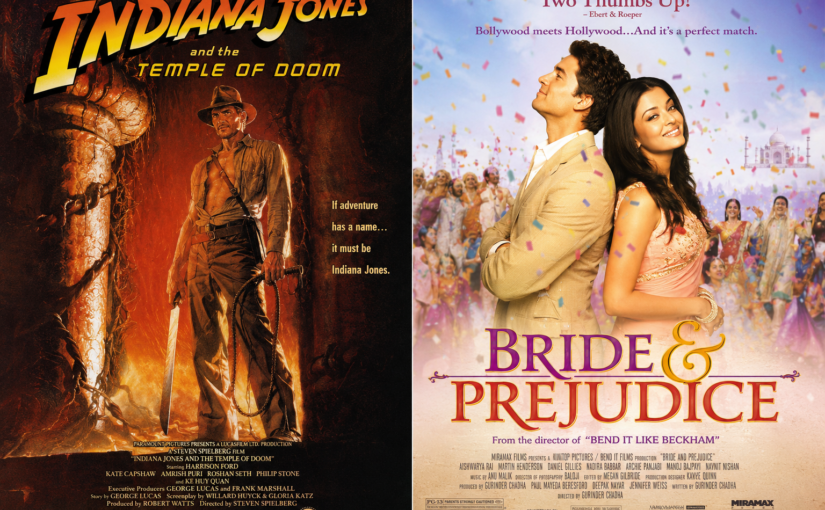
To make a change from some heavy topics, here is an essay I wrote during my undergraduate for a course at LUMS entitled “Culture, Media and Representation”. I just found a hard copy of this in my files and re-typed it. If I recall correctly, the two films under review were chosen by the instructor.
Cinema is a very powerful medium that can influence how people view the world. However, it is mainly a commercial industry concerned with maximizing profit through entertainment and audience appeal. For this reason, films often do not project a balanced view of reality, relying instead on stereotypes. Stereotype, according to Stuart Hall, reduces people to a few, simple, essential characteristics which are represented as fixed by nature (Hall 257). The two films that I will be reviewing in this paper, Indiana Jones and the Temple of Doom and Bride and Prejudice represent India and Indians in very different ways, neither of which are accurate or realistic depictions.
The particular ways that a film represents its subjects depends on many factors, including genre, creator, time period, and audience. Indiana Jones is an action/adventure movie made in 1984 by Steven Spielberg and George Lucas. One of the main conventions of the adventure movie is that character development and complexity are sacrificed in favor of plot. The conflict often revolves around confrontations between stereotypical “good guys” and “bad guys”. In this film, the good guys include Indiana Jones and his sidekicks, while the bad guys are the Thugees led by the fanatical priest Mola Rom.
The film does not depict all Indians in the same way. Rather, they are presented as two distinct groups, one consisting of dark and evil fanatics, and the other consisting of naive and childlike peasants. The “evil” group consists of Mola Ram and his followers, devotees of the Thugee cult that worship Kali Ma, the Hindu goddess of destruction. Throughout the film, these characters are shown as eating such things as snakes and chilled monkey brains, practicing voodoo and committing human sacrifice. They are also shown as oppressive, having enslaved all the children of a nearby village to dig for sacred stones. The naive and childlike group consists of the villagers who look to Indiana Jones to save them. A scene which typifies the behavior of this group is one that occurs near the beginning of the movie. As soon as Indian Jones steps off his boat and arrives in the village, all the villagers gather around him and hail him as their savior. The priest tells him “You were sent by Shiva to save us from evil.” This relation of the Western man as hero and the natives as supplicants strongly recalls the notion of the “white man’s burden” that obliges the West to civilize and save the natives from themselves. Continue reading A Comparison of the Representation of India and Indians in Indiana Jones and the Temple of Doom and Bride and Prejudice