
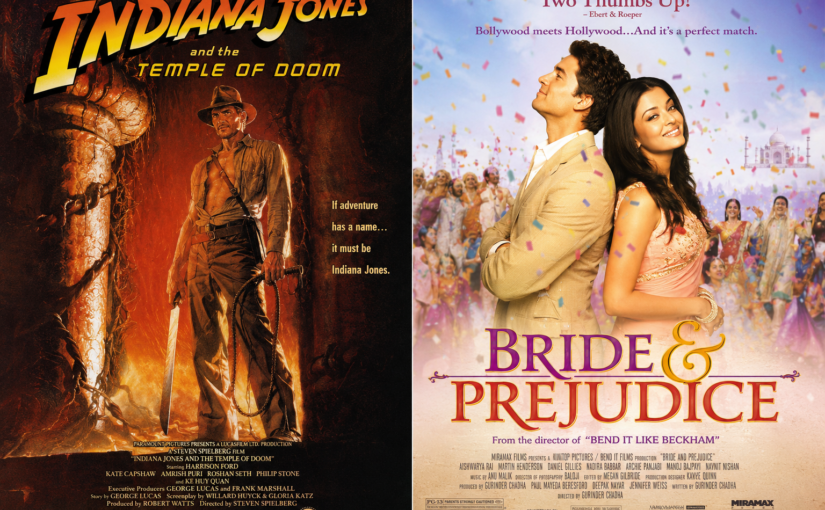
A Comparison of the Representation of India and Indians in Indiana Jones and the Temple of Doom and Bride and Prejudice
To make a change from some heavy topics, here is an essay I wrote during my undergraduate for a course at LUMS entitled “Culture, Media and Representation”. I just found a hard copy of this in my files and re-typed it.  If I recall correctly, the two films under review were chosen by the instructor. 

Cinema is a very powerful medium that can influence how people view the world. However, it is mainly a commercial industry concerned with maximizing profit through entertainment and audience appeal. For this reason, films often do not project a balanced view of reality, relying instead on stereotypes. Stereotype, according to Stuart Hall, reduces people to a few, simple, essential characteristics which are represented as fixed by nature (Hall 257). The two films that I will be reviewing in this paper, Indiana Jones and the Temple of Doom and Bride and Prejudice represent India and Indians in very different ways, neither of which are accurate or realistic depictions.

The particular ways that a film represents its subjects depends on many factors, including genre, creator, time period, and audience. Indiana Jones is an action/adventure movie made in 1984 by Steven Spielberg and George Lucas. One of the main conventions of the adventure movie is that character development and complexity are sacrificed in favor of plot. The conflict often revolves around confrontations between stereotypical “good guys” and “bad guys”. In this film, the good guys include Indiana Jones and his sidekicks, while the bad guys are the Thugees led by the fanatical priest Mola Rom.

The film does not depict all Indians in the same way. Rather, they are presented as two distinct groups, one consisting of dark and evil fanatics, and the other consisting of naive and childlike peasants. The “evil” group consists of Mola Ram and his followers, devotees of the Thugee cult that worship Kali Ma, the Hindu goddess of destruction. Throughout the film, these characters are shown as eating such things as snakes and chilled monkey brains, practicing voodoo and committing human sacrifice. They are also shown as oppressive, having enslaved all the children of a nearby village to dig for sacred stones. The naive and childlike group consists of the villagers who look to Indiana Jones to save them. A scene which typifies the behavior of this group is one that occurs near the beginning of the movie. As soon as Indian Jones steps off his boat and arrives in the village, all the villagers gather around him and hail him as their savior. The priest tells him “You were sent by Shiva to save us from evil.” This relation of the Western man as hero and the natives as supplicants strongly recalls the notion of the “white man’s burden” that obliges the West to civilize and save the natives from themselves. Continue reading A Comparison of the Representation of India and Indians in Indiana Jones and the Temple of Doom and Bride and Prejudice

The Long Dark Night for India’s Muslims

Our own Hindufication

We write this not as outsiders pretending to diagnose India, but as people who have undergone a gentler version of the same process. Over fifteen years of family and work on the subcontinent, our own Islamicate inheritance has been quietly sifted. The Persianate was retained. The Arabic was allowed to fall away. The qawwali, the food, the manners, the ghazal, the Mughal grammar of taste. All survived. The devotional Islamicate self did not. We arrived as something close to a Anglo-Islamicate hybrid. We are leaving, slowly, as a Hindu-Persianate one. We did not plan this. We watched it happen to ourselves.

The Persian survives. The Arabic does not. The poetry survives. The prayer does not. This is the formula. Once you see it, you cannot unsee it.

We made this passage with privilege, with distance, with choice, and with somewhere else to be if we changed our minds. The Indian Muslim, the one with no other passport and no other country, is being asked to make the same passage on terms set by people who never had to make it themselves. That asymmetry is this post.

The morning song

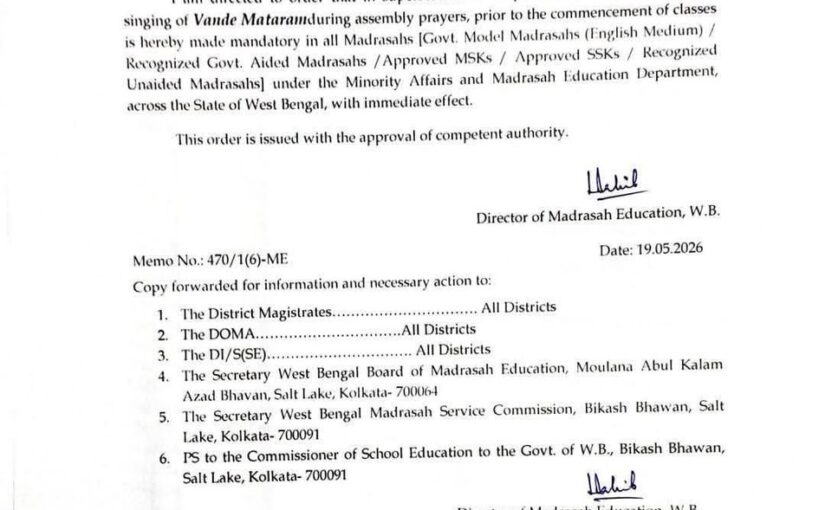
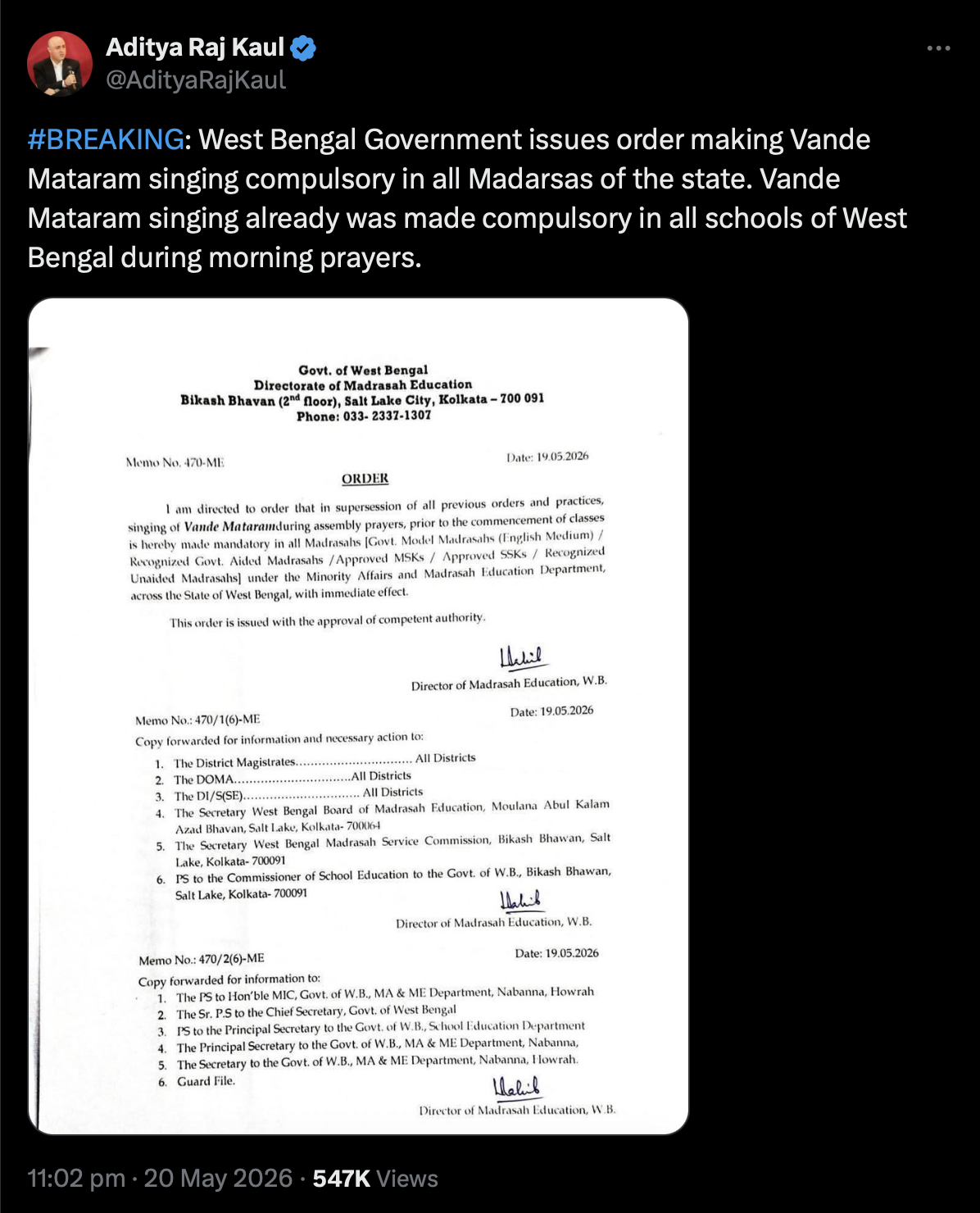
The news this week was Memo No. 470-ME, dated 19 May 2026, signed by the Director of Madrasah Education, Government of West Bengal. The order makes the singing of Vande Mataram mandatory at morning assembly in every state-recognised madrasa: government, aided, unaided, all of them. Immediate effect. Approval of competent authority.

Note the date. Suvendu Adhikari was sworn in as the first BJP Chief Minister of West Bengal on 9 May, ten days earlier, on a 207-seat mandate that ended Mamata Banerjee’s fifteen-year run. The order is ten days into the new government. Of all the actions available to a freshly-installed state administration, this is the gesture chosen. The first major item on the agenda was the Muslim schoolchild’s morning. The signal is the signal.

The Pakistani faction of our commentariat is aghast, and not unreasonably. The song is a hymn to the Great goddess Durga, drawn from a novel that called for war on Muslims, and forcing a Muslim child to recite it is a small humiliation that announces a large arrangement. One of our Pakistani commenters compared it to forcing a vegetarian Hindu to eat beef. The comparison overstates and understates at the same time. It overstates because nobody is forcing food into anyone’s mouth. It understates because food is forgotten by the afternoon, and a song sung daily for ten years writes itself into the spine.

The row is the symptom. The disease is older. Bengal is the latest frontier, not the first.

The Persianate without the Muslim

Continue reading The Long Dark Night for India’s Muslims

The High Signal Mandate

Brown Pundits is not in the news business. We are not in the takes business. We are not in the engagement business. We are in the signal business. This is our creed.

Signal is the mandate. Noise is the enemy. Every piece (like the Prussia of the Ummah) on the blog must clear that bar or it gets rapidly down-posted. We owe the reader nothing less.

The signal compounds.

What does signal mean here? Three things, in order of weight.

Continue reading The High Signal Mandate

Brown Pundits