If Amartya Sen was a Pandit, how would he vote?

“by winning 32.4 percent of the votes cast, the BJP has
effectively become the single largest political party in J&K in terms of
popular votes” 

Response: Naveen makes the excellent point that the BJP performance (and perception of performance) is exaggerated by the fact that the Valley Muslims do not vote either out of fear (of terrorists) or out of dislike (of India/Indians). At the end of the day it is the seat count (more so than the votes). The distribution is: 46 (Kashmir) and 41 (Jammu + Ladakh). BJP has announced a Mission 44 plan (with Article 370 as the winning formula). If the saffrons can capture even 40 seats it will re-create the politics of J&K

In the long run a partition (similar to Telengana/Andhra) may be the preferred path to unfreeze the frozen conflict, which may be healthy for everyone concerned.

Nilanjana Roy is mostly correct about her perceptions of our present day (Hindutva) over-lords. But then, if we discount the child-hood stories (which caused deep scars apparently) for the moment, she is also misremembering a golden age when the left was in charge of India (includes the Congress, Communists, and Left-Socialists) and the nature of freedoms enjoyed by the mango man. 

Rhetoric-wise Indira Gandhi was very much on the left (nationalization, garibi hatao etc.) but action-wise she was very much the dictator-in-chief. Not only did she ban foreign NGOs, she shut down the entire press and put the whole opposition behind bars. Her logic was that she was protecting the nation by defeating the RSS backed trouble-makers. If cartoon kids have managed to haunt Roy (her words) how come such an earth-shaking event had no impact on her? Is this because she agrees with one form of repression and not others?

The main problem with the left (as it is with the right) is that ideologues really cant respect democracy. Since the elections, leftists have gone hoarse in pointing out that BJP won 52% of the seats with 31% of the vote. The problem with this vote-share fetish is that suddenly all elections everywhere (except those in Syria, Egypt, Algeria, and North Korea) are illegitimate, because the majority did not vote for the ruling party (coalition). 

Instead of whining from the sidelines, the left should carefully (and urgently) examine the reason why BJP is suddenly the single largest vote winner in Jammu and Kashmir and may even be in a position to wield power. The left has traditionally benefited from minority polarization and mobilization. In Jammu it is now the Hindu minority community which is mobilized against the Muslim majority. Thus you have a strange situation whereby the BJP may come to power in Jammu and Kashmir by copying from the left rule-book. 

Can we please have some soul searching about what has gone wrong while the Left was in charge these many decades and how we can fix this? How did the Pandit-cleansing problem, which is basically a humanitarian one, end up as a stick on the Right with which to beat up the Left? Of the kilo-liters of ink spent on the Kashmir problem, did the New York Times spend even a few drops on the Pandit problem? If not, why not?

As the Guardian editorial points out, the British have finally left India (and presumably, the Mughals as well). The Indian people (read Hindus) are speaking in a new voice that will not defer to people who are better placed in life. The dictatorship of the left is over (even as the dictatorship of the right is rising). To win votes it will not be enough to invoke the magical Amartya Sen, one has to undertake the painful task of coalition building. How do you prevent Naveen Patnaik and Jayalalitha from joining hands with the BJP? If there is no strategy, no game-plan, then be prepared for a long night of right-wing rule.

Finally (Nilanjana) Roy makes a big point about how the wrong-headed, ancient-minded Indians (all RSS volunteers apparently) are unjustifiably suspicious about the well-intentioned West. Has she bothered speaking to (Arundhati) Roy? Even a small sampling from Roy’s pen will make people completely paranoid about the devil that is the West. Bottom-line: is the West trying to control us or not?? Speak with one voice please.
…….


Of
all the pictorial charts used in Indian schools as teaching aids, it
was the Ideal Boy that haunted my generation.
The Ideal Boy woke up and
brushed his teeth with care, saluted his parents, prayed, had his meals
on time, helped others, performed sundry duties and, more puzzling, took
“lost children to police post.”

The
Ideal Boy embodied certain Indian values, and though these seemed
innocuous enough, there was something about his smudgy features,
identifiably mainstream Hindu and North Indian, and his expression of
saintly smugness that scarred my child brain. Now that I am an adult,
and that the right-wing has come back to power in India,
I understand why I was so queasy back then. 
The feeling was a
foreboding that otherwise unobjectionable traditional Indian values —
respect for one’s family, obedience to elders, modesty for women — might
be invoked to reject or repress certain groups.
The
new Bharatiya Janata Party government seems determined to look to Asia
for political and cultural inspiration. Prime Minister Narendra Modi
projects an image of himself as an authority — even an authoritarian —
figure, in keeping with the regional ideal of a strong leader.
All the
while he has been careful to reach out to his counterparts. His first
scheduled trips abroad will be to Bhutan and then Japan: and the Chinese
foreign minister has just ended a visit to India.
His
approach isn’t just a personal predilection; it also reflects a wider
shift within India: the search, especially among right-wing politicians
and intellectuals, for a common set of Asian cultural norms that would
help them create and strengthen a new sense of Indian identity.
In
the 1990s, Lee Kuan Yew, the former prime minister of Singapore,
triggered a fierce debate by drawing a line between Western freedoms and
human rights, on the one hand, and on the other, an Asian vision of
living in harmony, which might place individual rights in abeyance for
the good of the community. In India, this “Asian values” debate found
its way into discussions on development, among other things, notably in
arguments trying to discredit environmentalists for being too heavily
influenced by the West.
The
problems with that position are the same now as they were then. As the
economist Amartya Sen put it in 1997, “What can we take to be the values
of so vast a region, with such diversity?” As a result, invoking an
Indian, or Asian, identity in such a plural country, or region, often
becomes an excuse for the majority to speak over many minorities.
And
why assume, Mr. Sen also argued, that “Western notions” were “somehow
alien to Asia”? Yet just a couple of weeks ago, a report by the Indian
government’s Intelligence Bureau on the influence of NGOs was leaked to
the media. One of its conclusions was that many local NGOs — some funded
by “donors based in the U.S., the U.K., Germany, the Netherlands and
Scandinavian countries” — had been “using people-centric issues” to
stall development projects. Another was that some of their work served
“as tools for the strategic foreign policy interests” of Western
governments.


This
stiff-collared bureaucrat-speak isn’t just a peculiarity of the
Intelligence Bureau: It reveals a suspicion of the West — and of a human
rights culture seen to have been forged in the West — that is
widespread in India, among politicians and businessmen and, indeed, many
ordinary Indians.
Every
major case of rape recently, for example, has prompted a belligerent
reaction against the victim, often couched in terms that pit India
against the West. 
On June 7, a leading ideologue of the extreme
right-wing organization Rashtriya Swayamsevak Sangh, S. Gurumurthy,
raised a minor storm of protest when he tweeted: “If Indian women
westernize rapes will rise by 50/60 times to reach the levels of West,
But there will be no media report No UN intervention.” Among his next
few tweets was this definition of Westernization: “Unbridled
individualism which destroys relations and families.”
These
days, the purportedly shady influence of the West is invoked not only
to explain why women are victims of sexual violence, but also why Indian
culture is in danger, artists should be censored or anyone who
questions the costs of development is “anti-national.” In other words,
the return of the Asian values debate in India has already become an
excuse to assault civil and political rights.
The
first time around, Mr. Sen had argued that “The so-called Asian values
that are invoked to justify authoritarianism are not especially Asian in
any significant sense.” This was a wise attempt to get beyond hopeless
dichotomies. But it appealed to rationality, and lately rationality is a
value that has seemed not Indian enough.

……

As noted by
Firstpost before, “by winning 32.4 percent of the votes cast, the BJP has
effectively become the single largest political party in J&K in terms of
popular votes, ahead of the Congress (22.9 percent), PDP (20.5 percent) and
National Conference (11.1 percent). In actual numbers, the BJP got 1.15 million
votes, the Congress 8.15 lakh votes, the PDP 7.3 lakh votes and the NC just
under four lakh votes.” 
This unexpected performance has enabled the party to up
the stakes in the assembly polls and even think of a majority on its own.
According to this Mint report, the party is planning Mission 44 – the halfway
mark in an 87-member assembly – and will plan alliances in some regions for the
same. The report even talks of the party announcing its own chief ministerial
candidate. 
The J&K assembly has 37 seats for Jammu, 46 for Kashmir Valley,
and four for Ladakh. Having won Jammu, Udhampur and Ladakh, which collectively
account for 41 assembly seats, the BJP is wondering if it can sweep the polls
in Jammu and Ladakh and come within striking distance of the halfway mark. 
The
Mint report says the party plans to use the Article 370 issue – which
politically divides the Muslim-dominated Kashmir Valley from the
Hindu-dominated Jammu region – to maximise its gains in the latter region. To
push its chances in Jammu, the home ministry is announcing a package of Rs 20
lakh for displaced Kashmiri Pandits to reclaim and rebuild their old homes in
the Valley. While their actual return may be delayed due to continuing fears
about safety and the still unsettled militant situation in the Valley, the BJP
is clearly is mission mode with the Pandits and other prospective voters.

……

Link (1): http://www.nytimes.com/2014/06/16/opinion/debate-over-asian-values-returns-to-india.html

Link (2): http://www.firstpost.com/politics/will-the-next-jk-cm-be-from-bjp-the-partys-big-plan-for-kashmir-1572573.html
……

regards
Zarb-e-Azb: More the things change…

Insanity, Einstein said, is doing the same thing over and over again and expecting different results. 

Without a comprehensive deradicalisation strategy, dumping of good/bad Taliban dichotomy and a relook at relations with neighbors; it is difficult to understand what this very limited (to bad Taliban based in North Waziristan), much delayed  and crude (How many countries regularly deploy fighter jets to bomb insurgent hideouts in their own territory?) military operation will achieve apart from further alienation of local civilians from State, more reprisal killings of Shias, and violent attacks in  Pakistan’s cities.

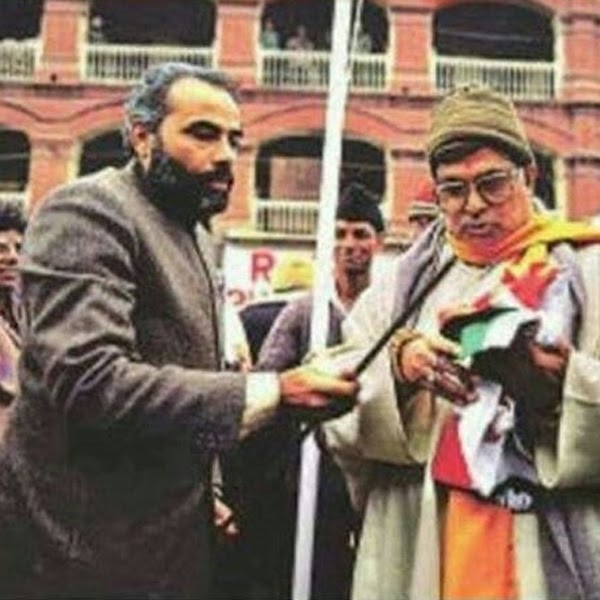
1992: Modi in Kashmir

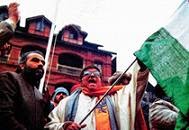
 Mr Modi and Murli Manohar Joshi hoisting Indian Flag at Srinagar’s Lal Chowk on 26 January, 1992
Since the issue has been doing rounds in ‘nationalist’ circles, Here are some of the sources on what really happened (without any value judgement from my side)-


Mr Narendra Modi’s narration of what happened-


What Mr Modi’s website says-

Shri Modi himself urged the people of India to strike the
death-knell of pseudo-secularism and votebank politics. An emotional
Narendra Modi watched with joy as the tricolor was finally unfurled in
Srinagar on 26th January 1992! The successful completion of this rare
national mission amidst the most challenging circumstances was a tribute
to Shri Modi’s ability to give effective replies to the anti-national
elements with unparalleled courage, vision, skill as the power of Bharat
Mata yet again demolished the folly of anti-India elements.

India Today’s report of the event in March 1992:

BJP flag-hoisting ceremony in Srinagar turns out to be a damp squib, militancy gets a boost

For the BJP. the Ekta Yatra didn’t turn out to be the second coming it
wanted. There was no saffron sunrise over Srinagar’s Lal Chowk and no
exuberant cheerleaders to shout rabble-rousing rah-rahs. BJP President
Murli Manohar Joshi’s face told the story….
Joshi drove up, on the morning
of January 26, in a police car, to be greeted by the sound of gunshots.
In
a hurry to leave the confines of the Valley, Joshi quickly got down to
the business of hoisting the tricolour he had carried with him from
Kanyakumari. And while a contingent of 67 BJP workers raised feeble
slogans of Vande Mataram, Joshi and yatra convenor Narendra Modi
struggled with the flag presented to him on December 21, its pole
snapped into two. Finally, Joshi had to make do with the state
administration’s flag.
The ceremony lasted precisely 12 minutes,
and there was not a single Kashmiri to witness Joshi’s embarrassment.
Despite the hype preceding the hoisting, Joshi had to fly into the
Valley under cover of darkness, the night before the event, swapping his
symbolic houseboat for a staid Indian Air Force an-32. Because, as a
police official put it: “Surprise is the best form of security.”
Security,
in fact, was Joshi’s main worry. He even spent the night at the BSF
mess close to the airport because it was not safe to drive through the
city. All along the 15,000-km route of the yatra, Joshi had boasted: “We
have more volunteers than the militants have bullets.”
But in
the end. the bullets won, as an audaciously-planted bomb exploded on
January 24 at the police headquarters, injuring DGP J.N. Saxena and four
other senior officers. Added to this were the rocket attacks and the
incessant firing, as well as the attempt to shoot down the Indian
Airlines IC-421 as it was landing in a curfew-bound city.

As
JKLF- commander-in-chief Javed Ahmed Mir told India Today over the telephone: “Our mujahedins are in a state of preparedness. The curfew is
a measure of our success. The entire nation’s eyes are on Srinagar, not
because of the yatra, but because of us.”
Indeed. The yatra
united the scattered militant groups as even the Centre’s worst mistakes
couldn’t. Gathering together under one umbrella and launching
‘Operation Snowstorm’, they set up ‘Maqbool Butt’ squads to tackle the
travellers.
And succeeded in sending a chill through Srinagar’s
ghostly air, which may last long after winter’s gone. For, Joshi’s
coming has swung a losing battle in the militants’ favour and further
wounded the Kashmiri psyche.
The signs were evident on the last
lap of the yatra. Having billed itself as a long distance runner, the
BJP ran out of oxygen after Jammu. Much of it was due to the attack on
yatris near Phagwara on January 23.
As an anxious Atal Behari
Vajpayee, on board the flight to Jammu, said: “The killings in Punjab
could give ideas to the Kashmir terrorists.” They did. By the time, BJP
leaders trickled into their Jammu hotel, the news of the Srinagar blast
wrecked their remaining confidence.
All through the day, L.K.
Advani, Vijayaraje Scindia, Vajpayee – among others – debated whether
politics was more important than protection. And Governor Girish Saxena
shuttled between his house-turned-office and the hotel. Ultimately,
security prevailed. It remained for Joshi to put the seal on the deal.
Soon,
the fanfare at Joshi’s Jammu reception faded into insignificance. There
were no press briefings, no off-the-record conversations and no
official announcements – from either the Centre, the state Government or
the BJP leaders – but details of the agreement started filtering
through. And Modi was blunt enough to tell journalists: “From now on,
you are on your own. If you can, reach Lai Chowk and we will see you
there.”
Convincing the BJP leaders wasn’t difficult. After
consulting bureaucrats at the Centre, Saxena told them: “We cannot
assure your security if you travel by road to Srinagar. We will do our
best, but you will have to take your chances.”
The officials
convinced the BJP top brass that even handing over the national highway
to the army could not guarantee their safe passage. Then, there were
reports that the militants had proclaimed a ban on private vehicles on
the highway from 6 a.m., January 25, to 12 noon, January 26.
The
only quibble the BJP had was on the timing of Joshi’s flight – the
pretext, they said, should be that they had to stop because of
landslides. Somebody up there must have heard. When the yatra set off
from Jammu, there were two landslides near Banihal.
But those in Jammu who showered petals and chanted Vande Mataram
and Jai Shri Ram while sending off the yatris were blissfully unaware
of this high drama. Barely 5 km from Udhampur, when the yatris had
broken off for lunch, District Magistrate B.L. Nimesh told the press
cars to go no further.
And as agitated yatris blocked the road,
they were told by Modi to head for home. Even as they looked on, angry
and confused, Joshi was whisked away, with six others, in three cars led
by Nimesh.
The next thing they knew, two iaf Chetak helicopters
were heading for Srinagar. The reaction of a Rajasthan MLA, Tara
Bhandari, was typical: “All of us feel cheated. What was the need to
bring us all here and make us look like fools?”…
Ultimately, Hindutva draped in the tricolour proved
politically expensive – for the BJP and for the country. The Yatra’s
odyssey to Srinagar was unnecessary provocation at. a time when the
earlier mood of confrontation has discernibly abated. By raising
political temperatures along with the Indian flag, the BJP has lost much
and gained little.

A local Kashmiri news outlet Greater Kashmir’s report on the event (from eyes of the locals)

On January 26, 1992, Kashmir was different. In  government quarters, it
was regarded as almost a ‘liberated zone’ with the armed militants
ruling the streets in Srinagar and villages, while in a show of defiance
the Border Security Forces (BSF) and army personnel fortifying the city
centre- Lal Chowk- turning it almost into a war zone.
The
announcement to hoist the flag came in the midst of this situation, when
the then BJP President, Murli Manohar Joshi announced it during a rally
attended by thousands of party supporters in Jammu…
“Murli
announced he would come to Kashmir by road with his 10,000 supporters to
hoist the flag,” Fayaz Ahmad Zargar, 38, a resident of Amira Kadal,
said.
BJP President had undertook “Ekta Yatra” that year from
Kaniyakumari to Srinagar to hoist the tri-colour at Lal Chowk on January
26.
On the other hand, the militants who called the shots in Kashmir
those days were furious over the BJP announcement. All the militant
outfits chalked out a joint strategy to stop BJP from raising the flag
on clock tower.
The militants intensified their attacks from Jan 24,
1992, onwards. In one of the intrepid acts, they orchestrated an attack
in PHQ Srinagar where DGP along with the other command sustained
critical injuries after a bomb, concealed in a drawer, exploded.
It
was the same incident in which Ahad Jan- the police cop who shot to fame
after hurling a shoe on chief minister Omar Abdullah on August 15,
2010- was promoted after he saved the life of DGP Saxena and rushed him
to hospital.
“Apart from attacks, the Mujahideen outfits also divided
themselves with each party getting its share of task,” a former Student
Liberation Front militant said. “The foremost thing for us that time
was to guard Srinagar- Jammu highway. The BJP leaders along with their
supporters had planned to come on their vehicles taking that route.”
In
the wake of militant threats, the authorities imposed indefinite curfew
and issued shoot at sight orders. However, the militants managed to
control the highway forcing government to go for alternative means of
transport. The BJP president was thus airlifted to Srinagar.
With the arrival of BJP president Joshi, the city was turned into a battle zone.
“I
vividly remember the day of Jan 26, 1992,” Javed Ahmad, a resident of
Lal Chowk said. “A radio announcement was aired that Lal Chowk has been
handed over to army.”
Ahmad said BSF along with army erected sandbag bunkers, temporary check-posts and enforced strict curfew.
“They
were armed to teeth,” he said. “Even security personnel were deployed
at each door. They took roof tops, buildings and each structure that
could have aided militants to mount any attack.”
The army was a new
guest in the city those days, so was the heavy weaponry they carried. As
a result, the fear- stricken residents, who lived around Lal Chowk,
fled, except one or two male members who guarded their respective
houses.
“On Jan 26, 1992, we heard only firing. There were explosions
also we could make out from all directions of the city neighborhood,”
Ahmad said. “It was like a war going on.”
Unlike Ahmad, Abdul Rashid,
a resident of Koker Bazaar was unfortunate. He sat on the window sill
of the second floor of his house to smoke and get relaxed in the scary
situation.
However, he had taken only two drags, before the prying
eyes of alert Border Security Force personnel occupying a temporary
check post, spotted him.
“They broke open the door and pulled me by
collar down on the rain soaked street,” Rashid said. “I was kept hanging
body upside down. They did it for 15 minutes in that bone chilling
cold. Then they made me stand on the road. It was a punishment since I
had breached curfew.”
Ahmad said Army and BSF had enforced a strict
curfew and nobody was allowed to venture outside home, especially in Lal
Chowk area.
On the chilly afternoon, BJP president, surrounded by alert soldiers and BSF personnel appeared in Lal Chowk.
During the same time, at least four rockets were fired towards the flag hoisting venue. But none of them reached there.
As
Murli raised the flag on the pedestal of clock tower, the rod broke
down and one half along with flag fell on his forehead. He got injured.
Till
the evening of Jan 26, 1992, scores of people got killed and some
injured. It was reported in Srinagar that 10 people, most of them
militants, were killed at different locations on the Srinagar-Jammu
highway.

Why were the Jihadis created?

Mr Haji Sriram Pasha ( ) has a theory:

I have said it before, but it’s worth often repeating. The Taliban, the sectarians, and the Kashmiri jihadi were raised to intimidate, harass, and browbeat people of Pakistan. Their ops outside of Pakistan were merely training missions in the art of subversion and terror within the country. The strategic depth had nothing to do with India. It was all about raising a militia to keep the people of Pakistan down.
In the Geo affair, the Army trained outfits assisted to surmount aggressive questioning. Inquiring minds terrified by multiple means. During all the hoopla, terrorist assassinated a human rights activist in Multan without a whimper.
The terrorist group MQM already occupies Urban Sindh. Now PTI is set to repeat the same in Punjab. PTI Youthias are not any different than the young Urdu speaking that were the first victims of MQM. The MQM job is to frighten the intelligentsia and business. PTI will do the same in Punjab and perhaps in KP too.

My comment was this: Absolutely spot on, at least about the Jihadis…. The only thing I would add is that within GHQ only a few people probably had any clue about what they were setting out to do. The other morons were held in place using bullshit like “strategic depth”, “Force multipliers” and “two nation theory”….

Has any army, even a moronic army, armed and trained half a million fanatics and let them loose within its own borders? We did. And they are doing what they were always meant to do. America, China, India, even Afghanistan, its all collateral damage…

Is Kashmir’s Jung a Jihad? A Pakistani Cleric answers

This is not about Indo-Pak cocky slugfest on the broader Kashmir conflict but purely on technical grounds (for guidance of true believers), Sheikh Tauseef ur Rehman seems to make better sense than  team Hafeez Saeed –


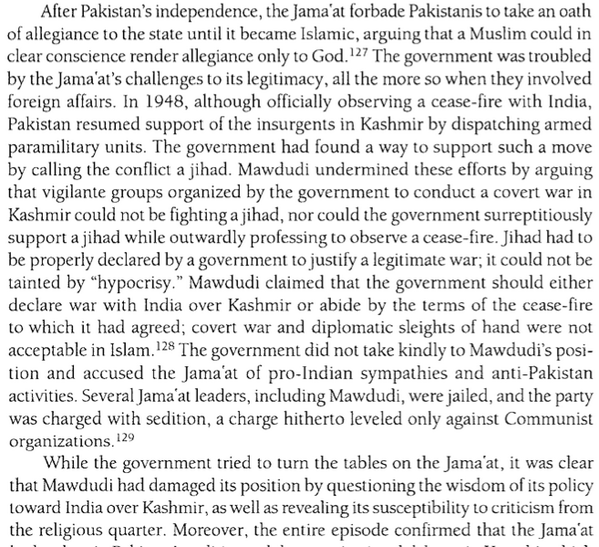
Interesting to note that Abu Ala Maududi (founder of Jamaat-e-Islami), had also opposed Jihad-e- Kashmir(on technical grounds) in 1947 . An excerpt from @vali_nasar‘s book on the same-

(high-explosive) Toys for child soldiers

“They [army] would
give us one gola (grenade) each and send us to throw them on the
Indians,” Ali, a cook at Nadra, said. “The children were small and were
hard to detect at night. And plus we knew all the inside routes that
even the adults didn’t. So they gave us a gola each and off we went,
running up the hills.”

……….. 
Kargil is/was hopefully the last time that we will see hand to hand combat in South Asia. While war is exciting for some people, for us ordinary humans, it is the human factor that is of primary interest, the fact that war (always) creates hidden victims who will never find the support they need from a society which has forgotten them.

On the Indian side, one example was particularly shocking. This was the Adarsh society scam, a building which was intended for widows of the Kargil war dead (soldiers). The top people from politics, bureaucracy and (shamefully) military were involved. Here is the kicker- after all the investigations (as they say in vernacular) not even a single hair was touched. The culprits (alleged) are all out on bail due to a technicality (CBI did not charge-sheet them in a timely manner…why was that??). Ashok Chavan resigned as Chief Minister of Maharashtra and now elected as Member of Parliament in the latest Lok Sabha elections.

People who opine that corruption is the necessary grease that propels developing nations towards developed nation status should stop and reflect about the implications of Adarsh (and a thousand other scams, most of which have not seen any light of the day) and what it means for a country to disgrace the memory of her fallen soldiers.

On the Pakistani side, the report below confirms what was well known- the fact that Pakistan Army disowned its own soldiers as mujahideen and went to the extreme extent of refusing to take the bodies back. The soldiers (who fought for a lost cause) did not get a penny as compensation for their heroics in the battlefield.

However the most shocking revelation (for us) is as follows: child soldiers who were advised by the Army to lob grenades at the enemy. We are not from a military tradition so we would not know about all the intricacies, but it seems that the lines between a professional force and a religious cadre bent on jihad is a very thin one. 
……
[Ref. Wiki] The Adarsh Housing Society is a posh, 31 storey building constructed on prime real estate in Colaba, Mumbai, for the welfare of war widows and personnel of India’s Ministry of Defence.
Over a period of several years, politicians, bureaucrats and military
officers allegedly conspired to bend several rules concerning land
ownership, zoning, floor space index and membership get themselves flats
allotted in this cooperative society at below-market rates.
 

The scam was unearthed in November 2010 which forced the then Chief Minister of Maharashtra, Ashok Chavan, to resign (Sidnote: he has now been elected as a member of Parliament).

In January 2011, the Maharashtra government
set up a two-member judicial commission to inquire into the matter. The report highlighted 25 illegal allotments, including 22 purchases made by proxy.
The report also indicted four former chief ministers of Maharashtra: Ashok Chavan, Vilasrao Deshmukh, Sushilkumar Shinde and Shivajirao Nilangekar Patil, 2 former urban development ministers: Rajesh Tope and Sunil Tatkare and 12 top bureaucrats for various illegal acts. The allottees included Devyani Khobragade (Sidnote: main actor in the non-payment of wages to maid case in New York).

There was a spate of petitions filed in Bombay High Court seeking to monitor CBI investigation. The petitions are Criminal PIL
No. 34 of 2010 by former Journalist Ketan Tirodkar, Criminal Writ
Petition No. 3359 of 2010 by Simpreet Singh and Criminal PIL No. 36 of
2010 by Mahendra Singh. Ref. Bombay High Court order dated 17th Feb.
2011.
By this order High Court asked CBI to amend the F.I.R. by adding Benami
Properties Transaction Act section 4. Also, the High Court transferred
the missing filed probe from Mumbai Police to CBI. Praveen Wategaonkar
filed Criminal PIL later seeking invoking of Prevention of Money
Laundering Act (PMLA) into the case. So it has been invoked and
Enforcement Directorate came into picture.


….
Reacting to these petitions and based on the slow pace of the investigation in the last two years, Bombay High Court severely castigated Enforcement Directorate for its failure to initiate any probe in the matter on 28 February 2012. 
Expressing its unhappiness the court observed, “It
is unfortunate that ED has remained a mute spectator. There is a
serious lapse on the agency’s part for not probing into money laundering
offence. ED has not moved an inch. It reflects a sorry state of
affairs. We are summoning the director as there has been no assistance
from his department to the court.” 

The Court also rapped the CBI for the tardiness in its investigations (begun in January 2011).
The High Court, again on 12 March 2012, severely castigated the CBI for
not arresting any of the accused in spite of having evidence and
ordered it to take action without fear or favour.
ED having registered a case under Prevention of Money Laundering Act,
has decided to launch attachment proceedings of the flats after going
through the latest charge-sheet filed by CBI.

Following the Court’s criticism, the CBI carried out eight arrests including two retired Major Generals
TK Kaul and AR Kumar, retired brigadier MM Wanchoo, former General
Officer Commanding(GOC) of Maharashtra, Gujarat and Goa, Adarsh promoter
Kanhaiyalal Gidwani and Pradeep Vyas, the then city collector and currently, finance secretary (expenditure) in the Govt. of Maharashtra.
Accordingly on 22 March 2012, the Chief Minister of Maharashtra, Prithviraj Chavan announced in the legislative assembly that the two IAS officers whose names have figured in the scam, Pradeep Vyas and Jairaj Phatak have been suspended from government service.


In a further twist to the case, the CBI
officers arrested their own lawyers, J K Jagiasi and Mandar Goswami.
Jagiasi allegedly asked an Air India (AI) official, one of the accused
in the case, to pay a bribe of Rs 5 million in exchange for diluting
charges levelled against him. The petty cash books maintained by Jagiasi
helped unearth the conspiracy. 


In addition, Rs 2.5 million was
allegedly paid to Goswami. He was the Special Counsel in the Ministry of
Law and Justice and at present is working as Retainer Counsel for CBI.
According to CBI sources, the tainted AI official approached the CBI for dilution of the case filed against him. Jairaj Phatak
and Ramanand Tiwari were arrested by the CBI on 3 April 2012, for their
alleged involvement in receiving illegal gratification in the Adarsh
Housing Society Scam.

On 29 May 2012, a special CBI court granted bail to seven of the nine
arrested accused in the Adarsh scam since the CBI failed to file a charge-sheet within the stipulated 60 days from the time it took them in custody.
Those granted bail include Maj. Gen. (Retired-retd) A. R. Kumar, Maj. Gen. (retd) T. K. Kaul, Brig. (retd) M. M. Wanchu, IAS officer and former Mumbai district collector Pradeep Vyas, former Defence Estate officer R. C. Thakur, IAS officer P. V. Deshmukh and former Congress member of the Legislative Council Kanhaiyalal Gidwani (the chief promoter of Adarsh). 

………………………………. 

I needed a new guide to help me
find the elusive colony of people displaced by the Kargil conflict and
living somewhere behind Islamabad’s Bari Imam shrine. Wars between
Pakistan and India have claimed thousands of victims but forgotten among
them are the living victims of the Kargil war who have sought uncertain
refuge in the squalor of shanty towns around the country.

Across a
bridge and up and down narrow streets lined with palm trees and mud and
brick houses, their doors painted in shades of orange and green, Baqir,
our pied piper, led me and a long line of local children to a small
hamlet teetering on the edge of the creek. 

A sheepish Wafadar found us
again somewhere along the way. “Why did your family move here?” I asked
him. “I don’t know,” Wafadaar said. “Ask my father.” Something terrible
had happened to Wafadar’s father — something senseless but dreadfully
common among hundreds and thousands of people who have been displaced
from several parts of Pakistan brutalised by war.

A sepahi in the
Pakistan army, Shah returned to his village across the border from
Kargil one morning to find that an Indian shell had crashed through the
roof of his two-storey house and left his son and daughter dead. His
second daughter, 10-year-old Sidra, was lying semi-conscious under a
tree, her skull crushed by the bombardment.

As he gathered his
children’s bodies, Shah says he remembers fretting that the bales of hay
stacked on the roof for the goats’ winter fodder had caught fire during
the shelling. He worried for his animals. A few days later, after India
blocked water to the area, Shah fled, his bleeding daughter bundled in
his arms. Sidra died a few days later. But grief and remorse
trailed him to Islamabad, combining with other stresses: financial
troubles and the absence of support from relatives and friends. 

Fifteen
years later, Shah is a driver at the Earthquake Reconstruction and
Rehabilitation Authority, surviving on a meagre salary and a Rs5,000
pension. He blames Nawaz Sharif. “Kashmir was in our hands,” he told me
at his house, sitting in a blue plastic chair under harsh fluorescent
lights and a clock that read 6:54, no longer keeping time.

“But
then Sharif went to the United States and we had to give Kargil back.”
For Shah, and his neighbours, many of them ex-army men, Sharif’s
greatest betrayal was calling the Kargil fighters mujahideen. “Kashmiri
mujahideen?” he scoffed. “He said we were mujahideen! I’m retired from
the army. He disowned his own army.” While Shah has never been
compensated for what he left behind, and several trips to the GHQ have
borne nothing, Sharif will travel to India next week to make gains for
the future.

A neighbour’s son Ali Raza, now 20, also remembers
shells: exploding Indian shells dripping like rain every day on his way
to school. A shell fell near his school bus once, so close it rocked the
bus from the side to side. He tells me about the 12-year-old girl whose
nose was sliced off by shrapnel. He also tells me about how the war
changed children’s lives — and their toys too.

“They [army] would
give us one gola (grenade) each and send us to throw them on the
Indians,” Ali, a cook at Nadra, said. “The children were small and were
hard to detect at night. And plus we knew all the inside routes that
even the adults didn’t. So they gave us a gola each and off we went,
running up the hills.”

As Ali tells me about the unusual toys and
the invented games, his infant daughter plays with a rattle by his feet.
She chuckles. At least for her, one can pray, the war is over.

…..
Link: http://www.dawn.com/news/1108390/footprints-kargils-leftovers
….

regards

Kashmiri students expelled from Meerut

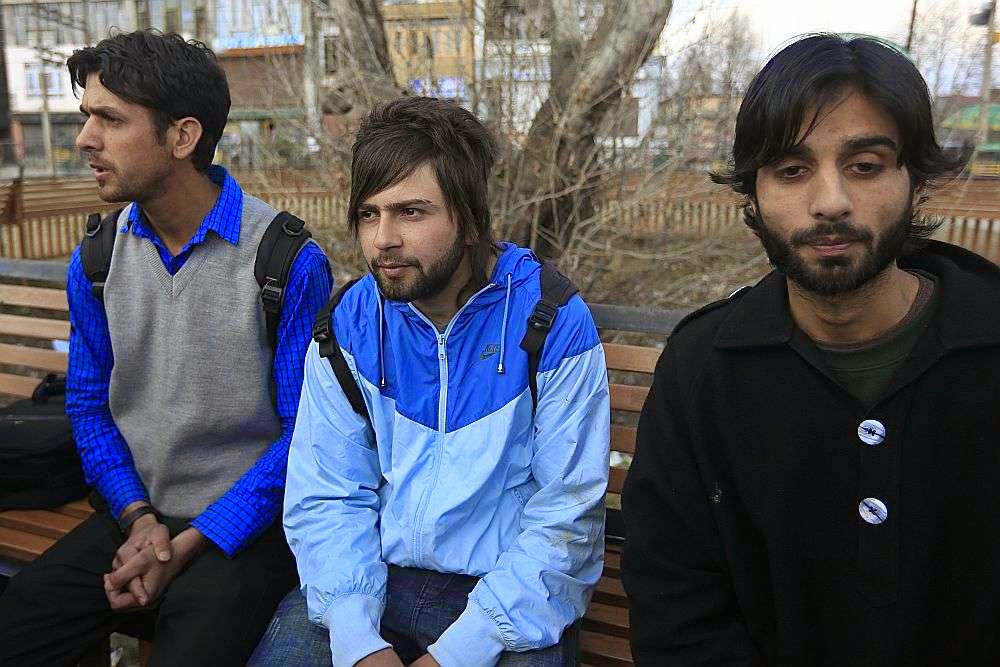
First charged with sedition, now expelled from college. This will create even more bad feelings, in our opinion, young people must be allowed to have their say, else they may go down the path of violence. Post 2014, India and Pakistan must have a public plan for Kashmir, put things down in pen and paper, and reduce tensions and improve commerce. Enough is enough.
……….
10 Kashmiri students caught in a row over cheering for the Pakistani
cricket team have been expelled by a private university here after they
were found guilty of misconduct and damaging property while the
suspension of 57 other Kashmiri students was revoked.


Over two months after a controversy broke out over Swami Vivekanand
Subharti University taking action against students for allegedly
cheering for the Pakistani team, a disciplinary committee set up by the
university found ten students guilty of misconduct and damaging
university property, Vice- Chancellor Prof Manzoor Ahmed said here
today.


However, the committee revoked the suspension of 57 other students.


“The 10 students are writing their exams now. Once exams get over, they will be sent back home,” he told PTI, adding after their exams are over, they will be issued migration certificates.


67 Kashmiri students of the SVSU were suspended after they had allegedly
distributed sweets at the university hostel and cheered for the
Pakistani cricket team’s victory in a cricket match with India on March
2.


….

The university authorities had set up a disciplinary committee to probe the incident.


The city police even slapped sedition charges on students which was
later withdrawn following widespread criticism, including from Jammu and
Kashmir Chief Minister Omar Abdullah.


The local police is also probing the matter and they have recorded
statements of the university administration and committee members.

………
Link: http://news.outlookindia.com/printitem.aspx?841687
……

regards

Herat

The long war continues with proxies in the lead. There were bombings yesterday in Xinjiang as well. The islamists are ambitious but they may be making a big mistake in provoking China. However Chinese Kashmir is much more vulnerable to civilian attacks due to the Chicom policy of settling Hans in Xinjiang (to the point where Muslims have become a minority).
….
I’m a bit surprised that the explosion that killed dozens of people at an open-air market in the city of Urumqi in China’s Xinjiang
province yesterday hasn’t gotten more international notice…..But I suspect it’s also because these incidents are becoming
depressingly commonplace. Today’s explosion follows recent deadly
attacks on train stations in Guangzhou, Urumqi, and Kunming, all of them blamed on Uighur extremists from Xinjiang.
 

Today’s attack, however, is of another order of magnitude more
serious. With at least 30 dead, it may be China’s most serious terrorist
attack in years,
and the use of explosives indicates an escalation in
tactics over the other recent attacks, most of which were mass
stabbings. The mysterious car attack on Tiananmen Square, which took
place while I was in Beijing last October, would have been a substantially more serious event if the perpetrators had used the tactics seen today. 


A Xinhua article this month also highlighted the fact
that “Separatists appear to be shifting their focus from symbols of the
government – such as public security stations and police vehicles – to
random, ordinary civilians, and operating in areas outside Xinjiang.”


After the last attack in Urumqi, President Xi Jinping promised a “strike first” strategy
against separatists in Xinjiang, where Uighur Muslims have longed
agitated for independence and claimed discrimination by the authorities.


But with attacks expanding in both geographical scope and severity,
it’s becoming increasingly clear that Beijing’s default strategy of
cracking down hard on Xinjiang isn’t working.

….

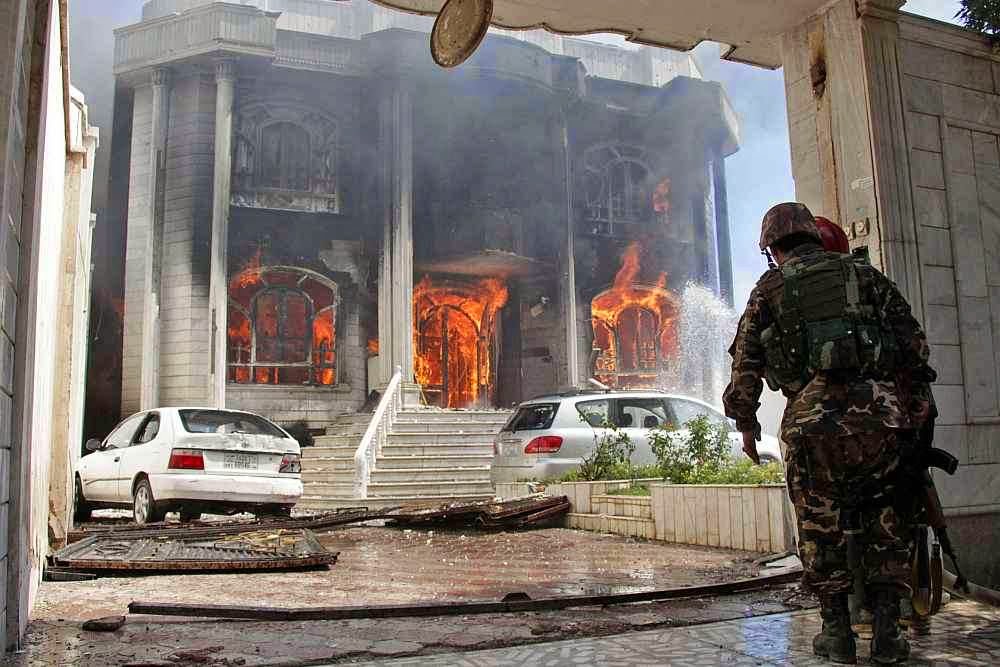
The Indian Consulate in Afghanistan’s
Herat province was today attacked by heavily armed gunmen, who were also
carrying rocket-propelled grenades, top Indian officials said, adding
that everyone was safe.


“India’s Consulate in Herat, Afghanistan attacked. Brave ITBP
(Indo-Tibetan Border Police) personnel and Afghan soldiers rebut
attackers. All are safe,” said a spokesperson in the Ministry of
External Affairs in New Delhi.

Three gunmen were killed, one by the ITBP (Indo-Tibetan Border
Police) and two by the Afghan Police, out of four attackers who struck
the Consulate which houses two buildings, Indian Ambassador to
Afghanistan Amar Sinha said.


In a pre-dawn assault, the gunmen attacked the building which houses the
residence of the Consulate General, Sinha said, adding that there were
nine Indians in the mission apart from local Afghans.


One attacker was killed while climbing the wall to enter the premises of the consulate, Sinha said.
“India-Afghanistan officials (were) in touch on attack on India’s
Consulate in Herat. Foreign Secretary Sujatha Singh (was) monitoring
(the) situation,” the official said.


Afghan police officials said that three gunmen armed with machine guns
and rocket-propelled grenades opened fire on the consulate early this
morning from a nearby home. The police killed two of them, though one
continued to fire on security forces.


No group has claimed responsibility for the attack.


….

India has invested in some major infrastructure projects in Afghanistan
like Salma Hydroelectric Dam in Herat province and the Afghan Parliament
building in Kabul.
India’s development assistance programme for Afghanistan currently
stands at USD 2 billion, making it the leading donor nation among all
regional countries.


….

Afghanistan has experienced a rise in Taliban attacks as foreign troops
plan to withdraw from the war-torn country by the end of the year.


In August last year, a failed bombing on the Indian Consulate in
Jalalabad city near the border with Pakistan killed nine people,
including six children. No Indian officials were hurt.


The Indian Embassy in Kabul was attacked twice in 2008 and 2009 that left 75 people dead.

….

Link (1): http://news.outlookindia.com/printitem.aspx?841659

Link (2): http://www.slate.com/blogs/the_world_/2014/05/22/urumqi_explosions_china_has_a_real_terrorism_problem_now.html
….

regards

Inshallah Kashmir: Living Terror

More Indians need to watch this…

Ashvin Kumar’s  documentary Inshallah Kashmir was released online  in 2012 on 26th January (India’s Republic day). In 2013, It won in “Best Investigative film” category of 60th National Film Award.
The documentary recounts tales of ordinary Kashmiris affected by the militancy and its terrible response in last 2 decades. Among other things; it covers  Kashmiri nationalist narrative, the rigging of 1987 State assembly elections, rise of armed militancy, Islamist hijack, Pandit exodus, Army’s brutal response (Srinagar’s Papa-II detention center; CRPF’s Gawkadal massacre, alleged mass rape in Kunan Poshpora by jawans of Rashtriya Rifles), APDP’s struggle to recover missing persons and a senior babu Wajahat Habibullah’s backgrounder on the conflicting narratives & India’s goofups.

It is my view that self-censorship on Kashmir,  by mainstream Indian media   has done more harm than good- it has fed the shallow hypernationalist narrative (thus increasing the gulf b/w Kashmiri & Non-Kashmiri Indians) and in past allowed Security forces to get away with gross human right violations (further alienating local populace). It is not my case that the Lashkars/Mujahids or the urban semi-educated Islamist youths can offer any salvation for Kashmir. Independent or within Indian Union, only a secular democratic model with free trade, travel & interactions with India (and Pakistan) can bring long lasting peace & prosperity to Kashmiris and to the next door Jammu region (where large communities of Hindus & Muslims live cheek by jowl). Having said that, if India’s claims to a democratic and federal republic are anything more than a hollow rhetoric, high time non-Kashmiri Indians, start taking note of concerns of Kashmiris as fellow equal Indians (or else not crib when Kashmiris raise banners of Azadi).
PS: A good news- After 4 long years,  ban on Texting has been finally uplifted in Kashmir, though by now Kashmiris had shifted to Whatsapp

Couple of thoughts.

(1.) Chetan Bhagat is going for the kill; separate laws for Kashmir & Muslim is the basis of Indian secularism. Will the permanent rightward shift in India (in identity) mean that this majority will hold? Not necessarily but to look at Israel while the Knesset is full of coalition it’s definitely Likud taking the lead (though Israel interestingly enough doesn’t do dynastic politics – yet).

(2.) India has done what Pakistan has done last year since PML-N is a mirror of the BJP. Remember when these two parties last faces each other in the late 90’s there was nuclear testing. 
(3.) On a more personal topic my sleeping hours have dramatically shrunk (5hrs). It seems to be down to a combination of chewing sugar cane before bed (so I don’t wake up with low sugar or a headache), having a warm room and readjusting my pillow to only support the arch of my neck. Either way it seems to be a good development..
Brown Pundits