1947-48 Kashmir War

Extracts from Major Amin’s history of the 1947-48 war.

THE 1947-48 Kashmir War

Major Agha Humayun Amin

The war of lost opportunities 
History is made by those who seize fleeting opportunities in the critical time span in any particular situation and relentlessly execute their plans without second thoughts, subduing inner fears, overcoming procrastination and vacillation, and above all by those who are propelled by the burning desire to defeat the enemy rather than any half hearted judiciousness and timidity. Ninety years of loyalism and too much of constitutionalism had however made the Muslims of 1947 slow in taking the initiative and too much obsessed with consequences of every situation.This attitude was excellent as long as the British were the rulers, but not for a crisis situation, in which geography, time and space, alignment of communications and weather temporarily favoured Pakistan, in case initiative and boldness was exercised and simple but audacious plans were executed in the shortest possible time!

Today, it is fashionable to blame the Indians, Mountbatten, Gracey etc as far as the 1947-48 War is concerned. A dispassionate study of the events of 1947-48 clearly proves that victory was closer in 1947 than ever again as far as the Pakistan Army was concerned. Opportunities were lost because very few people who mattered at any level apart from Mr Jinnah, Brigadier Akbar Khan and some  others were really interested in doing anything!
Continue reading 1947-48 Kashmir War

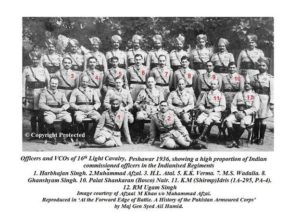
16th Light Cavalry. A historic picture and an anecdote from Kashmir

Corrected Officer List: Sitting on ground Left to Right: Lieutenant Harbhajan Singh (1) and Lieutenant Muhammad Afzal (2).

First Row Seated: Left to Right: Captain Khalid Jan, Captain Hira Lal Atal, Second-in-Command (2IC) Major Basil Holmes, DSO, Commanding Officer Lieutenant Colonel A. H. Williams, MC (with dog in his lap), Major Faiz Muhammad Khan, Captain K. M. Idris (11), Risaldar Major Ugam Singh (12).

First Row Standing: Left to Right: Unidentified VCO, Lieutenant Inder Sen Chopra (3), Lieutenant Enait Habibullah (4), Lieutenant K. K. Verma (5), Captain S. D. Verma (6), Captain M. S. Wadalia (7), Lieutenant Ghanshyam Singh (8), Lieutenant J. K. Majumdar (9), Lieutenant P. S. Nair (10) and unidentified VCO.

16th Light Cavalry was one of the first cavalry regiment of the Indian army that was Indianized.  7th Light Cavalry was the second cavalry regiment that was Indianized and later 3rd Cavalry was also earmarked for Indianization.  Disproportionately, large number of future senior cavalry officers of Indian and Pakistani armies belonged to these three Indianized cavalry regiments. They were the founding fathers of armored corps of Indian and Pakistan armies.

King Commissioned Indian Officers (KCIOs) were graduates of Sandhurst and Indian Commissioned Officers (ICOs) were trained at Indian Military Academy (IMA) at Dehra Dun. During the war, Indian officers were commissioned as Emergency Commissioned Officers (ECOs) after only six months of training. The picture is circa 1936, therefore most Indian officers are KCIOs and only two ICOs as first IMA batch known as ‘pioneers’ was commissioned in December 1934. Both are from the first IMA course.

Major Basil Holmes: In this 1936 picture, he was Second-in-Command (2IC) of the regiment. He was an Australian and served with Australian army during First World War.  He was ADC to his father Major General William Holmes who was killed by a shell in France during a tour. He won Distinguished Service Order (DSO) in First World War. After the war, he transferred to Indian army and after a career of twenty one years in India, retired as Colonel and went back to Australia. Continue reading 16th Light Cavalry. A historic picture and an anecdote from Kashmir

“we are muslims”

…“We have source besides the (Pakistan) army…people in
Kashmir are fighting….just need to incite them….
we can fight with the (Indian) army from both the front
and back
….we are Muslims”…..

….
This is true, there is a hot war going on right now in Kashmir and all the familiar arguments (pro-war, pro-peace) are being re-hashed. It is time to examine them anew.

We have ex President/General Musharraf noting that the path to freedom in Kashmir involves inciting Kashmiri Muslims to launch an intifada. He is confident that the inherent strength in the “we are muslims” argument will (finally) lead to the vanquishing of a half-million strong Indian army.

Short response: Our opinion is that the only feasible way forward in Kashmir is to bring Indian civil society on-side by impressing on the moral arguments about self-rule. For that two things (at the minimum) need to happen. First, there has to be a popular consensus in India that meaningful peace is possible with Pakistan. As of now, only Pranay Sharma (see below) and a few committed leftists believe in this. Any Pak incitement will only lead to more Kashmiri deaths (and a rise in popularity of Modi).

Second, moral arguments are not convincingly made by (or on behalf of) people who do not have any inherent faith in them. Large sections of Kashmiri muslims rejoiced when the Pandits left. The argument is simple: get rid of the people (minorities) and the land is yours to enjoy for all times. As originally battle-tested by the proponents of the two nation theory, this winner-takes-all argument has been a winning one all across South Asia. Today in Hindu majority Telangana, the man in charge compares himself favorably to Hitler (see link below) and wants to chase away all Andhra people (also Hindu majority and Telugu speaking).

Thus to win the argument Kashmiri muslims (and their well-wishers such as Musharraf and a Hindu Brahmin like Vishal Bharadwaj) have to stipulate that suppression of the weak by the strong is wrong. But Musharraf is not making that argument. He is claiming that victory will come from Pak army fighting outside-in, even as the Intifada fights inside out. This “we are muslims” dream helped in the birth of Pakistan and (seemingly) helps hold Pakistan together even now. But it will not help liberate Kashmir.
……………..

Next, Bruce Riedel worries about a cross-border nuclear war and Pranay Sharma frets about Modi using “Pakistan card” to consolidate his power.

It is interesting (and typical) to see how differently the two analysts read the same situation, while “neocon” Riedel points out that not responding to Pakistan’s misadventures will encourage them to attack even more, “aman ki asha” Sharma is worried that a robust response from India will invite backlash from Pak (we think both predictions are correct, an ideological response holds constant regardless of the counter-response).

India has a no-first strike policy on nuclear weapons. Thus the only way a nuclear war happens is if Pakistan initiates a strike. Two things are for sure. First this will not happen without Chinese authorization and that seems unlikely. After all India CAN launch a nuclear missile on Beijing (it is a bit closer to home than MARS). Doomsday scenarios are fun to discuss but beyond the recycled concerns we doubt there is anything fresh to ponder upon.

Second, if Pakistan does strike it will be also the end of Pakistan as a nation. We know that the Pak army has a long history of being irresponsible, but we doubt they are suicidal. 


Former president General Pervez Musharraf on Thursday said Pakistan needs to incite those fighting in Kashmir, India Today reported.   
“We have source (in Kashmir) besides the (Pakistan) army…People in
Kashmir are fighting against (India). We just need to incite them,”
Musharraf told a TV channel.

Musharraf, who assumed power in 1999 soon after the Kargil conflict
as hostilities erupted between Indian and Pakistani troops in the area,
claimed that the Pakistan army is ready for war with India. But he
cautioned India against any misadventure.


“India should not be under the illusion that Pakistan will not hit back,” he warned.


“In Kashmir, we can fight with the (Indian) army from both the front
and back…We are Muslims. We will not show the other cheek when we are
slapped. We can respond tit for tat,”
he said, while commenting on the
recent firing along the Line of Control and working boundary.


At least 12 people have been killed since India resorted to
‘unprovoked’ firing on the border.

“Modi is anti-Muslim and anti-Pakistan. He has not changed. The
problem is with us… We are running to attend his (Modi) inauguration, we
should keep our dignity.”

………….. 


Let us be absolutely clear on this: the only person who has no dignity left over Kashmir is Ex-P/G Musharraf. He has been exposed as a person who was betraying his allies in the West and (specifically looking at Kargil) betraying his own (Muslim) troops.

The argument that democracy (even if imperfectly) should come to all corners of South Asia (and the near-abroad) is a powerful one.

But then Pakistan as the worst case offender should repair the democracy deficit urgently and teach big brother a “peaceful lesson” in how democracy works, starting with (muslim) people in “Azad Kashmir”. Unfortunately there is not a chance of that happening anytime soon, not in Pakistan, but also not in Nepal, Bhutan, Bangladesh, Burma, Thailand, Sri Lanka, Maldives, Iran, Afghanistan, and China. And we will be very surprised if Ex-P/G Musharraf will ever come to a position where his opinion counts for anything, except as a measure of what his fellow citizens think (and dream).

…….
India and Pakistan have fought four wars since 1947 and had several
crises that went to the brink of war. Both tested nuclear weapons in
1998. Now tensions are escalating between the two again.


It began in May, when a heavily armed squad of Pakistani terrorists
from Lashkar e Tayyiba (Army of the Pure) attacked India’s consulate in
Herat, in western Afghanistan.
They planned to massacre Indian diplomats
on the eve of the inauguration of India’s new Hindu nationalist prime
minister, Narendra Modi. The consulate’s security forces killed the LeT
terrorists first, preventing a crisis.


Since LeT is a proxy of Pakistan’s military intelligence service
known as the ISI, Indian intelligence officials assume the Herat attack
was coordinated with higher-ups in Pakistan.  They assume another LeT
attack is only a matter of time.  They are probably right on both
counts.

This summer, clashes between Indian and Pakistani troops
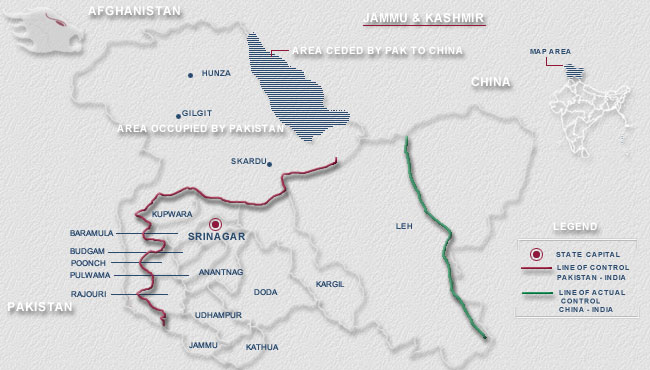
have escalated along the ceasefire line in Kashmir. Called “the Line of
Control,” the Kashmiri front line this year has witnessed the worst
exchanges of artillery and small arms fire in a decade, displacing
hundreds of civilians on both sides. More than 20 have died in the
crossfire already this month. Modi has ordered his army commanders to
strike back hard at the Line of Control to demonstrate Indian resolve.


Although Modi made a big gesture in May when he invited his Pakistani
counterpart, Nawaz Sharif, to his inauguration, since then Modi has
canceled routine diplomatic talks with Pakistan on Kashmir and signaled a
tough line toward terrorism. He also appointed a very experienced
intelligence chief, Ajit Doval as his national security adviser. Doval
is known as a hard-liner on terrorism—and on Pakistan.

Modi’s Bharatiya Janata Party strongly criticized his predecessor,
Manmohan Singh, for what it saw as a weak response to LeT’s attack on
Mumbai in 2008. No military action was taken after 10 LeT terrorists,
armed and trained by the ISI, killed and wounded hundreds of innocents,
including six American dead.


In 2001, a previous BJP government mobilized the Indian military for
months after a Pakistan-based terror attack on the Indian parliament.
The two countries were eyeball to eyeball in a tense standoff for almost
a year. Two years before that, the two countries fought a war in
Kashmir around the town of Kargil.


In the 1999 Kargil War, the Pakistani army crossed the LOC to seize
mountain heights controlling a key highway in Kashmir. BJP Prime
Minister Atal Vajpayee responded with airstrikes and ground forces. The
Indian navy prepared to blockade Karachi, Pakistan’s major port and its
critical choke point for importing oil. A blockade would have rapidly
cut off Pakistan from oil supplies. The Indian navy was so eager to
strike it had to be restrained by the high command.


The Pakistanis began losing the fight at Kargil. Then they put their
nuclear forces on high alert. President Bill Clinton pressured Nawaz
Sharif (the prime minister then and now) into backing down at a crucial
summit at Blair House on July 4, 1999. If Clinton had not persuaded
Sharif to withdraw behind the LOC, the war would have escalated further,
perhaps to a nuclear exchange.


Kargil is a good paradigm for what a future crisis might look like. A
BJP government is not likely to turn the other cheek. It cannot afford
to let terror attacks go unpunished. That would encourage more.


The difference between the Kargil War and today is that both India
and Pakistan now have far more nuclear weapons and delivery systems than
15 years ago. Pakistan is developing tactical nuclear weapons and has
the fastest growing nuclear arsenal in the world.
China provides
Pakistan with its nuclear reactors. India has missiles that can reach
all of Pakistan and even to Beijing. The escalatory ladder is far more
terrifying than it was on the eve of the millennium.


For retreating in 1999, Sharif was overthrown in a coup by the army
commander, Pervez Musharraf, who had planned the Kargil War. Now
Musharraf is calling for Sharif to stand up to Modi and not be pushed
around by India. The main opposition party leader, Bilawal Bhutto, has
called for a tough line defending Kashmiri Muslim rights, promising to
take “every inch” of Kashmir for Pakistan if he is elected prime
minister in the future. Sharif is under pressure from another party
leader, Imran Khan, to resign. The politics on both sides in South Asia
leave little room for compromise or dialogue.

America is seen in South Asia as a power in decline, a perception
fueled by the Afghan War. U.S. influence in New Delhi and Islamabad is
low. A Clinton-like intervention to halt an escalation will be a tough
act to follow. But the consequences of a nuclear exchange are almost too
horrible to contemplate.

……

The hype notwithstanding, Narendra Modi’s ‘tough’ line on Pakistan,
as reflected in the fortnight-long firing across the Line of Control and
the International Border by Indian and Pakistani soldiers, sets a
dangerous precedent.


A flag meeting that could have ended the firing between the rival
troops earlier than it did was put off because of India. Officials in
New Delhi justify the Indian stand to argue that it was to prevent
Pakistan from embarking on similar ‘adventurism’ in the future. In the
process, however, this also opens up space for India’s own ‘adventurism’
which it can adopt in dealing with other smaller neighbours as well.


To his myriad supporters, Modi’s hard stand against Pakistan is
something that was long needed. In Modi they see an Indian leader who
has finally decided to set the parameters of engaging with Pakistan in a
manner that is both effective and couched in terms that the neighbour
can well understand.


However, despite the prevailing mood of belligerence in the country,
especially among the prime minister’s admirers, the Modi government’s
policy of how to deal with Pakistan raises some serious concerns.


There are clear indications that much of India’s tough response was
fashioned by Modi to shore up his image domestically, especially before
the crucial assembly elections in Maharastra and Haryana.
According to a
report in the Economic Times, during the entire period of
firing at the border, Modi did not convene a single meeting of the
Cabinet Committee on Security (CCS). The decision to escalate the Indian
response to the Pakistani firing was taken solely by the Indian prime
minister and his national security advisor Ajit Doval, a former
Intelligence Bureau chief.

Modi decided to refer to the developments at the border and the tough
stand his government took several times during his campaigns in
Maharashtra and Haryana. This clearly shows that irrespective of the
death of several people, including hapless civilians living near the
border areas, the prime minister continued with his tough line to raise
his own stock
and brighten the chances of his party’s victory in the two assembly elections.


But the willingness to adopt such a stand and to use Pakistan to
build his own image can have negative implications. One, its success may
encourage him to play the Pakistan card every time he finds himself in a
spot and needs to boost his image with his countrymen at home. Two,
Pakistan can play this game of brinkmanship as well in future, with
dangerous consequences.
 

Whether or not it results in a war between the
two nuclear-armed countries, heightened tension between the hostile
neighbors will surely scare off potential investors from India and
derail India’s project of economic development.


More importantly, a tough, confrontational line drastically reduces
the diplo­matic space to resolve differences through peaceful
negotiations between the two countries. The precedent Modi is setting
can also send a negative signal to India’s smaller neighbors in South
Asia. If they continue to feel nervous about India, they may end up
moving closer to China
—the other big power in the region. And surely the
Indian leadership would not desire a possible scenario where India gets
isolated in South Asia. For the sake of its own development and growth,
India needs a peaceful neighborhood, particularly in South Asia.


The Indian prime minister will therefore have to go back from where
he started—by reaching out to India’s immediate neighbours. A policy
that not only ensures a peaceful neighbourhood but also allows the space
for others to grow and develop with India may turn out to be much more
effective in dealing with neighbours. Modi may as well show his strength
by taking the ‘tough’ political decision to reach out to Pakistan and
resume his engagement with the recalcitrant neighbour.

……

Suffice to say the Congress govt followed Sharma’s prescription and lost
respect on the international stage and politically at home. Sharma
makes the economic point that investments in India will suffer in case
of escalation in conflicts but then where were these investments in the
peacetime of 2009-2014?

Also, as is clear from the recent state elections
in Maharashtra and Haryana, Modi will keep winning due to a complete
vacuum in the opposition ranks. Congress is finished, Mayawati also
looks finished. Modi has been accepted as an OBC (Shudra) leader by Indians drawing from all sections of society. India is also an OBC nation by a large majority…thus we have a truly strange situation where powerful OBC communities like Yadavs in Uttar Pradesh, Marathas in Maharashtra, and Jats in Haryana opposing Modi (and he will still win).

As far as the muslims are concerned the in-fighting between the “secular” parties have left them without any sure source of political patronage. The understandable reaction has been to vote for “communal” parties like AIMIM headed by the odious Akbaruddin Owaisi. Unfortunately, this will lead to even more marginalization. Strategically, it would make much more sense for muslims to vote for the BJP and make it bend to minority demands (this is starting to happen in some strange places….in Kerala and in West Bengal).

It is early days yet but Modi is transforming into Indira Gandhi (it is a good thing that he has no sons to hand over the baton when the time comes).
The weakness of Man Mohan Singh was that the public knew that he was a
puppet. So yes, India will not turn the “other cheek” as the
provocations keep coming…and Pakistan becomes more and more isolated
as a nation with no friends.

Finally, Pranay Sharma knows this well: small neighbors of India seem to be working much better with Modi than the small neighbors of China. Not to mention how the Iran-Pak border has become hot as well as Iranian soldiers violate borders and shoot down Sunni insurgents. It also seems that Afghanistan will not remain passive if ISI continues with the “incite muslims” strategy.

So all in all, even the strongest opponents of Modi are only peddling weak arguments. We have to look harder for better leaders and better arguments (since we are pro-peace after all) but right now all we see is Modi all around us (even if with a broom and a dusting-pan).

Link (1): tribune.com.pk/pakistan-needs-to-incite-those-fighting-in-kashmir-musharraf

Link (2): dailybeast.com/icymi-india-pakistan-head-for-nuke-war

Link (3): outlookindia.com/printarticle.aspx?292284

Link (4):  firstpost.com/kcr-can-even-be-hitlers-grandfather-to-stop-injustice-telangana
 

regards

First time for a woman (2)

.….“We don’t care if you have to give away Kashmir..Kashmir de do,
kuchh bhi de do, hamare logon ko ghar wapas lao”
…..Jaswant Singh made bold to suggest ….nation’s interest….we could not
be seen to be giving in to the hijackers…..That fetched him abuse and rebuke…“Bhaand me jaaye desh aur bhaand me jaaye desh ka hit. (To hell with the country and national interest)”……

…..
For people who believe in true equality for women, it must be accepted that the laws will also equally apply. There is no reason why women will be any less intelligent or resourceful than men, it follows that they may be just as ruthless and cruel. And yes, women can be serial killers, nothing surprising about that. While we do not believe in the death penalty, the Indian people AND the leadership both believe in this form of retributive justice (and path for closure for the victims).
……..

…..

Once if it is proven beyond reasonable doubt that you have harmed children, we have no sympathy to spare. Put these people behind bars and throw away the keys….for life. We oppose death penalty since there is a chance that the convicted person has been falsely implicated.
…..

….
One exception that troubles our conscience is how we should deal with terrorists. If we jail them, there may be attempts to free  them by taking innocent people hostages (see below). In a democracy you really do not have a choice…as the Head of the Nation, you cannot look scores of families in the eye and tell them that their loved sons, daughters, brothers, sisters will not be coming home in order to preserve some abstract national interest.  

That memorable slogan from 1999…..to hell with the country and the national interest…there is no arguing with that sentiment in good faith…what if it was YOUR daughter who was kidnapped by the terrorists? By the same token, who cares if a terrorist is killed…to hell with your principles...or would YOU rather be the one talking to the widow of Squadron Leader Ahuja?
……

Two
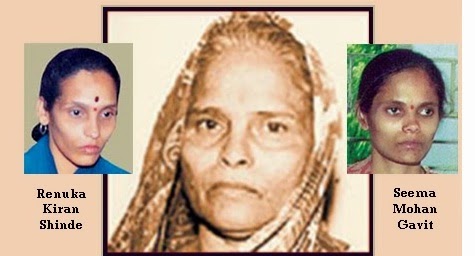
Kolhapur women, who were sentenced to death in 2001 for kidnapping 13
children and killing nine of them, may become the first women ever to be
hanged in India.

……..


President Pranab Mukherjee late last month
rejected Renuka Kiran Shinde and her sister Seema Mohan Gavit’s mercy
petitions.
The buffer period before their hanging – time taken by the
state home department to inform all concerned after receiving the note
from Rashtrapati Bhavan – ends on Saturday.


The number of
people executed in India since Independence is a matter of dispute.
Government statistics claim that only 52 people have been executed since
independence. However, research by the People’s Union for Civil
Liberties indicates that the actual number of executions is in fact much
higher, as they have located records of 1,422 executions in the decade
from 1953 to 1963 alone. However, there is no record of any woman’s
execution.

Renuka and Seema, who partnered their mother
Anjanabai Gavit to kidnap the kids and push them into begging and killed
some of them after they stopped being productive, are currently lodged
at the Yerwada jail in Pune. Anjanabai passed away during the trial, and
the sisters’ father Kiran Shinde turned approver and was acquitted.

Desk officer Deepak Jadiye of the home department
said no objections have been received yet on the Kolapur sisters’
hanging. “We have informed the two convicts, their relatives, the legal
remedial cells of the Supreme Court and also the district court about
the rejection (of their mercy plea),” he said.

While awarding
the death sentence to the sisters in 2001, Judge G L Yedke in Kolhapur
had described the nine kids’ murders as ‘the most heinous’, and observed
that the two sisters seemed to have enjoyed killing the children.

……

The Indian Airlines flight from Kathmandu to New Delhi, designated IC
814, with 178 passengers and 11 crew members on board, was hijacked on
Christmas eve, 1999, a short while after it took-off from Tribhuvan
International Airport; by then, the aircraft had entered Indian
airspace. Nine years later to the day, with an entire generation coming
of age, it would be in order to recall some facts and place others on
record.


….
In 1999 I was serving as an aide to Prime Minister Atal Bihari
Vajpayee in the PMO, and I still have vivid memories of the tumultuous
week between Christmas eve and New Year’s eve. Mr Vajpayee had gone out
of Delhi on an official tour; I had accompanied him along with other
officials of the PMO. …

The hijacking of IC 814 occurred while we were
returning to Delhi in one of the two Indian Air Force Boeings which, in
those days, were used by the Prime Minister for travel within the
country.


….
Curiously, the initial information about IC 814 being hijacked, of
which the IAF was believed to have been aware, was not communicated to
the pilot of the Prime Minister’s aircraft. As a result, Mr Vajpayee and
his aides remained unaware of the hijacking till reaching Delhi. This
caused some amount of controversy later.


It was not possible for anybody else to have contacted us while we
were in midair. It’s strange but true that the Prime Minister of India
would be incommunicado while on a flight because neither the ageing IAF
Boeings nor the Air India Jumbos, used for official travel abroad, had
satellite phone facilities.


….
By the time our aircraft landed in Delhi, it was around 7:00 pm, a
full hour and 40 minutes since the hijacking of IC 814. After
disembarking from the aircraft in the VIP bay of Palam Technical Area,
we were surprised to find National Security Adviser Brajesh Mishra
waiting at the foot of the ladder. He led Mr Vajpayee aside and gave him
the news. They got into the Prime Minister’s car and it sped out of the
Technical Area. Some of us followed Mr. Vajpayee to Race Course Road,
as was the normal routine.


….
On our way to the Prime Minister’s residence, colleagues in the PMO
provided us with the basic details. The Kathmandu-Delhi flight had been
commandeered by five hijackers (later identified as Ibrahim Athar,
resident of Bahawalpur, Shahid Akhtar Sayed, Gulshan Iqbal, resident of
Karachi, Sunny Ahmed Qazi, resident of Defence Area, Karachi, Mistri
Zahoor Ibrahim, resident of Akhtar Colony, Karachi, and Shakir, resident
of Sukkur City) at 5:20 pm; there were 189 passengers and crew members
on board; and that the aircraft was heading towards Lahore.


….
At the Prime Minister’s residence, senior Ministers and Secretaries
had already been summoned for an emergency meeting. Mr Mishra left for
the crisis control room that had been set up at Rajiv Bhavan. In between
meetings, Mr Vajpayee instructed his personal staff to cancel all
celebrations planned for December 25, his birthday. The Cabinet
Committee on Security met late into the night as our long vigil began.


….
Meanwhile, we were informed that the pilot of IC 814 had been denied
permission to land at Lahore airport. With fuel running low, he was
heading for Amritsar. Officials at Raja Sansi Airport were immediately
alerted and told to prevent the plane from taking off after it had
landed there.
 

The hijacked plane landed at Amritsar and remained parked on the
tarmac for nearly 45 minutes.
The hijackers demanded that the aircraft
be refuelled. The airport officials ran around like so many headless
chickens, totally clueless about what was to be done in a crisis
situation.


…..
Desperate calls were made to the officials at Raja Sansi Airport to
somehow stall the refueling and prevent the plane from taking off. The
officials just failed to respond with alacrity. At one point, an
exasperated Jaswant Singh, if memory serves me right, grabbed the phone
and pleaded with an official, “Just drive a heavy vehicle, a fuel truck
or a road roller or whatever you have, onto the runway and park it
there.” But all this was to no avail.


…..
The National Security Guards, whose job it is to deal with hostage
situations, were alerted immediately after news first came in of IC 814
being hijacked; they were reportedly asked to stand by for any
emergency. The Home Ministry was again alerted when it became obvious
that after being denied permission to land at Lahore, the pilot was
heading towards Amritsar.


….
Yet, despite IC 814 remaining parked at Amritsar for three-quarters
of an hour, the NSG commandos failed to reach the aircraft. There are
two versions as to why the NSG didn’t show up: First, they were waiting
for an aircraft to ferry them from Delhi to Amritsar; second, they were
caught in a traffic jam between Manesar and Delhi airport. The real
story was never known!


…..
The hijackers, anticipating commando action, first stabbed a
passenger, Rupin Katyal (he had gone to Kathmandu with his newly wedded
wife for their honeymoon; had they not extended their stay by a couple
of days, they wouldn’t have been on the ill-fated flight) to show that
they meant business, and then forced the pilot to take off from
Amritsar. With almost empty fuel tanks, the pilot had no other option
but to make another attempt to land at Lahore airport. Once again he was
denied permission and all the lights, including those on the runway,
were switched off. He nonetheless went ahead and landed at Lahore
airport, showing remarkable skill and courage.


…..
Mr Jaswant Singh spoke to the Pakistani Foreign Minister and pleaded
with him to prevent the aircraft from taking off again. But the
Pakistanis would have nothing of it (they wanted to distance themselves
from the hijacking so that they could claim later that there was no
Pakistan connection) and wanted IC 814 off their soil and out of their
airspace as soon as possible. So, they refuelled the aircraft after
which the hijackers forced the pilot to head for Dubai.


….
At Dubai, too, officials were reluctant to allow the aircraft to
land. It required all the persuasive skills of Mr Jaswant Singh and our
then Ambassador to UAE, Mr KC Singh, to secure landing permission. There
was some negotiation with the hijackers through UAE officials and they
allowed 13 women and 11 children to disembark. Rupin Katyal had by then
bled to death. His body was offloaded. His widow remained a hostage till
the end.


….
On the morning of December 25, the aircraft left Dubai and headed
towards Afghanistan. It landed at Kandahar Airport, which had one
serviceable runway, a sort of ATC and a couple of shanties. The rest of
the airport was in a shambles, without power and water supply, a trophy
commemorating the Taliban’s rule.


….
On Christmas eve, after news of the hijacking broke, there was
stunned all-round silence. But by noon on December 25, orchestrated
protests outside the Prime Minister’s residence began, with women
beating their chests and tearing their clothes. The crowd swelled by the
hour as the day progressed.


….
Ms Brinda Karat came to
commiserate with the relatives of the hostages who were camping outside
the main gate of 7, Race Course Road. In fact, she became a regular
visitor over the next few days. There was a steady
clamour that the Government should pay any price to bring the hostages
back home, safe and sound. This continued till December 30.


…..
One evening, the Prime Minister asked his staff to let the families
come in so that they could be told about the Government’s efforts to
secure the hostages’ release. By then negotiations had begun and Mullah
Omar had got into the act through his ‘Foreign Minister’, Muttavakil.
The hijackers wanted 36 terrorists, held in various Indian jails, to be
freed or else they would blow up the aircraft with the hostages.


…..
No senior Minister in the CCS was willing to meet the families. Mr
Jaswant Singh volunteered to do so. He asked me to accompany him to the
canopy under which the families had gathered. Once there, we were
literally mobbed. He tried to explain the situation but was shouted
down.


……
“We want our relatives back. What
difference does it make to us what you have to give the hijackers?” a
man shouted. “We don’t care if you have to give away Kashmir,” a
woman screamed and others took up the refrain, chanting: “Kashmir de do,
kuchh bhi de do, hamare logon ko ghar wapas lao.” Another woman sobbed,
“Mera beta… hai mera beta…” and made a great show of fainting of grief.


…..
To his credit, Mr Jaswant Singh made bold to suggest that the
Government had to keep the nation’s interest in mind, that we could not
be seen to be giving in to the hijackers, or words to that effect, in
chaste Hindi. That fetched him abuse and rebuke. “Bhaand me jaaye desh aur bhaand me jaaye desh ka hit. (To hell with the country and national interest),” many
in the crowd shouted back. Stumped by the response, Mr Jaswant Singh
could merely promise that the Government would do everything possible.


…..
I do not remember the exact date, but sometime during the crisis, Mr
Jaswant Singh was asked to hold a Press conference to brief the media.
While the briefing was on at the Press Information Bureau hall in
Shastri Bhavan, some families of the hostages barged in and started
shouting slogans. They were led by one Sanjiv Chibber, who, I was later
told, was a ‘noted surgeon’: He claimed six of his relatives were among
the hostages.


…..
Dr Chibber wanted all 36 terrorists named by the hijackers to be
released immediately. He reminded everybody in the hall that in the past
terrorists had been released from prison to secure the freedom of Ms
Rubayya Sayeed, daughter of Mufti Mohammed Sayeed, while he was Home
Minister in VP Singh’s Government. “Why
can’t you release the terrorists now when our relatives are being held
hostage?” he demanded. And then we heard the familiar refrain: “Give
away Kashmir, give them anything they want, we don’t give a damn.”


…..
On another evening, there was a surprise visitor at the PMO: The
widow of Squadron Leader Ajay Ahuja, whose plane was shot down during
the Kargil war. She insisted that she should be taken to meet the
relatives of the hostages. At Race Course Road, she spoke to
mediapersons and the hostages’ relatives, explaining why India must not
be seen giving in to the hijackers, that it was a question of national
honour, and gave her own example of fortitude in the face of adversity.


……
“She has become a widow, now she wants others to become widows. Who
is she to lecture us? Yeh kahan se aayi?” someone shouted from the
crowd. Others heckled her. The young widow stood her ground, displaying
great dignity and courage. As the mood turned increasingly ugly, she had
to be led away. Similar appeals were made by others who had lost their
sons, husbands and fathers in the Kargil war that summer. Col Virendra
Thapar, whose son Lt Vijayant Thapar was martyred in the war, made a
fervent appeal for people to stand united against the hijackers. It fell
on deaf ears.


…..
The media made out that the overwhelming majority of Indians were
with the relatives of the hostages and shared their view that no price
was too big to secure the hostages’ freedom. The Congress kept on slyly
insisting, “We are with the Government and will support whatever it does
for a resolution of the crisis and to ensure the safety of the
hostages. But the Government must explain its failure.” Harkishen Singh
Surjeet and other Opposition politicians issued similar ambiguous
statements.


……
By December 28, the Government’s negotiators had struck a deal with
the hijackers: They would free the hostages in exchange of three dreaded
terrorists — Maulana Masood Azhar, Mushtaq Ahmed Zargar and Ahmed Omar
Sheikh — facing various charges of terrorism.


…..
The CCS met frequently, several times a day, and discussed the entire
process threadbare. The Home Minister, the Defence Minister and the
Foreign Minister, apart from the National Security Adviser and the Prime
Minister, were present at every meeting. The deal was further
fine-tuned, the Home Ministry completed the necessary paper work, and
two Indian Airlines aircraft were placed on standby to ferry the
terrorists to Kandahar and fetch the hostages.


…….
On December 31, the two aircraft left Delhi airport early in the
morning. Mr Jaswant Singh was on board one of them. Did his ministerial
colleagues know that he would travel to Kandahar? More important, was
the Prime Minister aware of it? The answer is both yes and no.


…..
Mr Jaswant Singh had mentioned his decision to go to Kandahar to
personally oversee the release of hostages and to ensure there was no
last-minute problem. He was honour-bound to do so, he is believed to
have said, since he had promised the relatives of the hostages that no
harm would come their way. It is possible that nobody thought he was
serious about his plan. It is equally possible that others turned on him
when the ‘popular mood’ and the Congress turned against the Government
for its ‘abject surrender’.


……
On New Year’s eve, the hostages were flown back to Delhi. By New
Year’s day, the Government was under attack for giving in to the
hijackers’ demand! Since then, this ‘shameful surrender’ is held against
the NDA and Mr Jaswant Singh is painted as the villain of the piece.


……
Could the Kandahar episode have ended any other way? Were an Indian
aircraft to be hijacked again, would we respond any differently? Not
really. As a nation we do not have the guts to stand up to terrorism. We
cannot take hits and suffer casualties. We start counting our dead even
before a battle has been won or lost. We make a great show of honouring
those who die on the battlefield and lionise brave hearts of history,
but we do not want our children to follow in their footsteps.


…..
We are, if truth be told, a nation of cowards who don’t have the
courage to admit their weakness but are happy to blame a well-meaning
politician who, perhaps, takes his regimental motto of ‘Izzat aur Iqbal’
rather too seriously.


…..
  
Home Minister P Chidambaram said on Thursday that there is no set formula for dealing with terrorists.

……..
When asked if India should have a policy not to negotiate with
terrorists, he said that while this worked in principle, in reality,
when the human element came into play, he was unsure of how he would
deal with the crisis.


….
“I do not know how I would have reacted if 150 families came to my
door and pleaded that their loved ones in that aircraft must be saved.
It is easy to criticise but if one is in that position, it is a very
difficult decision,” he said at the NDTV’s Indian of the Year Awards
function in New Delhi on Wednesday night.


….
The NDA government’s decision to release dreaded terrorists in
exchange for hostages in the Kandahar hijack 10 years ago had come under
attack from several quarters but Home Minister P Chidambaram is “not
sure” saying it is a “very difficult” decision.


….
The decision of the Vajpayee government to release three dreaded
terrorists including Jaish-e-Mohammad (JeM) chief Masood Azhar in
December, 1999 received a lot of flak from various political parties
including the Congress, more so because the then external affairs
minister Jaswant Singh accompanied them (terrorists) to Kandahar.


…..
Azhar’s name has subsequently figured in the December 2001 terror
attack on Parliament and the attack outside Jammu and Kashmir Assembly
in Srinagar in the same month. 

 
….

Link (1): http://Two-sisters-from-Maharashtras-Kolhapur-may-become-the-first-women-to-be-hanged-in-India

Link (2): http://kanchangupta.blogspot.in/2009/03/when-indians-let-down-india.html

Link (3): http://www.ndtv.com/article/india/the-hijacking-of-indian-airlines-flight-ic-814-7755

…..

regards

Kashmir “not ours” (re-draw the lines)

…..Kashmir and Telangana…..annexed to the Indian union….After 1947, we became a part of India…Then
the troubles really started…..We need to
come out clean on Kashmir….Few parts were not ours….we should redraw the lines and move on……Development is suffering…. frequent bombings….R2.50 lakh crore allotted to defence…..If we have a peaceful environment we can spend money on education, women’s development or sanitation……


To be duly noted that K Kavitha is (i) Hindu, (ii) a Member of the Parliament (Lok Sabha, Nizam-abad constituency from Telengana district, member of Telengana Rashtra Samithi party, daughter of TRS founder K Chandrashekar Rao), and (iii) a woman.  

Kavitha is also – as a strong, independent woman should be- standing up for her sisters and for the Uniform Civil Code!!! Eat your heart out, Arundhati Roy.
……
Let us try and unpack the statement (for transcript excerpts, see below) and the history behind it. Telengana (Muslim ruler, significant Muslim population) and Kashmir (Hindu ruler, majority Muslim population) wished to remain independent post-1947 (Jodhpur, Bhopal and Travancore had similar ambitions). The powerful combination of Patel, Menon and Mountbatten persuaded most royals to join India, in exchange for payment of an annuity (the “privy purse”). This privilege was abolished by Indira Gandhi (arguing for a socialist state) through a constitutional amendment in 1971.
……
There were also a number of irregularities as to how parts of Bengal and Punjab were awarded to India or to Pakistan. In the Sylhet district (then East Pakistan, now Bangladesh) Hindus lost in a close vote. It is alleged (by Hindu Bengalis) that this process was aided by Asomiya (Hindu) leaders who were worried that Sylhet as part of India would lead to Bengali domination in the North-East.OTOH Gurdaspur district (East Punjab) was awarded to India (allegedly because of romantic link between Nehru and Edwina Mountbatten). Similarly it was possible that Lahore would be go to India while Calcutta would be go to Pakistan.

Any Indian law-maker who says today that some territory should be an independent nation is liable to face sedition charges. This
is because Kavitha (unlike Roy) has sworn by  the Indian constitution
to protect the nation. It will be interesting to see what the courts
make of her statements.

However on free speech grounds
it is simply remarkable that in today’s climate (if left-liberals are to
be believed), one can even think of making such statements. Indeed she
should have pointed out that Goa, Sikkim, and Junagadh were also
annexations, albeit with varying levels of coercion.

Where Kavitha (in our opinion) goes off-track is the claim that all “troubles” started after 1947- meaning oppression of Telengana people by Andhra people. People may conclude from this that she is making a pro-royalist argument in the form of either the British (de-facto), or the Dogras (Kashmir) and Nizam (Hyderabad). Actually we suspect it is something far more sinister.

If the plea is for devolution of power to the lowest level of administration, we would agree in full measure. Panchayati Raj (village rule) was what Gandhi had wanted. Instead what we have are 29 powerful states with a lot of inequalities at the district (and lower) level.

What she really means is that in a state where her dad is the (genuine) people’s hero, she can’t wait to be king. Just like Odisha where Naveen (Patnaik) Babu has benefited from the legacy of Bjiu Babu. Also see Punjab (Badal) and Tamil Nadu (Karunanidhi). The paid goondas of her party would be merrily going around extorting money from Andhra business-people (just like Kashmiri muslims are pelting stones at Pandits who plan to visit temples). This is why Hyderabad should have been declared an Union Territory but then Congress was busy playing (desperate) vote games. 

If the proposed BJP plan to forcibly settle Pandits in Kashmir goes through (we are not in favor, many many more killings aka “sacrifice” on both sides) it will only work if they are settled in Union territories (feel free to draw Palestine analogies).  True peace will not come to Kashmir unless Pakistan Army co-operates and that is unlikely to say the least.

Finally one thing that did bother us…a lot. Kavitha mentioned the defense spend and we agree that we should spend much less on defense and more on social justice. But then she talked about “frequent bombings” as a justification for (unilateral) surrender. It is our opinion that extremists will always find a reason to bomb us, Kashmir or no Kashmir. The same bunch of jihadis are responsible for “frequent bombings” in Pakistan, destroying shrines and killing fellow muslims (forget for the moment, the atrocities against non-muslims). There are very good reasons why we should settle the Kashmir problem but violence is not the answer and violence will be met with more violence (as has been indeed the case).
…………….

K Kavitha, Anupriya Patel and Pratap Simha, first-time MPs of
TRS, Apna Dal and BJP respectively, talk about the hurdles they face in
Parliament and their views on J&K and Article 370. This Idea
Exchange was moderated by Senior Editor D K Singh


K KAVITHA: I am a Masters in Computer Science and I
was part of the Telangana movement for seven years. I run an NGO called
Telangana Jagruthi, and we have tried to revive ethnic festivals that
are getting lost in these Valentine’s Day, Mother’s Day etc… 

After the
formation of the Telangana state, our TRS party formed the government.
Then I won the (Lok Sabha) election from Nizamabad. My area of interest,
other than representing the aspirations of the people of Telangana, is
the Jammu and Kashmir issue. I hope that this government, which has a
massive majority, will take serious decisions and implement them.


….
ANUPRIYA PATEL: My journey is not very old in
politics. I joined politics after my father’s demise in 2010, and 2012
was the first election of my life. I spent two years as an MLA and now I
am an MP from Mirzapur, UP. One of my prime concerns is uplifting the
living conditions of tribals in Mirzapur. 

There are other issues — the
poor standard of education and medical facilities — which I will try to
bring to the notice of the government. I’m one of the allies of the BJP,
a very small ally with only two members in the House. So I have my
party issues as well. My party is working for the backwards, tribals and
Scheduled Castes. I feel the government is not giving attention to this
aspect. I have tried to speak to the Prime Minister on these issues,
that a major section of the OBCs and the SC/STs turned in your favour.
They quit the SP, BSP, and turned to you because they found that you’re a
man of hope.


….
Coming to Parliament is a great experience because now you know what a
big responsibility it is and how the House works, the rules,
techniques, devices. It’s an enriching experience and, as a young MP,
exciting also. You become anxious because you don’t know lots of things
and at the same time you feel good too because it’s such a big platform,
the entire nation is watching you and you can learn  and contribute so
much.


….
PRATAP SIMHA: I represent Mysore-Kodagu constituency in Karnataka.
I’m a Kannada journalist. My column is called Bettale Prapancha, which
means ‘naked world’, it bares facts. I write on contemporary issues,
sports, politics — anything, except science and technology. 

When the
general elections were announced, the state and central BJP were looking
for an image makeover, so they looked for achievers from other fields.
Two or three names were announced, and one was mine. I’m also the
biographer of the first unofficial biography of Narendra Modiji. I
published it in 2008 and it was released by Arun Jaitley. It got
translated into Gujarati and Marathi. That is how I came in contact with
Modiji. 

My constituency comprises two districts, Mysore and Coorg. In
one part of my constituency, they grow world-class tobacco, a majority
is exported. Coorg is the hometown of coffee breweries. Mysore has eight
engineering colleges, but only one major software firm. We need to
provide jobs to graduates. Also, the road connectivity between Mysore
and Bangalore is quite bad.


…..
D K SINGH: Being the son/daughter of a politician is an
advantage. But do you think it also becomes a baggage because people
have huge expectations from you and even if you do something great, it’s
attributed to your parents?


K KAVITHA: It’s an advantage because whatever
positive things come from my father (K Chandrasekhar Rao) are attributed
to me. At the same time, I’m compared to him. He’s a very good orator.
So whenever I pick up a mike, everybody, especially in Telangana, looks
at me with expectation. 

The fear of failing is horrible and takes a toll
on your own creativity. To come out of that shadow is very difficult.
On a lighter note, people who cannot reach my father to either vent out
their anger or appreciate him come to me. Somebody who’s really upset
with my father will say, ‘Arre, his daughter is not good’. Politically,
it’s an advantage because we already have our own agenda, set map,
ideology. We practically grew up in a political atmosphere. I’ve seen
people flocking around my father from my childhood. So I understand the
dynamics of the system.


…..
ANUPRIYA PATEL: I don’t fall in Kavita’s or Pratap’s
category. Although my father (Sone Lal Patel) started the Apna Dal, the
party didn’t achieve success. He was not an MLA or MP. He left me with
the legacy of some votes which never converted into a powerful position.
So I see myself as a beginner. There’s nobody in my party to guide me.
But people perceive that Anupriya comes from a political background, so
she knows all.


…..
Pratap Simha: Having a political background
certainly helps you on the way. If my father was a politician or had
money, I would’ve gone to St Stephen’s or another good college. My
English would have been better. I would have learned other languages,
and studied in foreign colleges. 

Whenever I enter the premises of
Parliament, there are a lot of photographers. No one takes our
photographs. When Jyotiraditya Scindia comes in, some daughters and sons
of great politicians, they’ll rush towards them, they’ll take their
photographs. If I have to raise my voice in Parliament, I have to
struggle to ask questions, or struggle during the zero hour. If there’s a
quota in every job sector, in Parliament also, we should be allotted
some time. Those who come up on their own should be allowed to speak.


……
Manoj C G: Kavitha, you said you feel strongly about Jammu
and Kashmir. As young MPs, how do you feel about issues like Article 370
and the uniform civil code which are on the BJP’s agenda?


K Kavitha: Jammu and Kashmir and Telangana were both
forcefully and at the same time annexed to the Indian Union. When I say
I feel strongly, it’s because we were both separate countries, but were
merged with the Indian Union after Independence. 

In 1947, we were not a
part of India.  After 1947, we became a part of India. Then the
troubles really started. None of our people was very rich before. So
it’s from the people’s perspective that I’ve started reading about Jammu
and Kashmir. We need to solve issues, particularly the Kashmiri
Pandits’ issue which is put up in the agenda of the BJP. They say we can
all take them back home, but it is just a political statement. You have
to create a safe environment before you take them there. 

We need to
come out clean on Jammu and Kashmir. Few parts were not ours, we should
agree, we should redraw the international lines, and move on.
Development is suffering and you see frequent bombings.


Our economy takes a toll. Even in the Budget, almost Rs 2.50 lakh
crore has been allotted to defence.  If we have a peaceful environment
in our bordering states, we don’t have to spend so much on defence. We
can spend that money on education, women’s development or sanitation.
Today, if I talk about no bathrooms in girls’ schools, I should be
ashamed of being a citizen of this country.


…..
MANOJ C G: What about uniform civil code?
K Kavitha: A lot of Muslim organisations are opposing
it, but I am for uniform civil code. We cannot control anybody’s
religion, but when it comes to law and order, to controlling the
internal security issues, a citizen is a citizen and should be dealt
with that way. So certain clauses need to be included in the uniform
civil code, some could be debated about. Only the marriage clause could
be excluded and dealt with separately.


…..
ANUPRIYA PATEL: To me, this idea is very strange
that we are a nation and we have a separate system in a state that falls
within the boundary of the Indian Union. However, I totally agree where
Article 370 is concerned. I heard the honourable PM say that, ‘Why
can’t we talk about it? Why can’t we discuss it?’. I feel that there
should be debate over Article 370, its existence and its relevance.


….
PRATAP SIMHA: As far as the uniform civil code is
concerned, the BJP has a stated stand on this, I don’t want to talk more
on this issue, and Modiji has called for a debate on Article 370. Has
Article 370 achieved what it intended to? If a Kashmiri woman marries
someone not from J&K, her children will not have the right to her
property. We need to raise our voice against this kind of
discrimination. There are no industries in Jammu and Kashmir because
they will not allow the industries to flourish there. And in 2009,
during the Amarnath Yatra, the pilgrims were not allowed to have a
permanent structure there.


…..
K KAVITHA: On the issue of not owning land or
property, Kashmir and Telangana have similar laws. We also had a
condition, a council, which said that no outsider could hold land in
Telangana. 

But when N T Rama Rao came to power and scrapped the council,
he violated the Constitution, nobody was there to hear our voice, it’s
all gone. But Kashmir still has that law and council, so natives have
that protection. 

But when you want to completely remove it, we have to
seriously think of the capacity of the natives regarding the issue. The
same thing we had in Telangana, but once it was removed, we suffered
very, very seriously. So when we are talking about the property rights
of Kashmiris, the opinion of the natives should be sought.


……

Link: http://indianexpress.com/article/india/india-others/no-one-guides-us-in-parliament/99/

….

regards

Anthropogenic heat-wave in Kashmir (451F)

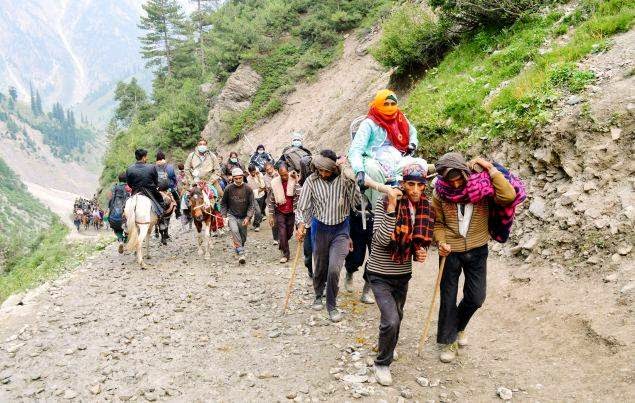
The Amarnath Yatra was
suspended….50 people were injured in police action….110 tents and community
kitchens were gutted in fire and 70 LPG cylinders exploded….police fired
teargas shells and lathi-charged locals…
 

….

Every year it is the same stupid movie, thousands of devotees marching up to Amarnath through hostile territory (you hate us and we hate you back) and all it takes is a small spark to morph into a giant fireball.

Kashmir differs from Gaza strip in that the local administration (and even militants) is made more pliant by Indian bribes. Also Indian tolerance for dead troops is probably higher than that of Israel. This is as opposed to the Uighurs who are being subjected to ethnic swamping and cultural genocide.  

It may be short-sighted (and wishful thinking) on our behalf but Kashmir at this point looks more stable than Xinjiang. If any future peace treaty leads to withdrawal of army then that may be the best possible compromise to be had amongst the main stake-holders (except the Pandits who will never see their native land again).


At the end of the day cold war is just as bad as hot war. India of all countries should have the courage to solve difficult problems through non-violence. In the worst case scenario it has to learn how to let go with grace. India should build a strong, high wall along the Chenab river and look East to South-East Asia. 

The advantage of this strategy will be that North-East will finally see the development it deserves. There are many many valleys in Arunachal Pradesh, just as beautiful as Kashmir and much more serene.
………………….
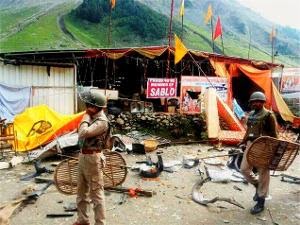
The
Amarnath Yatra was suspended on Friday after at least 50 people were
injured in police action and clashes between two groups following
alleged stabbing of a Kashmiri businessman near Baltal base camp.  
   

Around
110 tents and bhandara or community kitchens were gutted in fire and 70
LPG cylinders exploded. Police also arrested four people including two
CRPF men for the violence.

Officials said the pilgrimage to
Amarnath cave shrine in south Kashmir Himalayas continued along the
Pahalgam route and was only suspended via Baltal in Ganderbal district.
The suspension is temporary, officials said. Police said 20 people were
hurt when police fired teargas shells and lathicharged locals protesting
against the attack on Anwar Khan, who supplies tents to pilgrims in
Baltal.

News agencies said the quarrel turned violent after the
CRPF tried to intervene and at least two jawans were arrested based on
allegations against them of setting some tents on fire.

Khan
was injured and taken to a Srinagar hospital after owners of a kitchen,
Rahul and Rohit, allegedly stabbed him over a dispute. Police sources
said IG (Kashmir) Abdul Gani Mir rushed to the scene to monitor the
situation.

 The
CRPF constables arrested were Pawan and Sushil, along with the two
langar owners for the attack after hundreds of people took to the
streets to protest the stabbing as the news of the attack spread.

“A law and order situation arose because of some minor squabble between
some people in Baltal Yatra camp. The situation has been brought under
control. Some civilians and policemen got injured in the incident,”
said a police spokesman. He added some tents and a few langars caught
fire, which was brought under control. A source said 110 tents and
langars were burnt down.

……

Link: http://timesofindia.indiatimes.com/india/Violence-at-Amarnath-base-camp-yatra-stalled/articleshow/38637553.cms

……

regards

Is this the end of the 2-state solution

It seems that two hostile neighbouring states can’t be partitioned into new ones anymore.

In light of the world having gotten far more interesting, we may have reach the apex of the nation state.
I finished (for the book club) the book Diamond Age (by Seattle author Neal Stephenson) and it seems we are hurtling towards a world where national & state boundaries are going to get subordinated. Just as it’s de rigeur now for Elitestanis to have second passports so in the same way middle classes are coming under significant strain in the West.
Paradoxically after the Malaysian crash I am beginning to think the third world can be a better safe haven than the first world. London, Moscow and NY may be prime targets but who’d want to do anything in the DRC?

Kashmir: End of Militancy but not of Militarisation

A decade back, More people were dying every month in militancy-countermilitancy associated violence in J&K than there are now in entire year! Total casualties have fallen to the level when militancy began (1988-89) and  unlike the bad old days, most casualties nowadays are of the militants (and not civilians).
Incidents
Civilians
Security Force Personnel
Terrorists
Total
1988
390
29
1
1
31
1989
2154
79
13
0
92
1990
3905
862
132
183
1177
1991
3122
594
185
614
1393
1992
4971
859
177
873
1909
1993
4457
1023
216
1328
2567
1994
4484
1012
236
1651
2899
1995
4479
1161
297
1338
2796
1996
4224
1333
376
1194
2903
1997
3004
840
355
1177
2372
1998
2993
877
339
1045
2261
1999
2938
799
555
1184
2538
2000
2835
842
638
1808
3288
2001
3278
1067
590
2850
4507
2002
NA
839
469
1714
3022
2003
NA
658
338
1546
2542
2004
NA
534
325
951
1810
2005
NA
521
218
1000
1739
2006
NA
349
168
599
1116
2007
NA
164
121
492
777
2008
NA
69
90
382
541
2009
NA

55

78

242

375

2010
NA
36
69
270
375
2011
NA
34
30
119
183
2012
NA
16
17
84
117
2013
NA
20
61
100
181
2014
NA
10
16
42
68
Total*

47234

14682

6110

22787

43579
*Data till June 22,
2014 (Source: South Asia Terrorism Portal) 

In an
ideal scenario, end of militant violence ought to be followed by
demilitarisation and a political settlement with the weakened militant
elements. The script has been played out in Bodoland, Nagaland and Mizoram with
decent results (though inter-ethnic/tribal violence is yet end in Nagaland and
Bodoland). There has indeed been less visible military presence in Valley’s cities. But, right now, prospects of complete demilitarisation or any significant ‘drawdown’ from Valley’s internal cities seem
dim for several reasons:
  1. Elections and a cautious
    Indian State:

    Kashmir Valley recorded the lowest regional turnout in Indian
    Parliamentary elections. Barring Kupwara district and a few Shia/Gujjar
    dominated pockets; Separatists largely succeeded in ensuring a boycott in
    Valley- at places (Srinagar’s Bemian, Sopore) through genuine sympathy for
    Hurriyat’s call; and at other places (rural South Kashmir) through
    assassination of Panches & creating a fear-psychosis. This has been a slap on the face for Indian State. Now, the State assembly elections are
    due later this year. Usually, State and Panchayat (unlike National)
    elections, record decent turnout in Valley. Given the ignominy faced in
    Parliamentary polls, Indian state would not like to do anything radical,
    that holds the potential to spoil the state elections (and discredit
    itself further).
  2. BJP in Centre: With BJP in Power, even Article 370, is no longer a holy cow. 
    Defence Minister Jaitley has already made trips to Srinagar,
    mainly to assess the Security preparedness against Terrorist
    threats. Modi will do the same in early July.  
  3. Kashmiri Pandit Repatriation:
    There have been some
    overtures by Central and State Government, for resettling Kashmiri Pandits
    in Valley. Whether these overtures materialise or not, talk for the same
    means there will have to be Central security forces in valley to reassure
    Pandit community.
  4. Af-Pak muddle next door and
    ISIL, Al-Shabab, Boko-Haram adventures in far off lands:
    Requires no further elaboration.
There is
little doubt that in past, Central Governments in Delhi have acted in a
autocratic manner (spark for insurgency itself was started by a rigged state
assembly election in 1987) and there exists a really huge and horrible laundry
list of rights violation by the security forces stationed there with virtually
no convictions. At times, Kashmiri students have also been attacked by their
hypernationalist college mates in North India.
Having
said that, It has to be recognised that (unlike her esteemed neighbors) as of
today; Kashmir is free of polio, and (unlike Syrians, Afghans, Sri Lanka’s
Tamilians and Pakistan’s Ahmedis/Shias) Kashmiris are not jumping onto
overcrowded boats in Indian ocean or crossing over to neighboring countries for
political or religious asylum (infact many
who did cross LoC, at peak of militancy, now wish to return home
).
Nor do Kashmiris go around blowing themselves in mainland Indian cities. Also
despite out-migration of Valley’s Pandits and multiple attacks by separatist
militants in Jammu’s temples and pilgrims in past, by and large, Jammu region’s
communal harmony has been retained (leaving aside 1947 killings). Things could have been a lot  worse. Credit (be it
to the local culture or the Security forces) must be given, where it is due.
Or is it a case of Confirmation Bias? I am
no longer in immediate demilitarisation camp
A year
back, I would have backed complete demilitarisation of Valley and handing law
and order entirely to Local Police. But events in Iraq, Nigeria and Pakistan
have turned me into an agnostic inclined towards holding one’s ground. Given the existing popular disenchantment amongst
the Sunni Kashmiri majority and presence of significant Islamist firepower in region; there
is a very realistic chance of many a cities
falling into the hands of Islamist militants as soon as Central
military/para-military forces withdraws- assuming here that J&K State
police is no better than State Police elsewhere in India and like Iraq- if push
comes to the shove, Police may very well switch sides or simply run away
This, in my view, will
not be followed by any dawn of Azadi. Instead like Waziristan, Northern Sri Lanka, and now Tikrit; Fighter Jets and heavy artillery may end up bombing the
entire place to retake cities, causing major civilian casualties and mass
migrations. Kashmiri separatists, even with Pakistani assistance, are too small a lot to defeat India by force. How all of this will impact with Jammu’s (if not rest of India’s)
multireligious settlements is anybody’s guess. What looks certain is that, end
result could very well be far far worse than the present ground situation and
would take decades to heal. For long-lasting peace and prosperity in Kashmir Valley, A popular
political reconciliation/settlement in a hate free environment has to be the
goal; but at the moment, priority, has to be not allowing Kashmir to descend into
a Syria/Afghan level hellhole.

Iraq’s Reverberations in India

Indian Shias worried

With
holy Najaf and Karbala now in ISIS crosshairs, Indian Shias are an anxious lot.
Some 
protested against Shia persecution at Delhi’s Jantar Mantar  and about
3000 have volunteered  to go to help Iraq
. In Jammu and Kashmir, Kargil is
strongly backing Iraqi Nation.

In
Lucknow, Shia groups (alongwith many non-Shias) have also
appealed to people
of all religions to lend their moral support to people
being massacred by ISIS. 
Interestingly,
Shias found an unlikely ally in BJP’s outspoken Hindutva activist,  Subramanian Swamy who urged Indian
Government to offer military and economic support to Iraq and “stand with Shias
in the emerging Shia-Sunni attrition war.” because as per him, within
India the Hindu-Shia amity had been cordial for decades and non-alignment was
not an option here.

However,
Given India’s limited capacity (couldn’t handle even Afghan and Sri lankan mess in
her own backyard); heavy economic reliance on Gulf (Iran, Levant and Arabian
Peninsula ) for jobs, remittance and Oil; and the likely domestic terror
backlash; Is it really advisable for India to pick a side in what is now a full
blown regional Proxy cum Civil war?  I doubt.


Closer Economic Ties
with Iran

While
any militaristic siding with Iran in Gulf region may be beyond India’s capacity,
the thaw in Iran-US relations (due to rise of ISIS), has meant India
now able to pay some of pending oil payments.
In past, US has been a big hurdle
in India’s economic ties with Iran. Perhaps one can look forward to closer
Iran-India economic cooperation in future.


Stuck Nurses to Stay
Put

After
being promised wages by the rebels, the Indian Nurses stuck in Tikrit, have
decided to stay back.
 Some nurses
who returned from Iraq also want to go back
so that they can repay the loans. This does not come as a surprise to me-Indian
workers in Gulf and East Europe (unlike US) are by and large, a poor lot,
always ready to risk their lives for some quick cash.
Meanwhile, Twitter
Jihadis are claiming some Kashmiris and mainland Indians are fighting for ISIS

Brown Pundits