The Sun that Rose From the Earth

Shamsur Rahman Faruqi’s The Sun That Rose From the Earth: Insights into the world of Urdu poetry in the Late Mughal Era

By Kabir Altaf

South Asians continue to be fascinated by the Mughal period.  Whether one sees this period as the origin of North India’s high culture (the view of most Pakistanis and partisans of the Islamicate culture) or as hundreds of years of slavery under the Muslims (the view of the Hindu Right), it is clear that the Mughals remain central to India’s history and to the country’s conception of itself.   This period was also the time when there was a great flourishing of the arts, including music and poetry. For example, it was during the reign of Muhammad Shah “Rangila” (r. 1719-1748) that khayal gaiyki—presently the main style of classical vocal music in North India—was developed. Some scholars also state that it was in Muhammad Shah’s time that Urdu replaced Persian as the language of the Mughal court.   What is without question is that the 18th and 19th centuries were when Urdu poetry reached its heights and when the works of authors such as Mir Taqi Mir (1723-1810) and Mirza Ghalib (1797-1869) were created.

It is the lives and works of these poets which forms the core of Shamsur Rahman Faruqi’s collection of novellas, The Sun That Rose From The Earth—the author’s own translation into English of his Urdu work Savaar aur Doosre Afsane.  The three major stories–“Bright Star, Lone Splendour”, “In Such Meetings and Partings, Ultimately” and “The Sun That Rose from the Earth”—are about Ghalib, Mir, and Mushafi respectively.  Faruqi is known as the “grand old man of Urdu literature” and received the Padma Shri from the Government of India in 2009.  His novellas reflect his vast knowledge of Urdu poetry and the culture that produced it.

“In Such Meetings and Partings, Ultimately” is one the longest stories in the book and revolves around Mir Taqi Mir’s romance with Nurus Saadat, a courtesan from Isfahan.  The title comes from one of Mir’s verses from his first divan (1752), which Faruqi translates as follows: “In such meetings and partings, ultimately/ Lives are lost. There is no end to Love/And Beauty never relents.” The story ranges from Armenia—where Nurus Saadat’s mother, Labiba Khanam, is orphaned and becomes a courtesan, to Isfahan, and finally to Delhi, where Mir meets Nurus Saadat.  Since she is a courtesan and is contracted to another, her meetings with Mir must remain secret.  She is also dying of consumption and eventually she pushes Mir away so that he will not have to deal with the grief of her death.

Faruqi is a master at physical description and at describing people’s clothes (which reveals his immense knowledge about the cultural details of the period). Here is his introduction of Mir: “He was twenty-two, twenty-three years of age, tall but slim. His wrists were strong and broad, his eyes, red with sleeplessness—or was it drink?—were still commanding, full of character, though it could be seen that they could twinkle with humour when the occasion demanded. His beard was not long or dense…”  This physical description is followed by a paragraph on Mir’s clothes, which begins: “He had a short, light, full-sleeved tunic on his upper body. It was called nima, or angarkha, depending on the style. The nima was worn waistcoat fashion. The fabric was woolen, russet coloured. It was called banat, but it was not of the best quality and its russet was now fading somewhat. Under the nima he wore a long woolen tunic. His trousers were of Aurangabadi mashru…” (Faruqi 250).  Though such long descriptions tend to slow down the narrative pace, they are invaluable for giving one a sense of the period.

Another noteworthy aspect that Faruqi gets across is that it was not only Muslims who were involved in the creation of Urdu poetry.   One of Mir’s close friends is Rai Kishan Chand Ikhlas, an Urdu poet in his own right.  Similarly, the narrator of the story about Mushafi is Darbari Mal Vafa, whose father, Kanji Mal Saba, was a Persian poet and a student of Mushafi’s. The fact that Hindus are shown as being involved in the creation of Urdu and Persian poetry gives the lie to the modern Hindutva version of history that the religious majority was deeply oppressed under “Muslim” (really Mughal) rule.  Faruqi’s book is thus an essential corrective to the revisionist myths of today’s India.

The book is filled with Persian and Urdu verses, though these suffer from being sometimes awkwardly translated into English.  However, this is my limitation as a reviewer of being unable to fluently read the Urdu version of Faruqi’s book. Probably, the verses would have more power there. In the English version, they sometimes get in the way of advancing the plot.

Overall, The Sun That Rose From The Earth provides a fascinating look at Delhi at the beginning of the long Mughal decline. It is a must-read for those with an interest in Urdu poetry and culture.

Kabir Altaf received a B.A. in Dramatic Literature from George Washington University. He has studied Hindustani Classical Vocal and is currently teaching Music History at the Lahore University of Management Sciences (LUMS)

Shithole countries

How wrong was Trump?

I’m half Pakistanis & half Iranian. While I have a patriotic love for my origins; it’s hard to deny how disorganised Pakistan & Iran are (to varying degrees).

Obviously what Trump said was offensive however the fact that usually when a country has a diaspora, it means there’s something very wrong with it.

This is of course just my thoughts on the matter; it is offensive but how wrong is it? Is it offensive to tell the truth?

CPEC

Before I share the notes on CPEC I thought I would share the Achievements of the Punjab Govt.

I attended a round table discussion on CPEC (I believe it stands for China Pakistan Economic Corridor).

A few salient points I gathered from the talk:

(1) there seem to be two routes for CPEC; one via West Punjab, Sindh and the other via KPK/Baluchistan.

(2) the Brits historically conceived as India ending West of the Indus and the start of Central Asia. British strategic planning in what was to become West Pakistan (West of the Indus) was essentially security related; to prevent incursions from the North West. Hence the discordance of railways in inner India and the lack of connectivity in Outer India (West of Indus). British approaches to West Pakistan would later formulate colonial approach to much of Africa (mitigation & mining as opposed to management; as the academic used the shorthand “diamond & slaves approach).

(3.) CPEC is a “black box” at the moment; very little information available on it at the moment. Criticism is also very muted and in fact there are reports of Pakistan societies in the UK being coerced to “shut up” by governmental authorities.

(4.) I raised the point that CPEC could never really be an economic endeavour but is a masquerade for PAK foreign policy. Lahore-Delhi and/or Bombay/Khi Links would generate tremendous eco-cultural several orders of magnitude to CPEC.

I’ll add more points as they come to mind..

China’s Israel

My friend Ammar wrote up this very informative article for The News on ChinPak relations:

In 1960, Zulfikar Ali Bhutto, Pakistan’s natty and cocky minister in President Ayub Khan’s cabinet, abstained from voting on, instead of voting against, China’s membership of the United Nations. Using his discretionary powers as head of his country’s delegation to the United Nations in New York, Bhutto, by abstaining, had sent a personal signal to China about his preferred direction for Pakistan’s foreign policy. However, his action elicited strong protest from Washington, Pakistan’s closest ally, and Bhutto’s discretionary powers were revoked by Pakistan’s foreign minister.

Hardly a decade after independence from the British, Pakistan, at that time, was firmly entrenched in the Washington camp as a member of anti-Communist blocs such as CENTO and SEATO. On the other hand, India and China, during the 1950s, enjoyed a close relationship as leading anti-colonial and non-aligned states equidistant, politically, from both Washington and Moscow. The winds of change began to blow in 1959 when Tibet crises erupted and led to a full-blown Indo-China war in 1962; it resulted in a humiliating defeat for India and provided an opportunity to Islamabad to improve relations with Beijing.

Six decades after Bhutto’s flirting with the Chinese at New York, the relationship between Pakistan and China has mutated into a reputed “all-weather” friendship; it also shows how strategic interests can successfully trump a bewildering array of cultural, economic, physical and security obstacles. It was the mutual hostility towards India, the common neighbour, which brought Pakistan and China together for the first time; over the decades, China has become Pakistan’s chief diplomatic partner, its main arms supplier, and the most trusted friend to whom it turns at the first whiff of trouble or peril.

Pakistan tried to play China card in 2011 after American raid on Abbottabad to capture Osama bin Laden. It is important to note that China, at that time, rebuffed Pakistan’s efforts and advised Islamabad to mend its relations with Washington.

In the coming decades, with the recently signed US $60 billion economic projects, known as China Pakistan Economic Corridor (CPEC), China is slated to become the principal financier of economic projects in Pakistan. CPEC has been touted as a game-changer and forms an integral part of China’s ‘One Belt One Road’ strategic vision for the region. Athough China’s relations with India, since the 1962 war, have improved significantly resulting in billions of dollars’ worth of trading deals, Chinese investment and interest in Pakistan’s economic projects form the centre-piece of its confident economic and strategic policy for the whole neighbourhood.

Apart from India, Pakistan’s nuclear programme and its relations with Washington, situation in Afghanistan, war on terror and against militants after 9/11 are other important areas on which Pakistan-China dialogue and cooperation have focused. In the early 1970s, Pakistan played the matchmaker role between Washington and Beijing when China became member of the United Nations and established diplomatic relations with the United States.

China sided with Pakistan during its two wars with India in 1965 and 1971 but did not intervene or open any front with India; Washington discontinued military aid to Pakistan in 1965 and failed to exert any meaningful pressure on Indira Gandhi in 1971 despite then recent and successful diplomatic efforts by Pakistan to bring Washington and Beijing closer to each other.

Pakistan was disappointed by the failure of both Chinese and Americans to come to its rescue in the 1971 war against India; both countries paraded their sympathies without offering much in material support to Pakistan who lost one-fifth of its territory and half its population in this catastrophic war. Pakistan realised the limits of diplomacy or military alliances, when it came to its two allies, and turned towards a strategic deterrent, the nuclear bomb option, to bolster its defense against traditional rival India.

Although China did not intervene during the 1971 war with India, it has emerged as the main arms supplier to Pakistan. More importantly, as Andrew Small argues in his book, it was in the realm of nuclear cooperation that Pakistan-China relationship bound forward and assumed a distinctive character of its own. Andrew Small has written a fascinating and compelling book titled The China-Pakistan Axis — Asia’s New Geopolitics.

Small has worked on Chinese foreign policy and economic issues in a number of capitals across the globe and is presently serving as a Transatlantic Fellow at the George Marshall Fund in Washington D.C. His book crackles with insight and information on topics such as Beijing’s extraordinary and essential support to Pakistan’s nuclear programme and defence planning, their strategic cooperation on India, the United States and Afghanistan, and the implications for counterterrorism efforts.

China, as a matter of its policy, has eschewed military or defense alliance with Pakistan but has whole-heartedly supported its hugger mugger efforts to acquire nuclear capability — the ultimate means of self-defense — and develop or upgrade ballistic missiles system. Pakistan, on its part, has also extended full support to China by readily giving access to western military equipment, including the American missiles which landed in Pakistan or the US Marines’ helicopter that crashed in Abbottabad in 2011 during the raid to capture Osama bin Laden, so that Chinese engineers can copy western military equipment through reverse engineering.

In 1966, a few months after the war with India, when Chinese Premier visited Pakistan he was cheered by jubilant crowds and welcomed by a phalanx of Pakistani officials in Lahore, prompting the US Consul General in the city to bemoan that “Pakistan is lost”. Decades later, China’s military chief General Xiong Guangkai, during his exhaustive parleys with his American counterparts, remarked that Pakistan is China’s Israel. China has also timed its missile sales to Pakistan, Washington noted, as a retaliatory move to US sales of F-16s to Taiwan in 1992.

Strategically, Beijing views Pakistan as a counter-balance to India but at the same time wants Pakistan-US relations to be robust as this places limits on the scope of US-India relations. It also means that Pakistan does not become an issue of tension in US-China ties and more importantly does not impact Sino-Pakistan security ties due to Washington’s pressure or sanctions.

After the Lal Masjid incident in 2007, terrorism in Pakistan assumed menacing proportions till Pakistan army cleared the militants from FATA and Swat following a series of failed agreements. China, as a matter of policy, has advised Pakistan to control and combat militancy which is a threat to both Pakistan’s society and state and can potentially derail Chinese growing investment in Pakistan’s economic projects.

More importantly, Pakistan has become the most dangerous overseas location for Chinese workers. China may have been sympathetic to the blowback argument used by Pakistan’s officials in the past to justify its reluctance to move decisively against militants but as China’s stake in Pakistan’s economy expands, Pakistan’s security apparatus will likely come under increasing Chinese pressure to step up its anti-militants drive.

On Afghanistan, a stable settlement, which also includes reconciliation with Taliban, is the preferred option for China who does not want Afghanistan to become a safe haven for Uygur militants, actively operating in China’s provinces, or descend into chaos so that it becomes a threat to China’s growing interests in the region. It is not in China’s interest that Washington should walk away immediately leaving Afghanistan without a workable solution and at the mercy of militants.

Despite military cooperation with Pakistan over the decades, China, during the Kargil war in 1999, coordinated its efforts with Washington and prodded Pakistan to de-escalate the situation by pulling back its forces from the theatre of war. However, in 2002, following attack on Indian Parliament, and later in 2008, in the aftermath of Mumbai attacks, China, in coordination with Washington and other Western capitals, exerted pressure on India to bring down the temperature as the situation had become quite tense and febrile on both occasions.

Small forcefully avers that if the US approach to India over the last decade has been one of de-hyphenation from Pakistan, China’s has been one of re-hyphenation. In response to US-India nuclear power deal, China has signed up new nuclear power plant agreements with Pakistan. China is heavily involved in developing Gwadar, Pakistan’s deep water port off the Balochistan coast. In 2015, Pakistan and China signed a US $5 billion deal for sale of eight Chinese submarines to Pakistan, making it the largest Chinese defense deal to date and facilitating Pakistan’s nuclear capability in the shape of sea-based deterrent.

There is a consensus on the side of Pakistan’s both civilian and military leadership to sign up to CPEC. If Pakistan’s relations with China were unaffected by Bhutto’s hanging in 1979, despite Chinese efforts to save him, it is quite certain that Pakistan-China relationship is not hostage to any political or military leader’s presence on the scene or staying in power of any specific political party in Pakistan.

Pakistan tried to play China card in 2011 after American raid on Abbottabad to capture Osama bin Laden. It is important to note that China, at that time, rebuffed Pakistan’s efforts and advised Islamabad to mend its relations with Washington. In the past, China has made limits of its support clear to Islamabad on different occasions. However, as Small argues, China’s increased investment and involvement, during the last decade, in Pakistan’s economic landscape and security deals might have changed the nature and calculus of Sino-Pakistan relationship.

China will increasingly defend Pakistan in face of future American pressure but at the same time will exert more pressure of its own to steer Pakistan towards a path which is economically beneficial but will place constraints on the free hand that Pakistan’s military and civilian elite has hitherto enjoyed in their decision-making.


The Obliquity of Oriental Culture

I love the Tipping Point genre. I was recently reading Matthew Syed’s “Bounce” & I also enjoyed the Rational Optimist, Black Swan (which is tbh slightly different to the rest). However most of all Obliquity deeply impacted me.

I tend to be oblique, or indirect, in my aims & agenda. It’s something that’s perplexing for my wife, who is extraordinarily direct. That suits her in her academic career and cultural heritage, where Sindhis seem to wear their hearts on their sleeves.

Growing up I was deeply impacted by the very restrained mores of Irani Yazdi Baha’i culture (it’s a thing trust me & disproportionately influential in the South Asian Baha’i world). I always found desi culture much more emotional whereas ours was reserved (almost) to the point of being British, to this day I find emotional outbursts to be troubling and a personal failure (also for someone so chatty I find it difficult to discuss deep emotions).

Further to that is the distinction between the public face and the private one, again a relic of Persian culture. Now by Persian culture I have no idea whether it’s prevalent in the mainstream Iranian culture but rather in the diasporan pockets of Baha’i communities in the Gulf & South Asia. However ta’arof (the art of politeness) is a pretty universal thing among Persian speakers I imagine.

Ironically these Oriental cultural features, obliqueness, reservedness, class consciousness (that one I picked up from Pakistan which in the 90’s & naughties was positively Victorian in its class hierarchy), the private & public distinction were all cultural traits that hyper-accelerated my integration into Britain. Britain is a complex country and the class system is still very much a national feature; especially in the regions that I’m in (Oxbridge Formals sometimes feel straight out of Hogwarths).

For instance take the term “micro-aggression”; now I’m not exactly sure of what it means but I understand it to be a way of scoring racial points by white people in as subtle a way as possible. That’s basically Persian Baha’i culture because our Faith is so idealistic we can never be outright rude to one another so sometimes we manifest anger in very mundane, petty & hurtful ways.

My wife makes a good point that Pakistani & her Sindhi Bhaiband culture are very similar; there’s a love of socialising, glamour and opulence. It’s very very different to the sub-culture that I grew up in that preferred the under-stated and refined rather than scale or lavishness.

Brown Pundits becomes interesting to me personally when I need to reflect on my culture, on my mindset and whether it hinders me or aids me. I imagine if I had moved to the US instead of the UK I would have probably emphasised the more Pakistani-desi aspects of my heritage; the extroversion, the ebullience & conviviality (again I’m talking about the Karachi KGS sub-culture in Pakistan). In Britain however the haunting & melancholic tones of a lost Persia (Yazdi culture is a culture of mourning & redemption in the Faith) chime very very well here and sort of facilitated an interest in the rarer circles of British life.

I do find posh Britain to be a bit common & vulgar at times, especially when they are always trying to get sloshed/drunk (alas the English & their drink), but once one swims among the older generations there is a sense of artistic and aesthetic inclination coupled with a love of good conversation.

However nothing prepared me for my wife’s hugely superior approach she took to life in the West. Whereas I was always holding on to my idealised constructions of my heritage; she essentially junked that and showed me that even though I was a many-generationed Baha’i there was some ineffably Islamic bug about my mentality that hindered my full progression in the West.

Islamic cultures have this sort of puffed up pride because of their glory-days and Bahai’s too can sometimes have it because our Prophets were Persian. This unearned haughtiness makes us feel sometimes that the West is only technically and materially superior but nothing more. What my wife has shown me that Westerners have an extremely different, not so positive, impression of our cultures and that only through internalisation of this reality can one hope to truly compete in the West.

For all this time even though I commingled in White Society, in a variety echelons, I somehow stayed apart & alien to it because my own conception of my heritage bubbled me from truly intimate interactions. It’s only when I popped the bubble, thanks to my wife, did I truly join White Society and began to realise there are things like white privilege, micro-aggression and that white people behaved pretty much like much like ethnic people just much more subtly.

I also realised that when I went from being an exoticised & fascinating alien to be an actual member in England among the English that why so many immigrants prefer the ethnic enclave. The English are not racists but neither are they entirely welcoming. Brexit reflected that silent strain of superiority brought upon by Memories of the Empire.

If I wasn’t naturally very extroverted I would have retreated back to Londonistan a long time ago. My wife & I find ourselves in situations where we are the only dark-haired people in crowded room (it’s shocking how mono-ethnic social groups are in multi-cultural societies) and Society does see us as Sui generis.

  • As an example we have the very un-Asian thing where we have a puppy (mA a beautiful one at that) as opposed to a child (Asians are more into kids, white people more into pets).
  • My wife is more educated and accomplished than I am, which is rare in most couples but even more so in desi ones. We are in Oxbridge because of her.
  • We live in the shires and not in the multi-ethnic urban zones.
  • Even though I write on BP as Pakirani IRL I will usually call myself an Indian out of respect for my wife. The country that I cannot bear to see criticised/humiliated is India because I see it as an attack on my wife (irrational I know).
  • Mind you this is very different to the BP banter where Internet Hindus wants to see me as this crazed Paki & I like to provoke them.
  • For an Asian/Indian woman my wife has privileges and a voice that is rare even in emancipated Western cultures. As I said in my wedding speech I see my wife as an incarnation of Lakshmi (maybe a tad hyperbolic but YOLO).

Will the last Parsi to die please blow out the sacred fire?

Our ancestors, Persia’s first-born, preserved their ancient faith in the underground warrens of Yazd. Zarthushti houses had to be on a lower level to Muslim homes so that if it rained the water of infidels couldn’t contaminate that of the believers. It is only fair that for the sake of those ancestors who have sacrificed so much that at least some of their descendants should go on to light the sacred fire for the generations to come. 

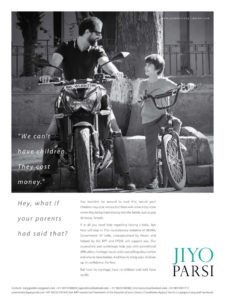
Twitter is in a huff about Jiyo Parsis’s last-gasp campaign to raise the anemic Parsi birthrate through blunt ads. The liberal opposition are featuring an angsty article denouncing JP as racists:

Imagine a khap panchayat in rural Haryana – a kangaroo court of village elders – launching a slick ad campaign encouraging members of their caste to marry (each other) and rapidly multiply to increase their dwindling numbers.

(Disclaimer: I had my Navjot when I was nine, despite having a Hindu father.) 

Anahita Mukherji is a US-based journalist who has a quarter-Parsi son with a full-Parsi name.

The author’s father is a Bengali Brahmin and she herself married out of the Parsi caste. Anahita’s only sop to her mother’s identity is to give her son a Parsi name.

Now she’s the designated American voice of the (liberal) pushback against those Indian Parsis who understandably want to preserve Zoroaster’s bloodline for posterity. If the Parsi community were to follow Anahita’s personal example; they’d be extinct in a generation.

She has every right to lead her life as she sees fit but it is unacceptable to hector others to follow her PC non-solutions. When it comes to the Parsi community there are simply no lemmings left to fall of the cliff.

Good luck Jiyo Parsi!

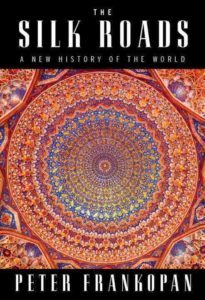
Book Review: The Silk Roads

This is a frustrating, though still useful, book. Historian Peter Frankopan’s title claims this is “a new history of the world”. He then proposes that what the world needs is to reorient its focus from Europe to “the silk roads”, vaguely defined by him as “the region between East and West.. from the Eastern shores of the Black Sea and the Mediterranean to the Himalayas”. This almost certainly reflects the fact that the core of this region happens to his particular area of interest (Turkey, Persia, Central Asia and Russia) as a historian. Having made this decision, he has to force the rest of the story to keep coming back to this region, to somehow keep his argument afloat. My recurring thought on reading this book was that all this is unnecessary. He could have written a history of the region without pretending that this was the REAL history of the world, and it would have worked fine. Or he could have attempted a history of the world and not bothered with this tendentious framing. But he insists on doing both, and it causes endless (and needless) irritation. Continue reading Book Review: The Silk Roads

The Bokhari Brothers and Lionell Fielden

December 25, 2016
This summer on a visit to the
grave of Patras Bokhari, I spent some quite time at his grave.  I
reflected about the lives of two Bokhari brothers and an amazing character of his
times Lionell Fielden.  This piece was the outcome of that exercise. 
 Good time to pay tribute on the death anniversary month of December of AS
Bokhari and birth anniversary month of January of ZA Bokhari. 
Hamid
Bokhari
Brothers
Hamid
Hussain
Ahmed
Shah Bokhari and Zulfiqar Ali Bokhari were scions of Peshawar.  Both
brothers were very talented, had multiple interests and excelled in their
chosen fields.  Bokhari brothers are associated with the history of
broadcasting in India. 
Radio
service in India was started in July 1927 as a private and amateur venture when
Bombay radio station was established.  This was the birth of Indian
Broadcasting Company (IBC) about seven months after establishment of British
Broadcasting Company (BBC).  This private venture ended in a failure and
company was liquidated in 1930. 
In
August 1935, Lionell Fielden arrived in India on loan from BBC to start Indian
broadcasting.  When radio arrived in India, no one knew about the
importance of this new invention. In 1935, Marconi Company offered a radio
transmitter and fifty radio sets to Indian government but no one was interested
in it.  Central government asked provincial governments if anyone was
interested in the offer.  Governor of North West Frontier Province (N.W.F.P.)
Sir Ralph Griffith accepted the offer.  He chose a young recent Oxford
graduate Muhammad Aslam Khan Khattak in-charge of this project.  Later,
Fielden organized Indian broadcasting on a professional level and soon radio
became the main instrument of information and entertainment.

Ahmed
Shah Bokhari (25 October 1898 – 05 December 1958)
Ahmad
Shah Bokhari was educationist, writer, broadcaster and a diplomat.  He was
born in a lower middle class family in Peshawar city. He completed his early education
in Peshawar.  He learned English by reading old English newspapers
collected from soldiers stationed in Peshawar.  After completing his
maters in English from prestigious Government College Lahore, he started
teaching at his alma mater. He went to Cambridge and returned back to
Government College.  In 1936, he was offered the job of Deputy Controller
Broadcasting of All India Radio in New Delhi.  In 1940, he became the
Controller (in 1943, the designation was changed to Director General) and served
at this post until 1947.  In Delhi, towering personalities of the time
were frequent visitors to his house.  Ahmed’s guest list included
Jawaharlal Nehru, Sarojini Naidu, Abul Kalam Azad, Zakir Hussain and Faiz Ahmad
Faiz.  In 1947, he became principal of Government College Lahore. His
residence in Lahore attracted famous writers and poets. M.D. Taseer, Imtiaz Ali
Taj, Sufi Tabassum and Ghulam Abbas frequently visited his house in
Lahore.  In 1951, he was appointed Pakistan’s permanent representative to
United Nations (UN). In 1954, he became Under Secretary Information at UN and
served at this position until his death in 1958. His simple small house in New
York was full of books and he had a wide circle of friends from diplomatic and
literary society. 

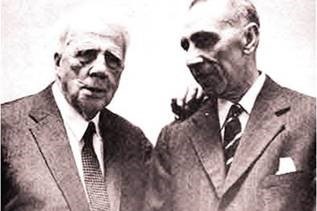
Ahmed
Shah and American poet Robert Frost (Picture from Website about Ahmad Shah
Bokhari. 
http://patrasbokhari.com
He
is buried at Kensico cemetery at Valhalla New York.  This summer when I
visited his grave, I was gratified that he could not be buried at a better
place.  He is buried at a picture perfect serene place and surrounded by
graves of numerous artists.  Many stage, television and film actors, opera
singers, writers and poets including famous composer Sergei Rachmaninoff are buried
at Kensico cemetery. On his tombstone are inscribed words of his American poet
friend Robert Frost, “Nature within her innermost self divides to trouble
man with having to take sides from iron tools and weapons’
.

A.S.
Bokhari’s grave at Kensico cemetery New York.  Photograph by Hamid
Hussain, 14 August 2016.
He
wrote Urdu prose with pen name of Patras Bokhari and is known by his pen
name.  He published a small collection of short stories but it was a
masterpiece and gave him a place in the ranks of famous Urdu writers.
Zulfiqar
Ali Bokhari  (01 January 1904 – 12 July 1975)
Zulfiqar
Ali Bokhari popularly known as Z. A. Bokhari was younger brother of Ahmad
Shah.  He was the rebellious one and didn’t attend college.  He
completed oriental courses of munshi fazil and adeeb alim
He was employed in the office of board of examiners in oriental languages of
General Staff branch at army headquarter at Simla. Board of examiners evaluated
British officers who completed native language courses.  In Simla, Bokhari
became friend of ADC to Governor of Punjab.  When Lionell Fielden came to
India to start broadcasting, this ADC referred Bokhari to him.  Lionell
appointed him assistant station director at Delhi. In 1937, Bokhari went to
England for training.  In 1940 Malcolm Darling of BBC hired Bokhari at the
recommendation of Fielden.  Bokhari was in charge of Indian section of the
eastern service of BBC in London.  He covered Second World War in Europe
and returned to India in December 1944 to become station director at
Calcutta.  After independence in 1947, he served a long career in
broadcasting in Pakistan.  He served as director general of Radio
Pakistan.  In 1967 he became general manager of Karachi television
station. He was also a poet and also wrote a book on classical music. 

Z.
A. Bokhari as BBC Home Guards at Bedford College, 1941. (Picture from Imperial
War Museum).
Lionell
Fielden had great influence on the lives of both brothers.  Fielden is an amazing
character for his time period.  He was member of British aristocracy, a
relative of Viceroy Lord Linlithgow and personal friend of British Prime
Minister Stanley Baldwin.  He was raised on a Surrey family estate and
educated at Eaton but became rebel at a very early age. He was closely
associated with E. M. Forster and J. R. Ackerly.  His experience in First
World War when he fought at Gallipoli made lasting impression on him.  He
was intelligent enough to see the gross negligence of military high command and
developed disdain for authority.  He passed the civil service examination
but was so irked by his interview at Foreign Office that he denounced the
Balfour Declaration and told his interviewers that Britain had sold out the
Palestinian Arabs to Jews.  In 1927, he landed at BBC when it was
established.  In 1935, he came to India on loan from BBC to start
broadcasting service in India.  He was an outsider and frequently clashed
with authority.  He settled in Italy where he was involved in renovating
old buildings damaged during Second World War.  He died in 1974 in Italy.
There
was lot of speculation about relationship between Lionell Fielden and his young
Indian protégés.  The relationship was not a normal superior and
subordinate or even a friend.  Lionell was a homosexual and though he
admitted this fact later in his memoirs, there was enough evidence from his
behavior that this subject was talk of social circles in India and
London.  Lionell was member of a group of young British men and women disillusioned
with the slaughter of First World War.  Many were writers, intellectuals
and a number of these men and women were homosexuals.  It is an open
question whether they were naturally inclined or this was one of the symptoms
of rebellion against an established order.  Official British circles and
traditional aristocratic elites called these folks having ‘loose morals’. 
In India, Indian police special branch was keeping a tab on Fielden.  One
police official brought some intercepted letters to show to Fielden what was
being talked about him.  True to his character, Fielden refused to look at
the letters stating that it was inappropriate to look at private
correspondence.
It
is important to understand social conditions of India in 1930s to comprehend
why Fielden generated controversy both among British and Indians.  British
interaction with Indians was mainly in official context.  There was not
much social mingling between two communities although there may be few
exceptions.  British would unwind only in the presence of fellow
countrymen at exclusive civil and military clubs.  Fielden crashed on the
scene breaking all the rules.  He avoided British social circle and
interacted with Indians of different social backgrounds.  Indians had not
interacted with British in such informal, friendly and relaxed
environment.  Many Indians developed genuine respect and admiration for
Fielden even if there was no sexual aspect to the relations. Official British
circle was aghast at Fielden’s non-adherence to social norms as well as
personal indiscretions. 
Fielden
also faced criticism from Indian circles.  Fielden had personal relations
with Congress leaders and polarized politics of the time meant that some Muslim
League leaders were critical of his work.  Fielden had surrounded himself
with newly educated urban Muslim youth.  These young men saw Persianized
manners of old Mughal court and Urdu as a refined cultural heritage.  This
prominence of Urdu in emerging broadcasting arena aroused anger of Hindu
nationalists who saw old Indian Hindu cultural heritage as true beacon for
emerging nationalist India.  They constantly criticized Fielden for giving
preference to Urdu as the expense of old Sanskrit arts and literature.
Fielden’s five year stay in India was full of all these clashes at different
levels.
Z.A.
Bokhari’s own memoirs in Urdu provide enough evidence that he had special
relationship with Fielden.  Bokhari was close to Fielden and took care of
his personal chores and in charge of his household.  Bokhari went to meet
Fielden at Cecil Hotel in Delhi for the interview. He narrates his first
meeting with Fielden that when he entered the room, Fielden was naked only in
his underwear.  Fielden told him that it was too hot and that he should
also take off his coat. Bokhari states that ‘this meeting was like love on
first sight’ and that ‘after few minutes it felt like we knew each other for
long period of time’. Fielden hired Z.A. Bokhari but Bokhari’s boss a Colonel
at army headquarters at Simla refused to let him go to Delhi.  Fielden
wrote to Viceroy Lord Willington to remove all hurdles and brought Bokhari to
Delhi.  Fielden then took Bokhari to his house and summoned his own tailor
to measure Bokhari and ordered six suits for him.  When Bokhari went to
London for training, Fielden’s tailor in London stitched Bokhari’s suits. 
Bokhari describes Fielden’s dress on his first day of work ‘silk pants, half
sleeve open collar see through shirt’.  Bokhari was seriously injured
after a fall in a blind well.  When he woke up, he saw his room filled
with flowers and Fielden crying.  Later, Fielden took him to the hill
station of Almora to recuperate where they spent a lot of time together and in
the company of famous scientist Boshi Sen.  Bokhari writes about that time
together at Almora that ‘my heart was attracted towards Fielden like a
magnet’.  Fielden had gout problem and Bokhari narrates that while in
London at one time Fielden suggested to him that ‘let’s resign and settle down
in an Italian city’.  

Fielden
hired a number of young and handsome Indian men in their early twenties when he
came to India to start broadcasting service.  Fielden in his autobiography
recounts the disappointment when faced with choosing his personal bearer from
two old men.  He wrote, ‘Had I not pictured to myself something so vastly
different?  Slim, intelligent youth, with eyes of gazelles, worshipping me
with silence but so effective service’? In his memoirs, Z.A. Bokhari describes
the physical features of his colleagues.  He calls Sajjad Sarwar Niazi
‘dashing’ and goes on to describe him having ‘fair skin, sharp features and
thin rose petal like lips’.  Israr-ul-Haq Mejaz is described as having
‘long black hair, salty complexion and thin waist’.  Agha Ashraf (grandson
of famous Urdu writer Maulana Muhammad Hussain Azad) had ‘salty complexion and
white teeth that were blinding the vision’. These are unusual expressions for
male colleagues and suggest special attraction. 

Mohammad
Aslam Khan Khattak who was in-charge of first radio transmission project in
N.W.F.P. narrated in his memoirs that he was offered the post of deputy
director general in Delhi under Fielden.  He states that ‘I went to Delhi
for a look and found the people, who had taken over broadcasting, nauseating’. 
He didn’t elaborate what he found ‘nauseating’ but he may be referring to
twenty something youths in matching silk suits surrounding Fielden. 
Khattak instead opted for Indian foreign commercial service.

Z.A.
Bokhari with Risaldar Major Muhammad Ashraf Khan IOM, IDSM of RIASC  in
England 1940
A.S.
Bokhari was an educationalist, broadcaster, writer and diplomat.  Z. A.
Bokhari was an amateur theatre actor, poet and broadcaster. Bokhari brothers
were a very talented duo who excelled in their chosen fields and left a mark on
the pages of history of India and Pakistan.
Sources:
  • Z. A.
    Bokhari.  Sarguzhust (in Urdu). English translation of
    extracts used in the article is by the author.
  • Khalid
    Ahmed.  Pakistan Behind the Ideological Mask (Lahore:
    Vanguard), 2001
  • Raza
    Rumi.  Reclaiming the Legacy of ZA Bokhari.  The Friday Times,
    14 October 2014
  • Joselyn
    Zivin.  Bent: A Colonial Subversive and Indian Broadcasting.  Past
    and Present
    , No: 162 (February 1999), pp. 195-220
  • Lionell
    Fielden.  Natural Bent (London: Andre Deutsch), 1960
  • Kanchan
    Kumar.  Mixed Signals.  Economic and Political Weekly,
    May 31, 2003
  • Mohammad
    Aslam Khan Khattak.  A Pathan Odyssey (Karachi: Oxford
    University Press, 2004), p. 32)
Hamid
Hussain

December 23, 2016

Middle East Musings on New Pundits

I do more writing on New Pundits now but I thought I would point to three recent posts of mine dealing with the geopolitics in the region:

The Ghost of the Persian Empire will Own the Middle EastThe ghost of geopolitics means that the only true counterweight to Iran is not Saudi Arabia, Pakistan or Israel (The Sunni-Semitic axis Egypt doesn’t even figure, as it’s geopolitically so dependent on Israel post Aswan Dam) but Turkey. However Anatolia is ultimately a bridge to the West and Turkey’s highland configuration point towards Istanbul and that land bridge.

The “Iran deal” signals Persia’s return to Geopolitical PreeminenceThe Iranians, like their closely related kin the Indians, are an Aryan people who settled on the hugely strategic Iranian plateau. Unlike the Indians upon conquest (or a few centuries after) the Iranians gave up their hugely influential native born faith, Zoroastrianism, to embrace Islam and consequently the hugely Iranian inflected Shi’ite faith. Of course Islam can properly be conceived of a fine line between the more orthodox (and less theologically innovative) Sunni practises, which adhere most closely to the original Arabian teachings, and the far more syncretic Ismaili cluster, in which 12ver Shi’ite Islam falls in the middle.

How Pakistan and Turkey must play the crisis in the Middle EastNow far more interesting, in that it is much contestable, about what is Pakistan. I would argue Pakistan is the Mughal Empire successor state reimagined (even if partially) on the Indus River Valley System. This linkage survived 1971’s breakup and to put it succinctly Pakistan looks to Akbar, its arch rival fratricidal twin India looks to Asoka.

Brown Pundits